Helicopter Flight from Wickenburg to Las Vegas

Notes from another flight.

I’m still in Las Vegas, attending an HAI-sponsored helicopter tour operator summit. And since I had such an enjoyable flight up here from Wickenburg, I thought I’d share some of the highlights with folks interested in that kind of stuff.

Unfortunately, I don’t have any photos. My little Canon PowerShot seems to go into convulsions ever time I turn it on and I can’t take a picture with it. I didn’t feel like dealing with the Nikon SLR while flying — you think it’s easy to use a camera while flying a helicopter? — so I just didn’t get any shots at all. If I fly home the same way, I might try the Nikon.

I did include images from sectional charts, however. If you’re a pilot, you’ll recognize them. If you’re not a pilot, see if you can follow my path on the chart segments; unfortunately, this computer doesn’t have any good annotation tools on it, so I couldn’t mark up the images before uploading them.

Wickenburg to Lake Havasu

I got off to a late start from Wickenburg — I almost always do — departing from the west end of the ramp to the west. There was an airplane on final as I departed, but he was still a way out and I had plenty of time to get on my way. I was surprised, however, when he called a go-around when I was still in the traffic pattern area. I used my radio to assure him that I’d stay low until I was clear, giving him all the room he needed to climb out and do another traffic patter.

A go-around, in case you’re wondering, is when the pilot decides that he’s not going to actually land as he approaches the runway and, instead, powers up and climbs out for another try. Pilots do go-arounds when they’ve botched up the approach or if there’s something in their way on the runway. (I experienced my first airliner go-around on Saturday evening when there was a plane on Sky Harbor’s runway and the tower instructed our flight to go around.)

I continued on my way, flying low across the desert. Just past the hills near Wickenburg Airport, the desert gets flat. Since there aren’t any homes out there, its an excellent place to practice low flying. So I did. I scooted along about 100 feet up, doing about 110 knots. Below me was dry desert terrain with scattered bushes and cacti and the occasional rock outcropping.
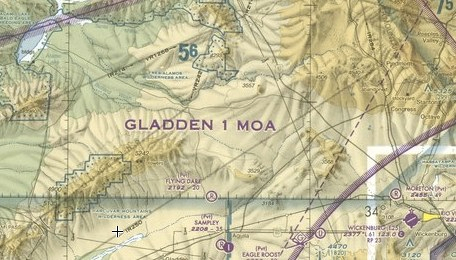
E25 to Alamo Lake

I was at least five miles away from the airport when the airplane pilot who’d gone around and made all his subsequent radio calls in the pattern announced that he was going around again. That made me wonder: (1) What’s keeping this guy from landing? (2) Does he know how to fly a plane? (3) Will he ever land at Wickenburg? I switched the radio’s frequency to 122.7 for Lake Havasu, my first waypoint.

I climbed to about 300 feet to clear the high tension power lines that run southwest to northeast across the desert. Then I skirted the edge of a rock outcropping that’s obviously made of ancient volcanic material. Arizona has a lot of volcanic rock, although this area lacks the cinder cones you can find in quantity in the vicinity of the San Francisco Peaks near Flagstaff. Instead, all we have is that dark brown rock, all sharp and crumbly. It forms hills and small mountains and sometimes volcanic core mountains like Vulture Peak, south of Wickenburg.

From there, the desert slopes mostly flat down to a basin where three water sources meet. A dam at the west end of the basin holds in Alamo Lake, Arizona’s attempt to keep some of its precious water from entering the Colorado River, where it would become fair game for California. I changed to a more northwestern course, hoping to hook up with the dirt road that runs from Route 93 to Alamo Lake. Once I reached the road, which was completely deserted, I followed that, low-level, toward the lake.

The road was narrow, sandy, and a bit windy where I picked it up. But it soon led me to the more maintained part, which is wider and straight. I flew for about 10 miles without seeing anyone. Then I caught sight of a pickup truck up ahead and decided to climb a bit so he didn’t think I was going to hit him. (For the record, I was low, but not low enough to hit a truck.) The Wayside Inn was up ahead and I didn’t want to blast past the folks living in trailers there.

The Wayside Inn property looked different to me and it took a moment to figure out why. The Inn was gone, with only a concrete slab to show that it had ever been there. I wondered what happened to the place. Had it burned down? There was no sign of fire. I wondered what happened to the Polaroid photos of people’s trophy fish and the pool table and the bar. I wondered if it would ever be rebuilt. And I realized that I could no longer promote my “Hamburger in the Middle of Nowhere” tour. Another destination, gone.

I reached the lake, which was surprisingly full. We’d had some rain about a month ago and the dam operators had apparently decided to keep as much water as they could. There were quite a few trailers and motorhomes parked near the eastern shore, but not many boats out on the lake. Alamo Lake is a fishing destination. It’s too small and remote for much else.

I crossed the lake and started to climb again. There were mountains to cross and I needed to climb from my current altitude of 2,000 feet to about 5,000 feet to clear them. The desert on this side of the lake was full of rocky outcroppings with a few winding roads leading to old mines and a few newer roads leading down to the lake’s west shore. I didn’t see a soul as I continued on my way, using Grossman Peak in the distance as my navigation tool.
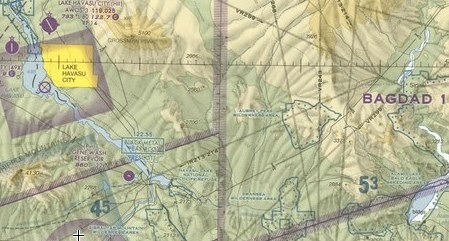
Alamo Lake to Lake Havasu

I leveled off when I reached an altitude that enabled me to cross all the rock outcroppings and mesas in front of me without changing altitude. I was actually flying a lot lower — maybe 500 feet lower — than I usually did in that area. I don’t particularly care for this part of the flight. There’s too much of that volcanic rock, few roads (although there is a buried pipeline), and not much of interest to look at. But I was rewarded for my low altitude. I caught sight of a natural arch in one of the volcanic outcroppings — something I’d never seen there before.

I crossed a detached mesa and the canyon beyond it. Then I was over a relatively smooth sloping hill, at the south end of Grossman Peak, descending toward the lake. I could see the lake in the distance, as well as the manmade island that was home to the old airport. (The current airport is about 10 miles north of town and is extremely inconvenient for anyone flying in.) A few minutes later, I was flying down the canal the founders of Lake Havasu City had dug so they’d have a place to put London Bridge.

If you’ve never head this story, it’s worth taking a minute to read about it. The guys who first imagined Lake Havasu City decided that they needed a tourist attraction. At around the same time, the City of London was getting ready to take down London Bridge and replace it with a new bridge. The Havasu guys bought the bridge and had it shipped over to the U.S. They trucked it out into the middle of the desert alongside this lake and reassembled it on the canal. It’s a very attractive bridge, but nothing terribly special. When Americans think of “London Bridge,” they usually think of Tower Bridge. That’s not what the Brits sold us. They sold us London Bridge, a simple stone arch structure. So when people see it, they’re usually pretty disappointed.

Anyway, Lake Havasu is formed by the Parker Dam on the Colorado River. It’s not part of the national recreation area system, so it’s not subject to Federal rules and regulations that “protect” Lake Mohave, Lake Mead, and Lake Powell farther upstream. A lot of people live at Lake Havasu City, but I doubt most of them are there year-round. Temperatures get into the 100s six months out of the year. It’s like hell, with a lake.

There were pilots doing touch and goes at the airport. Most of them spoke with German accents. Lufthansa pilots in training from Goodyear. I expected them to do instrument approaches to Needles airport next.

Lake Havasu to Bullhead City
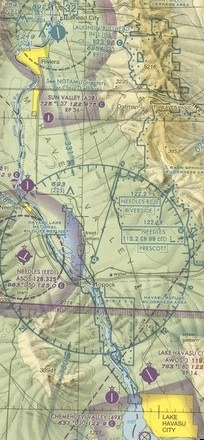
Lake Havasu to Bullhead CityI followed the eastern Arizona shoreline of Lake Havasu uplake. I wasn’t flying very high, so I needed to stay within gliding distance of land, in case I had an engine failure. Pilots are programmed to think like that.

Although the lake was nearly full — it usually is — the water was clean and clear enough for me to see the bottom of the lake in many places. I assume it was much shallower there. I could also see the patterns the water makes in the sand as it flows over it. Although this is a lake, there’s a definite flow of water from north to south.

There weren’t many people on the wide part of the lake and even fewer uplake in the Topok Gorge area. This is a beautiful part of the lake, where sharp rock cliffs narrow it down to a river-like area — a glimpse of what it might have been like before the dam and lake existed. It’s a wilderness area and aircraft are requested to stay 2,000 feet or above. I admit I wasn’t that high. It always bothered me that I had to stay so far from the lake in this spot while thunderously loud race boats could scream though it all day long. But the people who take care of the lake may have put a stop to that. I saw buoys across the water in two place in the gorge. I’m not sure if they were setting up a speed zone or if they’d closed that section off completely for some reason. There weren’t any boats in it. It would be a shame if it were completely closed. Mike and I had once taken a pair of wave runners from Lake Havasu to Laughlin, NV on this route; it was a fun trip that others with appropriate equipment — ie., watercraft suited for operation in shallow water — should be able to enjoy.

After the Gorge, the landscape opened back up and the river widened again. I dropped down to follow it a few hundred feet up, banking left and right to stay right over the center of the channel. There were people camped out alongside the lake in trailers and motor homes in what must be a primitive camping area. It was just north of where I-40 crosses the river; I hope to be able to check it out one day soon with our camper. There were a few small boats on the water and their occupants waved up at me as I flew over. I also passed the Laughlin to Havasu jet boat, a tour boat that runs once a day from Laughlin to the London Bridge. All along this stretch of the river, the water was very shallow and I could see the bottom from the air. In a few places, there were even small rapids (ripples).

I followed the river faithfully, climbing every once in a while to make sure I was clear of wires crossing from one bank to the other. I was tuned into the Bullhead City airport frequency. There’s a tower there but very little traffic. One plane had a short exchange with the female controller there. Ten miles out, I figured it would be a good time to check in.

“Bullhead Tower, helicopter Six-Three-Zero-Mike-Lima is ten to the south over the river. Requesting transition up the river at about 1,000 feet.”

The reply came quickly. It isn’t as if she had much else to do. “Helicopter Zero-Mike-Lima. Transition approved at or above 1,000 feet. Current Bullhead altimeter is Three-Zero-One-Two. Report two miles south.”

“Zero-Mike-Lima will report two south,” I replied as I made a miniscule adjustment to my altimeter.

I was at 800 feet, but I was still a few miles short of their airspace. And I was enjoying my zig-zagging flight up the river. So I kept at my current altitude and kept enjoying the flight.

Meanwhile, below me on both sides of the river, were homes built right up to the river’s banks. The water was very low here and a few boats that had been tied up to docks were sitting high and dry on sand. The river’s water level is determined by the Davis Dam, just north of Bullhead City and Laughlin. When power is needed, water is released to generate power. This usually happens during the day. So the water is at its lowest level just south of the dam around dawn. Little by little, the water level rises. But the water doesn’t reach everywhere at the same time. So 20 or 30 miles downstream, the water level might not rise until 10 AM or thereabouts (depending on the season, the electrical needs, etc.) . The same thing happens in the Colorado River in the Grand Canyon, but on a much larger scale, with water released from the Glen Canyon Dam at Page.

I approached the green dotted circle on my GPS that signified Bullhead City’s airspace and climbed obediently to 1,000 feet. I crossed the green line and continued on my route. The 200 foot climb really seemed to distance me from the terrain.

I passed the remains of a high-rise hotel/resort/casino that had begun construction years ago. It was a rotting frame of concrete and steel on the Nevada side of the river, surrounded by a chain-link fence to keep out the vandals. Abandoned long ago, I wondered whether anyone would ever finish or demolish it.

I should probably explain why there’s a towered airport with hardly any traffic alongside the Colorado River in the middle of the desert. Bullhead City is the Arizona side of the Laughlin/Bullhead City area. Laughlin, on the Nevada side, is a sort of baby Las Vegas. It’s a gambling town with a few high-rise hotel/casinos and all the crap that goes with them. It’s popular with the seniors from the Phoenix area because its a lot cheaper than Vegas — hell, you can get a decent room for about $25 midweek and all-you-can-eat buffets start at about $6. Busloads of seniors leave Sun City, etc. daily, taking these folks up to the slots in Laughlin.

It’s a depressing little town, mostly because when it’s full, its full of sad old people who are hoping to turn that social security check into the next big progressive slot jackpot. Mike and I once witnessed two oddly dressed seniors stuffing food into their pockets at one of the buffets. (I’m not talking about stealing a roll or a pastry or some fruit; these people were taking unwrapped pork chops and pieces of ham and turkey. It was really gross to watch.) And once a year, the Harley boys descend on the place with their loud motorcycles and tattoos and guns. A few of them got shot right on a casino floor one year. It’s an ugly scene.

Bullhead City, across the river where there is no gambling, is the support town. Laughlin workers live there. There’s a great little airport with free transportation across the river provided by the casinos. There’s also the usual collection of in-the-middle-of-nowhere businesses that you need to survive: supermarkets, hardware stores, etc.

“Bullhead Tower, helicopter Zero-Mike-Lima is two miles south.”

“Zero-Mike-Lima roger that. Report clear to the north.”

“Zero-Mike-Lima.”

Since the casinos were right on the river and I was flying right up the river, I flew about 100-200 feet past their rooftops. Down below, on the riverfront walkways, few people wandered about. Lots of cars in the parking lots, though. I guess the slots were getting a post-Thanksgiving workout.

Bullhead City to the Hoover Dam
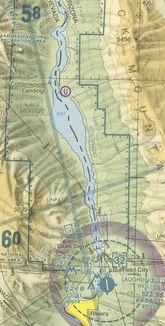
Bullhead City to Lake MohaveI continued up river, now climbing to clear the wires just south of Davis dam and the dam itself. Beyond the dam was Lake Mohave. There’s a marina on the eastern shore, not far from the dam. Otherwise, the lake is completely undeveloped, part of the Lake Mead National Recreation Area.

Lake Mohave has an interesting shape. The southern end is pretty narrow, as the river passes through some mountainous terrain. But ten or so miles beyond that, the mountains fall back and the lake sits in a huge basin. It gets very wide here. Farther up is Black Canyon, where it becomes a narrow stream in a twisting canyon.

I don’t recall seeing a single boat in the wide part of the lake. Maybe because it was windy — I was flying in a 20-knot headwind. I flew along the Arizona shore, dropping low again to check out the terrain. There were small trees growing right up alongside the lake and the skeletons of dead trees stuck out of the water. At one point, I caught sight of a herd of wild burros. There had to be about a dozen of them, including some babies. I zipped past without bothering them much, and kept looking for more. That’s when I caught sight of two park ranger trucks on the shore. They gave me a good look, but I must not have bothered them much because I haven’t gotten a phone call.

I should mention here that there’s no minimum altitude for helicopters operating under FAR Part 91. So theoretically, I could have been skimming 10 feet off the ground and I wouldn’t have been breaking any rule. But that’s really not a good and safe thing to do, even in the middle of nowhere. So I was about 200 feet up. Since I wasn’t in a wilderness area, there really wasn’t anything the rangers could complain about. Maybe they knew that. Or maybe, more likely, they didn’t think it was such a big deal since I wasn’t being a nuisance. Just a pilot passing through.

As the lake began to narrow, I realized that I hadn’t called Bullhead to tell them I was clear. I was now about 20-30 miles north and wasn’t sure if my radio would reach them. I climbed to increase my chances of success.

“Bullhead tower, helicopter Six-Three-Zero-Mike-Lima?”

“Zero-Mike-Lima, Bullhead Tower.” Her voice came through scratchy. I continued to climb.

“I forgot to call clear. Sorry about that. I’m definitely clear to the north.”

“No problem. Thanks for calling.”
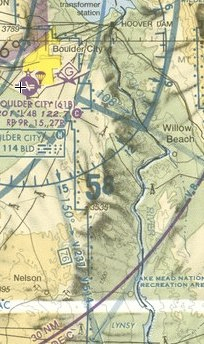
Lake Mohave to Hoover DamAfter considerable squinting at my Las Vegas terminal area chart, I switched to the frequency in use by helicopter tour operators in the vicinity of Hoover Dam. I was about 10 miles short of the dam, entering the bottom of Black Canyon. The dark canyon walls climbed up on either side of me and I climbed with them. This was harsh terrain where an engine failure would be a very bad thing indeed. But it was also beautiful, in a dark and mysterious kind of way. The river wound between the rock walls with a few power boats on its surface.

I knew I had the right frequency when I started hearing the tour pilots giving position reports. Most of them were considerably higher than I was — for reasons I would discover at the tour operator summit I’d flown to Las Vegas to attend. This meant the chance of meeting one of them midair was very slim. But to be safe, i started calling out my position when I passed Willow Beach.

Willow Beach, by the way, is home of a fish hatchery about five river miles south of the dam. There’s a campground and day use area down there, too, right on the river. I’ve been there a few times. You can get there by car by making a turn off route 93 a few miles before (on your way north) or after (on your way south) of the dam. Seeing it from the air really made it clear how small the place is.

A Papillon helicopter pilot made a call that he was crossing the river at 3000 feet. I looked up and saw him 1000 feet above me, to my left. If they were going to fly that high, I had room to climb, so I did.

Then the construction cranes for the bridge came into view. The bridge has been under construction for a few years now. When finished, it’ll be a high river crossing, just south of the dam. Right now, all traffic crossing in the area has to drive over the dam. This is how it has been since the 1930s, when the dam was built. In fact, the dam is the only crossing in the area. The next crossing upriver is at Marble Canyon, which is on the other end of the Grand Canyon. The next crossing downriver is at Bullhead City/Laughlin, south of Lake Mohave.

Because of terrorist concerns, trucks are no longer allowed to cross over the dam and all cars are stopped for a search before crossing. And, to further mess up traffic, the dam has only one lane in each direction, forming a pretty good bottleneck for traffic.

But I remember the days when you could not only drive anything across the dam, but you could park on it. That’s right: there were parking spaces on the sides of the road along the top of the dam. You could park, get out, and walk around up there. If you wanted a tour of the dam’s innards, it would cost you a whole dollar and would be led by a volunteer. The dam became such a popular tourist attraction that they decided to cash in on it. They built a new visitors’ center and multi-story parking garage. Now they charge a few dollars to park your car and $8 per person to tour the dam. And with terrorist concerns, I don’t think the current dam tour is quite as complete as the old one.

Such is progress.

I would have enjoyed my overhead view of the bridge under construction and dam if it weren’t for the tour helicopter making some sort of S-turn right over it. The pilot was a bit higher than me, but since I didn’t know his route, I had to keep an eye on him. We exchanged a few position reports and he explained which way he was going. I told him I was at his 9 o’clock and he finally caught sight of me. I passed behind him. By then, I was pretty much past the dam. And since I was concerned about other traffic in the area, I didn’t circle around for another look. Maybe I’ll get a better view on the return flight.

Hoover Dam to Las Vegas

I’d decided to fly into McCarran Airport, which is the main International airport at Las Vegas. It was mostly an economic decision. Usually, I fly into Henderson, which is south of there. It costs me $7/night to park there and about $40 each way for the cab right to the Las Vegas Strip. It’s a much more laid back airport, with just two runways and friendly folks in the tower. Relatively stress-free. McCarran, however, is at the south end of the Strip, so ground transportation would be much cheaper. Sure, I’d pay $20/night to park and I’d be required to buy at least 25 gallons of fuel at a whopping $6.53/gallon to avoid a $50 ramp fee, but I’d save on the cab fare. I’d also save time by flying an extra 10 minutes and avoiding the 30 to 45-minute cab ride. As it turned out, I even saved on the cab far, since the FBO gave me a free lift to my hotel and I just tipped the driver $5.
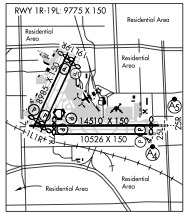
Las VegasMcCarran is huge: two pairs of parallel runways that meet at the southwest corner of the field, numerous FBOs, a least a dozen tour helicopters coming and going, and jets of all sizes landing and taking off and just taxiing around. I admit I was nervous about coming into such a big place. But one of the things about being a commercial pilot is that you have to be prepared to fly into any airport that a client wants to fly into. Coming into McCarran would be good practice in case I ever needed to do it with a client on board. That, in fact, was another reason I’d decided to land there.
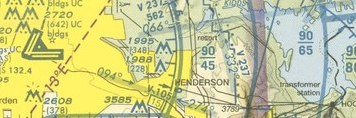
Hoover Dam to LASI’d decided to come in from the east, making my call at Lake Las Vegas. Lake Las Vegas is a relatively small lake created by damming up one of Lake Mead’s tributary washes. Some people blame that dam — at least in part — for the low water levels at Lake Mead.

I flew up the west shoreline of Lake Mead, keeping an eye out for tour traffic and fiddling with my radio to tune in the ATIS for McCarran. I soon learned not only the weather conditions, but the special frequency for helicopter operations, which was not on the chart or in the taxi diagram. I tuned into that, glad that I wouldn’t have to deal with approach control. But I also tuned the standby frequency to the regular tower frequency, just in case I needed it.

The smog layer that blankets Las Vegas came into view and I could see the high-rise structures shrouded within it. The tower of the Stratosphere was most identifiable, really standing out on the horizon.

I was just coming up on Lake Las Vegas, about 10 miles out from the airport, when I made a tentative call. Up to that point, the frequency had been completely quiet and I was worried that it might not be the right one.

“Las Vegas Helicopter Control, helicopter Six-Three-Zero-Mike-Lima?”

A woman’s voice responded immediately: “Helicopter Six-Three-Zero-Mike-Lima, this is Las Vegas Tower. Squawk four-two-zero-two.”

“Zero-Mike-Lima is squawking four-two-zero-two,” I replied. I reached down to my transponder and punched in the numbers.

As I did this, a TV helicopter called in with a request to fly at a higher than usual altitude over the Strip. There was an exchange between the tower and that helicopter. Then the controller said, “Helicopter Zero-Mike-Lima, say request.”

“Helicopter Zero-Mike-Lima is over Lake Las Vegas with November. I’d like landing at Atlantic.” Lake Las Vegas was my position. November was the identification letter of the current ATIS information; this told her I’d heard the recording and had current wind, runway use, and altimeter settings (among other information). Atlantic, oddly enough, was the name of the FBO where I’d arranged to park. It was located on the northwest corner of the field.

The response came right away: “Helicopter Zero-Mike-Lima, we have you on radar. Cleared to enter Class Bravo airspace. Landing will be at your own risk at Atlantic.”

“Helicopter Zero-Mike-Lima is unfamiliar, so I might need a little guidance.” Unfamiliar is a magic word in aviation. It tells the controller that you’re not familiar with the area, airport, or landing procedures there. It puts an extra burden on the controller, because now she needs to provide some directions to get you where you need to be without messing up the other traffic.

“Helicopter Zero-Mike-Lima are you familiar with the Tropicana?”

I knew roughly where it was, but I couldn’t pick out its tower from the other ones silhouetted in the smog. “Vaguely,” I replied.

“Okay, helicopter Zero-Mike-Lima, proceed westbound for now.”

“Zero-Mike-Lima is going west,” I confirmed.

I checked my compass and adjusted course a tiny bit. I was heading right toward the Stratosphere tower — the easiest landmark in front of me.

Unfortunately, I was also heading toward the setting sun. It was about 4:35 PM — at least on my clock; Nevada is one hour behind Arizona this time of year — and the sun was low on the horizon. I’d neglected to clean the plexiglas of my helicopter’s bubble, so the dust particles stuck there were catching and holding the light. Although I had no trouble seeing all around me, I had to raise my hand and shade my eyes periodically to get a good look at my eleven o’clock position. Just a little something to add to the stress of the situation.

I was about five miles out when the controller said, “Helicopter Zero-Mike-Lima turn heading two-six-zero.”

“Two-six-zero, Zero-Mike-Lima.” I adjusted my course from 270 degrees to 260 degrees. At this point, I was north of the east/west runways, so incoming traffic on those runways would pass on my left. I still couldn’t see the airport.

I should make a note here about a helicopter pilot’s ability to see an airport on approach. You need to understand that helicopters fly at a much lower altitude than airplanes. I was about 600-700 feet over the city. The perspective from that altitude tends to “hide” an airport behind buildings and other structures. The smog makes things worse and the setting sun in my face made it even worse. So although my GPS told me where the airport was and I had a pretty good idea where it was in relation to the skyline, I couldn’t actually see it.

After another mile or so, the controller came back. “Helicopter Zero-Mike-Lima turn heading two-five-zero.”

“Two-five-zero, Zero-Mike-Lima.” I made another slight course adjustment. Now I was pointing right at the fake Empire State and Chrysler buildings of the New York, New York casino.

Another minute or two went by. The controller had been talking to other helicopters, none of which were anywhere near me. Then she said, “Helicopter Zero-Mike-Lima, Atlantic is on the north end of the 1/19 runways. There are no inbounds for those runways, so you’re clear to cross. Landing is at your own risk. Report landing assured.”

“Zero-Mike-Lima cleared to cross the runways and land.” By now, I could see the runways in question, primarily because a plane had just departed to the south from one of them. The ramp area looked big and wide beyond them. I was already down to about 200 feet AGL when I spotted the Atlantic FBO’s building.

“Helicopter Zero-Mike-Lima, there’s a red and white 737 taxiing near the end of the runway. We don’t like helicopters to fly near taxiing airplanes.”

I spotted the plane right away. How could I not? “Zero-Mike-Lima will stay clear,” I assured her. That turned out to be more difficult than I expected, mostly because I was worried about his jet wash when I passed behind him. So I kept it high until he was really clear, then made a slow descent down to the ramp.

There was some confusion about parking. A girl who apparently worked there directed me to park beside a jet. I did. But before I could throttle down to idle, a van sped over and signaled me to follow him. I lifted off and followed him down the taxiway. He directed me to what turned out to be a helicopter parking lot quite a distance from their facility.

I throttled down again and started the cooldown process while the van waited for me and other helicopters came in behind me to park on the ramp. Then I remembered the controller’s request about reporting landing assured. I keyed the mike: “Helicopter Zero-Mike-Lima is on the ground.”

The Westin Casuarina, Las Vegas

A quick hotel review.

I came to Las Vegas yesterday afternoon for a helicopter tour operators’ symposium sponsored by HAI (Helicopter Association International), which I am/was (long story) a member of. The event is being held in the conference rooms at the Westin Casuarina Hotel, which is about two blocks east of the strip on Flamingo Boulevard, not far from Bally’s, Bellagio, and Caesar’s Palace.

Reservation and an Overactive Imagination

I screwed up my reservation. When I was invited to the event and decided to go, I clicked the link in my invitation e-mail to get the special rate of $134 (I think) per night (plus tax, of course). I did the Web reservation thing and got myself a nice room with a king bed and turn-down service (which I haven’t experienced since my ADP auditing days in the late 1980s). Unfortunately, I must have forgotten to click the final “reserve” or “confirm” button because my reservation was never saved. I discovered all this on Sunday when I called the hotel to check. (Good thing I called.)

The reservation person was very nice and helpful. She got me the same kind of room for only $10 more per night. She also told me how lucky I was, since the hotel was very popular and the rooms were normally much more expensive. I believed her. The photos on the Web site backed her up. The place looked great and included a spa. I imagined a relatively large property with an outdoor pool and lounge area. I was looking forward to the trip, for a chance to get away to a nice hotel with a resort-like atmosphere in the heart of Sin City.

Reality Strikes, but not Hard

On arrival at the hotel, I realized it wasn’t nearly as big as I’d imagined: a 17-story building set perpendicular to the strip. Inside was a small casino, the obligatory Starbuck’s, a nice but not terribly trendy restaurant, a gift shop, some conference rooms, and the registration desk. There were more conference rooms on the second floor, which also housed the spa,fitness room, and pool. They’d decked the halls — probably right before Thanksgiving — and everything had that seasonal feeling that comes from lots of fake pine and poinsettias and red sparkly balls.

There was no line at the desk and I stepped right up. The woman who helped me was pleasant and friendly and did not put on airs. (That was a good thing because I’d chosen comfort over style and was wearing cargo pants and a thermal shirt with a scarf around my neck and sneakers on my feet.) I asked for a room on an upper floor, telling her that this was my big few days away from home. She obliged and put me on the top floor with a room facing south.

The room is small — probably the same size as the room we recently stayed at in the Sheraton New York and Towers. But it’s much more pleasantly appointed. The bed is big and soft, with a cosy down comforter. There’s a desk, two easy chairs with ottomans, and a dresser with a TV on top of it. There’s also a mini-bar, but I turned down the key at check in, not wanting to be tempted by $5 packages of M&Ms or $8 cans of Coke. (I might be exaggerating here; I didn’t actually check the price list.) It’s also pretty quiet up here, although my fellow floor mates do have a tendency to slam their doors on their way out.

The room looks recently renovated. It’s clean and very comfortable. My only gripe is that they charge an extra $12.99 per day for Internet access, which I think is obscene. But that’s why I have the Treo — I can use that to connect my computer to the Internet. (Look for an article with detailed how-to instructions for that on Peachpit’s Web site soon.)

The bathroom is also well-appointed with a blow dryer, lighted makeup mirror, shampoo and all the stuff that goes with it, and thick towels. There are two shower heads, so you can shower two parts of your body at the same time. (Has anyone told these folks that we’re in a desert?) There’s even a terry robe in the closet. And I can iron the Flying M Air shirts I brought with me because there’s an iron and ironing board in the closet.

From my big windows (which, sadly, do not open), I can see the airport 2-3 miles away; MGM Grand; the fake Chrysler and Empire State Buildings of New York, New York; the backs of Planet Hollywood and Paris; most of Ballys; and a glimpse of Belagio’s front. I can also see a long row of multistory parking structures behind the strip hotels. Not exactly a perfect view, but not a boring one, either. (Heck, how can you go wrong on the 17th floor of any hotel that doesn’t have an equally tall hotel right beside it?)

I didn’t get turn-down service last night — Darn! I was so looking forward to the mint on my pillow! — but there were three newspapers on my doorstep this morning: the Wall Street Journal, USAToday (McPaper), and the Las Vegas Review-Journal.

The conference rooms downstairs were set up nicely and the food and beverage service was excellent. As someone who has conducted seminars in many hotels all over the country, I was impressed with the facilities and catering service. So it seems like a really good place to have a conference.

Conclusions

Overall, the Westin Casuarina isn’t a bad hotel. It’s definitely not the place to come if you like to gamble in an exciting atmosphere — the small casino was pretty dead at 7 PM when I came up after dinner. Its location off the strip means you’re walking a bit if you want to go exploring. (But don’t we all need to do more walking?) I can’t say I recommend the restaurant — I think the price was a bit high for the quality of food served — but it won’t kill anyone to eat there.

There are definitely some very nice things about it: the comfort of the room and small size of the hotel. Ever stay at the MGM Grand or Caesar’s? You’ll walk a half mile just to get back and forth to your room. A hotel this size is much more manageable and real. The furnishing seem to be of a higher quality, too. Service is great and everyone who works here — from the desk clerks to the restaurant personnel to the women at the Starbuck’s counter — is incredibly friendly and helpful. I could be at a small hotel in a small city for the way I’m treated and the service I get.

Would I stay here again? Not sure. Truth is, I’ve stayed in Las Vegas at least a dozen times and I seem to stay at a different place every time. But I certainly prefer it over some of the other big name hotels I’ve stayed at — Circus Circus comes to mind; that place is a pit! But with dozens of hotels and thousands of rooms to choose from, every stay in Las Vegas is a new adventure. Who knows if I’ll be back for seconds here.

Clean Up Patrol

I clear out my old office.

I”ve owned a condo in Wickenburg for the past eight or so years. It was the first non-stock investment I made when I started making decent money. I figured that real estate is always a good investment, and it would be nice to have a property that someone else paid for. So I bought the condo — which had been previously occupied by a single renter for 11 years — and put it up for rent.

The condo isn’t anything special. It’s two bedrooms, one bath, with a kitchen that’s separated from the living room by a breakfast bar. Total square feet is about 900. The big living room window faces out to the parking lot, a park where there are ball fields and the town pool, and the mountains. The bedroom windows face out on another parking lot and route 93, which is the main thoroughfare between Phoenix and Las Vegas for cars and trucks. The condo property includes a well-maintained swimming pool, a not-so-well-maintained spa, and mailboxes. (A big deal in a town that’s only had mail delivery for about 15 years. The place is a short walk to a supermarket and other shopping and is well within walking distance to two schools.

I put it up for rent within a month of closing on it and had a tenant within a month. Thus began my long career as a landlord.

Being a Landlord Sucks

Being a landlord is not a job for the faint of heart. Although most tenants show at least some level of responsibility, there are always a few in the crowd who will treat your property like it belongs to their worse enemy. Some tenants go out of their way to find things to complain about — one family complained so many times about how the shower door didn’t roll properly that Mike and I went to the apartment, removed the shower door, and replaced it with a curtain. (Let’s see you have problems with that.) And did I mention that the average tenant isn’t interested in living in the same place for 11 years? I witnessed a parade of four tenants in less than five years, with lots of cleaning and painting and empty unit time between them. Anyone who thinks being a landlord manager is an easy way to make a living is fooling himself. It’s a pain in the ass.

To make matters worse, I had another good year and bought another property. That one was a 3-lot parcel with a 4-unit studio apartment building and two bedroom, two bath house on it. What the hell was I thinking? I multiplied my single unit landlord headaches by five. Now there was always an empty unit somewhere, a unit to clean, a tenant complaint to deal with, an apartment to advertise and show.

I won’t go into the gory details. I’ll just say that after trying a rental agent (who took a fully-occupied property and had it down to just one tenant in four months) and letting Mike manage the place for a short while, I got smart and sold the larger of the two properties, leaving me with the condo.

In the meantime, the condo’s last tenants, a young married couple with a baby, terminated their lease early and disappeared. But not before they completely trashed the carpet, doing what would turn out to be $1,600 in damage.

I’d had enough. I was sick of being a landlord. I decided to take the apartment off the market and move my office into it.

An Office in Town

Having an office outside my home for the first time in about 12 years was a treat. My work wasn’t in my face all the time. I didn’t drift from the kitchen to my office and get caught up reading e-mail or working through edits. I went to work in the morning, worked until I felt done for the day, and went home to a life. Mike, who was working from home at the time, did the same. I took the condo’s living room, so I could look out over the mountains, and Mike took the larger of the two bedrooms. The place had everything we needed to be comfortable — full kitchen with dishwasher, bathroom, and access to high-speed Internet. (For about a year, MIke had wireless access that we think he picked up from the local Radio Shack. Ah, the days of unsecured wireless networks.)

The really good part about all this is that we reclaimed both of the bedrooms we’d been using as offices at home. Mike’s old office became the full-time guest room, with all the furniture you’d expect to find in a bedroom. My old office became the “library,” with all of our non-work related books, a desk, framed maps, and a futon for overflow guests. We usually kept the guest room closed off in the summer and winter so we didn’t have to air condition or heat it.

Of course, there were some drawbacks to the office situation. First of all, my office was about 6 miles away, which meant that if I needed something there, I was taking a drive. I had everything there except my 12″ PowerBook, so I dealt with all work-related matters there. For a while, we didn’t even have Internet access at home, since we didn’t “need” it. (It didn’t take long for that to change.)

But the worst part of the situation was when I got calls in the middle of the day for a helicopter flight. The airport is on the opposite end of town. So if I got a call for a flight that day, I’d have to pretty much drop everything I was doing, lock up the office, hop in my vehicle, drive home to put on some more appropriate clothing, and drive to the airport to preflight the helicopter and pull it out. That took a minimum of an hour. When the flight was over, I’d do the same thing in reverse. By the time I got back to my office, my concentration was gone and I wasn’t usually able to get back to writing. Sometimes, the whole day would be shot to hell for a 25-minute tour around Wickenburg that put just $195 in the bank — that’s gross, not net.

When space opened up at the airport for an office, I tried to get it. The Town of Wickenburg’s Airport Manager jerked me around to no end. (If you think coming to Wickenburg to start a business is easy, think again. It seems that the town management isn’t happy unless they present at least a dozen hoops for a new business owner to jump through. The smart ones take their plans elsewhere. I’ve spoken to three different people who were interested in bringing medium sized businesses to Wickenburg, and all three said they’d built their businesses elsewhere after dealing with the town.) It took over a year, intervention from the FAA, an RFP process, and the threat of a discrimination case to get a contract. Now I’m wondering whether I want the Town of Wickenburg for a landlord. Like the smart folks who give up when they see the hoops, I don’t think I do.

So I moved my office back home.

There’s No Place Like Home

The move wasn’t easy, but we were smart enough to do it in the winter months, when it was comfortably cool during the day. We gave away a lot of furniture so we could fit my desk and the things I needed back in the library. All the books went back upstairs, into some built-in shelves, so my work books — including the ones I’ve written — could go in my office. Mike, who now has much less need for space, took the library’s desk upstairs and set that up by one of the big windows with the good views. We put his old desk in my hangar, so I had more space there to do my FAA-required paperwork. (My old desk there had gone up to Howard Mesa months before.)

So now I live with my work again and, frankly, I don’t mind one bit.

I had a book to write, so I got right down to work before everything in the condo had been moved. It I was more ambitious about it, I would have cleared the place out right away, had it thoroughly cleaned, and put it back up for rent. But I dreaded the thought of dealing with all the accumulated paper — including boxes I’d packed in our first Wickenburg home (an apartment on Palm Drive) and ones I’d packed back in New Jersey ten years ago. So I just moved everything aside to give the carpet folks room to lay the new carpet, turned the heat pump off, and locked the place up.

Now I’m Cleaning Up

Months passed. And I finally did something radical to get me to clean up: I hired a professional cleaner. And I told her to come next Wednesday, when I’ll be away in California.

Of course, I don’t expect her to go through all my crap and box it up for my office or storage. That’s something only I can do.

I put it off as long as I could. Yesterday, I had a dawn photo flight here in Wickenburg and a lunch meeting with one of the companies I advertise with. A good day to work on my old office, I reasoned. Lunch would make a good mid-day break. I’d put in 6 hours or so and be done.

Wrong! Although lunch was a good break, I didn’t come close to finishing. I worked in the condo from about 8:30 AM to 11 AM, did some errands, went for lunch, and got back to work at 1 PM. Then I spent the next 3-1/2 hours going at it.

I threw away 7 tall kitchen bags — you know, the 13-gallon size? — full of junk, including stuff I’d saved for more than 15 years. I got rid of all the Apple promotional and developer disks I’d accumulated from 1992 through 2001. I got rid of old software and manuals. I got rid of magazines — about 40 issues of MacAddict that were still in their original wrappers. I got rid of loose receipts, bills, and bank statements. I was ruthless. My hands got filthy — I washed them at least once an hour. My feet got sore from walking barefoot on the cheap carpet I’d had installed in the place.

I filled six file boxes with stuff I wanted to keep. I made piles of stuff to give away — some stuff for the cleaner, miscellaneous paper items for my neighbor’s kids to do crafts, photo and negative holders for a photographer friend, empty CD-cases for the local print shop guy (who also uses Macs).

Later, at 4:15 PM, when Mike rolled up to help me take some of the boxes out, I was exhausted. We loaded most of the boxes into my Jeep and his car, dropped some of them off in storage, and brought the rest home.

But I’m not done.

I’m mostly done. I don’t think I’ll need more than another 4 or so hours. And frankly, I might take the lazy way out and just box up the stuff and stick it in storage without sorting through it. It’s a terrible, nasty job, but there’s only me to blame for it. I just keep too much crap.

So today, after getting a haircut at 8:30 AM, I’ll go back to work in the condo. I’ll get all the loose stuff gathered together, throw away some more junk, and stack up the boxes to go into storage.

Hell, at least I can turn on the air conditioner.

Phoenix Sky Harbor to Grand Canyon

I never thought a flight like this would become so routine.

The call came at 9:30 on Friday morning. The voice had a heavy Japanese accent. He wanted to go from Sky Harbor, Phoenix’s busy Class Bravo airport, to Sedona or the Grand Canyon.

“The earliest we can pick you up is 12:00,” I told him. “That’s a little late for the Grand Canyon.”

Flying M Air offers day trips to Sedona and Grand Canyon. The day trip includes roundtrip helicopter transportation following scenic routes, 4 to 5 hours on the ground, ground transportation to Uptown Sedona or into Grand Canyon National Park, and a Sedona red rocks helicopter tour. Grand Canyon is about 45 minutes farther away from Phoenix than Sedona. I’d need to leave either one by about 5:30 PM.

We agreed on a Sedona day trip. I took down his name and weight, his companion’s name and weight, and his credit card information. I’d charge the card before I flew down to get him and he’d sign the receipt when I saw him. Then I hung up and began the process of planning the flight and doing all the paperwork required by the FAA for charter operations. That includes checking weather, creating and filing flight plans, and calculating a weight and balance for each leg of the flight. I do all of it by computer, using Duats for weather and flight planning and my own R44 Manifest form, built with Excel, for the passenger manifest and weight and balance calculations.

By 10 AM, I was done with the paperwork. I changed into more professional clothes, debating whether I should wear a long sleeved or short sleeved shirt. Fortunately, I went with the long sleeved shirt. I packed some hiking shoes and a T-shirt into my day pack, along with my 12″ PowerBook, punched my passengers credit card info into my terminal, and stuck the resulting charge receipt in my shirt pocket. I was ready to go to the airport by 10:30.

At the airport, I did my preflight in the hangar before pulling the helicopter out onto the ramp for fuel. Both Sky Harbor and Sedona tend to have outrageous fuel prices, so I wanted to top off both tanks in Wickenburg. With only two passengers on board, each weighing less than me, weight would not be a problem. By 11:08, I was lifting off from Wickenburg Airport for my passenger pickup point.

Flying into Sky Harbor

These days, most of my big charters are out of the Phoenix area — usually Deer Valley or Scottsdale Airport. Every once in a while, however, I’ll get a charter out of Sky Harbor. Sky Harbor, which lies just southeast of downtown Phoenix, has three parallel runways, with a row of terminals between the north runway and the middle runway. The general aviation FBOs, Cutter and Swift, are on the southwest corner of the field, requiring me to cross arriving or departing airline traffic for my approach or departure.

Sky Harbor, like many towered airports, has a letter of agreement with helicopter pilots called Sharp Delta. Sharp Delta defines terminology and lays down rules for transponder codes and flight altitudes. It used to include instructions and diagrams for landing on the helipad on top of Terminal 3, but that helipad closed down when they began construction on the new tower. I never landed there. I don’t know if it’ll reopen any time soon, but I hope so. It’ll make things a lot easier for my passengers, who have to get transportation to or from Cutter (my FBO choice) to meet me. Cutter has a free shuttle to the terminals, but it adds a step of complexity for passengers who don’t have their own ground transportation.

At first, flying in and out of Sky Harbor was extremely stressful for me. Let’s face it: I fly in and out of Wickenburg, a non-towered airport. I could fly all day long and not have to talk to a tower or controller. The only time I talk to controllers is when I fly into one of the bigger airports in Class Delta, Charlie, or Bravo airspace. And among pilots, there’s this feeling that the controllers at the big airports full of commercial airliners simply don’t want to be bothered by little, general aviation aircraft. We feel a little like recreational baseball players asking the manager of a professional baseball team if we can join them for practice.

Of course, there’s no reason to feel this way. In this country, general aviation aircraft have just as much right to fly in and out of Class Bravo airports like Sky Harbor, O’Hare, LAX, or even JFK as the big jets do. But since those controllers are generally a bit busier than the ones at smaller towered airports, we need to know what we want and where we’re going before requesting entrance into the airspace, be brief and professional with our requests, and follow instructions exactly as they’re given.

The Sharp Delta agreement makes this easy for helicopter pilots flying in and out of Sky Harbor’s space. And, at this point, I’ve done it so many times that it really is routine.

I fly from Wickenburg down to the Metro Center Mall on I-17 and Dunlap. By that time, I’ve already listened to the ATIS recording for Sky Harbor and have dialed in the altimeter setting, which is vital for helicopter operations down there. I wait for a break in the radio action and key my mike: “Phoenix Tower, helicopter Six-Three-Zero-Mike-Lima at Metro Center, Sharp Delta, landing Cutter.”

Phoenix TAC

My usual route.

The tower usually comes back with something like, “Helicopter Six-Three-Zero-Mike-Lima, squawk 0400. Ident.” This means I should turn my transponder to code 0400 and push the Ident button. The Ident button makes my dot on the controller’s radar stand out among all the other dots so he can see exactly which dot I am.

“Zero-Mike-Lima identing,” I reply as I push the button. I don’t know if ident can be used as a verb, but other pilots do it, too.

I keep flying toward the airport, heading southeast toward Central Avenue, waiting for clearance. The controller might give an instruction or two to a big jet landing or taking off. Then he comes back on the radio. “Helicopter Zero-Mike-Lima, radar contact. Proceed via Sharp Delta. Remain west of Central.”

That’s my clearance. He must say either “proceed via Sharp Delta” or “cleared into the Class Bravo airspace” for me to enter the surface airspace for the airport. Because I’m a helicopter using Sharp Delta, I get the Sharp Delta clearance. An airplane or a helicopter not on Sharp Delta would get the other clearance.

I continue toward Central Avenue, the main north/south avenue running down Phoenix. Most of Phoenix’s tall buildings are lined up along this road. I need to stay west of Central and descend down to about 1800 feet MSL (mean sea level). That’s about 600 feet AGL (above ground level). When I’m lined up a block or two west of Central, I turn south and head toward the buildings.

If I have passengers on board, this is usually pretty exciting for them. I have to stay low because of other air traffic, so I’m not much higher than the building rooftops. These days, I have to watch out for cranes for the few buildings under construction downtown. But it gets better. By the time I cross McDowell, I have to be at 1600 feet MSL — that’s only 400 feet off the ground.

Somewhere halfway through Phoenix, the controller calls me again. “Helicopter Zero-Mike-Lima, contact tower on one-one-eight-point-seven.”

I acknowledge and press a button on my cyclic to change to the south tower frequency, which I’ve already put in my radio’s standby. “Phoenix tower, helicopter Zero-Mike-Lima is with you on one-one-eight-point-seven.”

“Helicopter Zero-Mike-Lima, proceed south across the river bottom for landing Cutter.”

I acknowledge. At this point, we’ve crossed the extended centerline for the airport’s north runway, which is less than 5 miles to the east. Commercial airliners are either taking off or landing over us, depending on the wind, which will determine runways in use. I’m always worried about wake turbulence, but it’s really not a problem because we’re so far below.

I cross the extended centerline for the other two runways and approach the bed of the Salt River. It’s usually pretty dry — dams upriver have trapped all the water in five lakes. I’m only about 300 to 400 feet off the ground here and need to keep an eye out for the power lines running along the river. Once across, I turn left and head in toward the airport. I make my approach to the west of Swift, follow the road that runs between the taxiway and the FBOs, and come in to Cutter. They’ve usually heard me on the radio and have a “Follow Me” car to guide me to parking. I follow the car in until it stops and a man jumps out. He uses hand signals that tell me to move up a bit more and then to set down.

That’s all there is to it.

Well, I should mention here that I’m seldom the only helicopter in the area. One of the medevac companies is based at Swift and has two or three helicopters going in and out of there. I also pass a few hospitals with rooftop helipads. And if there’s traffic or an accident or a fire or an arrest going on, there’s usually at least one or two news helicopters moving around. So although I don’t have to worry about other airplanes, the helicopter traffic can be pretty intense.

That’s how it went on Friday. I shut down the helicopter and hitched a ride in a golf cart to the terminal. My passengers were waiting for me: two Japanese men. My contact was probably in his 30s and his companion was possibly in his late 50s. After making sure they both spoke English, I gave them the passenger briefing.

“Can we go to the Grand Canyon instead?” my contact wanted to know. “We really want to see the Grand Canyon.”

I didn’t really want to fly to the Grand Canyon, but there was no reason I couldn’t. Changing the flight plan would be easy enough and I’d already checked the weather for the whole area. I warned him that we wouldn’t have much time on the ground and that we needed to leave by 5:30. I didn’t want to cross any mountains in the dark with passengers on board.

So I did what I needed to do and we departed for the Grand Canyon instead of Sedona.

To the Grand Canyon

I won’t bore you with the details of leaving Sky Harbor. It’s basically the same but backwards. South departure, west until I’m west of Central, then north low-level over the river bottom. They cut me loose when I’m clear to the north.

My two passengers enjoyed the flight through Phoenix, even though they were both seated on the side opposite the best views. (They’d get the good view on the way back.) They both had cameras and were using up pixels with still and video images. We crossed through the west side of Deer Valley’s airspace — with permission, of course — and headed north. I pointed out various things — the Ben Avery shooting range, Lake Pleasant in the distance, the Del Webb Anthem development, Black Canyon City. Once away from the outskirts of Phoenix, I pointed out open range cattle, ponds, roads, and mountains. We saw some wild horses grazing near some cattle in the high desert past Cordes Junction.

I took them along the east side of Mingus Mountain and showed them the ghost town of Jerome and its open pit copper mine. Sedona was to the east; I told them we’d pass over that on the way back. We climbed steadily, now on a straight line path to Grand Canyon airport, and reached an altitude of over 8,000 feet just east of Bill Williams Mountain. From there, it was a slow descent down to about 7,000 feet. Our path took us right over our place at Howard Mesa, which I pointed out for my passengers, and right over Valle. I called into Grand Canyon tower, and got clearance to land at the transient helipads.

At the Grand Canyon

Once inside the terminal, I asked my passengers if they wanted to go right into the park or take a helicopter overflight. I’m not allowed to fly over at a comfortable altitude, so if my passengers want to overfly, I set them up with Grand Canyon Helicopters or Maverick Helicopters. Both companies fly EC 130 helicopters — the Ecostar — which are much nicer than the old Bell Long Rangers I used to fly for Papillon. I prefer Maverick these days (for mostly personal reasons that I’d prefer not to go into here).

“What do you recommend?” my passenger asked.

“Well, if money is not a concern, I definitely recommend the helicopter flight,” I told him. And that was no lie. Everyone who can should experience a flight over the east side of the Grand Canyon. It’s the longer, more costly tour, but if you don’t mind spending the money, it’s worth every penny.

“Okay,” he said simply.

I didn’t have Maverick’s number on me, so called Grand Canyon Helicopter. A long tour was leaving in 20 minutes. I booked it for two passengers and we walked over to Grand Canyon Helicopter’s terminal.

The helicopter returned from the previous tour and they switched pilots. The woman pilot who climbed on board was the tiny Japanese woman who’d been flying for Grand Canyon Helicopters when I was a pilot a Papillon. I told my passengers what her name was and that they should greet her in Japanese.

Grand Canyon HelicoptersThen they got their safety briefing and were loaded aboard. I took a photo of them taking off. Then I hiked over to Maverick to meet the Chief Pilot there. I had 45 minutes to kill and planned to make the most of it.

I was back at Grand Canyon Helicopters when my passengers’ flight landed. They were all smiles as they got out. I called for transportation into the park and was told it would be 20 minutes. As we waited, the Japanese pilot came into the terminal and spent some time chatting with us. She’s 115 pounds of skilled and experienced turbine helicopter pilot — a dream come true for any helicopter operator. This is her fifth year at the Canyon. They call her their “secret weapon.” When the van pulled up, she bowed politely to my passengers, saying something to them in Japanese. I think they really liked getting a reminder of home so far away.

We took the van into the park and were let off at El Tovar. It was 3:20 PM. I told my passengers to meet me back there at 5 PM. It wasn’t nearly as much time as I like my passengers to have, but our late start had really limited our time. I left them to wander the historic buildings and rim trail on their own and went to find myself something to eat. I hadn’t eaten a thing all day and was starved.

What’s weird about this particular trip to the Canyon is that I don’t think I spent more than 5 minutes looking into the canyon from the Rim. I didn’t take a single picture. This is why the word routine comes to mind. It’s almost as if the Grand Canyon had ceased being a special place. A visit like this was routine. It was something I’d do again and again. If I didn’t spend much time taking in the view this trip, I could do it on my next trip. I think that’s what was going on in the back of my mind.

The time went by quickly. I had lunch, browsed around Hopi House, and took a seat on El Tovar’s porch to wait for my passengers. I was lucky that it was a nice day — I didn’t have a jacket. Several people told me it had snowed the day before and there had been snow on the ground just that morning. But by the time we got there, all the snow was gone and it was a very pleasant day. Not even very windy, which is unusual for the spring. But as the sun descended, it got cool out on the porch. I was glad when my passengers showed up just on time.

I called for the van and was told it would take 20 minutes. That’s the big drawback to taking people to the Canyon — ground transportation. I’d rent a car if there was a car there to rent. But there isn’t, so we’re at the mercy of the Grand Canyon Transportation desk. The fare isn’t bad — $5 per person, kids under 12 free — but the service is painfully slow, especially during the off season. It’s about a 15-minute drive from Grand Canyon Village to the Airport in Tusayan, but between the wait and the slow drivers, it stretches out to 30 to 45 minutes. That’s time taken away from my passengers’ day at the canyon.

Back to Sky Harbor via Sedona

We were in the helicopter and ready to leave the Grand Canyon Airport at 5:45 PM. At that time of day, the airport was dead. Tour operators have a curfew and cannot fly over the canyon past 5 PM this time of year; that changes to 6 PM in May. So there wasn’t anyone around. Fortunately, the terminal was still unlocked with people working at the Grand Canyon Airlines desk when we arrived so we had access to the ramp.

I’d put in a fuel order before we left earlier, so both tanks were topped off. We warmed up and I took off to the south. I set the GPS with a Sedona GoTo and the direct path took us southeast, past Red Butte, east of Howard Mesa. We saw a huge herd of antelope — at least 50 to 100 of them! — in an open meadow about 10 miles north of I-40. It was the same meadow I’d seen antelope before.

We climbed with the gently rising terrain. The forest ended abruptly and I followed a canyon east and then south, descending at 1000 feet per minute into the Sedona area. The low-lying sun cast a beautiful reddish light on Sedona’s already red rocks. The view was breathtaking. My passengers captured it all with their cameras.

We flew through Oak Creek Village, then turned toward I-17. I started to climb. There was one more mountain range I needed to cross. Although a direct to Sky Harbor would have put us on a course far from I-17, I prefer flying a bit closer to civilization, especially late in the day.

At one point, I looked down and saw a single antelope running beneath us, obviously frightened by the sound of the helicopter above him.

We watched the sun set behind the Bradshaw Mountains as we came up on Black Canyon City. There was still plenty of light as we came up on Deer Valley Airport. I transitioned through the west end of their airspace and continued on.

Sky Harbor was considerably busier when I tuned in and made my call. But my approach was the same as usual. My passengers took more pictures and video as we passed downtown Phoenix just over rooftop level, then crossed the departure end of the runways and made our approach to Cutter. It was just after 7 PM when we touched down.

We said our goodbyes in Cutter’s terminal, where I got my passenger’s mailing address in Japan so I could send him a receipt for the additional amount I’d have to charge him for the longer flight. They called a cab for their hotel and I paid the landing and ramp fee Cutter sometimes charges me. (I don’t mind paying the $17 fee because my passengers nearly always use their free shuttle and I rarely take on any fuel.) Then I hurried out to the ramp for the last leg of my flight, back to Wickenburg.

Flying Home

It was dark by the time I was ready to leave Sky Harbor. This was the first time I’d depart Sky Harbor at night. Of course, just because the sky was dark doesn’t mean the ground was dark. It was very bright, well lighted by all kinds of colored lights.

I launched to the south just seconds before a medivac launched from Swift. We were both told to squawk 0400 and Ident. I never caught sight of the helicopter behind me, but he had me in sight. Together, we flew west to Central. Then he headed up Central Avenue and I headed direct to Wickenburg. The north tower cut us both loose together as we exited their space.

The flight to Wickenburg was easy. I simply followed the bright white line drawn on the ground for me by traffic heading southeast on Grand Avenue. The road goes from Phoenix to Wickenburg and is the most direct route. At night, it’s lit up by traffic and very easy to follow. When I got closer to Wickenburg, the red taillights heading to Las Vegas far outnumbered the white headlights heading toward Phoenix. After all, it was Friday night.

I set down at the airport in Wickenburg and gave the helicopter a nice, long cool down. I’d flown 4.1 hours that day and was glad to be home.

You want WHAT for free?

The amazing nerve of some people.

This morning, I got a lengthy e-mail from a photographer that started out like this:

Hi Maria. I’m [name omitted], an award winning VR photographer famous for my interactive, fullscreen 360° aerial panoramas. I’m the only photographer in the country that does this from a helicopter.

I can’t seem to catch the attention of the larger helicopter charter companies, evidently they have all the business they want, so I’m hoping a smaller company like yours will have a little more vision.

In April I want to shoot a series of aerial panoramas for an “aerial virtual tour” of Las Vegas and the Grand Canyon, and I’d like to make a trade with you: Give me a free flight, and I’ll give you some of the 360° aerials for your website.

He then went on to explain how valuable his photos were and exactly why I should fly him around — for free.

Gee, I wonder why he “can’t catch the attention” of other helicopter companies. Could it be that, like me, they’re in business to make money, not to collect photographs? That, like me, they can’t pay their mechanics and insurance companies and fuel providers and pilots with pretty pictures? That flights like those he suggests can cost thousands of dollars and tie up the helicopter, preventing it from doing revenue flights at the same time?

But the kicker is this: he claims he’s “the only photographer in the country” that does panoramic 36° interactive VR photos from a helicopter. And that simply is not true.

Just the other day, I got a copy of a photo taken by one of my clients this past fall that is exactly what he describes. It’s an incredible piece of work that shows the confluence of the San Juan and Colorado Rivers on Lake Powell. You can drag your mouse to look up and down and circle around. You can see the sky and the water. You can zoom in or out. I’m waiting for the photographer to give me a watermarked version so I can put it on my Web site and share it with everyone else.

So I guess he’s not “the only” one, huh?

I followed a link and found that he introduced himself in a forum using the same exact first paragraph he used with me. Guess he has a macro key that inserts it everywhere he needs to introduce himself. Talk about tooting his own horn.

This really gets me. These guys are so full of themselves that they think everyone else should be giving them their services for free. But if he was so good, he’d have the money to pay for these services — like the rest of the professional photographers I’ve worked with over the years.

I forwarded the message to one of my photographer clients — you know, one who pays me to fly him around. He looked the guy up online and wrote back, outraged. A quote: “What bullshit!” So even photographers think this guy is a jerk.

Will some hungry helicopter pilot take this guy around for free? Maybe someone with a few hundred hours and an R22. Let’s just hope he knows how to recover from settling with power, which is a real danger when flying for this kind of work.

But I hope members of the professional helicopter pilot community take the same stand I have. Maybe it’ll take this guy down a rung and get him to put his money where his swelled head is.