How to Wash a Helicopter

It’s a dirty job, but someone has to do it.

I washed my helicopter today. It isn’t the first time I’ve done the job and it won’t be the last. I don’t like doing it — it rates right up there with washing Alex the Bird’s cage. But it has to be done periodically to keep it looking nice for the folks who spend big money to fly in it.

Take a moment to consider the task. The helicopter is about 32 feet long from the front of its cockpit to the end of its tail. (Or 38-1/2 feet, if you include the main rotor blades, lined up front and back.) It’s twelve feet tall, from the bottom of its skids to the main rotor hub. The surfaces are painted aluminum and Fiberglas and Plexiglas. Few of the surfaces are flat.

Over the past two years, I’ve developed a technique for washing the helicopter. I start by pulling it all the way out of my hangar so it’s parked in front, on its ground handling equipment. I get a bucket of warm (or hot) water from the airport terminal (I don’t have hot water in my hangar) and add some car wash liquid detergent. I like Rain Dance, but I had some other “spot-free” stuff that I used today. I make it all sudsy with the hose. Then, after making sure all the doors and vents are closed, I get down to business.

The first task is spraying down the tail section, from the end of the main part of the body to the tail rotor. I use a spray nozzle on a hose. Power washers are not allowed and some people think you shouldn’t use a hose spray nozzle either. My response: how are you supposed to rinse it off?

Once it’s wet, I start at the very end and work my way forward with a car wash sponge and the warm soapy water. It’s the kind of sponge that’s spongy on one side and a bit rougher on the other. I use the rough end on the leading edges of the horizontal and vertical stabilizers and the tail rotor blades to remove the dead bugs that have accumulated there. They usually come right off with a little elbow grease. I need to climb a ladder to get the top of the vertical stablizer. I use an 8-foot ladder that I keep in my hangar for preflighting the main rotor hub. While I’m doing this, I’m checking all the screws and rivets and the tail rotor’s pitch change links, looking for weird stuff that I might miss on a preflight.

Then I rinse where I washed and rewet the forward part of the tail cone. I do a lot of rinsing. Unfortunately, unless I wash the helicopter an hour or two before sunset, I have to wash it in the sun. The Arizona sun likes to dry things very quickly. That’s not a good thing, because the water has a lot of minerals in it and it tends to spot when it dries, no matter what kind of car wash detergent you’re using. So I keep it wet until I can get it out of the sun.

I continue washing and rinsing and checking screws and rivets, moving forward on either side of the tailcone until it’s all done. I make sure I wash off the strobe light and antennas back there, too. Then I move the helicopter back into the hangar a bit so the part I just washed and rinsed numerous times is now in the shade and the rest of the helicopter is still outside.

Now I’m up to what I call the R44 butt. It’s a panel that covers the rear end of the fan scroll at the back of the engine compartment. It gets coated with a white, kind of greasy film. Car wash soap cannot remove it. So I get out what I call R44 Butt Cleaner. It comes in an orange spray bottle. I spray it all over that panel, as well as at the bottom of the tailcone near it, which also gets that nasty film. I spray so everything’s coated. Then I get out a shop rag and wipe the film right off. This stuff works great and I’m thinking of repackaging it and selling it to R44 owners as a specialized R44 product at three times what I paid for it.

Although the panel is all shiny when I’m done, that’s not good enough. I want to wash off every trace of whatever that junk is. So I spray it down and continue with my wash, rinse, wash, rinse routine.

Next are the skid pants. That’s not what they’re really called, but it’s what I call them. The skids are the long black things that make contact with the ground when the helicopter isn’t flying. There are four legs that attach the rest of the helicopter to the two skids. Each leg has an aluminum fairing. That’s what I call skid pants. Their front, rounded sides get full of dried bugs, which I usually scrub off with warm soapy water and the rough side of the sponge. Today I used bug and tar remover with a brush.

I do the back end of the body next, along with the back windows. They’re “bubble” windows that kind of bulge out so passengers can stick their heads out a bit and look in all directions. I use the soft side of the sponge; they don’t usually get very dirty.
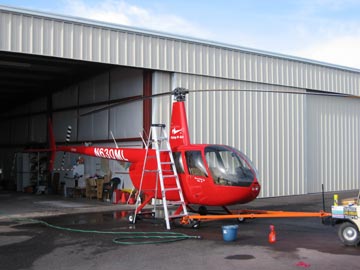
Washing a HelicopterNext is the mast, which has a cowling over it. The front, rounded side of the cowling is completely covered with baked on, squished on bugs. It’s bad, mostly because it’s so darn high off the ground that I need a ladder to clean it so I only clean it when I wash the whole helicopter. I used bug and tar remover with a brush on it today. Not a good solution, but it did work. I have to move the ladder and climb up either side of the helicopter to wash it all properly. Then it’s rinse, rinse, rinse and move the whole thing back a bit more into the hangar.

The front bubble comes next. It’s usually pretty clean — after all, it is the window I look through when I fly, so I wash it before just about every flight. The area under it — including the painted area around the landing lights — is another story. The bugs are really stuck there. On a whim, I decided to try the R44 Butt Cleaner. Would you believe it worked? No scrubbing required, either. Of course, I still had to wash that junk off, so I did double duty. But it is the cleanest it’s been in a while.

After a good rinse, I move the whole helicopter back into the hangar and begin the drying cycle. I use towels. I have a bunch of towels that are pink because I consistently wash them with red shop rags. They’re my helicopter and car wash towels. I use them to dry the whole helicopter, from the bubble back. The tailcone is usually just about dry by the time I get back there, but I dry it with a wet towel anyway, just to prevent the spots from setting in.

No, I don’t wash the main rotor blades. They’re drooping about 11-1/2 feet off the ground and are very difficult to reach to wash properly. I’d have to climb to the second to the last step on the ladder, which I’d have to reposition four times for each blade. It’s a ton of work and I get very wet, with soapy water running down my arms as I reach up. And I simply can’t deal with the ladder thing.

It’s kind of funny, because I had a perfect technique for washing the blades on my old R22. Those blades weren’t nearly as high up. I’d drive to the airport in Mike’s pickup truck and back it up, perpendicular to the helicopter, aligned with the mast. Then I’d turn the blades so one of them was lined up right over the bed of the pickup. I’d climb up in the bed of the pickup with my bucket and sponge and wash the blade, top and bottom, scraping all the dead bugs off the leading edge. Then I’d climb down, spray the blade to rinse it, and rotate the blades a half turn so the other blade was over the bed of the truck and repeat the process. Another wash and rinse cycle and I was done. One time, I even waxed them.

Unfortunately, the R44 blades are so high off the ground that I’d need a ladder inside the bed of the pickup to use the same method. And that’s not something I’m ready to do. So they go unwashed until their 100 hour or annual inspection. The guys who do the maintenance wash and detail the whole helicopter for me, including the blades.

The was job takes a good hour. It goes faster with help — one person can rinse while the other washes and it gets done very quickly. Then it’s usually still wet when we dry it off.

If I have time and it isn’t too hot, I use some spray wax to finish it off. It’s sold as RV cleaner/wax and it does a nice job, as long as you use it in the shade. It dries too quickly in the sun. I don’t usually do the whole helicopter. It takes too long. Instead, I start with the painted surfaces in the front and work my way back. I usually run out of steam before I get to the tailcone.

I didn’t wax it today. I ran out of time and had to get it out on the ramp for a flight. It sure looked good out in the sun, all clean and shiny.

Although I don’t like to wash the helicopter — primarily because it’s so much work and I always wind up getting dirty and wet — I’m glad I do it. It gives me an opportunity to look over the entire ship closely. I once found a loose screw on the mast cowling and have never forgotten it. Now I check every screw, every rivet. There hasn’t been a loose screw since, but if there is, I’ll find it.

The Hermosa Ranch Insanity

Greed and stupidity collide.

In early October, the Wickenburg Town Council approved a 34-unit subdivision on 35 acres of land on “Vulture Mine Road near the Country Club.” That’s how the land’s location was described in the newspaper and likely in the P & Z and Town Council Meetings. It was not given its other descriptor: approximately 3400 feet from the departure end of Wickenburg Municipal Airport’s runway 5 (see photo).

Hermosa RanchI heard about this newly approved subdivision and did some research. I learned that it had been proposed in mid August and had miraculously gone through the approval process in about six weeks. A miracle of Town efficiency — the same town that took four months to choose between two bids for an Airport Fuel Manager last year. The same town that routinely keeps old business “old business” at many commission meetings, including the Airport Advisory Commission’s monthly meetings.

Perhaps that’s why it didn’t take so long to approve. It was never presented to the Airport Commission, despite the fact that it lies well within the airport’s area of influence.

As most regular readers know, one of my jobs is as a pilot. I operate an FAA-certificated Part 135 charter operation at Wickenburg Airport. That means a few things. It means that I’m a commercial pilot who has undergone extensive flight training and testing to meet certain standards. It means that I have gone the extra step to get special certification from the FAA to perform operations above and beyond those allowed by basic, “Part 91” commercial operators. It means I meet with the FAA regularly for flight checks and am subjected to unannounced inspections of my aircraft, hangar facility, and documents. I also operated the Airport Fuel Manager concession at the airport for a year and a half not long ago — a fact that a few people seem anxious to forget.

In other words, I know a little bit about aviation, airport operations, and FAA regulations.

And I know that putting homes within 100 feet of an airport’s runway centerline is not only stupid, but potentially dangerous for home and property owners.

Sure, someone will buy these homes. There are deaf people who won’t be bothered by the sound of flight school airplanes from Deer Valley and Goodyear doing touch-and-gos past or over their homes throughout the day every day. I’m not sure how they’ll like the rattling of their china when a jet departs. And there are lots of people who make home purchase decisions on the very day they see a piece of property — perhaps a windy or overcast day or a summer day when the airport isn’t very busy and the Realtor says something like, “There’s an airport to the west, but you can see how busy it is.” (A local Realtor once told me that he spent all day at his west-side subdivision and only saw two planes operating. His subdivision’s homes are right under the airport’s traffic pattern where at least 75% of the pilots fly. I can only imagine what he tells potential buyers.) There might even be a few people who think they like planes and might find living under the approach and departure path to an airport kind of interesting. I assure you, the novelty will wear off quickly. It sure wore off quickly when a train lover like me moved into a home next to a railroad track. It wasn’t easy to find another sucker to buy the house, either.

But what happens when Wickenburg gets commuter airline service? This isn’t as far-fetched as it might seem. Such service is already available in Prescott, Kingman, Lake Havasu, and Bullhead City. As Wickenburg’s precious roof count soars, it’s only a matter of time before such service is demanded by its citizens. Wickenburg won’t have 737s landing on its newly extended 6,000 foot runway, but it’s likely to have large turboprop planes or small commuter jets. The runway already accommodates 10 to 20 jet operations per week in the peak season — why do you think the town wanted the runway extended in the first place? What if there were an additional 14 operations per week with daily flights by Mesa Air or some other regional carrier? Do you know how much noise these kinds of planes make during takeoff?

And don’t hand me that tired old line about Forepaugh. Forepaugh is a dirt strip 15 miles west that isn’t even marked by name on a chart. Wickenburg has no jurisdiction over it and it straddles State and BLM land. Even if the Town of Wickenburg did manage to cough up the money to buy or lease the land (don’t forget airport insurance), it would take years and millions of dollars to get it up to the standards needed to allow commercial jet operations. And don’t forget — the Town would probably have to use eminent domain to get possession of the ranch that already exists on the south end of that runway, right on Route 60. How long do you think that will take? Forepaugh as a regional airport is at least 20 years away. Wickenburg will have likely annexed all the land up to Aguila by then.

But noise is only one problem with locating homes at the end of a runway. The other, more important problem is safety.

Think for a moment about how a plane takes off. Even if you’re not a pilot, you should be able to visualize a takeoff. The plane starts at one end of the runway, where the pilot opens the throttle wide for power. The engine roars as the props (or jet engine) produce thrust. The plane rolls down the runway, gathering speed. When the plane reaches a certain velocity, the pilot pulls back on the yoke (or stick) and the plane’s nose tilts up. The plane lifts off the ground. It then begins its climb into the air.

The steepness of an airplane’s climb (and the amount of runway it needs to reach takeoff speed) depends on a few things:

  • How powerful is the airplane’s engine? A powerful plane can climb out at a steeper angle than one with a less powerful engine.
  • How heavy is the airplane? A lighter plane — one with just a pilot and a light load of fuel — can climb out at a steeper angle than one full of people and fuel.
  • How hot is it outside? Hot temperatures reduce aircraft performance, making it more difficult to climb out on takeoff.

All kinds of planes come to Wickenburg Airport and every takeoff is different. An ultralight with one person on board can climb out at an amazing angle, using only a little bit of runway. But a fully loaded single engine air tanker (SEAT), like those that operate at Wickenburg airport during the hot summer fire season, uses every inch of runway and climbs out at a very shallow angle. Other planes have takeoff profiles somewhere in between.

The FAA recommends a 20:1 ratio for a runway’s approach/departure corridor. That means that for every 20 feet away from the runway end, a plane is expected to climb at least 1 foot. With 3400 feet from the end of Runway 5 to the property line of Hermosa Ranch, that means planes could be flying over Hermosa Ranch as low as 170 feet off the ground. Would you like an airplane flying that low over your house on takeoff?

It’s this shallow angle that should concern the developers of Hermosa Ranch. Imagine a freshly refueled SEAT, heavy with a load of fire retardant. The pilot rolls down the runway, gathers speed, and lifts off less than 3500 feet from a Hermosa Ranch house to fight a fire at Lake Pleasant. He’s only 200 feet off the ground as he nears Hermosa Ranch. Suddenly and without warning, his engine quits. Where do you think that plane is going to hit the ground? And with a load of Jet fuel on board, how much damage do you think the post-crash fire will cause? Are you still imagining? Then imagine that plane crashing near a birthday party around the pool in someone’s backyard.

Right now, there’s a big empty patch of land that stretches from the departure end of Runway 5 to Vulture Mine Road (see photo). If Hermosa Ranch didn’t exist, that plane would crash and burn in that empty land. The world would lose a pilot and a plane, not one or more homes or possibly dozens of people.

Think engine failures on takeoff don’t happen? Go to the NTSB Accident database and search for “engine failure takeoff” and get the truth. Just because you didn’t hear about it on the evening news doesn’t mean it didn’t happen. The NTSB’s Web site lists scores of accidents all over the country that occurred on takeoff or landing. Engine failure is just one scenario.

So it appears to me that either the Hermosa Ranch developers don’t care about the safety of their subdivision’s home buyers (not likely) or they didn’t fully think out the safety implications of building so close to the end of a runway.

What’s troubling to me, however, is that the Town of Wickenburg failed to fully investigate the potential conflicts of such a development with airport operations. Although the proposal was presented to the P & Z Commission, the warnings presented there by then-Council Candidate George Wilkinson went completely unheeded. There was no effort on the part of the P & Z staff or Town Planner, Miles Johnson, to investigate the FAA guidelines regarding building near airports. These guidelines are available on the FAA’s Web site 24/7. If Dr. Johnson or his assistant didn’t have the time to look them up, a few phone calls would have gotten them an answer. The phone numbers are on the Web, too.

I got the documents and made the phones calls to the FAA to confirm my belief that the FAA would not be happy with the Hermosa Ranch subdivision proposal. It took me about 20 minutes. The FAA compliance person I spoke to was amazed that such a subdivision would even be considered at that location. If Dr. Johnson — who is also Airport Manager — had done his job, he would have been better informed about the potential problems with this proposed subdivision.

It has been claimed that the “airport consultants” approved the development. Who are they and what kind of authority do they have? And is their approval in writing? I seriously doubt it, since making such an approval could get them into hot water if liability issues arose. (I can only imagine the lawsuits generated by a plane crash/birthday party accident like the one we imagined earlier.)

Why wasn’t the Airport Advisory Commission consulted about the Hermosa Ranch proposal? The commission, which has 5 (of 7) members who are active pilots in Wickenburg, would certainly have pointed out the conflicts between the airport and proposed development. Yet Dave Lane, who sits on the Town Council and Airport Commission (as its Chairman for the past four or more years) failed to bring it up to the Commission for discussion. The Airport Commission members I spoke to didn’t even know about the development until after it had been passed by the Town Council. Councilman Lane’s failure to bring up this project for discussion and his rubber-stamping of the approval were irresponsible and a complete neglect of his duties as Councilman and Chairman of the Airport Advisory Commission.

So what are we left with? A 34-home subdivision in the path of arriving and departing airplane traffic at Wickenburg Municipal Airport, with homes less than 100 feet from the extended runway centerline — that’s the path planes attempt to follow when taking off or landing. A subdivision approved in what’s probably record time by P & Z and the Town Council after ignoring safety and noise issues presented by at least two Wickenburg residents. A proposal never presented to the Airport Advisory Commission for discussion, never researched with the FAA for compliance with “airport-compatible zoning” requirements. A development that appears to have the only goal of adding to Wickenburg’s roof count, placing high-priced homes in an undesirable and potentially unsafe location.

Why did I start a petition to stop this insanity? Do you really have to ask?

When the elected officials fail to make decisions that are in the best interest of all citizens (rather than a handful of supporters), it’s the duty of the public to step forward and, using the democratic process guaranteed by the First Amendment in the U.S. Constitution’s Bill of Rights, provide input and guidance. My petition was a wake-up call, the only way I knew of to get the attention of the Town’s elected officials and staff and the public. It was a way to get the FAA involved to offer guidelines to the Town for making airport-vicinity zoning decisions. It was a way to propose a safety zone around the airport, one that can prevent the horror of a plane crash on take-off from taking more lives than just the ones on the ill-fated plane.

I’m not the only person who thinks that Hermosa Ranch and any building at the end of the runway is a bad idea. Of the 79 people I approached for signatures, 76 of them signed. Two of the signers are Airport Advisory Commission members. If they’d been consulted before this got to the Town Council — as they should have — the proposal is likely to have been denied on the very grounds I cited in my petition and in this article.

Safety should come first. Lifestyle should come next. Profit should come near the end of the list. Shouldn’t it?

Now, I understand that members of Wickenburg’s Good Old Boy Network are whining that this petition will cost the Town of Wickenburg $10,000 to run an election and put it to vote. I want to remind those people — and the rest of Wickenburg’s citizens — that if the Town Council and P & Zoning Commission had done their jobs and made a responsible decision, this petition and the costly election would not be necessary at all.

What do you think about this? Don’t tell me — I’ve already done my part. Call the Mayor, Council Members, and the Town Planner. Town Hall can be reached at 928/684-5451. Call the members of the P & Z Commission — you can get their names from the Town Clerk. Ask them why they approved such a plan. Ask them if they care about Wickenburg and the safety and well-being of all of its residents.

And let them know that you care — at least as much as I do.

How Much, How long?

The financial dynamics of selling helicopter rides.

I went down to Goodyear, AZ yesterday to offer helicopter rides at the Goodyear Balloon & Air Spectacular. This was my second year doing rides at the event; last year I did them at Glendale as a subcontractor for another helicopter operator. This year, when the event was moved to Goodyear (a Phoenix-managed airport), the paperwork requirements were more stringent. The other company couldn’t get their paperwork together on time. They dropped out. I had all my paperwork in order. I did the show without them.

First I need to say something about the show. Formerly known as the Thunderbird Balloon & Air Classic (and still run by a company of the same name), the event is a combination balloon gathering and air show. The balloons, which can only fly early in the morning or in the evening, do their thing in their time slot. I wrote last year about walking among the balloons during the nighttime glow and about arriving at the airport as the balloons were departing at dawn. It was an incredible experience. Oddly enough, most people don’t go to the show for the balloons. They go for the air show which goes on during the day. There are aerobatic displays, war birds, F-16s, and this year, the Blue Angels. On the ground, there are food vendors, car and motorcycle dealers, navy recruiters, carnival rides, and souvenir sellers. There is literally something for the whole family. And although it ain’t cheap to attend — $15/adult, less for children and seniors — it’s a great event for a family to attend together: outdoors, surrounded by history, technology, and carnival food.

This is an extremely professionally run event, with excellent management and crowd control. The entertainment is top notch and the announcer is incredible. There’s no shortage of staff members to help with a problem. And the Air Boss, who works behind the scenes with the pilots and airspace, is safety-conscious, reasonable, helpful, and well…professional. I cannot stress what a pleasure it is to work at an event that’s so well run.

Unfortunately, the new venue at Goodyear had a bit of a dust problem. Instead of being on pavement like the vendors were at Glendale last year, they were on dirt. Which turned to dust. Even the water truck couldn’t keep up with it. Thank heaven it wasn’t windy like it always is in Kingman for the Mohave County Fair.

And unfortunately for us, my landing zone was about a mile away, near the main terminal building. (On concrete, thank heaven.) So we had to provide transportation from the ticket sales area to the LZ and back. The folks I was supposed to fly for were going to provide transportation via golf cart. We didn’t have a suitable golf cart, so we used Mike’s truck.

I say “we” because when I realized I’d be doing the event without the other helicopter company, I had to get together a full ground crew. For me, a full ground crew consists of three people: a money person to sell tickets, answer questions, and hold the money and two loaders who do safety briefings and escort passengers to and from the helicopter. (We do hot loading, like most helicopter operators do, and I don’t want anyone walking unescorted or unsupervised near the helicopter while the blades are turning.) In a pinch, with a secure LZ, I can do with one experienced loader (my husband, Mike), but I really like two. It speeds up the loading/unloading process by having one crew member on each side of the helicopter.

DarleneDave
Our great ground crew: Darlene and Dave (photos by Dave and Darlene).

I should point out one thing here about the R44 helicopter. The main rotor blades are 10 to 12 feet off the ground (depending on RPM and rotor droop) so the possibility of someone getting hit on the head by the blades is remote, especially at 68% RPM, which I maintain during loading/unloading. That’s one less thing to worry about when hot loading.

Me in the Pilot SeatBecause the LZ was so far from the rest of the venue and there were aerobatic displays going on while I was giving rides, I couldn’t fly past or around the venue to attract future passengers. That turned out to not be a problem. We had a steady stream of riders for our 8-10 minute rides. And, when the Blue Angels were done flying at about 4:15 PM, I started up and flew just about nonstop until 7:15 PM.

Here’s where the finances come into the picture. Last year, the other helicopter operator charged $45/person for 10-minute rides. Of that, I got $35, which I thought was a fair price for the ride. They did the money stuff and provided transportation to/from the LZ, which was about 1/4 mile from the ticket booth that year. (Easy walking distance, but who likes to walk?) They also provided one ground crew member, but since they were flying a helicopter, too, he mostly dealt with loading/unloading that helicopter. So Mike came along and took care of my passengers.

At $45/person, I flew 131 people last year over a 3-day period. To date, that’s my second-best gig, surpassed only by 2005 at the Mohave County Fair (150). I personally could not believe that so many people were willing to lay out $45/person for a ride. To put it in perspective, for about $120 a person can get a 25-minute helicopter flight over the Grand Canyon with Papillon. That’s a more memorable flight than 8-10 minutes over Sun City.

Yet this year, when I went to the Mohave County Fair and tried to sell 8-10 minute flights for $35/person, I had very few takers. I had to resort to Plan B, which offered 3-4 minute rides around the fair for $15. That kept me busy. In Congress, I did 5-minute rides for $20 around Congress. I had a line for 3 hours straight and probably could have sold the same rides for $25 without losing a single passenger.

So what I learned during the year (or thought I learned) was that I could keep flying if I priced the rides at a price most people would consider cheap. I want to keep flying. Sitting on the ground, spinning my blades while I wait for a passenger burns fuel without earning revenue or paying my ground crew. The problem is, if I make the rides too cheap, I don’t make any money. Duh.

At yesterday’s event, I offered the rides at $35/person, which was what I would have gotten if I’d flown with the other company anyway. I’m not greedy, but I do have loan payments to make. The result was a steady stream of passengers who couldn’t believe how cheap the rides were.

So what’s expensive in Kingman, AZ is cheap in Goodyear, AZ.

Our flight path, in case you’re interested, left Goodyear airport heading southeast. I flew straight down to the Phoenix International Raceway (PIR), where they have NASCAR events, and came back to the airport. There were cars on the track (not NASCAR) for much of the day, and people riding quads and fishing along the Gila River, which we crossed in two places. At night — because I flew for over an hour after sunset — I flew more to the east, trying to stay in a well-lighted area and give my passengers something to see. At night, the city is a blanket of lights in every color and it really doesn’t matter what you’re looking at. It’s just so darn pretty from the air.

Maria and MikeAlthough it was a 3-day event, I missed the first day due to a miscommunication. (Long story and please don’t ask me to tell it because I’m still pretty pissed off about it.) Yesterday was the second day and we did pretty well. Unfortunately, there are limitations on when I can fly. Those limitations are imposed by the Air Boss, who is basically an air traffic controller during the event. Keep in mind that the air show part of the event runs all day long and has many performers. Some of them simply don’t like operating while a helicopter is making flights in and out of the airspace. And in other instances, the Air Boss himself might consider my operations a hazard while other performers are on. So throughout the day, I’d be asked by the Air Boss to stay on the ground. These stoppages could be as short as 5 minutes or as long as 90 minutes. They broke up the flying day, limiting the number of people I could fly.

This happened last year, too, but there weren’t as many of these breaks so they didn’t affect me as much. This year, they really put a damper on things. People who showed up at the booth at 1:30 PM, ready to fly, were told they had to wait until 4 PM. Not everyone wanted to wait. And I certainly didn’t want to sit in the dusty booth waiting for the green light. But when 4:15 rolled along, I started flying again — for 3 hours straight.

Unfortunately, we had to skip today at the show. That’s not so bad. Mike is fighting a cold and he needs the rest. And I’m still exhausted from flying so long after nightfall — it takes more concentration, at least for me, and it really wipes me out.

Now if you’re doing all the math and coming up with some really big numbers for our ride revenue, remember a few things. It takes (and costs) more than just fuel to operate a helicopter. My insurance alone costs $60/hour (based on my current 200-hours per year flight level). And then there’s the reserve for the overhaul my helicopter will need at 2,200 hours — that currently costs $185,000, which is about $85/hour. There’s regular maintenance (at $50 to $75/hour), fuel (at about $4/gallon), oil (at about $5/quart), and hangar rent (at several hundred dollars a month). There’s additional costs to comply with service bulletins (SBs) and airworthiness directives (ADs). There’s advertising with signs, banners, brochures, and business cards. There’s business licenses and drug testing program fees and credit card acceptance fees. And there’s state and local sales tax, which must be paid out of every qualifying revenue hour — including rides. (Although we charged $35/person, $2.68 of that goes to Maricopa County and the City of Goodyear with its total 8.3% sales tax rate.) On an event like this, there’s also the cost of the ground crew, which must be transported, housed (in some instances), fed, and paid. There’s also the cost of operating the helicopter to get from its home base to the event location — cost that has no revenue associated with it. And let’s not even talk about the cost of equipment such as shade structures, tables, and chairs for a booth; a camper that can sleep up to 8 for overnight events; and a truck to haul all of this stuff around on the ground.

As you can see, the math isn’t as simple as saying 60 rides x $35 per ride – fuel costs = big profit. That’s the formula some passengers try to use. I only wish it were that simple.

What did I learn about this past weekend’s event? Confirm and reconfirm all the information I get. Stay involved in the setup process from the beginning. Don’t miss any meetings. Have a ground crew ready and waiting if needed.

And if they want to pay $45 per person for a ride, let ’em.

Many thanks to Darlene and Dave, Ground Crew Extraordinaire, for taking photos at the show and sharing them with me so I could put them here.

Southwest Circle in a Blur

That’s what happens when you compress a 6-day trip into 3-1/2 days.

Just got back from a 3-1/2 day version of Flying M Air‘s Southwest Circle Helicopter Adventure. I won’t do that again. A photographer and I rushed around from Tuesday morning until Friday at noon, trying to visit and photograph or video all of the destinations and the flights in between. I’m talking about Sedona, Grand Canyon, Lake Powell, Monument Valley, and Flagstaff. In 3-1/2 days. Should make your head spin just thinking about it.

I have some stories to tell about the trip, as well as photos and video taken by me and by my companion for the trip, Richard Noll. If you’re a Bigfoot follower, you may know of Rick — he’s done documentaries about monster hunting for Discovery Channel and cable networks.

Rick’s job was to take photos and videos while we were in flight — which is something I can’t do — as well as on the ground where permitted. He left me with about 3 hours of video and close to 900 12-megapixel digital photos. My job, over the next few months, is to turn our raw footage into slideshows, video podcasts, and a DVD to show people some of the things they’ll see on the excursion.

But they’ll be lucky. They’ll be able to see it over 6 days, which is far more reasonable.

Flying in PhoenixRick took the photo you see here as I was flying into Phoenix yesterday at around noon. As helicopters enter the Phoenix Class B airspace, they’re instructed to stay below 2,000 feet (Sky Harbor is at around 1,200 feet, I believe) and normally approach the airport by flying down the west side of Central Avenue. That’s what you see here out the front windows. The red thing on the left (that’s reflecting on my window) is one of the back doors. We took a door off each day so Rick could take glare-free videos and photos. This photo will probably be the opening shot of the first video podcast I put together.

More later. Got a bunch of stuff to do this morning.

Night Flight Around Phoenix

Good practice for me, great fun for my passengers.

When a Phoenix-based helicopter tour company began the slow spiral of death (for the company, that is), its owner canceled at least one charter. That customer tracked me down and called in a near panic, looking for a replacement flight.

He said the flight was for his aunt and uncle for their anniversary. He’d planned it months ago and now the tour company he’d booked it with had cancelled it. He was anxious to get another company to do the trip. Could I do it?

The trip was an hour long, nighttime flight around Phoenix, starting from Scottsdale Airport.

I live in Wickenburg and my helicopter lives there, too. It’s about a 30-minute flight from Wickenburg to Scottsdale. But since most of my work has been coming from the Phoenix area these days, I have special pricing for that area. The first hour of the flight is enough to cover my ferry time plus a profitable hour of flight with passengers. In other words, it covers two hours of flight. There’s a one-hour minimum, so the flight is worthwhile for me. Every subsequent hour is at a reduced rate more in line with my local rates. This seems to work just fine with people down in the Valley. I’m still the least expensive game in town, so they’re satisfied. And I get what I need to make money. Everyone is happy.

Mike and I flew down to Scottsdale to arrive at 5 PM. We locked up the helicopter on the ramp and walked to P.F. Chang’s for dinner. I brought along my Terminal Area Chart for Phoenix and studied it with Mike as we waited for our food. Where would I take them for an hour? Which airports would I have to communicate with? Which frequencies would I have to monitor or speak on? Who would I contact for Phoenix Sky Harbor airspace? Where would we go?

I decided on a route that would take me north from Scottsdale and then west, on the north side of the Deer Valley Airport airspace (so I wouldn’t have to talk to the tower there). From there, we’d continue west, then southwest and follow the Loop 101 from the Arrowhead Mall area to the new Glendale Arena, in Glendale Airport’s airspace. We continue down to I-10 and turn east. That’s when I’d have to talk to Sky Harbor and enter their space. We’d follow I-10 to Central Avenue (that’s the main road in Phoenix where the tall building are) and turn north up Central, flying only a few hundred feet off the building rooftops. We’d exit Phoenix airspace near Camelback Mountain, turning east to pass on the north side of Camelback. At that point, we’d be within 10 minutes of Scottsdale Airport. I’d check the remaining time and, if I needed to fly more, I’d head south toward Falcon Field and spend some time over Mesa before flying back to Scottsdale.

I was nervous but not terribly so. Sky Harbor was the big challenge. I didn’t know how busy they’d be and whether they’d grant a request to a helicopter. Light wasn’t an issue. I’ve done a good bit of night flying and have never had any doubt about which way is up. Even though it would be dark at 6:30 PM, the flight time, the moon would be rising soon afterward and the city was already full of light from the ground. I just had to be careful north of Deer Valley where it wasn’t very developed and there were a few small mountains that would look like pools of blackness in the night. I’d learned on other night flights in the Phoenix and Wickenburg areas never to fly into areas that were completely black — they were usually desert mountains.

We finished dinner and walked back to the airport. The terminal, which was open until 10:00 PM, was completely empty. The restaurant there was closed — it has changed hands yet again — and the charter plane and car rental desks were deserted. This was at 6:15 PM on a Saturday night. We waited. I admired the photos in the waiting area: poster-sized blowups of aerial photos taken throughout the state. Nice. The Lake Powell photo was similar to one Mike had taken only a few weeks before. But there was a lot more water in the photo in the terminal. There was probably a lot more water in all of Arizona back on those days.

It was 6:40 and I was just about to call the customer to find out where my passengers were when a car pulled up in the parking lot. Two surprisingly young people literally ran into the building. Both were dressed up as if ready to go out for dinner. He was excited and talked a mile a minute. He told me that he hadn’t known about it until just a while ago. Everyone else knew, but it was a surprise to him.

I left Mike in the terminal to find his way to the FBO where a plasma TV with the Mets game on awaited him. We made our way out onto the ramp, which was terribly dark. I took photos of them in front of the helicopter with a disposable camera. I gave them the safety briefing and strapped them in. He sat up front. She sat behind him. She was wearing lots of perfume and it smelled nice.

While I started up, he flipped open the phone and let the light from its screen illuminate my hands. He started asking questions as I started the engine. We warmed it up and I answered them the best I could. His wife, who didn’t speak English as well, asked questions in their language. He explained in English and whatever language it was that the spoke. Indian? Arabic? Pakistani? Iranian? Heck, I had no clue. Something middle-eastern.

I talked to the tower and we lifted off, heading north as I’d planned. The moon, full and round and bright, rose just as we departed. Coincidentally, we flew right past the housing development where they lived, east of Deer Valley Airport. They tried to see their house from the air, but it was too dark. We were too high for my landing light to help them.

They asked lots of questions. I answered them. I pointed out landmarks I knew — highways, malls, airports, stadiums. He pointed out where his first business had been and told me how the area had changed since he’d first moved here in 1970. When I had to talk to a tower, I flipped the pilot isolation switch so I could communicate without interrupting them (or letting them interrupt me). There was some confusion with Sky Harbor — I made the mistake of contacting Phoenix Approach when I should have called Phoenix Tower — but when I got the right guy on the radio, my request was cleared without problem. Sky Harbor — and all the other Phoenix area airports, for that matter — were pretty dead. I could see all the other aircraft — planes are actually easier to see at night than during the day, especially when you’re flying below them and their lights are bright against the night sky.

We flew east on I-10 and then up Central Avenue. Flying right through downtown Phoenix was a real thrill for all of us. I’d only done it twice before, and only one of those times was at night many years ago. Of course, Phoenix isn’t like New York — it’s pretty dead at night. I couldn’t imagine flying up Broadway in Manhattan at night but would love to try it sometime.

When we got to Camelback, we had some time. So I headed southeast, passing just west of Falcon Field’s airspace. It was dead there, too. I got a few miles south and started my turn. The controller game me permission to cross midfield. I hadn’t flipped the isolation switch, so my passengers heard the whole exchange. As we passed the tower there, he said to his wife, “She just to talked to a woman in there” — he pointed at the tower — “and she told us we cross the runways here.” I never realized how cool it might be to a passenger to see and hear what goes on between pilots and air traffic controllers.

We crossed the darkness of the indian reservation just southeast of Scottsdale and I called the tower. It was dead there, too. The controller told me to report 1/2 mile out. I relied on the rotating beacon to find the airport — it’s nearly impossible to make out among the lights when approaching from that direction, day or night. I called a mile out (per my GPS; it sure looked closer) and he cleared me to land. I touched down right in front of the terminal building.

Mike met us and helped my passengers out. He took some photos of them and I gave out my card and a few postcards. He escorted them to the terminal while I waited, engine running. I didn’t need to shut down with Mike along. He returned a moment later, climbed in with our dinner leftovers, and strapped in. Moments later, we were on our way home in the moonlight.

It was a great flight. I hope I get more calls for nighttime flights around Phoenix soon.