Amazon.com Wish Lists

A great way to let people know what you want.

I’ve maintained an Amazon.com wish list for at least a year now. I do it for two reasons:

  • To keep track of the books, DVDs, CDs, and other items I want. When I place an order with Amazon.com for something I need and I either need another item to get free shipping or want to piggyback a little gift to myself on that order, I pick something off the list and buy it in the same order.
  • To let other people know about the books, DVDs, CDs, and other items I want. This is especially useful for family members around the holidays, when they don’t know what to get me. But it’s also nice for site visitors. After all, I’ve bought Amazon.com wish list items for other bloggers and software developers. I thought maybe someone might want to surprise me.

My list grows. I add more things to it than I actually get. In fact, I added about 10 books today (after going through a back issue of Bookmarks).

My Amazon.com wish list didn’t help my mother buy me a Christmas gift this year. I sent her the link to my list and she e-mailed me back saying, “Is that all you have on the list? Books and movies?”

When I told her that was it, she didn’t reply. But the Friday before Christmas, she e-mailed me to let me know she’d sent my Christmas gift late. I still haven’t gotten it, but I know she didn’t buy anything on my Amazon.com wish list. I’m imagining a sweater (I live in Arizona) from Belk, a Florida-based department store. I distinctly remember the fruit trees she bought me for my birthday a few years ago. Yes. Live fruit trees. Apple and pear, I believe. (Remember, I live in the Sonoran desert of Arizona.) I sent them back to her in Florida. They probably died en route — she never mentioned them. The trees are one of the reasons I created the wish list.

I don’t get it. The wish list includes items ranging in price from about $10 to $75. A person can choose any number of things to buy a perfect gift for his/her budget. Shipping is usually free for orders over $25. And ordering is as simple as clicking a few onscreen buttons. (She even has DSL now!) I know my brother and sister would have used the wish list if they hadn’t bought us a wonderful set of Calphalon cookware for a combo Christmas/Wedding present. (Something else on a wish list.)

So apparently it’s up to me to eat away at the wish list by piggybacking items with other things I need to buy. That’s okay. The wish list is there when I need it, so I won’t forget what items I want.

Anyway, I recommend creating an Amazon.com wish list if you don’t already have one. Then keep the link handy for the next time someone asks what you want for Christmas or your birthday. But if your mom is like mine, add a few things other than just books and CDs. Otherwise, you might wind up with a sweater, too.

Christmas at Howard Mesa – Part I

I was dreaming of a white Christmas.

On the Friday before Christmas, Mike and I loaded up the truck with a bunch of things, including some furniture, food, tools, Jack the Dog, and Alex the Bird. At about 9 AM, we headed north, to our property at Howard Mesa.

In Wickenburg, it was raining. It was the first time there had been enough rain there to actually get your skin wet for at least a month. Part of me wanted to stay behind and enjoy the weather. But the other part of me knew that it was likely to clear up in an hour or two and I’d just be disappointed. We don’t get many good rainy days in the desert and Friday was not going to be one of them.

Our path took us up Route 93 to Route 89, through Congress and up Yarnell Hill. We stopped at the Cornerstone Bakery for some fresh baked goods to munch on in the car and enjoy on Saturday morning for breakfast. It was a freezing rain there, but nice and toasty in the bakery, which was filled with the usual collection of locals.

Back on the road, we took 89 through Peeples Valley, turned toward Kirkland at Kirkland Junction, got on Iron Springs Road in Kirkland, and followed that to the first traffic light in Prescott. Then Williamson Valley Road to the Pioneer Parkway to Willow Springs Road to 89A. In Chino Valley, we stopped at Safeway, where Mike filled the truck with diesel and I hurried through the store to get veggies and a few last-minute food items. By this time it was snowing pretty hard, with just enough wind to blow the flakes at about a 30° angle to the ground.

Back in the truck, we followed 89A to Ash Fork, where we got on I-40 eastbound. The snow was sticking up there, coating the road with a thin layer of snowy ice. Trucks and cars were taking it easy, preferring a self-mandated speed limit of 35 or 45 MPH rather than the legal 75 MPH limit. It was slow going, but I’m sure it was better that way. Alongside the road, a light dusting of snow covered fields and trees. It looked more like Christmas than it has in a long while for me.

At the exit for the Grand Canyon (the third exit, the one that’s really for the Grand Canyon), we got off and followed Route 64 northbound. There was a lot of snow on the ground there but very few vehicles. Still, we both felt relieved when we reached the turn for Howard Mesa and began our last five miles of the trip. 20 minutes later, we were pulling through our gate while the snow swirled around us.

The entire drive, including the two short stops, had taken about 4 hours.

Inside our camping shed, the temperature was hovering around 35°F — which was pretty much the same temperature as outside. Mike turned on the gas and I struggled a bit to get the heater turned on. He unloaded the car while I turned on the fridge and started putting things away. Jack the Dog immediately got to work terrorizing whatever small rodents had made homes in the fire pit outside. Alex hung out in the truck where it was warmer. He didn’t come in until the temperature had risen to nearly 50°.

My first main task was to clean up after our unwanted lodgers — the mice. The shed has a mouse problem that we’ve tried everything to solve. The last time we were there, we’d gotten desperate enough to leave poison around. I had to scoop up what remained of it (only one of four pieces) before Jack came in. Then I had to uncover the furniture and get the vacuum going to suck up the mouse droppings that seemed to be just about everywhere. I used a lot of disinfectant cleaner on the floor and countertops. I took my time about it — there really wasn’t any reason to rush; I had all day. I had my iPod sitting in the iHome base, playing Christmas songs. Within two hours, I was pretty much done.

In the meantime, Mike was working in the bathroom on the plumbing. On our last brief visit (by helicopter during snow showers), we had discovered that most of the pipes had frozen and cracked. Mike had brought along pipes and connectors and tools to replace the broken pipes with new ones. The job required that he cut away one wall to access the pipes and do a lot of disconnecting. There was no running water in the shed and wouldn’t be until the pipes were repaired. Even the 5-gallon water cooler jug was mostly frozen; I had to light a candle under its spigot to get the water to flow.

I made us a hot lunch of canned chili with scallions and cheese, then washed up using water I boiled on the stovetop. It reminded me of the old days at Howard Mesa, when we’d camped out in our pop-up camper. That camper was wonderful on warm summer nights, but it lacked basic conveniences, such as a refrigerator or toilet. We’d use the tiny two-burner stove to heat water in the morning for coffee and washing up. During the day, we’d use those solar shower bags to heat water for showering and washing dishes. (They really do work in Arizona; we once had the temperature of the water in one of those bags up to 110°F — too hot to shower in!)

After lunch, I went on mouse cleanup duty on the shed’s little loft, which is where we sleep when we camp there. I discovered a place where they might be getting in; I’ll work on closing it up this weekend. Outside, the snow was still falling lightly. Everything was covered with a dusting of it. Jack the Dog was still hard at work at the fire pit, with the fur on the lower half of his body soaking wet. Oddly enough, it wasn’t windy, even though the weather forecast had called for wind gusts up to 28 MPH. A low cloud hung over the mesa, cutting our view to only a few miles.

Before the end of the day, Mike had finished replacing all the cold water lines. He connected the hose from one of our water tanks to the shed’s water line, turned on the pump, and pressurized the system. That’s when he saw the cracks in the hot water lines. We turned off the pump and disconnected the hose, then let any water in the lines run out.

The sun went down and it got dark. We brought Jack in. I made leftovers from home for dinner. The heater, which had been set to 85°F, had gotten the temperature in the shed up to a high of 64°. It didn’t seem that cold. We settled down on the sofa with my 15″ MacBook Pro on a folding table in front of us. I popped in a DVD from the first season of 24. We watched two episodes. We’d heard a lot about the show but had never actually seen it. So I’d added it to my Netflix queue (along with the second season of Boston Legal) and we were checking it out for the first time. Not bad. I can’t imagine watching it with commercials, though.

I slept badly. It’s the stupid hot/cold/hot/cold middle-aged woman thing, combined with the sounds of sleeping someplace different. It was pretty quiet when we first got to sleep, but at about 3 AM, the wind finally kicked up, blowing from the west right at the loft’s only window. I’d left the window open a crack — I’m always worried about asphyxiation in a closed space with a gas appliance running — and Mike had to close it. Sometime during the early morning hours, the wind shifted around to the northeast, which is the back side of the shed. It wasn’t blowing hard enough to shake the building, as it sometimes does. Just loud enough to hear it rushing past in the piñon and juniper pines scattered over our 40 acres. The sky had cleared and there were billions of stars out.

In the morning, the temperature in the shed was 43&degF with the outside temperature 28&deg. This was a problem. The heater was turned up, still set on 85°. As we moved around, making coffee and tea, washing up with water heated on the stove, we started finding drafty places. Around each window. Where the water heater sits against the outside wall. Around the edges of the door. I got my assignment for the day: caulk.

Mike decided he needed something from the hardware store to keep working, so we made a trip down to Williams, AZ. The town was remarkably busy for the time of year. I think it’s because the Grand Canyon Rail Road is doing a special “Polar Express” to the Grand Canyon each day and that’s attracting a lot of families. The town also sets up a real Christmas tree on side street off Route 66 and blocks off the street so visitors can walk around it. Nice.

We took care of business in the True Value hardware store, buying about $90 worth of stuff that included a new front door mat and weather stripping. Then we hit Safeway for a few things, stopping at the Starbucks counter on the way out for mocha lattes.

By the time we got back to the mesa, before lunchtime, a lot of the snow had melted. Mike got back to work and Jack continued his vigil at the fire pit. Sometime during the day, he started barking at something — we looked out the window in time to see an antelope hopping away across the road. One of the open range cows also came by, but since we’d kept the gate closed, she didn’t get into our property. (Cows have done a lot of damage at our friends’ place on the other side of the mesa, making us very glad we fenced in our entire lot years ago.)

Soup and sandwiches for lunch. The shed temperature was in the low 60s while it remained in the 30s outside.

I went through a whole tube of caulk on the windows. The shed was built with window frames that they’d stuck standard sized windows into. Unfortunately, the frames were about 1/2 inch too wide and tall for the windows, leaving a gap on at least two sides. They’d finished the outside of the windows with trim, closing up the gaps a bit, but they were still drafty. And one window leaked. I’d fixed the leaky window during the summer but had never thought that the gaps might cause drafts in the window. So I went to work with the caulk gun, which I’m actually pretty good at using. I ran out of caulk before I’d finished all of the windows, but I’d closed up the worst of the gaps.

Mike, as part of his pipe insulation procedure, had sealed up around the water heater with Fiberglas and foam insulation. I used garage door weather striping around the front door. The door was made to fit the shed and it doesn’t fit quite right. You can see light through the cracks around the door. Even with the thick rubbery weather striping, you can still see light in a few places. But it’s a lot better than it was.

Mike finished up all the piping by sunset. Hooked up the water again, ran the pump, and pressurized the system. No leaks. He turned on the water heater. I washed dishes from lunch. He cleaned up. Then he was ready for a shower.

Unfortunately, he’d waited too long. The outside temperature had dropped and the hose, which had never fully defrosted from the night before, had thickened up with ice. The pump was unable to bring in enough water. His shower was very short-lived. He stepped out, cranky and miserable. I was just glad I’d let him go first.

Getting water from the tanks to our camping equipment had always been a problem in cold weather. In the spring of 2004, I’d moved up to Howard Mesa in our horse trailer with living quarters, which also had a pump to get water from the tanks to the inside plumbing. Unfortunately, during the night the hose would freeze and the pump would try in vain to get the water out. That would run down the trailer’s battery and burn up the pump. So I had to turn off the pump each night and use the trailer’s internal water storage system for water. Not a big deal. Once every few days, I’d fill the internal tank so there was always water there when I needed it.

But here at the shed, we don’t have internal water storage. All the water has to come from one of the big tanks. The closest one is about 40 feet away. Because this is not a permanent setup, we didn’t dig a trench and put in a pipe. We use a hose. And the hose freezes every night, even though we do our best to drain the water out of it.

At least it hasn’t cracked yet.

Anyway, we spent Saturday night much the same way as Friday night. A nice hot dinner and two episodes of 24 on my MacBook Pro’s wide screen. The shed was much warmer — it had gotten up to 71°F by late afternoon. I slept well, waking about an hour before dawn. Outside, the moonless sky was bright with stars.

This morning, the inside temperature was 57°; outside it was 31°. I like to think it was my excellent caulking and weather striping that kept the shed reasonably warm overnight.

Today, Christmas Eve, I’ll finish cleaning up the shed — didn’t get much done in the bathroom with Mike making such a mess in there. Then we’ll put up the Christmas lights. Later, when it gets warmer, we’ll go for a walk around our fence line, making repairs and looking for castoff elk antlers as we go. It’s beautifully clear outside — I can see for at least 50 miles in every direction — and, as I write this at 10 AM, its already nearly 40°. It’ll be nice to get out. And I’m sure Jack the Dog is looking forward to a good run. He’s been going nuts every time the coyotes start howling nearby.

This afternoon, after a nice hot shower (got my fingers crossed), we’re going up to the Grand Canyon to meet some friends for dinner at El Tovar. Then dessert at our friends’ house on the other side of the mesa.

I’m looking forward to driving back to our place tonight, to seeing those red Christmas lights all alone in the middle of nowhere.

[composed on top of a mesa in the middle of nowhere with ecto]
Back from Vacation

Well, not really vacation…more like a bunch of visits.

If you’re wondering why this blog has been so quiet lately, it’s because I was away on what I thought might be a vacation. It turned out to be a bunch of visits to friends and family in Florida, which is actually a very different thing.

I brought my laptop with me on the trip, but none of the places I stayed had a wireless Internet connection for me. I wasn’t interested in dialing up and I didn’t have an Ethernet cable with me (almost brought one, though) to connect to a friend’s DSL router. In fact, the first time I got on the ‘Net was while waiting for our delayed plane out of Jacksonville, FL. They have free wireless Internet there — a great thing that every major airport should have — and I sucked down a week’s worth of e-mail before climbing on board the plane.

Marco Island BeachOur trip to Florida started in Fort Myers. We can’t fly direct from Phoenix to that airport so we flew Continental and stopped over in Houston. We arrived late at night, rented a car (can you believe they gave me a PT Cruiser?), and drove to our first host’s house on Marco Island, about 60 miles south. Will is Mike’s former partner (now retired) and Annette is his wife, who was also the bookkeeper for the company. He sold the company a few years back and the buyer bought out Mike’s share. Will and Annette bought a home on Marco Island, right on one of the many canals there. We got to stay in one of their guest rooms.

Stan's Idle House RestaurantWe wound up staying there for four nights, which I think is the most number of nights we’d ever stayed at someone’s house. It was very comfortable. Each day, we’d do something different — breakfast at the country club followed by a walk on the beach and a visit to Stan’s Idle Hour Restaurant, a boat ride to a lunch spot, a walk around the Naples historic and shopping areas (nearly indistinguishable, although several blocks apart). I took photos, but not many.

On Wednesday, we headed out early for a long drive to my Mom’s house in the St. Augustine area. Imagine Florida — a long peninsula of land. Marco Island is near the bottom, on the west side. St. Augustine is on the top, on the east side. I don’t know how many miles we covered, but it was a long drive.

Along the way, we stopped at my Dad’s house. He lives in Ft. Pierce, which is a little less than halfway up the peninsula, on the east side. About halfway to my Mom’s place. We had a short visit with him and his wife that included lunch out at a marina and homemade cream puffs for dessert. They have four cats and it’s a lucky thing that we went out for lunch. Mike is allergic to cats and he had some breathing trouble for a while after we left.

We hit traffic on I-95 just 20 miles short of my Mom’s place, but managed to get there just after 7 PM. A leg of lamb dinner awaited us.

We camped out in the guest bedroom my Mom had designed into the house for my grandmother. We call it Grandma’s room. It’s not a big room, but it’s at the end of a private hallway with its own bathroom and has its own private entrance to the pool area. Although my grandmother stayed there a few times, she never moved in. She’s gone now and her room is the most coveted of the guest rooms.

Flagler CollegeOn Thanksgiving morning, Mike and I took a walk around St. Augustine, which I believe is the oldest city in the U.S. Lots of great architecture. This photo shows Flagler College.

Thanksgiving was nice at my Mom’s house. She had another couple over to join us, so there was just six of us. And a ton of food. Turkey, stuffing (you might call it dressing), mashed potatoes, yams, mushrooms, artichoke, turnips, broccoli (from her garden, picked moments before cooking), peas and carrots, cranberries, gravy, and rolls. For desert, there were pies and bread pudding. When her friends left at around 7 PM, another few friends arrived. Dessert lasted about 2 hours, which is how dessert should last in a perfect world.

On Friday, we packed up and went to Orlando. I’d bought my Mom and Stepdad tickets to see Cirque du Soleil at Downtown Disney. Since the show was at 9 PM, I also got a pair of hotel rooms at the nearby Buena Vista Palace. We had an excellent (and terribly expensive!) dinner at Wolfgang Puck’s before the show. The show was great. This is the fifth Cirque du Soleil show I’ve seen and I’ve never been disappointed. This was the first for my parents, and they were delighted.

Blue Spring State ParkThe next day was my Stepdad’s 70th birthday. We’d done all our celebrating the night before, so there wasn’t anything special planned. On our way back from Orlando to St. Augustine, we stopped at Blue Spring State Park to see the manatees that hang out there. Although we could clearly see them lounging in the water, we didn’t get any close views (or photos). But we did have a nice walk in the jungle-like forest around the spring.
Our return flight to Phoenix (by way of Houston) was from Jacksonville. We got home just after sunset.

And that’s my week, in a nutshell.

On Blogging

Maria Speaks Episode 32: On Blogging – Looking back on three years as a blogger.

This episode covers my thoughts on blogging: why I blog, my personal history as a blogger, and the future of blogging as I see it. The transcript for this episode can be found on my Web site, www.aneclecticmind.com.

And sorry about the nasal sound of my voice. I’m just getting over a cold.

Transcript:

Last month, I celebrated my third anniversary as a blogger. Well, I didn’t really celebrate anything because I really didn’t think about it then. But I realized today that it had been more than three years since my first blog entry. A little research found that entry online in my current blog: “iBlog.”

Why I Blog

I am a writer. I’ve been a writer since I was 13 or so, in the days when I worked on stories and a novel while sitting at the desk in the room I shared with my sister. I’ve probably written billions of words by now.

The way I see it, there are two kinds of writers. Well, three:

  • The first is the person who writes because of that need to write. The person who, like me, started at a young age and got hooked on it. But for whatever reason, they did not pursue a career in writing.
  • The second is the person who doesn’t have that need to write but writes for a living. Copywriters, business people who spend much of their time writing reports, tech writers — those might be some examples.
  • The third is the person who needs to write and writes for a living.

Through hard work, an understanding of the writing business, and a good dose of luck, I’ve managed to join that third group of writers: I write because I need to write and I’m fortunate enough to get paid for it.

Writing is like an addiction for the people who need to write. They can’t go more than a day or two without writing something. And that’s where blogging comes in. It’s the perfect outlet for writing whatever you want, whether it’s a description of how you spent your weekend (Days in My Life), your view on current politics (Deep Thoughts), a narrative about your hobbies (Flying for Pleasure, Writing for Pleasure), or a discussion of your work (Flying for Hire, Writing for a Living).

And that’s why I’m a blogger. It gives me the opportunity to vent (so to speak) the words and thoughts that are in my mind.

My History as a Blogger

Back in October 2003, I got started as a blogger using a blogging client called iBlog. It was an interesting tool that was very easy to use and didn’t require a bit of HTML or programming knowledge. I’d create blog entries on my computer, using a WYSIWYG format. When I was ready to publish, the software would create all the pages and links and upload them to a Web server. They were static pages — that means they existed in plain old HTML on the server until I replaced them with new pages.

I liked the software, but as technology moved forward, I ran into its limitations. The author of the program — it’s shareware — was busy with work and couldn’t spend the time needed to rework his creation and add features. I decided that it was time to find another solution.

I played with Blogger and actually built two podcasts that used it for an engine. (I even wrote an eBook about it.) But Blogger had a lot of limitations, too. I wanted something I could get under the hood to change, something I could tweak forever, fine-tuning the appearance and functionality all the time.

The answer was WordPress. I decided to install it on a Mac OS X server in my office. It was a chore and a real learning experience. But I always get a certain feeling of satisfaction when I work my way through a tough task and succeed.

The first big challenge (after getting WordPress up and running on the server) was to import my 300+ iBlog entries to my new WordPress site. That required exporting all entries as an RSS feed, modifying the entries to be WordPress compatible, and importing them into the new blog. I did this over time, in batches. I still have about 50 entries to import, but they include photos and require a lot of work. Frankly, I’ve been too lazy to do it.

Once the content was online, I reworked the blog to merge it with my personal site and my book support site. That posed some organizational challenges: to keep my work separate from my blog but both of them in the same place. I’ve gotten complements on the site’s organization from several people, so I think I may have done a good job.

Now, with the work mostly done — other than the tweaking, which I do occasionally to fine-tune the site — I’m free to write. I never stopped, of course. The site has been building itself slowly but surely, with 5 to 20 new entries a week, depending on my schedule. These days I’ve been pretty busy, so I’m not writing as much. But I still try to get a post in each morning, as I sit drinking my coffee, listening to my parrot run through his repertoire of words, phrases, and weird sounds.

The Future of Blogging

Over the past few years, I’ve seen blogging change from its original purpose — a personal online journal — to a commercial phenomena. People are blogging for money, splashing advertisements all over their sites. Companies are starting blogs to advertise their own products and services.

Although I will be the first to admit that I talk about my books and articles and flying services on this site, those topics are not my primary focus. They’re part of my life and, like most of my life, they become blogging topics. But I just can’t bring myself to splash all those Google ads all over my sites. I’m not in this for the money. The little ads that appear at the bottom of some pages on my sites are just my attempt to raise cash to pay for this blogging habit of mine. (Please feel free to click one or two on every visit. ;-) )

But it saddens me that blogging has become so commercialized. That some bloggers are using this form of communication solely to gain wealth and fame — or try to. That some bloggers are irresponsibly spreading inaccurate information in an attempt to sway public opinion. That the media is spreading falsehoods by quoting blogs as news sources. That some blogs (like some podcasts) are simply another form of advertising to sell products and services in a world that’s already so full of advertising that it invades every part of our lives.

I don’t know what the future of blogging will bring. But I do know the future of my blogging activities: the same as the past.

I blog because I like to blog. I need to blog. And whether my words are appreciated or scorned, I’ll just keep blogging.

How to Wash a Helicopter

It’s a dirty job, but someone has to do it.

I washed my helicopter today. It isn’t the first time I’ve done the job and it won’t be the last. I don’t like doing it — it rates right up there with washing Alex the Bird’s cage. But it has to be done periodically to keep it looking nice for the folks who spend big money to fly in it.

Take a moment to consider the task. The helicopter is about 32 feet long from the front of its cockpit to the end of its tail. (Or 38-1/2 feet, if you include the main rotor blades, lined up front and back.) It’s twelve feet tall, from the bottom of its skids to the main rotor hub. The surfaces are painted aluminum and Fiberglas and Plexiglas. Few of the surfaces are flat.

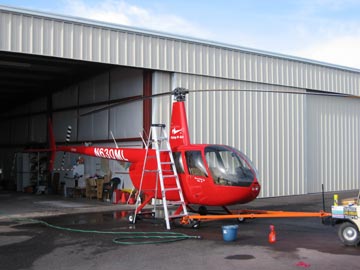
Over the past two years, I’ve developed a technique for washing the helicopter. I start by pulling it all the way out of my hangar so it’s parked in front, on its ground handling equipment. I get a bucket of warm (or hot) water from the airport terminal (I don’t have hot water in my hangar) and add some car wash liquid detergent. I like Rain Dance, but I had some other “spot-free” stuff that I used today. I make it all sudsy with the hose. Then, after making sure all the doors and vents are closed, I get down to business.

The first task is spraying down the tail section, from the end of the main part of the body to the tail rotor. I use a spray nozzle on a hose. Power washers are not allowed and some people think you shouldn’t use a hose spray nozzle either. My response: how are you supposed to rinse it off?

Once it’s wet, I start at the very end and work my way forward with a car wash sponge and the warm soapy water. It’s the kind of sponge that’s spongy on one side and a bit rougher on the other. I use the rough end on the leading edges of the horizontal and vertical stabilizers and the tail rotor blades to remove the dead bugs that have accumulated there. They usually come right off with a little elbow grease. I need to climb a ladder to get the top of the vertical stablizer. I use an 8-foot ladder that I keep in my hangar for preflighting the main rotor hub. While I’m doing this, I’m checking all the screws and rivets and the tail rotor’s pitch change links, looking for weird stuff that I might miss on a preflight.

Then I rinse where I washed and rewet the forward part of the tail cone. I do a lot of rinsing. Unfortunately, unless I wash the helicopter an hour or two before sunset, I have to wash it in the sun. The Arizona sun likes to dry things very quickly. That’s not a good thing, because the water has a lot of minerals in it and it tends to spot when it dries, no matter what kind of car wash detergent you’re using. So I keep it wet until I can get it out of the sun.

I continue washing and rinsing and checking screws and rivets, moving forward on either side of the tailcone until it’s all done. I make sure I wash off the strobe light and antennas back there, too. Then I move the helicopter back into the hangar a bit so the part I just washed and rinsed numerous times is now in the shade and the rest of the helicopter is still outside.

Now I’m up to what I call the R44 butt. It’s a panel that covers the rear end of the fan scroll at the back of the engine compartment. It gets coated with a white, kind of greasy film. Car wash soap cannot remove it. So I get out what I call R44 Butt Cleaner. It comes in an orange spray bottle. I spray it all over that panel, as well as at the bottom of the tailcone near it, which also gets that nasty film. I spray so everything’s coated. Then I get out a shop rag and wipe the film right off. This stuff works great and I’m thinking of repackaging it and selling it to R44 owners as a specialized R44 product at three times what I paid for it.

Although the panel is all shiny when I’m done, that’s not good enough. I want to wash off every trace of whatever that junk is. So I spray it down and continue with my wash, rinse, wash, rinse routine.

Next are the skid pants. That’s not what they’re really called, but it’s what I call them. The skids are the long black things that make contact with the ground when the helicopter isn’t flying. There are four legs that attach the rest of the helicopter to the two skids. Each leg has an aluminum fairing. That’s what I call skid pants. Their front, rounded sides get full of dried bugs, which I usually scrub off with warm soapy water and the rough side of the sponge. Today I used bug and tar remover with a brush.

I do the back end of the body next, along with the back windows. They’re “bubble” windows that kind of bulge out so passengers can stick their heads out a bit and look in all directions. I use the soft side of the sponge; they don’t usually get very dirty.

Washing a HelicopterNext is the mast, which has a cowling over it. The front, rounded side of the cowling is completely covered with baked on, squished on bugs. It’s bad, mostly because it’s so darn high off the ground that I need a ladder to clean it so I only clean it when I wash the whole helicopter. I used bug and tar remover with a brush on it today. Not a good solution, but it did work. I have to move the ladder and climb up either side of the helicopter to wash it all properly. Then it’s rinse, rinse, rinse and move the whole thing back a bit more into the hangar.

The front bubble comes next. It’s usually pretty clean — after all, it is the window I look through when I fly, so I wash it before just about every flight. The area under it — including the painted area around the landing lights — is another story. The bugs are really stuck there. On a whim, I decided to try the R44 Butt Cleaner. Would you believe it worked? No scrubbing required, either. Of course, I still had to wash that junk off, so I did double duty. But it is the cleanest it’s been in a while.

After a good rinse, I move the whole helicopter back into the hangar and begin the drying cycle. I use towels. I have a bunch of towels that are pink because I consistently wash them with red shop rags. They’re my helicopter and car wash towels. I use them to dry the whole helicopter, from the bubble back. The tailcone is usually just about dry by the time I get back there, but I dry it with a wet towel anyway, just to prevent the spots from setting in.

No, I don’t wash the main rotor blades. They’re drooping about 11-1/2 feet off the ground and are very difficult to reach to wash properly. I’d have to climb to the second to the last step on the ladder, which I’d have to reposition four times for each blade. It’s a ton of work and I get very wet, with soapy water running down my arms as I reach up. And I simply can’t deal with the ladder thing.

It’s kind of funny, because I had a perfect technique for washing the blades on my old R22. Those blades weren’t nearly as high up. I’d drive to the airport in Mike’s pickup truck and back it up, perpendicular to the helicopter, aligned with the mast. Then I’d turn the blades so one of them was lined up right over the bed of the pickup. I’d climb up in the bed of the pickup with my bucket and sponge and wash the blade, top and bottom, scraping all the dead bugs off the leading edge. Then I’d climb down, spray the blade to rinse it, and rotate the blades a half turn so the other blade was over the bed of the truck and repeat the process. Another wash and rinse cycle and I was done. One time, I even waxed them.

Unfortunately, the R44 blades are so high off the ground that I’d need a ladder inside the bed of the pickup to use the same method. And that’s not something I’m ready to do. So they go unwashed until their 100 hour or annual inspection. The guys who do the maintenance wash and detail the whole helicopter for me, including the blades.

The was job takes a good hour. It goes faster with help — one person can rinse while the other washes and it gets done very quickly. Then it’s usually still wet when we dry it off.

If I have time and it isn’t too hot, I use some spray wax to finish it off. It’s sold as RV cleaner/wax and it does a nice job, as long as you use it in the shade. It dries too quickly in the sun. I don’t usually do the whole helicopter. It takes too long. Instead, I start with the painted surfaces in the front and work my way back. I usually run out of steam before I get to the tailcone.

I didn’t wax it today. I ran out of time and had to get it out on the ramp for a flight. It sure looked good out in the sun, all clean and shiny.

Although I don’t like to wash the helicopter — primarily because it’s so much work and I always wind up getting dirty and wet — I’m glad I do it. It gives me an opportunity to look over the entire ship closely. I once found a loose screw on the mast cowling and have never forgotten it. Now I check every screw, every rivet. There hasn’t been a loose screw since, but if there is, I’ll find it.