The Dan Brown Code

More on Dan Brown.

Slate’s recent article, “The Dan Brown Code – In a court filing, the best-selling author of The Da Vinci Code reveals all the secrets of a pulp novelist,” by Bryan Curtis, offers some interesting insight into the mind of a failed songwriter turned bestselling author. It also makes for some amusing reading.

Also from Slate, Tim Wu’s “Holy Grail Wars” echoes many of the concerns I blogged earlier about the plagiarism lawsuit. If you don’t have time to read or listen to it, here’s the crux of it for me:

The authors of Holy Grail chose to make claims to truth—and while that gives their book a certain rhetorical power, it should also mean their work loses much legal protection. When copyright starts saying you can’t borrow claims to truth, it stops helping and starts hurting all authors.

Let’s start at the beginning. One of the basic principles of copyright law is that you can’t copyright historical facts, though you can own how you express those facts. Say you write the first article ever saying that John F. Kennedy had Addison’s disease (a fact). If the law says that you now own that fact, almost anyone who wants to write about Kennedy’s life or illnesses needs your permission. That’s a broad right, one that’s not just a damper on future scholarship and authorship but possibly a damper on that fact itself—you might, for example, be a Kennedy loyalist who wants to keep his disease secret forever.

It also appears, from the article, that the British courts have a different take on the copyright issue than American courts. Evidently, borrowing ideas from material presented as fact is okay unless you borrow too many of those ideas. What?

Just Say No…

…to taking kids on helicopter rides over one hour long.

Why? It’s simple. They puke.

It happened on Wednesday, during our Wickenburg to Meteor Crater to Grand Canyon flight. Christopher just couldn’t listen to Dad and take dramamine. By the time he did, it was too late. No barf bags handy, so he puked into my insulated lunch bag. But what’s worse is that he forgot to move his mike boom out of the way. Not only did he get kid puke all over the foam cover for my $1,000 Bose headset, but we had to listen to him puke as we flew.

And, of course, I had to get kid puke on my hand when I removed the foamy thing to wash it. And I had to wash it, too, so his sister, who sat in front on the way back, wouldn’t have brother puke near her mouth.

(One of the reasons I don’t have kids is because I never wanted to clean up kid puke.)

It happened again today. Paul did take the motion sickness pills in advance. But it wasn’t enough to stop him. Fortunately, I had a barf bag handy. His sister opened it up and handed it to him. He moved the mike boom. (I did remind him about six times, so he wasn’t likely to forget.)

I opened the vent to let in fresh air. Paul got cold. I closed it. His sisters begged me to open it back up. I smelled it, too. Paul got and stayed cold.

At least he got it all in the bag.

In both cases, we’d been airborne for more than an hour. I think it was the first two times time I’d had a kid on board so long. And a puker each time. That’s not a coincidence. It’s a trend.

So no kids on flights lasting longer than an hour.

The rule has been made and will not be broken.

Swansea Here We Come!

I finally get my BLM permit for Swansea.

Miners houses at Swansea Town SiteIn December 2004, I applied for a permit to conduct helicopter tours to Swansea Town Site. Swansea is a ghost town in a remote area of the Arizona desert, west of Alamo Lake, south of the Bill Williams River, north of Bouse, and east of Parker. I takes about 3 hours to get there by car — well, by Jeep, since a car can’t make it on the sometimes sandy, sometimes rocky dirt roads — and about 40 minutes to get there by helicopter. The idea was to take day trippers out to the town site, let them walk around with a BLM self-guided walking tour brochure, give them some refreshments when they’re done, and fly them back to Wickenburg. The trip would cost $495 for up to three passengers.

Miners houses at Swansea Town SiteYou might be asking why I need a permit to use public land. BLM, in case you’re not aware, stands for Bureau of Land Management. It’s a part of the Department of the Interior. Of the Federal Government. These are government managed lands that belong to the people. And the people can use them, as long as they follow certain rules. Among those rules are that if you want to make money by operating a tour or anything else on BLM lands, you have to get a permit.

I applied for that permit in December. It cost me $80 that was not refundable and there was no guarantee that I’d get the permit. Talk about gambling!

Of course, I didn’t get any response at all to my application. I followed up in January. That’s when I was told they needed more information, like proposed landing zones. So I took my helicopter, which was brand spanking new at the time, and my GPS, and John and Lorna, and flew out to Swansea. I landed on my preferred landing zone, which was near the middle of town, and walked around taking GPS readings of the places that would work as landing zones. I came up with about seven of them. I also took photos. One photo showed my preferred landing zone, which just happened to have my helicopter in it.

When I got back to my office, I fed the GPS coordinates into my mapping software to produce a topo map with the coordinates on it. I then numbered them in order of preference. I took the photos from the flight, stuck it in an envelope with a cover letter and the map, and sent it to BLM in Lake Havasu.

A few days later I got a message on my voicemail from BLM scolding me for landing at Swansea. It was my understanding that as a private citizen on personal recreation (not for hire), I was allowed to land on BLM land, as long as it wasn’t wilderness area or my landing would cause damage (common sense stuff). So I wrote a letter back to them. They replied grudgingly, in writing, that I was right. It’s one of those letters you keep, if you know what I mean.

Next, they told me they’d have to do an environmental impact study. This irked me for two reasons:

  • The majority of people who come to Swansea do so on ATVs and some of them have no qualms about tearing up the desert with their fat little tires. They don’t care about archeological sites or desert tortoises. Irresponsible. Yet when I land, my vehicle touches the ground in precisely two long places — where my skids touch down — and I don’t damage a thing.
  • This environmental impact study, which I thought was a waste of time and money, would be done with taxpayer dollars. I’m a taxpayer. And it made me wonder how much other wasteful spending BLM did.

But you can’t fight them. You really can’t. So although I voiced my protest and even wrote to my senators and congressmen, I had no choice but to wait.

In actuality, what I did was write off the $80 as a bad investment and swear I’d never send another dime to BLM.

Time passed. The guy who was working my case retired. I really didn’t expect to ever hear from BLM again.

Then, in December, my cell phone rang while I was at the airport putting away the helicopter after a flight. It was a new person from BLM. He introduced himself and said he was working on my application.

“Bad news?” I asked, figuring he was calling to say that it had been turned down.

“Well, no,” he replied, sounding a bit surprised. “At least I don’t think so. We’re almost done with the application and it looks like it will be approved.”

I tried not to sound shocked. He went on to tell me that he’d need BLM listed on my insurance policy as an additional named insured (no problem). We then had a very pleasant conversation about Swansea and what a great place it was. He was very friendly and knowledgeable and a real pleasure to talk to. I wrote his name and phone number down so I could follow up.

Of course, I lost that information. (if you saw my desk, you’d know why.)

Months passed. Then on Thursday of last week, my BLM man called again. He wanted to put the permit in the mail, but needed the insurance. No problem, I assured him. I’d fax it over. He gave me his name and fax number. (Can you believe I lost them again?) Today, I called the office, got the information I needed, and faxed over the insurance. And when I got home from work the permit was in my mailbox.

I still can’t believe it.

Now I know my original contact had warned me that the process could take as much as six months. Well, he really said 180 days. But maybe he meant 16 months? Or 480 days? Because that’s how long it took. The government doesn’t exactly move quickly. (Look at New Orleans after Hurricane Katrina.)

The permit is a simple piece of paper. The letter that came with it has some restrictions that are easy to live with. Only 3 allowed landing zones — none of which is my preferred, but one of which is very good. A maximum visit of 2 hours — as if there will be someone there with a stopwatch to time us. No overnight camping. No more than four people total — that’s all that my helicopter can seat anyway, so it would be impossible to bring more.

My contact told me he needs to chat with me before I start using the permit. i’ll call him on Thursday.

In the meantime, I’m looking forward to adding the Swansea Ghost Town tour to Flying M Air’s Web site.
Dana’s Last Flight

I take a passenger on his last journey.

It all started months ago. Dana had been diagnosed with a brain tumor. He called, wanting to join a flight up the Hassayampa River so he could tell me where he wanted his ashes scattered. Talk about planning ahead.

His friend Joe had gotten a custom half-hour tour for Christmas. Joe and his wife invited Dana to take the third passenger seat in the helicopter for the flight. When they arrived at the airport, I was very surprised. Dana didn’t look good. He was having trouble walking and had become bloated from the treatments he was going through. But he was alert and eager to go on the flight. He sat behind Joe in the left passenger seat. Joe snapped photos for the book he was co-authoring with Dana.

When we got near Seal Peak, Dana pointed it out. “I want to be scattered on the side closer to the Hassayampa River,” he told us. “So my ashes get washed into the river.”

I assured him I’d make sure it was done to his request. He wanted to know how much it would cost and did some math. He said he’d have the money set aside in his estate.

Oddly enough, I didn’t feel uncomfortable about it at all. I felt kind of good. I was getting final instructions — emphasis on “final” — from a customer. There would be no guessing as to whether the place we’d drop his remains was right. I knew it would be right.

Dana got a little better, then took a turn for the worse. His caregiver called me one day. She told me he talked all the time about his helicopter flight. She said she wanted to take him for another one. We talked about money. I could tell my regular prices were a bit beyond her means. But Dana was a lifelong Wickenburg resident, one of the folks who had helped shaped the town. There was a street named after his father and a flat named after his mother. The town claimed they’d be naming one of the peaks near his home after him. Surely I could contribute something to his last days.

His two caregivers brought him to the airport at the appointed time. He didn’t look good at all. His caregiver had to practically lift him into the helicopter. But he sat up tall and seemed alert, even though he didn’t talk much. His two caregivers climbed into the back seats — it costs the same to fly one passenger as three.

A while later, we were airborne, back toward Seal Peak. He wanted to be sure that I knew where to scatter him and that he’d have enough money set aside to pay for it. From there, we flew up the Hassayampa. I asked him where the old dam had been, the one that had washed away in the 1880s and killed all those Chinese workers. He pointed it out. He also pointed out the place downstream where some of the dirt from the dam had washed up. I took him southeast, past the Sheep Mountain house. They all enjoyed the views of the lake. Then west, over Santa Domingo Wash, across Grand Avenue, and around Vulture Peak. We were flying past Rancho de los Caballeros on our way to the airport when the low fuel light flickered. Time to land.

We’d been out longer than I’d planned. But it was worth it. Dana really enjoyed the flight. And his two caregivers, who probably needed the break, enjoyed it, too.

Dana passed away about a week and a half ago. One of his caregivers called to give me the news. She also dropped off one of Dana and Joe’s books at the airport for me. It was about Constellation Road and it had a few of the pictures Joe had taken during that first flight.

There was a big write-up in the paper about Dana. I didn’t see it because I don’t read the local paper.

Joe called later in the week. We made arrangements for Friday. Dana’s brother and sister would be joining him. I explained how the ash scattering worked: we’d wrap Dana’s remains in tissue paper and toss it out over the designated scattering area.

Joe, John, and Sophie came in two cars. They were surprisingly cheerful. We went into the airport’s back room to prepare Dana’s ashes in their tissue paper wrapper. I used two sheets — I didn’t want any parts of Dana slipping out during the flight.

We took a little scenic flight over town and past Dana’s house. Then we headed toward Seal Peak. I started to climb. I wanted to be at least 700 feet over the peak so the ash package would open and scatter.

My passengers pointed out places of interest along the way. They were enjoying the flight.

I circled the peak. The wind was blowing hard from the southwest. Joe saw the spot he wanted to aim for, but when he dropped the package, the wind took it toward the river. He saw a puff of dust — a puff of Dana, in fact — before the paper disappeared from view. We headed back to the airport along Constellation Road, making a short detour to try to figure out which peak the town was naming after Dana.

On the ground, Dana’s brother asked what he owed me. I knew Dana had set aside some money for the flight. I told him that it was my honor to take Dana on his last ride. I told them that the three of them should go out and have a nice lunch on Dana and me.

When they invited me to join them, I had to turn them down. Too much writing work to do. But maybe another time.

Sedona Sky Ranch

One of Sedona’s little secrets.

When we have out-of-town guests, we sometimes take them to the usual tourist spots in Arizona. (I can’t tell you how many times I’ve taken people to the South Rim of the Grand Canyon.) This past week, Mike’s mother has been in town. And over the weekend, we took her to Sedona for an overnight stay.

Sedona is a beautiful place. It has also become a bit of a tourist trap. “Uptown” Sedona is full off gift shops and counters for booking tours. Its sidewalks are roamed by people trying to get you to come see their timeshare opportunities. (I never could understand the attraction of timeshares.) If you’re looking for a t-shirt or a piece of Indian jewelry or some junky souvenir of red rock country, this is the place to come.

Uptown Sedona is right at the mouth of Oak Creek Canyon, a beautiful spot with a year-round creek, shady trees, and towering cliffs. A drive up through the canyon is the nicest way to reach Flagstaff, especially in the fall when the leaves on the trees along the creek are changing color.

So right before you reach the beauty of Oak Creek Canyon, you have to drive through the most touristy cluster of shops in Arizona. The same shops that block the views of some of the incredible red rocks that people have supposedly come to Sedona to see.

To be fair, Sedona’s local government has enacted certain zoning laws that require new construction to blend in with the environment. That’s why you’ll see a lot of reddish buildings. It’s also one of the few places I’ve seen dozens of homes painted a dark sage green–to match the scrubby desert pine trees that grow in the area. Unfortunately, those laws were not passed before Uptown Sedona was developed, so most of that area is pretty ugly.

We planned to spend the night in Sedona and needed a place to stay. We wanted to stay at a nice place–the last time we’d taken his mother on a trip in Arizona, we’d stayed at a weird place down near Tubac that had been built on top of an old missle silo. (I can’t make this stuff up.) Mike surfed the Web and came up with a place that included the word “Spa” in its name. The pictures looked good, but it was supposedly in West Sedona. I was worried that it would be too far away from the things his mom wanted to see–primarily shops–or tucked away in some back corner without any views. So I suggested a place where I knew there were good views: Sedona Sky Ranch.

Sedona Sky Ranch is Sedona’s airport motel. And that’s why so few people consider it as a place to stay. I consider it one of Sedona’s little secrets.

Sedona Airport is on a mesa just south of town. For those of you who didn’t pay attention during geology lessons in school, a mesa is a flat-topped mountain. There are a lot of them in Arizona and the rest of the southwest. Sedona’s airport sits on one of them. (The St. George, UT and Bagdad, AZ airports also sit on mesas.) It’s kind of neat because as you approach the runway in a plane, it’s a lot like landing on an aircraft carrier.

Sedona Sky Ranch is on the northwest side of the mesa, walking distance from the airport’s little terminal. It sits on the edge of the mesa and has about a dozen rooms that look right out over the town. And the red rocks beyond it.

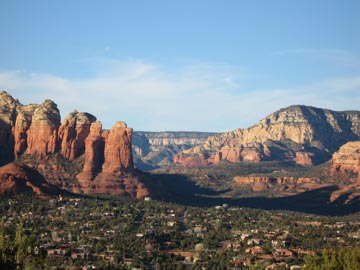
View from Sedona Sky RanchWe’d reserved two Red Rock View rooms for the night. The rooms included 2 queen beds, a deck overlooking the views, and a kitchenette with a small fridge, microwave, and sink. And a bathroom, of course. Not what I’d call luxurious, but certainly very comfortable. And the views! At about 500 feet above the town, we didn’t have to look at any ugly commercial buildings. Sedona’s famous red rocks were right there. The photo here shows the view from our deck. The rock formation in the left center is called the Coffee Pot. (Think percolator.)

Mike and I shared a bottle of wine on the deck while the sun dropped down on the horizon, making the red rocks even redder. (Mike’s mom watched television in her room.) In the overlook parking area, which was a few hundred yards away, a native American musician played the drum and flute while tourists looked on. The sun set, the flute stopped abruptly, and the tourists got into their cars to go down to their hotels far below us. The full moon rose above the buttes in the east.

The next morning, when we checked out, we made reservations for October. We chose the cabin next door, which is slightly larger that our room, has a larger deck, and a slightly better view. We’ll drive up in the Jeep with Jack the Dog (they allow pets) and spend a few days exploring the back roads of the area while the autumn leaf show is in progress.

It’ll be a nice escape.

Oh, and that “spa” Mike found online? It was on the main road in West Sedona, right next to the Safeway shopping center. How’s that for atmosphere?