Denali

A National Park with a difference.

The second part of our Alaska vacation was a trip to Denali National Park, some 240 miles north of Anchorage. Denali is known primarily as home of Mount McKinley, the tallest mountain in North America, which measures 20,320 feet tall. McKinley (named Denali by the native people) is usually hiding in the clouds, so it’s not often seen by tourists. The park, however, offers many opportunities for seeing wildlife, including grizzly bears, Dall sheep, and caribou.

We took the train from Anchorage to Denali. Although the Alaska Railroad runs perfectly good train cars daily, we upgraded to the McKinley Explorer deluxe dome cars. Each passenger is given an assigned seat on the second floor of the train car, with excellent views in all directions. At mealtime, passengers come down in groups to eat on the first floor of the train car, which is set up as a dining car with waiter service.

Alaska RailroadMike and I soon realized that the best place on the train — weather permitting — was the open area between the train cars. There was generally enough space for two people on each side (right and left) of each car at each end. This place was perfect for shooting photos of the train as it wound around the track or for some of the scenic views we passed.

View from the TrainMike and I had very high expectations about the train ride, primarily because everyone kept telling us how great it was. As a result, we were disappointed. Don’t get me wrong — it’s a really great trip and one you should not pass up if given the opportunity. But it is about seven hours long (each way). Although there are plenty of incredible views, there are also a lot of boring stretches when there’s nothing but trees on both sides of the train. A one-way trip is enough. I wished we’d either flown or driven a rental car one way and taken the train the other way. Fourteen hours on a train (in the span of 3 days) was a bit much for me.

Mt. McKinleyWe did luck out as far as seeing Mount McKinley goes. At one point in the track, the train guide pointed it out in the distance. I managed to snap a few photos. The mountain wasn’t completely visible — there were plenty of white clouds masking various parts of it — but its summit rose up through it all. Magnificent.

On arrival and after settling in at our hotel, we made our way to the Wilderness Access Center for information about the park. That’s when we realized that Denali was very different from all the other National Parks we’d visited over the years. Access was heavily restricted — if you came by car, you could only drive in about 15 miles. To go farther, you’d need a special permit or to be a passenger on a tour bus. That pretty much forced us to do the tour bus thing, despite the fact that we normally like to strike out on our own.

Dall SheepWe signed up (and paid up) for a shuttle to Fish Creek. My understanding of the shuttle was that you could ride it as far as Fish Creek, but get off at any point, hike around for a while, and board another shuttle going in either direction. The reality was that the “shuttle” was a basic tour bus with a driver who stopped for wildlife spottings and took well over 4 hours to go 60 miles. The round trip was supposed to take 8 hours. For us, that’s a lot of time to be stuck on a tour bus.

Grizzly BearWe took the 7:30 AM shuttle all the way to Fish Creek, where the driver turned the bus around. Along the way, we spotted some Dall sheep, a grizzly bear, and three caribou (all at one place), along with some other sheep, bears, and caribou. The highlight was spotting a mama grizzly with two cubs. I got some excellent photos of them.

SquirrelWe got off at a McKinley viewpoint on the way back. Mike and I spent about 30 minutes just sitting on the ground, looking toward McKinley. Clouds completely obscured its top. We waited for them to clear, but they never did. I did get a few shots of a squirrel that was obviously far more friendly that it should have been. This is common in National Parks. People feed the wildlife and the wildlife becomes almost tame. The only problems with this is (1) tourists aren’t around all the time, so animals used to being fed don’t eat much off-season and (2) people food (like Cheetos and ham sandwiches) aren’t very good for them. The National Park Service at the Grand Canyon actually has to kill mule deer who scavenge in garbage pails during the winter, eat plastic bags, and get very sick.

Denali ViewWe hiked along the road for about a mile, then flagged down a bus and rode to the next stop. We passed by the mama bear and babies again. We rode along to a rest stop, then got off and hiked a while more. The problem with Denali is that there aren’t any many hiking trails. If you want to hike, you either have to bushwack through the tundra and run the risk of running into a bear or walk along the road, where you can flag down a bus. The road is not paved, so every time a vehicle goes past, the dust gets kicked up. It isn’t terribly pleasant. But the views are great and it’s wonderful to stumble upon some sheep high on a hill or some caribou drinking in a glacial runoff stream without a bus driver having to point it out to you.

CaribouWe learned too late that there’s lodging deep inside the park. If we go back, that’s where we’ll stay. Then we can do short hikes from our room or longer hikes with outfitters based there. That’s probably the best option for us, since we really prefer to avoid the tour bus crowd.

A nice park. My only regret (other than accommodations) is that we didn’t have more time to spend there.

Keeping Busy on the Left Coast

Where I’ve been for the past few days.

On Sunday, May 20, Mike and I climbed aboard Zero-Mike-Lima for a flight to the Los Angeles area. (It was a relatively uneventful flight and, if I find time, I will bore you with the details in another blog post.) We landed at Torrance Airport, where we had business to do, and took a cab to LAX, where we rented a car for the week. Zero-Mike-Lima is sitting at the ramp in Torrance, right in front of the Robinson Helicopter factory, waiting for our flight back to Wickenburg on Sunday.

We came out here primarily to take the Robinson Factory Safety Course, a 3-1/2 day course designed to educate helicopter pilots about how accidents occur — and how they can be prevented. This was my third time at the course and Mike’s first. I’ll probably be writing more about it in another blog post because I really think it’s worth covering in some detail.

We’ve been on the go almost since arriving in the area. In fact, other than sleep at night, the only rest we had was right after checking into our hotel in Torrance on Sunday.

On Sunday night, we went down to the Redondo Beach pier for a seafood dinner.

Monday, we were in class from 8 AM to 4 PM. Then we zipped into Los Angeles for a walk around the Farmer’s Market and Grove shopping center.

Tuesday, class from 8 AM to 4 PM. Then, after a quick walk around a mall to pick up a few things, we headed back into Los Angeles for dinner and some shows at The Magic Castle with my friend (and fellow author) Deb Shadowitz. We got in to our hotel at 1 AM.

Wednesday, class from 8 AM to 4 PM. Then we hopped in the car and headed south along the coast, ending up in San Clemente for a visit with our friend (and fellow helicopter pilot) Jim Wurth.

Thursday, class from 8 AM to 11 AM. Then, after a quick trip to the Verizon Wireless store for some bad news, we headed back to the Robinson factory for lunch and to wait for Mike’s flight. (Mine was on Tuesday, during class.) Then it was back in the car for a drive up the coast, with a quick stop in Venice, to our new hotel in Malibu.

As you can see, we’ve been pretty much on the go since Sunday morning. Actually, it’s been since Saturday morning, when we gave helicopter rides at Yarnell Daze.

So I haven’t had any time to write in my blog.

imageIt’s Friday morning and, as usual, I was up at about 5:30 AM. Our hotel is weird. It was probably an old hotel that was recently gutted and renovated. Our room has nice (fake) hardwood floors, clean white walls, and a king-sized bed. But not much else. Really. There’s no dresser, no chairs (other than on the little balcony), no table, no sofa. There are two night tables and one lamp. No clock. The TV is a 17 or 19 inch flat screen, mounted on the wall. There’s a 3 cubic foot refrigerator and a wire clothes rack on wheels as a closet. The place is trying to be “trendy minimalistic,” and although the effect is pleasant, it isn’t comfortable. We have views of the ocean from our windows, but no access to the beach. And the two lanes (in each direction) of the Pacific Coast Highway run right past the place. Cars, trucks, and motorcycles drive by throughout the day and night.
There’s Internet access via an unsecured network named “default,” but to get connected, you have to stand in a certain place in the room with your computer on the windowsill. I’ll probably use that to publish this entry.

This is the part of the trip I’ve been looking forward to: the part where Mike promised we’d just “take it easy.” We both expected this place to be on the ocean with access to the beach, so we’re very disappointed (to say the least). We’ll probably find another place later today. In my mind, “take it easy” means to relax in a comfortable place, read, write, or just chat. It doesn’t mean hopping in the car and driving all over the place. I know he’s not going to want to hang out here. I probably won’t either. So I’m not sure when I’ll find time to write again.

Stay tuned. More to come.

[composed in a hotel room in Malibu, CA with ecto]

Clean Up Patrol

I clear out my old office.

I”ve owned a condo in Wickenburg for the past eight or so years. It was the first non-stock investment I made when I started making decent money. I figured that real estate is always a good investment, and it would be nice to have a property that someone else paid for. So I bought the condo — which had been previously occupied by a single renter for 11 years — and put it up for rent.

The condo isn’t anything special. It’s two bedrooms, one bath, with a kitchen that’s separated from the living room by a breakfast bar. Total square feet is about 900. The big living room window faces out to the parking lot, a park where there are ball fields and the town pool, and the mountains. The bedroom windows face out on another parking lot and route 93, which is the main thoroughfare between Phoenix and Las Vegas for cars and trucks. The condo property includes a well-maintained swimming pool, a not-so-well-maintained spa, and mailboxes. (A big deal in a town that’s only had mail delivery for about 15 years. The place is a short walk to a supermarket and other shopping and is well within walking distance to two schools.

I put it up for rent within a month of closing on it and had a tenant within a month. Thus began my long career as a landlord.

Being a Landlord Sucks

Being a landlord is not a job for the faint of heart. Although most tenants show at least some level of responsibility, there are always a few in the crowd who will treat your property like it belongs to their worse enemy. Some tenants go out of their way to find things to complain about — one family complained so many times about how the shower door didn’t roll properly that Mike and I went to the apartment, removed the shower door, and replaced it with a curtain. (Let’s see you have problems with that.) And did I mention that the average tenant isn’t interested in living in the same place for 11 years? I witnessed a parade of four tenants in less than five years, with lots of cleaning and painting and empty unit time between them. Anyone who thinks being a landlord manager is an easy way to make a living is fooling himself. It’s a pain in the ass.

To make matters worse, I had another good year and bought another property. That one was a 3-lot parcel with a 4-unit studio apartment building and two bedroom, two bath house on it. What the hell was I thinking? I multiplied my single unit landlord headaches by five. Now there was always an empty unit somewhere, a unit to clean, a tenant complaint to deal with, an apartment to advertise and show.

I won’t go into the gory details. I’ll just say that after trying a rental agent (who took a fully-occupied property and had it down to just one tenant in four months) and letting Mike manage the place for a short while, I got smart and sold the larger of the two properties, leaving me with the condo.

In the meantime, the condo’s last tenants, a young married couple with a baby, terminated their lease early and disappeared. But not before they completely trashed the carpet, doing what would turn out to be $1,600 in damage.

I’d had enough. I was sick of being a landlord. I decided to take the apartment off the market and move my office into it.

An Office in Town

Having an office outside my home for the first time in about 12 years was a treat. My work wasn’t in my face all the time. I didn’t drift from the kitchen to my office and get caught up reading e-mail or working through edits. I went to work in the morning, worked until I felt done for the day, and went home to a life. Mike, who was working from home at the time, did the same. I took the condo’s living room, so I could look out over the mountains, and Mike took the larger of the two bedrooms. The place had everything we needed to be comfortable — full kitchen with dishwasher, bathroom, and access to high-speed Internet. (For about a year, MIke had wireless access that we think he picked up from the local Radio Shack. Ah, the days of unsecured wireless networks.)

The really good part about all this is that we reclaimed both of the bedrooms we’d been using as offices at home. Mike’s old office became the full-time guest room, with all the furniture you’d expect to find in a bedroom. My old office became the “library,” with all of our non-work related books, a desk, framed maps, and a futon for overflow guests. We usually kept the guest room closed off in the summer and winter so we didn’t have to air condition or heat it.

Of course, there were some drawbacks to the office situation. First of all, my office was about 6 miles away, which meant that if I needed something there, I was taking a drive. I had everything there except my 12″ PowerBook, so I dealt with all work-related matters there. For a while, we didn’t even have Internet access at home, since we didn’t “need” it. (It didn’t take long for that to change.)

But the worst part of the situation was when I got calls in the middle of the day for a helicopter flight. The airport is on the opposite end of town. So if I got a call for a flight that day, I’d have to pretty much drop everything I was doing, lock up the office, hop in my vehicle, drive home to put on some more appropriate clothing, and drive to the airport to preflight the helicopter and pull it out. That took a minimum of an hour. When the flight was over, I’d do the same thing in reverse. By the time I got back to my office, my concentration was gone and I wasn’t usually able to get back to writing. Sometimes, the whole day would be shot to hell for a 25-minute tour around Wickenburg that put just $195 in the bank — that’s gross, not net.

When space opened up at the airport for an office, I tried to get it. The Town of Wickenburg’s Airport Manager jerked me around to no end. (If you think coming to Wickenburg to start a business is easy, think again. It seems that the town management isn’t happy unless they present at least a dozen hoops for a new business owner to jump through. The smart ones take their plans elsewhere. I’ve spoken to three different people who were interested in bringing medium sized businesses to Wickenburg, and all three said they’d built their businesses elsewhere after dealing with the town.) It took over a year, intervention from the FAA, an RFP process, and the threat of a discrimination case to get a contract. Now I’m wondering whether I want the Town of Wickenburg for a landlord. Like the smart folks who give up when they see the hoops, I don’t think I do.

So I moved my office back home.

There’s No Place Like Home

The move wasn’t easy, but we were smart enough to do it in the winter months, when it was comfortably cool during the day. We gave away a lot of furniture so we could fit my desk and the things I needed back in the library. All the books went back upstairs, into some built-in shelves, so my work books — including the ones I’ve written — could go in my office. Mike, who now has much less need for space, took the library’s desk upstairs and set that up by one of the big windows with the good views. We put his old desk in my hangar, so I had more space there to do my FAA-required paperwork. (My old desk there had gone up to Howard Mesa months before.)

So now I live with my work again and, frankly, I don’t mind one bit.

I had a book to write, so I got right down to work before everything in the condo had been moved. It I was more ambitious about it, I would have cleared the place out right away, had it thoroughly cleaned, and put it back up for rent. But I dreaded the thought of dealing with all the accumulated paper — including boxes I’d packed in our first Wickenburg home (an apartment on Palm Drive) and ones I’d packed back in New Jersey ten years ago. So I just moved everything aside to give the carpet folks room to lay the new carpet, turned the heat pump off, and locked the place up.

Now I’m Cleaning Up

Months passed. And I finally did something radical to get me to clean up: I hired a professional cleaner. And I told her to come next Wednesday, when I’ll be away in California.

Of course, I don’t expect her to go through all my crap and box it up for my office or storage. That’s something only I can do.

I put it off as long as I could. Yesterday, I had a dawn photo flight here in Wickenburg and a lunch meeting with one of the companies I advertise with. A good day to work on my old office, I reasoned. Lunch would make a good mid-day break. I’d put in 6 hours or so and be done.

Wrong! Although lunch was a good break, I didn’t come close to finishing. I worked in the condo from about 8:30 AM to 11 AM, did some errands, went for lunch, and got back to work at 1 PM. Then I spent the next 3-1/2 hours going at it.

I threw away 7 tall kitchen bags — you know, the 13-gallon size? — full of junk, including stuff I’d saved for more than 15 years. I got rid of all the Apple promotional and developer disks I’d accumulated from 1992 through 2001. I got rid of old software and manuals. I got rid of magazines — about 40 issues of MacAddict that were still in their original wrappers. I got rid of loose receipts, bills, and bank statements. I was ruthless. My hands got filthy — I washed them at least once an hour. My feet got sore from walking barefoot on the cheap carpet I’d had installed in the place.

I filled six file boxes with stuff I wanted to keep. I made piles of stuff to give away — some stuff for the cleaner, miscellaneous paper items for my neighbor’s kids to do crafts, photo and negative holders for a photographer friend, empty CD-cases for the local print shop guy (who also uses Macs).

Later, at 4:15 PM, when Mike rolled up to help me take some of the boxes out, I was exhausted. We loaded most of the boxes into my Jeep and his car, dropped some of them off in storage, and brought the rest home.

But I’m not done.

I’m mostly done. I don’t think I’ll need more than another 4 or so hours. And frankly, I might take the lazy way out and just box up the stuff and stick it in storage without sorting through it. It’s a terrible, nasty job, but there’s only me to blame for it. I just keep too much crap.

So today, after getting a haircut at 8:30 AM, I’ll go back to work in the condo. I’ll get all the loose stuff gathered together, throw away some more junk, and stack up the boxes to go into storage.

Hell, at least I can turn on the air conditioner.

Aircraft User Fees

And why general aviation pilots and businesses should be fighting back.

There’s been a lot of talk — and fighting against — the Bush Administration’s “Next Generation Air Transportation System Financing Reform Act of 2007.” I’ll be the first to admit that I don’t have all the details. But here are a few things that seem pretty clear to me.

Higher Fees Hurt Business

The User Fee system proposed by the Bush Administration may severely cut the activities of general aviation pilots. According to AOPA President Phil Boyer, “Nine out of 10 AOPA members have told us that this would reduce, curtail, or end their flying.” What’s that going to do for the aviation industry? As current pilots who can no longer afford to fly regularly sell off their aircraft, the used aircraft market becomes flooded. Fewer people will be buying new aircraft, so manufacturers will suffer. Suppliers to those manufacturers will suffer, as will employees all around.

As costs increase for general aviation businesses like flight schools, charter services, and tour outfits, those costs get passed along to consumers. That drives prices up, possibly making these services too costly for the marketplace. There are fewer customers. Businesses fail. This continues the cycle of used aircraft sales and unemployment.

Proposal Seems to Ask General Aviation Pilots to Bail Out Airlines

Shifting the cost of ATC services from airlines — which are responsible for hundreds of thousands of passenger hours a day — to general aviation is simply unfair. Many of these companies are failing financially because of their top-heavy management organization and unreasonable pay scales. Why is it that some airlines — Southwest comes to mind — are financially fit and offer good service to their customers while other airlines — think United — can’t stay afloat without government funds and pension rule changes? Could it be that some companies are simply managed better than others?

Do you think it would be fair for all people who use banks to pay a certain tax to the government for a fund that’ll bail out mismanaged banks that go under? Like the ones that gave out mortgages to anyone capable of writing their name on a form, no matter what their financial situation was?

Or how about a tax on drivers to be put in a fund to bail out automakers who don’t build the cars we want to buy at a price want to pay?

Or a tax on homeowners living in the desert for a fund that rebuilds oceanfront summer homes destroyed by hurricanes?

Is any of that fair?

Get Involved!

If you think the administration’s proposal is a bad one — or even if you want to learn more — get involved. If you’re an AOPA member, you can sign up to get e-mail notifications of developments, as well as instructions on how you can contact your government representatives to tell them what you think.

You can also go to this page to get more information about the funding debate.

Don’t wait until it’s too late. Act now.

Flying to Sedona (again)

A helicopter flight that has become routine.

As I write this, 36% of the site visitors who have taken the time to vote in my Most Interesting Topics Poll (that’s 11 people so far; I’m hoping for continued growth in that vote count) have said that Flying is the most interesting topic on this site. So I decided to devote this morning’s blog session to a flying article.

(For those of you just tuning in for the first time, among the hats I wear is a commercial helicopter pilot hat. I operate a Single Pilot Part 135 helicopter tour and charter company out of Wickenburg, AZ — Flying M Air.)

I flew yesterday. I flew three passengers from Wickenburg to Sedona and back. The passengers were originally from Russia and now live in the U.K. They’re staying at the Flying E Ranch, one of Wickenburg’s remaining three guest ranches.

I can’t get excited about this flight. It was so routine. After all, by now I must have flown from Wickenburg to Sedona and back at least 50 times.

The only thing unusual about the flight yesterday was visibility. In Arizona, it’s clear and sunny almost every day. Not only can I usually see the Weaver Mountains about 15 miles to the north, but I can usually see them clearly — that means I can distinguish rocks and canyons and other features from 15 miles away. But yesterday was different. It was hazy, as if a thin gauze had been stretched across my eyes. As I drove to the airport at about 10:00, it was apparent why: there was moisture in the air. There was condensation on my Jeep and even a little frost down where the horses were munching their morning meal. Imagine that. Moisture.

My passengers arrived early, all bundled up for the 50°F temperatures we expected in Sedona. After giving them their preflight briefing and loading them on board, I started the helicopter and waited for it to warm up. A few minutes later, we were on our way, climbing to the northeast into hazy skies.

The air was smooth, the sights were the same as usual (except for the haze) and I pointed them out faithfully to my passengers. They didn’t talk much, which is always a danger with me. I wind up talking to fill the silence, telling them more about the area than I usually do. I had three passengers on board, so I had to make sure I pointed out things on both sides of the helicopter — normally, with just two on board, I put them on the same side of the helicopter so I only have to point out things on one side.

We crossed the Weaver Mountains not far from the hidden cabins I’d discovered years before. Then we followed the Hassayampa River up toward Prescott, crossing the Bradshaws. My passengers were thrilled by the sight of snow on the north side of the moutains. I was thrilled by the fact that the haze had cleared out and it was a nice, clear day up there.

As we got close to town, I reported in to the tower at Prescott Airport. I planned to follow Route 69 a bit and then head toward the pass atop Mingus Mountain. This would have me cutting as much as one mile into Prescott’s airspace. (I normally go around it so I don’t have to talk to the tower, but our heavy weight had our airspeed a bit slower than usual and I wanted to save a few minutes of time.) We were over Prescott Valley when the tower pointed out a Baron about 400 feet above us, crossing in front of us. I descended about 500 feet — I was high because of all the mountains I’d have to cross — to stay out of his way. Then the tower cut me loose and I climbed up and over Mingus Mountain, reaching my highest elevation of the flight: about 8,000 feet.

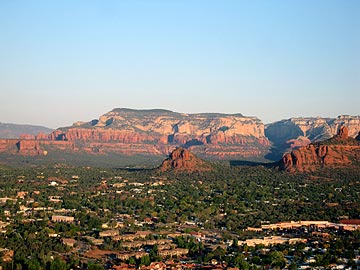
West SedonaFrom there, I started a 1,000 fpm descent to the northwest, descending past the former ghost town of Jerome. I told my passengers about the first time I’d been there nearly 20 years ago when only a handful of people lived there. Now it was a booming tourist town, with art galleries and restaurants in the old buildings perched along its hillside. I showed them the open pit mine, then continued northwest to the red rocks. We did a red rocks tour on the way into Sedona, avoiding the flight path of the helicopter tour operators there, and landed at the airport.

Uneventful.

Of course, I’d been so concerned with getting my credit card terminal to work at the airport that I’d forgotten to bring a book or my laptop so I’d have something to do while my passengers went on their Jeep tour. Duh. After the Jeep picked them up, I walked over to Sedona’s restaurant for lunch. (I don’t think I can recommend the Chicken Alfredo with Broccoli; too thick and starchy, although the chicken was cooked nicely.) Then back to the terminal to wait.

I wound up renting a car from the car rental guy there. $20 for up to 3 hours (I think). I didn’t even have it two hours. I drove down off Airport Mesa and hit the New Frontiers grocery store at the bottom of the hill. It has a magnificent selection of cheese and a very knowledgeable cheese guy behind the counter. I tasted some cheeses and wound up buying them all. I also bough brussels sprouts on the stalk — something that’s simply not available in Wickenburg.Then into “uptown” Sedona to visit a bookstore (the Worm) which seemed to have fewer books than I remember. And coffee at the coffee shop across the street. Then back to the airport so I’d be there when my passengers returned.

I talked to everyone who worked at the airport. The car rental guy, the AZ Adventures helicopter tour guys, the FBO guys, and the Maverick helicopter tour guy. That kept me busy even after my passengers returned from the Jeep tour and went to have lunch at the airport restaurant. By 3:30 PM, they were back and it was time to go.

The return trip was almost as routine. The haze had moved in a bit and we were flying right into the sun. My hat was under my seat, so I had to shade my eyes with my hand once in a while. Instead of heading straight for the southern end of Mingus Mountain, we headed southeast to Oak Creek Village. My front seat passenger had his camera out and the red rocks were being illuminated by that gently filtered afternoon sun. The views out that side of the helicopter were great. I flew just past Oak Creek VIllage before turning to the southwest, back into the sun. The mountains rose as dark shapes silhouetted against the hazy light.

I didn’t have as much to say on the way back. Part of that was my intercom system, which was creating static again. (I have to fix that! It’s driving me nuts!) So I had the squelch set so it was less likely to make noise. My passengers weren’t talking anyway. They were just looking; the daughter, who was probably close to 18 years old, had her iPod on under her headset and probably wouldn’t have heard what we were saying anyway.

The farther south we flew, the worse the haze got. It was definitely brownish in color toward the Phoenix area — smog trapped in an inversion. At one point, we could clearly see a dark line in the sky that marked the inversion layer. Very unusual.

I flew them over Crown King, a tiny town in the Bradshaw Mountains. The main reason I go that way on the way back is that you can normally see Wickenburg Airport from the Crown King area — a distance of about 23 nautical miles. But not yesterday. The haze was so complete that if I didn’t have my GPS set to Wickenburg (or at least a heading in mind) I would have strayed off course. I simply couldn’t see that far away. Even Lake Pleasant was difficult to see from the air, although I did point it out for my passengers as we flew about 10 miles north of its northern edge.

We were over the Monte Cristo mine on Constellation Road when I was still trying to figure out exactly where we were. When I saw the mine shaft and buildings, I thought I’d stumbled upon a mine I’d never seen before. Then I recognized it and was surprised that we were so close to town. Less than 10 miles to the airport, according to my GPS. I could just about make out reflections downtown and the scars of the earth around the airport.

I flew over town and then headed out to Flying E to show them the ranch where they were staying from the air. (That’s something I do for people staying in our local hotels and guest ranches.) Then we landed by the fuel pumps at the airport. I cooled down and shut down.

Routine.

After a while, flying the same route over and over does become routine or — dare I say it? — boring. Sedona is a place of incredible beauty and the best way to appreciate its beauty is to see it from the air. Yet when you’ve seen it as many times as I have, the impact of all that beauty fades. That’s one of the things I talked to the FBO guys in Sedona about. They both agreed that when they’d first come to Sedona, they were amazed at its beauty. Now, living with it all around them every day, it simply isn’t a big deal.

I felt like that when I flew at the Grand Canyon, too. Don’t get me wrong — it never got so boring that I’d prefer to fly elsewhere. I just wished I had the freedom to alter my flight path for a slightly different view or a new way of seeing things.

And here in Wickenburg. The upstairs front windows of my home look out over the Weaver Mountains in the distance. When I first moved into the house, I thought it was a view I’d never grow tired of. But I did. Kind of. I’m not sure why.

I’d be interested in hearing from other pilots who fly in beautiful places and have somehow lost sight of that beauty because of routine. Use the Comments link.