Greed and stupidity collide.
In early October, the Wickenburg Town Council approved a 34-unit subdivision on 35 acres of land on “Vulture Mine Road near the Country Club.” That’s how the land’s location was described in the newspaper and likely in the P & Z and Town Council Meetings. It was not given its other descriptor: approximately 3400 feet from the departure end of Wickenburg Municipal Airport’s runway 5 (see photo).
 I heard about this newly approved subdivision and did some research. I learned that it had been proposed in mid August and had miraculously gone through the approval process in about six weeks. A miracle of Town efficiency — the same town that took four months to choose between two bids for an Airport Fuel Manager last year. The same town that routinely keeps old business “old business” at many commission meetings, including the Airport Advisory Commission’s monthly meetings.
Perhaps that’s why it didn’t take so long to approve. It was never presented to the Airport Commission, despite the fact that it lies well within the airport’s area of influence.
As most regular readers know, one of my jobs is as a pilot. I operate an FAA-certificated Part 135 charter operation at Wickenburg Airport. That means a few things. It means that I’m a commercial pilot who has undergone extensive flight training and testing to meet certain standards. It means that I have gone the extra step to get special certification from the FAA to perform operations above and beyond those allowed by basic, “Part 91” commercial operators. It means I meet with the FAA regularly for flight checks and am subjected to unannounced inspections of my aircraft, hangar facility, and documents. I also operated the Airport Fuel Manager concession at the airport for a year and a half not long ago — a fact that a few people seem anxious to forget.
In other words, I know a little bit about aviation, airport operations, and FAA regulations.
And I know that putting homes within 100 feet of an airport’s runway centerline is not only stupid, but potentially dangerous for home and property owners.
Sure, someone will buy these homes. There are deaf people who won’t be bothered by the sound of flight school airplanes from Deer Valley and Goodyear doing touch-and-gos past or over their homes throughout the day every day. I’m not sure how they’ll like the rattling of their china when a jet departs. And there are lots of people who make home purchase decisions on the very day they see a piece of property — perhaps a windy or overcast day or a summer day when the airport isn’t very busy and the Realtor says something like, “There’s an airport to the west, but you can see how busy it is.” (A local Realtor once told me that he spent all day at his west-side subdivision and only saw two planes operating. His subdivision’s homes are right under the airport’s traffic pattern where at least 75% of the pilots fly. I can only imagine what he tells potential buyers.) There might even be a few people who think they like planes and might find living under the approach and departure path to an airport kind of interesting. I assure you, the novelty will wear off quickly. It sure wore off quickly when a train lover like me moved into a home next to a railroad track. It wasn’t easy to find another sucker to buy the house, either.
But what happens when Wickenburg gets commuter airline service? This isn’t as far-fetched as it might seem. Such service is already available in Prescott, Kingman, Lake Havasu, and Bullhead City. As Wickenburg’s precious roof count soars, it’s only a matter of time before such service is demanded by its citizens. Wickenburg won’t have 737s landing on its newly extended 6,000 foot runway, but it’s likely to have large turboprop planes or small commuter jets. The runway already accommodates 10 to 20 jet operations per week in the peak season — why do you think the town wanted the runway extended in the first place? What if there were an additional 14 operations per week with daily flights by Mesa Air or some other regional carrier? Do you know how much noise these kinds of planes make during takeoff?
And don’t hand me that tired old line about Forepaugh. Forepaugh is a dirt strip 15 miles west that isn’t even marked by name on a chart. Wickenburg has no jurisdiction over it and it straddles State and BLM land. Even if the Town of Wickenburg did manage to cough up the money to buy or lease the land (don’t forget airport insurance), it would take years and millions of dollars to get it up to the standards needed to allow commercial jet operations. And don’t forget — the Town would probably have to use eminent domain to get possession of the ranch that already exists on the south end of that runway, right on Route 60. How long do you think that will take? Forepaugh as a regional airport is at least 20 years away. Wickenburg will have likely annexed all the land up to Aguila by then.
But noise is only one problem with locating homes at the end of a runway. The other, more important problem is safety.
Think for a moment about how a plane takes off. Even if you’re not a pilot, you should be able to visualize a takeoff. The plane starts at one end of the runway, where the pilot opens the throttle wide for power. The engine roars as the props (or jet engine) produce thrust. The plane rolls down the runway, gathering speed. When the plane reaches a certain velocity, the pilot pulls back on the yoke (or stick) and the plane’s nose tilts up. The plane lifts off the ground. It then begins its climb into the air.
The steepness of an airplane’s climb (and the amount of runway it needs to reach takeoff speed) depends on a few things:
- How powerful is the airplane’s engine? A powerful plane can climb out at a steeper angle than one with a less powerful engine.
- How heavy is the airplane? A lighter plane — one with just a pilot and a light load of fuel — can climb out at a steeper angle than one full of people and fuel.
- How hot is it outside? Hot temperatures reduce aircraft performance, making it more difficult to climb out on takeoff.
All kinds of planes come to Wickenburg Airport and every takeoff is different. An ultralight with one person on board can climb out at an amazing angle, using only a little bit of runway. But a fully loaded single engine air tanker (SEAT), like those that operate at Wickenburg airport during the hot summer fire season, uses every inch of runway and climbs out at a very shallow angle. Other planes have takeoff profiles somewhere in between.
The FAA recommends a 20:1 ratio for a runway’s approach/departure corridor. That means that for every 20 feet away from the runway end, a plane is expected to climb at least 1 foot. With 3400 feet from the end of Runway 5 to the property line of Hermosa Ranch, that means planes could be flying over Hermosa Ranch as low as 170 feet off the ground. Would you like an airplane flying that low over your house on takeoff?
It’s this shallow angle that should concern the developers of Hermosa Ranch. Imagine a freshly refueled SEAT, heavy with a load of fire retardant. The pilot rolls down the runway, gathers speed, and lifts off less than 3500 feet from a Hermosa Ranch house to fight a fire at Lake Pleasant. He’s only 200 feet off the ground as he nears Hermosa Ranch. Suddenly and without warning, his engine quits. Where do you think that plane is going to hit the ground? And with a load of Jet fuel on board, how much damage do you think the post-crash fire will cause? Are you still imagining? Then imagine that plane crashing near a birthday party around the pool in someone’s backyard.
Right now, there’s a big empty patch of land that stretches from the departure end of Runway 5 to Vulture Mine Road (see photo). If Hermosa Ranch didn’t exist, that plane would crash and burn in that empty land. The world would lose a pilot and a plane, not one or more homes or possibly dozens of people.
Think engine failures on takeoff don’t happen? Go to the NTSB Accident database and search for “engine failure takeoff” and get the truth. Just because you didn’t hear about it on the evening news doesn’t mean it didn’t happen. The NTSB’s Web site lists scores of accidents all over the country that occurred on takeoff or landing. Engine failure is just one scenario.
So it appears to me that either the Hermosa Ranch developers don’t care about the safety of their subdivision’s home buyers (not likely) or they didn’t fully think out the safety implications of building so close to the end of a runway.
What’s troubling to me, however, is that the Town of Wickenburg failed to fully investigate the potential conflicts of such a development with airport operations. Although the proposal was presented to the P & Z Commission, the warnings presented there by then-Council Candidate George Wilkinson went completely unheeded. There was no effort on the part of the P & Z staff or Town Planner, Miles Johnson, to investigate the FAA guidelines regarding building near airports. These guidelines are available on the FAA’s Web site 24/7. If Dr. Johnson or his assistant didn’t have the time to look them up, a few phone calls would have gotten them an answer. The phone numbers are on the Web, too.
I got the documents and made the phones calls to the FAA to confirm my belief that the FAA would not be happy with the Hermosa Ranch subdivision proposal. It took me about 20 minutes. The FAA compliance person I spoke to was amazed that such a subdivision would even be considered at that location. If Dr. Johnson — who is also Airport Manager — had done his job, he would have been better informed about the potential problems with this proposed subdivision.
It has been claimed that the “airport consultants” approved the development. Who are they and what kind of authority do they have? And is their approval in writing? I seriously doubt it, since making such an approval could get them into hot water if liability issues arose. (I can only imagine the lawsuits generated by a plane crash/birthday party accident like the one we imagined earlier.)
Why wasn’t the Airport Advisory Commission consulted about the Hermosa Ranch proposal? The commission, which has 5 (of 7) members who are active pilots in Wickenburg, would certainly have pointed out the conflicts between the airport and proposed development. Yet Dave Lane, who sits on the Town Council and Airport Commission (as its Chairman for the past four or more years) failed to bring it up to the Commission for discussion. The Airport Commission members I spoke to didn’t even know about the development until after it had been passed by the Town Council. Councilman Lane’s failure to bring up this project for discussion and his rubber-stamping of the approval were irresponsible and a complete neglect of his duties as Councilman and Chairman of the Airport Advisory Commission.
So what are we left with? A 34-home subdivision in the path of arriving and departing airplane traffic at Wickenburg Municipal Airport, with homes less than 100 feet from the extended runway centerline — that’s the path planes attempt to follow when taking off or landing. A subdivision approved in what’s probably record time by P & Z and the Town Council after ignoring safety and noise issues presented by at least two Wickenburg residents. A proposal never presented to the Airport Advisory Commission for discussion, never researched with the FAA for compliance with “airport-compatible zoning” requirements. A development that appears to have the only goal of adding to Wickenburg’s roof count, placing high-priced homes in an undesirable and potentially unsafe location.
Why did I start a petition to stop this insanity? Do you really have to ask?
When the elected officials fail to make decisions that are in the best interest of all citizens (rather than a handful of supporters), it’s the duty of the public to step forward and, using the democratic process guaranteed by the First Amendment in the U.S. Constitution’s Bill of Rights, provide input and guidance. My petition was a wake-up call, the only way I knew of to get the attention of the Town’s elected officials and staff and the public. It was a way to get the FAA involved to offer guidelines to the Town for making airport-vicinity zoning decisions. It was a way to propose a safety zone around the airport, one that can prevent the horror of a plane crash on take-off from taking more lives than just the ones on the ill-fated plane.
I’m not the only person who thinks that Hermosa Ranch and any building at the end of the runway is a bad idea. Of the 79 people I approached for signatures, 76 of them signed. Two of the signers are Airport Advisory Commission members. If they’d been consulted before this got to the Town Council — as they should have — the proposal is likely to have been denied on the very grounds I cited in my petition and in this article.
Safety should come first. Lifestyle should come next. Profit should come near the end of the list. Shouldn’t it?
Now, I understand that members of Wickenburg’s Good Old Boy Network are whining that this petition will cost the Town of Wickenburg $10,000 to run an election and put it to vote. I want to remind those people — and the rest of Wickenburg’s citizens — that if the Town Council and P & Zoning Commission had done their jobs and made a responsible decision, this petition and the costly election would not be necessary at all.
What do you think about this? Don’t tell me — I’ve already done my part. Call the Mayor, Council Members, and the Town Planner. Town Hall can be reached at 928/684-5451. Call the members of the P & Z Commission — you can get their names from the Town Clerk. Ask them why they approved such a plan. Ask them if they care about Wickenburg and the safety and well-being of all of its residents.
And let them know that you care — at least as much as I do.

 This gate and corral was on one of the roads I followed near the railroad tracks before I got into the National Forest. Nearby were the remains of a few buildings. It had once been part of a train station where cattle had been loaded onto cattle cars and shipped south for sale and slaughter. Now it’s just a picturesque spot on a remote dirt road, captured with my camera during a Jeep outing with my dog.
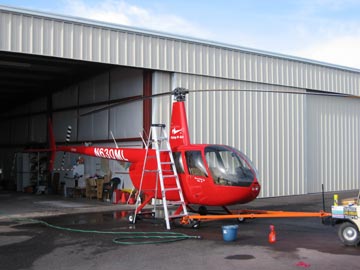 Next is the mast, which has a cowling over it. The front, rounded side of the cowling is completely covered with baked on, squished on bugs. It’s bad, mostly because it’s so darn high off the ground that I need a ladder to clean it so I only clean it when I wash the whole helicopter. I used bug and tar remover with a brush on it today. Not a good solution, but it did work. I have to move the ladder and climb up either side of the helicopter to wash it all properly. Then it’s rinse, rinse, rinse and move the whole thing back a bit more into the hangar.
 I heard about this newly approved subdivision and did some research. I learned that it had been proposed in mid August and had miraculously gone through the approval process in about six weeks. A miracle of Town efficiency — the same town that took four months to choose between two bids for an Airport Fuel Manager last year. The same town that routinely keeps old business “old business” at many commission meetings, including the Airport Advisory Commission’s monthly meetings.