Flying to Sedona (again)

A helicopter flight that has become routine.

As I write this, 36% of the site visitors who have taken the time to vote in my Most Interesting Topics Poll (that’s 11 people so far; I’m hoping for continued growth in that vote count) have said that Flying is the most interesting topic on this site. So I decided to devote this morning’s blog session to a flying article.

(For those of you just tuning in for the first time, among the hats I wear is a commercial helicopter pilot hat. I operate a Single Pilot Part 135 helicopter tour and charter company out of Wickenburg, AZ — Flying M Air.)

I flew yesterday. I flew three passengers from Wickenburg to Sedona and back. The passengers were originally from Russia and now live in the U.K. They’re staying at the Flying E Ranch, one of Wickenburg’s remaining three guest ranches.

I can’t get excited about this flight. It was so routine. After all, by now I must have flown from Wickenburg to Sedona and back at least 50 times.

The only thing unusual about the flight yesterday was visibility. In Arizona, it’s clear and sunny almost every day. Not only can I usually see the Weaver Mountains about 15 miles to the north, but I can usually see them clearly — that means I can distinguish rocks and canyons and other features from 15 miles away. But yesterday was different. It was hazy, as if a thin gauze had been stretched across my eyes. As I drove to the airport at about 10:00, it was apparent why: there was moisture in the air. There was condensation on my Jeep and even a little frost down where the horses were munching their morning meal. Imagine that. Moisture.

My passengers arrived early, all bundled up for the 50°F temperatures we expected in Sedona. After giving them their preflight briefing and loading them on board, I started the helicopter and waited for it to warm up. A few minutes later, we were on our way, climbing to the northeast into hazy skies.

The air was smooth, the sights were the same as usual (except for the haze) and I pointed them out faithfully to my passengers. They didn’t talk much, which is always a danger with me. I wind up talking to fill the silence, telling them more about the area than I usually do. I had three passengers on board, so I had to make sure I pointed out things on both sides of the helicopter — normally, with just two on board, I put them on the same side of the helicopter so I only have to point out things on one side.

We crossed the Weaver Mountains not far from the hidden cabins I’d discovered years before. Then we followed the Hassayampa River up toward Prescott, crossing the Bradshaws. My passengers were thrilled by the sight of snow on the north side of the moutains. I was thrilled by the fact that the haze had cleared out and it was a nice, clear day up there.

As we got close to town, I reported in to the tower at Prescott Airport. I planned to follow Route 69 a bit and then head toward the pass atop Mingus Mountain. This would have me cutting as much as one mile into Prescott’s airspace. (I normally go around it so I don’t have to talk to the tower, but our heavy weight had our airspeed a bit slower than usual and I wanted to save a few minutes of time.) We were over Prescott Valley when the tower pointed out a Baron about 400 feet above us, crossing in front of us. I descended about 500 feet — I was high because of all the mountains I’d have to cross — to stay out of his way. Then the tower cut me loose and I climbed up and over Mingus Mountain, reaching my highest elevation of the flight: about 8,000 feet.
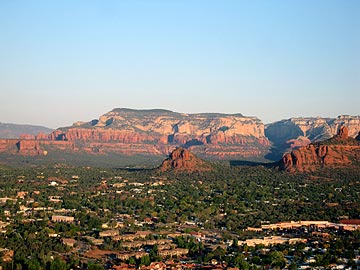
West SedonaFrom there, I started a 1,000 fpm descent to the northwest, descending past the former ghost town of Jerome. I told my passengers about the first time I’d been there nearly 20 years ago when only a handful of people lived there. Now it was a booming tourist town, with art galleries and restaurants in the old buildings perched along its hillside. I showed them the open pit mine, then continued northwest to the red rocks. We did a red rocks tour on the way into Sedona, avoiding the flight path of the helicopter tour operators there, and landed at the airport.

Uneventful.

Of course, I’d been so concerned with getting my credit card terminal to work at the airport that I’d forgotten to bring a book or my laptop so I’d have something to do while my passengers went on their Jeep tour. Duh. After the Jeep picked them up, I walked over to Sedona’s restaurant for lunch. (I don’t think I can recommend the Chicken Alfredo with Broccoli; too thick and starchy, although the chicken was cooked nicely.) Then back to the terminal to wait.

I wound up renting a car from the car rental guy there. $20 for up to 3 hours (I think). I didn’t even have it two hours. I drove down off Airport Mesa and hit the New Frontiers grocery store at the bottom of the hill. It has a magnificent selection of cheese and a very knowledgeable cheese guy behind the counter. I tasted some cheeses and wound up buying them all. I also bough brussels sprouts on the stalk — something that’s simply not available in Wickenburg.Then into “uptown” Sedona to visit a bookstore (the Worm) which seemed to have fewer books than I remember. And coffee at the coffee shop across the street. Then back to the airport so I’d be there when my passengers returned.

I talked to everyone who worked at the airport. The car rental guy, the AZ Adventures helicopter tour guys, the FBO guys, and the Maverick helicopter tour guy. That kept me busy even after my passengers returned from the Jeep tour and went to have lunch at the airport restaurant. By 3:30 PM, they were back and it was time to go.

The return trip was almost as routine. The haze had moved in a bit and we were flying right into the sun. My hat was under my seat, so I had to shade my eyes with my hand once in a while. Instead of heading straight for the southern end of Mingus Mountain, we headed southeast to Oak Creek Village. My front seat passenger had his camera out and the red rocks were being illuminated by that gently filtered afternoon sun. The views out that side of the helicopter were great. I flew just past Oak Creek VIllage before turning to the southwest, back into the sun. The mountains rose as dark shapes silhouetted against the hazy light.

I didn’t have as much to say on the way back. Part of that was my intercom system, which was creating static again. (I have to fix that! It’s driving me nuts!) So I had the squelch set so it was less likely to make noise. My passengers weren’t talking anyway. They were just looking; the daughter, who was probably close to 18 years old, had her iPod on under her headset and probably wouldn’t have heard what we were saying anyway.

The farther south we flew, the worse the haze got. It was definitely brownish in color toward the Phoenix area — smog trapped in an inversion. At one point, we could clearly see a dark line in the sky that marked the inversion layer. Very unusual.

I flew them over Crown King, a tiny town in the Bradshaw Mountains. The main reason I go that way on the way back is that you can normally see Wickenburg Airport from the Crown King area — a distance of about 23 nautical miles. But not yesterday. The haze was so complete that if I didn’t have my GPS set to Wickenburg (or at least a heading in mind) I would have strayed off course. I simply couldn’t see that far away. Even Lake Pleasant was difficult to see from the air, although I did point it out for my passengers as we flew about 10 miles north of its northern edge.

We were over the Monte Cristo mine on Constellation Road when I was still trying to figure out exactly where we were. When I saw the mine shaft and buildings, I thought I’d stumbled upon a mine I’d never seen before. Then I recognized it and was surprised that we were so close to town. Less than 10 miles to the airport, according to my GPS. I could just about make out reflections downtown and the scars of the earth around the airport.

I flew over town and then headed out to Flying E to show them the ranch where they were staying from the air. (That’s something I do for people staying in our local hotels and guest ranches.) Then we landed by the fuel pumps at the airport. I cooled down and shut down.

Routine.

After a while, flying the same route over and over does become routine or — dare I say it? — boring. Sedona is a place of incredible beauty and the best way to appreciate its beauty is to see it from the air. Yet when you’ve seen it as many times as I have, the impact of all that beauty fades. That’s one of the things I talked to the FBO guys in Sedona about. They both agreed that when they’d first come to Sedona, they were amazed at its beauty. Now, living with it all around them every day, it simply isn’t a big deal.

I felt like that when I flew at the Grand Canyon, too. Don’t get me wrong — it never got so boring that I’d prefer to fly elsewhere. I just wished I had the freedom to alter my flight path for a slightly different view or a new way of seeing things.

And here in Wickenburg. The upstairs front windows of my home look out over the Weaver Mountains in the distance. When I first moved into the house, I thought it was a view I’d never grow tired of. But I did. Kind of. I’m not sure why.

I’d be interested in hearing from other pilots who fly in beautiful places and have somehow lost sight of that beauty because of routine. Use the Comments link.

Open Range Cattle, Howard Mesa

Talk about road blocks!

A few years after buying our place at Howard Mesa (north of Williams, AZ, south of the Grand Canyon), my editor, Jeremy, came to visit us down in Wickenburg. It was January, right after Macworld Expo. As I do with all of our out-of-state visitors, I took him to the Grand Canyon.

Since our property was along the way, I decided to take a short detour to show it to him. We’re proud of our lot at Howard Mesa, mostly because of the incredible views in every direction. We like to show it off.

It had snowed hard the night before our visit and the ground was covered with a thick blanket of the stuff. I was driving my Jeep which was still relatively new and had good tires. The roads at Howard Mesa are not plowed in the wintertime — in fact, we’re pretty lucky if they get graded during monsoon season. And, of course, with only two houses on our side of the mesa at that time, it wasn’t as if a lot of people were going that way. Still, there were relatively fresh tire tracks to follow, so I could find the road.

Open Range CattleWe came up the state road, rounded a bend, and were rather surprised to see this small herd of young open range cattle in our path. As you may be able to tell by their faces in the photo, we weren’t the only ones who were surprised. I clearly remember rolling to a stop in the road about 50 feet from these animals, snapping a photo, and then just waiting for them to move. They didn’t.

I inched forward with the Jeep, trying to encourage them to get out of the way. I was probably about 20 feet away when one of them decided I was too close. It whirled around and started back down the road in the direction I needed to go. Since cattle are herd animals, within moments they’d all turned around and were trotting down the road.

I followed.

At this point, we still had about a mile to go to get to our place. The cattle may have been trotting, but they’re not exactly fast. When I sped up, they didn’t. They were already moving at top speed. I didn’t want to frighten them or hurt them.

Well, I had a Jeep. Jeeps can be taken off-road. So I found a break in the vegetation at the side of the road and drove around them. That was enough to scare them off the road. They cut cross country through another lot. I pulled back onto the road and we continued our trip over the existing tire tracks.

A while later, when we arrived at our place, we saw the cattle standing as a tight herd across the road, looking in at us. But they didn’t get in our way again.

Christmas at Howard Mesa – Part I

I was dreaming of a white Christmas.

On the Friday before Christmas, Mike and I loaded up the truck with a bunch of things, including some furniture, food, tools, Jack the Dog, and Alex the Bird. At about 9 AM, we headed north, to our property at Howard Mesa.

In Wickenburg, it was raining. It was the first time there had been enough rain there to actually get your skin wet for at least a month. Part of me wanted to stay behind and enjoy the weather. But the other part of me knew that it was likely to clear up in an hour or two and I’d just be disappointed. We don’t get many good rainy days in the desert and Friday was not going to be one of them.

Our path took us up Route 93 to Route 89, through Congress and up Yarnell Hill. We stopped at the Cornerstone Bakery for some fresh baked goods to munch on in the car and enjoy on Saturday morning for breakfast. It was a freezing rain there, but nice and toasty in the bakery, which was filled with the usual collection of locals.

Back on the road, we took 89 through Peeples Valley, turned toward Kirkland at Kirkland Junction, got on Iron Springs Road in Kirkland, and followed that to the first traffic light in Prescott. Then Williamson Valley Road to the Pioneer Parkway to Willow Springs Road to 89A. In Chino Valley, we stopped at Safeway, where Mike filled the truck with diesel and I hurried through the store to get veggies and a few last-minute food items. By this time it was snowing pretty hard, with just enough wind to blow the flakes at about a 30° angle to the ground.

Back in the truck, we followed 89A to Ash Fork, where we got on I-40 eastbound. The snow was sticking up there, coating the road with a thin layer of snowy ice. Trucks and cars were taking it easy, preferring a self-mandated speed limit of 35 or 45 MPH rather than the legal 75 MPH limit. It was slow going, but I’m sure it was better that way. Alongside the road, a light dusting of snow covered fields and trees. It looked more like Christmas than it has in a long while for me.

At the exit for the Grand Canyon (the third exit, the one that’s really for the Grand Canyon), we got off and followed Route 64 northbound. There was a lot of snow on the ground there but very few vehicles. Still, we both felt relieved when we reached the turn for Howard Mesa and began our last five miles of the trip. 20 minutes later, we were pulling through our gate while the snow swirled around us.

The entire drive, including the two short stops, had taken about 4 hours.

Inside our camping shed, the temperature was hovering around 35°F — which was pretty much the same temperature as outside. Mike turned on the gas and I struggled a bit to get the heater turned on. He unloaded the car while I turned on the fridge and started putting things away. Jack the Dog immediately got to work terrorizing whatever small rodents had made homes in the fire pit outside. Alex hung out in the truck where it was warmer. He didn’t come in until the temperature had risen to nearly 50°.

My first main task was to clean up after our unwanted lodgers — the mice. The shed has a mouse problem that we’ve tried everything to solve. The last time we were there, we’d gotten desperate enough to leave poison around. I had to scoop up what remained of it (only one of four pieces) before Jack came in. Then I had to uncover the furniture and get the vacuum going to suck up the mouse droppings that seemed to be just about everywhere. I used a lot of disinfectant cleaner on the floor and countertops. I took my time about it — there really wasn’t any reason to rush; I had all day. I had my iPod sitting in the iHome base, playing Christmas songs. Within two hours, I was pretty much done.

In the meantime, Mike was working in the bathroom on the plumbing. On our last brief visit (by helicopter during snow showers), we had discovered that most of the pipes had frozen and cracked. Mike had brought along pipes and connectors and tools to replace the broken pipes with new ones. The job required that he cut away one wall to access the pipes and do a lot of disconnecting. There was no running water in the shed and wouldn’t be until the pipes were repaired. Even the 5-gallon water cooler jug was mostly frozen; I had to light a candle under its spigot to get the water to flow.

I made us a hot lunch of canned chili with scallions and cheese, then washed up using water I boiled on the stovetop. It reminded me of the old days at Howard Mesa, when we’d camped out in our pop-up camper. That camper was wonderful on warm summer nights, but it lacked basic conveniences, such as a refrigerator or toilet. We’d use the tiny two-burner stove to heat water in the morning for coffee and washing up. During the day, we’d use those solar shower bags to heat water for showering and washing dishes. (They really do work in Arizona; we once had the temperature of the water in one of those bags up to 110°F — too hot to shower in!)

After lunch, I went on mouse cleanup duty on the shed’s little loft, which is where we sleep when we camp there. I discovered a place where they might be getting in; I’ll work on closing it up this weekend. Outside, the snow was still falling lightly. Everything was covered with a dusting of it. Jack the Dog was still hard at work at the fire pit, with the fur on the lower half of his body soaking wet. Oddly enough, it wasn’t windy, even though the weather forecast had called for wind gusts up to 28 MPH. A low cloud hung over the mesa, cutting our view to only a few miles.

Before the end of the day, Mike had finished replacing all the cold water lines. He connected the hose from one of our water tanks to the shed’s water line, turned on the pump, and pressurized the system. That’s when he saw the cracks in the hot water lines. We turned off the pump and disconnected the hose, then let any water in the lines run out.

The sun went down and it got dark. We brought Jack in. I made leftovers from home for dinner. The heater, which had been set to 85°F, had gotten the temperature in the shed up to a high of 64°. It didn’t seem that cold. We settled down on the sofa with my 15″ MacBook Pro on a folding table in front of us. I popped in a DVD from the first season of 24. We watched two episodes. We’d heard a lot about the show but had never actually seen it. So I’d added it to my Netflix queue (along with the second season of Boston Legal) and we were checking it out for the first time. Not bad. I can’t imagine watching it with commercials, though.

I slept badly. It’s the stupid hot/cold/hot/cold middle-aged woman thing, combined with the sounds of sleeping someplace different. It was pretty quiet when we first got to sleep, but at about 3 AM, the wind finally kicked up, blowing from the west right at the loft’s only window. I’d left the window open a crack — I’m always worried about asphyxiation in a closed space with a gas appliance running — and Mike had to close it. Sometime during the early morning hours, the wind shifted around to the northeast, which is the back side of the shed. It wasn’t blowing hard enough to shake the building, as it sometimes does. Just loud enough to hear it rushing past in the piñon and juniper pines scattered over our 40 acres. The sky had cleared and there were billions of stars out.

In the morning, the temperature in the shed was 43&degF with the outside temperature 28&deg. This was a problem. The heater was turned up, still set on 85°. As we moved around, making coffee and tea, washing up with water heated on the stove, we started finding drafty places. Around each window. Where the water heater sits against the outside wall. Around the edges of the door. I got my assignment for the day: caulk.

Mike decided he needed something from the hardware store to keep working, so we made a trip down to Williams, AZ. The town was remarkably busy for the time of year. I think it’s because the Grand Canyon Rail Road is doing a special “Polar Express” to the Grand Canyon each day and that’s attracting a lot of families. The town also sets up a real Christmas tree on side street off Route 66 and blocks off the street so visitors can walk around it. Nice.

We took care of business in the True Value hardware store, buying about $90 worth of stuff that included a new front door mat and weather stripping. Then we hit Safeway for a few things, stopping at the Starbucks counter on the way out for mocha lattes.

By the time we got back to the mesa, before lunchtime, a lot of the snow had melted. Mike got back to work and Jack continued his vigil at the fire pit. Sometime during the day, he started barking at something — we looked out the window in time to see an antelope hopping away across the road. One of the open range cows also came by, but since we’d kept the gate closed, she didn’t get into our property. (Cows have done a lot of damage at our friends’ place on the other side of the mesa, making us very glad we fenced in our entire lot years ago.)

Soup and sandwiches for lunch. The shed temperature was in the low 60s while it remained in the 30s outside.

I went through a whole tube of caulk on the windows. The shed was built with window frames that they’d stuck standard sized windows into. Unfortunately, the frames were about 1/2 inch too wide and tall for the windows, leaving a gap on at least two sides. They’d finished the outside of the windows with trim, closing up the gaps a bit, but they were still drafty. And one window leaked. I’d fixed the leaky window during the summer but had never thought that the gaps might cause drafts in the window. So I went to work with the caulk gun, which I’m actually pretty good at using. I ran out of caulk before I’d finished all of the windows, but I’d closed up the worst of the gaps.

Mike, as part of his pipe insulation procedure, had sealed up around the water heater with Fiberglas and foam insulation. I used garage door weather striping around the front door. The door was made to fit the shed and it doesn’t fit quite right. You can see light through the cracks around the door. Even with the thick rubbery weather striping, you can still see light in a few places. But it’s a lot better than it was.

Mike finished up all the piping by sunset. Hooked up the water again, ran the pump, and pressurized the system. No leaks. He turned on the water heater. I washed dishes from lunch. He cleaned up. Then he was ready for a shower.

Unfortunately, he’d waited too long. The outside temperature had dropped and the hose, which had never fully defrosted from the night before, had thickened up with ice. The pump was unable to bring in enough water. His shower was very short-lived. He stepped out, cranky and miserable. I was just glad I’d let him go first.

Getting water from the tanks to our camping equipment had always been a problem in cold weather. In the spring of 2004, I’d moved up to Howard Mesa in our horse trailer with living quarters, which also had a pump to get water from the tanks to the inside plumbing. Unfortunately, during the night the hose would freeze and the pump would try in vain to get the water out. That would run down the trailer’s battery and burn up the pump. So I had to turn off the pump each night and use the trailer’s internal water storage system for water. Not a big deal. Once every few days, I’d fill the internal tank so there was always water there when I needed it.

But here at the shed, we don’t have internal water storage. All the water has to come from one of the big tanks. The closest one is about 40 feet away. Because this is not a permanent setup, we didn’t dig a trench and put in a pipe. We use a hose. And the hose freezes every night, even though we do our best to drain the water out of it.

At least it hasn’t cracked yet.

Anyway, we spent Saturday night much the same way as Friday night. A nice hot dinner and two episodes of 24 on my MacBook Pro’s wide screen. The shed was much warmer — it had gotten up to 71°F by late afternoon. I slept well, waking about an hour before dawn. Outside, the moonless sky was bright with stars.

This morning, the inside temperature was 57°; outside it was 31°. I like to think it was my excellent caulking and weather striping that kept the shed reasonably warm overnight.

Today, Christmas Eve, I’ll finish cleaning up the shed — didn’t get much done in the bathroom with Mike making such a mess in there. Then we’ll put up the Christmas lights. Later, when it gets warmer, we’ll go for a walk around our fence line, making repairs and looking for castoff elk antlers as we go. It’s beautifully clear outside — I can see for at least 50 miles in every direction — and, as I write this at 10 AM, its already nearly 40°. It’ll be nice to get out. And I’m sure Jack the Dog is looking forward to a good run. He’s been going nuts every time the coyotes start howling nearby.

This afternoon, after a nice hot shower (got my fingers crossed), we’re going up to the Grand Canyon to meet some friends for dinner at El Tovar. Then dessert at our friends’ house on the other side of the mesa.

I’m looking forward to driving back to our place tonight, to seeing those red Christmas lights all alone in the middle of nowhere.

[composed on top of a mesa in the middle of nowhere with ecto]

A Professional Pilot?

I’m not impressed.

Yesterday, my friend Ray flew me down to Mesa, AZ, in his airplane so I could pick up my helicopter, which was down there for its big annual inspection. While we were taxiing from Ray’s hangar to Runway 23 in Wickenburg, we heard the following exchange between two pilots on Wickenburg’s frequency:

Premier 1-2-3 (not the exact call sign; Premier is a small “corporate” jet): Wickenburg, this is Premier 1-2-3. Is there anyone there?

PanAm 5 (not the exact call sign; PanAm is a flight school based at Deer Valley Airport (DVT) that does a lot of practice landings at Wickenburg): This is PanAm 5 at Wickenburg.

Premier 1-2-3: Can you tell me the winds down there?

PanAm 5: The winds are shifting around a little, but they’re mostly out of the southwest at about 5 or 6 knots.

Premier 1-2-3: Oh, great. Thanks….So that means you’re using Runway 26 down there? Is that the runway number?

PanAm 5: It’s actually Runway 23.

Premier 1-2-3: Oh, thanks. We don’t have any approach charts or anything for Wickenburg so we’re kind of flying by the seat of our pants.

Yes, he really said that.

The radio went quiet for a few moments, then another pilot called to say he was 5 miles north, inbound for landing.

Premier 1-2-3: Premier 1-2-3 is about 3 miles south. We’ll be making left traffic for Runway 23.

Pan Am 5: Actually, it’s right traffic for Runway 23 at Wickenburg.

Premier 1-2-3: Okay. Thanks. Right traffic for Runway 23.

At this point, the FBO attendant came on the radio to provide wind and unofficial altimeter setting information. (It’s a good thing the altimeter setting is unofficial, since it’s off by nearly 100 feet.) She asked if the jet wanted fuel on landing and he told her he didn’t, that he was just dropping off some passengers.

We were holding short behind a PanAm plane when the jet came in, zipping past us. He was nearing the other end of the runway where the terminal was when the FBO woman came on again to ask if he knew where to park to discharge his passengers. He told her he’d been there before, then advised everyone that he was off the runway.

Ray and I had been discussing this jet pilot’s lack of professionalism while we were waiting. Both of us knew that one of a pilot’s responsibilities for a flight, as stated in Part 91 of the Federal Aviation Regulations (FAR’s). From Section 91.103, Preflight Action: “Each pilot in command shall, before beginning a flight, become familiar with all available information concerning that flight.” Surely that must include runway numbers (which are determined by magnetic course headings) and traffic pattern information. This information is available on the Sectional Chart and in the Airport/Facilities Directory, both of which are required to be on board for commercial flights. They’re also available on the Web on various airport information Web sites and on the FAA’s Web site. Heck, I’m a helicopter pilot and I’m supposed to avoid fixed wing traffic when I land at airports, yet I usually know the runway numbers and traffic pattern information just so I can get an idea of where planes might be.

This guy simply hadn’t done his homework.

The PanAm plane in front of us took off. Ray rolled onto the runway. As the PanAm plane drifted to the north of the centerline (likely because of the wind), we took off and headed south.

I’ve since given the exchange a bit more thought. What if the Jet was arriving after 4 PM, when the FBO was closed, and the traffic pattern was empty. Where would he have gotten his information. He was only 5 miles out on his first call; would he have had time to look at his chart or A/FD? Or would he have assumed Runway 26 from memory, made a left traffic pattern low over the homes on the southeast and east sides of the airport, and adjusted his approach only when he realized he was on the wrong heading — 30° off? Approaching at a heading of 260 would have put him right over the homes on Broken Arrow Road — the homes of people already complaining about noise now that the runway is 1500 feet closer to their homes. Would his action have had a long-term impact on the airport?

The point here is, all pilots are responsible for gathering information about the flight — including the airport they intend to land at. This guy acted irresponsibly and was fortunate enough to have people on the ground that could provide him with the information he needed.

But as any pilot knows, you’re not always lucky. You need to do your homework before you get on board and start the engines.

An Evening Out

We visit a friend above town.

Last night, my husband and I spent the evening with a friend who lives part-time in Wickenburg. His house sits on a ridge overlooking the town.

As I drove up the road that led to his home, I felt I was rising above the scum that floats just below the surface of Wickenburg, the scum of small-town politics, corruption, and business owners being threatened for signing petitions that support their personal beliefs.

Our friend, Tom, can’t live full-time in Wickenburg. He simply can’t get the things he needs to live comfortably. So he has a condo in the Deer Valley area of Phoenix, near where his business is based. He comes to Wickenburg to work on his house, which he’s systematically torn apart and put back together over the past three years, working with one contractor after another to get each job done. By the looks of things, he’s about 80% finished. He shops in Trader Joe’s and Whole Foods Phoenix before he comes to Wickenburg, bringing up organic groceries to stock his kitchen and incredible wines to stock his in-wall wine “cellar.”

I used to try to get Tom to move his business up to Wickenburg, to build a building in the town’s industrial park and operate out of there. But he would tell me that he has a great staff in Deer Valley and he knows they wouldn’t commute up here. He doesn’t want to lose them. Now, after thinking about it for a long time and seeing the hurdles a small business needs to jump to get set up in Wickenburg — I’ve been trying, unsuccessfully, to get an office at the airport for my helicopter charter business for more than eight months — I don’t nag him about it anymore. I wouldn’t want to push him to a decision that would make him unhappy.

Tom’s ridgetop home offers stunning views in every direction, marred only by the power lines APS recently strung along another ridge nearby. The poles and wires are a heartbreak to Tom, who bought the house because of the incredible views. He’s angry because APS had an alternative route, one that would have taken the power lines through unoccupied areas of town where they wouldn’t be such an eyesore to residents. But APS took the easy route, following the edge of state land. Although I agree that they hurt his view, the situation is even worse for the homes they pass near. Literally dozens of homes were affected by the power line installation. But although he’s complained to APS and the Town of Wickenburg, no one seems to care.

We spent the evening listening to classical music and jazz, drinking wine, making dinner, and looking out at the lights of Wickenburg far below us. Tom’s view of the town at night is just like mine from the helicopter as I come into Wickenburg at the end of one of my moonlight dinner tours. He remarked at how many more lights there are now than there were just three years ago when he bought his home. “Imagine how the difference is to us,” I told him. “We’ve been here ten years.”

At Tom’s house, I felt so far removed from town, like I was in another place. A place where culture, fine wine, and quality food were an important part of everyday life, not something to be treated to once in a while. The air seemed somehow cleaner up there, the political situation not so dirty, the conversation more educated and interesting. It was as if we’d left Wickenburg and stepped into a city home. Not necessarily a Phoenix home, mind you. Perhaps one in New York, high above Second Avenue and 60th Street.

The feeling stuck with me all evening as I sipped wine chosen by my host, minced fresh garlic for the garlic bread, and ground sea salt over my soba noodles. Less than two miles as the crow flies from my home, I was in another world.