Wickenburg to Seattle by Helicopter: Day 1

Wickenburg to Page, AZ.

Regular readers of this blog who don’t follow me on Twitter might have been wondering where I’ve been. Did I fall off the face of the earth? Or finally, after six years, get tired of blogging?

Neither. I was making my annual helicopter repositioning flight to Washington State.

This year, I got an early start, piggy-backing my long cross-country flight at the end of a photo flight at Lake Powell. A photographer was willing to pay for the 4-hour round trip ferry time for me to get the helicopter from the Phoenix area to Page, AZ. At the end of that flight, I continued north to Salt Lake City instead of heading home. This put me several hours closer to my destination. At Salt Lake City, I picked up Jason, a low-time CFII interested in building R44 time for much less than the cost of renting. With Jason at the controls, we continued to Seattle.

The trip can easily be summarized by the number of days it took to complete. I’m putting it all down here, in four parts, while it’s still fresh in my mind. The photos aren’t terribly good due to glare through the bubble, but I hope the illustrate some of the terrain and weather we encountered.

In this first part, I’ll cover my trip from Wickenburg to Page, AZ. You can click here to see my approximate route on SkyVector.com.

I’ve made the trip from Wickenburg to Page (or Page to Wickenburg) countless times. It’s the kind of trip that I don’t even need to consult a chart to complete. I know the landmarks by heart.

But on Thursday, the weather promised to be a factor. Although it was sunny down in Wickenburg as I preflighted around 2:30 PM, the clouds were building to the north. I could see them thickening over the Weaver Mountains 15 miles away. And all the forecasts for all the points north of the Weavers called for high winds gusting into the 30s. It would be a bumpy ride.

So bumpy, in fact, that my friend Don and his wife decided not to join me on my trip to Page. Don’s got a helicopter very much like mine and he’d planned to fly up there with me, spend two nights, and let me show him around Lake Powell between my photo flights. But with the forecast so nasty, he bowed out. I didn’t blame him. No one wants to spend 2 hours getting thrown around the sky in a relatively tiny bubble of metal, Fiberglas, and Plexiglas.

And if wind wasn’t enough of a deterrent, the forecast also called for isolated showers and thundershowers north of I-40. So I knew I’d be dodging weather, too.

But I had a contract and my client had paid me to fly up there. I had a pilot waiting for me in Salt Lake City for a Saturday departure. The weather would have to be impossible to fly through to prevent me from making the flight.

So at 3:30 PM, I took off from Wickenburg (E25) into a 15 mph wind from the west and turned out to the north.

Wickenburg RanchI climbed steadily at about 200-300 feet per minute, gaining altitude slowly to clear the 5,000 foot Weaver Mountains ahead of me. Below me, I could see the scars the near-bankrupt developers had left on the desert where Routes 93 and 89 split off. Greed had scraped the desert clean, built a golf course, and then let the grass wither and die. Where there was once pristine rolling hills studded with cacti and small desert trees, there was now flattened dirt, void of vegetation, shaped by bulldozers and men. A dust bowl on windy days covering hundreds of acres of Sonoran desert.

I continued to climb, looking out at the Weaver Mountains ahead of me. The clouds were low over the mountain tops and I could clearly see patches of rain falling. The wind was moving the weather along at a remarkable pace. I picked a spot to cross the mountains, preferring the place where Route 89 climbs into Yarnell over the more direct crossing at the ghost town of Stanton and the valley beyond it. I knew from experience that the wind would be setting up some wicked turbulence in that valley as it gusted over Rich Hill and Antelope Peak. I braced for the turbulence I expected as I topped the hill at 5,000 feet MSL and was surprised when I wasn’t blasted.

That’s not to say there wasn’t turbulence. There was. But it was the annoying kind that bounces you around every once in a while just for the hell of it. The kind that makes flying unpleasant but not intolerable. The kind pilots just deal with.

Ahead of me was Peeples Valley, which was remarkably green. Our winter and spring rains had fallen as snow up there and it wasn’t until the warm weather began arriving that the grass could start sucking it up. The result was a carpet of new green grass that made good eating for the open range cattle and horses up there. All it needed was a little sun to give the illusion of irrigated pasture. But the sun was spotty, coming through breaks in low-hanging cumulous clouds.

Peeple's Valley to KirklandThe weather up ahead gave me a good idea of what I’d be facing for much of the trip: a never-ending series of isolated rain and snow showers. They appeared as low clouds with hanging tendrils of wispy precipitation. But unlike the gray rains hanging below summer rainclouds, these were white, making me wonder whether I was looking at rain or snow. With outside air temperature around 4°C (40°F), it could have been either. Or something worse; damaging hail or icy sleet.

I’d been taught at the Grand Canyon that if you can see through it, you can fly through it. But I didn’t think that rule applied to late spring storms at high elevations. I wasn’t going to fly through anything I didn’t have to.

Knowing which way the storms were moving made it easy to skirt around their back sides. Up near Kirkland, this put me several more miles west of my intended course. Before taking off, I’d punched the waypoint to our property at Howard Mesa into my GPS; I always fly over anytime I’m close, just to make sure everything is okay. Having flown the route dozens of times, I should be flying much closer to Granite Mountain. But that mountain was completely socked in by one of the storms, so I passed to the west of it, adjusted my course line with the push of two buttons, and continued northeast.

Near the Drake VORNear the Drake VOR, I detoured more to the east to avoid a rapidly approaching shower. Raindrops fell on my cockpit bubble and the 110 wind of my airspeed whisked them away. The sky was clearer ahead of me, although the tops of Bill Williams Mountain was still shrouded in clouds. The Prescott (KPRC) ATIS reported mountain obscuration and snow showers to the north, east, and west. I couldn’t see the San Francisco Peaks, which were likely getting more snow to extend the skiing season at the Snow Bowl.

Bill Williams MountainThen I was back out in the sun — a good thing, since the outside temperature had dropped to just over freezing and my cabin heat wasn’t able to keep up with the cold. I climbed up the Mongollon Rim just west of Bill Williams Mountain, trading high desert scrub for ponderosa pines. The mountain had recently been dusted with fresh snow. That didn’t surprise me; only three hours before, the airport at Williams (KCMR) had been reporting 1/4 mile visibility.

By now, the turbulence had become a minor nuisance that didn’t bother me much. I was listening to a genius mix on my iPod, hearing songs I didn’t even know I owned and trying to enjoy the flight. I was almost an hour into it and had more than an hour to go.

I reached Howard Mesa and flew over our place. Everything looked fine. I was surprised to see the wind sock hanging almost limp. Surely there was more wind than that.

I punched the next waypoint into my GPS; a point on the far east end of Grand Canyon’s restricted airspace. I wasn’t allowed to overfly the Grand Canyon below 10,500 feet. Since my helicopter starts rattling like a jalopy on a dirt road over 9,500 feet, that was not an option. Besides, one look out in that direction told me that no one would be flying anywhere near the Grand Canyon that day. All I could see to the north was a blanket of low clouds. I couldn’t even see Red Butte, a distinct rock formation that can normally be seen from 50 miles away. The Grand Canyon (KGCN) ATIS confirmed that things were iffy. The recording reported “rapidly changing conditions” and instructed pilots to call the tower for current conditions. You don’t hear that too often on an ATIS recording.

My course would take me east of that area, but the weather was also moving east. It soon became apparent that I was in a race against the storm. I was halfway to my waypoint when I realized that I wasn’t going to be able to go that way. Although there was a gap there between two storms, I knew from experience that gaps can disappear quickly, swallowing up whatever naive pilot slipped inside. The temperature had dropped down to 0°C and the clouds were only 300 feet above me as I zipped across the high desert, 500 feet off the ground. I’d have to detour to the east.

I aimed for the leading edge of the storm, hoping I could reach it and go around it. But the leading edge was racing eastward to cut me off. My course kept drifting eastward until I was heading due east. That would put me, eventually, over the Navajo and Hopi Reservations, far from any major road or town. I didn’t want to go that way.

I came down off the Coconino Plateau just southwest of Cameron. At least that’s where I figured I was. The low-hanging clouds had blocked all of my normal landmarks from view. To the north, where I needed to go, was a solid sheet of gray rainfall, blocking out whatever lay beyond it. As I descended from the plateau, still heading east, I began thinking of making a precautionary landing and waiting out the storm.

Then I saw a break in the storm with bright sunlight beyond it. It was still raining there, but I could clearly see my way through and what I saw looked pretty good. I banked to the north and entered the rainstorm. Soon, I was being pelted by rain. Visibility was still tolerable; I could see well enough to fly. Thankfully, there were no downdrafts to contend with. Just turbulence, rocking me around, punishing me for interfering with nature’s gift of rain. I held on and rode it out.

And that’s when the carbon monoxide detector light went on. On departure, I thought the heat had smelled a little more like engine exhaust than usual, but had put it out of my mind. The warning light brought it right to the front of my mind again. I opened my door vent and the main vent and pushed the heater control to the off position. I took stock of the way I felt: any symptoms of carbon monoxide poisoning? No, I felt fine. But soon I’d feel very cold.
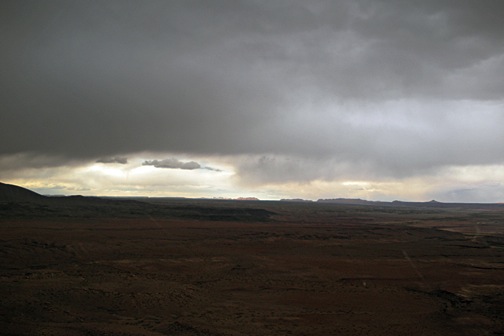
Echo CliffsI passed through the rain and emerged on the other side with a clean cockpit bubble and likely very clean rotor blades. Ahead of me, now due north again, the sky was brighter and I could clearly see the Echo Cliffs. Before entering the storm, I’d punched Tuba City (T03) into my GPS to keep my bearings; now I punched in Page (KPGA) and was pleased to see that I was already right on course. I aimed for The Gap, a small town at the gap in the cliffs, right on Route 89, adjusted power to maximize speed, and sped forward, 500 feet off the high desert floor.

The rest of the trip isn’t very interesting. I did get some different views to the west, where the Grand Canyon was still covered by a thick blanket of clouds. It would be snowing there, especially over the North Rim. My usual path was at least 20 miles to the west, much closer to the Canyon. It included overflying the Little Colorado River Gorge and mile after mile of nearly deserted flatlands on the far west edge of the Navajo Indian Reservation. I was still over the reservation on this path, but the land below me was sculpted by wind and water into mildly interesting patterns. This was the western edge of the Painted Desert, which is not quite as picturesque as most people think.

The GapI crossed Highway 89 at The Gap and flew through the gap in the Echo Cliffs. I was now about 45 miles from Page, flying among three sets of high tension power lines that stretched from the Navajo Generating Station on Lake Powell to points south. There was a dirt road here that made a short cut to page — if you didn’t mind driving more than 40 miles on a dirt road. Navajo homesteads were scattered about. The sky was a mixture of clouds and patches of deep blue. I warmed in the sunny spots and cooled in the shadows.

It was after 5 PM and I was starting to worry about reaching Page in time to pick up my rental car at 5:30. I began making calls to the FBO from 25 miles out. No answer. A while later, another plane called in from the northwest. Other than that, silence.

I was fifteen miles out when Lake Powell came into view. It looked gray and angry under mostly cloudy skies.

I landed on the taxiway parallel to runway 33 and went right to parking. A line guy from American Aviation arrived with a golf cart to pick me up. I shut down and jumped in. It was 5:30 PM; the 200 NM flight had taken almost exactly 2 hours. I was just in time to get my rental car.

Helicopters 101: Flight Planning

The basics of cross-country flight planning for helicopters.

Articles in the Helicopters 101 series:
Flight Planning
CG
Weight
Hover Charts
Ground School

Recently a reader of this blog wrote to suggest that I cover cross-country planning as a blog topic. I searched my archives and found that I already had. My post, “Flight Planning,” goes into a great deal of detail about the process I use to prepare for Part 135 charter flights, which require a complete flight plan. But that’s probably not what this reader was talking about. I think he was more interested in the nuts and bolts of creating a flight plan.

This weekend, I have to make three relatively long cross-country flights:

  • Wickenburg, AZ (E25) to Page, AZ (PGA) – 189 nm direct
  • Page, AZ (PGA) to Salt Lake City, UT (SLC) – 232 nm direct
  • Salt Lake City, UT (SLC) to Seattle, WA (BFI) – 601 nm direct

I’ve flown the route from Wickenburg to Page and back numerous times. I’ve done Salt Lake CIty to Page once and Seattle to Salt Lake City once. I figured I’d use the PGA to SLC flight, which I’ll be doing alone, as an example of how I plan a flight.

Weather

A few days before the scheduled flight, I start checking the weather along my route. I use the National Weather Service’s NOAA Web site for weather information. After all, the NWS is the source of all the weather data for the United States. That’s where the Weather channel and Duats and the FAA get raw weather data. Although each weather reporting organization may interpret it slightly differently, it’s all based on the same stuff. And the NWS site doesn’t bombard me with obnoxious advertising.

A lot of folks use the Aviation Weather link to get aviation weather information. I don’t — at least not a few days out. Remember, I’m flying a helicopter. I’m 500 – 1000 feet off the ground. I don’t care much about upper level disturbances, the jet stream,or icing in clouds. I’m not getting anywhere near that stuff.

Page Weather

The graphic weather forecast for Page on the morning this post was written.

What I’m interested in is forecasted conditions for the departure and arrival airports, as well as any cities in between. So, in this case, I would check out the weather forecast for Page, Salt Lake City, and possibly Richfield, which is roughly halfway between the two. I’ll pay close attention to the forecast for my day of travel, as well as the day before and after.

What I see today is relatively poor forecasted conditions for Saturday, the day of my flight, with chance of rain or snow at each location. Not what I want to see, but remember, it’s a forecast. It will probably change. I have to hope it gets better.

Route

Next, I plan out my route. Although I listed straight-line distances at the beginning of this piece, I seldom fly in a straight line. Instead, I try to find a route that’s a compromise between a straight line — which, out in the desert, usually means doing a lot of flying in the middle of nowhere — and following roads — which is where people will be if I need help.

Now I need to make it clear that unless there’s a road going the way I need to go, I’m not going to follow roads to get from Point A to Point B. I don’t want to go out of my way — at least not too far. Helicopters are expensive to fly and I’m not made of money. The time budget for this trip is 2 hours — that’s what the client paid for — and I’ll need all of it and then some. So what I want is a compromise that puts me near roads for part of my trip.

I plan my route with charts. World Aeronautical Charts (WACs) are very handy for long cross-country flight planning. But sectionals offer more detail.

Of course, I cheat. I use SkyVector.com. It puts the charts onscreen and enables me to do some very basic flight planning — mostly distances and directions. As the site warns — probably with the advice of lawyers — it’s not for navigation or preflight use. But I use it for preliminary planning. It really helps me get a good idea of where I need to go.

Options

The pink line at the bottom is the direct route from Page to Brice; the red and blue lines are my two options for continuing northbound without overflying 10,000 foot mountains.

In this case, I’m seeing that a direct flight from Page (PGA) to Bryce Canyon (BCE) would take me 57 nm mostly over remote, high desert terrain, climbing from about 4300 feet to over 7000 feet. No major mountain ranges to cross along the way — and that’s good.

From there, I can follow the East Fork of the Sever River and the road beside it northbound between a pair of mountain ranges topping out at over 10,000 and 11,000 feet, then follow a pass that’ll hook me up with Highway 89. This map shows it as the red route. That’s the way I flew last time and the only drawback I recall was the rough air in that pass.

The other option is to continue on almost the same heading to Panguitch (U55), which will hook me up with Highway 89. I can then follow that northbound between two mountain ranges topping out at 11000 feet, staying slightly lower in overall altitude and sticking with a well-traveled road. This map shows it as the blue route.

Completed Route

My planned route, roughed out on SkyVector.

I continue this process for the entire trip. This one’s pretty easy; I’ll be following Route 89 most of the way. When I get to the outskirts of Salt Lake City, I’ll be following I-15. This turns my 232 nm trip into a 259 nm trip and adds at least 15 minutes of flight time. But I’ve minimized my flying time over the middle of nowhere without detouring too much out of my way. The WAC charts I pasted together here from SkyVector screenshots give you an idea of what the entire route looks like. I can also see that my flight without wind could be as long as 2-1/2 hours. My helicopter’s endurance is just 3 hours, so I need to consider the possibility of needing a fuel stop if I hit headwinds. Fortunately, there are plenty of airports with fuel along the last 50 miles of my route.

By the way, the main benefit to following a road when you enter busy airspace and don’t know the local reporting points is that you can state your position to ATC in relation to the road. For example, “Helicopter Zero-Mike-Lima is ten miles south over I-15” is a very definite location.

Once I get a rough outline of the course, I go into detail with sectional charts. I buy them as needed for my cross-country flights. I’ll check to be sure there’s no special airspace or weird activity (think gliders and ultralights) along the way. I’ll also look for charted power lines — not that I’ll remember them when the flight time comes. I’ll make a cheat sheet of airport names, designators, elevations, and frequencies so they’re easy to enter into my GPS for added navigation assistance during flight.

Although I don’t usually mark up my local charts (Phoenix sectional and terminal area chart), I don’t mind taking a highlighter to the Las Vegas and Salt Lake City Sectionals I’ll use for this trip. I’ll also have a Salt Lake City terminal area chart on hand. Before I start my flight, I’ll fold them all neatly to expose the route. With just one hand to fiddle with charts, it’s much easier to prepare before lift off.

Destination Information

On this particular trip, I’ll be landing at Salt Lake City Airport, a Class Bravo airport I’ve never landed at before. I’ll need to know where on the airport I’ll be landing so I don’t sound like a complete idiot when I talk to the tower.

Airport Diagram

The airport diagram for SLC. General aviation is handled in the southeast corner, not far from the I-15 freeway.

I could pull out my Airport/Facilities Directory and look up the airport, but that green book is already stowed in the helicopter for the trip. So instead, I’ll hop online to the FAA’s AeroNav Services (formerly NACO) web site. Once there, I’ll click the link for Free Digital Products and then click d -TPP and Airport Diagrams on the page that appears. (Note that you can get a PDF of the page(s) for a specific airport from this site, too.) I’ll use links and search to get the Airport Diagram for SLC, which will be downloaded as a PDF. I can print it out for future reference and put it with my charts.

I’ll also go to AOPA Airports and get information for SLC. I’m interested mainly in FBOs. I was told to go to Million Air, so I want its location, frequency, and phone numbers. AOPA Aiports also shows a zoomed in satellite image of the FBO’s location, making it easy to mark on the airport diagram.

While I’m at the AOPA Airports site, I’ll also jot down the phone numbers for the AWOS or ASOS systems along my route. I’ll program these into my cell phone. This way, if I need up-to-date weather information for a specific airport, I can get it by simply calling. This has come in handy in the past in marginal weather conditions. I have quite a few airports stored in my computer and phone.

Note that I always get airport frequency information from FAA sources: up-to-date charts or the Airport/Facilities Directory. No online database that isn’t maintained by the FAA is guaranteed to be accurate. There’s nothing worse than trying to land at a towered airport and having the wrong frequency for it. I’ll also update my Garmin 420‘s database before this flight. I have an annual subscription, but I often skip updates because they’re such a pain in the butt to install.

Final Planning

I’ll keep watching the weather all week. If it starts to look like its getting worse, I’ll start thinking about rescheduling my trip. In all honesty, the only thing that would stop me from doing the flight would be winds in excess of 40 miles an hour (possible, but not likely), low clouds (definitely possible), or freezing rain (possible). Although I mostly fly in great weather here in the desert, I’ve flown in ugly weather, too. A fair weather pilot should not be flying for hire.

The day before the flight, I’ll call Million Air and tell them to expect me. I don’t have to do that, but it’s better than just dropping in. They’ll also give me some insight about where to land/park. I’ll note it on my airport diagram.

The day of the flight, I’ll check the weather again. This time, I’ll use Duats.com. I’ll punch in my flight plan airports and let Duats tell me the official aviation weather and notams and give me a more precise (official) flight plan that factors in the wind.

Could I do it by hand? Yes, if I had to. But I don’t so I don’t.

I’ll also make my fly/no fly decision.

I’ll file a flight plan via Duats. I might forget to open it when I take off, though. I often do when I fly by myself. But I have a Spot Messenger that broadcasts my location to a Web site that my husband monitors. I think that’s better flight following than I could get from the FAA without climbing to 12,000 feet. (Keep in mind that I don’t have oxygen and the R44 vibrates like a coin op motel bed at altitudes above 9500 feet.)

That’s About It

That’s all there is to it. The longer the flight, the more variables to consider. This is a pretty short one. The flight from Salt Lake City to Seattle is another story. Lots of variables there. My co-pilot on that trip will plan and fly the entire route. I’ve already looked at the route he suggested and it seems fine to me. I’ll just follow along on the chart.

The main thing that makes this different from planning for an airplane flight is the altitude issue. Airplanes climb several thousand feet over terrain. Mountains don’t get in their way; they’re above the mountains. Helicopters generally don’t fly that high, so we often look for routes that take us around obstacles like 11,000 foot mountain ranges. We also have the luxury of being able to land almost anywhere if we have a problem

Flight Planning Realities

It’s more than just drawing a straight line.

Every week I get at least one weird helicopter flight request. Yesterday’s was for a flight from Scottsdale to Four Corners and back.

Four Corners

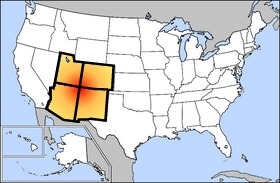
Four Corners, on a map. (Wikipedia image.)

When I say Four Corners, I’m talking about the place on the map where Arizona, Colorado, Utah, and New Mexico meet. In drawing their rather arbitrary state lines years ago, the mapmakers created this manmade point of interest: the only place in the United State where four state boundaries meet at one point. There’s a monument there that supposedly marks the exact point where the states meet. Tourists like to drive in and get down on all fours for photos with one limb in each state.

These days, the monument is managed by the Navajo Nation, which has land on three of the four states. The Colorado section is on Ute Indian land. I’m pretty sure there’s a fee to get in, but I could be wrong. I’ve driven past the point and flown over it, but have never stopped there.

So the passengers wanted to land at Four Corners, which is on Navajo land. That means I need permission from the Navajo Nation to land there. That’s the first hurdle the booking agent has to jump. (I won’t get permits for my passengers; I’ve wasted enough time trying for flights that didn’t happen.)

The booking agent evidently uses some kind of flight planning tool to estimate flight time. He estimated 2-1/2 hours each way. But the booking agent didn’t take into account the realities of endurance, refueling locations, weather, and FAA reserve fuel requirements.

I used SkyVector — highly recommended! — to come up with a basic flight plan — something I could use to estimate the cost of the flight. Its built-in aeronautical charts make it easy to identify places to stop for fuel if needed.

I learned that a direct flight from Scottsdale to Four Corners would take approximately 2-1/2 hours — just as he’d estimated. But this didn’t take into consideration the possibility of headwinds and my aircraft’s endurance. I roughly estimate 3 hours endurance on full tanks of fuel. But could I fill the tanks? I had no idea what the passengers weighed yet. And with my 20 minutes of required reserve fuel, planning a direct flight was not a good idea.

But what made it a really bad idea is that there is no fuel available between Winslow, AZ and Four Corners — a distance of 143 NM or 1-1/2 hour of flight time. Indeed, the closest fuel to Four Corners is 42 NM to the east — not on our way back — at Farmington.

My Flight Plan

SkyVector makes preliminary flight planning very quick and easy.

That meant I needed to plan three fuel stops: Winslow (INW) on the way up and Farmington (FMN) plus Winslow (INW) or Payson (PAN) on the way back. The resulting flight path is a narrow triangle totaling 549 NM and at least 5-1/2 hours of flight time. To be on the safe side, I’d estimate 6 hours.

This is what kills me about some of these booking agents. This particular one is based in Atlanta, GA. I can pretty much guarantee he’s never spent any time in an aircraft over the Navajo Reservation — which is where at least half this flight would be conducted. He has no concept of the vast distances and empty terrain a route like this would cover. He — and likely his passengers — can’t conceive of the utter boredom of six hours flying over this area. Sure, there are scenic parts, but not six hours worth. They’d be paying me close to $3,000 for this one-day adventure.

And all for what? A photo opportunity at a manmade “monument” in the middle of nowhere? Heck, look at it on GoogleMaps! There’s nothing there or anywhere near it!

Yet the booking agent will sell it to them if he can. And I’ll provide the service if it’s paid for.

I think the booking agent could do them a better service by selling them a Sedona tour or a trip up to the Grand Canyon. Or even Lake Powell, for Pete’s sake! Closer, cheaper to visit, and far more interesting.

Of course the weird requests of uninformed passengers or booking agents isn’t really my point.

My point is this: There’s a lot more to flight planning than simply measuring the distance between two points. The preliminary flight plan I cooked up here is just the first part of a lengthy planning process I have to go through if I get this job.

I have to admit that I find it a bit annoying when a booking agent oversimplifies the requirements of a flight — especially if he fails to inform his clients about what they’re getting into. In this case, it’s a long and expensive flight over the high desert of Arizona with very little of interest to see along the way.

More on Fan Mail

I’m actually starting to like it.

Way back in May 2006, I wrote a blog post about Fan Mail. In it, I voiced my embarrassment about getting it from readers.

201003160814.jpgThings seem different lately, and I’m not sure why. I’ve begun getting fan mail from readers of my articles in Aircraft Owner Online (AOO), an online magazine for aircraft owners (duh). The articles are mostly recycled and refreshed blog posts and, to date, are all at least five years old. The folks at AOO do a great job of laying out my text with the high resolution photos I provide, making a slick presentation of my work. (They do the same for the rest of the magazine, of course.) I enjoy preparing and submitting the pieces, mostly because it gives me an excuse to dig back into my archives and relive the flying experiences I’ve written about. The AOO editors barely touch my prose, so I don’t have any reason to complain about heavy-handed editing. It’s a truly positive experience all around.

But what’s most rewarding to me (beyond payment for my work) is the fan mail my monthly “Adventure Flight” column articles have garnered. I’ve been writing for the magazine since November 2009 and, to date, have received at least four e-mailed “fan mail” letters. The most recent came just this morning:

Just a quick note to tell you how entertaining your articles have been in Aircraft Owner online Magazine. You have a very descriptive way of writing that makes one feel (and wish) that they were there flying with you. My wife is from Nogales, Arizona and has a sister in Scottsdale presently. I looked over the map of the various places that you mentioned in your latest article and felt like I had made the flight with you. Keep up the great articles and from one pilot (SEL) to another, I wish the best to you in your various endeavors.

I just felt you should know how much your writing is appreciated.

I didn’t expect any note from a reader to make me feel as good as this one did. In the past, much of my “fan mail” has been glowing praise about my achievements in general, most of which included some kind of envy or “I wish I could do that” statement. That kind of stuff embarrasses me and makes me feel bad for the writer. Most of us have the power to achieve what we want, if only we set our minds to it and do what’s necessary to make it happen.

But a note like this is so different. It complements me on my writing skills rather than on the volume of my published work. (Isn’t acknowledgement of quality better than acknowledgement of quantity?) It let’s me know that I’ve made an impact in someone’s life — even if it’s just a small impact. After all, the note writer read my article about flying with my friend Jim and took the time to dig out a map to follow my progress. The places we flew on that trip aren’t easy to find on a map, but this reader succeeded. And it prompted him to take the time to track down my contact info and send me a very nice note.

A note that pretty much made my day.

So despite what I wrote four years ago, I think I might actually like getting fan mail.

A Great Photographer Takes a Great Photo

Some more good comes from a bunch of bad.

Back in October 2008, I embarked on one of Flying M Air‘s Southwest Circle Helicopter Adventures. But rather than paying passengers along for the six-day/five-night trip, I had a video team and a writer from Arizona Highways magazine. The trip itself went great. Good weather, great flying conditions, most accommodations right in line with my usual offerings.

It wasn’t until months afterwards that I realized what a mistake I’d made.

The video company, which I’d contracted to produce three television quality documentaries with footage taken, in part, during the trip, was in way over its head. A visit to the video editing guy’s “state of the art studio” — a partially refinished garage right off his kitchen — was the wake-up call. He’d never bothered to catalog any of the hours of video he and his companion had shot on my dime, using equipment I’d probably purchased with my prepayment. He was attempting to create a “trailer” video with footage shot solely with the POV camera that had been attached, at an off angle, to my helicopter’s nose. His “audio recording facility” picked up the noise from his fan-cooled computers and barking dogs. He didn’t understand the concept of matching music changes to scene changes. In other words, he had no clue.

I won’t go into more details than that. My lawyers are dealing with it. Let’s just say I got ripped off badly and have nothing to show for it but a hard disk full of mediocre video in about a dozen different formats, none of which is organized or cataloged to make scenes easy to find.

But often it takes a bunch of crap (think fertilizer) to make something good grow (think flowers). And the good thing that came from the outrageous expense of the trip was the article written by Keridwen Cornelius, the Arizona Highways writer who came along and sat taking notes for most of the trip.

But I’m getting ahead of myself here.

Before the article came out in the May 2009 issue of Arizona Highways, I was contacted by Jeff Kida, Photography Editor at Arizona Highways. I was familiar with Jeff’s work from the magazine. If you’ve never seen Arizona Highways, you should pick up a copy. It is, by far, the most impressive look at Arizona that you’re likely to see. The photography is beautiful, beyond description, and each issue of the magazine provides an in-depth look at the state that simply isn’t available elsewhere. Landscape photographers — amateur or professional — should use it as a standard to achieve in their own work.

Jeff said they needed a portrait of me and my helicopter for the article. We tossed around some ideas. I mentioned that near sunset, the late afternoon light often made the Weaver Mountains north of Wickenburg turn copper colored. I suggested that we put my helicopter out on the ramp at Wickenburg Municipal Airport with those mountains as a backdrop and stick me in front of it. He seemed to like the idea and made a date to do the shoot.

Jeff arrived early that day. So early that I figured I’d take him up for a aerial shoot of Wickenburg. I still had hopes about at least one of my videos and my husband, Mike, would shoot some HD footage with our Sony Handycam to use as B-roll. I pulled another door off in back for Jeff. We flew around town. He seemed to enjoy the flight, but he didn’t take many photos. It wasn’t until later that I realized he was an on-the-ground kind of photographer who liked to get up-close-and-personal with his subject matter. Aerial photography — especially in less than perfect conditions — didn’t interest him much.

We went back to the airport and I landed on the spot I’d envisioned. We put the doors back on. I went into the restroom to fix my hair a bit. I’d already put on makeup and a Flying M Air shirt. The sun crept lower into the horizon. The light started getting good.

The airport was deserted, which is (1) nothing unusual and (2) a good thing. Jeff had me stand at least 50 feet in front of the helicopter while he set up his tripod at least 50 feet from me. He used a long lens to frame me and the helicopter.

This is the difference between a photographer who knows what he’s doing and one who doesn’t. Sure, I could have stood closer to the helicopter and Jeff could have stood right in front of me. But instead, he’d decided to take advantage of the distance-compressing capabilities of a telephoto lens. By lining up his two subjects (me and the helicopter) in front of a distant background (the mountains 10 miles away) and framing us in a telephoto lens, he made everything appear much closer together. At the same time, he was able to sharply focus on me and leave the helicopter and mountains in a much softer focus.

Maria LangerThe result, as you can see here, is likely the best portrait of me that I’ll ever see.

What I like about this photo — other than the simple fact that I look happy and alive and even a wee bit attractive in it — is that it tells a story about me. I’m the subject, the helicopter is the topic, and the desert mountains in the distance is the setting. It can be rewritten as a sentence: “Maria is a helicopter pilot who flies in the desert mountains.” And I think that’s what a good portrait should be. More than just a picture of a face. A description of that person.

Arizona HighwaysAnyway, I didn’t see the photo until the May 2009 issue of the magazine came out. I was thrilled with it. I wrote to Jeff to ask if I could have a copy to use elsewhere. I also asked a few other questions. He answered the other questions, but didn’t send the photo. I thought perhaps the magazine had said no, so I let it go.

The article did great things for my business. I sold more excursions last year than I had in all the years I’d been offering it. While I didn’t net enough to cover the cost of my huge mistake with the videographers, it was great to get out there and share the trip with other folks.

This month I started a new project and really needed a good “author photo” to go with it. I remembered the photo from the Arizona Highways article. I contacted Jeff again. He apologized, saying he’d meant to send it to me the last time I’d asked but had forgotten. And he sent a high resolution image with permission to use it anywhere I wanted to.

I’m thrilled.

So now I have a good portrait that I can use on my blog (you’ll find it formatted as you see here on my Bio page) and on Flying M Air’s Owner/Chief Pilot Background page. And I’m sure you’ll see it elsewhere, too.

So that’s two good things that came from the ill-fated trip: the great article by Keridwen Cornelius in Arizona Highways‘ May 2009 issue and the great photo taken by Jeff Kida for that article. Thanks again, both of you!