Taking a Stand Against the Full Body Backscatter X-Ray

Stand up for our rights. You can make a difference.

Yesterday, when I went through security at Seattle-Tacoma Airport (SEA) for a flight to Wenatchee Pangborn Airport (EAT), I was one of four people in a five-minute period who opted for a pat-down rather than subject my body to the highly controversial full body scanner or backscatter x-ray machine.

BackscatterWikipedia image. (No, it’s not me. Sheesh.)

Because we had to wait while the TSA called screeners for each of us, we discussed why we’d made the decision. The four of us agreed that the use of backscatter x-ray technology for security screening was a violation of our privacy and constitutional rights. This “virtual strip search” is not only ineffective for revealing hazardous materials carried by determined terrorists, but it raises additional health concerns. Two of us were certain that the machine was hazardous — more on that in a moment — I’m not convinced either way.

All four of us had decided to make a stand against the use of the equipment by forcing the TSA to conduct a pat-down each time we were asked to go through the machine. This inconveniences the TSA far more than it inconveniences us. It only adds about 10 minutes to your screening time, but it forces the TSA to shuffle around staff, thus slowing down the whole security line. If enough people do this on a regular basis, the TSA will be forced to increase its staff to handle screening needs during busy times — or simply cease using the machines. After all, the normal metal detectors are still there and are used when the backscatter x-ray machines are down for maintenance. Why is it that they’re good enough at, say 5:10 to 5:30 PM one day but not good enough five minutes before or after that? It’s all bullshit, if you ask me.

One by one we were taken away for our pat-downs. Soon, it was just me and a man left chatting. He said he always gets the pat-down and is convinced that the machine is dangerous. I told him that I always ask for a private screening. This doubly inconveniences the TSA because it requires not only a private space, but two TSA screeners of the same gender: one to conduct the pat-down and another to observe — so you can’t cry foul, I suppose.

In addition, because they can’t separate you from your luggage, they must carry all your luggage and bins into the screening room with them. If you have a lot of stuff — think laptop, coat, belt, purse, briefcase, carryon bag, etc. — that could take more than one trip. You’re not allowed to touch it once you opt out so they’re forced to carry it for you to the screening room. One time, I had three of them tied up carrying my stuff around.

The man I was speaking to obviously liked the idea as much as I did and he opted for a private screening, too.

While a lot has been said about the obtrusiveness of pat-downs, having gone through it three times now, I can assure women that it isn’t a big deal. I didn’t feel violated or uncomfortable at any time. It’s just another woman wearing gloves patting you down. I’ve had seamstresses get more friendly when fitting me for a gown.

I try to make the situation more tolerable by chatting up the TSA women, teasing them gently, making sure they understand that I’m just opting for the pat-down to “get my money’s worth” out of the screening process. Occasionally, I’ll get one that admits the process isn’t effective or doesn’t make sense, but most times they’ll stop short of actually saying so. Yesterday, one of the women actually admitted that she thinks the backscatter x-ray machine is dangerous. Not only will she avoid it, but she’s told her mother not to go through it. Good to know that the TSA can’t even convince it’s own people about the safety and security of the system.

I usually mention the Israeli airport security system as an alternative method of screening. Often, they are familiar with it. Yesterday, one of the women said that they couldn’t use that system “because we’re not allowed to profile.” We both agreed that profiling should be allowed — at least to a certain extent. But rather than the kind of racial profiling Sheriff Joe uses to harass Hispanic people in the Phoenix area, airport profiling should look for signs of nervousness or other indicators that might suggest a person has something to hide. This is psychological profiling that requires extensive training and dedicated screeners. Unfortunately, members of the U.S. government would rather spend our tax dollars on sophisticated machines manufactured by their friends than useful training for TSA and other security agents.

As usual, yesterday’s pat-down was a non-event. I made my statement and was very pleased to see that I wasn’t the only one doing so. My only question is this: Why are most people acting like sheep, walking through a machine that displays nude images of them to strangers while dosing them with radiation?

The GOP and its propaganda arms (think Fox News and Rush Limbaugh) are constantly talking about government intrusion in our lives and violations of our constitutional rights, yet I don’t see any of them complaining about this complete disregard for privacy and Fourth Amendment rights. Why not?

Don’t they see that every time they introduce a measure like this, they’re subjecting us to more government intrusion and violating more of our rights?

I’m an American and I value my rights. Because of this, I arrive at the airport an extra 15 minutes early and do my part to protest the use of this ineffective, unnecessary, and possibly harmful intrusion of my privacy and violation of my rights.

If you care about your rights, you’ll do the same.

Feeling Overwhelmed?

Join the club.

Lately, I’ve been feeling a bit overwhelmed. It isn’t the first time and it won’t be the last. But it is bothersome — an uncomfortable feeling that makes me question everything about my life.

I’ve made some serious personal decisions recently that are likely to rock my world over the coming months. This is a stressful situation that’s not made any easier by the lack of support by friends and family members. I’m going it alone — as I so often do — and it’s weighing heavily on my mind.

But the feeling of being overwhelmed is primarily due to my workload. As a freelancer, I work when there’s work to do. When there isn’t work to do, I’m usually waiting for or looking for more work. Sometimes I need to make work. Other times, work appears unexpectedly — even when I don’t want it or have time for it. But I have to do it all — to turn down work is to possibly miss out on future work.

Such is the life of a freelancer.

Right now, I’m working on four content creation (writing, video, etc.) projects:

  • Book CoverFinishing up a special iBooks 2 interactive edition of my iBooks Author book. This requires me to record and edit dozens of screencast videos and completely re-layout the book in iBooks Author. The good news: I might be able to finish up today. That is, if Alex the Bird can keep quiet and the landscapers don’t spend much time blowing leaves outside my window. And the neighbor’s dog doesn’t bark nonstop for an hour. Again.
  • Lynda LogoPrepare scripts for a revision of my Twitter Essential Training course on Lynda.com. We’ll be recording this course soon and I want to be fully prepared before I fly out to Lynda to record. And my new producer, wants to see the scripts, too.
  • An aerial photography book. I began writing this last year and have put it aside repeatedly because I need artwork and photos that I can’t produce on my own. I suspect it’ll have to wait until this summer to finish up.
  • A book of helicopter pilot stories. I’m collecting these stories from other pilots and plan to compile them in a book for release later this spring. As I get more and more bogged down with other things, however, the self-imposed deadline keeps slipping. I suspect this will be finished up when I get to Washington, too.

Of course, with Mac OS X Mountain Lion announced, I know what I’ll be doing first when I get to Washington: Revising my Mac OS X Lion book for the new version of the OS. Oh, yeah — and then there’s the videos and Websites I’ve been asked to create for a handful of winemakers up there.

It’s not just writing work and the occasional helicopter flight that’s stacked up before me. It’s all the paperwork that goes with it.

I have two separate businesses, each with their own bank accounts and accounting records. I don’t have an accountant — hell, I am an accountant; my BBA is in accounting. To hire an accountant would be silly, since I could do that work myself and save a bunch of money. So I do. Or I try to. Often, it just stacks up, waiting for me to get to. I haven’t balanced a bank account in several months. And I’m only partially switched from Quicken (since it no longer works in the current version of Mac OS) to iBank (which I really don’t like). It’ll take days to sort out the accounting mess I face when I get around to it.

And then comes tax time. What a freaking nightmare that is.

And then my annual migration back to Washington. That’s a logistics issue. Find someone to fly up to Washington with me to help cover the flight costs. Do the flight. Catch a commercial flight back to Arizona. Pack the RV, get the truck ready. (Did I mention that I might have to buy a new truck this year, too? And take delivery before the end of April?) Make the 1200-mile drive to the Wenatchee area. Retrieve the helicopter from wherever I left it in Washington. Get my contracts set up for summer work.

Of course, that’s if there is summer work. My clients never want to sign up until after the last frost. There’s a chance I might get to Washington with the helicopter and a frost will wipe out the cherry crop. No need for my services then. Ready to fly but no clients. How do you think this possibility affects my stress levels?

On the flip side, there might be too much work for me to take on by myself. Then I have to scramble and find people who are willing to put their life on hold for 3-6 weeks and wait around for the rain in Washington. I’ve already started collecting possible candidate phone numbers. None of them are happy that they’ll have to wait until May to know whether there might be work for them.

Before I leave Arizona, however, I do have to pack up everything I own that’s in our Phoenix condo in case it’s rented or sold while I’m gone. That’s a whole office full of stuff, as well as clothes and other personal effects. Hell, I haven’t had enough time to unpack the boxes that brought some of this stuff here.

And I did mention that I have to travel to Lynda.com for a week to record a course, right?

And there is the possibility of a very big client needing to fly with me in late March or early April, before I go to Washington. Unfortunately, they can’t pin down a date. Once they do, if I’m not available, I’ll lose that job — and it’s not the kind of job I want to lose.

Along the way, I need to start seriously considering where I’m going to live and what I’m going to do when my work in Washington is done this year. I’ve been wanting to relocate for years. I’m sick of Wickenburg’s small-mindedness and the bullshit politics and greed that have ruined the town. Phoenix is no gem, either — except on February days like yesterday when the temperature hovers in the high 70s and there’s not a cloud in the sky. The personal decisions I’ve made recently give me a good opportunity to make the change. Unfortunately, I don’t know where I want to live. I’m leaning toward Oregon — perhaps in the Portland area — but who knows?

So with all this on my plate and on my mind is it any wonder that I’m feeling a bit overwhelmed?

But this is typical in my life — and in the life of most hardworking freelancers and business owners. Things don’t get done by themselves. And if things aren’t done, I start feeling it in the bank account. I don’t know about you, but I like to pay my bills on time and eat.

Guess I’d better get back to work.

Why Are We Still Powering Down All Electronic Devices on Airliners?

There’s no real reason for it.

A Twitter/Google+ friend of mine, Chris, linked to an article on the New York Times website today, “Fliers Still Must Turn Off Devices, but It’s Not Clear Why.” His comment on Google+ pretty much echoed my sentiments:

I do all my book reading on an iPad, and it’s annoying that I can’t read during the beginning and end of a flight, likely for no legitimate reason.

This blog post takes a logical look at the practice and the regulations behind it.

What the FAA Says

In most instances, when an airline flight crew tells you to turn off portable electronic devices — usually on takeoff and landing — they make a reference to FAA regulations. But exactly what are the regulations?

Fortunately, we can read them for ourselves. Indeed, the Times article links to the actual Federal Aviation Regulations (FAR) governing portable electronic devices on aircraft, 121.306. Here it is in its entirety:

121.306 Portable electronic devices.

(a) Except as provided in paragraph (b) of this section, no person may operate, nor may any operator or pilot in command of an aircraft allow the operation of, any portable electronic device on any U.S.-registered civil aircraft operating under this part.

(b) Paragraph (a) of this section does not apply to—

(1) Portable voice recorders;

(2) Hearing aids;

(3) Heart pacemakers;

(4) Electric shavers; or

(5) Any other portable electronic device that the part 119 certificate holder has determined will not cause interference with the navigation or communication system of the aircraft on which it is to be used.

(c) The determination required by paragraph (b)(5) of this section shall be made by that part 119 certificate holder operating the particular device to be used.

So what this is saying is that you can’t operate any portable electronic device that the aircraft operator — the airline, in this case — says you can’t. (Read carefully; a is the rule and b is the loophole.) You can, however, always operate portable voice recorders, hearing aids, heart pacemakers (good thing!), and electric shavers (?).

So is the FAA saying you can’t operate an iPad (or any other electronic device) on a flight? No. It’s the airline that says you can’t.

Interference with Navigation or Communication Systems

In reading this carefully, you might assume that the airline has determined that devices such as an iPad may cause interference with navigation or communication systems. After all, that’s the only reason the FAA offers them the authority to require these devices to be powered down.

But as the Times piece points out, a 2006 study by the Radio Technical Commission for Aeronautics found no evidence that these devices can or can’t interfere. Sounds to me like someone was avoiding responsibility for making a decision.

In the meantime, many portable electronic devices, including iPads, Kindles, and smart phones have “airplane mode” settings that prevent them from sending or receiving radio signals. If this is truly the case, it should be impossible for these devices to interfere with navigation or communication systems when in airplane mode. And if all you want to do with your device is read a downloaded book or play with an app that doesn’t require Internet access, there should be no reason why you couldn’t do so.

And can someone really make the argument that an electronic device in airplane mode emits more radio interference than a pacemaker or electric shaver?

And what about the airlines that now offer wi-fi connectivity during the flight? You can’t have your device in airplane mode to take advantage of that service. Surely that says something about the possibility of radio interference: there is none. Evidently, if you’re paying the airline to use their wi-fi, it’s okay.

What’s So Special about Takeoff and Landing?

Of course, since you are allowed to use these devices during the cruise portion of the flight, that begs the question: What’s so special about takeoff and landing?

As a pilot, I can assure you that the pilot’s workload is heavier during the takeoff and landing portions of the flight. There’s more precise flying involved as well as more communication with air traffic control (ATC) and a greater need to watch out for and avoid other aircraft.

But in an airliner, the pilots are locked in the cockpit up front, with very little possibility of distractions from the plane full of seat-belted passengers behind them — even if some of them are busy reading the latest suspense thriller or playing an intense game of Angry Birds.

Are the aircraft’s electronics working harder? I don’t think so.

Are they more susceptible to interference? I can’t see how they could be.

So unless I’m wrong on any of these points, I can’t see why the airlines claim that, for safety reasons, these devices need to be powered off during takeoff and landing.

It’s a Control Issue

I have my own theory on why airlines force you to power down your devices during takeoff and landing: They don’t want their flight attendants competing with electronic devices for your attention.

By telling you to stow all this stuff, there’s less of a chance of you missing an important announcement or instruction. Theoretically, if the aircraft encountered a problem and they needed to instruct passengers on what they should do, they might find it easier to get and keep your attention if you weren’t reading an ebook or listening to your iPod or playing Angry Birds. Theoretically. But there are two arguments against this, too:

  • You can get just as absorbed in a printed book (or maybe even that damn SkyMall catalog) as you could in an ebook.
  • If something were amiss, the actual flight/landing conditions and/or other screaming/praying/seatback-jumping passengers would likely get your attention.

But let’s face it: airlines want to boss you around. They want to make sure you follow their rules. So they play the “safety” card. They tell you their policies are for your safety. And they they throw around phrases like “FAA Regulations” to make it all seem like they’re just following someone else’s rules. But as we’ve seen, they have the authority to make the rule, so it all comes back to them.

And that’s the way they like it.

How Cell Phones Fit Into This Discussion

Cell phone use is a completely different issue. In the U.S., it isn’t the FAA that prohibits cell phone use on airborne aircraft — it’s the FCC. You can find the complete rule on that in FCC regulation 22.925, which states (in part):

22.925   Prohibition on airborne operation of cellular telephones.

Cellular telephones installed in or carried aboard airplanes, balloons or any other type of aircraft must not be operated while such aircraft are airborne (not touching the ground). When any aircraft leaves the ground, all cellular telephones on board that aircraft must be turned off.

There are reasons for this, but an analysis of whether or not they’re valid is beyond the scope of this discussion.

I just want to be able to read books on my iPad from the moment I settle into my airliner seat to the moment I leave it.

Airlines are Still the Best Deal for Point-to-Point Travel

Seriously; their planes might be bigger and costlier to operate, but there are more people footing the bill.

It happened again this weekend. I got a call from a guy here in Phoenix looking for a charter flight. He started by saying that his dad had died in Salt Lake City and that he couldn’t afford the $600 airfare to get up there.

I replied with two very truthful things:

  • I was sorry that his dad had passed away.
  • The airlines were the best deal for a flight from Phoenix to Salt Lake City.

I gave him some numbers to back up that second fact. I get about $500/hour for charter flights. Salt Lake City is at least a 4 hour flight from Phoenix. I had to be paid for the trip up there and the trip back. So he was looking at at least $4,000 plus any overnight fees to keep me there until he was ready to come back.

Sure beats $600, no?

And I don’t have a beverage service or rest rooms.

He then proceeded to ask me if I knew anything about a charter operator who flew out of Scottsdale to Salt Lake City. I didn’t.

He then told me he figured he could find someone with a small plane, “like a Cessna,” who’d take him up there for $150. I told him that was very unlikely.

It was difficult to extract myself from the conversation without being rude, but I managed.

I get calls like this pretty often. I’ve had calls for flights to Albequerque, Las Vegas, San Francisco, Los Angeles, San Diego, Houston, and even Montreal (which I still can’t believe; do you know how long that flight would take?). People assume that because my aircraft is smaller than an airliner, it would be cheaper to fly with me than with Southwest or United. This is not the case.

The simple truth of the matter is that airlines are the cheapest way to fly point-to-point if you need to go from one airline-serviced city to another. There are several reasons for this, the main reason being that the cost of the flight is covered by the 100+ people on the plane.

Yes, the cost of flying my helicopter between PHX and SLC is lower than the cost of flying a Boeing 737 between PHX and SLC. But I can carry 3 passengers; the B-737 can carry more than 150. So even if it costs me $3,000 and it costs the airline $30,000, $3,000 ÷ 3= $1,000 per person and $30,000÷150 = $200 per person. Doing the math, you can clearly see that the cost per passenger is considerably lower for the larger aircraft.

And that’s not even counting the money the airline is collecting for hauling mail and cargo on the same flight.

So folks, the next time you need a cost-effective way to travel 200 miles or more between two cities serviced by the airlines, just bite the bullet and buy the plane ticket. You won’t be saving any money with me.

Or if you’re that cost conscious and have a car that gets good mileage, just drive.

A Trip around the Peninsula, Day 3: Port Angeles to Clallam Bay

We take a road trip around the Olympic Peninsula in Washington state.

After three months contractually bound to the Quincy and Wenatchee areas of Washington, I was finally off contract at the end of August. Mike flew out to Washington and we went on a road trip to the Olympic Peninsula. This series of blog posts is a summary of that trip, with photos.

Back on the road, exploring Olympic National Park and the Pacific Coast of Washington.

We left the hotel in Port Angeles early on Wednesday. With half a cup of unsatisfactory hotel room coffee in my stomach, I hit the Starbucks in the local Safeway supermarket while Mike topped off the truck with diesel. Then we started up the road to Hurricane Ridge in Olympic National Park, leaving Port Angeles behind.

It was so early that when we reached the park entrance, no ranger was there to check our park pass.

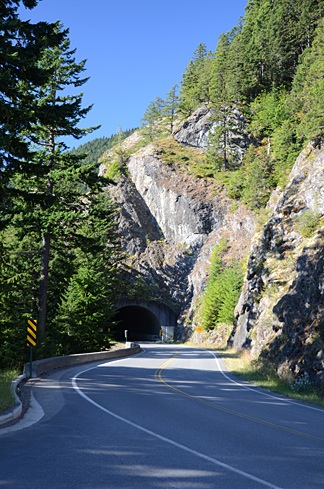
Tunnel on Hurricane Ridge RoadThe road climbed south slowly into the mountains on a narrow strip of park land. We found a parking area right before one of two tunnels and Mike parked the truck. There was a view to the northeast and we could clearly see the Juan De Fuca Strait, which runs between Washington and Canada’s Vancouver Island. It was relatively hazy and the conditions weren’t good for photography.


I spotted a paved path that wound into the woods and we followed it with our coffee cups and bags of breakfast pastries in hand. At the end of the short path was a viewpoint that looked southeast. The air was hazy; a wildfire was burning out in that direction beyond the mountains. Some interpretive signs talked about the rivers that ran invisibly in the cuts between mountain arms in front of us. I wasn’t sure, but I thought I could hear the water rushing in the distance.

We sat down on some steps and had our breakfast. A few people came and went.

Back in the car, we continued up the road. I should mention here that it was a remarkably beautiful day for that area of the country — not a cloud in the sky. Apparently, the area gets a lot of rain. We didn’t see any for the entire time we were traveling there, although we did run into some marine layer fog banks — more on that later.

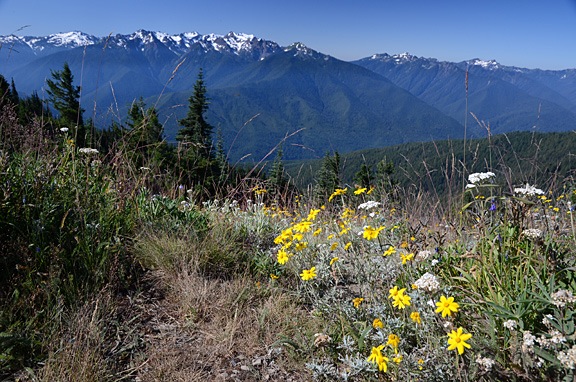
LupinesNear the end of the road was the Hurricane Ridge visitor center, a building with a gift shop, food, and great views to the south. There were also a few paved and unpaved paths that wound through grassy, flower-strewn meadows. We parked the truck and went for a walk. The quantity and size of lupine were phenomenal. Tall stalks of magnificent purple flowers seemed to grow everywhere.

Although the views in every direction were magnificent, a layer of smoke and haze from the wildfires miles away made it difficult to capture images of what should have been pristine wilderness. There was still snow on the peaks to the south of us and, with a pair of binoculars, we could examine the few remaining glaciers from afar. (There was also snow at our elevation, mostly on the north side of hills that would get little direct sunlight during the day.)

Snow-Capped Mountains

Mike and I spent quite a bit of time photographing the wildflowers. Although lupines dominated the scenery, there were some other wildflowers to capture in pixels. You can see two of my better closeup shots below. (You can click any photo with a watermark to see a larger version in my photo gallery.)

Butterfly and Bee Indian Paintbrush

We weren’t the only photographers up there, either. I saw at least two other people with tripods. (I was using my monopod.) You really needed some kind of platform to steady the camera when doing closeup images of the flowers.

After close to two hours exploring the area, we hopped back in the truck and continued down the road to the trailhead for Hurricane Hill. We wandered about a half mile up the trail, trying hard to lose a group of noisy hikers who seemed to pause every time we did. We finally turned around and walked back to the truck, eager to continue our trip.

We retraced our route back down the road, turning just after the park gate onto Little River Road. This road, which was mostly outside the park limits, was a “shortcut” that would take us to the Elwha area of the park. It was mostly paved; the unpaved part was smooth enough. We drove past patches of clearcut forest, along with areas of obviously new growth. The Olympic Peninsula — as well as much of Washington and Oregon states — have many tree farms where trees are planted and harvested for lumber. Most of the old growth forest is gone; the trees in the new forests have straight, narrow trunks.

We turned into the park road toward, heading toward an observation point. We flashed out park pass at the ranger and got a map for our efforts. Then we followed the Elwha River south. The water was rushing — even this late in the year — and there were huge pileups of tree trunks deposited by seasonal flooding.

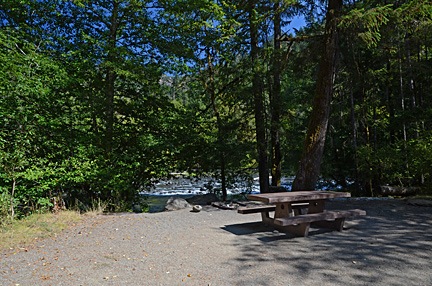
Picnic SpotWe were hungry and planned to dig into some of the cheese we’d brought along when we got to the observation point near the end of the road. But the road was closed for some kind of construction. So instead, we turned into the Altair Campground, which was mostly empty, and pulled into the first campsite, which was right along the river. We carried the cooler over to the picnic table, opened it up, and had a great meat, cheese, cracker, and cucumber lunch.
Afterwards, we headed out of the park, following route 101 northwest. A Piedmont on Crescent Lake, we turned north on a road that wound through more forest to Route 112. Eventually, we were back on the north coast of the peninsula.

We made a brief stop at a small park where we walked along a rocky beach. The tide was mostly out and the weeds that had been deposited on the shore were stinky and buzzing with flies. We didn’t stay long.

Route 112 left the shore and came inland, intersecting with Route 113. We followed 112 north to Clallam Bay. From there, we passed through the small communities of Sekiu, which appeared to be a very large RV park, and Neah Bay, a town on Makah Reservation. We followed the signs to Cape Flattery on a road that cut through the tip of the peninsula to bring us to the ocean side. We followed the road to the end where there was a relatively full parking area for the Cape Flattery trail.

Despite the fact that this trail is so far away from “civilization,” it’s really worth visiting. It immediately dives into the forest on an easy-to-follow pathway that descends gently under a dense canopy of evergreen trees. Most times, this trail is likely dripping wet with typical coastal rain forest weather, but the day we visited it was damp but mostly dry, with bright afternoon sunlight filtering through the branches. Where the trail was likely to encounter mud, it was “paved” with wooden planks or round cross-sections of large logs. It gave off a sort of magical feeling, as if we’d entered into a fairy tale, following the path of Little Red Riding Hood or Hansel and Gretel — but without the danger at the end.

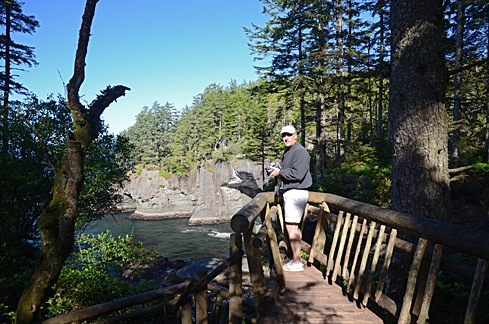
Mike At Cape FlatteryAs we got closer and closer to the point, we could clearly hear the ocean waves crashing against rocks. There were a handful of short side trails to points where you could see the rocky shoreline. Some of them had been built up with rustic log rails to prevent a fall into the water below.
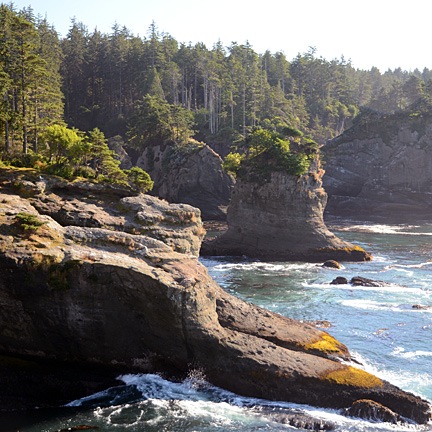
StacksAt the end of the trail was a platform that looked out to the northwest. There was an island out there with a lighthouse on it. To the north, was the opening of the strait and Vancouver Island; a container ship slowly made its way in toward the ports. Waves crashed on the shore against odd-looking formations called “stacks.”

Natural BonsaiBeyond the platform, a lone tree grew like a natural bonsai right at the edge of the cliff. Its gnarled trunk was twisted and curved from years of exposure to the elements. It made an interesting foreground subject for a view of the ocean and stack beyond it. I can imagine the shot being much better, with first light on the scene and a coastal mist partially obscuring the offshore landmarks.

By this time, it was late afternoon and we needed a place to spend the night. We debated about driving all the way back to Forks, which was on the way south. The Maps application on my phone — once I got back within range of the network — mentioned lodging farther south on the coast. I called the phone number. A recording answered and said the office was closed. It was 5:30 PM. I couldn’t understand how a place with cabins could just close at 5. We drove past and saw a bunch of relatively nice cabins, mostly unoccupied, adjacent to an RV park. The office was indeed closed. Their loss.

So we backtracked through Neah Bay and headed toward Forks. Despite very promising signs at Neah Bay about lodging, there was no place there I’d even consider staying. Between Sekiu and Clallam Bay, we spotted a motel with a restaurant next door. We pulled in.

I can’t remember the name of the place and that’s probably a good thing. It was not pleasant. The unit they put us in was at the end of a single-wide manufactured building. It consisted of two very small rooms, one of which had a kitchen it it. Although the place was clean, it was extremely run down and had a weird smell. I think it caters to fishermen. It did have a full sized refrigerator, which was good for us, because it let us store our remaining cheese and re-freeze the bottled water and freezer packs we were using to keep them cold. And it was quiet. And the restaurant was next door.

And, oh yeah: it was pretty cheap.

We had dinner in the restaurant next door. I had a fried fish platter, which was actually pretty good. We shared an ice cream sundae. Then we went back to our room with its cardboard walls, and called it a day.

I was exhausted.

Our Route: