Mike and I take a ride in the desert.
Since I’ve begun flying, I’ve not only been neglecting my motorcycles, but I’ve been ignoring my horses.
Mike and I have two horses. While I know that might seem like a big deal to the folks living in cities who are reading this, it isn’t a big deal at all when you live in Wickenburg, AZ. Much of the property here is “horse property” — that means that property where you’re allowed to have horses. We have 2-1/2 acres of “horse property” and wonderful trails in the desert are only minutes away by horseback.
Our horses spend most of their time in a one-acre corral down in Cemetery Wash, where they have plenty of room to walk around or stretch out in the sun. But they spend most of their time standing by the water trough, napping. Except near dinner time when Cherokee, my Paint Quarter Horse, decides it’s important to pace in the same path over and over until we feed him and his buddy Jake.
Some of my neighbors have horses, too. It’s easy and not terribly expensive. Hay costs $8-$10/bale here and a bale can last a horse 4-5 days. The only other major expense when you board your horse at home is shoeing — figure $55 per horse every 6 to 8 weeks. Cherokee, because of all his pacing, needs new shoes every 6 weeks; Jake could go 8 weeks, but we get them shod together to save our farrier the bother of making two separate trips.
Our horses get fed twice a day. We feed them in the morning before we go to work and in the evening, usually right before dinner. They make horse poop (of course) and we use an ATV with a sort of drag trailer behind it to break up the poop. It dries up in this hot, dry air and doesn’t even really smell. When the wash flows, it takes all the broken up poop downstream where it probably makes a really good fertilizer.
They don’t need a barn. This is the Arizona desert. The coldest it ever gets is in the high 20s, and that’s only at night during the coldest months — December and sometimes January. They grow heavy winter coats that shed (like a dog’s) in the spring. They’re shedding now; every time we brush them a bunch of hair comes off. We let the hair fall to the ground where we brush them and birds come around and pick it up to use it for their nests.
The horses do need a shade to keep them out of the hot sun. And plenty of fresh water — about 15-25 gallons per day per horse, depending on how hot it is. We have a hose running down to their yard and attached to a water trough that automatically keeps the same water level all the time. Easy.
So it really isn’t much of an expense or a bother to have horses living at home with you.
We’re fortunate to have miles and miles of riding trails in the empty desert behind our house. Our house doesn’t border state land, but the house behind us does. To get to the trails, we either ride up the unpaved road from our house to our “next door” neighbor’s house and go through the gate there or just ride down Cemetery Wash. So we can saddle up at the tiny feed barn we have halfway up the driveway to our house and ride out from there. Easy.
Since I started flying, I have a lot less time to do things like go horseback riding. Still, every once in a while, Mike talks me into it or there’s a ride with the Wickenburg Horsemen’s Association that I can participate in. And I’m always glad to be back in the saddle again.
Today, we had a nice, leisurely, Easter Sunday ride from our house, down the wash, through the slot canyon, and out into the state land adjoining Rancho de los Caballeros. Los Cab (as the locals call it) is our best “dude ranch” and it has miles and miles of maintained trails out in the State and BLM land. We were out for about 2 hours and took a bunch of different trails we hadn’t been on in a long time. I had my old GPS turned on and tracking the trail we rode — I’m making a map of the trails out there using the GPS — you can see our path on a topo map (courtesy of Terrabrowser software) below.

Our house is just below the W in Wash.
Oh, and if you want to see how it looks from a satellite in orbit around the planet, look at this:
The ride was 4.3 miles long and we were moving for about an hour and a half of that time. We ran into two other trail ride groups (from Los Cab) while we were out there.
Today was an incredible day. High 70s, light breeze, not a single cloud in the sky. What more could you ask for on Easter Sunday? The ride was just long enough to be enjoyable without being tiring for either us or the horses. I think we all enjoyed it.
When we got back, we hosed the horses off good. Jake took it like the ranch horse he is (or was) while Cherokee wiggled around, pretending he didn’t like it. They both rolled down in the sand, getting all dirty all over again, when we brought them down to their corral at the end of the ride.
A nice way to spend the morning. Makes me wish I could find time to do it more often.

 One of the great things about digital cameras is that you can snap as many stupid pictures as you like. You can then just delete them all without any money or film or paper wasted. But once in a while, one of those stupid pictures is a keeper. That’s what I think about this photo I took while Mike was driving us across the Whitestone Bridge, from the Bronx to Queens, the day after Thanksgiving, 2005.
 We had a rim-view room that overlooked some of the most beautiful rock formations Sedona has to offer. We spent the late afternoon on the room’s back patio, sipping wine and watching the setting sun change the shadows on formations like the Coffee Pot shown here.
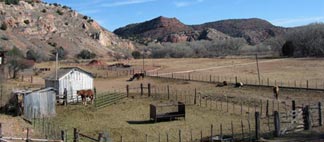 The ride ends at Perkinsville, where the canyon opens up to a broader valley. There’s a ranch there and the train stops literally in front of the ranch house. The place appeared occupied — there were horses and cattle there — but there wasn’t a person in sight. The conductor guy told us the story. Years and years ago, when the railroad was built, the land at the ranch was needed as a station to take on water and fuel for the steam engines. The railroad had offered the land owners a lump sum or a royalty for the use of the land. The Perkins family had taken the lump sum, giving up their control of the right of way. Today, under new ownership, the tour train had control of the land. The people who live in the house make themselves scarce when the train stops there on every run.
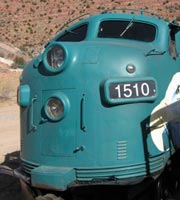 Why does the train stop at all? Well, this is the place the engines are moved from the front of the train to the back for the return ride. There’s a siding there and while we’re waiting, enjoying the scenery and feeling kind of bad for the people who have to deal with 130 tourists a day looking into their windows, the engineer takes the two engines and moves them. The task takes about 20 minutes and they sell ice cream sandwiches to us while we wait. Then we’re on our way back to Clarkdale at a slightly faster speed, leaving Perkinsville behind.
 The very first image I created for this site’s rotating headers — in fact, the only image that appeared before I even installed and activated the rotating header feature — is this shot taken from our vacation property at Howard Mesa.
