The Toyota Comes Home

We revive my comatose Toyota and bring it home from Prescott.

In October, 1986, twenty years ago last month, I bought my second ever brand new car: a 1987 Toyota MR-2. It cost a whopping $15K, which in those days was above average for a new car, but not really considered “expensive.”

And what did I get for my money? A really fun, 2-seater sports car. Red, of course — it was my first red vehicle. It was also my first five-speed, and since I didn’t know how to drive a manual transmission in those days, I couldn’t even drive it home from the dealer.

Less than a week later, I was driving it to work in downtown Manhattan. One of the perks of my job with the City of New York, Office of the Comptroller, Bureau of Financial Audit was a free parking space near the Municipal Building, where I worked. I worked an 8 to 4 shift in an attempt to avoid rush-hour traffic. (New York’s rush hour is later in the day than Phoenix’s and doesn’t seem to last as long. I think good mass transit has something to do with that.) My big challenge in those early days of driving with a clutch and gearshift was the ramp from the Harlem River Drive up to the Cross Bronx Expressway and George Washington Bridge on my way home. The ramp was a steep climb and it was always backed up in the afternoon. If there’s one thing that’ll teach you how to drive a stick shift, it’s being forced to drive uphill in traffic.

Six months later, I was working in Redbank, NJ, for another company. The 60-mile (each way!) commute was only one of the reasons I hated that job. I found another one after just four months — I started looking after only two — and settled down to the last “9 to 5” job I’d ever have, at ADP’s corporate headquarters in Roseland, NJ. That was a 30-mile commute. Just right for the MR-2.

Years passed. I left that job and went freelance. I had a few questionable years. Then things started looking up. I had money and flexible time. But I kept the Toyota. Why not? It was a fun car to drive.

In 1995 (I think) I drove it across the country to Yarnell, AZ, which isn’t far from my current home in Wickenburg. It was loaded down with all the things I’d need for a winter as a snowbird — possibly the youngest snowbird in Arizona. I spent three months living and writing in Yarnell. I got to know Prescott and Wickenburg. And that winter, my Toyota had its first accident.

It happened right downtown in Wickenburg, right in front of St. Anthony’s Church on North Tegner. I was driving through town with Mike, who had come to visit for a week. We were on our way to Tucson to meet with his cousin Ricky. The person in front of me was making a left turn into Yavapai street. I was going straight. Unfortunately, a senior idiot from Pennsylvania, driving in the opposite direction, decided to make a left turn right in front of me. The road was covered with a thin layer of sand and when I hit the brakes, the car slid right into the corner of the guy’s bumper. The impact wasn’t hard — neither of us were going very fast — but it was enough to put a dent in the middle of the Toyota’s front bumper that made it look as if I’d hit a pole.

To say I was angry is an understatement.

Although the car was already almost 10 years old, the insurance company sprung for the repairs. Three weeks later, it was good as new. Actually, a little better. The air conditioning had started working again.

Before I went back to New Jersey at the end of that winter, I drove the Toyota out to California for a weekend. I took a picture of it at the beach on the Pacific ocean. From sea to shining sea. I’ve since lost that photo. After all, it was taken in the days before digital photography.

In those days, we called the Toyota “the mule” because I’d found a roof rack for it and, when it was installed, we could pack all kinds of stuff on it. I drove back to New Jersey by way of Florida — I was a speaker at a writer’s conference there. Mike came with me. Along the way, we camped out at Big Bend National Park and were nearly washed off the road by flooding in New Orleans.

Two years later, the Toyota and I made the drive again. This time, we were moving to Arizona, to an apartment I’d found in Wickenburg. I’d had enough of New Jersey’s cold, snowy winters. I wanted a new life in a warm place. Mike would leave his job (kind of; long story) and follow me five months later, in May, when our house was sold.

In 1999, I bought the red Jeep Wrangler I still drive around quite a bit these days. The Toyota began a life of leisure in the garage, pulled out for trips to Prescott or Phoenix. It was starting to look its age, but the paint was still bright and it still ran like a charm.

In 2000, I bought a helicopter. It was a two-seater. About a year later, when I started getting helicopter maintenance done in Prescott, I decided that it might be nice for the Toyota to live up there. Then, when I flew up, I’d have something to drive when I got there. Since I flew up at least once a month or so — not just for helicopter maintenance; we prefer shopping in Prescott to shopping in the Phoenix area — the car was driven quite regularly.

Meanwhile, at home, I missed the Toyota. The Jeep might be fun on dirt roads, but it’s miserable on highways. The Toyota is fun on all kinds of paved roads.

In June 2003, I bought a Honda S2000. So now I had a Jeep for dirt roads and around town driving and a sports car for paved roads and road trips. I vowed to never let the Toyota know I’d bought the Honda. I didn’t want it to get jealous.

One time, we got to Prescott to do a little shopping and found the Toyota’s battery just about dead. Mike gave it a push down a hill while I rode inside, gathering speed. I dropped the clutch and the car came to life. We drove it to Sears and bought it a new battery — its third in about 15 years.

In 2004, I got a summer job with Papillon at the Grand Canyon. I lived in a trailer on our property at Howard Mesa. The Toyota became my spare car up there, spending time either at Grand Canyon Airport or Howard Mesa or taking me from one point to the other. It shared this duty with my Jeep. So yes, I had two cars and a helicopter with me that summer. What good is an asset if you don’t use it?

At the end of that season, the Toyota went back to Prescott, where it stayed until it needed an oil pan replacement, which I wrote about in another blog entry. I was flying up there less and less. I’d sold my little helicopter and bought a bigger one. It was brand new and didn’t need much maintenance, especially since Ed Taylor, Wickenburg’s excellent aircraft mechanic, had gone to the Robinson Factory Maintenance Course and was authorized to do maintenance and repairs. He did all my engine-related work — oil changes, fuel reorientation SB, etc. — while the Prescott folks handled the helicopter-specific stuff (rotor blades, gear box, etc) and 100-hour and annual inspections.

Earlier this year, I switched helicopter mechanics. I now take my helicopter down to Williams Gateway airport in Mesa for work. I flew into Prescott less and less. I realized that it was kind of silly to keep a car there.

A few weeks ago, on our return trip from a weekend in Sedona, we decided to stop by the airport and pick up the car. We found it looking sad and feeling comatose. Even a push start wouldn’t get it running. We towed it back to a parking space and went home.

Yesterday, we drove up to retrieve it, bringing along jumper cables and tools. It started right up with a jump from Mike’s Honda, but there wasn’t enough juice in the battery to keep the engine running when it was at idle or when switching gears at low speed. (It still has its original clutch, which is really starting to show its age, so it’s a bit tricky to drive.) After two attempts to get it out of the parking lot, we decided to park it, remove the battery, buy a new battery at Sears, and put it in ourselves. (We do have AAA, but we needed the car towed to Sears sometime within our lifetimes and AAA seems to have a problem with fast service when it comes to towing.)

At Sears, the guy who tested the battery said it was the second deadest he’d ever tested. (How he made that conclusion is beyond me, since his meter didn’t read a thing when connected to the terminals.) We discovered that the old battery was only 3 years old, so I got a new one at a discount. We bought some other stuff at Sears, had sashimi for lunch in a nearby Japanese restaurant, hit Office Max for a computer cable and Petco for dog vitamins, visited Old Navy for some winter shirts, and then spent an hour (and almost $300!) at Costco. At 4 PM, we returned to the Toyota, which was waiting patiently, looking more faded and forlorn than ever. Mike installed the battery and I hopped in behind the wheel. I stepped on the clutch pedal, turned the key, and the car roared to life. “Let’s go!” it was saying.

Sounded good to me. After manually cleaning the dusty windshield — the wipers have dry rot and need replacement — we headed home. You know, I had that little sucker up to 80 mph? Wasn’t meaning to, of course, and was pretty surprised to see that speedometer needle in the straight-up position.

Mike followed me, just in case the car decided to lose a wheel or collapse on the way home. No problems, though.

I stopped at Safeway to pick up some groceries on my way home. When I pulled into the parking lot, people looked at me as if I were driving some kind of junker. Little did they know.

The Toyota is home now, in one of Mike’s parking spaces on the driveway apron. For the first time in a long time, all six of our vehicles (including his 1986 Mustang Convertible, which, in my opinion, looks worse than the Toyota) are in the same place at the same time. My Honda is in the garage, of course. We toyed with the idea of bringing the Toyota to live in my hangar at the airport, but I think I’d rather keep it home, at least for a while. I’m going to drive it today. I’ll get it an oil change and a little check up at Dan’s place. (The Toyota loves Dan.) I’ll bring it by the airport to wash it. I’ll pull out the Zymol and see if it can make what’s left of the paint shine again.

And then, when I’m finished playing with it and convincing it that I still love it, I’ll take it down to the Phoenix area and probably park it at Deer Valley airport, or perhaps Scottsdale, if I can find free long-term parking. These days, I seem to fly more in the Phoenix area than around Wickenburg anyway. It would be nice to take care of some errands while I was down there.

Oh, and for the record, the Toyota has a book value of about $250 these days. It costs about $400/year to insure. (No, I don’t have collision coverage on it.) It’s hard to sell a nearly worthless asset when it’s so cheap to keep.

Corral Gate, Northern Arizona

An idyllic scene in high desert range land.

Mike and I own 40 acres of “ranch” land about 30 miles south of the Grand Canyon at Howard Mesa. For the past three years in a row, I’ve spent a good portion of my summer camping out there with my dog, bird, and horses.

I’m an explorer. I like to look at a map, find a potential destination, then hop in my Jeep (or helicopter) and see what it looks like. On a summer day in 2006, Jack the Dog and I took the Jeep to follow some of the dirt roads that run through National Forest land just south of the Grand Canyon’s South Rim. My objective was to take a photo of the Grand Canyon Railroad’s steam engine as it made its way to the depot in Grand Canyon Village.

I wrote about that day in my blog, so I won’t spend a lot of time repeating myself here. I’ll cut to the chase.

Corral GateThis gate and corral was on one of the roads I followed near the railroad tracks before I got into the National Forest. Nearby were the remains of a few buildings. It had once been part of a train station where cattle had been loaded onto cattle cars and shipped south for sale and slaughter. Now it’s just a picturesque spot on a remote dirt road, captured with my camera during a Jeep outing with my dog.
How to Wash a Helicopter

It’s a dirty job, but someone has to do it.

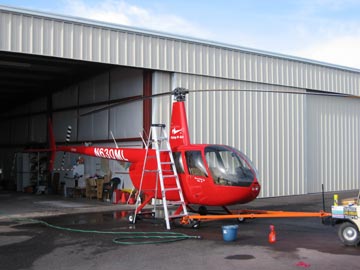
I washed my helicopter today. It isn’t the first time I’ve done the job and it won’t be the last. I don’t like doing it — it rates right up there with washing Alex the Bird’s cage. But it has to be done periodically to keep it looking nice for the folks who spend big money to fly in it.

Take a moment to consider the task. The helicopter is about 32 feet long from the front of its cockpit to the end of its tail. (Or 38-1/2 feet, if you include the main rotor blades, lined up front and back.) It’s twelve feet tall, from the bottom of its skids to the main rotor hub. The surfaces are painted aluminum and Fiberglas and Plexiglas. Few of the surfaces are flat.

Over the past two years, I’ve developed a technique for washing the helicopter. I start by pulling it all the way out of my hangar so it’s parked in front, on its ground handling equipment. I get a bucket of warm (or hot) water from the airport terminal (I don’t have hot water in my hangar) and add some car wash liquid detergent. I like Rain Dance, but I had some other “spot-free” stuff that I used today. I make it all sudsy with the hose. Then, after making sure all the doors and vents are closed, I get down to business.

The first task is spraying down the tail section, from the end of the main part of the body to the tail rotor. I use a spray nozzle on a hose. Power washers are not allowed and some people think you shouldn’t use a hose spray nozzle either. My response: how are you supposed to rinse it off?

Once it’s wet, I start at the very end and work my way forward with a car wash sponge and the warm soapy water. It’s the kind of sponge that’s spongy on one side and a bit rougher on the other. I use the rough end on the leading edges of the horizontal and vertical stabilizers and the tail rotor blades to remove the dead bugs that have accumulated there. They usually come right off with a little elbow grease. I need to climb a ladder to get the top of the vertical stablizer. I use an 8-foot ladder that I keep in my hangar for preflighting the main rotor hub. While I’m doing this, I’m checking all the screws and rivets and the tail rotor’s pitch change links, looking for weird stuff that I might miss on a preflight.

Then I rinse where I washed and rewet the forward part of the tail cone. I do a lot of rinsing. Unfortunately, unless I wash the helicopter an hour or two before sunset, I have to wash it in the sun. The Arizona sun likes to dry things very quickly. That’s not a good thing, because the water has a lot of minerals in it and it tends to spot when it dries, no matter what kind of car wash detergent you’re using. So I keep it wet until I can get it out of the sun.

I continue washing and rinsing and checking screws and rivets, moving forward on either side of the tailcone until it’s all done. I make sure I wash off the strobe light and antennas back there, too. Then I move the helicopter back into the hangar a bit so the part I just washed and rinsed numerous times is now in the shade and the rest of the helicopter is still outside.

Now I’m up to what I call the R44 butt. It’s a panel that covers the rear end of the fan scroll at the back of the engine compartment. It gets coated with a white, kind of greasy film. Car wash soap cannot remove it. So I get out what I call R44 Butt Cleaner. It comes in an orange spray bottle. I spray it all over that panel, as well as at the bottom of the tailcone near it, which also gets that nasty film. I spray so everything’s coated. Then I get out a shop rag and wipe the film right off. This stuff works great and I’m thinking of repackaging it and selling it to R44 owners as a specialized R44 product at three times what I paid for it.

Although the panel is all shiny when I’m done, that’s not good enough. I want to wash off every trace of whatever that junk is. So I spray it down and continue with my wash, rinse, wash, rinse routine.

Next are the skid pants. That’s not what they’re really called, but it’s what I call them. The skids are the long black things that make contact with the ground when the helicopter isn’t flying. There are four legs that attach the rest of the helicopter to the two skids. Each leg has an aluminum fairing. That’s what I call skid pants. Their front, rounded sides get full of dried bugs, which I usually scrub off with warm soapy water and the rough side of the sponge. Today I used bug and tar remover with a brush.

I do the back end of the body next, along with the back windows. They’re “bubble” windows that kind of bulge out so passengers can stick their heads out a bit and look in all directions. I use the soft side of the sponge; they don’t usually get very dirty.

Washing a HelicopterNext is the mast, which has a cowling over it. The front, rounded side of the cowling is completely covered with baked on, squished on bugs. It’s bad, mostly because it’s so darn high off the ground that I need a ladder to clean it so I only clean it when I wash the whole helicopter. I used bug and tar remover with a brush on it today. Not a good solution, but it did work. I have to move the ladder and climb up either side of the helicopter to wash it all properly. Then it’s rinse, rinse, rinse and move the whole thing back a bit more into the hangar.

The front bubble comes next. It’s usually pretty clean — after all, it is the window I look through when I fly, so I wash it before just about every flight. The area under it — including the painted area around the landing lights — is another story. The bugs are really stuck there. On a whim, I decided to try the R44 Butt Cleaner. Would you believe it worked? No scrubbing required, either. Of course, I still had to wash that junk off, so I did double duty. But it is the cleanest it’s been in a while.

After a good rinse, I move the whole helicopter back into the hangar and begin the drying cycle. I use towels. I have a bunch of towels that are pink because I consistently wash them with red shop rags. They’re my helicopter and car wash towels. I use them to dry the whole helicopter, from the bubble back. The tailcone is usually just about dry by the time I get back there, but I dry it with a wet towel anyway, just to prevent the spots from setting in.

No, I don’t wash the main rotor blades. They’re drooping about 11-1/2 feet off the ground and are very difficult to reach to wash properly. I’d have to climb to the second to the last step on the ladder, which I’d have to reposition four times for each blade. It’s a ton of work and I get very wet, with soapy water running down my arms as I reach up. And I simply can’t deal with the ladder thing.

It’s kind of funny, because I had a perfect technique for washing the blades on my old R22. Those blades weren’t nearly as high up. I’d drive to the airport in Mike’s pickup truck and back it up, perpendicular to the helicopter, aligned with the mast. Then I’d turn the blades so one of them was lined up right over the bed of the pickup. I’d climb up in the bed of the pickup with my bucket and sponge and wash the blade, top and bottom, scraping all the dead bugs off the leading edge. Then I’d climb down, spray the blade to rinse it, and rotate the blades a half turn so the other blade was over the bed of the truck and repeat the process. Another wash and rinse cycle and I was done. One time, I even waxed them.

Unfortunately, the R44 blades are so high off the ground that I’d need a ladder inside the bed of the pickup to use the same method. And that’s not something I’m ready to do. So they go unwashed until their 100 hour or annual inspection. The guys who do the maintenance wash and detail the whole helicopter for me, including the blades.

The was job takes a good hour. It goes faster with help — one person can rinse while the other washes and it gets done very quickly. Then it’s usually still wet when we dry it off.

If I have time and it isn’t too hot, I use some spray wax to finish it off. It’s sold as RV cleaner/wax and it does a nice job, as long as you use it in the shade. It dries too quickly in the sun. I don’t usually do the whole helicopter. It takes too long. Instead, I start with the painted surfaces in the front and work my way back. I usually run out of steam before I get to the tailcone.

I didn’t wax it today. I ran out of time and had to get it out on the ramp for a flight. It sure looked good out in the sun, all clean and shiny.

Although I don’t like to wash the helicopter — primarily because it’s so much work and I always wind up getting dirty and wet — I’m glad I do it. It gives me an opportunity to look over the entire ship closely. I once found a loose screw on the mast cowling and have never forgotten it. Now I check every screw, every rivet. There hasn’t been a loose screw since, but if there is, I’ll find it.

Dining in Sedona

Disappointing, I’m afraid to say.

Oak CreekEarly this year, in February, Mike and I took Mike’s mom to Sedona for an overnight trip. While we were there, we thought it might be nice to return in the autumn to enjoy the fall colors. After all, there are trees in the area. Oak Creek Canyon is full of them. We figured they must shed their leaves in the autumn like the trees we knew back east.

So we made reservations at Sky Ranch Lodge, one of Sedona’s best kept lodging secrets. We made those reservations in February for this past weekend in October.

One of the nice things about Sky Ranch Lodge is that they allow pets. This worked out really well for us because we wanted to do some hiking, which Jack the Dog loves to do, too. And, as usual, we had trouble finding someone to bird-sit for Alex the Bird (mostly because he’s mean to just about anyone except me). So we brought the both of them with us.

It was actually kind of comical. Imagine a Jeep Wrangler with the back seat pulled out. Now add a birdcage, a standard wheelie bag, a small cooler, two canvas bags of stuff, and a border collie/australian shepherd mix. All that’s in the back. In the front are two full-sized people. Now imagine this Jeep load driving from Wickenburg to Sedona, by way of Yarnell, Peeples Valley, Wilhoit, Prescott, Prescott Valley, Jerome, and Cottonwood. With a nice stop along the way at the Cornerstone Bakery in Yarnell (excellent, as usual) and Murphy’s Grill in Cottonwood (highly recommended). We arrived at 1:30 PM to check in and, after some confusion about the reservations (they were in Mike’s name, not mine), we were told to return at 4 PM when the room was ready.

We spent the next two hours traveling around the area, climbing up Oak Creek Canyon to the view point at top, and hitting the local natural grocery story, New Frontiers, where I was tickled to find a cheese counter with a man who actually knew about cheese. I left $98 there and we headed back up to Sky Ranch with two bags of cheese, crackers, and other snack foods.

Our room wasn’t a room. It was a cabin right on the mesa’s rim, overlooking the town of Sedona and all those wonderful red rocks to the north and west of it. Two queen beds, a kitchenette, sofa, table and chairs, gas fireplace, and private deck. I set Alex up on the coffee table and we spent some time unpacking. Then we watched the sun set from the comfort of the deck, each with a glass of wine and Jack curled up at Mike’s feet.

Very nice.

Dining wasn’t quite so nice.

Now if you’ve been reading this blog for a while, you know that food is a major part of my life. I like to eat. I like to eat well. I don’t always get a chance to eat well, but when the opportunity is there, I usually take advantage of it. And since Wickenburg is not exactly a hotbed of fine dining opportunities (more on that elsewhere throughout this blog), any time we’re out of town is a potential opportunity for something new and different to eat.

Even the cheese counter at New Frontiers was something far and beyond what I can get at home, so it really isn’t hard to please me.

Last time we went to Sedona, we ate at Shugrue’s Hillside. It’s a relatively posh restaurant with $$$$ prices (in the usual $ to $$$$$ range). The food was fine but the waiter was absolutely horrible. He insisted on calling Mike’s mother “sweetheart,” even after we asked him not to. He tried serving our main course while we were eating our salads (no, I didn’t let him get away with that), and he made one other major infraction (which I can’t recall at the moment). He completely ruined my meal. An expensive meal that I paid for. I gave him a crappy tip and complained to the manager about him.

We didn’t go back there this past weekend.

Instead, we tried a place recommended by Dee at Sky Ranch: Savannah’s. It seemed like a nice enough place. But I made my first mistake when I asked the hostess not to seat us next to the live music. (I really don’t like loud music when I eat. Maybe it’s because I can’t chew, swallow, and listen at the same time.) She evidently didn’t have anyplace else to seat us indoors, so she took us outside to show us the “cabin,” which she said was a more intimate dining room. FIne with me. Unfortunately, she stopped at what appeared to be a tent that had been erected along the way. It was decorated with black and white sparkly fabric and had white Christmas tree lights all over it. There were people sitting at tables eating and outdoor heaters keeping the enclosed area warm. It looked like a wedding reception sans bride and groom, with a handful of guests who didn’t know each other.

“Unless you’d like to eat in here?” she suggested. She looked at Mike.

Mike was zoned out from the cold he’s battling and hadn’t heard about the intimate dining room that was a bit farther down the path. “Fine with me,” he said. I kept quiet. Mike’s a lot pickier than I am about where we sit in restaurants and I was afraid he wouldn’t like the other option.

So she sat us in the tent.

I watched a waiter greet another table. He was extremely professional and pleasant. At least we’ll get good service, I thought to myself.

Wrong! Our waitress bounced up to the table. She was typical dumb blonde material, about 22 years old, and dressed in a ridiculous outfit that included a short black and white striped skirt (think referee), black pants, and a black shirt. She told us briefly about the specials, managing to make them sound not very special at all, and made some inane comments which completely turned me off. Then she bounced away, leaving us to stare at each other in dumb shock.

At the next table, the professional waiter was providing detailed information about the specials, filling us in on what we’d missed by sitting at the wrong table. In a tent.

The beverage consultant, Steve, greeted us next. He looked like a cleaned up hippie, but was also professional, knowledgeable, and friendly. He promised to return once we’d studied the wine list.

After a while, our waitress bounced back in to take our order. We ordered Chateaubriand for two. The restaurant had “toppings” and sides. Toppings were additional sauces or other things that you could put on top of your meat. She suggested hollandaise — which made me cringe. We both chose caramelized onions. She then attempted to take our beverage order. At first, I told her the wine we’d been thinking about and she wrote it down, but then I told her I wanted to consult with Steve to get his opinion. She disappeared to get him. Heck, if there’s a beverage consultant available, I may as well make use of his services. I could learn something new.

Turns out, the wine I’d chosen was no longer available — how would the waitress have handled that, I wonder? — and Steve suggested an alternative. When he returned to serve the wine, I was very glad. Just the other day, some dimwit waitress had tried to serve us wine and had spilled a good portion of it on the tablecloth and all over the outsides of our glasses. Steve was extremely capable and — dare I say it again? — professional. That’s a nice thing. When you’re spending $50+ on a bottle of wine, you want all of it to get in your glasses. (And yes, I know that $50 isn’t a lot of money for a bottle of wine in a restaurant. But that’s about the high end of our budget, so it’s a lot to us.)

The dippy blond remained outside the tent for about 20 minutes. We talked and watched the other diners get service from their servers. Then she bounced back in with two shot glasses of an extremely icy sorbet. Raspberry and basil, she said. Okay. She bounced back out. We ate it. It was weird but not bad. Just icy. Like with little bits of ice in it.

The busperson (is that what they’re called these days?) appeared to remove our empty shot glasses. Even he was giving better service than our waitress.

She bounced in after another fifteen or so minutes to tell us that our meal was next. While we waited, we watched the other tables be served salad by one of three different servers. One of them (a woman) had tattoos on her back. She’s also the one who told the table next to ours that there was chocolate soufflé for dessert, but it needed to be ordered with dinner because it took 35 minutes to make. Chocolate soufflé! Now that’s not something we’re likely to get in Wickenburg.

When our waitress bounced back in with our meals, I said, “I heard a rumor there was chocolate soufflé for dessert.” To her credit, she didn’t miss a beat. “Did you want some of that?” she asked. “I’ll put in the order.”

We started eating our excellent meal. The beef was tender without an ounce of fat on it and cooked to perfection. The accompaniments were delicious. And the wine was perfect.

But I think I had scared our waitress with my soufflé comment. She started checking in on us. She’d bounce over to the table and ask how everything was. Then she’d pick up the wine bottle and gingerly pour about 1/2 ounce in each glass. She did this three times. I think she realized that her tip was in jeopardy and was trying to make up for it. Too little, too late. I was still wondering why we were the only people in the tent who didn’t get salads.

She returned after our plates had been cleared and took orders for coffee (me) and tea (Mike). She brought them quickly. My coffee was cold and weak. That probably isn’t the restaurant’s fault. Most restaurants seem to serve coffee-flavored water. Unfortunately, I like the kind of coffee you can’t see through if you pour it in a glass cup.

Then she brought the soufflé. She placed it in front of Mike, dug a little hole in it with a spoon, and poured some kind of sauce in the center. Then, thankfully, she went away.

The soufflé was out of this world. Worth sitting in a tent to eat. And worth dealing with an airhead bouncy waitress.

She bounced back with the coffee pot to warm my coffee and bring the check. I told her not to bother; the coffee was too weak to drink. She offered to make me a fresh pot. I told her not to bother (it would just be as weak as the first pot; that stuff is premeasured), that I’d just finish my wine. She looked at the check and said she’d take the coffee off of it. I told her that wasn’t necessary but would be nice.

I paid the bill. I didn’t give her a good tip. But I didn’t stiff her, either.

All the way back to the lodge, Mike and I debated how a good restaurant could hire a waitress like that.

My Jeep in SedonaThe next day, we took the Jeep and Jack the Dog out on Sycamore Pass Road, which winds through the desert to the Dogie trailhead. We went for a short hike and I managed to twist my ankle so badly that I thought for a while that it was broken. Mike and Jack hiked without me, leaving me in the shade to study the maps and think deep thoughts about nothing in particular.

Afterwards, we went back into town, where Mike bought an ankle brace for me. We put it on, then headed out on Dry Creek Road in search of a good picnic spot. Mike found a good spot on a little hill just before the second trailhead. It looked out on the red rocks with a golf course and very large house beneath them. Picturesque. We set up the folding chairs I keep in the back of the Jeep and used the top of the cooler as a table. Then we dug into that wonderful cheese, along with some olives and salads we’d also bought at New Frontiers.

TlaquepaqueLater, we visited Tlaquepaque. Although the merchandise in the shops is generally priced above our budget, it’s a very pleasant place to walk around. My bum ankle slowed me down a little, but we still managed to stroll the whole place before returning to the Lodge.

Dinner that night was another less-than-perfect experience. It was a Sunday night and we figured that with all the weekenders gone, we’d have no trouble getting a seat in a restaurant. Not true.

The first place we went to, a Japanese place on Jordan Road, had some empty tables, but the person at the desk told us they were “completely full.” I like to think that he was talking about people who had reservations and were expected shortly. They didn’t have a sushi bar to sit at, so we left.

We left Uptown Sedona and headed west on 89A. Mike was looking for a restaurant he’d seen earlier in the day. We couldn’t find it. We wound up at Reds, the restaurant in the Sedona Rouge hotel. It was about 6:30 PM at this point and only half the tables in the smallish dining room were full. A hostess seated us with a pair of menus, along with what she said was the Specials menu. It was a Dessert menu. We watched one waiter go from table to table, apologizing for the wait. That’s when we realized that there was only one waiter. Good thing the restaurant wasn’t full.

We didn’t have to wait long at all for the waiter to visit us. He traded the dessert menu for a specials menu and took our drink orders. The hostess brought them a short while later. When the waiter returned to take our order, we ordered three appetizers off the two menus. We weren’t terribly hungry so soon after our huge cheese lunch. We like variety in our food and often order a bunch of appetizers rather than two main courses.

Little did I know it then, but this would put us at the very bottom of the waiter’s priority list when the restaurant started to fill up. We waited a good 20 minutes for the first appetizer and then another 15 minutes for the other two. The waiter was working on all the tables around us, handling them rather well. He had a full staff of buspersons to help him out with the basics like clearing plates, filling water glasses, delivering food, etc. But somewhere between the first appetizer and the second two, he began to openly ignore us. He asked the couple at the table beside us how their salad was three times (the last time, the salad plates had already been cleared), but didn’t visit us at all. This continued after we finished our meal and the plates had been cleared. I was looking forward to the banana crepe I’d seen on the dessert menu, but I had no opportunity to order it. We sat for at least 20 minutes waiting for him to come by or to get the opportunity to flag him over. He was completely ignoring us and doing it in a very obvious way.

He finally stopped by and offered us our bill. He did not ask if we wanted dessert or coffee. Just the bill. Since I didn’t want my dessert for breakfast, I took it.

Now I don’t want you to think we ordered three appetizers because we’re cheap. That’s not the case. Our bill for two drinks and three appetizers came to over $70 — which is the same as it would have been if we skipped the appetizers and ordered two entrees. And I don’t think I’m being unfair to the waiter in expecting him to pay a little bit of attention to us, even though the restaurant was filling up and he was the only server. I just think he was suffering from what Mike and I now call the “Sedona Syndrome.”

The Sedona Syndrome is a hospitality industry affliction. Its symptoms include a poor attitude toward the throngs of tourists that flow through the place on a regular basis. Since most of these people don’t live in town, hospitality people don’t have to worry about return business. And since there’s such competition for restaurant seating, they can treat customers any way they like because there’s always someone out there to fill a seat. In other words, service doesn’t matter.

This, I believe, is the fault of the customers. People are so willing to accept poor service that few hospitality industry folks in tourist destinations (and elsewhere) are motivated to provide good service. After all, why go the extra mile if your clientele are willing to settle for the first 20 feet?

The next morning, we went to the Sedona Airport Restaurant for breakfast. (Pardon me if I don’t link to their Web site; it revolves around a stupid animation with music and I just can’t support that kind of Web work.) We sat by a window overlooking the runway and had a good, inexpensive meal served by someone who actually seemed to care that we were there. The best service of any restaurant we’d visited in Sedona.

Later in the day, on our way back to Wickenburg, we stopped at the Asylum at the Grand Hotel in Jerome for lunch. I highly recommend this place. It sits high on the hillside, overlooking the Verde Valley. We had an excellent lunch of interesting and well-prepared food served by a waiter who was pleasant and attentive. Our lunch with tip wasn’t cheap, but it was worth every penny.

But that was to be expected. We were not in Sedona.

A Whinny in the Night…

…means there’s something wrong.

Horses are generally very quiet animals. They spend their lives eating, pooping, and sleeping. And they do it without vocalizations.

So when I woke last night at about 1:30 AM to the sound of a horse whinnying, I didn’t just roll over and go back to sleep.

Although Wickenburg has traditionally been a horse-property town, the new subdivisions going in all over town don’t allow horses. How could they, with lot sizes shrinking from over an acre per house (we have 2-1/2 acres) to 1/2 acre or less? Even the subdivisions with relatively large lots bordering open land — Saddle Ridge comes to mind — have prohibited horses. Many horse people are moving out of town and existing horse property is being bought by newcomers who don’t have horses. So while there used to be nine horses in our immediate area, there are now only five. And two of them are ours.

Jake and Cherokee at Howard MesaJake and Cherokee are a pair of Quarter Horses. Jake is a former ranch horse that was likely abused — or at least handled roughly — during his working life. He’s very hand shy — don’t try to pet his face! — and doesn’t like to be bothered on his free time. To him, that means any time there isn’t a halter on his face or a saddle on his back. But get him saddled up and he’ll do whatever you want. Jake’s about 25 years old now, which is getting up there in years for a horse. He’s sorrel (reddish brown) and has a swayback. He’s the alpha male in our little herd, bossing around his buddy and terrorizing any other horse we might put in with them.

Cherokee is a paint Quarter Horse. He’s a very pretty boy and he knows it. Previous owners spoiled him and neglected to train him properly, so when we got him, he was difficult to handle and rather “bratty.” Over time, I showed him who was boss. He still tries to get away with things — stopping for no reason on a trail, dancing around while being saddled, biting Jake’s back leg on a trail ride — so whoever rides him has to be on constant vigilance. We don’t put visitors on Cherokee’s back. Cherokee taught me how to fall off a horse — and it took me several lessons over that first year to get it right. I taught him that rabbits were nothing to be afraid of. He’s about 17 now and very fat because he manages to eat more than half the food when we feed the two horses together.

Anyone who thinks that horses are just big dumb animals have obviously not spent any time around horses. Each horse has its own personality and, once you get to know a horse, you can predict what he’ll do in any situation. Jake is all business. He’s calm and will never kick or bite anyone — including another horse — while under saddle. You could drive a freight train right by him while there’s a rider on his back and he’d probably stand his ground until the train was gone. He’s very standoffish when he’s not working. Cherokee is the complete opposite. He’s friendly and will often come up to the fence when another rider goes by, just to silently say hello. He’ll always come to the fence when our friend Pete comes by with his grandkids or when John and Lorna stop by. He knows they bring treats and he wants to get the carrot or apple they’ve got for him. He loves to be petted and brushed and talked to. But get a saddle on him and take him out on the trail and you never know what might spook him or how he’ll behave.

The two horses are buddies, although it wasn’t Jake’s idea. Jake seems to hate every horse while Cherokee seems to love every horse. So when we first put them together, Jake would chase Cherokee away from him and his food and Cherokee would keep coming back for more. He’d be bitten and kicked but he’d take it like a dope. In time, he wore Jake down and now Jake doesn’t chase him off so often. It’s like he’s given up because he knows how useless it is.

Of the two of them, Jake is more vocal. He whinnies around feeding time, when he sees one of us around the hay shed preparing the food. It’s like he’s nagging us. “Hurry up! I’m hungry.” It’s an impatient whinny. Although Cherokee’s life revolves around food, he’s quiet about it.

The only other time they’ll whinny is when they’re separated. Horses are herd animals. They like to be together. When one of them is taken out for a ride or to the vet without the other, the remaining horse whinnies. Sometimes they both whinny. But if the one taken out is with other horses, he’s okay and usually stays quiet.

Sometimes when you get a bunch of strange horses together — like when we go on a trail ride with the Wickenburg Horsemen’s Association — they’ll whinny at each other. But our boys don’t usually participate in that ritual. They’re generally very quiet.

So when I heard a whinny in the middle of the night, I knew something was up. And since only two houses in the neighborhood have horses, there was a good chance that the problem was in our corral.

Now a lot of people who don’t live in a warmer climate think that horses live in barns. In colder climates, they often do. But not in Arizona. Most of the horses that live in Arizona live outdoors year-round. Our boys have two corrals: a large acre+ enclosure down in the wash (a dry riverbed) that runs through our property and a smaller pen with a turnout halfway up the driveway to our house. They spend the day together down in the wash, unless heavy rain is possible (and the wash could run). They eat their morning meal of alfalfa and grass and stretch out on the sand in the late morning for a nap. They spend the afternoon nibbling on whatever grass is left or biting the seed pods off the mesquite trees around them or just standing around the water trough dozing. At around 6 PM, we move them to the upper corral, where each of them has his own enclosure. We separate them in this area so Jake has enough time to eat. He eats more slowly than Cherokee and if they were always together, Cherokee would always get at least 3/4 of the food. We feed them alfalfa and grass, as well as a concoction we call “bucket” that includes red beet pulp, grain, bran, and a bunch of other stuff to add nutrition and keep their digestive systems clear. Jake also gets a “senior” pelleted feed and pelletized alfalfa to help fatten him up. If we didn’t do this, his ribs would show all the time.

Although they’re in separate enclosures, the two enclosures are adjacent to each other. In fact, you have to walk through one of them to get to the gate of the other. So they’re together. They just can’t share their food.

The other day, Jake wasn’t feeling too well. He was lethargic in the morning and we thought he was sick. Possibly with colic, a digestive problem that kills horses. We got him to the vet and he was checked out. The doctor gave him a shot and he seemed okay.

So when I heard the second whinny in the middle of the night, I thought of Jake.

Mike was awake as I pulled on my sweatpants. I asked him to come with me. I told him I was afraid of what I might find. We got a flashlight and started down the driveway. I immediately saw Jake, standing in his part of the corral, looking up at as as we came down. He was fine.

But Cherokee was nowhere in sight and the gate to his part of the corral was wide open.

Remember what I said about separation? Cherokee had wandered off and Jake was missing him. Thus, the whinny.

Now there were only two places he would have gone by himself. The closest (but less likely) was the lower corral. We walked down there and peeked in. The gate was open and there was no food down there, so there was no reason he’d be hanging out. He wasn’t. But it made sense to check there first.

The more likely destination was our neighbor’s horses. Remember what I said about horses liking to be together? We crossed the wash to their corral while Jake whinnied again behind us. My flashlight picked up Cherokee’s brown and white coat immediately. But he was inside one of their spare corrals. And when we got there, we found the gate securely latched behind him. He gave us a typically dopey look as we put the lead rope around him and started walking home. Our neighbor’s dog barked like crazy. Jake whinnied. One of our neighbor’s horses whinnied. It was a heck of a racket at 2 AM.

We walked Cherokee up the driveway and put him back in his corral. We opened the gate between the two horses. We closed the outer gate and secured it with a chain. That chain had been bought years ago when Jake learned to open gates. It appeared that Cherokee had learned the same trick.

In the morning, our neighbor stopped by to tell us our horse was in his corral. It was still dark and he didn’t realize we’d already retrieved him. He said that he’d been wandering around their place at about 10:30 PM. They’d caught him and put him in the corral for safekeeping. I’d figured it had been something like that.

But what I still can’t figure out is why he left in the first place. It’s so unlike Cherokee to take a walk by himself. The last time he’d opened the gate, he’d just hung around near Jake until we found him.

Could it be that our fat little boy is growing up?