Creating Wire-Wrapped Jewelry, Step-by-Step

My five-step process.

I’ve been making (and tweeting about) the wire wrapped jewelry (my hobby gone wild) that I picked up this past winter in Quartzsite, AZ for about three months now.

I currently do one style of wire-wrapped jewelry; there are many. The work I do features multiple thicker wires bound together info frames using a thinner wire. My wire wraps are tiny and as close to “perfect” as I can get them. Another style, which I’d like to explore — possibly next year with a tutor — uses a single thicker wire, often hammered flat, to wrap the stone in a more freestyle look.

I thought I’d take a few moments to provide some basic how-to information to give readers an idea of what I do and what it entails. True to my how-to book author roots, I’ve broken it down into five steps. Here they are.

Step 1: Choose a stone and wire for the job.
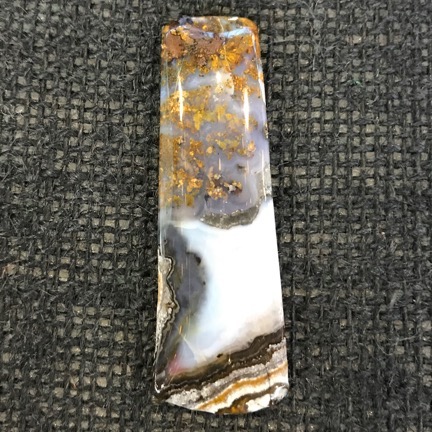
Bull Canyon Agate
For this example, I chose a 57mm long Bull Canyon Agate cabochon. This is a little larger than most of the stones I use.
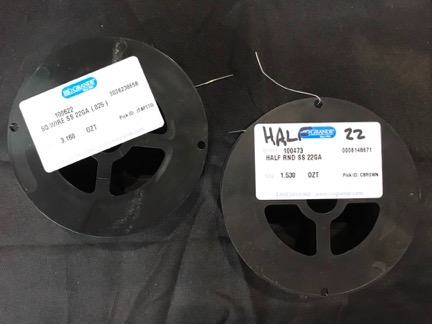
Wire Reels
I buy wire in bulk from RioGrande.com. For this project, I used 22 gauge square and half-round dead soft sterling silver wire.

I start by going into my collection of cabochons and choosing a stone I feel like working with. Maybe I have an idea I’ve come up with while doing something else during the day. Or maybe I want to try a wrap similar to one I’ve seen in a video. Or maybe I’ve realized that a certain color is missing from my collection of finished pieces and I choose a stone to fill in that gap.

For some stones, I get to choose which end is up. (Actually, I can do that for all of the stones, but certain shapes are easier to wrap when held in certain orientations; for example, teardrop shapes are best wrapped with the pointy end up, although I have wrapped them with the pointy end down.) I hold the stone in a variety of directions and decide which looks best.

Then I choose the wire. I use thinner wire for smaller stones because I don’t want the wire to hide the stone. I use more wires for thicker stones because I want the sides of the stones suitably covered. I use dead soft sterling silver wire for just about all the pieces I create now, although I do have some copper wire on standby if I feel like working with copper. (So far, all the pieces I’ve sold have been silver-wrapped, so I have to assume copper is less desirable.) I always keep 21 and 22 gauge square wire and 22 gauge half-round wire in stock.

By the time I’ve selected the stone and wire, I already have an idea for the style of wrap I’m going to do.

Step 2: Create the frame.
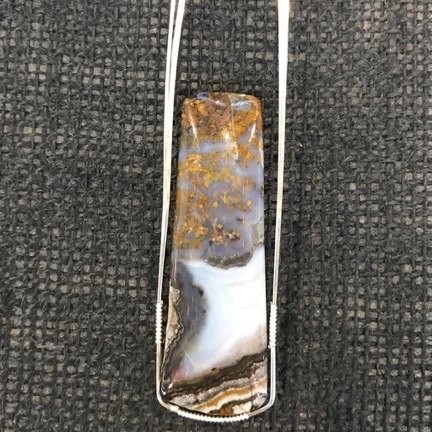
Started Frame
For this frame, I created three anchor wraps and made tight bends so the stone would fit snugly.
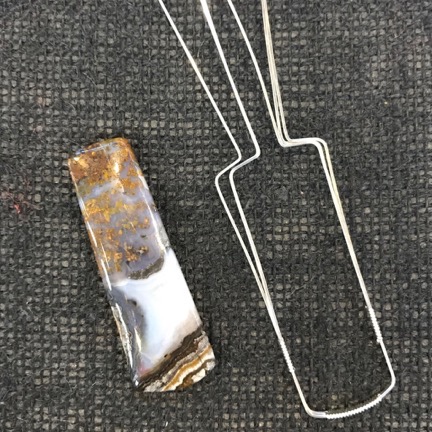
Open Frame
Here’s the same frame after making the bends at the top. A stone like this is tough because not only do the corner bends need to fit the stone exactly, but the top bends need to meet exactly in the middle.

The stone is held in place by a frame. Creating the frame normally entails using half-round wire to secure the thicker wires together in anchor wraps and then bending the thicker wires into a shape that will completely surround the stone.

The number of anchor wraps I do varies depending on the size of the stone and the style of the wrap, although I normally do two to four of these wraps. For example, if I’m working with a small oval or teardrop shape, I can probably get away with just two anchor wraps, one near each side of the bottom of the stone. If I’m working with a larger or odd-shaped cabochon, I’ll use more anchor wraps.

The bends must exactly match the stone. This is probably one of the trickiest parts, especially when dealing with odd-shaped stones. If I put a bend in the wrong place, I have to straighten the wires and then rebend them.

Step 3: Complete the frame and create the bail.
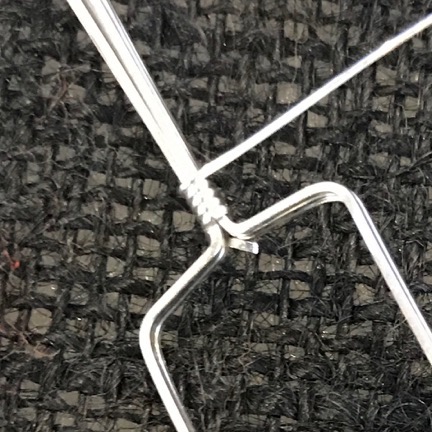
Closing Up the Top
I use the half-round wire to close up the top with tight wraps around all six wires.
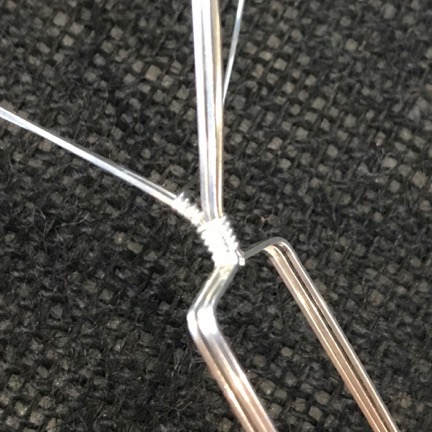
Starting the Bail
Then I separate out the two back wires and wrap them separately to start the bail.
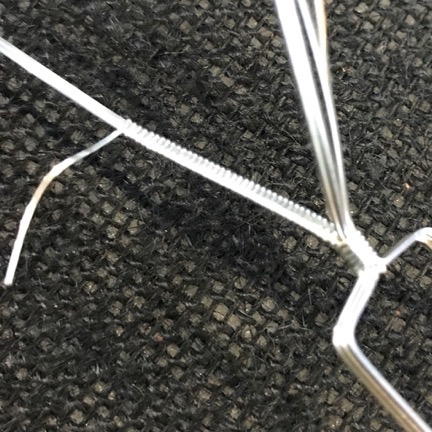
Wrapped Bail
I continue wrapping until I have enough wrapped wires to create the bail.

Completing the frame means closing up the gab at the top of the frame with wire wraps. This is probably the most difficult part of the process; the finished frame has to be the exact size and shape of the stone.

Sometimes I’ll finish the frame with the stone taped inside it using masking or painters tape. But as my skills improve, I’m able to finish the frame without the stone in place.

Once the frame is closed I usually follow up by wrapping two of the six or more wires sticking out the top and bending them back to create the bail. Sometimes I finish the bail then, before the stone is secured; other times, I wait until after I’ve secured the stone to finish it.

Step 4: Secure the stone and (if necessary) complete the bail.
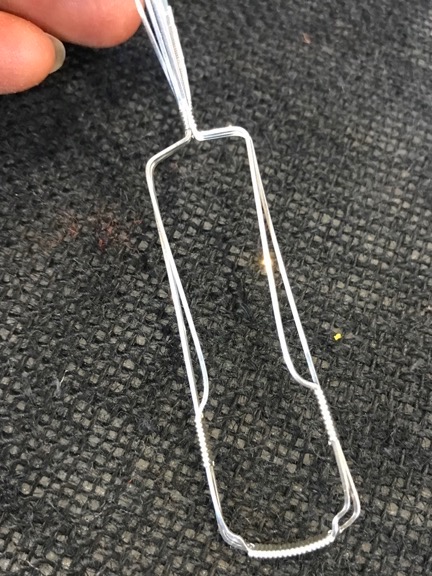
Starting to Secure
In this example, I’ve begun bending the front of the frame to hold the stone before inserting the stone. Doing this makes it easier for me to do the bends without scratching the silver wire.

This step is crucial and can be tricky. I need to get the stone into the frame and then carefully bend the frame wires so they hold the stone in place.

The hard part is making sure the bends are the same on both sides of the stone; if the stone’s shape is symmetrical, it’s important (at least to me) to have symmetry in the wires that hold it in place. The harder part is making these bends without scratching the metal with my tools. I use my thumbnail a lot as a tool — it won’t scratch metal — and it’s really screwing up my thumbnails.
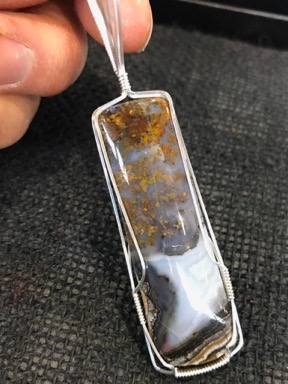
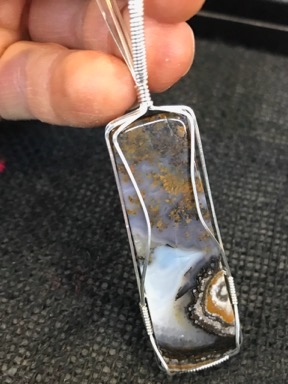
Front Back
Here’s the front and back of the piece once the stone has been secured. Although I concentrate my efforts on the front, which is what most people will see, I try to make the back even, too.

Once the stone has been secured, front and back, I can finish the bail (If I haven’t done so already) by securing the tail end either with half-round wire or one or two of the loose frame wires.
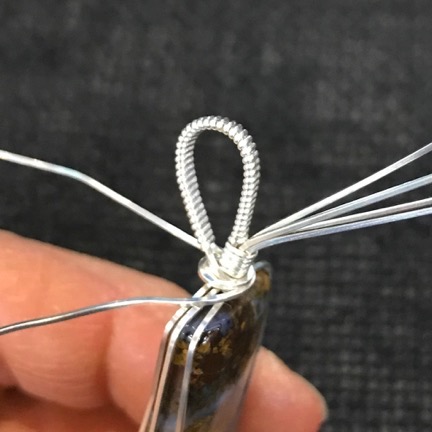
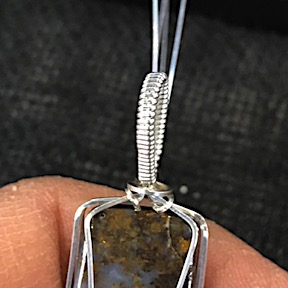
Finishing the Bail Finished Bail
In this example, I’ve finished off the bail by using the two loose ends of the bail wires and wrapping them around the top of the piece. I then trimmed off the excess and tucked them into the back of the frame.

Step 5: Add decorative flourishes, trim off excess wire, and tuck in all wire ends.

At this point, I have a stone secured in a wire frame with a bail and four or more frame wires poking out the top. I need to take those wires and creatively finish them off.

This is where the swirls at the top of each of my pieces come from. There are all kinds of things I can do. I like draping the wire around the base of the bail or creating loops in front of the bail, but I occasionally bring the wire down into the piece and finish with a loop.

I cut off all wire beyond what I need and finish the cut edges, which could be sharp, by tucking them into the metal work or creating tiny loops. After some final adjustments, the piece is done.
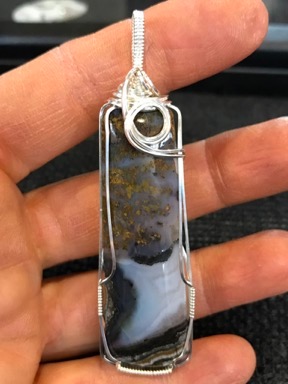
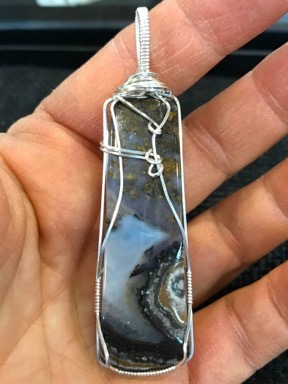
Finished Front Finished Back
Here’s the finished piece, front and back. I don’t usually leave the wire ends visible in the back of pieces, but for this piece, I wanted a little extra security for the stone.

It Takes Time

It takes me from one to three hours to make a piece of jewelry.

I don’t rush. I’d like to do it in 90 minutes or less, but I still sometimes have trouble with steps 3 and 4 above. I’ve learned that some shapes of stones are easier to work with than others and when I want to do a piece quickly, I work with an easier stone.

I’ve also learned that the more I try to get experimental, the more likely I am to struggle. Still, if I don’t try new techniques, I won’t improve my skills and learn what works and what doesn’t work.

Try It!

This blog post isn’t enough info to try it for yourself; you really need to see it done to do it. If you can’t get one-on-one instruction like I did, you can try videos on YouTube. Although an earlier post on this topic linked to one or two wire wrap jewelry videos there, I’ve since found a better artist: OxanaCrafts. The work she does, although often a lot more ornate than I do or like, is quite similar to what I do and I’ve gotten a lot of ideas from watching her videos. I credit her for the neatly wrapped bails I’ve been doing in almost all of my recent pieces. But while her work seems to feature the actual wire work, I prefer to feature the stones. That’s the main reason my wraps are simpler than hers — and my stones are usually a lot more interesting.

Want a good basic tutorial? Try this one: Quick Beginner Wire Wrap. Just keep in mind that a single anchor point, as she uses in this video, probably won’t work for larger or thicker stones.

If you want to give it a go, remember that there are certain tools and wires that you’ll need to get started. You might find them at your local craft store; I got my start using silver plated copper “hobby wire” which I’ve seen in Michael’s and Hobby Lobby. Tools are important; don’t be tempted to use standard pliers you might get at the local hardware store. The ridges carved into these tools will mar the wire.

Nice cabochons are a little tougher to find; I get many of mine from gemstone dealers and rock and mineral shows. I choose my cabochons individually — and pay for them accordingly — but you can often buy them in lots. If you don’t care what your stones look like and just want cheap stones, this will probably work for you; try eBay. But if you care and don’t mind paying for quality, you’ll find that it’s worth the effort to find the stones you want.

A great source of quality wire, tools, and even cabochons to get you started is RioGrande. That’s where I buy my wire and I can’t say enough nice things about them. (Thanks, Dorothy, for recommending them!) I’m not sure if they sell the cheaper craft wire, although I know they do sell better quality silver, gold, and even platinum.

If you do try it — or if you have already created your own wire-wrapped jewelry pieces — please use the Comments for this post to share a link to your finished work. I’d love to see it.

Support My Jewelry Making Habit!

But you know what I’d really like? I’d really like it if you visited ML Jewelry Designs and picked out a piece of jewelry for yourself or a loved one. You can support my jewelry-making (and stone collecting) habit while getting a truly unique piece of wearable, handmade art. Many thanks to blog readers who have already done so!

And if you want this piece, you can find it here in my online store. But don’t wait; all of my pieces are one-of-a-kind and when this one is gone, it’ll be gone for good.

Buying N7534D

The saga of my recent aircraft purchase.

By now, regular readers know that I crashed the helicopter I bought brand new in 2005 and have owned for the past 13 years, N630ML. I started looking for a replacement almost immediately. After all, cherry drying season was just a few months away and I needed to make sure I had something to fly.

To Buy or Not to Buy

As I mentioned in another blog post about the aftermath of the crash, I did have a brief period when I considered not replacing the helicopter at all. It would have been nice to just stick that big, fat insurance check into the bank and ease out of my flying career. I could still manage my cherry contracts and, without the cost of a helicopter, would probably net nearly as much money as I would if I flew. To this day, I wonder whether I should have done just that.

But the truth of the matter is, I’m not ready to stop flying. I enjoy exploring the world around me from the air. I enjoy giving passengers an opportunity to see the area from a new perspective. I enjoy giving kids their very first helicopter rides at events. I enjoy landing Santa Claus next to Pybus Public Market in downtown Wenatchee with hundreds of kids and parents looking on. And yes, sometimes I even enjoy cherry drying.

So although I’ve been thinking about retirement for the past few years, I didn’t expect to do so until 2025 at the very earliest. After a lot of thought about it, I still think that’s a good idea. I’ll keep flying until it isn’t fun anymore — or my body tells me to give it up.

Of course, that didn’t mean I needed to buy a helicopter. I could lease one. I did talk to one leasing agent about that with the idea of leasing only half a year. I discovered that leasing companies don’t like short term leases and that if I did lease, I wouldn’t make any money at all. Lease rates and minimums are just too high for organizations that don’t fly at least 25 hours a month. I fly a lot less than that.

The Search Begins

But I’m getting ahead of myself here. I actually started shopping before I started thinking — which is never a good idea.

A few days after the accident, my insurance agent recommended a helicopter broker based in Florida to start my search. If you’ve ever owned a Robinson helicopter I guarantee you’ve gotten at least one postcard mailing from this guy. I’d actually met him once when I was researching operations to do the overhaul on Zero-Mike-Lima; his company had an authorized Robinson service center. I started working with him right away to find a replacement.

I figured that I should replace the helicopter with something just like it. Zero-Mike-Lima was a 2005 R44 Raven II model just a year out of overhaul. I’d insured it for what I thought it was worth: $350K. I had a loan on it to pay for part of that overhaul. I figured that the insurance would pay off the loan and give me enough for a good downpayment on another helicopter in about the same condition. I could get another loan for about the same amount and continue operating as if nothing had happened.

I soon realized that I’d erred in estimating the value of Zero-Mike-Lima — by about $50K. That became apparent when I started looking at what was available via the broker’s listings. Still, I found one in Canada that I really liked, mostly because it was just like Zero-Mike-Lima on the inside. I think it was a year newer. Tan leather with a standard VFR panel, just out of overhaul. They were asking $389K.

I spoke to a bunch of people who know about helicopters. (I was, after all, still at Heli-Expo.) Several said that the Canadian version of the FAA — I think it’s the CAA? — had higher standards than the FAA so the ships were usually in better shape. Others said the Canadian helicopter market was soft and that I should offer 10% less than the asking price. 10% was nearly $40K and I didn’t want to insult anyone. So I offered $360K, keeping in mind that I’d be spending $10K to $20K to get it into the country and registered with the FAA.

I was turned down with no counteroffer.

I exchanged numerous emails and a few phone calls with the broker. What was the best price I could get? Would the seller help me get the ship into the US? Would they pay for import taxes or fees?

The seller remained firm on the price and wouldn’t even transport the helicopter to the border less than 50 miles away.

Now keep in mind that I’ve bought and sold more than a few large ticket item assets in my life: helicopters, condos, apartment buildings, homes, cars. I’ve never bought or sold at the asking price. So when these Canadians stayed firm, I was surprised and more than a little pissed off. Fuck them, I thought in typical native New Yorker style, and I kept looking.

By this time, I was on my way home from Vegas in my truck with my camper and boat behind me. I stopped in Mcminnville, OR, to look at another ship just out of overhaul. It seemed to be in good enough condition and the seller was definitely motivated. But there was something about the ship that I just didn’t like. The inside looked tired. And I definitely did not like the panel, which was set up for instrument training and had an unfamiliar audio setup. The seller was asking $390K and I got hints that he’d accept less. I told him I’d think about it and continued my trip, part of me thinking I should make an offer while the other part had a problem paying that kind of money for something I didn’t really like.

Online Shopping

With no other options coming from the broker, it was time to get serious. I went online to start my search in earnest about two days after I got home from California with my truck and camper. That was about ten days after the accident.

I was still pretty sore and not feeling 100%. I’d been pushing myself hard since the accident, traveling to Las Vegas the very same day, attending Heli-Expo every day the following week, and then driving from Las Vegas to my Washington State home over a period of five days. (I just counted them and can’t believe it took me that long. I would normally do it in two days.)

So on Thursday morning, I sat at my breakfast bar with a cup of coffee and my laptop and started searching for options on the three sites most likely to have listings for what I was looking for:

I found the most listings on Controller. I started making notes and sending email messages. I started thinking and re-thinking my options. Maybe I should get a ship that was a little farther out of overhaul? One that would cost less so I could take out a smaller loan? I started making and getting calls to and from sellers. I was having trouble keeping the options straight in my head.

And that’s when the headaches started.

You see, although I wasn’t knocked unconscious in the accident and I didn’t have any obvious head injuries and I wasn’t diagnosed with a concussion or anything like that, my brain wasn’t quite ready to go back to work. When I described the accident and the bouncing the cockpit had done on the way to its final resting place with me inside it to the local doctor who looked at my leg injuries, she suggested that I may have been concussed. She recommended that I “rest my brain” for a few days.

That was on Thursday afternoon. I took her advice for the rest of that day.

I tried working on the listings again the next day and was fatigued with a headache before 10 AM. Crap. I spent the rest of the day taking it easy.

In fact, I didn’t pick up the search until the following Monday.

Analyzing My Options

By the time I resumed my search, I was feeling a sense of urgency — even though I still had two months to get a helicopter for cherry season. I got back to the listings and started really thinking about what my options were. Fortunately, my brain was ready for the task and the headaches did not return.

Here’s what I came up with:

  • Buy a new one. Well, the prices of R44s have really gone up since I bought mine in 2005 for $346K loaded. A similar ship would cost $550K or more and I’d have to wait months for it. This option was really no option in my situation.
  • Buy a newish one. I figured that if I bought one that was 2012 or later model with low enough hours I could get 6 or more years out of it before having to overhaul it. But I simply couldn’t find any in this category.
  • Buy a recently overhauled one. This is the option I’d been working with: replace my recently overhauled ship with one just like it. The prices ranged from around $390K to $450K. It was doable if I was willing to walk into a big, fat loan. I wasn’t sure that I wanted to.
  • Buy a partially overhauled one. This is where it gets weird and where you really need to know what you’re buying. Robinson helicopters have a required 12-year or 2200 hour (whichever comes first) overhaul to maintain airworthiness. This cost me about $220K at the end of 2016; my ship was almost 12 years old and had about 2050 hours on it. But there’s a loophole for folks who want to save money. If the ship is 12 years old and has a lot less than 2200 hours on it, you can replace the calendar-limited parts in a partial overhaul and leave the hours-limited parts for later replacement. I cannot believe how many ships I found that fell into this category.
  • Buy one that would need overhaul within the next 4 years. There were a handful of ships like this out there and they were cheap. So cheap that I wouldn’t need a loan at all. The benefit of that is that the $30K I paid annually on a loan could go into a savings account for the overhaul.

The partial overhauls looked promising — at first. One of the ones I found was a particularly sharp looking, fully loaded 2006 ship that was selling for only $300K. Is it possible that I could get it and fly it commercially? The short answer is no. I did my research and discovered that the Lycoming engine also has a 12-year overhaul requirement. It would cost about $50K and take at least 2 months to have the engine pulled and overhauled. Although I wouldn’t mind spending the money, I didn’t have the time.

Also in this category were ships with various life-limited parts that are normally replaced in overhaul that had been replaced for various reasons during the life of the ship, leaving it very unclear what still needed to be done and when. My head spun just thinking about these ships.

And then there was the guy who argued with me that the bladder tanks really weren’t required and offered to let me talk to his mechanic for an explanation of why they were actually bad. Needless to say, he didn’t get any traction with a person whose life may have been saved by those tanks.

I found two ships that had been overhauled once and had about 400 hours left until the next overhaul. They were selling for $200K and $220K respectively — I wouldn’t need a loan for either one. One was an instrument training ship, the other wasn’t. One had a hook — another thing I didn’t want or need. I was leaning toward the one in Tennessee and started looking for a good mechanic to go out there with me for a pre-purchase inspection. I was looking at the cost of two round-trip plane tickets to Knoxville, an overnight stay, and an inspection fee: at least $6K total and two full days of my life. And that’s before buying it.

I wasn’t a happy camper.

Enter N7534D

All this time, I’d been texting on and off with Paul, the Director of Maintenance at Quantum.

Quantum did Zero-Mike-Lima’s overhaul in late 2016. I chose them because I think Paul is the best Robinson mechanic on the planet and the price they quoted was fair. I have a lot of respect and admiration for Paul and I know he’d never steer me wrong.

He mentioned offhand that Quantum had a 2005 R44 Raven II for sale. I eventually asked him for details. It sounded just like what I needed; it had (or would have) everything required for Part 135 operations without things I wouldn’t need (like an instrument training panel or hook). I asked for pictures. I swear my heart must have skipped a beat when I saw the interior: it was almost identical to Zero-Mike-Lima.

N630ML
Okay, so it’s a terrible picture. But it’s the only one I have from the day I picked up N630ML at the Robinson factory in Torrance, CA in January 2005.

And here’s where I need to take a step back and be honest with myself and my readers. Understand that after ordering a helicopter to my specifications, flying it brand new from the factory, putting more than 2100 hours of time on it, using it to earn a living, having so many adventures with it, and seeing it through overhaul after 12 years of ownership, I really loved Zero-Mike-Lima. Yes, I had developed a possibly unhealthy bond with a machine. The biggest problem I was having with choosing its replacement was the possibility of ending up with one that was so different it wouldn’t feel like mine.

So when I saw the inside of N7534D, I felt as if I was looking at Zero-Mike-Lima. It would be an easy transition for me.

Of course, the outside was a different story. It was “Ford Deep Impact Blue” — an unfortunate color name given the circumstances of my need to purchase. (It also reminded me of the BMW motorcycle my wasband had crashed in Arizona years before.) But when I fly a helicopter, I don’t see the outside.

The ship had one problem: it had only 216 hours until it needed an overhaul. I’d need to stretch that through two flying seasons to save up for a good downpayment on an overhaul I’d likely need to start in November 2019.

But it also had a lot going for it. It was the first R44 with air conditioning, which was kind of cool (no pun intended) but also meant I could dry cherries without taking off a door for ventilation. It had been owned and operated by Quantum for its entire life. That meant it was always hangared and well maintained by a crew managed by my favorite mechanic. It had been used for training, but apparently not much. It had been on a Part 135 certificate so it had (or would have) all the instruments needed to get it on my certificate. It already had ADS-B Out installed, which would save me at least $3K before the deadline for installation at the end of 2019. And knowing that I needed a radio altimeter by October, Paul offered to pick up the cost of labor on the installation of one, saving me about another $5K.

So for about the same price as the other two ships I was looking at, I could get one that would satisfy the FAA without getting a loan or dealing with a pre-purchase inspection. There would be no worries or doubts or concerns about what I’d bought. It would be a pretty much stress-free purchase. I could just fly down to Arizona with a check and fly home with it.

And that’s pretty much what I did. I didn’t even go down to look at it before committing to purchase it. I just texted and talked with Paul to make sure it had everything I needed/expected. I sent my friend Woody to take a look at it; he reported back that the black stripe made it look “bitchin.” I sent a check for the radio altimeter hardware purchase. I waited for my insurance check and sent it to the bank to pay off the loan, then got the net directly deposited to my savings account. I got a small bridge loan from Bank of Laura Langer, then got a certified check for the purchase price, stuck it in my wallet, and flew First Class down to Phoenix on Alaska Air. That was on Wednesday.

N7534D
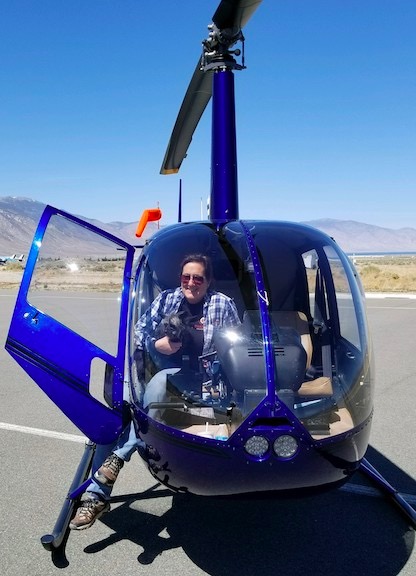
Here I am with Penny, sitting in the pilot seat of N7534D in Hawthorne, NV, on our way home this past Saturday. (Photo by my friend Janet, who came along for that long ride.)

On Thursday, I saw it for the first time, got the warm and fuzzy feeling I was expecting, handed over the check, signed a bunch of papers, and immediately started installing the mounts I’d need for my iPhone and iPad and stowing various other equipment on board. Penny got to sit in the front seat while I worked.

On Friday, I was on my way home. But that’s another story.

Why I Blocked You on Twitter

The answer to a question I received by email.

The other day, I got the following email message through the message form on this blog:

Just curious. Why did you block me on Twitter? @[redacted]

Was interested in following your flight home with the new bird.

I honestly don’t remember blocking this specific person. I probably block about a dozen people a week.

Twitter LogoThe reason I usually block people is because of their unreasonably voiced political views. You know the kind of folks I mean: the ones who watch Fox News and echo the bullshit they’ve been fed there. The ones with #MAGA in their Twitter profiles. The ones who share obnoxious memes that bash Obama or Clinton or liberals in general.
Yes, I’ll admit it: I block Trump supporters who attempt to interact with me on Twitter. I honestly have no time or patience for their bullshit. I am a New Yorker at heart and, like most New Yorkers with a brain, I know that Donald Trump is a conman. During the 2016 presidential election, he conned the same kind of people he conned into signing up for Trump University: the desperate and the gullible. I am neither and no one will ever get me to support him.

And frankly, I’m offended by the kinds of things his supporters do and say to attack the people who don’t support him.

Twitter is a haven for these people. They make a game out of preying on people who don’t agree with them, using personal attacks and ridicule, often getting other Trump supporters to join them. They try to make a living hell for the people they find on Twitter who dare to question their glorious leader. It’s fortunate that Twitter makes it easy to prevent these people from targeting us — that’s what the Block feature is for and I’m not afraid to use it.

So there’s a good chance that’s why I blocked the person who emailed me last week. I was simply heading off what I thought might be a Trump supporter following me to see Tweets he could attack. It’s happened before and it’ll happen again.

If I erred and he really was interested in following my trip, he would have been disappointed anyway. I didn’t tweet much along the way. And a blog post about it will be posted here shortly; he can always read that to catch up.

And if that’s truly all he wanted from me, I do apologize. But if he’d been on the receiving end of as many Trump supporter attacks as I have on Twitter, I think he’d understand.

Planning the Long Flight Home

I begin flight planning for the trip from Phoenix, AZ to Malaga, WA with my new helicopter.

I haven’t been blogging much about flying lately, but that’s because I haven’t been doing any lately. It took me about a month to find a good replacement for my old helicopter and, truth be told, I haven’t even gone to see it in person so I don’t have any good stories or photos to share. I’m thinking of discussing the purchase in a separate blog post and if life doesn’t stop hurling distractions at me, I might just get that done. But it’ll be a complete piece — from the start of the search to the pickup of the replacement helicopter — and since that process isn’t complete yet, I can’t very well write about it.

So instead I’ll give you an idea of what’s going through my mind this weekend and week as I plan to fly the replacement helicopter home from the Phoenix area.

Planning a Flight in the American West

The one thing that city folks — and people from areas areas that are normally or densely populated — don’t get is that out west there can be very long distances between points. And since there aren’t as many people here outside the big cities, there can be a whole lot of nothing on a long cross-country flight. Or even on a relatively short one. Heck, when I was first building time in my R22, I once flew solo in a straight line 85 miles east to west just north of the Grand Canyon’s airspace and didn’t cross over a single paved road for the entire distance. Can you do that in New York?

I used to fly between Arizona and Central Washington twice a year. From 2008 to 2013, I lived in Wickenburg, Arizona and spent 7 to 16 weeks every summer in the Wenatchee area of Washington for cherry drying. In May, I’d pack up the helicopter and fly north and in July or August, I’d pack it up again and fly south. I often had a pilot interested in building time in an R44 at the stick to help cover flying costs; once (I think) it was my future wasband, who got the flight time for free on a flight that included a good part of the Oregon coast.

There are basically four good routes — five if you count the California/Oregon coastal route — to get from the Phoenix area of Arizona to Central Washington State. Those routes are determined primarily by terrain, fuel availability, and airspace restrictions.

The Shortest Route

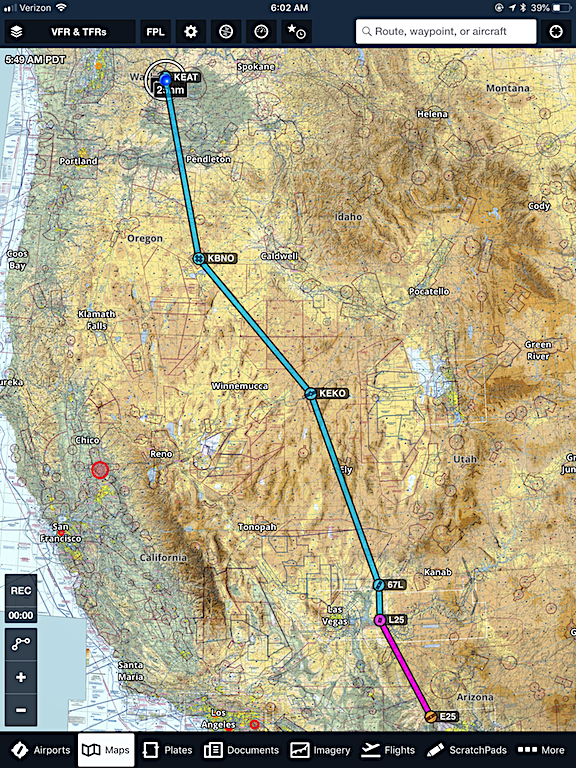
By far, the shortest route is through the middle of Nevada. Going north from Wickenburg (E25), it’s Mesquite, NV (67L), Elko, NV (EKO), Burns, OR (BNO), to Wenatchee, WA (EAT). Note that those legs are pretty long — 2-1/2 or more hours each. But it’s only 891 miles total and I’ve done the whole flight in a single day twice with another pilot on board.

The Shortest Route
Here’s Foreflight with the shortest route plotted in. I added a waypoint to route me around the Grand Canyon’s airspace, which I can’t fly through. There’s a whole lot of nothing on this route.

Pros:

  • Short route; it can be done in less than 10 hours without headwinds.
  • The shortest route is also the cheapest route.
  • Only three fuel stops also speeds up the trip; stopping for fuel takes at least 30 minutes.
  • Between Elko and Burns, there are many herds of wild horses.

Cons:

  • Not many options for fuel if headwinds slow you down. Rerouting along the way could make the trip a lot longer.
  • Flight crosses miles of empty desert with absolutely no sign of civilization. For example, there’s a stretch between Elko and Burns where there are no roads, buildings, or even fence lines for more than 90 minutes of flight time. So if you need to land because of a problem, you’re pretty much screwed.

The Salt Lake City Route

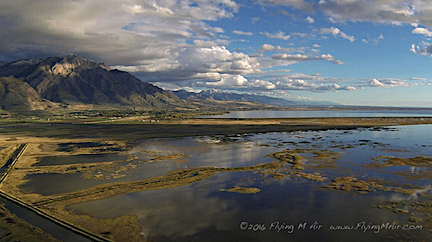
Salt Lake
My GoPro nosecam captured this amazing image of Salt Lake on my last flight southbound through the area in October 2016.

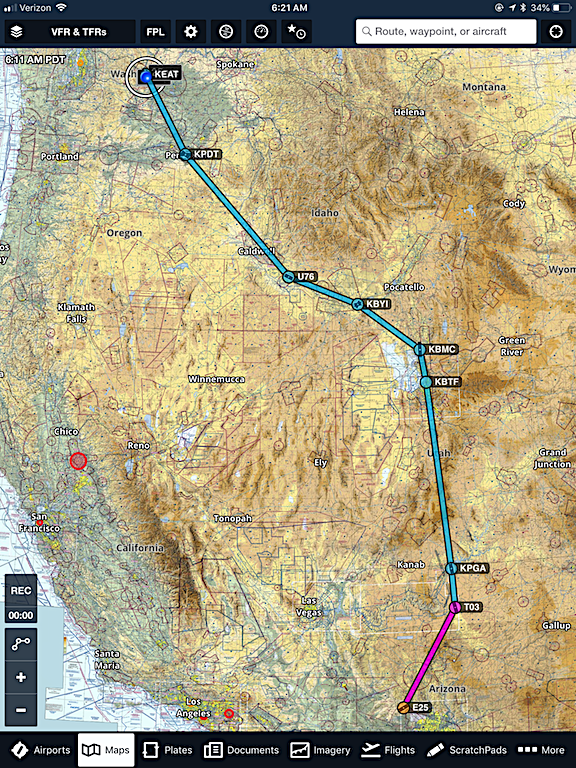
When I flew the late, great Zero-Mike-Lima south to get its overhaul back in 2016, I took what I call the Salt Lake City route. This route follows roads pretty much all the way. Zero-Mike-Lima’s engine was nearly 12 years old and an oil change had uncovered more than the normal amount of metal fragments in the filter. If the engine was going to give me trouble, I wanted to be able to land somewhere close to where I could get help and that meant near a road. An example of this route goes from Wickenburg (E25) to Page, AZ (PGA), Salt Lake City (Skypark), UT (BTF), Burley, ID (BUR), Pendleton, OR (PDT), and Wenatchee (EAT). This comes out to a minimum of 985 miles.

The Salt Lake City Route
This is what I call the Salt Lake City Route, IFR edition. I’ve added waypoints beyond the fuel stops listed here, to guide me around the Grand Canyon’s airspace and keep me over roads for most of the way.

Pros:

  • I can be an IFR (I Follow Roads) pilot. There are very few stretches along this route that can be considered remote.
  • There are corner-cutting opportunities to save time and fuel. For example, if I don’t mind flying over Salt Lake, I can go direct from Salt Lake City to Burley. (I really don’t like flying over water so I’ve only done that once.)
  • There are many potential fuel stops along the way. And many options for short detours to get to them.
  • The first 2 hours of this flight takes me over my old stomping grounds in northeastern Arizona, including the Navajo Reservation and Lake Powell.
  • My friend Megg lives in Salt Lake City and has, more than once, provided overnight accommodations.

Cons:

  • It’s not the shortest route. I don’t think it can be done safely by one pilot in a day.
  • It crosses over a lot of high elevation terrain. In April, that means there’s a real possibility of snow or icing conditions that I can’t fly in. Getting grounded because of weather wastes time and gets expensive.

The Western Nevada Route

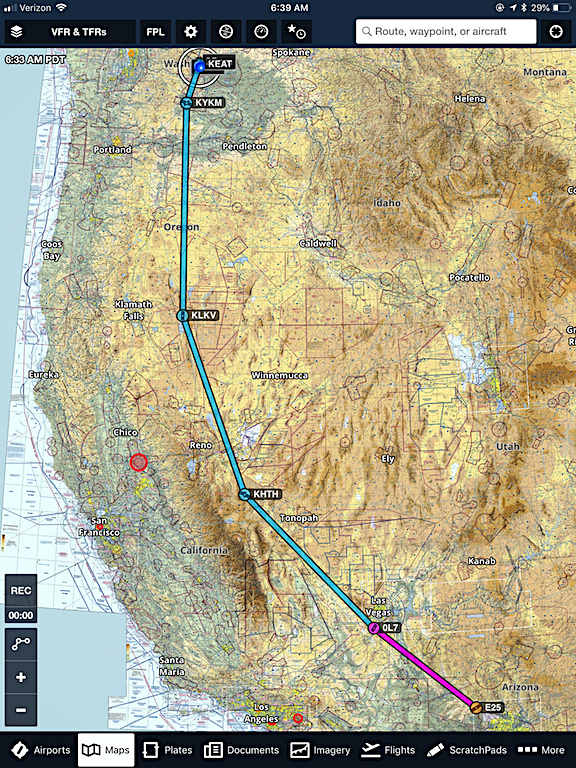
Another way to go that successfully avoids the restricted airspace in Nevada is up the east side of the Sierra Nevada Mountains and up into Oregon. In looking at this route, I realized that I’d never done the whole thing. Once I traced the Tonopah (southeast of Hawthorne) to Wickenburg part of this route with my wasband on board when we had to abandon the coastal route, stopped for the night at a friend’s house in Georgetown, CA, and came over Echo Pass near Lake Tahoe. We might have cut through Death Valley along the way. The route I’m looking at now is at least 942 miles: Wickenburg (E25), Jean, NV (0L7), Hawthorne, NV (HTH), Lakeview, OR (LKV), Yakima, WA (YKM), and Wenatchee (EAT).

Western Nevada Route
The western Nevada route is one I’ve never done before, but it looks like it might work out.

Pros:

  • Relatively short route.
  • Not completely familiar so I’d get to see new sights.
  • A stop at Hawthorne would mean getting to see Betty, the unofficial airport greeter there.

Cons:

  • Not completely familiar so I’d have to be even more prepared for the unexpected than usual.
  • Fuel stops are limited so monitoring fuel consumption and planning well in advance is vital, especially with headwinds.
  • There’s some remote terrain. Help might not be close in the event of a problem.
  • There’s some high elevation terrain. Winter weather could be an issue in April.
  • With restricted airspace and high mountains on either side of the Nevada portion of the route, there aren’t many opportunities to divert for fuel or overnight accommodations.
  • The Central California Route

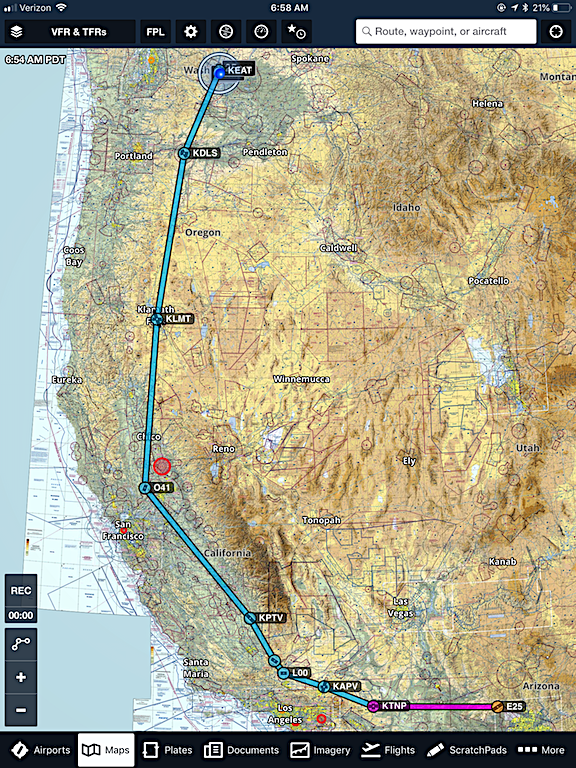
    The longest two routes take me through California. The shorter version goes up the Central Valley of California. I basically head west through the Arizona and California deserts, then pop over the foothills of the Sierra Nevada Mountains at Tehachapi and fly up the Central Valley. Then I continue North through Oregon on the East side of the Cascade Mountains. A flight plan might be Wickenburg (E25), Apple Valley, CA (APV), Porterville, CA (PTV), Woodland, CA (O41), Redding, CA (RDD), The Dalles, WA (DLS), and Wenatchee (EAT). That’s a minimum of 1100 miles.

    Central California Route
    The Central California route is long but very familiar. The stops shown here are just an example; there are plenty of options for fuel and overnight stay in the Central Valley.

    Pros:

    • I know this route really well. I can’t tell you (without looking in my log book) how many times I’ve flown either the entire thing or parts of it.
    • There are lots of places in California’s Central Valley for fuel and overnight stops.
    • More than half the route is through heavily populated areas. Plenty of places to get help if needed.
    • There is very little high terrain so winter weather is not likely to be an issue.
    • Weather is nearly always perfect — although it could be windy — in the desert areas.
    • I can stop along the way to pick up the cockpit cover for my old helicopter, which is somewhere in the Sacramento area of California.

    Cons:

    • The route is long. Enough said.
    • There’s a chance that you won’t be able to cross into the Central Valley at Tehachapi because of low clouds on the Central Valley side. The wind seems to funnel the weather south and when the clouds hit the mountains there, they just stop and accumulate. I’ve had this happen to me twice. The options are to wait it out or detour farther west to Grapevine.
    • Just under half the route is through sparsely populated areas.
    • There are limited fuel stops in the desert areas and in Oregon.
    • Did I mention that the route was long?

    The Coastal Route

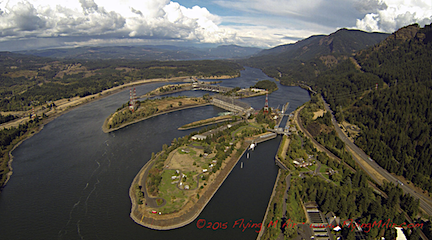
    Bonneville Dam
    When I fly back from the coast, I usually fly along the Columbia River. Here’s a nosecam shot of the Bonneville Dam. I can’t get my hands on any of my coast photos right now.

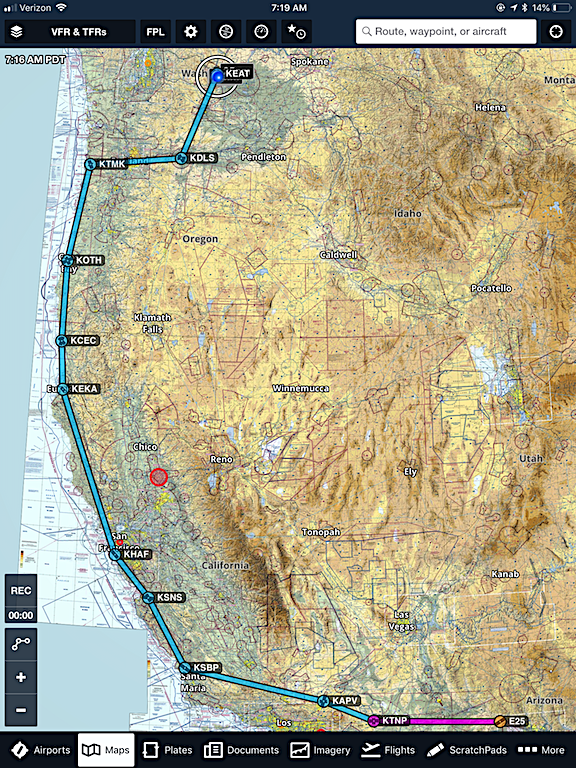
    If you’ve never flown in a small aircraft, low and slow up the coast of California and Oregon, you have no idea what you’re missing. When the weather is good, the flight is absolutely amazing. I’m talking about tiny seaside communities, waterfalls plunging off cliffs into the Pacific Ocean, and odd rock formations just off the coast with waves crashing picturesquely against them. If time and money is no object, this is the way to go. A typical route might be Wickenburg (E25), Apple Valley, CA (APV), San Luis Obispo (SBP), Half Moon Bay, CA (HAF), Eureka, CA (EKA), North Bend, OR (OTH), Tillamook, OR (TMK), The Dalles, WA (DLS), and Wenatchee (EAT). Those aren’t all fuel stops; they’re just points along the way where fuel is available. This flight is over 1300 miles long if you follow the coast as closely as possible. It’s a lot longer if you join the coast at a point south of San Luis Obispo — for example, Santa Barbara (SBA) or Long Beach (LGB).

    The Coastal Route
    Got money to spend and time to kill and you don’t mind gambling with Mother Nature? Then do the coastal route. The extra waypoints I plotted in here are just to keep you on the coast as much as possible. You’d have to calculate and pick your fuel stops.

    Pros:

    • The scenery! There’s none better.
    • Lots of fuel stops — if you plan properly.
    • Did I mention the amazing scenery?

    Cons:

    • Weather. The chances of being able to stay on the coast for the entire distance from San Luis Obispo to Tillamook are about as close to zero as you can get without hitting zero. The marine layer is real and it will definitely force you inland for at least part of this route. That means you need to have an infinite number of Plan Bs. And there’s nothing worse than flying out of your way to get to the coast and then having to backtrack because it’s socked in with fog.
    • Possibly flying over water. I hate flying over water.
    • Some of the coastal areas are quite remote. So even if you’re flying over land, if you have a problem and need to land you might not be anywhere near help.
    • You can’t stick to the coast in certain wildlife refuge areas unless you want to climb to 2000 feet. I get nosebleeds up there.
    • The airspace gets a little crazy around San Francisco, especially if you have to come inland.
    • And seriously: 1300 miles for a trip you can do in less than 1000 miles on at least two other routes? A bit extravagant, no?

    Picking a Route

    Those are pretty much the options I’m looking at. I was leaning toward the Central California route until I started looking at the Western Nevada route in more detail. It definitely has possibilities and I shouldn’t write it off just because I haven’t done it before. If it saves me 2 hours of flight time, that’s hundreds of dollars in ferry flight costs. While I don’t think I can do it in a day, it’s definitely feasible.

    In the end, there are just two things that will help me make the decision: the weather forecast and whether I can stop in California to fetch that cockpit cover. And although my flight is scheduled to begin on Friday, April 13 — yeah, I know — it’s still to early to get a reliable forecast. I’ll likely decide by Wednesday or Thursday — and be prepared to change my mind.

    That’s how flight planning goes.

    Another (Brief) Facebook Rant

    This might be enough to get me to completely pull the plug.

    I’ll admit it: the only reason I haven’t completely pulled the plug on my Facebook account is because I use it to promote two businesses: Flying M Air and ML Jewelry Designs.

    Flying M Air has been on my Facebook account for years. For a while, I tried hard to use Facebook to share information about what the company is doing through events, offers, galleries, and plain old posts. I was checking in daily to stay on top of messages. Flying M Air’s website has an annoying pop-up window that invites visitors to like us on Facebook. (I’m still trying to figure out how to turn that off.) The only thing I didn’t do was pay money to promote a Facebook post.

    And here’s the rub. Flying M Air’s Facebook page has over 1000 likes. That means that over 1000 Facebook users have indicated that they want to see new content. I don’t post much anymore — heck, there are only five or six new posts since July — so it isn’t as if I’m bombarding page followers with content. It doesn’t matter, though. Facebook isn’t showing this content to the people who want to see it. Indeed, one of my posts from last summer “reached” only seven people.

    Yeah. Seven out of over 1000.

    Facebook Post
    This post came out two days ago, yet was shown to only ONE person. For all I know, it could be me.

    Against my better judgement, I set ML Jewelry Designs up on Facebook, too. I figured: why not? But rather than put a lot of energy into keeping its page up-to-date with new content, I set up new posts on its WordPress-based website to automatically post to the ML Jewelry Designs page on Facebook. This means the page gets new content just about every day. (I schedule posts so no more than one new item appears each day.) Now the page is less than a month old and has only 20 followers. But I’m getting the same ridiculous low reach numbers I get with Flying M Air.

    So here’s the situation. Facebook users have indicated that they want to see the content posted on certain pages. But the Facebook algorithm has decides what they should and shouldn’t seen. My two business pages don’t pay for “promotion” so they’re pretty far down on the list of what gets shown. As a result, my content doesn’t appear for anywhere near the number of people who have indicated they want to see it.

    So why bother posting it?

    And what about the people who like a page because they want to see all of its new content? How many of them think there just isn’t anything new because it doesn’t appear in their newsfeed?

    Can you see why I’m just so done with Facebook?