
I realize (belatedly) that my fifteenth anniversary of being my own boss has just gone by.
May 29, 1990. That’s the day I left my last “real job” and began my life as a freelancer.
The job was at Automatic Data Processing (ADP) and I worked in the Corporate Headquarters in Roseland, NJ. I was a senior financial analyst, moved into that position after doing my required 2-year sentence as an internal auditor. I hated being an auditor, despite the fact that I was very good at it. No one likes a job where people are constantly trying to avoid you. Hell, men used to run into the men’s room when they saw me coming, just because they knew I couldn’t follow them there.
I’d been doing the 9 to 5 (well, actually 8 to 4 whenever possible) thing since graduating from college in May 1982. The ADP position was a good one, with benefits, a good paycheck, and a clear upward path in the corporate hierarchy. If I stayed and continued to play the corporate game — pretending, of course, that it wasn’t a game and that I liked it — I’d probably be some kind of vice president by now. I’ve seen the annual report — I still have 282 shares of ADP stock from the employee stock purchase program — and have recognized one or two co-workers in those coveted top-floor office positions.
But that’s not what I wanted. Heck, I didn’t want the corporate thing at all. I never did. I wanted to be a writer since I was a kid. My family pushed me into a career I showed some interest in, just because it would come with a big paycheck. Accounting was (and still is) something I enjoyed, but I wound up as an auditor and got burned out before I could escape. By the time I’d finally achieved the financial analyst position and spent my days crunching numbers with Lotus 1-2-3, I was sick of the whole 9 to 5 joke and tired of playing the games I was expected to play to move up. I wanted out.
My ticket to leave came in the form of a contract to write a 4-1/2 day course for the Institute of Internal Auditors (IIA). Ironic, isn’t it, that auditing got me into the corporate world and auditing got me out. There was a $10,000 paycheck attached to the contract, enough to keep me for a few months. I asked for a leave of absence, was told I couldn’t have it, and resigned. No hard feelings, just get me out of this place.
My mother freaked. How could I give up my career to be a writer? Watch me.
To help make ends meet, I got a job as a per diem computer applications instructor with a New Jersey-based computer company. The rate was $250 per day — not too shabby — and, at times, I would work as many as four days in a week. I averaged about 10 days a month and that really helped to pay the bills. They called me when they needed me, preferring their full-time employees because they were cheaper. They tried about four times to make me an employee and I kept turning them down.
I finished the course, wrote another one based on it, and got another job as an assistant trainer for a Macintosh troubleshooting course. That one had a nicer paycheck — $700 a day for two-day courses — and I got to travel all over the country. One year, in June, I did six courses in six different cities. I remember riding in the Club car of an Amtrack train on my birthday, admiring a rainbow as we approached the Delaware River from Washington, DC to Newark, NJ. Although I was allowed to fly to Washington, I preferred the train and took it whenever I could. It’s far more relaxing and comfortable.
Somewhere along the line, I started to write. First some articles for little or no money. Then a few chapters of a book as a ghostwriter. Then half a book as a coauthor. Then a whole book at an author. That first book with just my name on the cover came out in 1992 and I haven’t looked back since.
I did some FileMaker Pro consulting work for a while, too. I built a custom solution for Union Carbide. Not a big deal, but they needed me to update it each year and didn’t balk at $85/hour, so who am I to complain? I also did consulting work for Letraset at the same nice hourly rate. That was good because they were only 15 minutes from my house.
The trick to freelancing successfully is to not put all your eggs in one basket. I never — not once in 15 years — had only one source of income. I’d be training for two companies and writing articles. Or training for one company and writing books and articles. Or consulting and training. You get the idea. There was always more than one client, more than one editor, and more than one project in the works. Before I finished one book, I was negotiating a contract for the next. I remember one day not long after coming to Wickenburg when I signed four book contracts. Four, in one day. That was guaranteed income of $32K within the next six to eight months. And that didn’t count the other income producing tasks I was doing.
For some people, it’s difficult to stop getting a regular paycheck. I don’t recall it ever being difficult for me. I do remember the second year after leaving ADP having a dismal year and only making $19,500. That was a far cry from the $45K/year I pulled in that last year at ADP. But things improved quickly, I got out of that slump, and have since brought in considerably more every year. I’ve been pulling in six digits for the past seven years, a fact I’m rather proud of. I’m certain that I’m earning more now as a freelancer than I would have earned if I’d stayed at ADP to climb that corporate ladder. And I don’t have to wear a business suit or pantyhose to do it.
But no matter how you slice it, it’s not as smooth and easy as a weekly or biweekly paycheck. Advances come four to eight weeks after they’re due, royalties normally come quarterly, consulting clients pay a month after you bill them, magazines pay when they get around to it. You learn to earn first and collect later. You learn to avoid clients who don’t pay promptly, no matter how hard you need the work. If you’re good, you’ll find someone else who will pay on time.
The freelance life is not the easy life. Not only are you constantly on the prowl for paying assignments, but when you get them, you’re working your butt off to get them done on time in a way that’s satisfactory to the client. Anyone who thinks they can succeed as a technical writer — which is what I guess I am — without meeting deadlines and keeping editors happy is sadly mistaken. There are hundreds, if not thousands, of people out there who want the same job and all it takes is one who can do it a little better to get his foot in your editor’s door. I succeeded as a technical writer because I gave my editors what they wanted quicker than anyone else could, with a format and writing style that required very little editing or modification. My editors love me and, when they treat me with the respect I think I’ve earned, I love them right back.
By comparison, the cushy corporate job is the lazy way to earn a living. Show up, do what they tell you, collect a paycheck. No looking for work, selling yourself, and collecting.
Don’t get me wrong — being a freelancer gives me benefits that far outweigh those I’d have in a corporate job. No one is counting my days off. They’re not watching a clock, noting when I arrive late or leave early. I typically take one to two weeks off between books — if not more — just to clear my head. During that time, I goof off, fly, write blog entries, or go on road trips. Or all of the above.
But when I’m working on a project, I’m working long days, working hard in my solitary office. There’s no chat at the water cooler, no long lunches with friends, no personal telephone calls. Just work. I start at 6:30 AM and quit after 4:00 PM. Every weekday and more than a few weekends.
It’s a trade-off, but I don’t mind. I love it and couldn’t think of any other way to earn a living.
Last summer, I had the first real job I’d had since 1990. I was a pilot on a 7 on/7 off schedule at the Grand Canyon. I had to be at work at 6:55 AM and I worked until about 6:30 PM. Seven days in a row, with seven days off after that. It didn’t matter how busy we were or how much I was needed. I had to come to work and be there, all day long, even if there wasn’t a damn thing for me to do. Sometimes it drove me batty. I’d much rather sit in a cockpit and fly all day long than sit in a chair in front of a television. Some people liked being paid to sit around and wait. I didn’t. I hated it. But what bothered me the most was having to come to work on a schedule, even if I wasn’t needed. Such a waste of time. I don’t do that as a freelancer. I go to work when there’s work to do. When there isn’t, I don’t.
I suspect that I’ll never be able to work at a “real job” again.
But hell, I’m a freelancer. Who needs a real job?
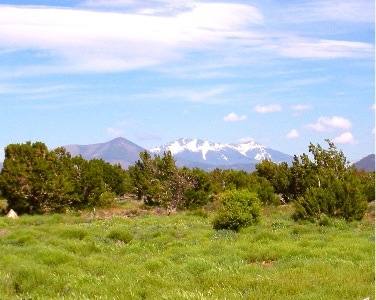 Howard Mesa was beautiful. Or maybe I should say that it was more beautiful than usual. The grass was knee-high and green and the seed tops swayed with the wind. The San Francisco Peaks were still snow-covered, off in the distance. Best of all, we seemed to have the whole place to ourselves — as usual.
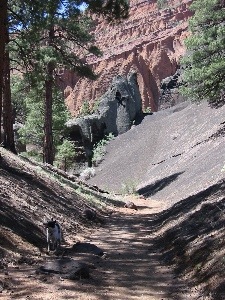 The trail, which was wide enough for hikers, bikers (the pedal kind, that is), or horseback riders, was smooth and covered with crushed red cinders. In places, it was heavily eroded, but not enough to make walking a problem. That was a good thing, because I hadn’t brought hiking shoes. I was wearing my red Keds and that’s probably the only kind of surface I could have walked 3 miles on. The trail climbed gently most of the way. It wound through the trees, then dropped into a smooth-bottomed wash and climbed toward the mountain in that. Soon, we were in a canyon with slopes of dark grey volcanic gravel on either side of us. It was fine stuff, like the red cinders we walked on. There were a few interesting formations right at the mountain’s entrance. Beyond them, we could see the red hoodoos inside the mountain.
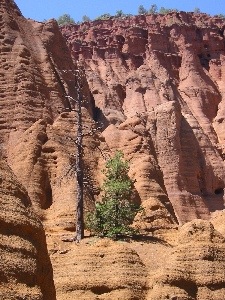 It appears to me that Red Mountain had once been a plain old mountain. Volcanic activity on one side had caused black lava to spew out of the ground. This undermined the mountain, causing a slide that took out about 1/3 of the mountain side. The result was the amphitheater the booklet told us about. Of course, this is all conjecture based on what it looked like. There was no interpretive sign in the parking area or elsewhere and no ranger to explain what we were seeing. I could have it completely wrong.
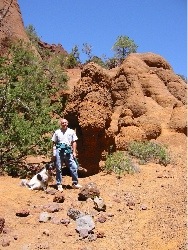 There are two ways into the mountain, both of which were described in the book. At the head of the wash we’d been following, someone had built a neat rock dam. A ladder climbed the six or eight feet up to the top of the dam where silt had backed up, raising the ground to the top of the dam. That’s how we went. Jack took the ladder like a champ. The other way was to climb up over a gray cinders covered slope. That’s probably the only way you could get in with a horse. (I know my horse doesn’t climb ladders.) Our way was easier. Inside the mountain’s amphitheater was exactly as the booklet had described. Lots of rock formations made of red sandstone carved by wind and water, with a bunch of dark gray formations just to make things interesting. We walked up to the head of the canyon, passing a family having lunch with their dogs. One dog, a Corgi, came yapping out after us, followed by a dog that looked like a mix of every dog breed in the world. Jack had some sniffing with them, then followed us.
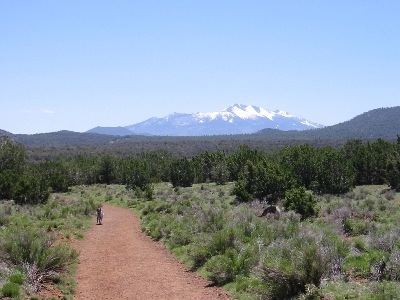 I took this photo of Jack as we neared the parking area. It’s the new desktop picture on my laptop. That’s the San Francisco Peaks in the background; you can see Jack running on the trail, tongue hanging out, on the left.
 The darn thing, which is smaller than a ChapStick, retails for $39.95. It was in the bin marked down to $29.95. So I bought it.