
A look at the things I like and don’t like about my new car.
Earlier this month, I blogged about buying my new Toyota RAV4 Plugin Hybrid. It was a (typically) long post that covered a lot of my thinking about buying a new car and, specifically, a plugin hybrid, to eventually replace two of the vehicles in my “fleet.”
The Decision
To recap the decision making process, I was interested in four things:
- A practical car that would serve me (likely) for the rest of my life. (I keep cars forever — or so it seems.) I needed something that was comfortable, could seat 4 people, and could carry stuff. It also needed to be able to handle the two miles of gravel road I live on, which is sometimes very washboarded, and foul weather.
- A fuel efficient car that would get good local and long distance fuel economy. These days, hybrids were the best option for that.
- A car that could take advantage of the cheap power where I live. That meant plugging in while at home.
- A reliable car built by a company with a good reputation and dealerships able to service it all over the country. That meant avoiding weird new manufacturers. I want a trouble-free car ownership experience.
Despite the low electricity costs where I live, I was not interested in a full-on EV because I was not interested in planning road trips around charging facilities and charging times. You might have an EV that you love and don’t think charging on a long trip is a big deal. That’s nice for you. I’m simply not interested in trying.
(I do want to mention that if someone sold a super small, no-frills EV, maybe just two seats with enough room in back to stow groceries, and priced that sucker under $10,000, I would consider it for a local-only car.)
I didn’t do much research. I’ll admit it. I knew Toyota’s reputation and I knew they’d been making hybrids for nearly 20 years. I thought about a plugin Prius, but it didn’t meet the practicality requirement. Everyone was talking about RAV4s and when I tried one on, it fit. So that’s what I bought.
The Woodland trim I went with has additional rugged road features that makes it even more practical for my life. I don’t have to worry about breaking it if I go on a rough road.
I made the decision, I started my search, I waited, and I picked up the car. All that’s covered in my earlier post about buying the car.
The Drive Home
I would make this post a lot longer than it needs to be if I went into a lot of detail about my drive home from Boise, which I did as a scenic road trip over three days. All I have to say is that the car performed exactly like you’d expect a brand new car to perform: flawlessly. It was comfortable, the air conditioning worked well in excessive heat, and the Apple CarPlay feature was something I’d been pining for for years, enabling me to follow a map on a big screen while listening to audiobooks and podcasts through the car’s speakers.
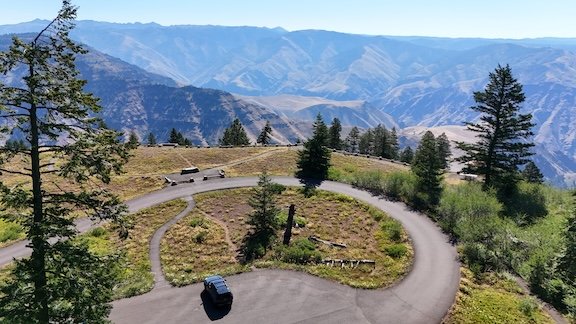
I stopped at Hell’s Canyon Overlook on my way home from Boise. The haze is due to wildfires in Washington, Oregon, and Idaho. I’m sure the smoke got worse after that.
Understand that my newest vehicle up to that point is a 2012 Ford Truck. Although it has some nice features in its Lariat trim, it’s nothing like what’s available in a mid-range car built 14 years later. My only experiences with many of the car’s new features were in cars I’d rented throughout the years. Some were great, others were okay, and a handful were simply annoying. (More on that in a moment.) The point is, there are lots of new features in new cars and it was fun to explore them.
One thing I want to point out, though, is the fuel efficiency. When I left the dealer showroom, the car’s hybrid motor battery had just 6% power available. The fuel tank was full, but the battery was nearly empty. The sales guy, Troy, told me that they had just begun carrying plugin hybrids and weren’t set up to charge them. Of course, the batteries were not fully charged during shipping. So although they could top off the gas tank, they could not top off the battery.
(Personally, I think this is a pretty lame excuse. After all, you don’t need a special charging station to charge plugin hybrids. More on that in a moment, too.)
The car has a battery display that indicates the battery level. It didn’t take long for it to go from 6% to 0%, but it built back up when I went down long or steep hills. Unlike a regular car, where you throw away energy when you use the brakes, a hybrid takes that energy and stores it in the battery for later use. This totally changes the way I drive. I am accustomed to using the brakes as little as possible to avoid throwing that power away, often getting to the top of a hill at a slower speed, knowing I’ll pick up speed on the way down. (This is especially true in my truck.) Now it seems to make more sense to try to keep a constant speed since braking is turned into useable power.
Although there was nothing stopping me from charging the battery along the way, it simply was not convenient to do so so I didn’t bother. That was the point of having the hybrid, no?
Anyway, I did 459 miles before refueling for the first time in Walla Walla WA. I took on a total of nearly 11 gallons. The math says I got just over 41 miles per gallon. Not bad.
At Home and Local Driving
At home, I backed it into the garage bay recently occupied by my Jeep. (The Jeep is now where my truck used to live while my truck is in the RV garage with my slide-in camper in its bed. My garage will always have enough room for all of my vehicles and trailers.) It was a tight fit — or at it least seemed so. I needed to get used to using the cameras to get the car in straight; I’m much better doing it now. (I always back my cars in.)
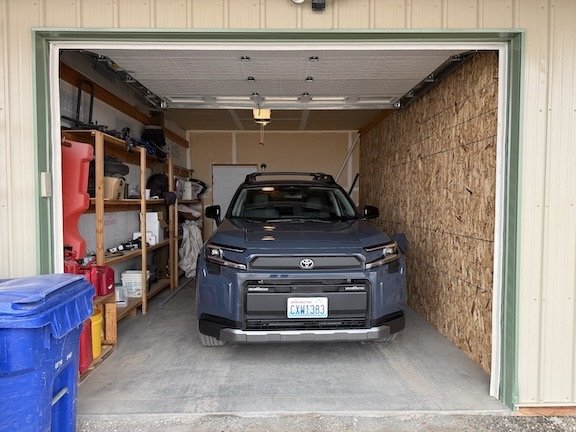
My most recent parking job. I never seem to get it truly centered because of have to navigate around my trash and recycle bins. (I’m thinking I should paint that back wall in the garage.)
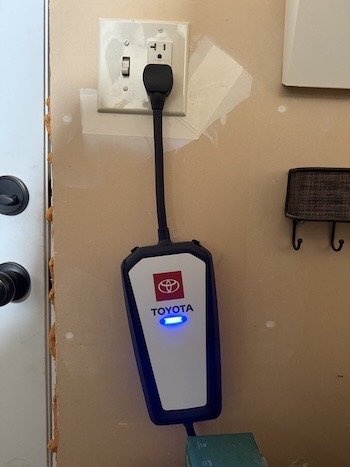
The charger came with a bracket and screws, but it isn’t that heavy and I don’t want a permanent installation. It seems to work hanging here just fine. (Yeah, paint would really dress up that wall.)
After unwinding from my trip, I took out the charging cable, plugged it into the wall, and plugged it into the charging port. The charger that comes with the car works with a standard wall outlet. I have a 20 amp socket just inside the door to the house so that’s where I plugged it in. The cable was just long enough to reach the port on the car which is forward of the driver’s seat, over the front driver’s side wheel. The car makes some unusual clicking sounds when you first plug it in.
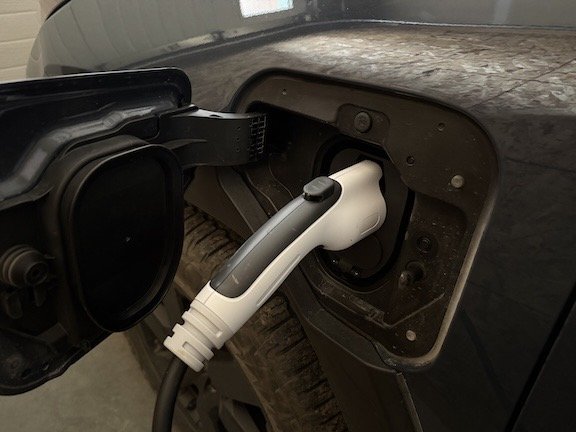
There are two little doors that look like fuel tank covers on the driver’s side of the car. The one up front is for the charging cable. The cable just reaches with the car backed in.
There was some confusion over the first day or two about a charging schedule. I’m still not sure if it was set up right and my changes messed it up. The car has an app (if you can believe that) and it was preset with a charging schedule that set charging times. The idea is that in lots of places power rates change based on the time of day. (I remember that being the case when I lived in Arizona; power was cheaper at night.) But that’s not the case here. My power is cheap — 2.8¢/kWh as I write this — all the time at residential usage levels. Anyway, at first it wasn’t charging. I made some adjustments to get the charger going.
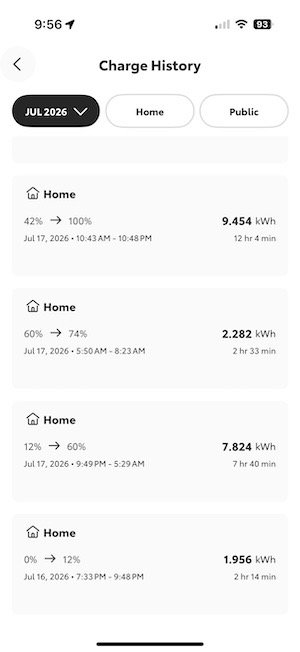
Here’s the charge history for my first few days at home. It took a while to figure out the charge schedule feature.
I won’t lie: it took a long time. 12 hours to 74%. That’s as far as it got before I had to use the car. I set it into Eco mode, where it prefers EV driving over regular hybrid driving, and went into town. 21 miles round trip took it down to 42%. Then 12 hours (overnight) of charging to get it to 100%.
Now I’ve got the charging schedule stuff figured out so it charges every time I plug in until its either 100% or I pull the plug. Nine times out of ten, it’s fully charged before the next time I drive it.
As far as power is concerned, the Toyota app shows that, too. I did a prorated calculation from the first three charging sessions shown here. 0% to 74% took 12.062 kWh. Divide that by 74 to get the number of kWh for each 1%: 0.163. Multiply by 100 to get the power for 0% to 100%: 16.3 kWh. Now multiply that by my power rate of 2.8¢/kWh: about 46¢.
So yeah: it costs just 46¢ to fully charge my hybrid car’s battery from 0% to 100% power.
Every time I go into town — a round trip of at least 20 miles, depending on where I go — the power level drops by 35% to 50%. So I’m using, at most, about half the battery power. The gas engine only engages during rapid acceleration in Eco mode — for example, when I turn onto the Malaga Alcoa highway where the speed limit is 50 mph — or when I’m climbing hills. A gauge on the dashboard indicates whether I’m in EV (Eco) or Power (Hybrid) mode. I can moderate how I use the accelerator to keep the car in EV mode, theoretically not using any fuel at all. But honestly, it isn’t worth it.
Because I live at a higher elevation than town, I can get all the way down to Malaga Alcoa Highway — a distance of about 6 miles — and not lose a single bit of battery charge. Still 100% when I get to the bottom of the hill. The trip back up eats up a lot of battery charge, though.
Another indicator tells me how my hybrid miles until empty. I can go into town with that reading 333 (using a recent example) and come home with it reading 332. I drove 20+ miles but it says I only used 1 mile worth of fuel.
This might all sound confusing to you if you’re not a numbers person like I am. I absolutely love these stats. I even keep a logbook in the car to list all the mileage and battery usage info. That’s how I’m able to spit out these numbers for you. They’re in my book.
A Fully Charged Road Trip
I made my first trip to Bellingham in late July. Bellingham is 199 miles from my house. About 1/3 of the trip is on winding mountain roads that cross the Cascades at Stevens Pass. Another 1/3 is on the I-5 freeway. The remaining 1/3 is on regular roads with speed limits ranging from 15 to 60 mph.
I started the trip with 100% battery power and enough remaining hybrid miles to get me there with miles to spare. I set the car to Normal mode. And then I drove as I normally would.
The battery dropped to 0% long before I reached Stevens Pass. I should have noted exactly where; I will on my next drive there. It gained a small amount back on the way down the mountain. And then it pretty much stuck to 0% for the rest of the drive.
I did not note the remaining hybrid miles on arrival but it was low enough that I decided to fuel before coming home a week later. I had driven 516 miles since my last fueling in Walla Walla. I put on 9.4 gallons of fuel, which comes to a very nice 55 mpg average.
So yeah: I’m definitely getting the kind of fuel economy I wanted.
I can do some more math here. I normally took my truck to Bellingham. It gets about 15 mpg when I’m not hauling anything. So I’m looking at roughly 27 gallons of diesel for that round trip drive. The RAV4, at 55 mpg, needs only 7 gallons of fuel for the same trip. That’s a savings of 20 gallons and with fuel prices around $5/gallon these days — remember, I live in Washington state and there’s a war in the mideast (for some reason) — I’m saving $100 on every trip.
Other Charging Stuff to Consider
Reality check here: I’m getting the best fuel economy on short trips where most of the trip is done on EV power. So the average MPG I calculated for my second fill up really takes into consideration the local driving I did between fill ups. If I had topped off the battery in Bellingham somehow — I’m sure there’s a charging station somewhere — I would have gotten better fuel economy. I’m not sure how it would have affected my overall cost, though. What does a charging station cost to use? I have no clue. I do have an adapter that enables me to charge with a Tesla charger; one of these days, if the battery is low or 0% and a charging station is convenient, I’ll give it a try. But I seriously doubt it’ll be anywhere near as cheap as it is at home.
I’d love to see what MPG I can get with local driving only. But if I only drove locally, I’d probably go months before needing to top off the fuel tank. My dealer claimed that he had a customer who only drove her hybrid locally; she drove 1,500 miles before needing to fill up her tank.
As for using a standard wall outlet as opposed to a fast charger I can get installed at my home, it doesn’t bother me how long it takes to charge at home. Remember, all I need is 50% to take advantage of the Eco mode features for short jaunts into town. And I don’t use the car every day anyway. I last drove it on Friday (I’m writing this on Sunday morning); I plugged it in Friday evening at 54% power and it was fully charged before 4 AM the next day. It’s been sitting in the garage, plugged in at 100% since then.
And before I consider a fast charger installation, I need to consider what it would cost me. Likely several hundred dollars for the parts and labor. And that’s if I have room in my electric panel for a 220v circuit (I actually don’t).
Comfort, Convenience, and the Other Stuff
If your brain isn’t fried by all those numbers by now — mine almost is — here’s some info that isn’t related to numbers: the things that make you like or not like a car.
I’ll split these into pros and cons. First the pros:
- Fuel economy. I already covered that in excruciating detail. ‘Nuff said.
- Comfort. The car is comfortable. The seats, which are a nice kind of fake leather that isn’t sticky or ugly, adjust all kinds of ways, including a lumbar support. The seats and steering wheel are heated. The climate control can split zones to make a front seat passenger happy. The mirrors adjust perfectly. There’s a moon roof with a shade that I can use to ventilate the car when I park in the sun.

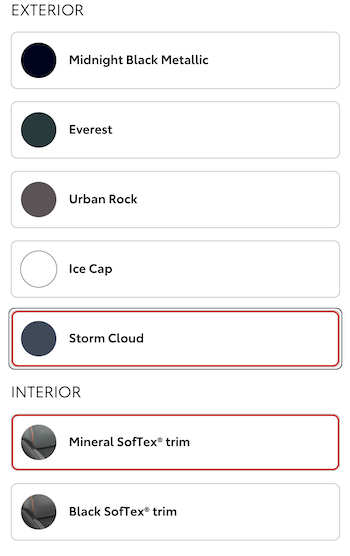
I found an excellent fast charging USB-C curly cord for my phone. This was before I realized that the shelf had a magnetic charger built in.Convenience. There’s a push-button start and stop; I just leave a fob in my pocket or purse. (I admit that took getting used to; none of my other cars have a fob.) The doors automatically lock or unlock with the wave of my hand in front of a door handle. It has single press electric windows for both front seats, up and down. There’s a push button opener and closer for the hatch back. There’s USB-C built in at the dashboard. (There’s even a magnetic charging pad, but I doubt I’ll use it.) And did I mention Apple CarPlay? I had a taste of that in rental cars; to have it in my own car is great! There’s also an AC power outlet in the cargo area — for a cooler, I was told, so I bought one. And the rear seat split and fold down nearly flat.
- Handling. All I can say is wow. This is an SUV, right? Or whatever the hell a crossover is? But it has nice, tight steering and very aggressive acceleration. Not much body roll. Nothing like I expected it to be. It’s not as fun as driving my Honda S2000 — that car is, after all, my Joy Machine — but it’s a hell of a lot better than driving my truck.
- Practicality. It definitely has that covered with the ability to comfortably seat 4 or 5 people and plenty of space in the cargo area. Fold down the seats for just two on board and you’ve got a lot more cargo room. There’s also a roof rack. I’ve already bought a tent that can attach to the back of the car to turn it into a comfortable car camping setup. And it can tow up to 3500 pounds, which is probably more than my Jeep can tow.
There are a few nitpicky cons:

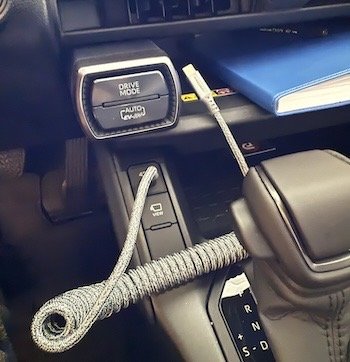
The color choices available for RAV4 cars as I write this. The website shows a red one but that’s not an option. Go Figure. Mine is Storm Cloud.The color. Although I like the color, I wish it wasn’t so dark. It gets nearly as hot in the sun as a black car would be and probably shows exactly the same amount of dust after several drives up and down by road. But other than white, all of the RAV4 Plugin Hybrid colors are dark.
- Excessive “safety” features. Let me start by saying this: I have been driving since I was 16 years old. We’re talking nearly 50 years here. I have a very good record of safety. I know how to drive and I know how to do it without causing accidents. In fact, I’m also a pretty good defensive driver. This car includes all the safety features car designers could possibly have come up with. Cruise control slows down if it thinks I’m getting too close to the car in front of me. The wheel shakes or actually steers the car (!) if I get too close to a lane dividing line. And the one I turned off before reaching my first destination: it monitors the driver’s eyes and beeps with a warning message on the instrument panel if the driver’s eyes aren’t on the road. Yes, these features can, for the most part, be disabled. I can see the attraction of them for people who like machines to think and act for them. I’m not one of those people. Rely on a system and you’re kind of screwed when that system is not available. No thanks.

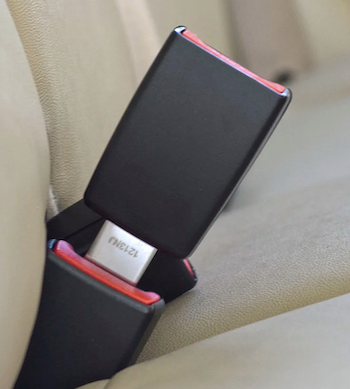
The seatbelt extender I use to defeat the seatbelt warning chime when I need to.Annoying seatbelt chime. For the record, I wear my seatbelt when driving the car on a road. I don’t wear it in my driveway, in parking lots (especially when backing up), or on slow speed rough roads. I don’t need an annoying chime to tell me to put it on. I am an adult. I turned off this chime on my Ford truck and my other two vehicles are too old to have the chime — they just have lights. The local dealer refused to disable it for me. So I went out and bought a seatbelt extender like the kind my Dad had in his Mustang. Leave that buckled in and buckle the seatbelt into it when you’re ready to buckle up. (Highly recommended.)
- Overall appearance. Let’s face it: it looks like half the freaking cars on the road. I’ve already tried to get into the wrong car twice. I’m not used to having such an ordinary looking vehicle. It’s attractive enough, but … yawn. Good thing I plan on keeping the Honda forever, too.
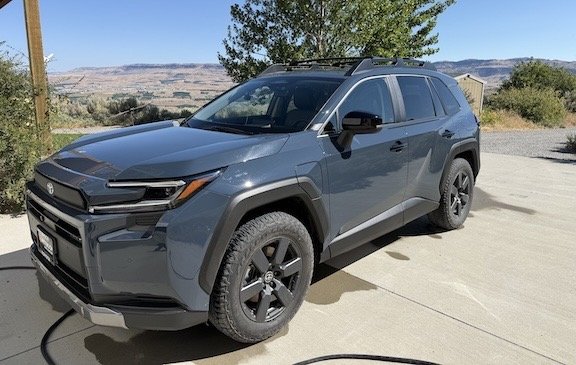
The drawback of having a dark colored car on a gravel road is that no matter where you wash it, it always has dust on it after a drive. Here it is after the first time I hosed the dust off. Damn hard water left spots.
Overall Conclusions
Despite my nitpicking, I love the car. I can’t imagine anything else meeting my needs so well for the same price.
And I’m very glad I didn’t wait to buy it.
Discover more from An Eclectic Mind
Subscribe to get the latest posts sent to your email.
Back wall – you should paint an outdoorish mural. I could give you some easy ideas . . .
Yes, especially if it is easy! I have a bunch of stuff still up against that back wall that I need to move. I’d like this first garage bay to be nice and neat. It was once.
Good choice Maria. I have had several Rav 4’s over the last 20 years. Good build quality, fast and economical. Winter weather? Perfect on ice or snow.
I’m really happy with the car so far. I’ve even towed two trailers with it and feel confident that a lightweight travel trailer is possible. I’m hoping to do some downsizing next summer; let’s see what I can come up with.
I am enjoying your vehicle series. I am in the market for a vehicle and am curious about your experience with mice where you live.
I am rural, having been urban before that, and didn’t have a problem with mice getting into the cabin of a vehicle until my 2019 Toyota Tundra. They got in through the cowling and would make nests under the seat from the cabin filter behind the glove box and poop on dash. Ugh! I sold the truck in 2020. We bought a 2025 Tundra and still the mouse problem. Our 2002 Tacoma and 2009 Tundra and 2012 Sequoia did not have this issue nor does the 2018 Ram.
I understand one cannot keep mice from the engine compartment but getting into the cab, chewing up the cabin air filter for nesting material, that seems preventable. I look forward to reading more of your experiences with the hybrid!
I just saw this… Sorry for the late response!
I’ve had mice in my vehicles, but never to the point where they damaged the vehicle. All of my vehicles currently live in my garage. So does my cat. I think that keeps the mouse population down.
I sure hope mice don’t become a problem with this new car or any of my others. I’m not sure what can be done to prevent them from getting into a vehicle in a rural area. Indoors will be better than outdoors, though. Mousetraps around the car might help. Good luck!