I Made It!

I arrive at Howard Mesa for my summer vacation.

It was months in the planning. And, near the end, it didn’t seem as if I’d make it as scheduled. But on Saturday, June 25, I flew up to Howard Mesa with whatever gear I could stuff into Zero-Mike-Lima. Mike, with his pickup filled with purchases, Jack the Dog, Alex the bird, and the horse trailer with two horses, came up the slow way.

I left Wickenburg about forty-five minutes after Mike. I wasn’t in a rush. The idea was to get there before him, but with an estimated flight time of about an hour and an estimated drive time of 2-1/2 hours, I had plenty of time. It was a relatively smooth flight, but the sky was quickly filling with cumulus clouds. Unusual, given that it was only around 8 AM. I was sprinkled on just east of Paulden, but it wasn’t enough rain to get the bugs off my cockpit bubble.

There was also enough sun during the flight for me to sun my legs. I was wearing a pair of ratty gym shorts with my Keds. I hate getting a Keds tan — that’s when your feet are white and there’s a tan line across the middle of your foot. So I took off my shoes and rested my heels on the tops of the pedals. I was pretty surprised that I still had good control of the pedals, even with my legs stretched almost straight out. Not that I needed to do much pedal pushing. At 110 knots, it isn’t tough staying in trim.

I stopped for fuel at Williams, where the 100LL price is currently $2.89/gallon. That’s 40¢/gallon cheaper than Wickenburg. I took 38.3 gallons. The Airport Manager, George, and his wife came out to look at the helicopter. He wanted to help me fuel, but I insisted on doing it myself. It was cool and breezy and quite a pleasure to be outside.

George wants me to offer helicopter rides from Williams airport for the summer. I told him I probably wouldn’t because I only planned to be in the area 6 to 8 weeks and I had lots to do at my place at Howard Mesa.

I took off after 20 minutes and headed north. Valle’s Planes of Fame museum was having their semiannual War Bird Fly In and I heard the pilots doing fly bys chatting on the radio. Things got a bit tense when one of them called a Mayday, but he evidently resolved the problem because he kept flying. (Hell, it the word Mayday ever comes out of my mouth, you can bet I’ll be on the ground as soon as possible.)

Since I had time, I decided to do a little fly by of my own. Zero-Mike-Lima isn’t a war bird, but kids like helicopters and I figured that if any kids were there, I’d give them a little bonus. I got into the pattern behind something slow — slower than me — and had to cut power and pull back to avoid flying up his butt. He did a low, slow fly by on Runway 14, which is closed, and I followed him, trying to hang back so I would steal any of his thunder. Then I dropped down to about 50 feet AGL and, as soon as he was out of the way, pushed my nose forward, increased power, and zipped past whoever may have been watching. Then I headed south to Howard Mesa, anxious to get away from slow-flying airplanes.
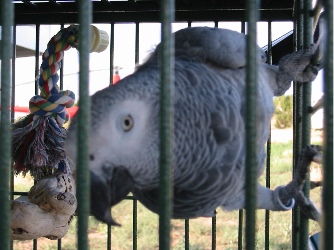
Alex in his cageI landed on my gravel helipad near the trailer and shut down. Then I proceeded to do chores. Unlocking the camper, turning on the power and refrigerator, tuning in the stereo (presets get lost when you shut power), hooking up the water, setting up the pump, opening the gate, putting out the carpet. I was just staking down the awning when I heard Mike’s truck pull in. He unloaded the horses and other critters and I made him lunch. Then we put away all the things he’d brought: Alex’s big cage from the coffee shop, the cabinets I’d bought for the shed, and the tools I’d need to work over the summer.

It was after 12 PM when we headed down to Williams. I had a radio interview with Inside Mac and they had requested that I call their toll-free number from a land line. Since there’s no land line at Howard Mesa, we decided to take care of it in Williams, where we had some shopping to do anyway. I found a payphone in the Fray Marcos hotel, spent exactly 12 minutes on the phone with a guy who mentioned the title of my Tiger book, using the wrong title (“virtual” rather than “visual”) about ten times. Then we hit the hardware store and Safeway supermarket and headed back up to the mesa.

We have forty acres at Howard Mesa and one of the first things we did after buying the place was to fence it all in. It took about a mile of fencing and $8K to get the job done. It was done by Grantham Custom Fence of Wickenburg and they did an incredible job. The straight bits are perfectly straight and the fence is good and sturdy. We do need to make repairs now and then when the top wire gets damaged by an elk jumping over. My only complaint is that the corner posts are coming out due to the annual freeze-thaw cycles. Although Ty’s guys used concrete and dug each one in at least two feet, the earth squeezes them up a little every year. The fence is still sound, of course, but it looks a little weird in the corners.

The reason we fenced it all in was so the horses could run free. We call it the “salad bar” because as soon as they step off the trailer, they’re grazing. They love it at Howard Mesa, although the first night they were up here this year, they did get snowed on. They have a round pen here where we put their food and water, but the gate is always open. They come and go as they please. Right now, as I write this, they’re about 100 feet away, grazing.

Somewhere along the line, Jack the Dog decided that it was his job to keep the horses away from us. He’d wait until they were about 50-100 feet away, then tear off after them, barking. Cherokee, who is afraid of rabbits, would take off and Jake, not quite sure why Cherokee was running, would start running, too. It look a lot of yelling and rock throwing — yes, at the dog — to get him to stop.

Cherokee at CageMike spent the afternoon hooking up the camper to our septic system. It was a good thing he did, because the camper had been used for three short trips without being dumped and it was beginning to get stinky. I took care of things inside — putting away groceries, making the bed, cleaning things up. Two hot showers later, we had dinner at the picnic table outside the camper, with our horses and the San Francisco Peaks to admire while we ate. Cherokee decided to stand on the other side of the bird cage while we ate dinner. His head was about 2 feet from Alex. Alex was very quiet while Cherokee was there. Then Cherokee decided to sample the corn cob litter I’m using at the bottom of Alex’s cage. I think he likes it. We had to scold him and chase him off. Jake came over and watched us eat our corn. I think he was begging. It was very weird having the horses so close to us — less than five feet away — while we ate. I’m not sure how much I like it. Meanwhile, Alex has already learned to imitate the squeaky screen door. He makes the sound every time we open the door. I’m waiting for him to learn how to call Cherokee.

We watched the sun set and it immediately cooled down. It had been in the high 70s all day, with several isolated thunderstorms that had missed us by a few miles. Nice rainbows. When the sun set, the temperature dropped about 10 degrees in less than 30 minutes. We went in for the night because we were cold.

Sunday dawned with a beautiful cloudless sky. For a while, there was very little wind. We had a light breakfast and set about our morning chores. My job was to take the new weed whacker and whack weeds. I started with the horse’s round pen, which we use to feed them. The weeds were knee high in some places, but I made short work of them. Then I whacked around the camper and went after the tumbleweeds growing on the southeast side of my helipad. The tumbleweeds were young and fleshy and they splattered me with green stuff. Anyone who uses a weed whacker without eye protection should have his head examined.

Mike worked on the shed’s roof. Some of the shingles on top were loose and he wanted to seal them up with glue and special nails. he finished before me and spent a lot of time watching me go after the weeds. I finally stopped when the engine was out of gas. I was out of gas, too. And my right arm was so weak I couldn’t lift a glass of water to my mouth.

We decided we’d go to Flagstaff for the rest of the morning, but changed our mind halfway down the mesa. Instead, we’d go to either the Grand Canyon or Williams for brunch. We decided on Williams because we didn’t feel like dealing with weekend traffic at the canyon. Bad decision. We wound up in a terrible restaurant in downtown Williams. The food was only partially edible, the service was terrible, and the waiter was skeevy. And it wasn’t cheap. A learning experience, we agreed. We wouldn’t go there again.

We went for lattes in a coffee shop and I discovered that they had free wireless Internet. I’ll probably have a latte there tomorrow morning while this is sent to my blog server and I collect my e-mail.

Zero Mike Lima at Howard MesaBack on the mesa, we relaxed for a while before doing our final chore for the day: surrounding the helicopter’s landing area with a “fence.” We had some plastic fence posts designed to hold electric tape. We’d bought the whole system — complete with solar fence charger — as an option for when we went camping with the boys. But we’d since used the fence charger and some of the tape to surround the chicken coop and keep our neighbors dogs and coyotes out. We had these posts and plenty of tape left, so we used them to make a perimeter around the helicopter. The idea is to keep the horses out of the landing zone when the engine is running. Our horses respect fences, so we knew it would keep them out. We just weren’t sure how well the posts and tape would hold up to rotor wash.

We got to try it out a few hours later. I was keeping Mike’s truck with me at Howard Mesa, so I needed to take Mike home. Let’s see…two hours round trip by helicopter or five hours round trip by truck? Tough decision, huh? Mike waited outside our little fence while I started up, warmed up, and brought it up to 100% RPM. The fence held. Mike climbed aboard and we took off. The horses watched from 150 yards away. Cherokee looked very confused.

We had a quartering headwind for most of the trip home, so it took us the full hour. Mike offloaded his stuff and put a few things from the hangar on board for me. I took off for the return trip with a quartering tailwind that brought my ground speed up as high as 144 knots. Yee-ha! I got back to the mesa in about 45 minutes.

As I came in for my landing, I looked for the horses. They were about 100 yards from the landing zone. When they saw me coming in, however, they took off running. Unfortunately, they decided that the safest place was their corral, which was about 50 feet from my fenced-in landing zone. They stood by the gate and watched me set down. I think Jake recognized the big red thing that had been parked there all weekend and had left just two hours before. I waved at them. When I killed the engine, I got out and talked to them, then got them some alfalfa. They forgot all about scary loud red flying machines.

I’ve done my chores for the evening and taken a walk “around the block” with Jack the Dog. The sun set about 20 minutes ago and it’s starting to get cool. I’m wearing long pants, a long sleeved shirt, and a sweatshirt. Mike, who called a while ago, says it’s in the 90s back home. He’s watching the Mets/Yankees game on television and says the house is weird with no animals or other people.

To me, Howard Mesa is weird with all these animals but no Mike.

Flex Time

I finish another book and prepare to take the summer off.

One of the best things about being a relatively successful writer is the flexibility of my time. Sure, when I’m working on a book with a tight deadline, I’m working 10-hour days, sometimes 7 days a week. But when there’s nothing pressing on my plate, my time is flexible.

Last Friday, I finished a revision to one of my Windows books. (I’m not at liberty to say which one.) Although this is usually one of my least favorite book projects, this year things went very smoothly. I think it’s because of the way I “attacked” the project. Instead of starting early, using an early beta that was bound to change, requiring all kinds of rewrites, I waited until a more finalized beta was available. This, of course, forced me to produce very quickly. The 500-page book has 20 chapters and 2 appendixes; the deadline gave me 10 days (including one weekend) to get it all done. I wound up taking that weekend off, due to a nasty cough and cold, but still finished in the 10 days I originally planned, just two days past the deadline. The project went by in a blur, not giving me any time for frustration. By the time I was starting to feel really burned out, I was finished.

The book is in editing and production now. The copy editor sends me, via e-mail, 2 to 4 chapters a day with her changes marked using Word’s revision feature. I go through her edits, reject the ones I don’t like (which are very few of them), add any requested text (normally section titles for cross references), and answer questions. Then I send them back to her. She cleans them up and sends them to the layout people. I get 2-3 page proof chapters a day via DHL and I go through those, checking for illustration cross-references and other glaring problems. I use e-mail to send back my comments to the copy editor. She (I assume) passes the info on to the production folks, who fix the problems.

(I got to meet the DHL guy the other day for the first time. What a nice guy! Reminds me a little of Larry, our old FedEx guy, who retired last year. Friendly and a real pleasure to talk to.)

All this finishing up stuff takes about 1-2 hours a day. I normally go over the proofs at breakfast, while I’m having my coffee. And since I can pick up e-mail with my laptop at home, I don’t even need to go into the office. But I usually do, for a few hours a day, because I prefer working on my G5 desktop machine when I’m working. I like to keep the laptop for personal stuff.

So after two weeks of long days in the office, I now have an extremely flexible schedule that allows me to…well, goof off. I’ve been doing helicopter flights (had to say No to an extremely lucrative one down in Scottsdale while I was working), hanging out at Stan’s Latte Cafe, and — if you can believe this — taking naps in the middle of the day. (The naps seem to be required these days, since the rather oppressive heat is sucking the life out of me every day.)

Although I have a few articles lined up for the next few weeks, there are no books on my plate until October. I did that on purpose, setting myself up for a summer off. Financially, I can handle it; the second installment of the advance on my Quicken book should take me right through the summer and I’m expecting a Peachpit royalty check any day now which should help things out. And payment for four articles is in the pipeline. So I’ll have enough money to pay my bills — including the rather large ones related to the helicopter — and cover my living expenses without working through the summer.

The plan, of course, is to go up to Howard Mesa. I’m flying up on Saturday. Mike will be coming up with the bird and the dog and the horses. We’ll do some work on our shed over the weekend and then I’ll fly Mike back. I’ll return to Howard Mesa to continue work on the shed during the day and work on a novel I’ve been wanting to write during the afternoons. I’m looking forward to spending a summer up there that doesn’t require me to be away all day long, flying at the Grand Canyon. I’ll actually get to enjoy my place during daylight hours and I’ll have Alex the Bird and the rest of the menagerie up there to keep me company.

That doesn’t mean I won’t be working at all. As I get article ideas, I’ll bounce them off my editor at Informit and, if she bites, I’ll write them. And I’ll try to write more regularly in these blogs. Of course, since there’s no Internet connection on Howard Mesa, it may take some time to get the entries on the Web. I was told that the Williams library is a wireless hotspot, so I’ll probably go down there two times a week to scoop up e-mail and publish blogs.

I’m looking forward to this summer off. If everything works well, I hope to do it every year.

On Old GPSes and New Activities

I discover geocaching and plan to take it to the extreme.

Years ago — I really don’t know how long — I bought a Garmin GPS 12Map. At this time, it was hot stuff. It was one of the first 12-channel receivers, which means it acquired satellites quickly and managed to hold enough of them in transit to be useful. It had a grayscale screen with a moving map. It had about 1.4 MB of memory, which you use to store detailed maps, so that detail would be available when you were using it. Although it didn’t talk to my Mac, it did talk to my PC. I downloaded Garmin maps into and uploaded waypoints and routes from it to another, more detailed software package.

I used it a lot. This was before I seriously got into flying and I had my Jeep, which we used to take on back roads once in a while. We’d load up the maps for where were were going and take a drive. We always knew exactly where we were and could consult the map to find our way in or out of a location. We also knew the names of all the land forms and other named places we passed.

I also used it for horseback riding. The GPS had an automatic tracking feature. I’d start it up, clear the track log, and attach it to my saddle, antenna side up. It would faithfully record every twist and turn in the trail. When I got to a gate, I’d mark it as a waypoint. Then, when I got back to my office, I’d upload the route information to the mapping software and display the horse trail on a topographic map. Do that a few times on all different trails and, before you know it, you’ve mapped all the trails on a topo map. Cool.

Although I stopped using the GPS regularly, I never really stopped using it. (Not like I stopped using my Palm or my Newton. But let’s not go there, huh?) Most recently, back in September, I pulled it out, loaded a few topo maps into it, and took it on a driving trip on the north side of the Grand Canyon. (I’m pretty sure I wrote about that trip in these blogs somewhere, probably in the “Travels with Maria” category.) Basically, any time I plan to take the Jeep off pavement, I bring the GPS, loaded with appropriate topo maps, with me. I have mounting hardware in the Jeep and a cable that provides power to the GPS. So as long as the engine’s running, I don’t have to worry about batteries.

For the record, I don’t use the GPS to drive from point A to point B on paved roads. If you need a GPS to do highway or city driving (“Turn left here.”), you really shouldn’t be driving. Take a cab or hire a chauffeur. Or ride Greyhound, and leave the driving to them. Or learn how to read a damn map!

Now, five or more years later, my GPS is outdated. Sure, it still does what it always did, but there are so many more GPSes out there with so many more features and so much more power. Color screens, more than 50 MB of memory, more waypoints, etc. For the past year or so — actually, every time I take out the GPS and use it — I think about how nice it would be to store 100 topo maps instead of just 4 or 5. That would certainly save a lot of trips to the PC in my office, just to load up maps. I could load all the maps I normally need and have that detail every time I went out.

But I don’t use it all that much and I can’t really justify the expenditure of $400 to $500 for the latest version of a “toy” I already have. (Hey, at least I could write paying articles about the iPod Photo.) So I haven’t replaced it.

Then I discovered geocaching. Wow, what a silly sport. Person A takes a weatherproof container that can be as small as a film canister or as large as an ammo can and fills it with trinkets like tiny stuffed animals, keychains, stickers, and beads, adds a small notepad with a pencil, marks it as a geocache, and hides it somewhere. He then takes the GPS coordinates (several times, to make sure they’re right) and publishes them on a Web site like www.geocaching.com, along with a name for the cache and a description or hints. Person B, having nothing better to do with his time, gets those GPS coordinates off the Web site and looks for the cache. When he finds it, he removes one relatively worthless item — perhaps the keychain — and replaces it with another relatively worthless item — perhaps a pin-on button. He also makes a note or two in on the notepad and then, when he’s back in front of his computer, he logs his find.

It may sound easy, but it isn’t. I went in search of one yesterday, just to see if I could find it. Named “Airport,” it was on the side of the road, not far from Wickenburg Airport. We zeroed in within 40 feet, stopped the Jeep, and got out to look. Unfortunately, our wet winter had resulted in tall grass and weeds that are now dead and likely hiding places for snakes. We arrived not long after sunset, while it was still dark, and cautiously searched the brush. At one point, my GPS told me I was within 4 feet. But I just couldn’t find it and I wasn’t prepared to push aside dead grass to look harder for it. So we let it go. I’ll try again another day, when I’m better prepared with a stick, a gun full of snake shot, boots, and gloves.

What I like about the idea of geocaching is the challenge of it and the fact that it forces you to go outdoors and explore off pavement. This alone is a good reason for people to do it. Think of all those mall walkers, trying to get exercise by walking in the mall. Now take off their walking shoes and replace them with hiking shoes, give them a GPS, and tell them to find a cache. They’re still getting exercise, but they’re breathing fresh air. They’re also seeing trees and bushes and grass and sky and maybe a few animals rather than whatever’s playing in mall shop windows. And there’s no Starbucks to lure them in for a mochachino. The terrain may be a bit more rugged and not suitable for some of the less steady folks, but I think it could work for lots of people. And even if they don’t find it, they’ll still probably have some fun.

I can imagine it now: five women and a man aged 60 to 75, out in the desert on a trail. They’re wearing sweatsuits that they bought in Wal-Mart, one of them has a sweatband around her head, and another has a walking stick she bought at the Grand Canyon. One woman, the tallest, is holding the GPS up, looking at it through the lenses of her half-frame glasses. (She got the GPS away from the man early on, when it was clear to her that he couldn’t program it.) “It’s this way,” she announces, pointing to her left. The group starts walking.

But seriously, it seems like an interesting activity and a great excuse to get outdoors.

Of course, I’ve started thinking of making it really challenging, not by hiding the cache in tall, potentially snake-filled weeds at the side of the road, but by placing it in a location that’s difficult to get to. A location with no roads or trails. A location that — you guessed it — is accessible by helicopter.

I call it extreme geocaching and it’s for people who need an excuse to go beyond the boundaries of civilization, to places no one ever goes.

All the cache locations would be within a mile of a Jeep-accessible road, but there may not be trails to get to them. It would take real skill and determination to reach them. But it would be worth it, not only for achieving a difficult goal, but for the destination itself. You see, the GPS coordinates wouldn’t take you to a bush or hollow tree. They’d take you to an interesting site with ruins, abandoned buildings, swimming holes, or hot springs. Someplace to explore. And you wouldn’t find dime-store novelties in the caches — there would be stuff with value, like current maps, books, flashlights, CDs, and gift certificates.

There would, of course, be a safe helicopter landing zone within a quarter mile of each of the caches. That would make extreme geocaching the perfect helicopter sport.

Of course, I feel pretty silly talking about extreme geocaching when I can’t even find a metal container on the side of route 60 just outside of Wickenburg.

Anyway, if you have an interest in geocaching, visit the Geocaching Web site. You can enter a zip code near the top of the Home page window to search for caches near you. I was amazed to find that there are about 6 of them within half a mile from my house. (We’ll take the horses out to find them when the weather cools down a bit.)

And if you live in Arizona and want a real challenge, keep checking in here. I expect to establish my first extreme geocache later this month. Use the comments link for this entry if you have any suggestions for what the cache should include. Keep in mind that my budget is $100.

Could it be? A building on our place at Howard Mesa?

Our soon-to-be cabin was finally delivered to Howard Mesa.

If you’ve been reading these blogs for a while, you may know that Mike and I own 40 acres of “ranch land” at the top of Howard Mesa, about 40 miles south of the Grand Canyon. The place got a lot of coverage in last year’s blog entries because I lived in our travel trailer there while I worked at the Grand Canyon. During those months, I grew to hate the confined space of the horse trailer with living quarters and dream of a more permanent structure that we could go to at any time, without a lot of preparation, to get away from home.

Yes, I’m talking about trading life at the edge of nowhere for life in the middle of nowhere.

A vacation cabin. After all, that’s why we bought the place five or six years ago. As a place we could go in the summertime, to escape the heat. But also, as a place to get away to when we needed to get away. And I need to get away a lot more than the average person does.

The trouble with the trailer is its cramped space — half of its 35 feet is set aside for horse transportation — and the difficulty in getting it up there. Our last trip up there, in April, was difficult (to say the least) and cost me about $200 in repairs. As Mike attempted to drive up the unmaintained road to the place, the trailer’s left wheels dropped into a ditch, smashing the gray water release and the holding tank valve. Thank heaven the black water (sewer) tank’s valve or pipe weren’t affected! Then the right wheels dropped into a different ditch, smashing the drop-down step. Sheesh. Mike had his share of expenses that weekend when he skidded off another road at Howard Mesa and had to pay a tow truck operator $250 to get it out. I was my at my bitchy New Yorker best at the association meeting the next day, demanding that the roads be properly maintained. I must have scared them, because they have since made the road we use most of the time better than it has ever been. You know what they say about the squeaky wheel. And I really do know how to squeak when I have to.

After much debate on different options — including a single-wide trailer (yuck), a double-wide trailer (double-yuck), a “park model” trailer, and a custom cabin, we settled on a compromise: a portable building that could be fixed up as living space. We ordered a custom shed, with a loft, to be delivered right to Howard Mesa.

I won’t go into details about how the deliver was screwed up twice. I may have already griped about that in these blogs. If not, you’re not missing anything. Let’s just say that we drove up to Howard Mesa twice — a distance of about 150 miles from Wickenburg — to receive the shed and both deliveries were cancelled.

But third time’s the charm, right?

This latest delivery date was set for Saturday morning. The delivery guy (who sold us the thing), said he was going to leave Wickenburg at 4:30 AM to meet us at Howard Mesa at 9:00 AM.

My problem was a scheduling conflict: I had to be in Chandler, AZ at 1:30 PM to do an Apple Store appearance. Chandler is 140 miles south (as the crow flies, mind you) from Howard Mesa. By car, it’s about a 4-hour drive.

You can probably figure out what the solution was. We took Zero-Mike-Lima to Howard Mesa with the idea of flying directly to Chandler afterwards.

We left Wickenburg at 7:15 AM. It was a nice flight — smooth, cool, and uneventful. We were at Howard Mesa by 8:20 AM. But David — the person we were supposed to meet, wasn’t there yet.

We decided to fly to nearby Valle Airport for fuel. While the guy was fueling us, Mike called David. He hadn’t even made it to Flagstaff yet. (He was taking I-17 to avoid the twisty roads near Yarnell and Prescott.) I seriously doubt that he left at 4:30 AM. So Mike and I took the airport courtesy car (which evidently does not have a reverse gear) and went to breakfast in Valle. At 9:15 AM, just as I was spinning up, David called. He’d just turned onto route 64, just 15 miles south of our rendezvous point. Perfect timing. We passed the rendezvous point before David got there and found him about five miles down the road. He was hard to miss. The building was huge on the trailer behind his truck. It’s 12 x 24 with a tall, barn-style roof. I circled around him and raced back to the turnoff for Howard Mesa. I circled my landing zone near the road once to check for wires and wind, then set down. Mike got out and I took off again, before anyone could wonder what I was doing there.

Zero Mike Lima at Howard MesaI flew over Larry Fox’s place with the idea of offering him a ride, but didn’t see his truck outside. I think his wife was working in the garden. So I just kept going, up to our place on top of the mesa. I was there in less than 4 minutes. It would take Mike and Dave and the soon-to-be cabin considerably longer. I landed on the far edge of the gravel helipad we’d made the previous season and shut down. Then I made some trips to and from the helicopter to unload the supplies we’d brought: primer, paint, paint rollers, curtain rods, wood patch, etc. I opened the trailer and immediately smelled something nasty. A quick glance in the fridge gave me the bad news: I’d forgotten to take home that leftover prime rib from dinner the weekend before. Oops. It had become a science project. I brought it outside and went back into open some windows. Then I turned on the stereo and brought out a book with the idea of reading.

Instead, I took a few pictures and went down to open the gate. I came back and adjusted the pink ribbon we’d used to mark out the area where the building was supposed to go. It was a beautiful day: clear, calm, and cool. The three Cs. (Beats the 3 Hs anytime.) I was excited about the arrival of the building. And I really didn’t want to go to Chandler. I was prepared to spend the weekend. But that was not an option.

Shed on ApproachAfter a while, I heard the sound of a laboring engine. The sound seemed to be coming from the direction of the road up the mesa. I remembered how the road grader had been parked partially in the road and wondered whether they were having trouble getting around it. But there was nothing I could do so I just waited. Then I saw it: the building! It was moving past the big metal tank about a half-mile from our place. It was about a three quarters of a mile drive from that point. Then I saw it again, further along the road. Then at the “four corners” intersection. Then it was coming up the road!They turned the corner into our driveway without falling into the ditch at the end of our culvert. Then they squeezed through the gate — I guess it was a 16-foot wide gate after all. Then they were on their way up the driveway to our living area at the top.
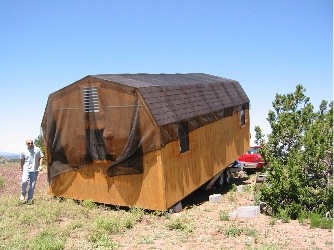
David looked thrilled to be up there. He immediately got out of the truck and lit a cigarette. So did his companion. Then they got to work, with Mike’s help.

I noticed an SUV at my neighbor’s house. The only people to build near us put in a gawd-awful looking doublewide (double-yuck) right across the road from our place. Then the husband and wife decided to get a divorce and put the place up for sale. If I won the lottery (which I now play quite faithfully), I’d buy the damn place and donate the house to a charity just to get it out of my sight. The SUV was likely to be a Realtor’s with customers. As I watched, they pulled out of the driveway, came up the road, and pulled into ours.

Damn. Look what happens when you leave the gate open.

“Get rid of them,” Mike told me.

No problem. I began psyching myself up to deliver a New York style, rude reminder that the no trespassing sign meant what it said. The car drove up to me and I bent over to look into the passenger window. A nasty “Can I help you with something?” was in my throat, ready to emerge. But the SUV contained our friends, Matt and Elizabeth, who now live year-round on the other side of the mesa. Heck, they were certainly welcome! It was the first time they’d visited us. I swallowed to clear my throat and greeted them enthusiastically.

Delivering ShedThey joined me to watch Mike, David, and David’s Spanish-speaking helper as they positioned the trailer over the spot where the building was supposed to go. It was a nice spot — the same spot I’d parked the trailer the summer before — with views out to the west and easy access to the fire pit we’d built the first year we came to Howard Mesa. Then they tilted the bed of the trailer and started to move the truck forward, gently sliding the building down. A short while later, the building was sitting on top of the cinderblocks we’d bought to keep if off the ground.

David and his helper took the protective netting off the roof and remove the screws that were making sure the door stayed closed. And then Elizabeth stepped inside, becoming the first official visitor to our soon-to-be cabin.

Howard Mesa from AirOf course, the building still needed to be leveled. And it was about 11:30 AM, a full 30 minutes after the time we’d promised to start our trip to Chandler. David promised to level it and close the gate behind him when he left. Matt and Elizabeth left. Mike and I locked up the trailer, hopped in Zero-Mike-Lima, started up, warmed up, and took off. Mike got this great picture of the site as we were leaving. We’ll be moving the trailer closer to the soon-to-be cabin next time we bring Mike’s truck up there. It’ll probably go perpendicular to the building, facing south, so they can both access the same septic system pipe and water line. The idea is to live in the trailer while fixing up the building to add amenities like a tiny bathroom, kitchen area, and solar powered electricity. (Howard Mesa is “off the grid.”) By the end of the season, the soon-to-be cabin should be a cabin and the trailer won’t be necessary. At that point, we’ll probably sell it or exchange it for a smaller pull trailer that trades horse space for living space. I’m thinking of a 18-foot model with a slide out or pop-out bed.

At this moment, my plans are to return to Howard Mesa with the horses, Alex the Bird, and maybe Jack the Dog at month-end, after revising a book for Osborne, and spending the summer as a carpenter/plumber/electrician. Keep checking in to see how I do.

Aunt Stella’s Last Flight

I fly my first ash scattering mission.

I was sitting in Stan’s hangar down in the high-rent district of Wickenburg Airport, enjoying a latte with a bunch of pilots and their wives, when two men and a boy approached us. They were on foot, far from the terminal building, and appeared as if they were on a mission. I wasn’t surprised when they came into the hangar and one of them said, “Maria?”

“That’s me,” I replied, rising. I met them halfway to the table to see what they wanted without disturbing the others.

What they wanted was a pilot who could help them scatter their aunt’s ashes over Vulture Mine. That’s where her husband’s ashes had been scattered, from an airplane, years ago. I asked if they had the permission of the folks who owned Vulture Mine. They told me they didn’t. I told them that I’m sure the owners would say it was okay and that I wasn’t comfortable hovering over private property to scatter ashes without getting the permission. They told me they’d talk to the owners. Then they set up a time for the ceremony: 3 PM that day. And they left.

I rejoined the coffee gang and told them about the assignment. I mentioned that I was heavy on fuel and, because of the time of day and weight of two of the three passengers, I had too much fuel on board. I’d have to siphon some off. Dave offered me his siphon hose and fetched it from his hangar across the way. They we talked about the pilot who had landed very long and very fast in what looked like a King Air and how he must have needed to clean his shorts when he finally got his plane to a stop at the end of the runway.

I went back to my hangar and tried the siphon hose. But I’m a nervous nellie when it comes to sucking gasoline out of a tank, so I went to Stewart Hardware and bought a siphon pump. It was fancier than what I had in mind (which was a hose with a bulb on it) but it did the job. I also bought an 8-foot length of 4″ plastic duct, with the idea of using that to send the ashes on their way, and a long necked oil funnel. I went back to the airport.

The siphon worked fine, although I did manage to get about a pint of fuel on the hangar floor and my right pants leg. 100LL evaporates quickly, so it wasn’t a big deal. I filled my two 5-gallon storage cans and checked my fuel gauges. Much better.

Then I started fooling around with the hose. About an hour later, I had it secured at the vent for the door behind mine — opposite the tail rotor, of course. The vent was completely sealed off with white duct tape and the bottom end of the duct was attached to the skid, right in front of the front leg.

Oh, did I mention that I had to run back to Stewart Hardware for duct tape and wire ties? I did.

Why all this bother? Well, any pilot can tell you stories about ash scatterings and none of the stories are pleasant. Most have the deceased’s ashes coming back into the aircraft or, worse yet, flying around inside the aircraft when the container is opened in preparation for the scattering. I didn’t want these people’s aunt in my hair or my carpet. She deserved better than that. So I had to come up with a solution for getting her out without 1) causing a hazard to the aircraft and 2) getting all over the inside of the aircraft.

I looked at my ductwork design. I started imagining the helicopter in flight, doing 80 knots. I imagined the plastic duct tearing off. I imagined looking very unprofessional in front of my clients.

There had to be a better solution.

I made a phone call to Guidance Helicopters in Prescott to give them my credit card number for a 100-hour inspection I’d had done the week before. “Is John there?” I asked when I was done. I was told he was out on a flight. “Tell him that I called and that I’m doing my first ash scattering mission. Tell him I’d appreciate any advice he has.”

The guy who answered the phone told me what he knew about it. It seems that he was a CFI doing duty on Fridays at the desk. He advised using a paper bag and suggested that I put an M-80 in it so it explodes in the air, scattering the ashes. I hope he wasn’t serious.

I’d already decided on a bag. I’d sew one up out of fabric. We’d put the ashes in and I’d attach it to the skid. One of the passengers would hold the top closed, using a drawstring. At the right time, he’d pull out the drawsting and push out the bag. The ashes would go out the bag.

I needed to make a bag. So I locked up my hangar and drove to Alco, where I bought some flowery fabric, ribbon, fishing weights, glue remover, and two other things I didn’t need but bought anyway. I went home, took out my sewing machine and ironing board, and sewed up the bag, hand-stitching fishing weights into the top end, out of sight behind a hem. It looked pretty and functional. I drove back to the airport and, while I was on the road, doing about 40 miles per hour, dangled the bag out the window. It whipped around dangerously. I started to realize that the weights might cause more harm than good.

I showed the bag to Ed Taylor, my Wickenburg mechanic. He’d been in on every step of the process and had cut the funnel for me for the original design. Twice. He admired the bag but seemed doubtful about the way it would work. I was already doubtful.

I took the ductwork off the helicopter and cleaned off the duct tape residue with the glue remover. I fiddled around with how the bag would attach to the helicopter. I didn’t like any of the methods.

Plan C began to look like the only obvious solution. A paper bag. Toss it out with the top open and the ashes should scatter. But it couldn’t be any old bag — like Ed’s lunch bag. It had to be a pretty bag. I hopped back in the Jeep and drove to Osco.

By now, of course, the day was more than half gone. It was 2:00 PM and the clients were expected in an hour. I was nervous about the flight, primarily because I wasn’t sure about the solution.

I looked around Osco for a pretty paper bag and came up empty. Then I tried Alco. Bingo. They had a bunch of very pretty little shopping bags, designed for gift giving. I picked one with colorful flowers, paid for it, and started back to the airport. Again.

My cell phone rang. It was John Stonecipher. He told me the best thing to do was to put the ashes in a paper bag, bring the helicopter into an out-of-ground effect hover over the site, and toss out the bag. The bag would open and the ashes would scatter. No danger to the helicopter, no messy remains in your face. Although he hadn’t used this technique, a friend of his had when scattering the remains of a close friend. John was sure that this was the best way.

That made me feel a lot better. I returned to the airport with the bag and waited for my clients.

When they arrived, they were all dressed up as if they’d just come from…well, a funeral. They were quiet, but in good spirits. But they gave me quite a scare when I saw the little trunk one of the held. It looked as if it were alligator skin and it was large enough to contain about six copies of my latest book (720 pages a pop). My bag was not going to be big enough. But then they opened the trunk and there was a much smaller plastic box inside. It looked as if I still had a chance. And when they opened that box, I breathed a sign of relief. Aunt Stella, as they told me her name was, fit into a small plastic bag. She’d certainly fit in the pretty paper bag I’d bought.

We transferred most of Aunt Stella into the paper bag and one of the men held onto her. The rest of Aunt Stella went back into the plastic box and the alligator skin box and was stored in the trunk of the convertible they were driving. We went over to the helicopter, where it was waiting on the ramp. I’d already taken off the door for the seat behind mine. I gave them a safety briefing, described how we were going to release Aunt Stella, and we climbed aboard. The kid — well, all dressed up, he looked like a young man — sat up front because it was his first helicopter ride. The two men sat in back.

We took off and headed south. I pointed out a few sights of interest, but headed straight toward Vulture Mine, climbing the whole time. I wanted us to be at least 1500 feet up when we took care of business. Aunt Stella’s nephew asked me again how to release the ashes and I told him. Then I brought the helicopter into a high hover, one of the men said a few words, and Aunt Stella was launched.

“Oh, shit!” It was the man who’d tossed Aunt Stella out. “It didn’t open.”

I was watching the bag and saw it fall. It did indeed look as if it hadn’t opened, but I was sure it had. There’s no way it couldn’t have. I think the problem was that we were watching a brightly colored bag tumble through the air and the light colored ashes were just not visible. I assured everyone that the bag had opened. Next time, I won’t use such a bright bag. Then the ashes will be more visible as they scatter.

The bag landed right near Vulture Mine.

I asked if they wanted to circle once, and they said no. So I gave them a little tour of the area. I have a half-hour minimum for flights and this was an opportunity for my youngest passenger to turn a sad day into a positive experience. So we did a modified Grand Tour, returning to the airport about 30 minutes after we’d departed.

My passengers were satisfied, if not happy. They’d honored Aunt Stella’s wishes, to be scattered in the area where her husband’s ashes had been scattered years before. I like to image tiny particles of their remains mingling together right now, on the desert floor.

And, as one of the men said, “We got away cheap. Where else could you bury someone for two hundred bucks?”