131 Passengers

Maria Speaks Episode 16: 131 Passengers.

This episode is straight from my blog, Maria’s WebLog. It discusses how I spent the last weekend in October. It wasn’t a typical weekend.

Transcript:

It all started during a conversation with Tom at Gold Coast Helicopters in Glendale about 10 days ago. He mentioned that they were going to be giving helicopter rides at the Thunderbird Balloon and Air Classic. That’s a huge annual event that includes balloons, warbirds, aerobatics, rides for the kids, and all kind of vendors. The event usually draws over 100,000 people and it lasts from Friday afternoon through Sunday afternoon.

“You flying the JetRanger?” I asked.

“No, just the R22.”

An R22, as you may know, is a 2-place helicopter. I owned one for about four years. It’s a great little helicopter, but it has one big drawback: it can only accommodate one passenger. That’s the main reason I sold mine and bought an R44, which can accommodate three passengers.

“You’re going to lose a lot of business to couples and families who want to ride together,” I warned, knowing this firsthand. It was a frustration I used to deal with regularly.

What followed was me suggesting that I bring my R44 down and fly with them to take groups of 2 or 3 passengers. I had already tentatively planned to spend Saturday of that weekend in Congress, doing rides at the Trading Post there. But that was tentative and could be easily changed. Tom and I talked money and decided on a reasonable number. Then he told me he’d ask Bill (the owner) and get back to me.

He called the next day. I was up at Howard Mesa, waiting for the gas guys to arrive, and my cell phone battery was getting low. So we kept it short. Bill had said yes. I should come down and meet with them Thursday before the show.

I flew down to Glendale on Thursday and met Tom face to face for the first time. He let me fly their R22 to the other side of the ramp to reposition it — the first time I was at the controls of an R22 in nearly a year. (I didn’t embarrass myself.) We talked business. We talked people in the business. We knew a lot of the same people and a lot of the same stories that went with them.

He told me to come back on Friday for a meeting at 1 PM. The air show was starting that afternoon. I should tell the controller I was with the show. Otherwise, he probably wouldn’t let me land on the ramp.

I was back the next day with my banners and signs and scale. I wasn’t sure what the GC guys had, so I brought along some of my gear. I had two yellow banners that said “Helicopter Rides” in big letters and some plastic signs that said “Helicopter Rides Today.” I also had my original A-frame sign that said “Helicopter Rides” with an arrow on both sides. I didn’t bring the flags.

I didn’t need the flags. GC had an excellent location for selling tickets. Their JetRanger and their other R22 was parked right in front of the terminal on the ramp. They had an EZ-Up set up between them with a table. My yellow banners decorated two sides of the EZ-UP and my A-frame sign went out in the aisle between booths, pointing in. It was a nice setup.

The airport was packed with other static displays of aircraft, as well as booths for food, aviation-related items, and a few simple rides for the kids. On the north end of the ramp was a parking area for the warbirds that would be participating in the air show. Beyond that was a ramp where 2 F-16s waited for their turn to fly.

There was some confusion, at first, over where we would base the helicopters. The place we thought we’d use was inside “the box” — the area set aside for aerobatics use. But we hopped in Tom’s car and drove around the airport, looking for another place. We found four. The best of the possibilities was right next to the F-16s. We went back and asked all the necessary people — five of them, I think — if it was okay to operate there. Then we talked to the Air Boss, who would be running the show while the airport was closed to traffic, and told him what we’d do. He assigned us call signs of Ride-Hopper-One (me) and Ride-Hopper-Two (the R22) and told us all he wanted to know was when we were departing and when we were returning. “Otherwise, I don’t want to hear anything from you.”

F-16sWe had no problem with that. I repositioned my helicopter to the north end of the ramp and set it down beside the two F-16s.
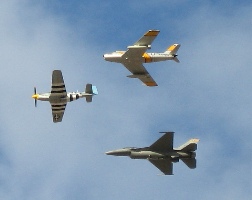
Heritage FlightThe airport closed at 3 PM and the Air Boss took over. A bunch of the performers took turns practicing their routines. It was mostly aerobatic stuff. The kind of flying that makes you wonder why people think helicopter pilots are crazy. These guys, purposely inverting their aircraft and letting it go out of control in tumbling dives are the ones who are crazy. But it was pretty cool to watch, as long as you didn’t try to think yourself into the cockpit. There was also a bunch of tight formation flying, including a flight with the F-16 and two other fighters: the Heritage Flight. (Not a bad shot with my new camera, huh?)

The gates opened to the public at 4 PM.

I did two flights that afternoon with 2 passengers each. The route was about 12 miles round trip. I’d take off from the ramp and follow the power lines between the Glendale and Luke airspaces. Then I’d either go northwest along Grand Avenue to Bell Road or continue north toward Sun City (which is laid out in a bunch of circles that look pretty cool from the air). Then I’d loop around to the right or left and come back pretty much the same way I’d left. The ride ranged from 8 to 12 minutes. GC helicopters was selling them for $45 per person, which I thought was a little high. (I was eventually proved wrong.)

We did rides while the air show was going on. Since we never crossed into the performance area, there was no danger. It was really weird to see a performer’s smoke trail on the return flight to the airport. We also did rides during the brief period when they reopened the airport to regular traffic. One time, on the second day, the Spitfire, which had to make a right traffic pattern during performances, flew over us. My passengers loved it. Late that afternoon, the GC guys brought their R22 over and I think they did a bunch of rides, too.

Balloon GlowThen the sun set and the balloon pilots started setting up for the big evening event: the desert glow. By 6:30, 19 balloons were floating right over the taxiway, using their burners to light up the night. The ramp was open to the public and thousands of people were wandering around right beneath the massive envelopes. It was magic.

I flew home in the dark, disappointed by the amount of work I’d done. Four passengers was not enough to even cover my transportation costs.

The next day — Saturday, October 29 — was distinctly different. Mike and I blew out of Wickenburg at 5:30 AM to arrive at the airport by 6 AM. It was dark in Wickenburg — especially dark since a power outage had affected the airport and none of the lights there worked. But I took off into the dark and soon saw the glow of Phoenix ahead. At 6 AM, I was three miles outside of Glendale. I made a radio call, which was answered by airport management. They told me the airport was closed. I told them I was part of the show. They told me to use caution when I landed.

I set down between the R22 and 2 F-16s again. The rent-a-cop the Air Force had hired to watch their birds overnight was standing exactly where he’d been the night before.

The balloons were already inflating for their morning flights. This was when the balloon owners actually made money — they sold hour-long rides as part of the show. Mike and I had taken a balloon ride back in New Jersey at an event like this years ago. It was expensive but something everyone should experience at least once.

Balloon ClassicI started flying at 7 AM, when the balloons were just lifting off. They drifted to the west-northwest, toward Luke Air Force Base. My pattern was a bit more north, so although I flew between a few of them, most of them were to my south. The view on the return part of our loop was incredible — dozens of balloons hanging in the early morning sky.

I flew on and off throughout the morning. The R22 did, too. Then somewhere around the middle of the day, things got busy. I flew nonstop for several hours, taking a break for fuel and another break when the F-16s flew. (For some reason, they didn’t want us in the air while the F-16 were flying.) Just after sunset, after finishing my last ride for the day, I consulted the tiny notebook where I’d been ticking off the passengers. 84 passengers. Wow.

I had a little excitement just after that last ride. The show had included a pair of rocket powered cars that sped down the runway, drag-strip style. I was still in the helicopter, listening to the radio, when someone told the Air Boss that one of the rocket cars had gone off the runway. The Air Boss acknowledged his words, but said nothing else. The other guy came back and said, “Well, can’t you send someone down there to make sure he’s alright?”

“I have no one to send,” the Air Boss replied.

“Ride-Hopper-One is spinning with no passengers,” I said. “Do you want me to go down and take a look?”

“Could you do that?” the Air Boss replied.

“Will do.”

I took off and sped down the taxiway while thousands of spectators watched me. It was dark and my navigation lights and landing lights were on. I probably looked like a blur of lights to them. I got down to the end of the runway around the same time as a pickup truck. The rocket car was pointed on an angle to the extended centerline, about 100 feet past the end of the runway. It was upright. Someone who looked like he could have been the driver was walking around. I reported all this to the Air Boss, along with the information that the pickup truck was there to help.

“We’re sending a fire truck down there,” the Air Boss said over the radio.

I started back along the runway. “The car is upright and there’s no smoke or flames,” I added.

I came back to my parking space on the ramp, set down, and shut down.

Mike and I watched the balloon glow together, walking among the balloons. It was still going on when we climbed back into Zero-Mike-Lima and went home. The next day, we arrived at the airport at 7 AM. Some of the balloons were already lifting off. The day got off to a slow start for us. But by 11 AM, we were cranking. I flew nonstop for several hours, then sent in the word that I was getting seriously tired and that they should stop selling tickets. By the time I finished at about 2 PM, I’d flown another 43 passengers.

I should say here that two things really amazed me. One was that folks thought nothing of spending $45 per person to take every member of the family for a ride. Mike thinks at least a dozen of the people I flew were kids under the age of 5. How many of those kids will remember the ride? A bunch of them were really excited and happy. One little red-headed boy had a smile bigger than the Cheshire Cat’s. I’m so accustomed to people balking at $30 or $32 per person for a flight that the idea of them lining up to spend $45 on multiple family members really surprised me.

The other thing that amazed me is how good kids are at buckling their seat belts. I don’t have kids and never had. I don’t spend much time at all with kids. But every once in a while, Mike would sit a kid in the front seat beside me for a flight. I’d tell him (they were mostly boys) to reach over and get his seat belt. He’d immediately locate the buckle (not just the strap), adjust it in the strap, and fasten it. Kids did this better than adults! I even watched one sharp 6-year-old untwist the belt before buckling it. Mike says it’s because kids that age are geniuses. They absorb everything they’re taught. I wish they could stay that way.

We managed to escape from Glendale right before one of the F-16s fired up for its part of the show. I called the Air Boss as I hovered into position for departure. “Ride-Hopper-One departing to the northwest.”

“Ride-Hopper-One, proceed as requested. This will probably be your last flight until the F-16 lands.”

“This is my last flight for the day,” I told him. “I’m going home. You guys have been great. Thanks.”

“My pleasure,” the Air Boss replied.

On my way back to Wickenburg, I pointed out the small herd of bison I’d spotted in a pasture less than a mile from Glendale Airport.

There Are Billions of Stars

I know because I look at them.

Last night, after a busy day that included 2 hours of physical therapy for my shoulder and six hours in the office polishing off two chapters of my upcoming QuickBooks book revision, I came home and spent some quality time on the back patio, just hanging out.

Lately, when I get home, I retire to the room we call the Library. It’s the second guest room, the one with the futon and the desk and a whole bunch of books. I sit at the desk and type what I like to think are words of wisdom into my PowerBook. Sometimes it’s the novel I’m working on. Other times, it’s a blog post. Still other times, it’s e-mail to friends. And once in a while, when I have question, I’ll surf to find the answer online.

But last night I decided to celebrate my first full day without painkillers. You see, I did something to my shoulder/neck last week and things came to a head on Sunday. I was in so much pain, I went to the hospital emergency room. The doctor there told me I had a pinched nerve and gave me a few prescriptions. The prescriptions helped me sleep, which did more to make me feel better than anything else.

Of course, when you’re on painkillers, you can’t drink. Not if you want to keep your brain matter in decent condition. I’m not a big drinker, but I do enjoy a glass of red wine in the evening, with dinner.

Last night I opened a fresh bottle and had my first glass of wine in nearly a week. Ah. And what better place to sip it than on the back patio, watching the sun set?

And while I was at it, why not hook up my new iPod to the stereo speakers Mike put out there? And play some nice native American flute music? Some R. Carlos Nakai, perhaps?

So that’s what I did. Instead of cooping myself up in the library and not even noticing the day’s end and the evening’s start, I went outside to experience it firsthand, with a peaceful soundtrack of flutes and chanting and, later, crickets.

The sunset was not terribly impressive. It usually isn’t when there aren’t any clouds to illuminate from below. But the sky went through its usual ritual of changing colors. Venus was bright, high in the sky — the first star of the night. Then, as the light faded away, the stars came out, one by one. More stars than a city slicker could imagine. And beyond them, the glow of the Milky Way.

We see the Milky Way almost every night here. It isn’t a big deal. But I remember living in the suburbs near New York City. With all that ambient light, it was tough to see the stars at all. But here, out beyond the lighted streets, beyond the end of the pavement, tucked behind a hill that blocks the glow of Phoenix, we can see every star of the Milky Way. It’s a glowing band, a flowing path of densely packed stars.

We used to pull out our telescope once in a while and look into the Milky Way’s depths. If you’ve never seen it for yourself, you just can’t imagine. The entire lens filled with more stars than you can comprehend.

I watched a handful of airplanes, off in the distance, flashing their lights as they sped through the night sky. I remembered the night of September 11, 2001, when there weren’t any planes in the sky. We’d sat outside together that night, Mike and I, still shell-shocked by the events of the day. But it was the absence of airplanes at night that really put things into perspective for us. We — the American people — were afraid to let the planes fly.

I thought for a while last night about the people in homes around us. It was after 7 PM and many people had probably finished dinner. What were they doing? Watching the stars? Or watching their televisions? Did they know what they were missing?

I remembered when I was a kid, growing up in northern New Jersey. I remember summer nights at my grandparent’s house. I remember stretching out on their thick lawn watching the sky, trying not to think of the night-crawlers wriggling around in the moist earth beneath me. There were street lights, but I remember seeing the Milky Way. I remember my grandfather pointing it out. I remember him explaining that the sun rose in the east and set in the west. And knowing, even when I was very young, which direction was east and which was west.

Do kids sit out at night with their parents or grandparents just looking at the night sky? Do they get their first astronomy lesson at home? Do they even know that the Milky Way is something other than a candy bar?

Things are different now. But I’m not convinced that they’re better. People seem more concerned with what they see on television and what goes on in the lives of the rich and famous than their own lives and families. Mike sees this firsthand. He goes to work and he hears his coworkers talking about the shows that were on television the night before. They try to get Mike involved in the conversation, but he has no clue what they’re talking about and wouldn’t care if he did. We haven’t tuned into a prime-time network television show since Seinfeld went off the air. We don’t need television escapes to keep our lives interesting.

Are you reading this? Scoffing at me because of my nose-up attitude toward television and television-based values? That’s okay. I forgive you. You probably don’t know any better.

But do this one day. Go outside in the early evening with your significant other and kids or dog. Find a dark and quiet spot. Settle down on the grass or a lawn chair. And just listen. Listen to the animals, the sound of the wind, the birds, the traffic in the distance. And look at the sky as it changes from evening to night. Look at the stars. Find the airplanes. If it’s dark enough, you’ll see some satellites, too. If you’ve got the kids along, tell them about the stars. Tell them the stories that you remember from your childhood. Or make something up, something special and meaningful. Ask them questions, make them tell you what they think about things. Make them think.

An evening away from the television can be magic if you let it.

At about 7:30 last night, Mike’s car turned the corner to come down the hill toward our house. But I wasn’t watching it. I was watching a shooting star as it sped past Venus and faded into the night.

Planning Ahead

I get a strange request.

I got an odd phone call today in my office. A man I know — his name doesn’t matter — called to see if he could fly along with another group of passengers on one of my Hassayampa River Canyon tours. He evidently didn’t want to pay the whole price — the hour-long tour is $395 plus tax — and was hoping to split it with someone. I don’t get a lot of calls for that tour but I took his phone number and promised him that the next time I got a request for that tour with only one or two passengers, I’d give him a call.

He asked me if I’d heard the rumors about him. I told him truthfully that I hadn’t. Then he told me he’d been diagnosed with brain cancer. He was going through treatment, but just in case he didn’t make it, he wanted me to know where a specific peak in the Hassayampa River canyon area was so I could come back and scatter his ashes there. He’d buy the ticket for the scattering in advance and leave it with his papers so his sister and brother could have it taken care of.

Is it wrong for me to feel strange about this? Because I do.

I’ve done ash scatterings before, but never for someone who had flown with me and told me exactly where he wanted to be scattered.

Anyway, I’ll see if I can get some folks interested in the tour and give him a call. Perhaps some of his friends will chip in for a custom tour that’ll be shorter and cheaper.

But what I’m really hoping is that that brain cancer goes away and I don’t have to take him — either alive or in a baggy. The idea just gives me the willies!

Freebies

Maria Speaks Episode 14: Freebies.

In this episode, I’ll tell you why I think a professional writer should consider writing for free. So if you’re a writer or want to be one, keep listening for my point of view on this often argued topic.

This episode is an updated version of an article I wrote for Maria’s WebLog back in December 2004. You can still find the original article there, along with some other thoughts about writing for a living. The best way to get to Maria’s WebLog is to click the link on the home page of my Web site, www.aneclecticmind.com.

How Helicopters Fly

Maria Speaks Episode 12: How Helicopters Fly.

Transcript:

Hi, I’m Maria Langer. Welcome to episode 12 of Maria Speaks, How Helicopters Fly.

I thought I’d take a break from my usual computer related topics to talk about something I really enjoy doing: flying helicopters.

For most of my life, I thought it would be pretty cool to know how to fly a helicopter. In October of 1998 I had some extra money and a flexible schedule so I took the plunge and began taking flying lessons.

A lot of people think you need to learn how to fly an airplane before you can learn to fly a helicopter. That just isn’t so. I don’t know how to fly a plane, and frankly, I have no interest in learning. Helicopters have fascinated me since my first helicopter ride at age 8. Airplanes just aren’t as interesting to me. So I skipped the airplane stuff and went right to helicopters.

It took me a year and a half to get my pilot certificate. This wasn’t because I was a slow learner — at least I hope not. It was because I took lessons part time, only an hour or two a week. When summer came, I took the summer off. No one wants to practice doing hovering autorotations when it’s a 115°?F outside. I finally got my pilot certificate in April 2000.

I soon realized that I had a problem. I had a pilot certificate but nothing to fly. The closest place to lease a helicopter was Scottsdale, about 70 miles away. I’d drive down there, fly for an hour, and drive back. It wasn’t fun.

Fortunately, I had a good year and some extra money and was able to solve the problem. I bought a used Robinson R22 helicopter. And what I found is that the more I flew, the more I wanted to fly. As I’ve said elsewhere in my blogs, flying is addictive and I’m hooked.

Years went by. I got my commercial helicopter rating and starting taking passengers up in my two place helicopter. I got a summer job at the Grand Canyon flying LongRangers with up to six passengers on board. Then I decided to step up and buy a larger helicopter, and to expand my helicopter tour business. Today, I have 160 hours on my new Robinson R44 four place helicopter. And I still can’t fly enough to satisfy me.

If you like reading flying stories, check my blog. It has lots of stories about flying.

Anyway, what I really wanted to talk about was how helicopters fly. Most people are familiar with the way airplanes fly but few know anything about helicopters. I find myself explaining the controls to passengers all the time. Now I’ll explain them to you.

First of all, a helicopter does indeed have wings. But rather than having big, bolted-on wings like an airplane, a helicopter’s wings are its narrow rotor blades. My helicopter has just two of these blades, but they’re very long — about 16 and a half feet each. Other helicopters have three, four, five, or even more blades, depending on the design and size of the helicopter. Generally speaking, the more blades a helicopter has, the shorter they can be. Of course, if the helicopter is very big, the blades need to be big, too.

To understand how a helicopter’s main rotor blades work to produce lift, start by thinking about an airplane. Everyone has seen an airplane taking off — or has been in one when it took off. It rolls down the runway, gathering speed. This moves air — referred to as relative wind — over the airplane’s wings. The wing is shaped like an airfoil, so higher pressure builds up below the wing than above it, producing lift. Before the pilot reaches the end of the runway, he pulls the airplane’s nose up, which, in turn, changes the angle of attack — the way the wings cut through all the air rushing past. This increases the lift and the airplane takes off.

A helicopter’s rotor blades are also shaped like airfoils and they work pretty much the same way as an airplane’s wings. But instead of speeding forward to increase relative wind, the helicopter rotates the blades while parked. The faster the blades spin, the higher the relative wind. Once the blades are spinning at 100% RPM, the pilot lifts the collective, which changes the pitch or angle of attack on all of the main rotor blades. The result: the helicopter lifts off the ground.

Now I just mentioned one helicopter control: the collective. The collective changes the pitch of all of the main rotor blades the same amount — or collectively. This up-and-down lever is what a helicopter pilot holds in his left hand while flying.

There are three other controls.

The throttle, which is a motorcycle-style twist grip on the end of the collective, is what the pilot uses to add or reduce power. You see, the higher the pitch, the higher the drag. To overcome this drag without losing rotor RPM, the pilot must increase the throttle. Fortunately, most modern helicopters have a correlator or governor or some other kind of device that adjusts the throttle automatically as needed. This greatly reduces the pilot’s workload.

The cyclic is the control the pilot holds in his right hand while flying. The cyclic changes the pitch of each rotor blade individually as it moves to change the direction of the rotor disk. Think of it this way: the rotating blades are like a disk when they’re spinning. The cyclic tilts this disk in the direction you want to fly. Push forward, the disk tilts forward and the helicopter moves forward. Pull back and the disk tilts back and the helicopter slows down or backs up. Left and right do the same thing to the left or right. The cyclic is an extremely sensitive control and doesn’t need to be moved very much to get results. In fact, the hardest part of flying a helicopter is getting a feel for the cyclic.

The last controls are the anti-torque pedals. Remember Newton’s Laws? One of them says that every action has an equal but opposite reaction. Think about the main rotor blades spinning. If the blades spin to the left, the fuselage wants to spin to the right. So a helicopter has a tail rotor (or something equivalent). The blades on the tail rotor are mounted sideways so the “lift” pushes the helicopter’s tail to the right, thus pushing the nose to the left. The anti-torque pedals, which the pilot works with his feet, change the pitch on the tail rotor blades to increase or decrease this lateral “lift.” This keeps the helicopter from spinning out of control.

Sounds pretty simple, no? Well, it isn’t — at least not when you first start practicing it. You see, every time you make a control input with one of the controls, you have to adjust one or more of the other controls. For example, when you raise the collective, you increase drag on the blades, so you (or the governor) have to increase the throttle. But when you increase power with the throttle, the helicopter tries harder to spin to the right, so you need to add left pedal. Since you’re using up some of your power to generate more lift on the tail rotor, you might need more throttle. Get the idea?

One of the most difficult things to do in a helicopter is hover. Hard to believe but its true. It takes the average pilot 5 to 10 hours of practice time just to be able to do it. It took me about 7 hours. I thought I’d never be able to do it and then, one day, I just could.

Hovering requires that you make multiple minute control inputs all the time. There’s no “neutral” position you can put the controls into. It takes constant effort. Add some wind — especially from one of the sides or the back — and you’re working hard. After all, the helicopter is like a big weather vane and the wind just wants to push it around so the nose faces into the wind.

That’s the basics of flying a helicopter. There’s lots more to it, of course. But it isn’t that hard to learn. I like to tell people that if I can do it, just about anyone can.

One more thing. Lots of people think that if a helicopter has an engine failure, it’ll drop out of the sky like a brick. If the pilot does what he should be doing, however, that just isn’t so.

Here’s how it works. Suppose I’m flying along and my engine quits. My main rotor blades were spinning when the engine quit and they have lots of energy stored in them. There’s also energy stored in my altitude, airspeed, and weight. The first thing I do is lower the collective to reduce the drag on the blades. This helps keep them spinning. The helicopter starts a steep descent. I look for a possible landing area — a field, a parking lot, a dry river bed (we have lots of those in Arizona) — and steer towards it as I glide down. About 30 feet off the ground, I pull the cyclic back to bring the nose up and flare. This reduces my airspeed and transfers some of that energy to the main rotor blades. I level out and pull the collective up just before hitting the ground. Remember, pulling the collective up increases lift, so if I do it just right, I’ll cushion the landing. This whole procedure is called an autorotation and I’m required to demonstrate it annually as part of my FAA Part 135 check ride. I also had to do it to get my private and then commercial ratings. In other words, I have to prove that I can do it.

Of course, if I screwed up and didn’t lower the collective right away, drag on the unpowered blades would slow them to the point where they wouldn’t produce lift. Then I’d be in big trouble. Like a falling brick.

Have you ever gone for a helicopter ride? If you haven’t, you should. It’s quite an experience. If you do go soon, remember what I’ve told you and watch what the pilot does. If you’re sitting up front with him, don’t be afraid to ask questions once you’re under way. Most pilots like to talk to passengers about what they’re doing.

I remember a helicopter ride Mike and I took back in 1995 (or thereabouts) while driving cross-country. It was in Florida in the panhandle. There was a Bell 47 parked on the side of the road with a sign that said “Helicopter Rides, $25.” Mike and I climbed aboard and I sat in the middle. I told the pilot that I wanted to learn to fly a helicopter and when we were in cruise flight, he let me put my hand over his on the cyclic. He wanted me to see how little it needed to move to change direction. It was nice of him to do that for me.

Well, I could keep talking about helicopters all day, but I won’t. I’ll save some other stuff for another day.

I hope you enjoyed this topic. It was nice to take a break from talking about computers. I’d love to hear what you think about this episode and my podcasts in general. Write to me at mariaspeaks@mac.com.

Thanks again for listening!