A Trip Back East

Some photos from a trip back to New Jersey and New York for the Thanksgiving Holidays.

I didn’t want to go, but Mike talked me into it. Then we made flight reservations before I could change my mind. It would be a short trip. I’d fly out on Wednesday and return on Saturday. Only three nights, and those would be made comfortable with a room at the Glenpointe Marriott in Teaneck, NJ. Dinner with my family at my brother’s house in New Jersey on Thursday, dinner with Mike’s family at a restaurant in Queens on Friday, Dim Sum with family and friends in Ft. Lee, NJ on Saturday morning.

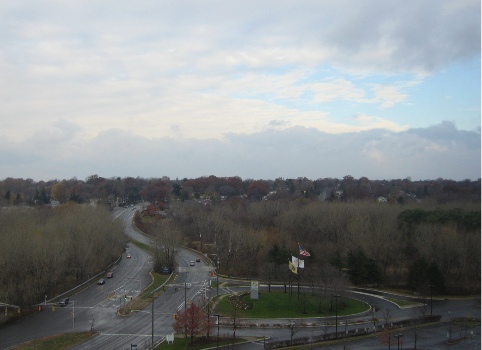
The New York/New Jersey metro area where I grew up and lived most of my life is very different from Wickenburg, AZ, where I live now. So different that I decided to take some photos to try to document some of the differences. I could have done better, but this is what I’ve got to share. This is the view from our hotel room in Teaneck, NJ, on Thursday morning. It had snowed and rained during the night and it was bitter cold that day.

This looks out to the southwest. As you can see, there are lots of tall trees, but they’re pretty much bare in late November. The overall effect is gray. A gray day with gray skies, gray trees, and gray pavement. I hated the gray of the New York metro area in the winter months. But it was the cold that finally chased me out of the area.
Photo

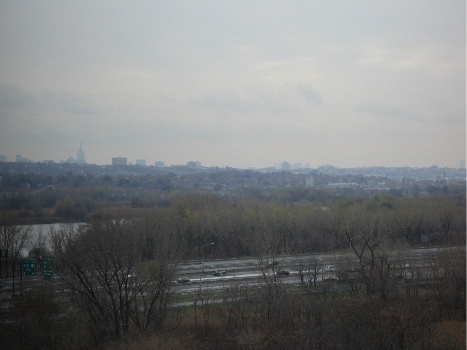
Here’s another look from our hotel room window. This view looks toward the southeast. The highway in the foreground is I-95, which stretches from Maine to Florida. The body of water is some marshland that might just be close enough to the Meadowlands to be considered part of it. The gray buildings poking into the gray sky are the skyscrapers of New York City off in the distance. The pointy one on the left is the Empire State Building, which is now the tallest building in New York again. It formerly held that title from 1934 to 1977, when the World Trade Center was completed. With the WTC gone, this depression-era building is once again the tallest in the city.
Photo

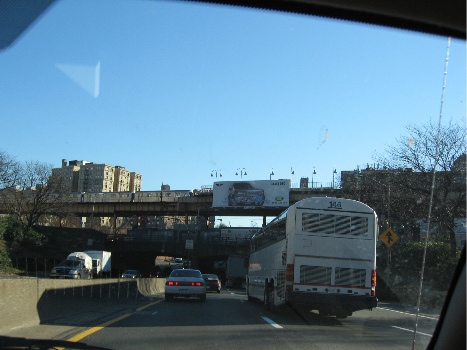
On Friday, we drove to Queens. Here’s a snapshot taken on the Cross Bronx Expressway, which goes from the George Washington Bridge (on the Hudson River), across the top of Manhattan and the middle of the Bronx, to two of the bridges to Long Island: the Whitestone and the Throgs Neck. When I was growing up, this area of the Bronx was filled with burned-out building shells, and we’d often see broken-down or abandoned cars being stripped on the side of the road as we drove through. But the buildings have they’ve since been renovated and people live there once again. Don’t get the idea that this is an up-and-coming area of New York, though. It’s still a poor, crime-ridden area. Ever read Bright Lights, Big City?
Photo

I forgot to take photos the day before, on the way to my brother’s house. We took the New Jersey Turnpike (I-95 down) and there are lots of weird scenic things along that, like the big gas tanks that appeared in a scene of Stephen King’s The Stand and Newark Liberty International Airport. Next time.

Here’s a pretty poor photo of the roadway on the Whitestone Bridge.
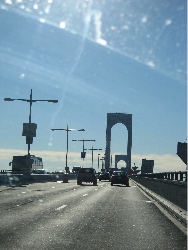
Photo

There are three bridges that’ll get you from the Bronx to Queens and Long Island and they’re all pretty similar in appearance: single-span suspension bridges. The Triboro Bridge has some nice art deco touches that make it my favorite of the three bridges, but that one’s much closer to Manhattan, which was out of our way. The Throgs Neck bridge has great views of the Long Island Sound which, in the summer, is full of sailboats and very picturesque. Of course, the Whitestone Bridge does offer the best long-distance views of Manhattan. I took a bunch of photos and this one was the best. It really gives you the flavor of new York from a distance. The tugboat with barge in the foreground, the plane departing La Guardia Airport (out of this shot on the left), and the huge cluster of buildings in midtown Manhattan. You can clearly see the Empire State Building almost dead center and CitiCorp Center (look for the slanted roof to the right). Astoria, Queens is in the foreground, on the other side of the water. And you can just about see the heavy black bridge of the train trestle that parallels the Triboro Bridge. If the World Trade Center were still standing, its towers would appear to the far left in this photo.
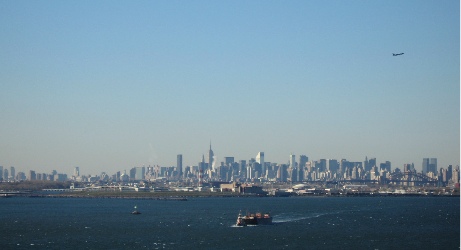
Photo

If you’ve never been to New York and you have the opportunity to visit, don’t pass it up. New York is like no other place on earth. As I was telling a Phoenix cab driver just the other day, it’s one of the few U.S. cities that blend old and new in a way that leaves you breathless. Go downtown, to the Wall Street area, and see exactly what they mean by the “Canyons of Wall Street.” The streets are so narrow and the buildings are so tall that light rarely gets down to the street. Although midtown has more tall buildings, the streets are a bit wider. You won’t believe the crowds walking the streets during a weekday lunch hour, the sea of yellow cabs, the bicycle messengers, the street vendors. This time of year, they’re roasting chestnuts near Rockefeller Center and steam is rising from manhole covers and vents on the street.

I do love New York, but I don’t have enough money to live there the way I want to. And New York is one of the grayest places I know.

We didn’t get into the city during this trip. Next time I go back, I’ll take some photos. But you might have to wait a few years. Once in Queens, we hopped on the Cross Island Parkway to go to Mike’s Mom’s apartment. I took this shot out the front window of the car. It’s an interesting example of one of Robert Moses’s parkways. He built them all over Long Island — Queens is on the eastern end of Long Island — and this was probably one of his first. One of the trademarks of his roadways was his stone overpasses. They all look pretty much the same, but they’re really nicely executed. When you look at this photo, it’s hard to imagine that tens of thousands of people live within a mile of where it was taken.
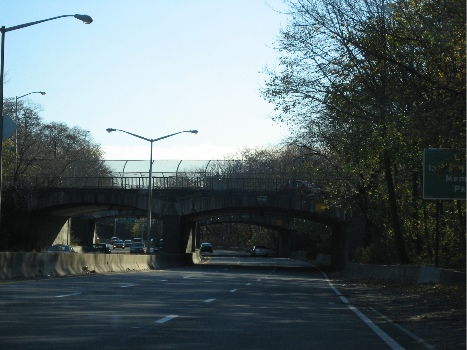
Photo

This stretch of roadway is sunken in and surrounded by trees. Mike and I had our first apartment together about 5 miles further down this road, in Bayside. We had a wonderful view of Littleneck Bay (you’ve heard, perhaps, of Littleneck clams?), but had to listen to a never-ending stream of cars going by far beneath our terrace.

At Mike’s mom’s place, we had bagels for breakfast. This is a photo of me holding a real New York bagel. Notice that it is large and plump. The outside is crusty and the inside is moist and almost doughy. It doesn’t have blueberries or cranberries or any other type of berry in it. This one has sesame seeds (my personal favorite), but they also come plain, egg, poppy seed, salt, pumpernickel, onion, cinnamon raisin, or everything. Everything means seeds, onion, and salt and is a real assault to the taste buds. A common way for a New Yorker to eat a bagel is to slice it open and toast it, then cover each half with cream cheese and slices of lox (smoked salmon). Some people add red onions, capers, and/or tomatoes. (I don’t like tomatoes on my bagels.) A quick spread of cream cheese is referred to as a “schmear” in New York; I prefer a more generous helping. You can’t get a good bagel anywhere outside of the New York metro area, although you can get decent ones here and there. Einstein Brothers makes a decent bagel. Bagels do not come in the grocery freezer section; anything you find there that is labeled a bagel is a mere imitation.
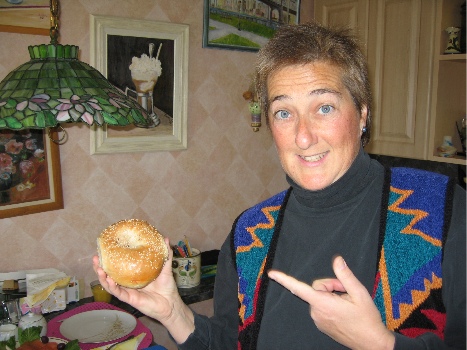
Photo

The next time you go to New York, have a bagel as described above. It’s part of the New York experience and should be required for all serious visitors. And, while you’re at it, take a ride down to the Lower East Side and have a corned beef, pastrami, and tongue on rye sandwich at Katz’s Deli. Get that with mustard. Do not ask for it with mayonnaise; you will be forcibly removed from the premises and publicly laughed at out on the street. A Dr. Brown’s Creme soda is a nice accompaniment — and don’t forget the kosher pickle. Leave the Carnegie Deli for the tourists. What you’ll learn — among other things — is how to properly make a sandwich. There should be more meat than bread. That’s something they just don’t get outside the New York metro area.

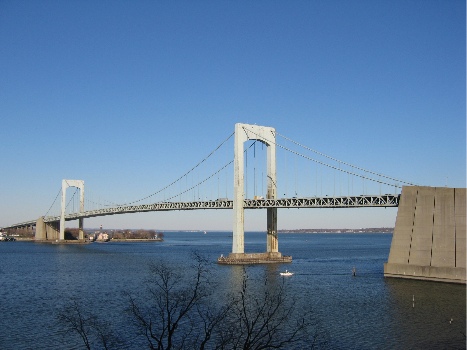
But I digress, again. This is a photo of the Throgs Neck Bridge, taken from Mike’s mom’s patio. She’s on the 7th floor and has a nice view out this way. Beyond the bridge is the Long Island Sound. Imagine it with lots of sailboats and you’re imagining the view on a summer Sunday afternoon. Put some green leaves in the tree in the foreground to complete the picture.
Photo

As you can see, it isn’t always grey in New York in the winter. Friday was a very nice day, although it was still bitter cold, with temperatures in the 30s and enough wind to make it feel a lot colder. Of course, it did get gray again on the next day.

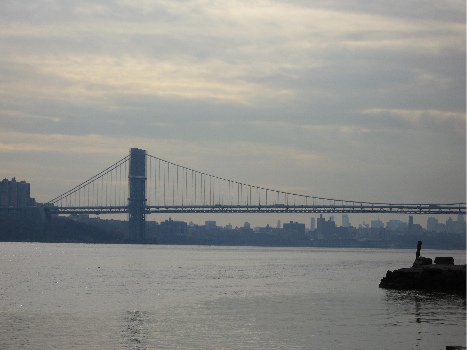
Here’s a look at the George Washington Bridge from the foot of the Palisades. The Palisades, in case you’re wondering, are a line of cliffs along the Hudson River in New Jersey. This photo was taken from a boat basin/park area almost directly across the river from the northernmost end of Manhattan. The view is to the southeast.
Photo

The GW Bridge has two decks — upper and lower — and is a major route between New Jersey and eastern New York. It’s actually the first bridge you get to if you sail up the river from New York Harbor. The next bridge is the Tappan Zee, which is at least 20 miles further upriver. To cross the river closer to downtown Manhattan, you can use one of two tunnels: the Lincoln (midtown at around 30th Street) and the Holland (downtown at around Houston).

When I was growing up in New Jersey, my family had a small boat that we used to take out in the river. I’ve been around Manhattan by boat more times than I can count. It’s a neat trip that you can do on the Circle Line tour boats. We also took a few perilous trips into New York Harbor and around the Statue of Liberty. I say perilous because our boat was really small and the water can get rough out in the harbor. I also remember going past Ellis Island long before it was fixed up and opened to the public. I’ve never been on the island, though.

Anyway, all those boat trips started at the base of the George Washington Bridge, on the New Jersey side. I can still remember the smell of the water at low tide, and the look of all those exposed barnacles. And the way the boat floated up and down as it was loosely tied at the boarding area. We didn’t swim in the river back in those days — it was too polluted south of the Tappan Zee — but we did fish in it, although we never ate any of the fish we caught.

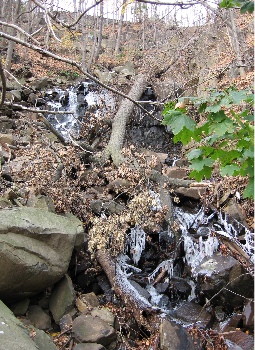
Here’s a shot of one of the “waterfalls” coming down the Palisades to the Hudson River. It’s really probably just runoff from a storm drain, but when we were kids, it was a waterfall and it was one of the most beautiful things we’d ever seen. My family often drove along the river’s shore road on Sunday outings. That’s back in the days when taking a drive in the family car was a cheap and fun day out. There were no malls, no computer games, no cell phones. We’d get in the car and go for a drive and drink up everything we saw out the window. If it was autumn, we’d go to a place called Tices Farms, which had apples and doughnuts (note the spelling) and cider and pumpkins for sale. When I got out of the car to take this photo, the smell of wet leaves brought me back to a time when we would rake them into huge piles and take turns jumping in them. Leave stems would stick in our sweaters and hair and we’d be breathless in the cool autumn sun. I don’t know if you can see it clearly, but there’s ice in the water in this photo. We’re talking cold enough to make a waterfall freeze. Cold.
Photo

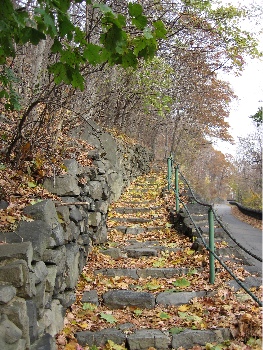
The Palisades area of Bergen County in New Jersey is one of its more historic areas. Originally settled by the Dutch in the 1600s, it was a hotbed of activity during the Revolutionary War. Posted alongside roads all over the area are “Washington’s Retreat Route” signs. Yes. This is the area George Washington retreated from when we weren’t doing very well in the first war with the Brits. Why we need that on signs is beyond me. But the area is also full of walking trails that were probably built during the depression. In more than a few places, you can find stairways and paths that climb the Palisades. This is one example, that follows the road for a short distance before cutting right up the cliff. We did a lot of hiking in the area when we lived there. The views from the top of the Palisades are magnificent.
Photo

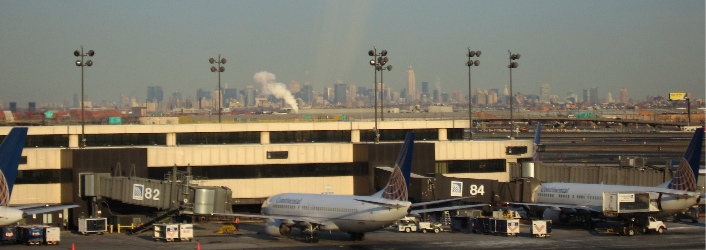
I took the shot that appears below from the AirTrain that travels around Newark Airport. That’s New York in the background.
Photo

This photo reminds me of a visit by one of my editors when we still lived in New Jersey. I picked him up at the airport and was driving north along the New Jersey turnpike toward our house. He looked off to the right as we climbed a bit of highway that passed over the marshes at the Meadowlands and said, “What city is that?” He was looking at New York. That’s when I realized that the skyline I’d grown up with wasn’t nearly as familiar to everyone else.

Am I homesick? Maybe a bit. Would I go back to live there again? Nope.

Been there, done that.

Robert’s Rules of Writing: 101 Unconventional Lessons Every Writer Needs to Know

A quick book review of a book for writers.

I started Robert’s Rules of Writing a few months ago and set it aside. It wasn’t because I didn’t like it. It was because I felt like reading something different at the time.

I picked it up the other day and took it on the plane with me to New York, where I spent the Thanksgiving Holiday. I didn’t feel like carrying the novel I’d borrowed from the library. I wanted something small and light, something I could pick up and put down without losing track of a plot or having to backtrack to remember what I was reading.

I’m about 4/5 through this book and I can’t say enough nice things about it. The author, Robert Masello, offers 101 “rules” for writers and uses about two pages, on average, to explain each one. Some of them seem to contradict known “rules” that writers have been following for years. For example, Rule #1, Burn Your Journal, would likely upset many creative writing teachers and the students who hang on every one of their words. But Mr. Masello carefully explains why a journal isn’t necessarily a good thing. I have to say that I agree with him.

In fact, I agree with just about everything he says — which is pretty unusual for me. We all know what a disagreeable person I can be.

In short, if you’re a beginning writer — or interested in becoming a writer — you really ought to pick up this book. It’ll give you a lot to think about. Or, in many cases, re-think about.

And if you’re already an established writer, you may want to pick up a copy and go through it. Although you should have learned most of this stuff for yourself, it’s good to read someone else’s take on it. And it’s given me quite a few ideas for essays that I can include in the Writing categories of this blog. Information from my own experiences that I think beginning writers may learn something from.

The only thing I didn’t like about the book was its funky layout. Someone in the publisher’s production department thought it would be cute to mix graphics in a distressed Courier (read that typewriter) typeface with book text, fiddle around with boldface type and indented text, change alignment for certain paragraphs, print some pages white on black, and generally make a mess of the book’s layout. I found it incredibly distracting and a bit difficult to read. When the words are good, why screw around with the way they appear on page? I’m sure someone in marketing had their hand in this one.

Overall, though, it’s a big thumbs up. And with an affordable price tag — $14.99 US — it’s a nice addition to any writer’s library.

An Example

I sit on a flight from Phoenix to Newark next to an example of what’s wrong in this country.

I should have seen it coming. She was too young, too stylish. Her boyfriend had too firm a grip around her waist as they waited for me to pull a few things from my bag before putting it in the overhead bin. The vacant stare, the bored look. She tolerated me only because she had no choice. She wasn’t impatient; just disapproving.

As I now am of her.

She’s been sitting in the seat next to mine for more than three hours now. Not a word to me. How could she? She spent the first 40 minutes of our time on board — time waiting on the ramp to be cleared for takeoff — “sucking face” with her boyfriend and impulsively grabbing for the celebrity magazines she’d brought on board with her. She knows more about fashion than I ever will, but what else does she know? And what else will she know when her mind is so caught up in crap?

Funny, but I was getting to the point where I thought my harsh criticism of today’s youth was just a little too harsh and perhaps a bit misinformed. After all, how many young people do I really know? And are the young people I see really representative of all of America’s youth?

But after studying this prime example beside me, I’m now sure that I’m on the right track. Although I pray that this specimen is an exception rather than the rule, I doubt it.

And no, I don’t have to worry about her reading this over my shoulder. I don’t think her reading skills can stand up to any task more strenuous than reading the caption under a photo of Paris Hilton.

Giving Thanks…

…and asking questions.

This Thanksgiving season, as I prepare to fly back east to spend the holiday with family members in their comfortable homes, I can’t help but think about the thousands of people left homeless by Hurricanes Katrina and Rita.

I can’t imagine what it must be like to have my home and virtually all my possessions taken away by a natural disaster. I can’t imagine what it must be like to wonder where I’ll be living next week, month, or year. What I’ll be doing for a living. How my kids will go to school. Whether I’ll ever have the same level of comfort — even if that comfort level was low by many standards — as I used to.

We drop canned goods into collection boxes and write checks to aid organizations. Some of us even participate in holiday meals at homeless shelters. But do any of us really think about the people we believe we’re helping? How far do you think a few cans of tomatoes and a couple of pairs of jeans that no longer fit you will go to help the people who lost everything?

Thinking about the Katrina victims, formerly of New Orleans, is hardest for me. The levees broke and the pumps failed partially because they were in serious need of maintenance. Maintenance they couldn’t get because of budget cuts and confusion over who would pay. But where did that money go? What government-funded project got the cash that should have gone to the levees and pumps? A new war monument? A parking lot? Mardi Gras clean-up?

And what of the money that should be funding FEMA in this terrible time of need? Oh yes, I know where that’s going. It costs a lot of money to fund a war. I guess our government believes it’s more important to shove democracy down the throats of the Iraqis than to ensure the safety, welfare, and well-being of our own citizens at home.

So as you’re eating your Thanksgiving turkey this year, stuffing yourself with stuffing and gorging yourself with gravy, take a moment to think about the thousands in need in this country.

And give thanks that you’re not one of them.

Flying for Food

Mike tries to arrange a group outing for lunch.

We were at Stan’s house on Saturday afternoon when Mike said, “Let’s go fly together somewhere tomorrow.”

Stan’s wife, Rosemarie, and Dave, another local pilot, were there. Stan flies a Cessna 182 and Dave just got a second plane, an RV-4, that he needed to build time in before he could take up passengers. Mike is half owner of a Grumman Tiger.

What followed was a discussion of various responsibilities the next day. We finally decided to meet at the airport at 1 PM and fly somewhere for lunch. The “somewhere” wasn’t decided.

On Sunday morning, during breakfast, Mike and I started to discuss where we could fly. We brainstormed and came up with a list of airports within flying distance that had restaurants nearby:

Restaurants on Field:
– Prescott
– Falcon Field (2!)
– Payson
– Kingman
– Deer Valley
– Glendale
– Scottsdale
– Chandler
– Winslow (weird hours)

Restaurants within walking distance:
– Seligman
– Valle
– Chiriaco Summit (CA)

Restaurants within free shuttle distance:
– Parker (restaurant at the casino)
– Bullhead City (restaurants across river in Laughlin)

Quite a selection. (Note that Wickenburg isn’t on this list. Why someone with a few bucks doesn’t build a restaurant on the field is beyond me. I know why I don’t do it: I’ve already been through the employer nightmare in Wickenburg and have learned my lesson.)

Sunday morning progressed. We had chores to do around the house. We even cleaned a small part of the garage! Then Mike made the fatal error of attacking the mistletoe that had begun killing some of our mesquite trees. (Mistletoe is a parasitic plant and, if not periodically cut out of the trees it infests, it’ll kill the trees.) It was hard work that required him to stand in awkward positions with a heavy saw over his head. After 45 minutes of that, he was too tired to do anything. Including fly.

That didn’t bother me. I wanted to fly anyway. I felt pretty confident that I could get to the destination around the same time as the two planes. Zero-Mike-Lima cruises at 110 knots, but I could easily push it to 120 knots with only two people on board. I’d already called Jim to invite him to join us with his Hughes 500c. Although he wasn’t sure he would, it would be nice to have two helicopters with the two airplanes. I was hoping we’d go to Falcon Field; I really love the Italian restaurant, Anzio’s Landing, on the southeast end of the runway. And there’s plenty of parking right out front.

By the time we got to the airport at 12:40 PM, the wind had kicked up a bit. It was blowing across the runway at about 8 to 10 knots. Airplane pilots don’t like crosswinds. When no one had arrived by 12:55, I got the feeling that Mike’s plan wasn’t going to become a reality.

Jim was already there, working on his Beech 18. He bought the Beech a few months ago in Florida and managed to leak 10 gallons of oil from one of its engines on the ferry flight back to Arizona. Since then, he’d been working on finding and fixing the leaks. He thought he had it taken care of when he flew out to Blythe for some touch-and-goes the other day, but the left engine was still oozing. A bad O-ring on one of the cylinders. He has to pull the cylinder to fix it. In the meantime, he’s begun pulling just about everything else. Last month, he pulled out the floor and replaced it. He’s now waiting for new runners on which to mount the rear seats. Yesterday, when we arrived, he was pulling instruments out of the panel and rearranging them in more logical positions. His helicopter was not at the airport. His wife, Judith, had already said she didn’t want to come with us, so Jim had decided to work on the Beech — something he could probably do for the rest of his life if he wanted to.

Stan and Rosemarie drove up right around 1 PM. I was talking to Jim when they pulled up, so I missed the beginning of their conversation with Mike. But the end result was that they’d come with us in the helicopter. Dave wasn’t coming. So a flight that started with potentially four aircraft ended up with just one.

Of course, with the helicopter, the list of dining opportunities increases. Helicopters don’t need no stinkin’ runway. There were at least five more places we could eat:
The Wayside Inn, near Alamo Lake, is the destination for Flying M Air‘s “Hamburger in the Middle of Nowhere.”
Robson’s Mining World, in Aguila, has a nice little cafe.
– Wild Horse West, near Lake Pleasant, has great burgers.
– The Kofa Cafe, out in Vicksburg Junction, used to be very good, but I haven’t been back since
my first experience with the new owner.
– A truckstop on I-10 south of Vicksburg has a dirt strip out back where you can land and not dust the truckers.

Mike wanted to go to the Wayside Inn, so that’s where we went. You can read all about it in another blog entry. The food ain’t bad and the atmosphere is definitely different, especially if you live in a big city and don’t have much exposure to an off-the-grid lifestyle.

We flew by way of Robson’s, which was pretty quiet that afternoon. Robson’s big anniversary celebration is coming up on the first Saturday in January, and I think they get more visitors in that one day than they get all year long. I do helicopter rides out there during the event and it’s always a lot of fun. Then we followed Ballard Wash (I think) from its narrow start almost all the way to Alamo Lake. I circled the Wayside once, trying to find a flag to judge the wind, then realized there wasn’t much wind there and just set down in my usual spot near the intersection of two dirt roads and the old, unmaintained dirt strip. (If you ever fly out there in a small plane, I recommend landing on the road rather than the strip; it’s a lot smoother and better maintained.) I kicked up a huge cloud of dust that drifted to the east as I cooled down the engine and shut down.

We crossed the road and went into the restaurant. Everyone at the bar looked at us. “I knew it was you,” the waitress said.

“Yeah, well…” I said. Everyone laughed.

We had lunch among the fish photos and trophies. The place was relatively quiet. The last time we’d been in there with helicopters, a crowd had gathered and the restaurant was completely full. I guess having four helicopters and a plane parked outside is a bit of a draw to the locals. But that day it was just us and a man eating at the bar. A few people came and went.

We paid up and left. As I started up, a few people in ATVs parked at the end of the dirt strip, facing us, ready for a show. They were not rocket scientists. Not only had they parked right in front of me, forcing me to depart in a different direction so as not to overfly them, but they were close enough to get seriously dusted when I took off. I took off to the northwest, along the road to Alamo Lake.

We did a tour of Alamo Lake, then the Santa Maria River, and then Date Creek before heading into Wickenburg. It had been a nice little outing — even if we were the only aircraft to participate.