Kids Ask a Lot of Questions

A quick note from a recent flight.

I recently flew a dad and his two kids on a 50-minute flight in the Wickenburg area. The kids were aged maybe 8 (the boy) and 10 (the girl). These are estimates. I didn’t ask and since I’m not a parent myself, I could be way off.

My helicopter has a voice-activated intercom system. That means that anything anyone says into their headset microphone can be heard by anyone else in the aircraft wearing a headset. (And yes, I do have an isolation switch I can use to “turn off” my passengers, but I rarely use it.) I narrated the flight, as I usually do, and pointed out interesting things.

Now I’ve flown kids before, but these kids were different. They asked a lot of questions. A lot. In fact, they pretty much never stopped asking questions.

I have no problem with this. It’s great to see kids who are interested in what’s going on around them. And it sure beats the kid who almost fell asleep on one of my Grand Canyon flights years ago.

Since I don’t have kids, however, it was a bit startling to me. It made me realize the limits of a young kid’s knowledge. For example, they repeatedly asked me to define words I’d used — irrigation and skeleton crew come to mind. They asked a lot of “why” and “how” questions. It was a real eye-opening experience for me. It was also a pleasure to be in the position where I could share some of my knowledge with them.

But the part I liked most was defining those terms I’d used without a second thought, bringing my vocabulary down to a level they’d understand and perhaps teaching them a few new words and concepts.

Grounded by the Light

How the failure of a $42.50 part can result in $3,000 in lost revenue.

It was Friday morning and, for a change, I was running early. I had to pick up a passenger in Scottsdale for a day trip to the Grand Canyon. It would be my first Phoenix-area charter for the 2008/2009 winter season. I was due at Scottsdale Airport, about 40 air minutes away, at 9 AM; it was 7:40 AM.

The helicopter was on a west end helipad at Wickenburg Municipal Airport (E25). I started the engine, engaged the clutch, and brought the engine up to 55% RPM while the clutch belts grabbed at the upper sheave, turned the drive shaft, and began spinning the rotor blades. I started unfolding my Phoenix sectional chart to jot down the frequencies for the airports I’d be flying near or to.

That’s when I noticed that the Governor light was on. I looked at the governor switch on the end of the collective. The governor was turned on. But the illuminated light said it was turned off.

I toggled the switch. No change.

I pulled the circuit breaker, waited a moment, and then pushed it back in. No change.

Damn.

I disengaged the clutch, let the rotor RPM wind down for the prerequisite 30 seconds, and pulled fuel mixture to shut down the engine.

About the R44 Governor

For those of you who don’t know what a helicopter governor is, here’s the short explanation.

When you fly a helicopter, you pull the collective lever up to increase the pitch of all rotor blades and climb. As you increase pitch, drag on the blades also increases. To keep the blades spinning at full RPM, you need to increase the throttle. The same is true, but in reverse, when you lower the collective to decrease pitch.

In the old days, the pilot had to coordinate the increase or decrease of collective with the increase or decrease in throttle as he flew. This greatly increases the pilot’s workload. Some modern helicopters still require this attention to the throttle. But most modern helicopters have what’s called a governor. This is an electronic device that automatically adjusts the throttle as needed to keep RPM in the green arc. On a Robinson helicopter, you can actually feel the governor at work sometimes as it twists the throttle while you’re holding its grip.

In the early days of Robinson helicopters, before there was a governor, a lot of pilots were getting themselves into deadly trouble by not keeping the RPM high enough for flight. Robinson introduced the governor and made it required for flight.

If you have a governor failure in flight, you can turn it off and manually adjust the throttle to maintain proper RPM. This happened to me once and it wasn’t a big deal. But, at the same time, if you have a governor failure before you take off, you can’t take off. It’s required for flight. (And yes, you can get a ferry permit to fly the helicopter to a mechanic, if necessary, to make the repair.)

So here I was, with a governor light on, telling me that the governor was not working properly. I was not able to fly until I resolved the problem.

Intermittency

Did you ever notice that a mechanical problem never manifests itself when a mechanic is around to observe it?

I fetched Ed, my Wickenburg mechanic, along with my parts manual. (Unfortunately, the maintenance manual was still up in Page.) Together, we went back to the helicopter to look at the situation.

I flicked on the master switch. The governor light remained off — as it should with the governor turned on.

Damn!

We got the Robinson factory tech support guy on the phone. Ed spoke to him; it made no sense for me to be in the middle of the conversation. When he hung up, we went through the motions of checking to see if the governor was still functioning.

Ed removed the panel behind the front passenger seat where the governor is installed. Everything looked good. We raised and lowered the collective. Everything seemed to be running fine. Then I started up the engine while Ed watched the governor in action. I warmed up, then brought the RPMs up to 80%. The governor, as designed, began twisting the throttle to bring the RPMs up to the top of the green arc on the tachometer. The light remained off.

So the governor seemed to be functioning fine.

I shut down and Ed looked under the instrument panel where a relay that controlled the light was located. It looked fine — no loose wires, no signs of burning or melting. Everything looked perfectly functional.

Now I was in a quandary. The governor and its light were working fine, so I was legal to fly. But what if I got up to the Grand Canyon with my passenger and the light came on again? We’d be stuck up there. That would be a bad thing.

I decided to fly down to Scottsdale as planned. If I had no trouble on the way down there, I’d do the flight to the Grand Canyon. But if I had a problem on my way down or when I got down there, I’d cancel the flight.

The Best Laid Plans…

With the plan laid and everything buttoned back up, I prepared to leave again. An hour had passed; I’d called the client and warned him I’d be late, explaining exactly why. I climbed back into the helicopter, buckled up, and began my startup procedure.

The light came on as soon as I flicked the master switch. Of course, Ed wasn’t around to see it.

Damn!

Now I knew I wasn’t going to fly to Scottsdale or the Grand Canyon that day. But I still needed an answer to one question: was the governor functioning even with the indicator light on?

I ran up the helicopter to 80% RPM. The governor took over and brought it smoothly to the top of the green arc. The governor was still working.

Troubleshooting and Doing the Math

At this point, I had a full summary of information for troubleshooting: The governor light was intermittently going on when it shouldn’t. The governor was working fine, even when the light was on. (Remember, light on is supposed to mean governor off.)

After shutting down and calling the client to cancel, I called Robinson’s tech support again and spoke to the same guy. I told him the symptoms. He said the only thing that could possibly cause the problem was a bad relay under the instrument panel.

I ordered a new one. It cost $42.50 plus shipping. Installation would be another hour or so at $75/hour, but would not happen until Monday at the earliest.

So I had to cancel my Grand Canyon charter that day and my appearance to do helicopter rides at Old Congress Days the following day. I also had to turn down a Phoenix Area tour on Sunday. In all, I figure I lost about $3,000 in revenue.

All for a failed $42.50 part.

The Rules

Now some of you might be saying, it’s not the governor that failed. It’s just the light. You should be able to fly.

Others might be suggesting that I just disconnect the damn light. (Three people in Wickenburg actually did suggest that.)

But I play by the rules. I’ve got too much time and money in my helicopter operations to risk losing my Part 135 certificate or pilot license for breaking the rules.

The rule I was worried about that day was my Part 135 requirements. Because I don’t have a minimum equipment list (MEL) I cannot legally fly my helicopter on any Part 135 flight with any part of the helicopter not functioning. A charter to the Grand Canyon would be a Part 135 flight. Clearly, a broken light would preclude me from flying that mission.

You could argue that I’d still be able to do the helicopter rides at Old Congress Days. After all, they were not Part 135 operations. They were part 91 (or 136). You could argue that the functionality of the light didn’t matter since the light is not required for flight. The governor is what’s required and it still worked fine.

I could agree, but I decided not to take the chance. Doing helicopter rides is not an easy job — especially at Congress’s confined space helipad. Flight after flight, I’m taking off and landing heavy, concentrating on clearing the short chain link fence and taller mesquite trees, keeping an eye out for trains (don’t ask), and dealing with the distractions of passengers. My work load is heavy enough without having to worry about whether the governor light can warn me about a governor failure. I decided it just wasn’t worth the risk.

I just don’t believe in taking unnecessary chances.

The Ad I Labored Over Today

How much can I squeeze into a 2-1/4 x 2 inch box? Quite a bit, it seems.

I’m working on a huge and rather costly marketing plan for Flying M Air. My goal is to push the multi-day excursions Flying M Air offers in Arizona, as well as the new Lake Powell houseboat/helicopter photography excursions we’re planning for next spring.

The entire marketing strategy will include a DVD video which has already been accepted for broadcast on at least one California television station. We’ll be “filming” that in mid to late October.

Flying M Air AdRight now, I’m working on print advertising. Today, I created a 2-1/4 inch wide by 2 inch tall advertisement for the Travel Directory of a relatively popular magazine. The challenge was to have a catch headline, say as much as I could about the excursions, show a photo, and provide contact information — all using my company’s “branded” color scheme and design. You’re looking at the result.

I created the ad in InDesign CS3 using design elements from my original brochure, which was designed by David Van Ness. The font is Optima, which is the “official” Flying M Air font. The photo is of Gregory Butte on Lake Powell, taken by my husband, Mike, a few years ago. I placed it at a 3° angle with a white frame and drop shadow to mimic the design on the brochures and Web site. Although it might not seem that way, the ad is legible — even by me! — when printed. It should look great on the page beside ads for the Amazon and Galapagos.

My next task is to freshen up the Flying M Air Web site with some new images and up-to-date pricing. I hope to get to that sometime this week.

I figure that I probably save at least $10,000/year by being able to do my own layout work. Once David created the basic design for my brochure, I was able to modify it as necessary for the Web site, business cards, rack cards, print and online ads, and other brochures. Best of all, since I have complete control over all documents, I can make changes whenever it’s time to reprint.

Anyone else out there handing all their business marketing needs? Want to share any ideas with the rest of us?

Tips for Flying at Lake Powell: Points of Interest

The third of a four-part series about flying at Lake Powell.

Although Lake Powell is simply a beautiful place to overfly, it does have a few specific points of interest that you may want to check out from the air. I’ll cover them in this part of my series, beginning with the downlake points and moving uplake as far as the tour planes go on their standard tours.

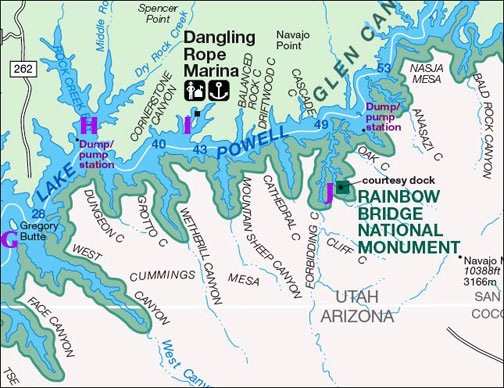
To help you locate these places, I’ve included several maps, each of which has letters corresponding to their descriptions here. This first map is for the downlake points; the map you’ll find a bit farther down in this article is for the points that are farther uplake.

LakePowellPoints1.jpg

Horseshoe Bend

Horseshoe BendThe first point isn’t even on the lake. Horseshoe Bend (A) is a horseshoe-shaped curve in the river a few miles downstream from the dam. It’s often photographed from the viewpoint at the outside “top” of the bend, which you can walk to from a parking area right off Route 89. Here’s a photo I took today from the overlook.
From the air, however, Horseshoe Bend takes on a completely different look, since you can see all of it at once. There’s an excellent photo of Horseshoe Bend from the air, taken by Mike Reyfman, in Part II of this series.

Keep in mind that this is one of the points visited by the tour planes. They’re normally flying a right hand turn around the bend at about 5500 feet, so be listening for them if you overfly.

Glen Canyon Dam

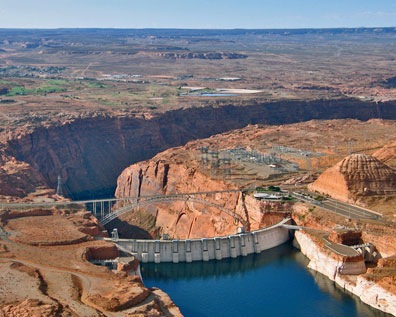
Glen Canyon DamThe Glen Canyon Dam (B) is the dam that keeps all the water in the lake. It’s accompanied by a bridge a few hundred feet downstream that crosses Glen Canyon. From the air, you can get good views of both.

Again, remember that the tour planes are also showing off this area. They tend to fly past between 4800 and 5500 feet, right after climbing out from the airport.

Wahweap Marina

Just past the dam, to the northwest, is the Wahweap area of the lake. It’s off the main channel and is home to the Wahweap Resort and Marina (C), currently managed by Aramark Services for the National Park Service. It includes a marina with slips and buoys, a tour boat dock, a rental boat dock, a resort hotel with two pools, and a campground. You can’t miss it.

The tour planes fly in the vicinity, usually at 5500 feet.

Navajo Canyon

Navajo Canyon (D) is an extremely long lake canyon that winds its way to the south. Outlined in white by the “bathtub ring” water line, it makes a fine subject for aerial photography early in the morning and late in the day. What sets it apart from other long side canyons on the lake is its width — it remains quite wide for miles. There’s also a huge sand dune against one canyon wall that’s a popular houseboat overnight spot.

The tour planes overfly this canyon, descending from 5000 feet (or higher) as they return to the airport.

Tower Butte

Tower Butte (E) is the iconic symbol of Lake Powell that you’ll see on various logos, etc. throughout Page. I don’t think it’s anything special, other than the fact that its top would make an excellent (but illegal) landing zone for a helicopter. It’s not even that close to the lake. But at sunset, it makes a good foreground subject for the illuminated cliffs and buttes behind it.

And if you’re flying low-level (think helicopter or ultralight) you might be able to spot some of the ancient ruins along the base of the butte — although I haven’t been able to find them lately.

This is a reporting point for the tour planes, which begin their descent for the airport right around here. Uplake beyond this point, the tour planes are on the uplake frequency (122.75).

Gunsight Butte

Gunsight Butte from Romana Mesa
Gunsight (F) is a large rock formation that resembles a gun sight. It’s just uplake from Romana Mesa, which is one of the tour plane reporting points. Beyond the butte is beautiful Padre Bay, which has some interesting history and is popular with houseboats.

This photo was taken from the top of Romana Mesa on one of my 4WD outings. In it, distant Navajo mountain is lined up in the “sight” of Gunsight Butte.

Gregory Butte

Gregory ButteGregory Butte (G) stands out in my mind primarily because of its photogenic qualities. If you’re flying uplake early in the day and take a photo up Last Chance Canyon with Gregory Butte in the foreground…well, you get the photo you see here. It’s one of my favorite views of the lake. This shot was taken by my husband on one of our first helicopter trips to the lake together. The water level is a bit higher right now. If it rises some more, Gregory will become an island.
This is another tour plane reporting point, as they fly downriver at 5000 or 6000 feet.

LakePowellPoints2.jpg

Rock Creek

The mouth of Rock Creek (H) is also an extremely photogenic viewpoint. Whether you’re looking up Rock Creek’s three separate canyons or up Lake Powell itself, the view from the air at this point is magnificent. I usually see it from around 4800 feet, which is admittedly low — remember, I’m doing photo flights — but it’s also good from above.

This is one of the turnaround points for tours, so expect a lot of tour plane traffic here. Listen in on 122.75. Traffic coming downlake will be at 5000 or 6000 feet. Traffic turning downlake here will be descending in a right hand turn from 5500 to 5000 feet.

Dangling Rope Marina

Out in the middle of nowhere, on the north side of the lake, tucked into a canyon, you’ll find Dangling Rope Marina (I). This is an important fuel and supply stop for boaters on the lake. What’s odd about it, however, is that it’s only accessible by water. There’s no road in or out of this place. Supplies are brought in on barges and garbage is taken out on the same barges.

Rainbow Bridge

Rainbow BridgeEveryone wants to see Rainbow Bridge (J) from the air. Everyone, that is, except those who know better.

The truth of the matter is, Rainbow Bridge is much better seen from the ground. The trouble is, it’s tucked into a relatively deep canyon that aircraft simply cannot get into safely. From a moving aircraft, you just get a glimpse of the bridge. And if you go too early or too late in the day, the whole thing is in shadow. Not the best experience.

If you’re serious about seeing Rainbow Bridge, get on a boat and take the 2-hour ride from Page to see it from the ground. You won’t regret it.

The Tour Points

Those are the basic downlake points of interest from the air. There are others, but I’ll let you discover them for yourself. As you’ll see when you overfly the lake, the entire lake is magnificent from the air. If it’s your first time visiting, you’ll be too awed to bother tracking down specific places to see. Just take it all in and enjoy.

In the final part of this series, I’ll tell you about some of the interesting points beyond Rainbow Bridge. If you’re flying in the area and aren’t on a schedule, you might want to check them out as well.

A Few Days at Home

A vacation…sort of.

On Sunday evening, I left my seasonal workplace in Page, AZ to spend a few days at home in Wickenburg.

I’d been in Page since August 10, when I flew my helicopter to Page airport from Seattle. Since then, I’ve been working with American Aviation to offer custom photo flights and day trips in the Lake Powell and Monument Valley areas. I squeezed in flights between chapters of a book I was contracted to write. Between flying, writing, and dealing with a bad back (now healed), I kept very busy. I was ready for a break.

I’d planned to go home on Monday, mostly because we’d had one of our horses put down on Thursday and I wanted to be there for my “family.” But I got a call on Saturday to do a helicopter flight in Wickenburg and the only time available was on Sunday afternoon. So I came back early and made a few bucks on a photo flight for some really nice guys.

I also had work to do at home. I needed to put together some promotional materials for flying at Page, using files on the iMac in my office. But the Internet was down for two days, making it difficult to get the information I needed to get the work done.

I soon found myself stressed out by a number of things:

  • My sole remaining horse, alone for more than a few hours for the first time in his life, spent a lot of time pacing his corral, calling out to a friend who would never come. It was heartbreaking. I had to keep the windows closed at night so his whinnies wouldn’t keep me up.
  • My inability to complete the work I needed to do because of the Internet outage. This was aggravated by the knowledge that I had more reliable Internet in a campground in Page than I had in my house in Wickenburg.
  • My growing dissatisfaction with life in Wickenburg. I’d spent the summer on the road and had seen a lot of places I’d rather be. I almost resented having to come home.
  • The seemingly endless list of chores I had at home. Life was much simpler in a 21-foot travel trailer in a campground.

When my Internet service came back online and Mike returned from his trip to New York on Tuesday evening, I started mellowing out. I was able to get work done and had someone to share the chores. I pushed back the date of my return to Page. And we went down to Scottsdale for a wine tasting with friends.

My friend, Tom, owns a house in Wickenburg. But these days he spends only one or two nights a week there. He owns a condo in the Deer Valley area of Phoenix, where his business is based. He has friends and a real social life down in Scottsdale. On Wednesday evening, I met Mike at the Kierland Resort for drinks and ceviche at Deseo. Then we drove over to Bacchus for their weekly wine tasting, where Tom was a regular. We tasted some extremely mediocre wines, then shared a few bottles of good wine with Tom’s friends. Then off to Ra to sober up with sushi and tea before the long drive back to Wickenburg.

Mike is thinking of buying a condo in the Biltmore area of Phoenix as an escape to civilization for us. He drives 80 miles each way from Wickenburg to Phoenix for work and is tired of it. (Unfortunately, there are very few good paying jobs in Wickenburg.) He knows about my growing dissatisfaction with Wickenburg and my need for a social life that’s impossible to attain in a half-dead retirement town. Wednesday evening’s activities confirmed our need to get out of town a lot more often.

I flew back to Page on Friday morning. While in Wickenburg, my mechanic, Ed, had installed a new battery and changed the oil in the helicopter. The starter had plenty of juice when I fired the helicopter up at 7:30 AM. I had a great flight back to Page, where I got a warm welcome from my friends.

And last night, I went to my very first high school football game. Mohave beat Page, 24 to 7.