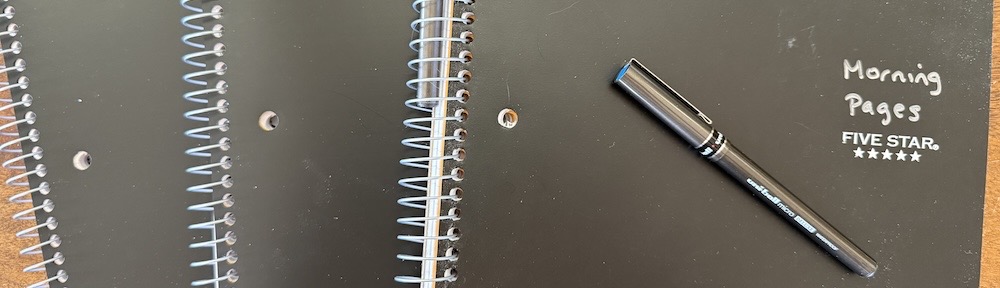
I add a new post to my old Writing Tips series of posts. This one focuses on simple tools to get the job done.
• Writing Tips
• Master the Basics
• Avoiding Distractions
• Soaking Up Creative Energy
• Making the Switch to a Writing Career
• Writing Accurate Descriptions
• Just Write!
When I sat down to write this post this morning, I thought I was starting a new series. But then I looked at my list of about 3,100 blog posts here and realized I already had a series it could fit into: Writing Tips. So with a little bit of editing, I wrangled what I’d written today to fit that series. I do, however, want to start with a new introduction.
About Me and This Series
I’ve been a writer since I was 13. I was always driven to write, to tell stories. I wrote them in spiral bound notebooks with the Bic fine point pen I preferred. I filled notebooks with my writing and I still have many of them. This was before the days of computers and word-processing, mind you. The two choices available for writers was longhand or typing. (It wasn’t until much later that I’d get my first typewriter.)
I’ve been a published — yes, by a real publisher — author since 1987 when I was about 26. (You can do the math; it won’t bother me.) That was an article for a professional newsletter. No money, but my first published clip. (There’s a chance I still have it around somewhere; I should hunt it down.) My first paid writing gig came in 1991 as a ghost writer on a John Dvorak book. I wrote 4 chapters and was paid $500 per chapter. My writing career took off from there — I’m sure I’ve covered its trajectory somewhere.
(Hmm. I just did a quick search of blog posts and can’t find one with the full story. I guess I’ll have to write it. In the meantime, here’s a list of all of the books I’ve written and all of the non-blog articles I’ve written.)
The point is that I’m a real writer. I’m driven to write, I have written books and articles that have been published, and I have even made a good living as a writer. Although I’m mostly retired now, I still write; my most recent article for Passagemaker Magazine was published this past week.
I’m telling you all of this because I want you to know who this series is by and for. You know about me; how about you? This series is for people who want to write. It’s not for people who are being forced to write by a boss or job requirements or even a teacher. It’s not going to cover things like grammar and spelling and style. It assumes you already know enough about all that to actually write.
This series is for the folks who, for some reason, want to write but are having trouble doing it. If that’s you, read on.
The Simplest Writing Tool and System
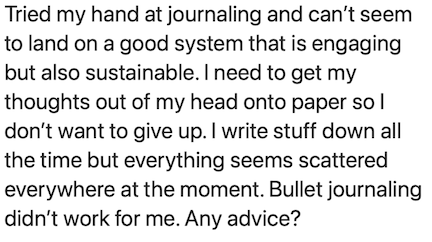
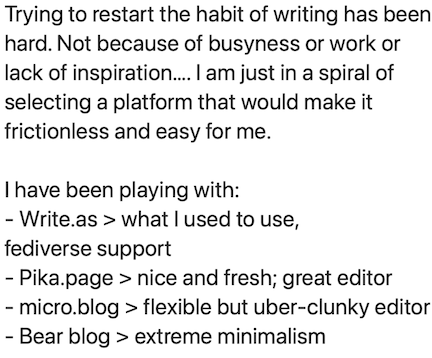
Two Mastodon posts by writers who can’t seem to understand that the simplest solution is right in front of them.
I’ve been thinking a lot about writing lately, looking at ways to get more motivated about doing it and seeing all kinds of weird (to me) posts on my social media platform of choice (Mastodon) from people writing or struggling to write. Two of them just came up in my feed today. I’m including screen grabs of them here for reference and have purposely omitted anything that identifies the poster. (I don’t want to embarrass anyone. If this is your post and you want to be identified as its author, let me know and I’ll modify it for you here.) These posts motivated me to sit down and answer the questions they posed, which I also answered online in replies to them.
In both examples, the author is talking about writing tools or systems to help them write. One mentions bullet journaling, the other lists software platforms. Neither seems ready to acknowledge the simplest tool/system available to them. I’ll give you a hint: it’s the same tool I used when I was 13 years old.
A pen and a notebook.
The Writing Tool/System Trap
Let me start by saying that I was also caught up in the writing tool/system trap that these folks are in. In today’s world, there is always an established and promoted solution for a problem. If someone can cash in on potentially solving a common problem, they will.
That’s what I think of bullet journaling, anyway. It seems that the guy who “invented” it is writing books and creating videos and selling notebooks with dots (instead of lines or grids). You can’t look up “bullet journal” without seeing him pushing his products.
As for software tools, it seems like a race to give writers the perfect app or platform to get their thoughts out there. Even Apple got into the game with its disappointing Journal app. (Why disappointing? Am I the only one who doesn’t want to lock my writing into a cloud-based app?) I even went so far as to spend good money on the app that every writer seems to use and rave about. And then not use it for writing. (I did find another use for it.)
Julia Cameron and The Artist’s Way
A few months ago, still searching for something to help motivate me to sit down and write, I began reading The Artist’s Way by Julia Cameron. This book has been around for 30+ years and still sells well. Every professional writer I know — including me — would love to have written and published a book like this.
Not only did I begin reading it, but I also listened to the audiobook version at the same time — a process some people refer to as “immersive reading” — and took notes. I wanted to squeeze everything I could out of this volume.
I didn’t last long. You see, Julia’s philosophy leans heavy on “spirituality,” her poorly disguised religious beliefs. In her world, a person’s success as an artist (including writers) relies on support from a Great Creator. Although she denies throughout the book that she’s talking about God, you’d have to be an idiot to believe her.
I’m a firm believer that we are each ultimately responsible for our own successes and failures so her Great Creator did not sit well with me. I stopped reading after the Week 2 chapter where her list of 10 “Rules of the Road” included three affirmations that rubbed me the wrong way:
In order to be an artist, I must:
…
6. Be alert, always, for the presence of the Great Creator leading and helping my artist.
…
8. Remember that the Great Creator loves creativity.
…
10. Place this sign in my workplace: Great Creator, I will take care of the quantity. You take care of the quality.
I found #10 especially offensive. (Here’s a newsflash for anyone waiting for a Great Creator to edit their writing: He’s already busy not stopping wars, famine, and injustice. What makes you think your writing is more important to Him than all of those other things that He apparently ignores anyway?) And since it became clear to me by then that a certain amount of religious belief (which I lack) would be necessary to get the most out of the book, I decided not to waste any more time with it.
Anyway, religion aside — I’m certainly not willing to discuss it here so keep your comments about it to yourself, please — I did come away from the book with one thing of great value: Morning Pages.
Morning Pages
The Artist’s Way program requires writers to write Morning Pages every day.
Morning Pages are three full pages, handwritten, about anything you want to write. It could be what you’re thinking or doing or seeing. It could be stream of consciousness. It could be notes for a book you want to write or are already working on. Anything. Words on paper, handwritten.
Since this requirement is stated early on at the beginning of the book (before I decided the book wasn’t for me), I started writing Morning Pages every morning. I had a spiral bound, college ruled notebook — the 8-1/2 x 11 inch kind, not the smaller ones they make to save money on paper. I was already using it for occasional notes, including (ironically) the notes I was taking while reading The Artist’s Way.
I did my Morning Pages every morning during my coffee in bed time with my pups. I’m an early riser, often up before 5 AM. I get up, make coffee, and bring it back to bed. I had been using that time to do some puzzles, catch up on Mastodon, and write a quick journal entry in a blank book I had for that purpose. But instead, I started doing Morning Pages and following that up with the journal entry.
It was easy. I can’t begin to tell you just how easy it was. If I can keep myself distraction-free, I can knock it out in 30 to 45 minutes. That might sound like a long time, but we’re talking about three densely packed pages of writing, roughly 1,000 words. With distractions, the time stretched. But in the 71 days I’ve been doing it — I number the entries — I only missed two days and did a short entry one day — all due to scheduling-related time constraints.
One of the reasons I think it’s so easy is because it doesn’t matter what you write. I usually write about the previous day and what I got done. I write about things I thought about, people I communicated with, and things I want or need to do. I write about the weather and the air quality — it’s smoke season here, after all. I write about my health. I write about ideas for blog posts and articles. I scold myself for not doing things I should be doing.
Seriously: I write about anything that comes to mind. It’s rapid-fire stuff with no formatting or editing. Heck, I don’t even create paragraphs. In one sentence I might wish for rain and in the next I might start writing about a new decorative paper process I’d like to try in my studio.
What is this doing for me? Well, it’s a brain dump, to be sure. Isn’t that what both of the Mastodon post examples I shared above seem to be looking for? It helps me organize my thoughts and create threads that often lead to new thoughts or solutions or even action plans. (I’ve actually begun writing my Morning Pages with my To Do list for the day nearby so I can add items to it.) It has also replaced my journal, which I had been keeping quite faithfully for nearly 2 1/2 years. I was a bit sad to see it go, but I realized that there was a lot of repetition. The additional space I have in that spiral notebook makes it possible to go into detail I could not fit in the old journal page format.
And it’s easy enough to make into a habit. Isn’t that specifically what one of those Mastodon posters wanted to do? Set a time of day to do it, make sure you’ve blocked out enough time, and just get it done.
It also reminded me of how I wrote way back when I was 13. Those notebooks! Those pages of neat printed writing in ink! I was able to be creative back then, to write longhand without editing.
Oh, how I rejoiced years later when word processors made typewriters obsolete! But did they really help me? Or hinder me? Morning Pages makes me wonder.
How Writing Tools/Systems Stifle Us
I mentioned earlier that I was once stuck in the mindset that I needed to use a special tool or system to be productive as a writer. Like the folks I quoted above seem to be. And I tried (and set aside) many software-based tools over the years.
Why? Well I found that once I had decided to use a specific tool to do all my writing, I could not write unless that tool was handy.
For example, when I write on a computer, I want to use a keyboard. A regular keyboard that I can touch-type on. I’m a pretty quick typist when I have the right keyboard, a normal sized one that fits my fingers. I can type nearly as quickly as I can compose in my brain. But needing a keyboard means I have to have a desktop or laptop computer with me to write. I cannot write on a phone or tablet. Unfortunately, it’s not possible to have a laptop or desktop with me all the time. So without that tool, I don’t write.
My blog lives online, but I don’t need to be online to write posts for it. I’ve been using an offline post editor for the past 20+ years. My current tool is called MarsEdit and it rocks. I could not imagine blogging without it (or something like it). Yes, it requires a desktop or laptop to use, but it does not require an Internet connection until I’m ready to upload my post.
That’s the most basic problem. The problem is worse when you have a cloud-based tool such as the sites listed in the second Mastodon post I shared above. They require you to be connected to the Internet to use them. Another hurdle. While many folks can’t imagine not being connected to the Internet, I can assure everyone that there are times and places where it simply is not possible to connect. What do you do then?
Using a specific writing app locks you up the same way. When you don’t have access to the app, do you find other ways to write? Or do you not write at all?
That pen and notebook are looking better all the time, no? Pretty easy to slip into a purse, messenger bag, backpack, or tote bag, no? (It doesn’t have to be letter-sized, you know. Try a steno pad.) Easy to pull out when you’re waiting for a friend to meet you for lunch or while killing time at the local DMV or even when heading out to the park for an hour of people watching or mindfulness exercises. I’ve begun taking a tote bag with me when I leave home to do my errands. Guess what’s in the bag? That same Morning Pages notebook; I can write anything in it.
If it’s always there with you, ready to receive what you want to give it, there’s no excuse not to use it to write.
Just Write
A side note here. I read something recently that also pushed the notion of writing every day, longhand, on paper. The author of that piece, however, demanded that you use a fountain pen. Can you believe that? What a freaking snob!
(Ditto for the idiot who said you need to write in cursive. Why? I’m 65 years old and have been printing my entire life.)
Although I loved the Bic Accountant Fine Point pen when I was a kid, these days I prefer a uniball Micro Deluxe roller ball pen. It makes a nice, fine line and feels good on the paper. But that’s my preference. If you do any writing on paper already, I’m sure you have your own preference. Go with it. Writing should be friction-free and there’s nothing that adds more friction than a crappy writing instrument.
Even if you don’t like the idea of Morning Pages, there’s something you can take from them: the idea of writing longhand to get what you want to remember out of your brain and onto paper.
Isn’t that the goal of writing? To write?
Don’t worry about having your writing in a format that isn’t “usable.” You can make it usable later. Consider what you write a draft. Then, when you need to create a final work based on it, you can edit it as you type it into your word processor (or blogging platform or whatever) of choice to create your second draft.
Oh, and I need to clarify one more thing. If you’re already diligently working in a writing tool — like maybe a word processor? — to write a book, story, or article, the advice here might not apply to you for that project. If you’ve already established a writing routine that works for you to create specific pieces, keep using it! The advice I’m offering here is mostly for brain dumps, journaling, and getting the random thoughts floating around your head out on paper where you can consult them later.
Is Writing Important to You?
If it is, stop making excuses that revolve around finding the perfect tool or system. Buy yourself a note book and a good writing instrument and just sit down and write.
But wait! There’s more!
This is not the only thing I’ve written about writing. I’ve been writing about writing since the very beginning of this blog. If you want to do a deep dive, I recommend checking out posts in The Writing Life category or posts tagged writing. Remember, all posts are listed in reverse chronological order with the most recent ones first.
Discover more from An Eclectic Mind
Subscribe to get the latest posts sent to your email.