Writing Tips: Just Write!

I add a new post to my old Writing Tips series of posts. This one focuses on simple tools to get the job done.

When I sat down to write this post this morning, I thought I was starting a new series. But then I looked at my list of about 3,100 blog posts here and realized I already had a series it could fit into: Writing Tips. So with a little bit of editing, I wrangled what I’d written today to fit that series. I do, however, want to start with a new introduction.

Continue reading

On Ghostwriting

There are only two reasons to do it.

Yes, I’m a helicopter pilot and jewelry artist now. But my second career, which has pretty much wound down at this point, was as a freelance writer. That career, which was in full swing when I started this blog in 2003 (not a typo) was successful enough for me to buy multiple investment properties, completely fund my retirement, take flying lessons, and buy a helicopter.

So yes, I think it’s fair to say that I know a bit about the business of writing.

The Crazy Ghostwriting Offer

So imagine my surprise when I see a tweet from a wannabe writer offering to “ghostwrite your sci fi, fantasy story, ebook, novel” for $5.

My first thought was what kind of desperate idiot would write someone else’s book for $5?

Let’s be clear here: writing may not be terribly difficult — it wasn’t for me — but it is time consuming. The fastest I ever churned out a book was a 280-pager in 10 days. It was my third or fourth book. Would I have taken $5 for 10 days of work? Hell no.

Would I have taken $5 for any piece of writing that had someone else’s name on it? Fuck no.

Ghostwriting Explained

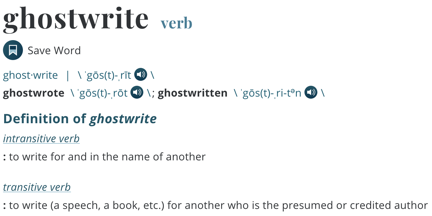
Ghostwrite definition
Definition from Merriam-Webster: ghostwrite.

That’s what ghostwriting is all about: writing something for someone else and having that person’s (or another person’s) name on on it as the author. In most (or probably all) cases, copyright goes to the person or organization who hired the ghostwriter. This is a work for hire, which is relatively common in the publishing world.

Ghostwriters are commonly used by famous people with a story to tell — often biographical in nature — who lack the skill, time, and/or desire to sit down and write it. Remember, writing isn’t easy for everyone, there are lots of really crappy writers out there, and writing takes time, no matter how good or bad a writer is. Ghostwriter names don’t usually appear as author, although sometimes they’ll appear in smaller print after “as told to” or something like that.

There’s no glory in being a ghostwriter.

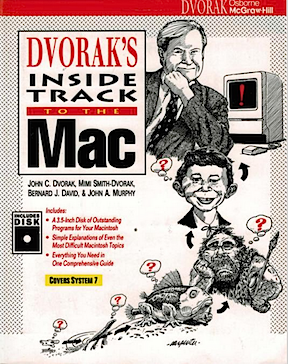
Dvorak's Inside Track
This is the first book I was involved in; I was a ghostwriter on 4 chapters and am mentioned in the acknowledgements.

I know this firsthand. My first book project was as a ghostwriter for John C Dvorak and Bernard J David on Dvorak’s Inside Track to the Mac back in 1991. Bernard hired me, after his agent suggested me, to write one chapter of the book. They liked what I turned in so much that they hired me for another three chapters. (You can read about this in a post titled “Freebies” on this site. I highly recommend reading this if you’re starting out as a writer and hope to make a living at it.)

Much later in my career, I ghostwrote a chapter or two for someone else’s book — was it the Macintosh Bible? I can’t even remember. In that case, I had expertise that the author lacked and the writing experience to get the job done right and on time.

Why Be a Ghostwriter?

Would I ghostwrite something today? Well, that depends. In my mind, there are only two reasons to ghostwrite a book:

  • Money. Plain and simple. That’s the only reason I did that second ghostwriting job. They paid me. And it wasn’t $5. (I honestly can’t remember what it was, but at that point in my career, it must have been at least $2,000.) Even that first ghostwriting gig, when I was a complete unproven unknown writer, paid me $500 per chapter — that’s $2,000 total.
  • Relationship building. This one is a little grayer. Suppose a publisher/editor contacted me about ghostwriting a book for a famous pilot. Suppose they were willing to pay (more than $5) but it wasn’t quite enough to get me to drop what I was doing and get to work. But suppose that this publisher/editor was building a book series by a bunch of pilots and the series was already popular. There was the definite possibility that ghostwriting this book could lead to more offers. And, if they liked my work enough, I’d be able to negotiate higher fees or other benefits — like an “as told to” byline on the cover — or even royalties on future work. If I thought this offer was a relationship builder that could lead to more or better opportunities in the future, I might go for it. It’s relationship building that I really got from those first four book chapters for Bernard. I co-authored my first book with him and that launched a solo writing career that spanned 85 books and hundreds of articles in just over 20 years.

At every writing opportunity, every writer should be asking one big question: what’s in it for me?

(Haven’t read my “Freebies” post yet? This is a perfect time to go do that.)

Why is this guy offering to write someone else’s book for $5? I can’t imagine — unless he just doesn’t have any ideas and wants someone to feed them to him?

Otherwise, why wouldn’t he just write his own damn book and self-publish it? Then at least his name would be on the cover and he’d own the copyright. He might even make more than $5.

Writers Write

I’ve been a writer since I was 13 years old and wrote stories and book chapters in spiral ring binders. Back then, I tried entering short story contests and failed miserably, not really knowing how to get started, and honestly, not being a very good writer. (I have those old notebooks to prove it; they make me cringe!) But I wrote anyway because I was a writer and the more I wrote — and read, don’t forget that! — the better I got.

(By the way, I write in this blog because I’m a writer. Real writers write. We can’t help it. I just don’t need to make a living as a writer anymore.)

Meanwhile, my family pounded the idea of having a stable career into my head. Writing was not a stable career — at least not in their minds. Being young and foolishly believing that they knew best, I made a wrong turn into a career in auditing and finance, losing 8 years that I could have spent building a writing career. By the time I became a freelance writer back in 1990, I had a home and financial responsibilities. I had to make a living as a writer. There was no going back.

Could I have made a living as a writer if I didn’t analyze every opportunity I found? Of course not. Instead, I’d be banging away at an office job, writing stories, likely never to be published, on evenings and weekends — as I did during my 8 year wrong turn.

The Take-Away

The takeaway is this: if you want to write, write. If you want to make a living as a writer, make sure you don’t sell yourself short. Take only the jobs that will move your career forward — or at least help pay the bills.

I Have No Patience for Lazy Writers

A brief rant.

This morning, I got this email from someone who is apparently farming out parts of his books to people with better description skills than he has:

You are the perfect person to help me. I’m writing a book about birding adventures that I had in 2011. One tense incident happened along the Rio Grande when armed cartel waded across the Rio Grande. To make a long story short, for the next forty-five minutes or so two helicopters (border patrol) circled overhead. Here is my question:

How would you accurately describe the sound these helicopters make?

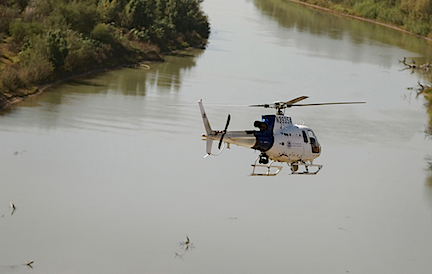
Border Patrol at Rio Grande
Photo of Border Patrol helicopter over Rio Grande from gallery on U.S. Customs and Border Protection website.

For the record, I’ve never been birding along the Rio Grande while Border Patrol helicopters circled overhead for 45 minutes. How would I know what it sounds like?

Yet this guy was apparently there and can’t describe it. He figures that since I’m a helicopter pilot and a writer, I can describe it for him. So he sends me this email message.

Here’s a tip: if you can’t accurately describe something with words, you shouldn’t be a writer.

And yes, I addressed this in my blog back in 2009: “Writing Tips: Writing Accurate Descriptions.” If you do read that post, pay close attention to the first paragraph under the heading “Do Your Homework,” since it pretty much covers my thoughts on getting email messages like this one.

About Style Guides…and a Tip for Writers

A writer’s cheat sheet — and how I maintain mine.

One of the challenges facing writers — especially tech writers — is maintaining consistency and proper usage of words and phrases that describe the things we write about. Is it toolbar, tool bar, ToolBar, or Tool bar? Is it Fonts panel, Font panel, Font window, or Fonts Pane? Is it iBookstore or iBookStore? Is it inspector or Inspector?

This might seem trivial to most folks, but for writers and editors, it’s very important. Inconsistent or incorrect use of established terms is one of the things that mark the work of an amateur. Professional writers do everything in their power to get things like this right — and editors help.

Style Guides

Chicago Manual of StyleStyle guides help, too. A style guide is a collection of words or phrases that might be used in a work, all presented as they should be in writing. You may have heard of some of the more famous style guides, including The Chicago Manual of Style and The Associated Press Stylebook. These are style guide books published for professionals who write about a wide range of topics.

But there are also style guides for more narrow topics. Apple, for example, publishes a 244-page document called the Apple Publications Style Guide. This is one of the books I turn to when I write my Mac OS books and articles. Written for developers and Apple’s in-house documentation teams, it lists the right and wrong ways to use hundreds of words, product names, and phrases. Not only does this include a correct list of all Apple trademarks, but it goes into tiny details. For example, did you know that you can “click the icon” but you can’t “click on the icon”? Page 37 of the latest (2009) edition is pretty specific on that point.

Microsoft Outlook 2011Individual publishers also have style guides. For example, when I wrote Microsoft Outlook for Mac 2011 Step-by-Step for Microsoft Press, I was handed not one but two style guides. They covered all of the product names and program terms I might use, as well as rules about usage. For example, I wasn’t allowed to write a sentence like this: “Outlook enables you to send and read email.” Why? Well, the word enables (in that kind of usage) was verboten. (The average reader has no idea what writers deal with when writing technical books for well-established publishers.)

My Style Guide Needs

Microsoft Outlook 2011Although I never used to have trouble remembering the proper forms and usages of the words and phrases I included in my books, as I’m aging — and as my life becomes more complex — I’m having trouble remembering the little things. So this past summer, when I worked on Mac OS X Lion: Visual QuickStart Guide for Peachpit Press, I developed and maintained my own style guide for the book.

The trick was to put the style guide in a place where it was easy to consult as I worked. I wrote (and laid out) the book on my old 24-inch iMac. I was living in my RV at the time, comfortably parked at an RV park with full utilities, but my workspace wasn’t large enough for the luxurious dual 24-inch monitor setup I have in my home office. I experimented with keeping the list of words and phrases in a Word document file, but the amount of overhead — Word running all the time, big window with all the trimmings, etc. — made it an awkward solution. Ditto for Evernote. All I needed was a tiny window where I could list the words I needed to use — these applications made maintaining and consulting such a list multiple times throughout the day a real chore.

The Solution: Stickies?

Stickies IconI stumbled onto the solution while writing the book. One of the apps that comes with Mac OS X is Stickies. This is an app whose sole purpose is to put virtual sticky notes up on your screen.

I never liked the app. I thought it was kind of dumb. After all, who would use an app to put a sticky note onscreen when you can just put a real sticky note on your screen?

But then I realized that the tiny windows Stickies creates were perfect for the simple lists I needed to consult. I could easily fit them on my screen, beyond the area I needed to work with InDesign.

Style Guide in StickiesAnd so I began creating and maintaining my style guides in Stickies.

And I continue to do so today.

There are a lot of benefits to using Stickies as a solution for this problem:

  • The contents of Sticky Notes are saved, even if you quit the application.
  • Stickies are easily modified and updated.
  • Stickies supports formatting, so if I want to remind myself about a word or phrase that should never be used, I can format it as strikethru text.
  • Stickies can be exported as plain text, so I could, theoretically, save a style guide list before closing the Stickies window when the book is done.
  • Stickies take up very little room onscreen.
  • All active Stickies notes open automatically when you open the app.
  • It’s easy to set up my computer so Stickies automatically opens at startup.

Sounds good, no?

For me, it’s a win-win. I get a solution to my problem. But what I also get is a reason to use a silly little free app like Stickies.

Writing Tips: Writing Accurate Descriptions

A response to a blog comment, and more.

I need to say that I really can’t thank blog commenters enough for taking the time to write. Not only do they often add useful information beyond what I know — thus adding incredible value to this blog — but they sometimes post questions or comments that get my mind going and give me fodder for new blog posts.

I received such a comment this morning and it prompted me to write a new article for my Writing Tips series.

The Importance of Accurate Descriptions

I touched upon the topic of accurate descriptions in fiction in a post I wrote last month: “Facts in Fiction.” In it, I explained why I thought it was important to get the facts about the “real” parts in fiction correct. I talked about the depth of a fictional world and how it would determine what facts and descriptions needed to be accurate.

My goal in that piece was to urge fiction writers to get the facts straight. Errors, when noticed by readers, can seriously detract from the work. For example, I believe I cited the example of a bestselling author who claimed that when a helicopter was low on fuel, it would be safer to fly lower than higher. This is downright wrong, no matter how you look at it. The author’s reasoning proved he knew nothing about the thought he was putting in a character’s head — a character that should have known better. This absolutely ruined the book for me, making me wonder what else he’d gotten wrong.

You can argue that fiction is fiction and that the writer can make up facts as he goes along. I disagree. My “Facts in Fiction” post explains why, so I won’t repeat it here.

Today’s Question

Today’s question comes from a comment on my recent blog post, “Dan Brown Doesn’t Know Much about Helicopters,” in which I painstakingly (and perhaps nitpickingly) point out a bunch of errors in Brown’s latest literary masterpiece (and yes, that is sarcasm), The Lost Symbol. The errors revolve around the inclusion of a helicopter as a repeating plot component throughout the book. Brown used his descriptive skills to make several claims about helicopters that simply were too far fetched to be believable. (But then again, isn’t that what Dan Brown’s work is all about?) I detailed them for blog readers.

One reader found the post useful. She wrote:

I just wanted to let you know I found this blog immensely helpful as I am writing a chapter in my book that involves a helicopter ride. I must say that I am striving to find new ways to describe the sound a helicopter makes. It’s rather unmistakable when you actually hear it, but to describe it to a reader is much more difficult. I recently wrote… “the deafening drill of the helicopter’s rotors made conversation impossible…” and one of my proof readers balked at the use of the word “drill.” I’d love to hear your comment on that one!

I started to respond in a comment, but the length of the comment soon bloomed into blog post length. So here’s the response.

First, I definitely agree about the word “drill.” Now here are some points to consider:

  • Have you actually heard a helicopter close up? Or at the distances you’re trying to write about? First piece of advice is to go someplace where you’re likely to hear helicopters and listen to them. Then describe what you hear.
  • Does the word “deafening” really apply? I think Dan Brown used that one, too. Deafening is a strong word. Unless the listeners were standing/sitting right outside the helicopter or inside with a door open/off, I don’t think deafening would be accurate. Helicopters are not as loud as people think — unless you’re right up next to them.
  • Lots of folks think it’s the rotors making all that noise. Close up, it’s the engine you mostly hear. Piston engine helicopters sound like airplanes; turbine engine helicopters sound like jet planes. Are you trying to describe the sound of the helicopter’s engine or spinning blades?
  • The tail rotor on many helicopters actually makes more noise than the main rotors. Why? The tail rotor blade tips are sometimes traveling near the speed of sound. Maybe it’s the sound of the tail rotor you want to describe.
  • How fast are the blades spinning? Is the helicopter just winding up? Is it at idle RPM (usually around 70%)? Is it fully spun up to 100% but still sitting on the ground? Preparing to lift off? In flight? There are differences — significant or subtle — in the sound depending on the blade speed and what the helicopter is actually doing.
  • How many blades does the helicopter have? You’re more likely to hear a rhythmic “wop-wop” sound coming out of a large helicopter with a two-bladed system — like an old Huey — than a smaller helicopter with four or five blades — like a Hughes 500C or D.

As you can see, it’s not as easy as asking someone if you can use the phrase “deafening drill” to describe a helicopter’s sound. There are too many variables. And at least three components are making that noise: engine, main rotor, and tail rotor. You need to hear the sound to describe it.

Do Your Homework

As I writer, I’m more bothered by the introduction of stereotypical descriptions — even if they’re not actually cliches — than inaccurate descriptions. Yes, it’s easy to ask a pilot whether a description you’ve written about flying rings true. But it’s lazy (for lack of a better word) to use a stereotype or cliche to describe a sound when you have the ability to hear it for yourself. And its irresponsible, as a writer, to expect a pilot or proofreader to come up with a better descriptive word for you. That’s your job.

If you want to write about the sound of a helicopter, for example, get your butt down to an airport or police helicopter base or medevac base. If you’re writing about a helicopter ride, as this commenter is, go for a helicopter ride.

Talk to the folks at the helicopter base about flying. Be straight with them — tell them you’re a writer and are doing research. (That is what you’re doing, isn’t it?) Let them read a passage or two from your manuscript if you think they can check it for authenticity. Then wait around until a helicopter operates in the area and listen. Get the permission (and possibly an escort) to stand or sit where you need to be to hear the sound as you need to hear it. Record it if you think it’ll help. Make sure you get the right sound for the right phase of flight. After experiencing this, you should be able to accurately describe it.

Do not rely on what you see/hear on television or in the movies. Many sounds are usually added after the fact. I’ve seen clips where the sound of an aircraft didn’t match the type of aircraft being shown. Movies also show helicopters departing almost straight up or landing almost straight down — a pilot will only do this if he must. (Read “The Deadman’s Curve” to learn why.)

Authenticity is Worth the Effort

There’s an added benefit to doing your homework: authenticity now and in the future.

For example, a visit to a helicopter base or ride in a helicopter will give you all kinds of additional details about the helicopter or flight operation. Do people really need to duck when getting out of/into a running helicopter? How is downwash different between an idling helicopter and a helicopter that’s just lifting off or arriving? How strong is the downwash from a hovering helicopter? What does it feel like? How does it smell? What does a turbine helicopter’s engine sound like when first starting up? (Think of your gas barbeque grill and you won’t be far off.) What are the pavement markings like on the helipad or helispot? What’s the pilot wearing? What’s he holding?

These little details will not only add authenticity to what you’re writing now, but they’ll give you plenty of useful material for the next time you need to write about helicopters.

It’s Not Just Helicopters

I’ve used the example of helicopters throughout this post because that’s one of the things I know from experience — and that’s what the question that prompted this post was all about.

But the advice in this post applies to anything that’s outside your realm of knowledge.

You know the age-old advice about writing: Write what you know. Well, you know what you experience. The more research you do — the more things you experience firsthand — the more you know. And the more you can write about accurately and authentically when you need to.