Stress Levels Rise as Blogging Frequency Falls

Something I’ve noticed.

You may have noticed that my blogging activity has dropped off again. There are two reasons for this:

  • I’ve tried three times to write a blog entry and all three times the text is moving off on a tangent that leads to a dead end. I’m blocked.
  • I’m working against three deadlines, only one of which is self-imposed, to get a bunch of stuff done. I can’t seem to work as quickly as I used to.

Whatever the reason, I’m blogging less and feeling more stressed. Some people might argue that those two things are not related, but I think they are, at least in part.

When I start my day with a blog post, as I did each day last week, I feel good about myself and ready to start the day. Maybe it’s because I’ve managed to produce something at the very start of my day, before most folks are even awake. Maybe it’s because it sets the pace of my day to get more done. Maybe it’s because writing in my blog often helps get things off my chest or out of my head, stored in a safe place so I can clear them from my mind. In any case, blogging helps me to think and to work better.

What’s on My Mind

This week I’ve got a ton on my mind.

My company was mentioned in Arizona Highways magazine and that has led to a dramatic increase in calls for my flying services. In the past two weeks, I’ve sold three 6-day excursions and have at least two other people seriously considering it. If this pace keeps up, I’ll be flying two to three excursions a month during the spring and autumn months. While this is a great thing, it also brings on a lot of stress — making reservations, worrying about customer satisfaction, thinking about weather and helicopter maintenance issues — the list goes on and on.

This stress is only complicated by the fact that I’m working on a book revision that I need to have done by mid-May. While the software I’m writing about isn’t technically even in beta yet, it’s pretty stable. But there are a few features that simply don’t work. I don’t have access to the bug reporter, where I normally contribute to the company’s efforts to identify and squash bugs, so I don’t know if they are aware of the little problems I’m seeing. And, in the back of my mind, is the possibility that the software’s interface might change. I’m 5 chapters into a 24 chapter book right now — a book rich with thousands of screen shots — and if there’s a major interface change tomorrow or next week or as I’m wrapping up, I’ll have to do the whole revision all over again. How’s that for a stressful thought?

And why do I need the book done by mid-May? That’s another stressful situation. I’ve been contracted for cherry drying in Washington State this summer. Unfortunately, I haven’t been given a start date yet. It’ll take me a week to get the helicopter up to Seattle for its annual inspection, come home to get my truck and trailer, and drive back up there to my contract starting point. But I don’t have any details about where or when I’ll begin work. I could theoretically get a call next week — while I’m on one of my excursions — telling me to report in on May 5. I’d have to scramble hard to make that happen.

Related to this is my need to fill at least one seat on the flight from the Phoenix area to the Seattle area. It’s about a 10 hour flight and the cost of such a flight is enormous. I need a couple of passengers or a helicopter pilot interested in building time to bring in some revenue for the flight. Trouble is, it’s hard to get the word out, few people who hear about it understand what an incredible opportunity the flight is, and those people who do want to go simply don’t have that kind of money. My summer profitability depends, in part, on covering my costs for the ferry flight with revenue.

And on top of all this is the video project from hell, which I prefer not to discuss here until it has been resolved.

So you can see why my mind might not be tuned in properly for blogging.

Taking it One Day at a Time

I know that the best way to work through this stressful time is to take one day at a time and get as much done as possible. My main motivation is peace of mind. The more things I complete, the fewer things I’ll have on my mind to stress me out. While some thing are out of my control — will they change the user interface of the software? will I be called to Washington before mid May? — others aren’t. I just need to plug away at them until I get them taken care of.

And I need to blog every morning. It sure does feel better when I do.

Another Season of Cherry Drying Planned

I finally have a plan for the summer.

Yesterday morning, I received a fax I’d been waiting for. It was from a helicopter services company based in central Washington state, not far from the Columbia River. I’d worked as a subcontractor to a subcontractor for them last year to dry cherries with my helicopter. This year, with the middle man out of the picture, I contacted them directly, offering my helicopter and services.

And then I waited.

Normally, cherry contracts start going out in March. This year, with the economy so questionable, the contracts went out a month late. My buddy, Jim, got his on Friday. When mine didn’t arrive by Saturday, I assumed they had enough pilots. After all, there’s a glut of them without jobs and plenty of flight schools that are finding themselves with plenty of helicopters and CFIs but not enough students. I assumed they’d chosen someone else — likely someone closer to the orchards — instead of me.

But on Monday morning, the fax arrived. It laid out the terms for my minimum 21-day contract. The money offered was the same as last year. If fuel prices stay stable — rather than spiking to new highs as they did last year — I’ll do okay. If it rains a lot — and I have my fingers crossed — I’ll actually bring home a decent amount of money. Maybe even enough to pay off my camper loan.

The Logistics

Although a specific start date wasn’t mentioned, I could start the contract as soon as May 15. It’s more likely, however, that I’ll be starting around June 1, as I did last year. Apparently, the cherry crop is running late again.

I told them I need a week’s notice to get the helicopter into position. Because of the distance involved — I’m about 1,000 miles away — it’s a multiple-step process to get all my playing pieces on the board:

  • Ferry the helicopter from Wickenburg to Seattle’s Boeing Field. I have two empty seats for this flight and am actively seeking one or two people to fill them. You can learn more about it here; I can’t exaggerate what an incredible experience this flight is — especially since I let my passengers choose the route. This flight will take 2 to 4 days, depending on what my passengers have in mind.
  • Drop off the helicopter for its annual inspection. I use the services of Rich Carter, who is probably one of the top 5 Robinson mechanics in the country.
  • Fly via airline back to Phoenix.
  • Prepare my camper and truck.
  • Drive from Wickenburg to my first base of operations in Washington State. If my truck behaves and the weather holds, I can do the 1,200-mile drive in two long days.
  • Set up the camper in a campground or grower field.
  • Take an airliner from Wenatchee, WA to Seattle, WA.
  • Ferry my helicopter from Seattle to my first base of operations.

I figure the absolute quickest I can do all this is five days. I’m hoping I get seven.

Of course, I can do a lot of the preparations this month, so when I return from Seattle, I can just hook up the camper and go. The preparations include giving my camper a total check out, loading it up with the things I’ll need to live and work in it for up to eight weeks, and fixing a few little broken things, like the DC jack in the kitchen area, which I use to power my iPod. I’m also considering the installation of a satellite dish that’ll get me Internet as well as television — although I don’t usually bring a TV with me.

Well, at least I can try to do the preparations. I’m working on a book this month and promised my editor I’d be done by month-end.

The Ferry Flight

San FranciscoThe ferry flight is the part I’m looking forward to most. Last year’s route took us due west across the Arizona and California deserts to the coast at San Luis Obispo. We then flew up the coast all the way to San Francisco, where the marine layer pushed us inland. We overnighted at the north end of Napa Valley, then pushed on to Portland the next day, doing a good portion of that flight over the coast, too. The last day, we made the quick flight to Seattle with a flyby of Mt. St. Helens, which was steaming. I still remember those towering waterfalls from snow melt off the cinder cone. You can read about each day of the flight and see more photos here, here, and here.

It’s pretty important that I get paying passengers on board for this flight, so I’ve cut my usual charter rate down to below my cost in an effort to attract deal seekers who want a once-in-a-lifetime flight experience. That’s my preferred approach.

Plan B is to offer the flight to helicopter pilots who want to build time in an R44. The trouble with this plan is the extra effort involved: I need to get the pilot on my insurance, which means he needs to have a certain minimum number of flight hours in R44s and has to have taken the Robinson factory safety course. The rate I offer these guys is lower than my charter rate, so I’d have to eat more of the ferry cost. And, of course, if someone is paying me for the privilege of flying my aircraft, I have to let him or her fly it. Frankly, I like to fly — even 10 hours worth — and would prefer to fly it myself. So Plan B, while certainly possible, is not my preference.

Plan C is even more distasteful. It means flying up there by myself. The good part of that is that I can do all the flying on whatever route I choose. The bad part is that I won’t get any of my ferry costs covered. And since my ferry costs are significant for a 10-hour flight, I’d rather get them covered than have the pleasure of a solo flight.

Besides, it’s nice to have company.

Settling In

Once all my tools are up there, I can settle in to wherever I’m based. I’ll likely spend 3 weeks at the first base and, with luck, get moved to another base farther north after that. Last year I started on the Columbia River near Quincy (south of Wenatchee), moved north to Pateros and Brewster, and then moved back to the high country around Quincy. Then I was done, having been on call for seven weeks with only two days of flying.

No, last year was not profitable. I just about broke even. But it was nice to get away from Arizona’s heat and do something that wasn’t tourism-related.

My TrailerHow much I “settle in” is questionable. While I had the trailer parked in the same campground spot for almost two full months last year (see photo) and spent 10 days at a motel in Pateros, this year I’m more likely to be moving the camper around. It’s pretty much self-sufficient — with solar panels that should keep the batteries charged on those long, summer days — but I’d like to get a full or partial hookup. I’m not opposed to parking on a grower’s property or even at an airport where the helicopter would be based.
I would like to minimize the number of times I have to move it, though. It takes about an hour to set up or break down camp, due to the nature of the pop-out beds. I don’t mind doing all this work, but if it happens to be a very rainy season, I’m not sure whether I’ll have time to do it. I’ve been told to expect 10-hour flying days if it’s a wet one.

Looking Ahead

I’m looking forward to the trip and the challenges it presents. I had a pretty crappy winter here in Arizona, dealing with a lot of bull that I’ll likely blog about sometime in the future, when it’s all a dim memory. While my company’s inclusion in the May 2009 issue of Arizona Highways magazine is already helping me book excursions for the upcoming fall flying season — and perhaps even one or two excursions before I leave for the summer — it’s not going to help me in the summer months, when I really do hate flying here. You cannot imagine the heat, and escaping the heat to the high country introduces all kinds of problems because of high density altitude. Cherry drying is challenging, tedious, and dangerous work, but it’s a change.

And I thrive on change.

Read More Posts about Cherry Drying:

On Aerial Photography

A comment turned into a blog post.

I just read “The Shot” on Helicopter Pilot, Will Travel. (If you’re a helicopter pilot and you don’t read this blog, you’re really missing out on something valuable.) The post was about aerial photography and the difficulties in getting good shots.

Combine from Air
I was a passenger in a friend’s R44 when I snapped this photo.
It was the best image of about two dozen attempts.

I started to write a comment on the post, but soon had more words than a polite commenter should be leaving on someone else’s blog. So I figured I’d just turn my blather into my own blog post on the subject.

I do a lot of flying with photographers and video folks on board. A lot of it is “fine art” photography in places like Lake Powell and Canyonlands National Park. There’s also some commercial photography — bridges, highways, buildings, etc. And lots of “action” photography and video of racing boats and off-road trucks.

I absolutely love this kind of work — especially the high-speed chase stuff. It gives me an opportunity to get “in the zone” with the aircraft. I usually sit the photographer in the seat behind me so we get the same view. This makes it easy to stay on the target.

It gets challenging when slow flight is required — especially if it’s windy or if we’re in high density altitude. I’ve gotten to the point where I know when to expect a settling with power situation and can recover from it quickly, with the minimum loss of altitude. I’m also smart enough to avoid it any time I’m flying low-level.

The quality of the photographer’s work varies greatly. There’s a video guy I work with on off-road races that’s incredible. The four of us — me, my helicopter, the video guy, and an up-front observer — make an excellent team. I’m not sure if it’s my ability to fly close to the racing vehicles or his ability to manipulate the camera — probably a combination of both — but his footage is mind-boggling.

The fine art photographers’ work depends on lighting and where we’re taking the photos. The southwest U.S. landscape is amazing, but early in the morning, just after dawn, or late in the afternoon, just before sunset, I really think it’s impossible to take a bad photo.

You can tell the experienced aerial photographers from the newbies by the equipment they bring — mostly lenses. I’ve had people show up with zoom lenses that not only forced me to fly far from the subject matter to get it to “fit” in the lens, but let in so little light that shutter speed was an issue.

On the other side of the coin is a photographer that always mounts his camera on a hand-held gyro stabilizer to minimize the vibrations coming in from the helicopter. I’m actually thinking of investing in one of these devices, so I can rent it to the photographers that fly with me. Being more flexible with shutter speed would give them more flexibility in terms of composition.

Gunsight

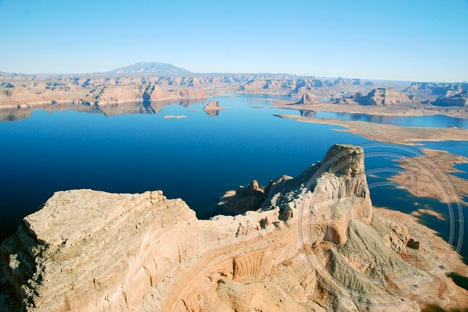
Gunsight Butte on Lake Powell.

My husband was at the controls while I snapped photos.

Unfortunately, I seldom get to try my own hand at aerial photography. You see, both hands are usually busy with the controls in my single-pilot R44. I did get an opportunity to fly with a fellow pilot in his R44 in Washington State last summer (see combine photo above), but more recently, I’ve begun doing some doors-off flying with my husband, who is also a helicopter pilot. We take turns playing with the camera. The shot accompanying this post is one of mine from a recent flight to Lake Powell.

One thing Keith is certainly right about in his post — it can take an awful lot of tries to get just the right photo.

A Perfect Storm

Why I’ve been neglecting this blog.

I don’t have much time to write this — and that’s the reason I haven’t been writing more regularly. I like to compose at least 5 blog posts a week, yet this is only my third in just over a week. The last post — a video — doesn’t really count, since I didn’t write anything.

So why the neglect? As I mentioned above: time.

Every once in a while, life throws a perfect storm at us. You know what I mean — it’s a period of time when everything seems to go crazy at once.

In my case, it was the following, which have all occurred since July 29:

  • Completion of the annual revision of one of my books (ongoing throughout this period).
  • Reposition my helicopter from Quincy, WA to Seattle, WA.
  • Reposition my camper from Quincy, WA to Page, AZ.
  • Brief 3-day catchup period at home in Wickenburg, AZ.
  • Distribute the animals among multiple boarding facilities.
  • Trip to Seattle, WA.
  • Reposition helicopter from Seattle, WA to Page, AZ.
  • Set up housekeeping in my camper in Page, AZ.
  • Entertain an overnight guest in a very tiny camper.
  • Deal with FAA, airport manager, and local tour operators in Page regarding tour, photo flight, and charter work in Page, AZ (ongoing).
  • Provide moral support for my sister, who has been laid off from her banking job.
  • Three photo flights from Page to Monument Valley.
  • Start of new book with August deadline.
  • Three trips to medical facilities in an attempt to diagnose some severe back pain.

It’s this last thing that’s really gummed up the works. I did something to my back while I was home and the pain became unbearable after the commercial flight to Seattle the next day. I was in an urgent care clinic there where I got prescriptions for drugs I couldn’t take because I had to fly. The pain has varied from annoying but bearable to absolutely crippling every day since then, with one day so bad I was in the hospital emergency room. It hurt to sit and since I need to sit to write, I couldn’t work on the new book — let alone write blog entries.

Miraz hit the nail on the head in her Twitter comment to me, when she said, “Pain is so time consuming and draining.” Wow. I’d never really thought of it like that — probably because I’ve never been in such severe pain for so long.

So now I’m behind in just about everything, racing against the clock to finish a book that’s due tomorrow. (It ain’t gonna happen.) The pain is under control — yesterday was the first day that it was tolerable throughout the day — and physical therapy starts on Monday.

Please bear with me. I do have lots to write about. When I get this book off my plate and catch up on my FAA stuff, I’ll be back with some interesting (I hope) new content here.

Real Scud-Running

Scud-running, defined.

In a recent post titled “Almost Scud-Running,” I recounted a flight through Snowqualmie Pass in Washington with low clouds and limited visibility. I said that was “almost” scud-running. But what we did on departure from Seattle’s Boeing Field (BFI) on Saturday was definitely scud-running.

So I guess a definition is in order here. This is my definition — other pilots might define it differently.

To me, scud-running is flying in weather that is so questionable that you’re required to alter your course to get around it. I’m not talking about an alteration planned before takeoff — we did that, too. I’m talking about multiple in-flight course changes to find your way around weather you can’t fly through. And that’s what we did on Saturday morning.

The original flight plan had us going through the pass again and, from Ellensburg on the other side, to Walla Walla and down into Oregon. But there were low clouds over Seattle that morning and a check with Duats and the Seattle FSS confirmed that Stampede Pass had just 1/4 mile visibility. Stampede Pass is one pass over from Snowqualmie and roughly the same altitude, so if it were fogged in, Snowqualmie probably was, too. (Stampede has an ASOS; Snowqualmie does not.) We could wait for the weather to lift – which might not happen that day at all — or take another route. Since I was suffering from severe back pain due to a possibly herniated disk, I wasn’t interested in waiting around. I wanted the flight over with. So we planned to go due south and find a path around the west side of Mt. Rainier and Mt. St. Helens.

Louis was flying and would do 95% of the flying for the entire ferry flight from Seattle to Page, AZ (Lake Powell). He’s familiar with BFI and handled the radio communications with the tower there before guiding us through the narrow corridor between Renton and Seatle airspace. Then we were heading south with the clouds just above us. We had perfect visibility ahead of us, but the mountains were obscured to the east.

How I Run the Scud

I have a technique I use for scud-running in mountainous terrain. This is a technique that’s easy in a helicopter — which has the ability to slow down, stop, descend almost vertically, and make very tight turns. I do not recommend using this technique in an airplane. Actually, I don’t recommend doing any kind of scud-running in an airplane.

In my technique, I fly as close to the desired course as possible as long as I can see the next upcoming ridge or mountain top. When I get near that ridge, I peek over the top of it. If I can see the top of the next ridge, I cross over and continue. If I can’t see the top of the next ridge, I fly parallel to the ridge in the direction of clearer skies, which is normally opposite the direction I really want to go. As soon as I can see the next ridge, I hop over the one beside me and head to it.

Of course, if the skies aren’t clearer in any direction, I just look for a landing zone, preferably an airport where there’s a lounge, restrooms, and vending machines or a restaurant. I do not want to get boxed in by the clouds with no options except down in mountainous terrain. And I’m not stupid enough to fly my helicopter in clouds, even if I wanted to punch out through the top.

I’ve used this technique safely in an attempt to get across the pass at Tehatchapi at the southern end of California’s Central Valley. That attempt was not successful — the pass was completely fogged in — but it did allow me to get close enough to make an informed decision without putting myself in any danger. I subsequently crossed out of the valley at Grapevine after landing at an airport and talking to the local FSS.

On Saturday

That Saturday, I guided Louis on a scud run using the technique discussed above. I had a sectional chart with me and always knew exactly where we were. There were lots of valleys that looked promising, but in quite a few cases, the chart clearly showed that these valleys would simply climb up toward either Mt. Rainier or Mt. St. Helens, both of which were hidden in the clouds. Sucker valleys. It was a good thing that there were two of us up front. If I’d been alone and unable to really study the charts as I flew, I would have tried more than a few of them and wasted a lot of time.

Scud RunningMike took this photo from the back seat when we were nearly out of it. It was pretty bright at this point and easy to see that the cloud tops weren’t far above us. It was tempting to punch out through a hole to the top. But I don’t like flying when I can’t see the ground. If the engine quits I want to see my spot right after entering an autorotation — not seconds before we hit the ground.

The result of all of this was that we wound up going nearly due south to avoid the weather. Here’s the track from my SPOT Messenger; ignore the numbers and just follow the track from Seattle south and then east:

Scud Running in Washington

Bonneville DamAll this groping around added an hour to our flight for the day and shifted our flight path to the south. The weather was still iffy with low clouds in the Columbia River Gorge between the Cascade Locks and Hood River. You can get an idea of the situation in this photo of the Bonneville Dam that Mike took when we flew by.

But by the time we got to The Dalles, it was clear and sunny — another beautiful day on the east side of the Cascade Mountains. We left the Columbia River behind and headed toward our first fuel stop at Pendleton, OR.