Giving Credit Where Credit is Due

Two people helped me get started in cherry drying.

Yesterday, I got an email message from someone I hadn’t heard from since 2009. His name is Rob and he’s one of the two people who helped me launch my cherry drying business here in Washington state.

The first person, of course, was Erik Goldbeck. Erik contacted me way back in 2006 about joining him in Washington for some cherry drying work. It was Erik who explained what the work entailed and why it’s done. He tried to get me up to Washington from my home in Arizona in the summer of 2006 and again in 2007, but he was unable to guarantee me work or the standby pay I needed to make the trip financially viable. It wasn’t until 2008 that Erik got enough contract work to bring a second pilot on board with guaranteed standby pay. He chose me and I prepared to come north to join him.
At Pateros
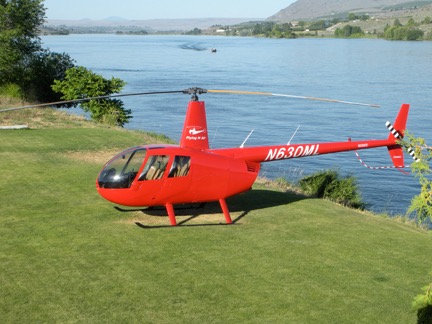
Here’s my helicopter, parked on the lawn beside a motel in Pateros, WA where I worked for 10 days that first cherry drying season.

Then two things happened. First there was a late season frost that destroyed half the crop. Suddenly Erik only needed one pilot. But Erik was not going to be that pilot. Almost at the same time, he was diagnosed with cancer. When I met him in person for the first and only time, he was in the hospital recovering from surgery, relearning how to walk. He sent me to Quincy, WA to handle the remaining cherry contracts he’d gotten for us. I was only there for seven weeks that first year and only flew five hours total.

The following year, 2009, Erik was out of the picture. (He died that summer; his illness and death had a profound effect on me.) I prepared to go to work for the same company he’d contracted with for much of the work the previous year. I had two contacts: Rob in the Quincy area and Dan in the Chelan area. They worked for a man named Ed, selling helicopter services to orchardists and getting helicopters to do the work.

About a month before my season start, Ed apparently decided he didn’t want to be in the business anymore. He shut down without any notice, leaving Rob and Dan unemployed, dozens of orchardists without any protection for their cherry crop, and more than a few pilots wondering what the heck they were going to do. I got in touch with Rob, who seemed disillusioned and fed up. He told me he was going to retire and then he did something I’ve always appreciated: he gave me the phone numbers for a bunch of orchardists in Quincy and Wenatchee who might need helicopters.

I worked the phones. I got enough orchardists interested in hiring me to make it worth coming north on my own. I created a contract based on the one Erik had with me. I collected standby pay. And in late May, I hooked up my old RV and headed north to Washington for the summer. I even managed to extend my season with a new contract that had me in the Wenatchee area until mid August.

At the end of the season, I sent Rob a “commission” check to thank him. I think he was surprised.

Each year, I built up my client base to add clients and orchards. By 2011, I had enough work to add a pilot for about three of my eleven weeks. The following year I added one for four weeks. The next year, there were three of us for a while. Then four. This year, which is my ninth season, I have four pilots helping me for my busiest part of the season: two in Quincy and two with me in the Wenatchee area, where I’ve been living full-time since May 2013.

But without the leads from Rob, I would never have been able to come back that second season and I wouldn’t be where I am now — living in a place I love, surrounded by good friends and friendly people, enjoying a life I’d only dreamed about having.

I tried to contact Rob a few times, mostly just to say hello. But I never got a response.

Until yesterday’s email, which was sent using the contact form on my blog.

I’d taken his two granddaughters, aged 6 and 3, on a helicopter ride during an event at the airport on Saturday. They “wanted to fly with the girl pilot.” He was writing to say hello and thank me. He mentioned that he was still retired and living at his orchard but he occasionally did some seasonal inspection work. I wrote back to tell him how good it was to hear from him and to thank him again for helping me get started.

Rob probably doesn’t realize how much he helped change my life for the better. Cherry drying was the good paying work I needed to make my helicopter business thrive. It gave me the excuse I needed to get away from Arizona’s brutally hot summers. Although I didn’t realize it at the time, it also gave me a chance to enjoy a few months of freedom every summer, living like a single person and making my own decisions. I fell in love with this area over those summers and it was a no-brainer to move here full-time when my marriage fell apart.

Rebuilding my life here has been one of the most pleasurable challenges in my life — and it wouldn’t be possible without the business I built here with Erik and Rob to help get me started.
Cherry Drying: A Narrated Video

Experience the glamour of being a helicopter pilot!

Drying Cherries
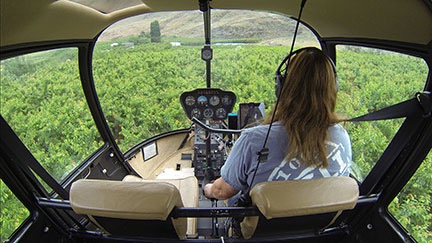
The camera position offers a clear view out the windscreen, as well as the instrument panel, and my hand on the collective. It also offers partial views out the side windows.

I’ve been fiddling around with my GoPro camera setup. A few years back, I positioned a mount between the two back seats. A few weeks ago, I put my Hero 3 Black in there and played around with various video options. I was satisfied with — I can’t say I really like — the results. Other people who saw stills and videos seem to like it a lot.

I think adding audio really made it better, though. Through the use of a cable I bought online, I can get audio right from the helicopter’s intercom system. That means you can hear anyone talking in a headset as well as radio communication. I think this can be an excellent teaching tool.

Cherry Drying?

I’ve been drying cherries in Washington state since 2008. As I write this, I’m starting my ninth season.

If you have no idea what this is all about, here’s the short version: In the last few weeks before harvest, cherries are susceptible to damage when it rains. When the cherries get wet, they absorb water though the skin and they split. They can also get mold or mildew growth. It’s bad; if 50% or more of a grower’s crop is damaged, he won’t pick at all. So growers hire helicopters with pilots to stand by in the area. When it rains, they call us out to hover low over the trees. This shakes the branches, thus shaking off most of the water.

Want more info? Here’s a post I wrote about this years ago.

I gave it a try on Saturday when I dried a new (to me) cherry orchard in East Wenatchee. The resulting video was about 45 minutes long. But when I edited out the flight to the orchard and the flight home, it shortened up to 25 minutes.

So if you’d like a good, long look at what it’s like to fly a helicopter low and slow over 16 acres of cherry trees in a wire-rich environment, here’s your chance. I warn you now: it isn’t riveting stuff. In fact, it’s downright tedious. The only thing that makes it remotely sharable is the narration, where I chatter away about what I’m doing and thinking. See for yourself:

I warned you!

And yes, I should be wearing a flight suit. I promise to wear it for the rest of the season.

And while I should also be wearing my helmet, there’s a limit to how much discomfort I’m willing to endure these days while doing this work.

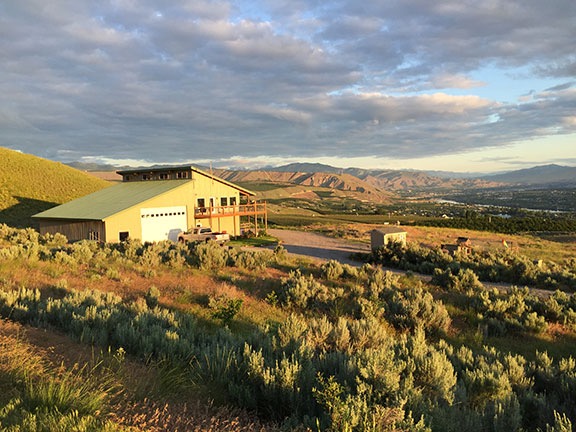
Golden Hour at the Aerie

Two shots showcasing my home.

Even amateur photographers — or at least serious amateur photographers like me — know that the best time for landscape photography is during the so-called “Golden Hour.” This is the time of day roughly one hour after sunrise and roughly one hour before sunset when the sun’s light is soft and often golden in color. Long shadows provide depth which adds texture and highlights contours in land forms. Colors are skewed reddish, which can make everything look just better.

Construction on my home has been mostly done — I still have a few things to do inside like finishing trim and building a set of stairs to the loft — for a few months now. I got my official certificate of occupancy about two months ago. I recently did some outside work to clean up “the yard” and make it look presentable. I have ten acres but I really only maintain about an acre of it — the rest is natural vegetation: bunch grass, sagebrush, and wildflowers. It gets really green here in spring but starts to brown up by late May. This year, we’ve had just enough rainfall to really turn on the wildflowers and keep the grass green and gold. Really pretty.

Perfect for capturing some shots of my home to share with friends and family.

I got the first shot the other day. I happened to be down at my Lookout Point bench late in the afternoon when I looked back up at my home. The light was just right to illuminate the multitude of wildflowers that had grown between the bench and my building. Unfortunately, I’d left my Jeep and truck in front of their garage doors and that made the place look less than perfect. By the time I moved them and came back, the light would be gone. I decided to do it another day.

Afternoon Home
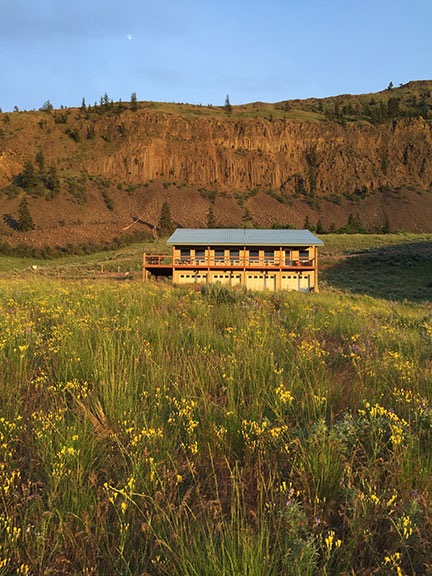
I like this shot the best, mostly because you can also see the nearly full moon in the sky above the cliffs.

That day came a few days later. I was inside, resting up from some minor surgery I’d had earlier in the day when I realized that the light was perfect. I grabbed my phone and ran down the stairs with Penny at my heels. We hurried down the path to Lookout Point and I turned around. Perfect!

I shot about 10 photos from different angles. This is the one I like the best.

I very seldom share this view of my home. The reason: it only photographs well in the afternoon in late spring, summer or early autumn. Other times, the cliffs to the south are in shadows.

This shot really shows off the beauty of the cliffs behind my home. They rise about 1,000 feet above my road and consist of basalt columns of rock laid down during Washington’s prehistoric volcanic past and carved away by ice age floods. My home sits on a shelf of tightly packed silt; the land drops away again toward the river to the north.

The vegetation up there, by the way, is ponderosa pine with the occasional aspen grove. I’ll be planting some of those on my property in the years to come. The irrigation lines to get them started are already laid.

This morning, the light and clouds were perfect again for a golden hour shot of the front of my home, which faces east. I didn’t mind the truck being parked on the concrete apron by the big RV garage door — although the truck does manage to make the 14 feet tall by 20 feet wide door look small. I grabbed my phone again and hiked up my driveway and partially up the road behind my home. I took just three shots from different angles. This was the middle one and I like it best.

Morning at Home
This shot, taken this morning, shows off the front and north side of my home, as well as the view beyond. The view, privacy, and quiet is what sold me on this building site when I first saw it back in 2012.

Every time I look at my home, I realize that none of it would have been possible if I’d stayed married to the sad sack old man who was living in a rut in Arizona. I’m sad for him — he would have really liked it here, maybe as much as I do — but I’m thrilled to have had the freedom to build the home I wanted and to live the lifestyle I’ve come to cherish.

Life is what you make it. If you want something badly enough, you need to make it happen. There’s nothing that says that more to me than my home here at the Aerie.

Two Years Ago Today

A photo reminds me of a personal milestone.

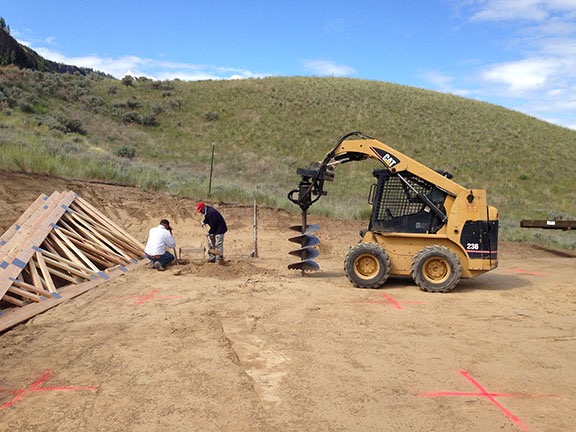
Two years ago today, on May 19, 2014, the builders broke ground on the construction of the home I’d designed for myself on 10 acres of view property in Malaga, WA. I’d bought the land the summer before, the day after my divorce decree was [finally] handed down from the judge. The building would utilize post and beam construction, commonly known as a pole building, to give me a 2,880 square foot garage/shop area and 1,200 square feet of living space with a 600 square foot deck. The goal: all my possessions under one roof with a comfortable, modern home that would showcase the amazing view.

After doing some prep work — bringing in temporary power, putting in a septic system, finalizing plans with the builder, and getting the building site prepped for construction — the four-man team that did 90% of the building construction work arrived with equipment and started digging. They dug 44 post holes that first day and had the posts set in concrete by the end of the next day.

This photo, which I stumbled upon this past weekend while digging up photos for another blog post, shows the workers digging that first hole. The auger did most of the work, but they did hit rocks that had to be removed by hand. Miraculously, this was the only hole with large rocks in it.

First Hole
X marks the spots where the holes needed to be dug. They only hit rocks on the first hole. The trusses for the RV garage roof are leaned up against the hill in this shot.

I was living onsite at the time, in my RV parked near the building site. I had a GoPro camera set up on top of it and made daily time-lapse videos of the work, which I shared on my blog starting on May 20, 2013. It was an exciting time — I was watching something I’d designed be built right before my eyes. I kept out of the way but took lots of photos. In the evening, after the crew left, I’d wander around the site and play with the equipment, sometimes using it to move dirt or easily climb to the second floor once it had been built.

Now, two years later, I’m living in that home with a Certificate of Occupancy as the County’s approval for not only my design and Western Ranch’s construction, but the hours of labor it took to turn a metal building shell into a home.

When I look at these old pictures of the place before my building existed, I find it hard to believe that I’ve come so far in such a short period of time. It’s amazing how much I can get done when there’s nothing holding me back.

This photo — and the blog posts and videos and other photos that document the work done — marks a milestone in my life, proof that I can move forward and make things happen — better than ever on my own.

It’s hard to believe that this photo was shot only two years ago.

May Morel Mushrooms

I find and bag my first morel mushrooms.

Science Friday, an NPR radio show (also available as a podcast), did a show last Friday about mushroom hunting. It got me interested in mushrooms all over again.

Last October, I attended a weekend-long seminar at the North Cascades Environmental Learning Center about mushrooms. We learned about mushrooms, hunted for mushrooms, identified mushrooms, and ate mushrooms. It was a fun weekend.

About a week later, I went mushroom hunting in the Leavenworth area with one of the other seminar attendees. We didn’t do too well, but didn’t come back empty handed, either: two chanterelles, some oyster mushrooms, and something else I can’t remember. I took home the chanterelles; my companion took the rest. I returned to the area several times since then but haven’t had any success.

I’d pretty much given up on doing any serious mushroom hunting.

And then Science Friday did their story, “Mushrooms: On the Hunt for Edibles.” And I started thinking about foraging for mushrooms all over again. After all, it was the right season for them and I knew places where the conditions might be right. So I emailed my hiking buddy Susan, who also has some mushroom foraging experience, and asked her if she was interested. Of course she was! We went out around 9 AM Monday morning.

We took the Jeep up into the mountains. That’s about as specific as I’ll get for the location. As any serious mushroom hunter will tell you, locations are never divulged. Morel mushroom hunting is serious business in Washington state; hordes of hunters cross the Cascades every weekend this time of year. Some are commercial hunters; Susan says morels are worth about $30/pound. Others are hobbyists like us who use a mushroom hunt as an excuse to get outdoors and walk around in the woods.

Although we were unable to take the Jeep as far as I’d hoped, we parked at a familiar parking area, grabbed our bags, and headed into the woods. Penny ran ahead. For the next three hours, we wandered around the underbrush on either side of trails or roads, looking for just the right environmental conditions.

Trouble was, I didn’t know the right environmental conditions. I’d never hunted for morels. The only thing I’d every heard was that they grew in areas damaged by forest fires. The Science Friday story said they grew under oak and apple trees, but we don’t have oak trees here and there aren’t any apple trees other than in orchards.

After wandering around the woods off to one side of the road, Susan climbed back down to the road. “I think there’s an easier way down over here,” she called back from up ahead.

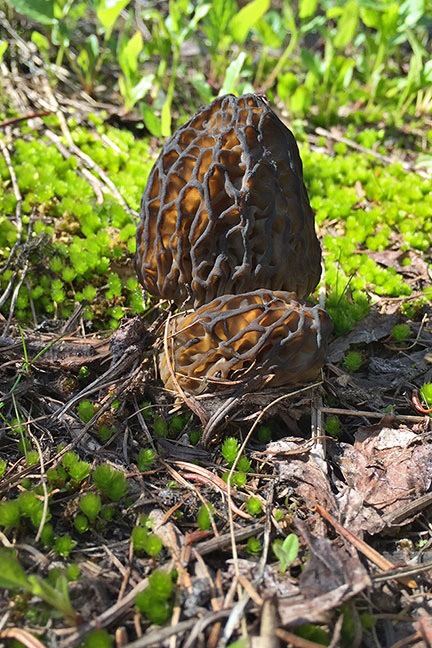
Morel Mushrooms
From my first find. Aren’t they gorgeous?

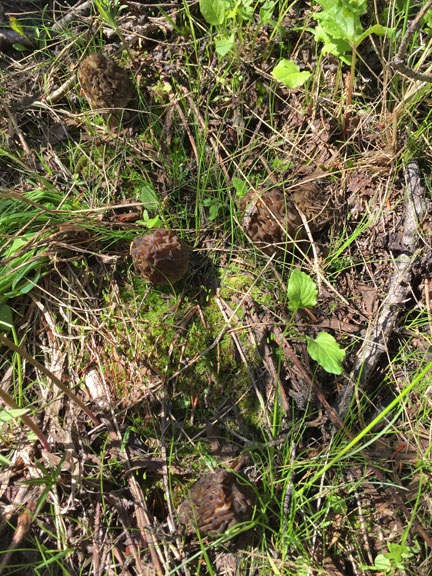
Morel Mushrooms
Can you see all five mushrooms here? Hint: two of them are together.

Morel Mushroom
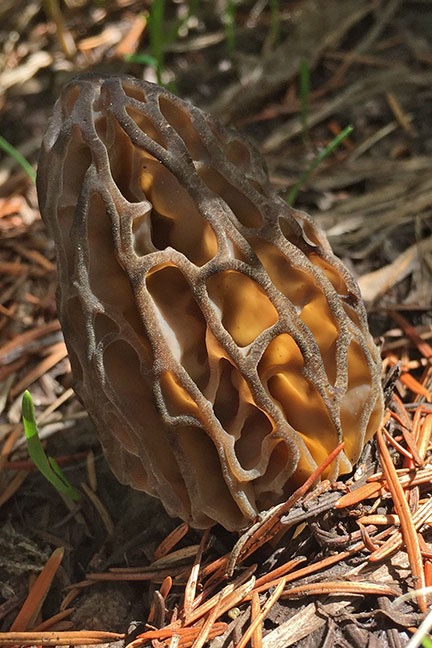
Here’s a closeup of one of the last morels I found. As you might imagine, from a distance, pinecones look similar.

I made my way through the underbrush. I was about halfway down the steep slope when I looked down and saw it: a very large morel mushroom. Within seconds, I’d seen three more.

They were beautiful — I mean, really beautiful. Perfectly shaped, popping up through the dirt looking clean and brown and exactly the way a morel should. I took photos. I marked GPS coordinates on my phone. And then I cut them and put them into my canvas bag.

Susan found the next batch not far away and packed them away in a paper bag she’d brought for the purpose.

We talked about the conditions they were growing in. Plants growing nearby. Moistness. Amount of sunlight. We found things in common between the two patches. We began getting a real idea of what to look for.

We continued wandering around, on and off the road, for the next two hours. We took turns finding mushrooms. At one point, Susan found a huge one about three inches from my foot and I spotted a smaller one nearby. At another point, I found five of them within a square foot of space. Much later, the two of us, working within 15 feet of each other, found several patches of them.

Now I don’t want you to think that the mushrooms were all over the place. Well, mushrooms were all over the place — mostly shiny brown round ones — but the morels were elusive. One of us would find a patch and then twenty minutes might go by before the other found a patch. We were out there for three hours and we each brought back maybe enough for a meal. I weighed mine when I got home: 9 ounces.

It was fun and, because we weren’t getting skunked, it never got frustrating.

It was nearly 1 PM when we called it quits. We’d only walked a little more than a mile according to my GPS tracker.

I drove us back to Susan’s place and took a quick tour of her backyard rose bushes and gardens. We talked about the mushrooms we’d found and how we each planned to double-check that we’d found morels and not false morels, which were not recommended for consumption. Then I headed home.

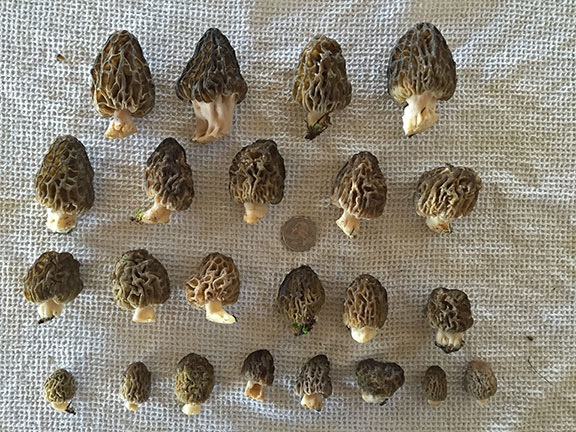
Later, I laid out the mushrooms I’d brought home to take a photo. I also weighted them on my postal scale: 9 ounces even. Good thing we weren’t hunting mushrooms for a living.

Morel Mushrooms
Not bad for a first time out, eh?

Dinner tonight or tomorrow: Pizza with Ramps, Morels, and Eggs. I might also try one of the recipes I found for fried morels.

And since mushrooms grow so quickly, there’s a pretty good chance there will be more to pick later this week in the same places we found them today. I’m game for another outing on Friday. I hope Susan is, too.