
Or why I’ll never be a long-haul trucker.
I’m writing this from the relative comfort of the desk in my RV. I just completed a 3-1/2 day drive from Arizona to Washington State and am parked alongside a very large garage adjacent to a private heliport at a friend’s house in Auburn.
I’m resting.
The drive was a lot more difficult than I imagined. Difficult enough for me to blog about it. In detail.
No, I’m not going to give you turn-by-turn driving instructions and list the sights I saw along the way. No one really wants to read stuff like that. If you’re at all interested, you can read about the first two days of the drive here. I wrote that two days ago when I was still relatively fresh.
Instead, I’ll tell you why I’m exhausted and why I’m glad I don’t have to drive again tomorrow.
Towing: the Basics
My RV is a 36-foot long Montana Mountaineer fifth wheel. Because our 2001 Chevy Silverado 3/4 ton pickup already had a gooseneck hitch receptor on it, I converted the RV’s hitch to a gooseneck. Well, I didn’t do it. The folks I bought the RV from did it. It makes it a bit tricky to hook up — still not sure how I’m going to line it up when I need to hitch it alone — but it does keep the pickup’s bed free of a bunch of extra hardware.
The trailer is 15,000 pounds max gross weight. I didn’t weigh it before this trip — I wanted to, but didn’t get around to it. (There’s a scale at the local dump in Wickenburg, so it wouldn’t have been so tough. Weigh the truck alone, then weigh the truck with the trailer and do the math.) I don’t think it’s fully loaded, but I bet it still close enough to 15,000 pounds to make the weight debate moot.
The truck can pull the weight. Its manual says it can and it can. I push a button on the gear shift lever to turn on the towing package feature and the Duramax diesel and Allison transmission do the rest. It stays in a lower gear so I can get it up to highway speed and then shifts back down into a lower gear when I brake for engine braking.
It takes a while for the truck to get up to highway speed. Normally, the truck is remarkably peppy for a diesel. That’s one of the things I like about it. But add 15,000 pounds and it’s working hard. 0 to 60 takes about 30 seconds. If I’m on flat road. Add an uphill climb and I might not even get it up to 60.
Add a downhill coast and I’ll have trouble keeping it below 60. And that’s the problem.
The Trick is to Avoid Using the Brakes
Imagine a freight train barreling along at 50 miles an hour. Now imagine some idiot stalled at a crossing on the tracks. He’d better get his ass out of the car and hope his insurance is up-to-date.
I once spoke to a train engineer for Conrail in New Jersey. He told me that if there’s something on the tracks, they don’t even bother trying to stop. Why? Because they won’t be able to stop in time anyway. It could take over a mile for a freight train moving at cruising speed to come to a complete stop. Why? Because of the inertia of all that weight moving at cruise speed.
As I gained experience at the helm of my own personal freight train, I quickly learned that my main goal should be to drive in such a way that I minimized the use of the brakes. There are three reasons for this:
- It takes a long time to stop — or even to slow down. The less often you need to stop or slow down, the better off you are.
- Using the brakes wastes fuel. Look at it this way: you pump a lot of fuel through the engine at high RPMs in a lower gear to get the damn thing moving. If you hit the brakes, not only are you throwing away all the stored energy in your weight and speed, but the engine is going to downshift again and use more fuel at high RPMs to slow you back down. May as well punch a hole in the fuel tank and let it drain out.
- Using the brakes wears down the brakes and works the engine. You have to press harder on the brakes to get a reaction out of them. That means you’re wearing them down more. And with engine braking, the poor engine is working hard even when you’re slowing down. Is that fair?
It’s the Stress that Exhausted Me
The difficulty in slowing down or stopping is where all the stress comes in.
The entire time I was driving, I was on alert. I needed to know that I had to stop or slow down before I had to stop or slow down. So I looked at every other vehicle around me — as well as traffic lights and stop signs when I wasn’t on the freeway — with a critical eye. Is that guy in front of me going to hit his brakes? Is the idiot next to him going to cut me off? Is that traffic light up ahead going to turn yellow before I get to it? Is that school bus up ahead going to stop?
Even when I was on straight, flat freeway with no other vehicles around me, I couldn’t relax. At one point, a dog ran into the freeway in front of me. A dog! Like that freight train engineer, I knew I wouldn’t be able to stop in time. If he didn’t get out of the road, I’d run right over him, just like a freight train. There’s no way I’d try to swerve at 60 MPH with all that weight behind me. I leaned on the truck’s horn. Fortunately for the dog, he ran back where he came from without becoming my victim.
So all day long, hour after hour, I was tensed up, fully alert and ready to react before I needed to. It exhausted me.
Now Add Some Mountains
The route I chose was mountainous. In Death Valley, I was 230 feet below sea level. Near Mammoth Lakes, CA, I was at over 8,000 feet above sea level. For three days, it seemed like all I did was climb up and down mountains.
Up wasn’t a big deal. Press the pedal and burn fuel in second or third gear, trying to maintain a decent speed so as not to annoy the people behind me. It didn’t matter if there was a curve up ahead — I probably wasn’t going fast enough to make negotiating it a problem.
But down…well, that’s another story entirely. The Chevy has never been a good coaster — my 1994 Ford F150 is far better at that — but add 15,000 pounds and gravity can turn anything into a coaster. I had to use the brakes going downhill just to prevent the speed from climbing higher than I could handle. The transmission did its part, of course, but that wasn’t enough on the 9% grade (not a typo) coming down into the Panamint Valley in Death Valley National Park. In second gear, with the engine red-lining, I was still pumping the brakes to keep the speed below 50 miles per hour as I negotiated curves on a two-lane road that hugged the side of a cliff.
You want to talk stress? I can’t imagine anything more stressful than that.
Add Rain
Actually, I can: wet pavement on those curvy downhill stretches.
The rain started on Day 3 and haunted me for the whole day. That’s the day I descended from the mountains in Northern California into southern Oregon. There was this one stretch just south of Ashland on I-5…a lengthy downhill ride hugging the side of a mountain with curves marked for 50 mph. Bad enough dry, but nightmarish when wet and surrounded by tractor-trailer trucks. Who the hell designs highways like that?
I’m an Arizonan. I don’t drive in rain because it doesn’t rain. When it does rain, the roads are slick because of oil accumulation. It’s terrifying. How slick were these roads? I didn’t know and I didn’t want to find out. I just struggled to keep my speed down, imagining the horrific crash if the trailer decided to slide a different direction than the truck was going.
Overreacting? Perhaps.
Reading this, you probably think I’m a sissy. But I have a lot of miles under my belt — I’ve driven clear across the country more times than I can count and have made 3-1/2 round trips from Arizona to Washington since 2005. I’ve driven everything from motorcycles to this rig, including hundreds of different rental cars.
But driving this rig was unlike anything else I’d ever driven. It wasn’t like my Ducati, which I could whip around curves by tossing my weight around. It wasn’t like my Honda S2000, which red-lines at 9,000 RPM and has just the tiniest bit of body roll in curves. It wasn’t even like the Chevy without its load, able to accelerate or stop quicker than you’d think a truck should.
Just the knowledge that slowing down or stopping was going to be so tough had me on edge the entire time.
And that’s what kept me safe.
But when it’s time to return to Arizona, I know one thing for sure: I’ll be planning the route with the straightest, flattest roads I can find.
How about doing something to show your appreciation? I’d love it if you’d add a comment at the end of this post to share your feedback with me and others. But I’d really love it if you’d visit my Support page and chip in a few dollars to help cover the cost of hosting this blog and motivate me to keep writing new, interesting content. It’ll only take a moment and I really would appreciate it!
 The image shown here shows the four days of my flight. Day 1 was
  I was airborne by 10 AM.
 I was now squarely in the middle of my middle-of-nowhere route from Page to Bryce Canyon. There were absolutely no signs of civilization below me or anywhere within sight. Instead, an ever-changing terrain revealed itself below me. Hills and mesas were cut deeply by canyons of exposed red rock. Sedimentary rock thrust up from the ground at odd angles, forming layered ridge lines that stretched for miles. Ancient sand dunes turned to rock stood revealed by the erosive forces of wind and rain over millions of years.
  The view seemed to change every five minutes, revealing wonder after wonder. I wanted to detour and explore. I wished more than ever that I’d installed my helicopter’s nose camera before departing Wickenburg the day before.
 I finally began seeing signs of civilization: paved roads, ranches, towns. There were plenty of red rock cliffs and hoodoos with roads — paved and unpaved — winding around them. Funny how people go to National Parks to see the sights when the same sights — or better ones — can be found right down the road.
 I climbed steadily at about 200-300 feet per minute, gaining altitude slowly to clear the 5,000 foot Weaver Mountains ahead of me. Below me, I could see the scars the near-bankrupt developers had left on the desert where Routes 93 and 89 split off. Greed had scraped the desert clean, built a golf course, and then let the grass wither and die. Where there was once pristine rolling hills studded with cacti and small desert trees, there was now flattened dirt, void of vegetation, shaped by bulldozers and men. A dust bowl on windy days covering hundreds of acres of Sonoran desert.
 The weather up ahead gave me a good idea of what I’d be facing for much of the trip: a never-ending series of isolated rain and snow showers. They appeared as low clouds with hanging tendrils of wispy precipitation. But unlike the gray rains hanging below summer rainclouds, these were white, making me wonder whether I was looking at rain or snow. With outside air temperature around 4°C (40°F), it could have been either. Or something worse; damaging hail or icy sleet.
 Near the Drake VOR, I detoured more to the east to avoid a rapidly approaching shower. Raindrops fell on my cockpit bubble and the 110 wind of my airspeed whisked them away. The sky was clearer ahead of me, although the tops of Bill Williams Mountain was still shrouded in clouds. The Prescott (KPRC) ATIS reported mountain obscuration and snow showers to the north, east, and west. I couldn’t see the San Francisco Peaks, which were likely getting more snow to extend the skiing season at the Snow Bowl.
 Then I was back out in the sun — a good thing, since the outside temperature had dropped to just over freezing and my cabin heat wasn’t able to keep up with the cold. I climbed up the Mongollon Rim just west of Bill Williams Mountain, trading high desert scrub for ponderosa pines. The mountain had recently been dusted with fresh snow. That didn’t surprise me; only three hours before, the airport at Williams (KCMR) had been reporting 1/4 mile visibility.
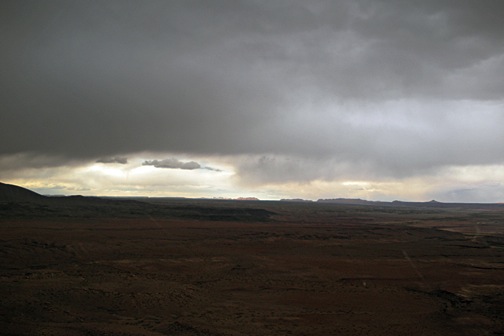 I passed through the rain and emerged on the other side with a clean cockpit bubble and likely very clean rotor blades. Ahead of me, now due north again, the sky was brighter and I could clearly see the Echo Cliffs. Before entering the storm, I’d punched Tuba City (T03) into my GPS to keep my bearings; now I punched in Page (KPGA) and was pleased to see that I was already right on course. I aimed for The Gap, a small town at the gap in the cliffs, right on Route 89, adjusted power to maximize speed, and sped forward, 500 feet off the high desert floor.
 I crossed Highway 89 at The Gap and flew through the gap in the Echo Cliffs. I was now about 45 miles from Page, flying among three sets of high tension power lines that stretched from the Navajo Generating Station on Lake Powell to points south. There was a dirt road here that made a short cut to page — if you didn’t mind driving more than 40 miles on a dirt road. Navajo homesteads were scattered about. The sky was a mixture of clouds and patches of deep blue. I warmed in the sunny spots and cooled in the shadows.