Mike and I go for a motorcycle ride to Prescott.
Before I started flying, before I started horseback riding, before I even moved to Arizona, I was an avid motorcyclist.
Learning to ride a motorcycle was one of the four life goals I’d set for myself long ago. I was 29 (or thereabouts) when I learned. I decided it was time and bought a motorcycle. It was a 1980 Honda CB400 Hawk, black with a bit of chrome. A standard bike with an upright seating position.
The Hawk had belonged to a woman who had died of cancer within a year of buying it. She only put 941 miles on it before she stopped riding. Her husband, a motorcycle dealer, had stored the bike for 11 years, so it was in good shape when he finally decided to sell it and I came along. We replaced some parts that had succumbed to dry rot, gave it a good tune-up, and it was ready to ride.
Of course, I wasn’t. I didn’t know how to ride a motorcycle. So I enrolled in a Motorcycle Safety Foundation course. Mike enrolled with me. We took the course and got the proper introduction to safe motorcycling. And anyone who thinks an MSF course is a waste of time and money is, quite simply, wrong. I still use techniques I learned in that course every time I ride.
Mike thought that we’d ride together on my bike. That meant he’d ride and I’d be the passenger. I guess Mike didn’t know me very well yet. We’d only been together seven years at the time. But I made it clear that if he wanted to ride, he’d have to get his own bike.
So he bought a used BMW. It didn’t look good, but it ran well and he seemed to like it. Together we gained experience. We eventually joined a motorcycle club for long rides on the twisty roads in northern New Jersey and southern New York State. They were sport bike guys and liked to ride fast. I understood the appeal.
We went to Americade every year. That’s a big motorcycle rally at Lake George in the Adirondack Mountains in upstate New York. Motorcycle manufacturers did test rides of their bikes there. That’s when I test rode a Yamaha Seca II, a “sport standard” bike. Like my Honda, it had a rather upright seating position. But it was sporty, chromeless, and faster. I wound up replacing the Honda with a Seca II.
 When we went to pick up the Yamaha, Mike stopped in at the BMW dealer next door and fell in love with an end-of-year clearance BMW K65. He bought it. A week later we both showed up at a group camping trip along the Delaware with a pair of brand new bikes. A few jaws dropped that day.
That was in 1992.
We rode most weekends with the group and sometimes by ourselves. Our big trip came in the mid 90s when we took the bikes from our home in Northern New Jersey down Skyline Drive and the Blue Ridge Parkway, then across to the coast and up the barrier islands. It was a 10-day trip that was mostly camping, with a few motel days thrown in to ensure a good night’s sleep. The roads were great, the autumn leaves were turning. We got caught in a thunderstorm in the Smokies, impressed folks at a campground with how much gear we could pack on two bikes, and rode three different ferries island hopping along the coast. Definitely one of my top 10 vacations.
Then one weekend we joined the group for a camping trip in the Finger Lakes area of New York. And that’s when I found the top end of my bike. There were about a dozen of us racing down beautiful farm roads, a ribbon of sport bikes zipping past cows and barns and green fields. We were going fast. Very fast. I was last in line and that was probably a good thing. Because when I twisted my throttle just a little more to keep up, I found that there was no more to twist. I’d twisted up to the stop and the bikes in front of me were easing away about 5 mph faster than I could go.
In a flash, I fell out of love with my bike.
 I didn’t waste much time replacing it with the Ducati. I’d taken one for a test ride at the local Ducati dealer — the same place I’d bought my Hawk years ago — and had been impressed. The bike I test rode was a Ducati Monster — a 900cc bike with a standard riding position and not much fairing. When the front wheel came off the ground in what I thought was normal accelleration, I knew I had a powerful machine beneath me. I wound up with a Ducati 900 SS CR, a sort of half-fairing sport bike. Well, to be fair, “sport bike” is a bit of an understatement. It’s really a race bike. Red, of course — I think they only came in two colors.
This was in 1996.
I kept the Yamaha for touring. I’d invested in Givi hard luggage for that bike and longed for another motorcycle vacation. The Ducati was not the kind of bike you’d want to ride for 400 miles in a single day, as I later found out.
We moved to Arizona. The bikes crossed over on the moving truck. We went back to New Jersey with a trailer to pick up Mike’s bike and brought the Ducati along. We made one last trip to Americade. Then we brought all the bikes to Arizona, where they have remained.
We made a trip with Chrome Caballeros in the late 1990s. It was a motorcycle camping trip where the outfitters carried all the gear. I took the Ducati. Mike took his BMW. All the other bikers on the trip rode Harleys. It was a great trip, but there was one day when we rode from Zion National Park to Flagstaff. That’s a hell of a long ride on a Ducati. I was pretty sore the next day.
I tried to find the top end on the Ducati once. It was out on Route 71 between Aguila and Congress. I had it up to 130 before I decided that I didn’t really want to go that fast or any faster. The Ducati had more to give but I didn’t need it.
Time passed. I started horseback riding. Then I learned to fly. I bought a helicopter. I decided I liked flying better than motorcycling or horseback riding. I began building a helicopter tour and charter business.
Mike kept riding, mostly by himself. He had a mishap on Mingus Mountain. A fox ran out in front of him, just as he was approaching a curve. He swerved to miss it and the bike got onto some gravel at the side of the road. He literally jumped off the bike. The bike went over an embankment and got really broken, really quickly. Mike tore the back pocket of his jeans and had to thumb a ride back to Prescott. A few weeks later, he bought a similar bike from a friend.
That brings us almost up to today. My two bikes had been lounging in my hangar, gathering dust and drying out their batteries. They both needed serious work to get them running again. I put $1,000 into them for repairs. But the repairs would only “hold” if I kept riding them.
We rode to Prescott on Saturday. I took the Ducati.
One of the reasons we don’t ride as often in Arizona is that there aren’t any really good riding roads nearby. Back in New Jersey, we were about 20 miles away from Harriman State Park, with seemingly endless roads that twisted through the mountains and forest, around small lakes. Challenging riding, beautiful scenery, lots of fresh air. Even getting there was a nice ride, on the Palisades Interstate Parkway, which I believe was designed by Robert Moses. Here in Arizona, there are lots of straight boring roads through empty desert before the roads start to twist and turn a little. So you have to work a little to get to that reward. And with only four roads leading out of town, there isn’t much variety.
But the ride to Prescott is one of the nicer rides.
First, you leave Wickenburg on route 93 and bear right on route 89 toward Yarnell. The road cuts straight across the desert until just past Congress. There, a sweeping right turn gets you started at the bottom of what we call Yarnell Hill. In just a few miles, you climb 1500 feet up the side of a cliff on a road that hugs the cliff face. There are guardrails, but hitting one would only serve as a launch pad for a flight off the cliff into space, so care is required. As you climb, the curves get ever tighter. Finally, at the top, you’re in Yarnell.
From there, you cut across high desert terrain on gently curving roads. The scenery is magnificent on this two-lane piece of blacktop and there’s very little traffic. At Kirkland Junction, it’s time for a decision: twisty White Spar Road or not-so-twisty Iron Springs Road? We always take White Spar.
At Wilhoit, the real fun begins, with a 15-mile stretch of mountain road. Imagine a ribbon of asphalt twisting among the 6000-foot mountains, hugging cliff-faces all the way. The double-yellow line is there for a reason: you can seldom see more than 50 yards ahead of you. You pivot the bike left and then right and then left as you take the curves one after the other, spending more time in a steep lean than vertical. As you ride with the RPMs high enough to take advantage of engine braking in the tightest of turns, a rhythm builds up inside you. This is why you ride.
It all came back to me on Saturday, just before I caught up with the midsize sedan from Kansas. He was driving at about 10 MPH below the speed limit, using his brakes for every single curve. (Hey buddy, you’re not in Kansas anymore.) There were plenty of places for him to pull over and let us pass — most considerate drivers do when they see motorcycles or a sports car behind them on this road — but he was either oblivious to us behind him or, more likely, too inconsiderate to care. I finally blew past him on one of the brief straightaways. Mike blew past him on the next.
Understand that the Ducati simply does not like to go slow. It lugs at RPMs under 3000 if you’re in any gear other than first or second and it takes some serious clutch work to keep it running smoothly at speeds under 20 mph. This is not the bike you’d take to work and ride in traffic. Your left hand would seize up from all the clutching. It likes to cruise with the RPMs up around 5000 and has no problem approaching that 9000 RPM redline when you need a little extra power for passing. Sixth gear is pretty much a waste.
We had lunch in a new restaurant in Prescott. Nawlins, or something like that. Supposed to be New Orleans style food. The food was good, but the restaurant’s territorial style and Santa Fe paint scheme didn’t match. (The place used to be Zuma’s.) Still, we’ll go back.
We hit the Mall, more to give us something to do and see than to buy anything. We had dessert. We stopped at the airport to put the current registration sticker on my Toyota, which lives up there. Then we fueled up and rode home, taking Iron Springs Road back to Kirkland Junction. From there, it was 89 through Yarnell and Congress and back to Wickenburg.
We’d ridden about 140 miles. I was sore. I’m really out of shape and not the person I was 10 years ago when I bought that bike. But the ride made me remember why I’d bought it and why I liked riding so much way back then.
Mike and I need to go to Napa, CA in June. We’re toying with the idea of taking the motorcycles up. It’ll be the Yamaha’s turn to get out for a while.
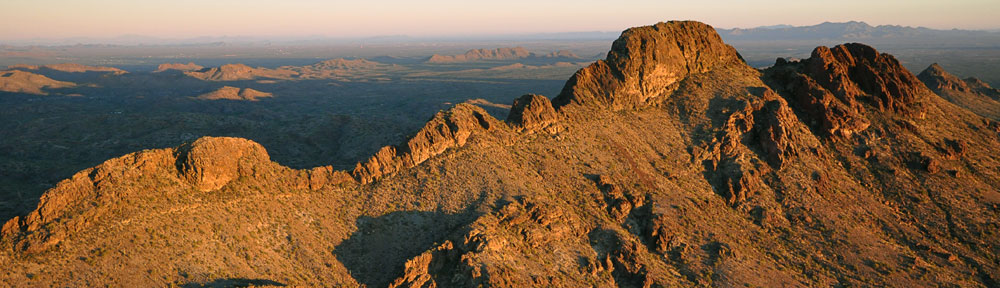
 The very first image I created for this site’s rotating headers — in fact, the only image that appeared before I even installed and activated the rotating header feature — is this shot taken from our vacation property at Howard Mesa.
 These first two eggs were both small. In the photo, my chicken’s egg is on the right and a store-bought Grade A Extra Large egg is on the left. I expect them to get larger over time. In about a month, they should be full size, somewhere between Large and Extra Large.

 When we went to pick up the Yamaha, Mike stopped in at the BMW dealer next door and fell in love with an end-of-year clearance BMW K65. He bought it. A week later we both showed up at a group camping trip along the Delaware with a pair of brand new bikes. A few jaws dropped that day.
 I didn’t waste much time replacing it with the Ducati. I’d taken one for a test ride at the local Ducati dealer — the same place I’d bought my Hawk years ago — and had been impressed. The bike I test rode was a Ducati Monster — a 900cc bike with a standard riding position and not much fairing. When the front wheel came off the ground in what I thought was normal accelleration, I knew I had a powerful machine beneath me. I wound up with a Ducati 900 SS CR, a sort of half-fairing sport bike. Well, to be fair, “sport bike” is a bit of an understatement. It’s really a race bike. Red, of course — I think they only came in two colors.