Traveling again.
If you’re wondering why you haven’t heard from me here in a while, it’s because I’ve been traveling. I’m doing one of my Southwest Circle Helicopter Adventures in northern Arizona, accompanied by a video crew and staff writer for a respected travel magazine.
The goal of this trip is to gather about 90% of the video needed to create three individual broadcast-length videos, each of which will be made available on DVD. It’s a huge project and, so far, we have at least 20 hours of raw video footage to wade through.
I’m flying with a door off and a video guy on board taking glare-free video images of what we fly over. He also has at least two POV.1 cameras mounted inside the helicopter at all times. The other video on the ground is “chasing” us — actually, he’s getting a big head start each day to drive to the airport where we’ll land before we arrive — and taking video of us landing. Then there are cameras whirring all over the place on the ground.
 The writer is sitting up front beside me, taking notes and using my Nikon D80 to shoot images of what she sees. Although a good portion of the shots have some unfortunate glare — not much you can do about that when shooting through Plexiglas — many of them are really good. Like this shot she took of a herd of wild horses we overflew on the Navajo Reservation two days ago.
It’s been a busy week so far. Although I’m trying to demonstrate to the writer what my Southwest Circle Helicopter Adventure is all about, I’m also working with the video crew to make sure we capture all of the footage we need for our three videos. I’m hoping she understands that my usual clients won’t be rushing around like nuts all day.
 I’m treating myself to a few of the activities my excursion guests get to enjoy. For example, on Tuesday, I joined the crew for a boat ride on Lake Powell that visited the “business side” of the Glen Canyon Dam before squeezing about a mile up Antelope Canyon (see photo) and gliding up Navajo Canyon for a look at the “tapestry” of desert varnish on some cliff walls. I skipped the Sedona Jeep tour and Monument Valley tour to work with one of the video guys or just rest up. Normally, while my guest are touring, I’m scrambling to get the luggage into their hotel room and confirming reservations for the next day. You might imagine how tired I am after 6 days of playing pilot and baggage handler.
At this moment, however, I’m sitting at the dining table of a double-wide mobile home near Goulding’s Lodge in Monument Valley. (Long story; believe it or not, the only lodging we cold get here in MV was in a pair of mobile homes that are part of the lodge.) I have the front drapes drawn aside so I can watch the eastern sky brighten for what promises to be a classic silhouetted butte sunrise. I always enjoy my dawns here at MV. Seeing the famous buttes outside my window is always surreal.
Today, we were scheduled to fly down to Winslow for lunch, then tour Meteor Crater and the Grand Falls of the Little Colorado River. Normally, the Southwest Circle Helicopter Adventure takes this route on the way to its last overnight stop at Flagstaff. But today we’ll probably go straight back to Page. I have four aerial photo shoots at Page starting on Friday morning; the money I make doing them will pay for this video excursion. We’ll do more video between those flights. Then we’ll hit the Crater, Falls, and Flagstaff on our way back to the Phoenix area on Sunday.
It’s a big trip and a bunch of huge projects. Just the kind of thing to keep me busy between flights for the winter season. But if all works well and as planned, I might be flying this route weekly in the coming spring and fall — with real paying passengers to take care of along the way.
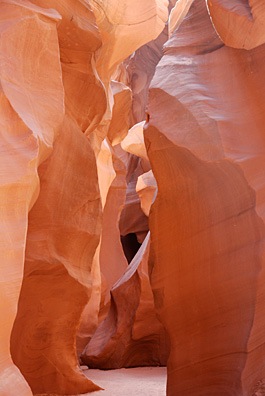 If you don’t know what Antelope Canyon is, you’ve probably never read Arizona Highways or seen any of the “typical” Arizona photos out there on the Web. As
  Lower Antelope Canyon is downstream from upper. It has far fewer visitors. I think it’s more spectacular — with corkscrew-like carvings and at least two arches — but I also think it’s harder to photograph. It’s also far more difficult to traverse, requiring climbing up and down iron stairs erected at various places inside the canyon, clambering over rocks, and squeezing through narrow passages. For this reason, the Navajo caretakers don’t really limit your time in Lower Antelope Canyon. You slip through a crack in the ground — and I do mean that literally (see photo left) — and are on your own until you emerge from where you descended or from the long, steep staircase (shown later) that climbs out before the canyon becomes impossible to pass.
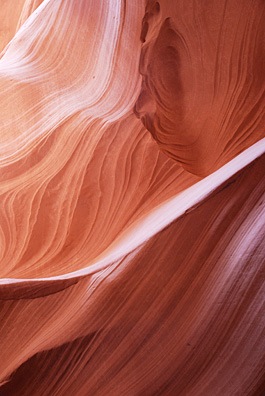 I went to Lower Antelope Canyon with my next door neighbor and fellow pilot, Robert, today. It had been a whole year since
 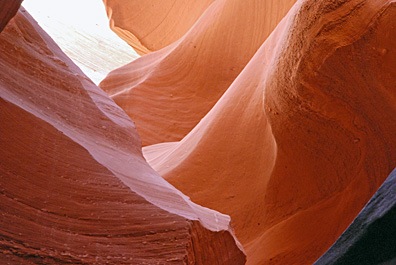 We arrived at about 11:20 AM and the place was unusually crowded. But Lower Antelope Canyon is large and everyone spread out. Most folks only made the walk one way, taking the stairs up and hiking back on the surface. We would have done the same, but we ran out of time. We were in there until 2:30 PM; Robert had to be at work by 4 PM.
 We made our way through the canyon slowly, stopping to take photos along the way. Positioning the tripods was extremely difficult sometimes, as the canyon floor was often only wide enough for a single foot to stand in it. My tripod really hindered me, but I made it work. I think Robert (shown here) had an easier time with his. We were two of dozens of photographers, most of which were very polite and stayed clear of other photographer’s frames. This is the biggest challenge at Upper Antelope Canyon. I find it stressful up there, as I told a trio of photographers from Utah. Lower Antelope Canyon is much more relaxing.
 Near the end of the canyon walk, I was worn out. It wasn’t the hike as much as the struggle to find the right shots and get the tripod into position. I felt as if I’d had enough. So when we reached the last chamber before the canyon got very narrow (and muddy) and I laid eyes on those stairs, I realized it would definitely be better to take the easier route back. I took this shot with my fisheye lens, which was the only way to get the entire staircase in the shot. If you look closely, you can see Robert’s head poking out near the top.
 I took about 95 photos while in the canyon. Some of the better ones — along with some to illustrate the story — are here. There’s a better collection in my Photo Gallery’s new
  The September 2008 issue of
  Here’s an example. This photo, which I call “Mercury,” is one of my favorites from the trip. The light is bad, but I really love the reflection of this boat. When you consider I snapped over 300 images in two weeks on this trip and I saw some amazing things along the way, I find it odd that this should be one of my favorites.
 I think it was in 2003 that Mike and I decided to try our hands at aerial photography. I bought a book about it (as I usually do, when I want to get a jump start on learning something) and the book said the best kind of camera for this kind of work was a
  I’m extremely pleased to spread the news that one of Flying M Air’s best clients,