A Few Desert Gigs

I spend two Saturdays doing rides in remote desert locations.

One of the things I like to do to earn a little money with the helicopter is short rides at outdoor events. We did great at the Thunderbird Balloon Classic back in October, but that was held down near Phoenix and attended by people with money to burn. Up here on the edge of nowhere, people are a little tighter with their hard-earned money. As a result, I have to price the rides affordably and give each passenger a lot of bang for the buck. The margins are lower at these outdoor events, but I get a lot of satisfaction giving people their first helicopter ride or showing them something they can only see from the air.

The past two Saturdays each had gigs like that.

On December 30, I flew at the ghost town of Stanton. Stanton was a mining town established in the 1800s. At one point, it was a thriving community, with an opera house, hotel, and stage stop. Situated at the foot of the Weaver Mountains alongside Antelope Creek, it was a gold mining community. Legend has it that a man looking for a lost burro climbed to the top of what would later be known as Rich Hill and found gold nuggets the size of potatoes. Like any idiot from that time, he couldn’t keep quiet about his find and, before long, miners were flocking to the area to cash in. The town grew. It was named after a man named Stanton who, I believe, was involved somehow in the Wickenburg Massacre. (More on that another time.) The town was eventually abandoned when it became too difficult or costly to pull out more gold. Later, a group called the Lost Dutchman’s Mining Association bought the townsite. They installed caretakers, which prevented the town from being vandalized like most ghost towns in Arizona were. (For example, there’s really nothing left of nearby Octave, another ghost town.) As a result, the Saloon/Opera House, hotel, and stage stop still stand. They’re actually in use to this very day, maintained by the Lost Dutchmen group. And a campground has sprung up around the property, giving the group members a place to camp out during the winter months.

I’d flown at Stanton before and although it wasn’t a lucrative gig, it made a small profit and was a lot of fun. The Lost Dutchman have “outings” at Stanton a few times a year. The year-end outing is the big one. Everyone wants to see the “Potato Patch” at the top of Rich Hill but no one wants the all-day hike to get up there. I can get them up there and back in 8 minutes, so that’s what I did.

Flying at StantonSo on December 30, at 12:30 PM, I arrived at Stanton as scheduled and landed on a seldom-used road near the campground. My ground crew — Mike, John, and Lorna — got out and set up a little table. I shut down and waited for the crowd to gather. They came in pairs and trios and when I had at least 4 people waiting, I started up again. Lorna took the money — $30, including tax, per person. Mike and John gave the safety briefings and loaded up the passengers. Then I took off toward Wickenburg, climbing, climbing, climbing. I rounded the south end of Rich Hill and climbed up its east side. The passengers had excellent views of what was left of Octave and the mining activity going on in that canyon. Finally, 2000 feet above Stantons’ elevation, I rounded the north end of Rich Hill, still climbing. We were over the next valley, with Stanton far below us in the mouth of the canyon. I pointed out the Potato Patch and the miner types oohed and aahed. I started the descent, coming down at a rate of more than 1,000 feet per minute. On the way down, I pointed out Wickenburg, far to the south, and Congress, to the west. Also, North Ranch (which, you may recall, the management claims occupants are too old for helicopter rides) and the dairy farm. Even at a 1,200 feet per minute descent rate, I can’t get to Stanton without overflying it and turning back, making an elongated spiral to my landing zone.

We flew 22 people that day. Not bad for a gig less than 15 miles from Wickenburg. Even with a side trip to Lake Pleasant before the flight, we made some money.

On January 7, I was back in the desert with my ground crew. This time, we went to Robson’s Mining World in Aguila. This was my third gig out there for their anniversary celebration. Every year was a little better and this year, I’d dropped my price from $35 per person to only $30. I think that made a big difference. We gave about 50 rides.

The setup for this event was a little more deluxe. Robson’s was having its annual Anniversary celebration and they had lots of activities and food and vendors inside their “town.” John and Lorna took their truck out there, so we were able to bring a long a lot of extra supplies. Flags, banners, a table, some extra fuel. Our setup, alongside the road, was very noticable, especially since we got there early enough to keep the space in front of our table clear of cars.

Flying at Robson's Mining WorldI flew for a few hours, taking a break for lunch before starting up again and flying some more. The route started from our desert clearing, which was just big enough for Zero-Mike-Lima to fit comfortably, to the east alongside the base of the mountain behind Robson’s. I climbed as I flew, pointing out where Wickenburg would be if we could see it (we couldn’t), Vulture Peak, Congress, and Alamo Lake if we could see it (we couldn’t). Then I came along the back side of the mountain, crossing over a saddle on the west side. (There were a couple of guys and a dog working an old mine shaft up there and I wonder what they think of the helicopter flying over them every 10 to 12 minutes or so.) I came through the canyon where Robson’s is nestled, pointing out the trail to the petroglyphs along the way. I flew jsut to the east of town, where everyone could see me but not be bothered by the sound of the helicopter, before circling around to land back in my LZ.

The passengers were all thrilled. They always are. It’s a rewarding job.

When it seemed as if we were done and the event was winding down, I shut down and took a walk with Mike, John, and Lorna to enjoy the event. The crowds were gone and it was pleasant. We bought $1 ice cream cones (brings back memories, doesn’t it?) and watched the old engines run out back.

Later, when we were ready to leave, there were a few people gathered around the helicopter taking photos. Two men who were part of a party of three people wanted rides. Since they were going back to Wickenburg, I offered to take them there for the same $30 each. (That’s where being a Part 135 operator really pays off; I can do that kind of stuff.) They agreed and while their friend drove to Wickenburg, we took off, overflying Robson’s one more time as we headed back to Wickenburg.

I should be doing similar events like this down in Buckeye and up in Yarnell over the next few months. I’m hoping to pick up a few new gigs in the meantime.

If you’re reading this in Arizona and think you have at least a dozen people interested in taking rides at $30 to $40 per person (prices depend on distance to the gig), give me a call. You can learn more at the Flying M Air Web site.

Stalled by a Bad CD-R/DVD-R Drive

I get ready to wipe my server clean and start installation but get hung up by bad hardware.

By Friday, I had all my Web sites moved over to GoDaddy.com. The LangerBooks.com site, which had been having problems since I initially set it up there on Monday, was not fixed by Friday. So I deleted the setup an started again. Within minutes, it was set up properly and ready to go. Over the weekend, the DNS change was propagated through the system. Just about every browser looking for one of the 18 domain names I host was pointing to the appropriate site on GoDaddy.com.

My e-mail is already hosted by GoDaddy.com. All my e-mail addresses use the theflyingm.com domain name and that domain has been hosted on GoDaddy for at least a year now. So I didn’t need to move any of my e-mail server stuff. Although it exists on my local server, nothing points to it.

There are only three things that remain hosted on my server:

(1) FileMaker Pro provides live access to searchable data. I’m running FileMaker Pro Server 6 on that machine, even though version 8 is current. I wrote all my Web-compatible routines using FileMaker’s CDML language, which is no longer supported by FileMaker Pro 8. So if I updated to the new version of the software, I might have to rewrite the Web interface. That’s not something I want to do. FileMaker also creates the static text ssi files I use on serveral sites. Those files are now put into place using AppleScripts that call Fetch into action. A cool solution, if I do say so myself. After I install the server, I’ll have to reinstall FileMaker Pro, including all the databases and CDML files that run with the Web sites. I’ll also have to reinstall Fetch and make sure the AppleScripts go in the right places. This should take about an hour.

(2) Nicecast is what gets KBSZ-AM radio on the Internet. It’s pretty much plug and play with just a few settings to tweak. I expect this to take about 20 minutes to reinstall.

(3) Evocam is what creates the Webcam image for wickenburg-az.com. It’s actually two images and a movie. It has FTP built right in. Reinstalling should be pretty straightforward.

One other piece of software runs on the server all the time. It’s called Audio Hijack Pro and its job is to automatically record and save certain broadcasts from KBSZ’s stream. For example, the 8 AM news report is available online every day after 8:20 AM. This is all automated: Audio Hijack Pro records the show and runs an AppleScript routine that uses Fetch to upload it to the appropriate directory on the KBSZ-AM Web site (now at GoDaddy.com). Likewise, Audio Hijack Pro records the daily “Around the Town” show and the first hour of the weekly “Rock-a-billy & Beyond Show.” (Starting tomorrow evening, it’ll also be recording my first radio show, “Classic Rock Cuts.” You can tune in online on Wednesday nights at 8 PM MST. I’m looking for sponsors; call KBSZ at 928/668-1250 during office hours to see how much bang you can get for $5 or $10 bucks. Make sure you tell Jo you want to advertise on my show, which will be podcast, too.)

So yesterday morning, I had a clear idea of what I needed to do and what files I needed to preserve from the server. I made copies of all the files I needed to preserve and put them in a folder that I’d use to create a CD. This would make it easy to load them all back in after I wiped the computer clean and reinstalled the software.

And that’s where I hit a brick wall. The CD burner wouldn’t work. It kept giving me error messages.

No problem. I used my network to move all the files over to my main production computer and created the CD there. Now I was all ready to install.

I put the Mac OS X 10.4 Server Unlimited Client DVD disc into my server computer and slid the drawer close. Then I waited expectantly for the disc icon to appear onscreen.

Nothing happened.

I pushed the button to slide the disc in and out and in and out. Nothing. I pulled the disc out and put in the first install CD. (It comes on one DVD or a bunch of CDs; I’d rather use the DVD so I don’t have to switch discs.) Nothing happened.

I put the DVD into my production computer. It appeared onscreen just like it should.

Shit. I had a real hardware problem.

I blew canned air into the CD drive. Lots of dust flew around. Not good.

My office can be a very dusty place. Part of the problem is that a few years ago, some idiot decided to drive a perfectly good western business — the Big Corral horse boarding/riding facility — out of its downtown home and bulldoze all the trees, shrubs, and buildings off the property. In its place, the idiot planted a “For Sale” sign and erected part of an ugly chain link fence. To this day, the land lies open and barren, baking in the sun, supplying that side of town with all the dust it can handle. In my situation it’s a bit worse. I had some work done on the floors in my unit’s kitchen and bathroom and the sanding done by the floor guy sent more fine dust into the air than I thought possible. With a big fan on the back of each of my computers sucking air in, it’s no wonder they were filled with dust.

Of course, I’d already used the canned air on that computer. Just a few days before, I’d installed 512 MB of RAM. While the machine was wide open, I’d used the canned air on it and it was pretty clean. But I hadn’t dusted the drives.

Long story short, I couldn’t get the drive to work. And I didn’t have a spare. And the nearest Apple store didn’t have one. And Apple’s telephone support people told me a replacement drive would cost $354 with tax and shipping. But while I was waiting on hold to hear this bit of news, I discovered I could buy an external Firewire drive for about $100. Sheesh.

By this time, it was after 2 PM and too late to do any installation anyway. I figured I’d bring my new 80 GB external Firewire hard drive — the one I bought t help out my PowerBook — to the office, make a disk image of the DVD onto that, and use the disk image to install the server. If that didn’t work, I’d just buy an external CD-R for the computer and use that. Of course, all this was putting me back in schedule, but I really had no reason to rush. The Web sites were enjoying their new home and were paid up for 2 months.

Of course, I had to give the CD-R/DVD-R drive one last try at repair. So I went to the local hardware shop, bought a cheap ratchet screwdriver with a bunch of heads, and removed the drive from the computer. This was no easy task because although the computer opens easily enough, the CD drive and the Jaz drive I’d bought to go with it (and used about 4 times) were really jammed in there. Then, with the computer up and running without it — no reason to keep that software offline — I removed screws and protective plates until the optical lens and drive mechanism were revealed. I had to peel back two pieces of tape that were obviously in place to prevent the average user from doing what I’d done. I blew more air on it and moved the drive mechanism back and forth with my fingers. It didn’t look screwed up. Satisfied that I’d done all I could do, I put it all back together and stuffed it back into the computer. I fired it all back up and pressed the button to slide the drawer out.

The drawer wouldn’t slide out at all anymore. I’d mounted it a tiny bit too high and it was catching on the computer case.

So I opened up the computer while it was running and did what anyone else in my position would do: I banged on the top of the CD drive to nudge it down. The drawer slid open.

I stuck the DVD in there, fully realizing that that might be the last time I ever saw it. Then I slid the drawer back in.

Would you believe it? It worked!

I couldn’t believe that it was really reading the DVD as well as it was, so I decided to test it by starting the computer from the DVD. That worked, too.

Of course, I didn’t really want to install the software then. It was after 3 PM and I didn’t feel like tackling the installation that late in the day. So I restarted from the hard drive and let all that software come up and run again.

But now I have my work ready for me today.

Flying for Food

Mike tries to arrange a group outing for lunch.

We were at Stan’s house on Saturday afternoon when Mike said, “Let’s go fly together somewhere tomorrow.”

Stan’s wife, Rosemarie, and Dave, another local pilot, were there. Stan flies a Cessna 182 and Dave just got a second plane, an RV-4, that he needed to build time in before he could take up passengers. Mike is half owner of a Grumman Tiger.

What followed was a discussion of various responsibilities the next day. We finally decided to meet at the airport at 1 PM and fly somewhere for lunch. The “somewhere” wasn’t decided.

On Sunday morning, during breakfast, Mike and I started to discuss where we could fly. We brainstormed and came up with a list of airports within flying distance that had restaurants nearby:

Restaurants on Field:
– Prescott
– Falcon Field (2!)
– Payson
– Kingman
– Deer Valley
– Glendale
– Scottsdale
– Chandler
– Winslow (weird hours)

Restaurants within walking distance:
– Seligman
– Valle
– Chiriaco Summit (CA)

Restaurants within free shuttle distance:
– Parker (restaurant at the casino)
– Bullhead City (restaurants across river in Laughlin)

Quite a selection. (Note that Wickenburg isn’t on this list. Why someone with a few bucks doesn’t build a restaurant on the field is beyond me. I know why I don’t do it: I’ve already been through the employer nightmare in Wickenburg and have learned my lesson.)

Sunday morning progressed. We had chores to do around the house. We even cleaned a small part of the garage! Then Mike made the fatal error of attacking the mistletoe that had begun killing some of our mesquite trees. (Mistletoe is a parasitic plant and, if not periodically cut out of the trees it infests, it’ll kill the trees.) It was hard work that required him to stand in awkward positions with a heavy saw over his head. After 45 minutes of that, he was too tired to do anything. Including fly.

That didn’t bother me. I wanted to fly anyway. I felt pretty confident that I could get to the destination around the same time as the two planes. Zero-Mike-Lima cruises at 110 knots, but I could easily push it to 120 knots with only two people on board. I’d already called Jim to invite him to join us with his Hughes 500c. Although he wasn’t sure he would, it would be nice to have two helicopters with the two airplanes. I was hoping we’d go to Falcon Field; I really love the Italian restaurant, Anzio’s Landing, on the southeast end of the runway. And there’s plenty of parking right out front.

By the time we got to the airport at 12:40 PM, the wind had kicked up a bit. It was blowing across the runway at about 8 to 10 knots. Airplane pilots don’t like crosswinds. When no one had arrived by 12:55, I got the feeling that Mike’s plan wasn’t going to become a reality.

Jim was already there, working on his Beech 18. He bought the Beech a few months ago in Florida and managed to leak 10 gallons of oil from one of its engines on the ferry flight back to Arizona. Since then, he’d been working on finding and fixing the leaks. He thought he had it taken care of when he flew out to Blythe for some touch-and-goes the other day, but the left engine was still oozing. A bad O-ring on one of the cylinders. He has to pull the cylinder to fix it. In the meantime, he’s begun pulling just about everything else. Last month, he pulled out the floor and replaced it. He’s now waiting for new runners on which to mount the rear seats. Yesterday, when we arrived, he was pulling instruments out of the panel and rearranging them in more logical positions. His helicopter was not at the airport. His wife, Judith, had already said she didn’t want to come with us, so Jim had decided to work on the Beech — something he could probably do for the rest of his life if he wanted to.

Stan and Rosemarie drove up right around 1 PM. I was talking to Jim when they pulled up, so I missed the beginning of their conversation with Mike. But the end result was that they’d come with us in the helicopter. Dave wasn’t coming. So a flight that started with potentially four aircraft ended up with just one.

Of course, with the helicopter, the list of dining opportunities increases. Helicopters don’t need no stinkin’ runway. There were at least five more places we could eat:
The Wayside Inn, near Alamo Lake, is the destination for Flying M Air‘s “Hamburger in the Middle of Nowhere.”
Robson’s Mining World, in Aguila, has a nice little cafe.
– Wild Horse West, near Lake Pleasant, has great burgers.
– The Kofa Cafe, out in Vicksburg Junction, used to be very good, but I haven’t been back since
my first experience with the new owner.
– A truckstop on I-10 south of Vicksburg has a dirt strip out back where you can land and not dust the truckers.

Mike wanted to go to the Wayside Inn, so that’s where we went. You can read all about it in another blog entry. The food ain’t bad and the atmosphere is definitely different, especially if you live in a big city and don’t have much exposure to an off-the-grid lifestyle.

We flew by way of Robson’s, which was pretty quiet that afternoon. Robson’s big anniversary celebration is coming up on the first Saturday in January, and I think they get more visitors in that one day than they get all year long. I do helicopter rides out there during the event and it’s always a lot of fun. Then we followed Ballard Wash (I think) from its narrow start almost all the way to Alamo Lake. I circled the Wayside once, trying to find a flag to judge the wind, then realized there wasn’t much wind there and just set down in my usual spot near the intersection of two dirt roads and the old, unmaintained dirt strip. (If you ever fly out there in a small plane, I recommend landing on the road rather than the strip; it’s a lot smoother and better maintained.) I kicked up a huge cloud of dust that drifted to the east as I cooled down the engine and shut down.

We crossed the road and went into the restaurant. Everyone at the bar looked at us. “I knew it was you,” the waitress said.

“Yeah, well…” I said. Everyone laughed.

We had lunch among the fish photos and trophies. The place was relatively quiet. The last time we’d been in there with helicopters, a crowd had gathered and the restaurant was completely full. I guess having four helicopters and a plane parked outside is a bit of a draw to the locals. But that day it was just us and a man eating at the bar. A few people came and went.

We paid up and left. As I started up, a few people in ATVs parked at the end of the dirt strip, facing us, ready for a show. They were not rocket scientists. Not only had they parked right in front of me, forcing me to depart in a different direction so as not to overfly them, but they were close enough to get seriously dusted when I took off. I took off to the northwest, along the road to Alamo Lake.

We did a tour of Alamo Lake, then the Santa Maria River, and then Date Creek before heading into Wickenburg. It had been a nice little outing — even if we were the only aircraft to participate.

131 Passengers

Maria Speaks Episode 16: 131 Passengers.

This episode is straight from my blog, Maria’s WebLog. It discusses how I spent the last weekend in October. It wasn’t a typical weekend.

Transcript:

It all started during a conversation with Tom at Gold Coast Helicopters in Glendale about 10 days ago. He mentioned that they were going to be giving helicopter rides at the Thunderbird Balloon and Air Classic. That’s a huge annual event that includes balloons, warbirds, aerobatics, rides for the kids, and all kind of vendors. The event usually draws over 100,000 people and it lasts from Friday afternoon through Sunday afternoon.

“You flying the JetRanger?” I asked.

“No, just the R22.”

An R22, as you may know, is a 2-place helicopter. I owned one for about four years. It’s a great little helicopter, but it has one big drawback: it can only accommodate one passenger. That’s the main reason I sold mine and bought an R44, which can accommodate three passengers.

“You’re going to lose a lot of business to couples and families who want to ride together,” I warned, knowing this firsthand. It was a frustration I used to deal with regularly.

What followed was me suggesting that I bring my R44 down and fly with them to take groups of 2 or 3 passengers. I had already tentatively planned to spend Saturday of that weekend in Congress, doing rides at the Trading Post there. But that was tentative and could be easily changed. Tom and I talked money and decided on a reasonable number. Then he told me he’d ask Bill (the owner) and get back to me.

He called the next day. I was up at Howard Mesa, waiting for the gas guys to arrive, and my cell phone battery was getting low. So we kept it short. Bill had said yes. I should come down and meet with them Thursday before the show.

I flew down to Glendale on Thursday and met Tom face to face for the first time. He let me fly their R22 to the other side of the ramp to reposition it — the first time I was at the controls of an R22 in nearly a year. (I didn’t embarrass myself.) We talked business. We talked people in the business. We knew a lot of the same people and a lot of the same stories that went with them.

He told me to come back on Friday for a meeting at 1 PM. The air show was starting that afternoon. I should tell the controller I was with the show. Otherwise, he probably wouldn’t let me land on the ramp.

I was back the next day with my banners and signs and scale. I wasn’t sure what the GC guys had, so I brought along some of my gear. I had two yellow banners that said “Helicopter Rides” in big letters and some plastic signs that said “Helicopter Rides Today.” I also had my original A-frame sign that said “Helicopter Rides” with an arrow on both sides. I didn’t bring the flags.

I didn’t need the flags. GC had an excellent location for selling tickets. Their JetRanger and their other R22 was parked right in front of the terminal on the ramp. They had an EZ-Up set up between them with a table. My yellow banners decorated two sides of the EZ-UP and my A-frame sign went out in the aisle between booths, pointing in. It was a nice setup.

The airport was packed with other static displays of aircraft, as well as booths for food, aviation-related items, and a few simple rides for the kids. On the north end of the ramp was a parking area for the warbirds that would be participating in the air show. Beyond that was a ramp where 2 F-16s waited for their turn to fly.

There was some confusion, at first, over where we would base the helicopters. The place we thought we’d use was inside “the box” — the area set aside for aerobatics use. But we hopped in Tom’s car and drove around the airport, looking for another place. We found four. The best of the possibilities was right next to the F-16s. We went back and asked all the necessary people — five of them, I think — if it was okay to operate there. Then we talked to the Air Boss, who would be running the show while the airport was closed to traffic, and told him what we’d do. He assigned us call signs of Ride-Hopper-One (me) and Ride-Hopper-Two (the R22) and told us all he wanted to know was when we were departing and when we were returning. “Otherwise, I don’t want to hear anything from you.”

F-16sWe had no problem with that. I repositioned my helicopter to the north end of the ramp and set it down beside the two F-16s.
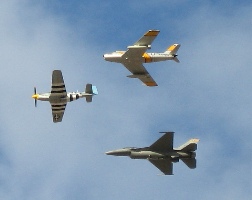
Heritage FlightThe airport closed at 3 PM and the Air Boss took over. A bunch of the performers took turns practicing their routines. It was mostly aerobatic stuff. The kind of flying that makes you wonder why people think helicopter pilots are crazy. These guys, purposely inverting their aircraft and letting it go out of control in tumbling dives are the ones who are crazy. But it was pretty cool to watch, as long as you didn’t try to think yourself into the cockpit. There was also a bunch of tight formation flying, including a flight with the F-16 and two other fighters: the Heritage Flight. (Not a bad shot with my new camera, huh?)

The gates opened to the public at 4 PM.

I did two flights that afternoon with 2 passengers each. The route was about 12 miles round trip. I’d take off from the ramp and follow the power lines between the Glendale and Luke airspaces. Then I’d either go northwest along Grand Avenue to Bell Road or continue north toward Sun City (which is laid out in a bunch of circles that look pretty cool from the air). Then I’d loop around to the right or left and come back pretty much the same way I’d left. The ride ranged from 8 to 12 minutes. GC helicopters was selling them for $45 per person, which I thought was a little high. (I was eventually proved wrong.)

We did rides while the air show was going on. Since we never crossed into the performance area, there was no danger. It was really weird to see a performer’s smoke trail on the return flight to the airport. We also did rides during the brief period when they reopened the airport to regular traffic. One time, on the second day, the Spitfire, which had to make a right traffic pattern during performances, flew over us. My passengers loved it. Late that afternoon, the GC guys brought their R22 over and I think they did a bunch of rides, too.

Balloon GlowThen the sun set and the balloon pilots started setting up for the big evening event: the desert glow. By 6:30, 19 balloons were floating right over the taxiway, using their burners to light up the night. The ramp was open to the public and thousands of people were wandering around right beneath the massive envelopes. It was magic.

I flew home in the dark, disappointed by the amount of work I’d done. Four passengers was not enough to even cover my transportation costs.

The next day — Saturday, October 29 — was distinctly different. Mike and I blew out of Wickenburg at 5:30 AM to arrive at the airport by 6 AM. It was dark in Wickenburg — especially dark since a power outage had affected the airport and none of the lights there worked. But I took off into the dark and soon saw the glow of Phoenix ahead. At 6 AM, I was three miles outside of Glendale. I made a radio call, which was answered by airport management. They told me the airport was closed. I told them I was part of the show. They told me to use caution when I landed.

I set down between the R22 and 2 F-16s again. The rent-a-cop the Air Force had hired to watch their birds overnight was standing exactly where he’d been the night before.

The balloons were already inflating for their morning flights. This was when the balloon owners actually made money — they sold hour-long rides as part of the show. Mike and I had taken a balloon ride back in New Jersey at an event like this years ago. It was expensive but something everyone should experience at least once.

Balloon ClassicI started flying at 7 AM, when the balloons were just lifting off. They drifted to the west-northwest, toward Luke Air Force Base. My pattern was a bit more north, so although I flew between a few of them, most of them were to my south. The view on the return part of our loop was incredible — dozens of balloons hanging in the early morning sky.

I flew on and off throughout the morning. The R22 did, too. Then somewhere around the middle of the day, things got busy. I flew nonstop for several hours, taking a break for fuel and another break when the F-16s flew. (For some reason, they didn’t want us in the air while the F-16 were flying.) Just after sunset, after finishing my last ride for the day, I consulted the tiny notebook where I’d been ticking off the passengers. 84 passengers. Wow.

I had a little excitement just after that last ride. The show had included a pair of rocket powered cars that sped down the runway, drag-strip style. I was still in the helicopter, listening to the radio, when someone told the Air Boss that one of the rocket cars had gone off the runway. The Air Boss acknowledged his words, but said nothing else. The other guy came back and said, “Well, can’t you send someone down there to make sure he’s alright?”

“I have no one to send,” the Air Boss replied.

“Ride-Hopper-One is spinning with no passengers,” I said. “Do you want me to go down and take a look?”

“Could you do that?” the Air Boss replied.

“Will do.”

I took off and sped down the taxiway while thousands of spectators watched me. It was dark and my navigation lights and landing lights were on. I probably looked like a blur of lights to them. I got down to the end of the runway around the same time as a pickup truck. The rocket car was pointed on an angle to the extended centerline, about 100 feet past the end of the runway. It was upright. Someone who looked like he could have been the driver was walking around. I reported all this to the Air Boss, along with the information that the pickup truck was there to help.

“We’re sending a fire truck down there,” the Air Boss said over the radio.

I started back along the runway. “The car is upright and there’s no smoke or flames,” I added.

I came back to my parking space on the ramp, set down, and shut down.

Mike and I watched the balloon glow together, walking among the balloons. It was still going on when we climbed back into Zero-Mike-Lima and went home. The next day, we arrived at the airport at 7 AM. Some of the balloons were already lifting off. The day got off to a slow start for us. But by 11 AM, we were cranking. I flew nonstop for several hours, then sent in the word that I was getting seriously tired and that they should stop selling tickets. By the time I finished at about 2 PM, I’d flown another 43 passengers.

I should say here that two things really amazed me. One was that folks thought nothing of spending $45 per person to take every member of the family for a ride. Mike thinks at least a dozen of the people I flew were kids under the age of 5. How many of those kids will remember the ride? A bunch of them were really excited and happy. One little red-headed boy had a smile bigger than the Cheshire Cat’s. I’m so accustomed to people balking at $30 or $32 per person for a flight that the idea of them lining up to spend $45 on multiple family members really surprised me.

The other thing that amazed me is how good kids are at buckling their seat belts. I don’t have kids and never had. I don’t spend much time at all with kids. But every once in a while, Mike would sit a kid in the front seat beside me for a flight. I’d tell him (they were mostly boys) to reach over and get his seat belt. He’d immediately locate the buckle (not just the strap), adjust it in the strap, and fasten it. Kids did this better than adults! I even watched one sharp 6-year-old untwist the belt before buckling it. Mike says it’s because kids that age are geniuses. They absorb everything they’re taught. I wish they could stay that way.

We managed to escape from Glendale right before one of the F-16s fired up for its part of the show. I called the Air Boss as I hovered into position for departure. “Ride-Hopper-One departing to the northwest.”

“Ride-Hopper-One, proceed as requested. This will probably be your last flight until the F-16 lands.”

“This is my last flight for the day,” I told him. “I’m going home. You guys have been great. Thanks.”

“My pleasure,” the Air Boss replied.

On my way back to Wickenburg, I pointed out the small herd of bison I’d spotted in a pasture less than a mile from Glendale Airport.

Planning Ahead

I get a strange request.

I got an odd phone call today in my office. A man I know — his name doesn’t matter — called to see if he could fly along with another group of passengers on one of my Hassayampa River Canyon tours. He evidently didn’t want to pay the whole price — the hour-long tour is $395 plus tax — and was hoping to split it with someone. I don’t get a lot of calls for that tour but I took his phone number and promised him that the next time I got a request for that tour with only one or two passengers, I’d give him a call.

He asked me if I’d heard the rumors about him. I told him truthfully that I hadn’t. Then he told me he’d been diagnosed with brain cancer. He was going through treatment, but just in case he didn’t make it, he wanted me to know where a specific peak in the Hassayampa River canyon area was so I could come back and scatter his ashes there. He’d buy the ticket for the scattering in advance and leave it with his papers so his sister and brother could have it taken care of.

Is it wrong for me to feel strange about this? Because I do.

I’ve done ash scatterings before, but never for someone who had flown with me and told me exactly where he wanted to be scattered.

Anyway, I’ll see if I can get some folks interested in the tour and give him a call. Perhaps some of his friends will chip in for a custom tour that’ll be shorter and cheaper.

But what I’m really hoping is that that brain cancer goes away and I don’t have to take him — either alive or in a baggy. The idea just gives me the willies!