The Chickies are Here!

A day late, but twice as many as I expected.

If you know anything about me, you know that I live in a rather rural area and have been keeping a small flock of chickens for the past six or seven years. My first flock was the best: eight hens who were tame and friendly because I’d raised them from chicks. Coyotes got three of them in a day (which is why I have a coyote tail hanging from the rearview mirror in my S2000), and, as a result, I had to keep them cooped up all day long, first in their relatively small chicken coop and later in a fenced in chicken yard my friend John built for me alongside the coop. The remaining five chickens produced, on average, four eggs a day. We’re not really big egg eaters, so we wound up giving away fresh eggs to just about anyone who showed up at our door — the farrier, the FedEx man, and the APS meter reader — as well as friends and neighbors.

Time passed. I got more chickens and coyotes and neighborhood dogs took some chickens away. We got a rooster from my friend Janet. I hatched one chick on my own, then bought two more to keep it company. One my my hens hatched her own brood of chicks, all of which were killed by the rest of the flock. Later on, I started replacing chickens with older birds that were less likely to be killed by the flock. Neighborhood dogs dug their way into the yard and killed all my chickens but one; we later electrified the outside of the yard fence to keep them out.

As I write this, I have two hens and a rooster that I got from my hairdresser, Sue. She was moving and looking for a home for her flock. When I got the hens from her, one of them was laying. But now neither of them do. We say they’re lazy chickens. And I’ve already decided that they’ll soon go to a new home in Wenden, where my Mexican friend Celia will turn them into enchiladas. She says fresh chicken is a lot better than store-bought. I don’t doubt her, but I’m not about to wring their necks, pluck them, and gut them to find out for sure.

When I decided to replace my little flock, I decided to start from scratch again — no pun intended — with a fresh batch of chicks. I ordered from Ideal Poultry in Texas. They’re one of the few hatcheries that will ship small orders (less than 25 chicks) and will vaccinate for Marek’s disease (which killed a few of my chickens a few years back). I ordered Ameraucanas (Araucanas), which are also known as the “Easter Egg Chicken.” Why? Because they lay colored eggs: brown, green, and sometimes even blue.

I’d had Ameraucanas before and I loved the green eggs. One of my hens laid a beautiful sage green colored egg that was almost the same color I’d painted my kitchen. The colored eggs are a novelty, but what’s nice is that this breed is a pretty good producer. All of my chickens laid regularly until their untimely deaths.I ordered 10 hens and 2 males from Ideal Poultry. I got an e-mail message a few days later, saying my chicks would be shipped out on December 7. Ideal ships via Priority Mail and I knew from experience that I could expect a call from the local post office on Friday morning, around 6 AM, telling me that my chicks had arrived. I prepared a large plastic storage container with pine shavings and paper towel sheets on the bottom. Bought new a new chick waterer and chick feeder, and bought the smallest bag of chick starter I could: 25 lbs. I also set up the heat lamp over my makeshift brooder. All I’d have to do when the call came was to plug in the heat lamp, fill the waterer and feeder, and bring the chicks home.

But the call never came on Friday. I went to the post office to try to track down the chicks, but without a tracking number, it was impossible. I was told to wait for the 11 AM express mail truck. It arrived at 1 PM. No chicks aboard.

Meanwhile, I’d called the hatchery and left numerous messages and e-mail messages. Chicks can survive without problems for up to 48 hours after hatching without food or water. After that, nothing’s guaranteed. All I could think of was a box arriving at Wickenburg Post Office the next day with a dozen dead chicks in it.

But there was nothing I could do. I had to be in Tempe that evening for Mike’s company Christmas party. The plan was to spend the night at the Embassy Suites on South Rural. I was hoping to do some Christmas shopping while I was down there — I needed a Lowe’s gift certificate for my brother and his wife — but I was already out of time. So I hopped in my Honda and zipped down to Tempe.

The hatchery called my cell phone just after I checked in at the hotel. The guy who called was probably the owner and he had a thick Texan drawl. He told me that the shipment had probably been delayed on Wednesday because of an ice storm in Dallas. (I guess I missed that on the news.) A lot of flights were cancelled. But the chicks, which had been hatched after noon on Wednesday, definitely went out. They should arrive by Saturday morning. The hatchery would replace them if they died enroute.

Not much I could do in Tempe, so I tried not to think about them.

We went to bed around midnight, which is almost like staying up all night for me.

Mike had a bad night. Neither of us drank very much at the party, but something he ate didn’t agree with him and he was up half the night. I woke at 7:30 AM and left him to sleep for a while. We had a suite, so I surfed the channels on the television in the other room while drinking coffee I brewed in the tiny pot in our kitchenette. I wanted to go home and get the chicks settled in — if they were still alive — but I was worried about Mike.

We finally checked out at about 9:30 AM. We each had our own car, so we went our separate ways. I got in to Wickenburg at about 10:45 AM and went right to the post office. I heard my new little babies peeping as soon as I got in the door.

The post office folks had been kind enough to cut down a plastic cup, put some water in it, and give it to the chickies. So I think some of them got something to drink. At this point, they were nearly 72 hours old and very vocal. I thanked the post office folks, put the box of chicks in the car, and drove home.

Ideal Poultry ships chicks in a small cardboard box with plenty of air holes. The box is held closed by a plastic strap, making it easy to open up the sides and peek in. The box is small on purpose; it forces the chicks close together so they keep each other warm. And it probably prevents them from falling over all the time. Normally, Ideal puts a rolled up straw thing in one side of the box, since I always place small orders. This time, it decided to fill the empty space with extra chicks. So when I started pulling them out, I didn’t stop until I had more than 20 of them in their new home.

There were two dead chicks on the bottom of the box; they’d obviously died early in transit because they were very small and their brethren had stomped them into the hay. Normally, I’d feel pretty sad about this, but with so many live chicks to occupy my mind, it didn’t bother me as much as it should have.

Most of the chicks were very active. I went through my ritual: taking each one and dipping its beak into the water to teach it how to drink. It sounds silly, but they really don’t know how to drink until you show them. And that’s kind of what gets them started on their unaided lives. Kind of like slapping a newborn baby on its butt to get it to breathe.

I haven’t gotten an exact count yet, but I think I have 28 chicks. The hatchery may have thought it was doing me a favor by shipping so many extras for free, but I have a definite space problem. The plastic bin I bought to house them for their first 3 to 4 weeks won’t last more than a week now. I’m already scrambling for a large box to move them into. Maybe they thought I had a nice, warm Arizona yard to keep them in. In reality, they’ll live in my garage for at least two months. That’s when they’ll have enough feathers and down to handle the cold winter nights.
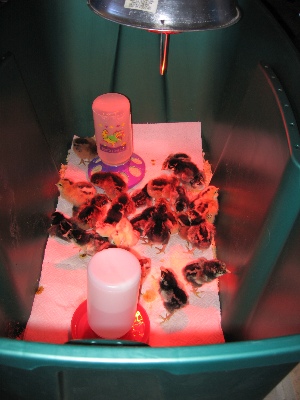
They are cute. No doubt about it. Most of them already have feathers growing on the ends of their tiny wings. They’re babies, so they’ll walk around and eat and drink and jump over each other and then suddenly get tired and fall asleep. They’re fun to watch. And when they’re all awake, they make a ton of noise.

As for my current adult flock: their days are numbered. I’ll see Celia again right before Christmas. Although I already gave her her Christmas present, she might be taking three bonus birds home with her that day. Enchiladas? Tamales? Or just roast chicken? If those girls don’t start laying eggs soon, they’ll be the main course on Celia’s table one day soon.

A Ride in the Desert

We spend three hours on horseback, enjoying perfect weather.

Mike and I have two quarter horses. Jake, a retired ranch horse, is now about 24 years old and is starting to show his age. He’s sorrel (that’s brown) with some white on his feet. He’s also swayback — that means that the place you put his saddle is way lower than it should be on a normal horse —  and has very high withers. Mike bought a special saddle pad for him and then had his saddle custom made to fit the horse. I got Jake for a good price and I think I know why. He’s an alpha male and likes to boss around the other horses he lives with. He’ll bite them and chase them and generally annoy them. That must have really been a nuisance for his previous owners, so they sold him off. But he’s an excellent horse, serious about work, and can be ridden by almost anyone at all. As far as I’m concerned, he was a bargain.

Cherokee, is another story. Cherokee’s main problem is that he’s beautiful. He’s a paint horse, brown and white, and his face is just so pretty, with big gentle eyes and a forelock that’s just the right length. He was 11 when I bought him six or so years ago, and he’d already had at least three previous owners. They evidently spoiled the hell out of him because when I got him, he was lazy, poorly trained, and extremely spooky. That horse taught me more about staying in the saddle during a Cherokee-style rodeo than any other horse I’ve ridden (or fallen off of). To add insult to injury, he cost more than I should have paid. But like his previous owners, I was suckered in by his good looks.

Jake and Cherokee have completely opposite personalities. Jake was always very standoffish — he didn’t really want anything to do with people on his time off. His definition of time off was any time there wasn’t a lead rope or saddle on him. Cherokee is incredibly friendly and curious and loves to be petted. When Jake is ready for work, he works. He’ll do anything you tell him to. When Cherokee is saddled up and ready for work, he’ll do everything he can to get out of doing it. While they both like to be fed treats, Cherokee will actually beg for them. At least that’s what it looks like to me. And if you’ve been reading these blogs for a while, you’ve probably seen the photo of him eating dropped bird food out of the bottom of Alex’s cage.

Cherokee is a big eater and it shows. He’s fat. Jake’s thin. Now if you recall what I said about Jake being the alpha male and consider that they both share the same space, you might wonder how it is that Jake can’t scare Cherokee away from the food. It isn’t like he doesn’t try. He puts his ears back (a horse’s way of saying “f*ck off”) and chases Cherokee. He even bites Cherokee once in a while, putting three or four rows of parallel teeth marks on that beautiful coat. But Cherokee is accustomed to his place at the bottom of the pecking order and is very stubborn. He also eats very fast. So as Jake ages and seems to get thinner and thinner, we’ve taken to separating them at dinner time and overnight, giving Jake more food than he can eat and plenty of time to eat it. Cherokee, of course, doesn’t like this, and after he gobbles up his food, spends the rest of the night pacing around outside the gate to Jake’s enclosure. Over the years, they’ve both changed a bit. Jake is now more friendly. Although his previous owners probably hit him in the face (he was very hand shy when we first got him), he now lets us pet him, even around his head. Cherokee has calmed down and isn’t afraid of rabbits anymore, so I haven’t had any rodeo practice lately. He’s also been trained to walk when I tell him to — without the use of a riding crop! — and to let me position him so I can open and close gates while on horseback. And a few years back, they both posed for a Christmas photo, wearing antlers on their heads.

Photo
Christmas Horses

Anyway, yesterday Mike and I went for a long horseback ride out in the desert. The horses seemed very pleased about going. Of course, when we got to the top of the hill, Cherokee thought we were going to Uncle Pete’s house. That’s where they stay while we’re away and I think he spoils them. When he realized we were turning left instead of right, heading down the trail instead of down the road, he did some Cherokee dancing. In the end, he just followed Jake, like I knew he would.

We live on the edge of town, about two lots from state land. So we normally saddle up and ride out from our house. We have two choices for a ride in the desert: turn down Cemetery Wash, which runs through our property, and take that or any of the trails that go into it or ride up the easement road from our house just past our neighbor’s house on 328th Avenue to a trail that goes right into the state land. We usually follow the second route, since there are far more trails closer to our house when we go that way. That’s also the same trails that the wranglers at Rancho de los Caballeros use for rides, so most of the trails are well worn in — perhaps too worn in in some cases — and easy to follow.

Jack the Dog came with us, of course. Jack likes to go horseback riding. He doesn’t ride a horse. He just runs along on the trail in front of us, chasing rabbits and birds. We realized that he liked horseback riding more than us when we sent two of our friends out for a ride on our horses and he went with them instead of coming back up to the house with us.

We went through the gate in the fence that separates state land from private property. The fence is there more to keep cattle out of people’s back yards than to prevent people from coming in or out of the state land. It also helps keep quads off the horse trails, although it doesn’t help enough. Every once in a while, a couple of quads will get in there and tear up the narrow trails with their wide wheels. There are so many places the quad riders can ride in town — hell, the hills are just criss-crossed with old mining roads and surrounded by sandy washes. Why do they insist on ruining the horse trails and going through people’s private property?We took the “golf course trail” west along the edge of the state land to Los Cab’s golf course, then we turned south to go around Los Cab’s property. We passed through another gate and followed a trail we’d followed a hundred times toward the west again. Spotting a new trail, we took that toward the east, climbing a small ridge that offered nice views of Los Cab. Then back down onto familiar trails, heading west again.

We spent three hours mixing old trails that we knew well with new trails. More than once, we were on trails I’d never been on before. And we wound up going a lot further southwest than we thought we were. I won’t say we were lost — that’s too strong a word — but at one point we were definitely not where we thought we were.

The ride was wonderful. Cherokee had settled down into a good pace and wasn’t the least bit jumpy. Jack chased rabbits and even a few deer. The temperature was perfect: warm enough that a long-sleeved shirt was fine without a jacket. There was some wind on the hills, but the air was quite still near the ground. We found one trail that took us high up onto a mountain, with incredible views of the town far below us, to the northeast. And we didn’t pass another soul.

It was the first time I’d been out for a good, long ride in a while. I’ve been so busy lately with work on my books, building up the helicopter business, and doing flights that I just haven’t had time to ride. And I seem too good at making excuses: it’s too hot, too cold, too windy, too early, too late. Sheesh. I’m an excuse machine when it comes to riding. I think that the truth of the matter is that I’m just too lazy to saddle up. But the reality is that it really isn’t that much work and it’s worth every minute once you get out into the desert on a nice trail.

I’d like to find a riding partner here in town who’d be willing to ride one day a week for about 2 hours. Sometime around noon or early afternoon. But it seems that few of the new people coming into town have horses and many of the ones who do prefer riding with big groups, so they can show off their riding clothes, saddles, and horse’s grooming. I like to ride in small groups, with people who don’t fuss about the terrain being too steep or rocky, with people who know how to control their horses, with people who have enough sense to wear the right clothes and bring enough water for the ride.

Anyway, there are two things about yesterday’s ride that I regret: 1) I didn’t bring my camera. How stupid is that? There were lots of photo ops and I think this entry would have been a lot more interesting with photos. 2) I didn’t bring my GPS. A few years back, I’d started a trail mapping project. Now I’m determined to finish it. And with 3 hours worth of riding yesterday, I could have mapped a lot of trails.

Anyone out there want to go riding on Wednesday afternoons? Get in touch. Experienced riders only, please. And don’t worry; I have a spare horse if you need one.

A Trip Back East

Some photos from a trip back to New Jersey and New York for the Thanksgiving Holidays.

I didn’t want to go, but Mike talked me into it. Then we made flight reservations before I could change my mind. It would be a short trip. I’d fly out on Wednesday and return on Saturday. Only three nights, and those would be made comfortable with a room at the Glenpointe Marriott in Teaneck, NJ. Dinner with my family at my brother’s house in New Jersey on Thursday, dinner with Mike’s family at a restaurant in Queens on Friday, Dim Sum with family and friends in Ft. Lee, NJ on Saturday morning.

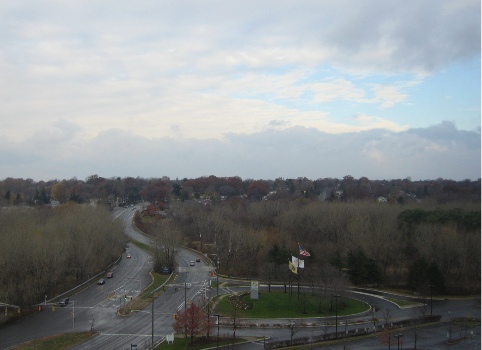
The New York/New Jersey metro area where I grew up and lived most of my life is very different from Wickenburg, AZ, where I live now. So different that I decided to take some photos to try to document some of the differences. I could have done better, but this is what I’ve got to share. This is the view from our hotel room in Teaneck, NJ, on Thursday morning. It had snowed and rained during the night and it was bitter cold that day.

This looks out to the southwest. As you can see, there are lots of tall trees, but they’re pretty much bare in late November. The overall effect is gray. A gray day with gray skies, gray trees, and gray pavement. I hated the gray of the New York metro area in the winter months. But it was the cold that finally chased me out of the area.

Photo

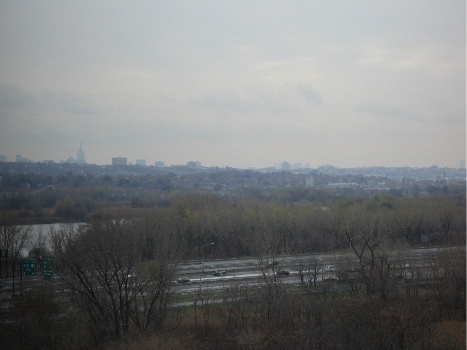
Here’s another look from our hotel room window. This view looks toward the southeast. The highway in the foreground is I-95, which stretches from Maine to Florida. The body of water is some marshland that might just be close enough to the Meadowlands to be considered part of it. The gray buildings poking into the gray sky are the skyscrapers of New York City off in the distance. The pointy one on the left is the Empire State Building, which is now the tallest building in New York again. It formerly held that title from 1934 to 1977, when the World Trade Center was completed. With the WTC gone, this depression-era building is once again the tallest in the city.

Photo

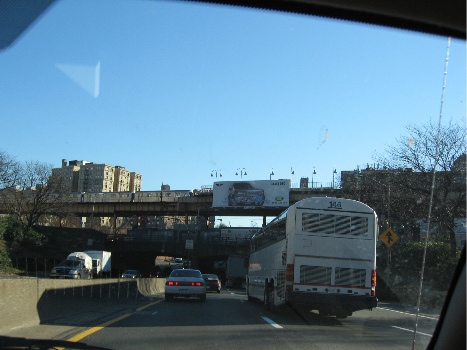
On Friday, we drove to Queens. Here’s a snapshot taken on the Cross Bronx Expressway, which goes from the George Washington Bridge (on the Hudson River), across the top of Manhattan and the middle of the Bronx, to two of the bridges to Long Island: the Whitestone and the Throgs Neck. When I was growing up, this area of the Bronx was filled with burned-out building shells, and we’d often see broken-down or abandoned cars being stripped on the side of the road as we drove through. But the buildings have they’ve since been renovated and people live there once again. Don’t get the idea that this is an up-and-coming area of New York, though. It’s still a poor, crime-ridden area. Ever read Bright Lights, Big City?

Photo

I forgot to take photos the day before, on the way to my brother’s house. We took the New Jersey Turnpike (I-95 down) and there are lots of weird scenic things along that, like the big gas tanks that appeared in a scene of Stephen King’s The Stand and Newark Liberty International Airport. Next time.

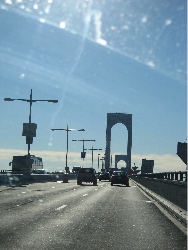
Here’s a pretty poor photo of the roadway on the Whitestone Bridge.

Photo

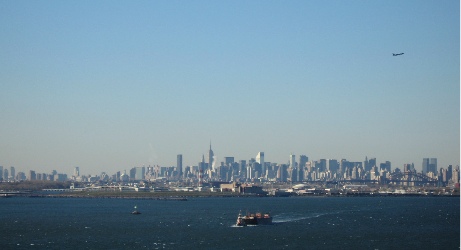
There are three bridges that’ll get you from the Bronx to Queens and Long Island and they’re all pretty similar in appearance: single-span suspension bridges. The Triboro Bridge has some nice art deco touches that make it my favorite of the three bridges, but that one’s much closer to Manhattan, which was out of our way. The Throgs Neck bridge has great views of the Long Island Sound which, in the summer, is full of sailboats and very picturesque. Of course, the Whitestone Bridge does offer the best long-distance views of Manhattan. I took a bunch of photos and this one was the best. It really gives you the flavor of new York from a distance. The tugboat with barge in the foreground, the plane departing La Guardia Airport (out of this shot on the left), and the huge cluster of buildings in midtown Manhattan. You can clearly see the Empire State Building almost dead center and CitiCorp Center (look for the slanted roof to the right). Astoria, Queens is in the foreground, on the other side of the water. And you can just about see the heavy black bridge of the train trestle that parallels the Triboro Bridge. If the World Trade Center were still standing, its towers would appear to the far left in this photo.

Photo

If you’ve never been to New York and you have the opportunity to visit, don’t pass it up. New York is like no other place on earth. As I was telling a Phoenix cab driver just the other day, it’s one of the few U.S. cities that blend old and new in a way that leaves you breathless. Go downtown, to the Wall Street area, and see exactly what they mean by the “Canyons of Wall Street.” The streets are so narrow and the buildings are so tall that light rarely gets down to the street. Although midtown has more tall buildings, the streets are a bit wider. You won’t believe the crowds walking the streets during a weekday lunch hour, the sea of yellow cabs, the bicycle messengers, the street vendors. This time of year, they’re roasting chestnuts near Rockefeller Center and steam is rising from manhole covers and vents on the street.

I do love New York, but I don’t have enough money to live there the way I want to. And New York is one of the grayest places I know.

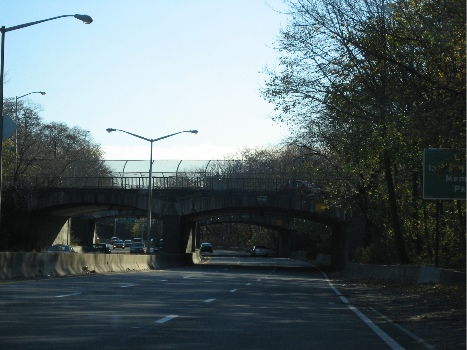
We didn’t get into the city during this trip. Next time I go back, I’ll take some photos. But you might have to wait a few years. Once in Queens, we hopped on the Cross Island Parkway to go to Mike’s Mom’s apartment. I took this shot out the front window of the car. It’s an interesting example of one of Robert Moses’s parkways. He built them all over Long Island — Queens is on the eastern end of Long Island — and this was probably one of his first. One of the trademarks of his roadways was his stone overpasses. They all look pretty much the same, but they’re really nicely executed. When you look at this photo, it’s hard to imagine that tens of thousands of people live within a mile of where it was taken.

Photo

This stretch of roadway is sunken in and surrounded by trees. Mike and I had our first apartment together about 5 miles further down this road, in Bayside. We had a wonderful view of Littleneck Bay (you’ve heard, perhaps, of Littleneck clams?), but had to listen to a never-ending stream of cars going by far beneath our terrace.

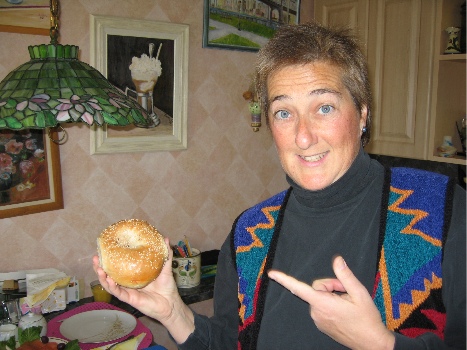
At Mike’s mom’s place, we had bagels for breakfast. This is a photo of me holding a real New York bagel. Notice that it is large and plump. The outside is crusty and the inside is moist and almost doughy. It doesn’t have blueberries or cranberries or any other type of berry in it. This one has sesame seeds (my personal favorite), but they also come plain, egg, poppy seed, salt, pumpernickel, onion, cinnamon raisin, or everything. Everything means seeds, onion, and salt and is a real assault to the taste buds. A common way for a New Yorker to eat a bagel is to slice it open and toast it, then cover each half with cream cheese and slices of lox (smoked salmon). Some people add red onions, capers, and/or tomatoes. (I don’t like tomatoes on my bagels.) A quick spread of cream cheese is referred to as a “schmear” in New York; I prefer a more generous helping. You can’t get a good bagel anywhere outside of the New York metro area, although you can get decent ones here and there. Einstein Brothers makes a decent bagel. Bagels do not come in the grocery freezer section; anything you find there that is labeled a bagel is a mere imitation.

Photo

The next time you go to New York, have a bagel as described above. It’s part of the New York experience and should be required for all serious visitors. And, while you’re at it, take a ride down to the Lower East Side and have a corned beef, pastrami, and tongue on rye sandwich at Katz’s Deli. Get that with mustard. Do not ask for it with mayonnaise; you will be forcibly removed from the premises and publicly laughed at out on the street. A Dr. Brown’s Creme soda is a nice accompaniment — and don’t forget the kosher pickle. Leave the Carnegie Deli for the tourists. What you’ll learn — among other things — is how to properly make a sandwich. There should be more meat than bread. That’s something they just don’t get outside the New York metro area.

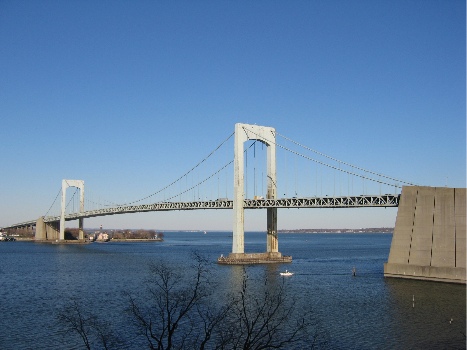
But I digress, again. This is a photo of the Throgs Neck Bridge, taken from Mike’s mom’s patio. She’s on the 7th floor and has a nice view out this way. Beyond the bridge is the Long Island Sound. Imagine it with lots of sailboats and you’re imagining the view on a summer Sunday afternoon. Put some green leaves in the tree in the foreground to complete the picture.

Photo

As you can see, it isn’t always grey in New York in the winter. Friday was a very nice day, although it was still bitter cold, with temperatures in the 30s and enough wind to make it feel a lot colder. Of course, it did get gray again on the next day.

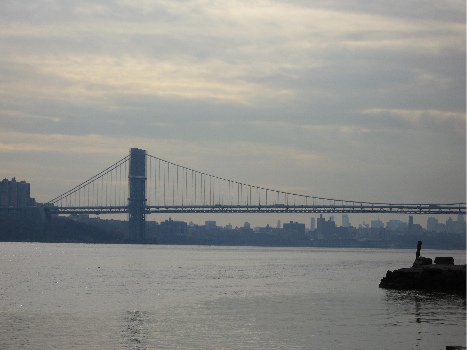
Here’s a look at the George Washington Bridge from the foot of the Palisades. The Palisades, in case you’re wondering, are a line of cliffs along the Hudson River in New Jersey. This photo was taken from a boat basin/park area almost directly across the river from the northernmost end of Manhattan. The view is to the southeast.

Photo

The GW Bridge has two decks — upper and lower — and is a major route between New Jersey and eastern New York. It’s actually the first bridge you get to if you sail up the river from New York Harbor. The next bridge is the Tappan Zee, which is at least 20 miles further upriver. To cross the river closer to downtown Manhattan, you can use one of two tunnels: the Lincoln (midtown at around 30th Street) and the Holland (downtown at around Houston).

When I was growing up in New Jersey, my family had a small boat that we used to take out in the river. I’ve been around Manhattan by boat more times than I can count. It’s a neat trip that you can do on the Circle Line tour boats. We also took a few perilous trips into New York Harbor and around the Statue of Liberty. I say perilous because our boat was really small and the water can get rough out in the harbor. I also remember going past Ellis Island long before it was fixed up and opened to the public. I’ve never been on the island, though.

Anyway, all those boat trips started at the base of the George Washington Bridge, on the New Jersey side. I can still remember the smell of the water at low tide, and the look of all those exposed barnacles. And the way the boat floated up and down as it was loosely tied at the boarding area. We didn’t swim in the river back in those days — it was too polluted south of the Tappan Zee — but we did fish in it, although we never ate any of the fish we caught.

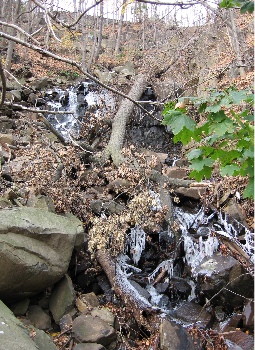
Here’s a shot of one of the “waterfalls” coming down the Palisades to the Hudson River. It’s really probably just runoff from a storm drain, but when we were kids, it was a waterfall and it was one of the most beautiful things we’d ever seen. My family often drove along the river’s shore road on Sunday outings. That’s back in the days when taking a drive in the family car was a cheap and fun day out. There were no malls, no computer games, no cell phones. We’d get in the car and go for a drive and drink up everything we saw out the window. If it was autumn, we’d go to a place called Tices Farms, which had apples and doughnuts (note the spelling) and cider and pumpkins for sale. When I got out of the car to take this photo, the smell of wet leaves brought me back to a time when we would rake them into huge piles and take turns jumping in them. Leave stems would stick in our sweaters and hair and we’d be breathless in the cool autumn sun. I don’t know if you can see it clearly, but there’s ice in the water in this photo. We’re talking cold enough to make a waterfall freeze. Cold.

Photo

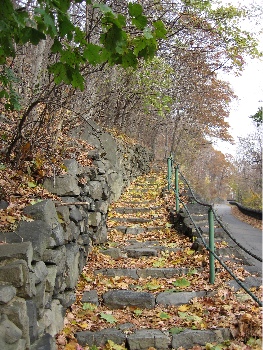
The Palisades area of Bergen County in New Jersey is one of its more historic areas. Originally settled by the Dutch in the 1600s, it was a hotbed of activity during the Revolutionary War. Posted alongside roads all over the area are “Washington’s Retreat Route” signs. Yes. This is the area George Washington retreated from when we weren’t doing very well in the first war with the Brits. Why we need that on signs is beyond me. But the area is also full of walking trails that were probably built during the depression. In more than a few places, you can find stairways and paths that climb the Palisades. This is one example, that follows the road for a short distance before cutting right up the cliff. We did a lot of hiking in the area when we lived there. The views from the top of the Palisades are magnificent.

Photo

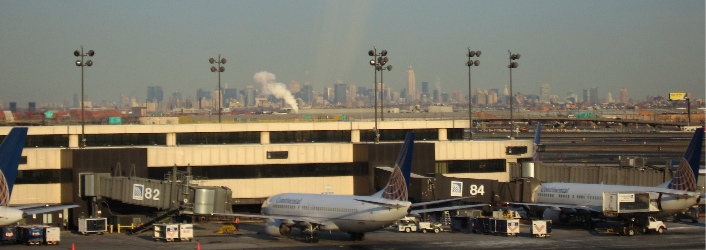
I took the shot that appears below from the AirTrain that travels around Newark Airport. That’s New York in the background.
Photo

This photo reminds me of a visit by one of my editors when we still lived in New Jersey. I picked him up at the airport and was driving north along the New Jersey turnpike toward our house. He looked off to the right as we climbed a bit of highway that passed over the marshes at the Meadowlands and said, “What city is that?” He was looking at New York. That’s when I realized that the skyline I’d grown up with wasn’t nearly as familiar to everyone else.

Am I homesick? Maybe a bit. Would I go back to live there again? Nope.

Been there, done that.

I really AM a geek!

I discover enhanced podcasts and just have to try making one myself.

Yesterday, after getting my dose of news from Salon and Slate, I checked out the iTunes Music Store’s Podcast Directory. I found CockpitCast, “A podcast from the $16million airplane strapped to my ass.” It’s a mildly interesting podcast for people into aviation, full of control tower chatter and radio communications as a pair of jet pilots fly from LAX to other points. I noticed that some of the episodes were marked as “enhanced” and wondered what that meant. It all became clear when I played one in iTunes.

Now please do forgive me. I know I make a living writing about computer topics, but I’m in the middle of a revision of a QuickBooks book right now and I’m trying hard to keep my mind off things like podcasting. So enhanced podcasts made their debut and I missed them. It won’t be the first time I missed a computer innovation and I’m sure it won’t be the last.

Well, the CockpitCast enhanced podcast included photos. And frankly, that kind of blew me away.

You see, I’ve been creating how-to podcasts on Maria Speaks — podcasts that teach people how to do things with their computer. One of the things the podcasts lacked was the ability to include screenshots, which can really help make an article understandable. I made up for that loss by including the transcript of each podcast on a Web site that I reference in the podcast. But with enhanced podcasts, I can now include the screenshots in the podcast itself.

I wasted no time locating and downloading a pair of software programs that would give me the ability to create these enhanced podcasts: Cast Easy and Podcast Maker. Although I first preferred Cast Easy, I soon realized that Podcast Maker was a much better product. And at only $30, it was quite affordable.

Podcast Maker enables you to take an audio file in MP3 or M4A format, insert chapters with pictures and link, and save it as a podcast. It’s very easy. (It’s also very disheartening, since I spent close to two days writing an eBook about how to create a podcast. Still my eBook explains how you can do it for free, so there’s some benefit there. Of course, that’s not an enhanced podcast. But it is a podcast with a customizable Web site. Oh, forget it.)

This afternoon, after finally finishing the 62-page Chapter 2 of my QuickBooks book revision, I came home and converted one of my Maria Speaks podcasts into an enhanced podcast. I used one that had a lot of screenshots. It explains how to send and receive faxes using Mac OS X Tiger. And it came out very nice, if I do say so myself. I just wish my voice wasn’t so nasal — I had a nasty cold when I recorded that episode.

Want to check it out? Visit http://feeds.feedburner.com/mariaspeaks/. Or better yet, just use that URL to subscribe to the podcast with iTunes 6.0 or later. You’ll see all the images in the iTunes window, or, if you have a new video iPod, you’ll see it on your iPod screen.

If anything was a motivator to get my QuickBooks book done quickly, this is it. I can’t wait to have a few spare hours to play around with this new technology. Stay tuned. I’m sure this isn’t the last enhanced podcast you’ll get from me.

Some People Just Can’t Read

I’m bothered by a reader seeking technical support.

I’d just checked into the Hotel McCall, in McCall, ID. Mike and I were making our way from the desk to the stairs when my cell phone vibrated.

“Hello?”

“Is this Maria Langer?”

“Yes.”

“The author of the bestselling guide to Quicken 2003?”

I started to get a bad feeling. “That’s what they tell me,” I replied.

The caller proceeded to introduce herself as an 88 year old woman living in New Mexico who had bought my Quicken 2003 book to learn Quicken. She was having a lot of trouble with the software and needed help.

“How much do you charge for consulting?” she finished.

“I’m sorry,” I told her as gently as I could. “I don’t do consulting anymore. And I don’t support my books by phone.” This is clearly stated numerous places on my Web site. “You called on my cell phone,” I added. “I’m on my way out. I’m sorry. I can’t help you. Go to Intuit’s Web site for help.”

And before she could protest, I flipped the phone closed.

Some readers just can’t read. They search my Web site for a phone number and call anyway. In this case, she went the next step: when she didn’t get me at my office (on a Saturday afternoon, no less), she decided to interrupt my weekend by bothering me on my cell phone.

I didn’t have a computer with me. And even if I did, it wouldn’t be a PC with Quicken 2003 installed. The current version of Quicken is 2006; can she honestly expect me to support (or remember) software that’s 3 years old?

In a way, I admire her guts. But don’t get any ideas. I don’t provide technical support by phone. Period. End of statement.

In fact, her call kind of pissed me off. Why? Because like a few other people over the past few years, she seemed to think that the statements I made on my Web site about technical support didn’t apply to her. Maybe it was because she was 88 years old. Maybe because she was a woman. Or because she lived in the southwest. Or because she was crafty enough to track down my phone number and dial it.

There’s an FAQ system on my Web site. One that I designed and implemented, with no small amount of effort, with FileMaker Pro. It’s basically a database of questions and answers. Readers seeking support are asked to read the questions and answers for the book they’re interested in. If their question is not answered, they may post another question. I usually get around to answering them within a week or so. Sadly, few readers bother to read the questions before posting their own.

And what is it with people? They think that just because they spend $25 on a book, they own a piece of the author. (And how much of that $25 do they think I get?) I don’t mind clarifying or correcting information in my book, but so many people want more. They want me to add content, just for them. Just write a few more pages covering the obscure topic they need to learn about.

So half the contents of the FAQ system fall into one of two categories: questions that are beyond the scope of my book and questions that I’ve already answered in the FAQ system. Once in a while, I’ll get a question from someone who claims to own the book but, if so, doesn’t know how to use a table of contents or index. When I get one of those, I just give him/her the page reference in the most recent edition of the book.

There’s another thing, too. I clearly state on my Web site that I only answer FAQ questions about books listed in the pop-up menu there. Quicken is not one of the listed books. Why? Because of all the abusive readers I’ve had to put up with over the past few years. People who use the FAQ system to post nasty comments about the book, followed by a question they demand an answer for. Comments and questions regarding missing content that is so obscure they’re likely to be the only people to miss it. Content that I wouldn’t cover even if the book were 2,000 pages long. One day, a reader pushed me too far. I deleted all the Quicken FAQs, removed the book from the menu of books, and stated that I was no longer supporting it. When I told my editor what I’d done, she wasn’t concerned. She thought that the FAQ system was already above and beyond the call of duty. So now readers can get support for the book from the publisher’s Web site.

Anyway, this reader’s call bugged me for a few hours. But then I tucked the experience away in the back of my mind and got on with my life.