The Chickies are Here!

A day late, but twice as many as I expected.

If you know anything about me, you know that I live in a rather rural area and have been keeping a small flock of chickens for the past six or seven years. My first flock was the best: eight hens who were tame and friendly because I’d raised them from chicks. Coyotes got three of them in a day (which is why I have a coyote tail hanging from the rearview mirror in my S2000), and, as a result, I had to keep them cooped up all day long, first in their relatively small chicken coop and later in a fenced in chicken yard my friend John built for me alongside the coop. The remaining five chickens produced, on average, four eggs a day. We’re not really big egg eaters, so we wound up giving away fresh eggs to just about anyone who showed up at our door — the farrier, the FedEx man, and the APS meter reader — as well as friends and neighbors.

Time passed. I got more chickens and coyotes and neighborhood dogs took some chickens away. We got a rooster from my friend Janet. I hatched one chick on my own, then bought two more to keep it company. One my my hens hatched her own brood of chicks, all of which were killed by the rest of the flock. Later on, I started replacing chickens with older birds that were less likely to be killed by the flock. Neighborhood dogs dug their way into the yard and killed all my chickens but one; we later electrified the outside of the yard fence to keep them out.

As I write this, I have two hens and a rooster that I got from my hairdresser, Sue. She was moving and looking for a home for her flock. When I got the hens from her, one of them was laying. But now neither of them do. We say they’re lazy chickens. And I’ve already decided that they’ll soon go to a new home in Wenden, where my Mexican friend Celia will turn them into enchiladas. She says fresh chicken is a lot better than store-bought. I don’t doubt her, but I’m not about to wring their necks, pluck them, and gut them to find out for sure.

When I decided to replace my little flock, I decided to start from scratch again — no pun intended — with a fresh batch of chicks. I ordered from Ideal Poultry in Texas. They’re one of the few hatcheries that will ship small orders (less than 25 chicks) and will vaccinate for Marek’s disease (which killed a few of my chickens a few years back). I ordered Ameraucanas (Araucanas), which are also known as the “Easter Egg Chicken.” Why? Because they lay colored eggs: brown, green, and sometimes even blue.

I’d had Ameraucanas before and I loved the green eggs. One of my hens laid a beautiful sage green colored egg that was almost the same color I’d painted my kitchen. The colored eggs are a novelty, but what’s nice is that this breed is a pretty good producer. All of my chickens laid regularly until their untimely deaths.I ordered 10 hens and 2 males from Ideal Poultry. I got an e-mail message a few days later, saying my chicks would be shipped out on December 7. Ideal ships via Priority Mail and I knew from experience that I could expect a call from the local post office on Friday morning, around 6 AM, telling me that my chicks had arrived. I prepared a large plastic storage container with pine shavings and paper towel sheets on the bottom. Bought new a new chick waterer and chick feeder, and bought the smallest bag of chick starter I could: 25 lbs. I also set up the heat lamp over my makeshift brooder. All I’d have to do when the call came was to plug in the heat lamp, fill the waterer and feeder, and bring the chicks home.

But the call never came on Friday. I went to the post office to try to track down the chicks, but without a tracking number, it was impossible. I was told to wait for the 11 AM express mail truck. It arrived at 1 PM. No chicks aboard.

Meanwhile, I’d called the hatchery and left numerous messages and e-mail messages. Chicks can survive without problems for up to 48 hours after hatching without food or water. After that, nothing’s guaranteed. All I could think of was a box arriving at Wickenburg Post Office the next day with a dozen dead chicks in it.

But there was nothing I could do. I had to be in Tempe that evening for Mike’s company Christmas party. The plan was to spend the night at the Embassy Suites on South Rural. I was hoping to do some Christmas shopping while I was down there — I needed a Lowe’s gift certificate for my brother and his wife — but I was already out of time. So I hopped in my Honda and zipped down to Tempe.

The hatchery called my cell phone just after I checked in at the hotel. The guy who called was probably the owner and he had a thick Texan drawl. He told me that the shipment had probably been delayed on Wednesday because of an ice storm in Dallas. (I guess I missed that on the news.) A lot of flights were cancelled. But the chicks, which had been hatched after noon on Wednesday, definitely went out. They should arrive by Saturday morning. The hatchery would replace them if they died enroute.

Not much I could do in Tempe, so I tried not to think about them.

We went to bed around midnight, which is almost like staying up all night for me.

Mike had a bad night. Neither of us drank very much at the party, but something he ate didn’t agree with him and he was up half the night. I woke at 7:30 AM and left him to sleep for a while. We had a suite, so I surfed the channels on the television in the other room while drinking coffee I brewed in the tiny pot in our kitchenette. I wanted to go home and get the chicks settled in — if they were still alive — but I was worried about Mike.

We finally checked out at about 9:30 AM. We each had our own car, so we went our separate ways. I got in to Wickenburg at about 10:45 AM and went right to the post office. I heard my new little babies peeping as soon as I got in the door.

The post office folks had been kind enough to cut down a plastic cup, put some water in it, and give it to the chickies. So I think some of them got something to drink. At this point, they were nearly 72 hours old and very vocal. I thanked the post office folks, put the box of chicks in the car, and drove home.

Ideal Poultry ships chicks in a small cardboard box with plenty of air holes. The box is held closed by a plastic strap, making it easy to open up the sides and peek in. The box is small on purpose; it forces the chicks close together so they keep each other warm. And it probably prevents them from falling over all the time. Normally, Ideal puts a rolled up straw thing in one side of the box, since I always place small orders. This time, it decided to fill the empty space with extra chicks. So when I started pulling them out, I didn’t stop until I had more than 20 of them in their new home.

There were two dead chicks on the bottom of the box; they’d obviously died early in transit because they were very small and their brethren had stomped them into the hay. Normally, I’d feel pretty sad about this, but with so many live chicks to occupy my mind, it didn’t bother me as much as it should have.

Most of the chicks were very active. I went through my ritual: taking each one and dipping its beak into the water to teach it how to drink. It sounds silly, but they really don’t know how to drink until you show them. And that’s kind of what gets them started on their unaided lives. Kind of like slapping a newborn baby on its butt to get it to breathe.

I haven’t gotten an exact count yet, but I think I have 28 chicks. The hatchery may have thought it was doing me a favor by shipping so many extras for free, but I have a definite space problem. The plastic bin I bought to house them for their first 3 to 4 weeks won’t last more than a week now. I’m already scrambling for a large box to move them into. Maybe they thought I had a nice, warm Arizona yard to keep them in. In reality, they’ll live in my garage for at least two months. That’s when they’ll have enough feathers and down to handle the cold winter nights.
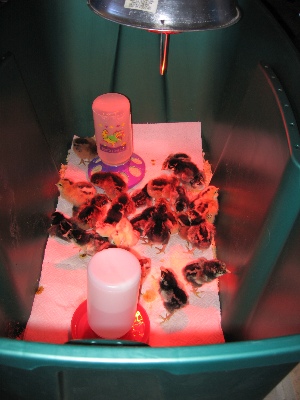
They are cute. No doubt about it. Most of them already have feathers growing on the ends of their tiny wings. They’re babies, so they’ll walk around and eat and drink and jump over each other and then suddenly get tired and fall asleep. They’re fun to watch. And when they’re all awake, they make a ton of noise.

As for my current adult flock: their days are numbered. I’ll see Celia again right before Christmas. Although I already gave her her Christmas present, she might be taking three bonus birds home with her that day. Enchiladas? Tamales? Or just roast chicken? If those girls don’t start laying eggs soon, they’ll be the main course on Celia’s table one day soon.
Two Interesting Charters

I find that there’s more to flying helicopters than giving tours.

Lately, I’ve been getting calls from folks who want to use my helicopter for more than just transportation or tourism.

The first good assignment I got came a few months ago, when I flew a camera crew around the a carmaker’s test track in Arizona. I wrote about it in another blog entry. This past week, I did two more.

The first, on Tuesday, was for a professional photographer hired to take aerial and ground photographs of the new bridge being built over Burro Creek on state route 93. There’s already a beautiful bridge there and the construction crew is building a twin on the north side of it (the road runs pretty much east-west there). Burro Creek runs in a deep canyon there and the Sonoran desert landscape is breathtaking. The site is also far from civilization — about 55 miles north of Wickenburg and perhaps 20 miles south of Wickiup.

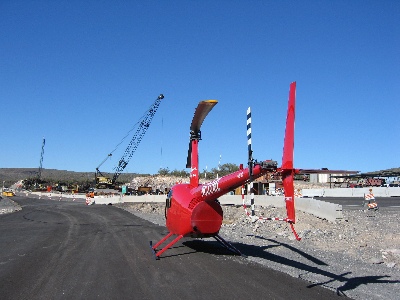
It was a cold morning when we left Wickenburg, so I left the helicopter’s doors on. It took us about 30 minutes at my top cruise speed (110-115 knots with two on board and full fuel) to reach the site. I set down in a fenced-in area where the construction folks were storing cactus to be replanted after work was done. I took the passenger door off while my client got his camera equipment out — a pair of Hasselblad medium format cameras with three different lenses. A construction truck pulled up and my client got out to talk to the driver. He came back and told me that the next time I landed, I could land on the new road right near the bridge. It was closed to traffic and was smoothly paved. We took off and began circling the bridges from various altitudes. My client snapped away, cranking the camera’s advance do-dad after each shot. He was perfectly at ease leaning out the door; he’d flown in many helicopters before. After about ten of fifteen minutes of that, I set down on the road near the bridge and shut down. (I had to set down on the edge of the road, as shown in the photo below, because the road was banked for a curve and the only real level spot I could find was at the very edge of the road.) My client climbed out, filled a smaller camera bag with equipment, and walked off to take his ground shots.

I pulled out my iPod and a book and settled down on the side of the road to read. Cars and trucks drove by and I wondered how many of them were headed to or from Wickenburg.

He was gone about 90 minutes. When he returned and finished fiddling around with his equipment, we climbed back on board and I fired the helicopter back up. The light had changed, so we did another 10 or 15 minutes of circles around the bridge at all different altitudes. Then he told me to head back and I broke off circling and headed back.He took some more photos on the way back — using up extra film on shots he thought he might be able to sell the construction folks. Then we set down on Eric Barnes’s dirt strip, on route 93 near the Santa Maria River, so I could put the door back on. With the door off, it was loud and my speed was limited to 100 knots. With it on, it was quieter and I could get it up to 120 knots. When we got back to Wickenburg, I’d put 1.4 hours on the Hobbs. My client paid for that, as well as for some waiting time.

Two days later, I was in Aguila, doing a job for the maker of a “breadcrumb” communications system. Breadcrumb systems, as they were explained to me, create a wireless network that can be used for voice, data, or video communications. The folks who hired me had an impressive system they wanted to mount in the helicopter. The idea was to have me fly around with the system and a few techs on board to see how well the system stayed connected to other breadcrumbs on the ground and how well video that one of my passengers shot could be seen at ground-based stations.

As the photo here shows, I had to remove both doors on the pilot side so they could mount the unit’s antenna. The breadcrumb box itself was positioned at the feet of the passenger behind me; you can barely see it in this photo because it’s just a flat box standing on one end. Although the unit can be powered by batteries, my helicopter has a 28 volt DC port that looks like a cigarette lighter port. The breadcrumb had a cable that could take this voltage, filter it, and step it down to the 12 volts it needed. So they just plugged it into my DC port. The boss of the operation wasn’t happy about the positioning of the antenna — he wanted to dangle it somehow under the helicopter’s body — but we soon proved that it was fine.

One of the techs also had a GPS and, at first, they wanted to mount it on my tailcone. They claimed that in the work they’d done with RC helicopters, they’d found that there was too much interference from the main rotor disk for the GPS to get a good signal. When I told them that my handheld GPS worked in the cockpit cabin, they decided (to my relief) to give it a try. (For the record, I would not have let them mount it on my tailcone. That’s much too close to the tail rotor! We might have mounted it on a skid if we had to.)

My passengers climbed aboard and we took off, flying circles around their base of operations at Robson’s Mining World. One guy in the back did the video while the guy beside him kept reporting on the status of the breadcrumb: green, blinking green, green, green, etc. We kept in touch with other breadcrumbs on the system at all altitudes and even when we flew behind a mountain. We only lost touch once, and that was for only a few seconds. The video went down to the guys on the ground, who clustered around a laptop set up on the hood of a car in the parking area. We did this for about 20 minutes, then landed.

I didn’t realize it then, but I was done with my assignment. What followed was about an hour spent giving everyone there a ride. I took them three at a time and did a 4-minute ride around the base, climbing up the mountain behind Robson’s and descending back into the desert for landing in my designated landing zone. When everyone had their ride, they told me to shut down and have lunch with them. Some other folks would be taking photos of the setup while I was eating.

I ate outside, with the guys from Rotomotion. They build RC helicopter systems to be used for surveillance and unmanned observation. The company founder started the company when he got frustrated that he couldn’t fly an RC helicopter. (Having owned one for a while, I know exactly how he feels; I couldn’t fly mine, either.) He wrote a computer program that would fly the helicopter for him. His company now builds helicopters that work with his Linux-based software system. They had three helicopters with them: a small electric model (on the table in this photo), a medium diesel model, and a large model powered by a chain saw engine.

The software is extremely cool. Once the helicopter is airborne, the software takes over and can hold it in an absolutely perfect out of ground effect hover. You can also tell it to go to certain coordinates at a certain altitude and it’ll go. It uses wireless communications to control an onboard camera or other equipment. If it loses its radio control signal, it’s programmed to return to its home base. Although they have a routine for software-controlled take off, they need a reliable but small altimeter to judge distance from the ground before a good landing program can be written. I have no doubt that they’ll add this feature soon. These guys definitely know what they’re doing.

While the rest of the group went off to go shooting out in the desert, a small group of us remained to watch the RC helicopters fly. A police officer from Chandler had come up to get a demonstration and we just watched. He said that the system has many applications in law enforcement and he seemed excited about it.

I went home a while later and put my dusty helicopter away. I’d logged 1.6 hours for the assignment — not much, but enough to make it worthwhile. And the technology I’d seen while I was out there was well worth the time spent.

A Trip Back East

Some photos from a trip back to New Jersey and New York for the Thanksgiving Holidays.

I didn’t want to go, but Mike talked me into it. Then we made flight reservations before I could change my mind. It would be a short trip. I’d fly out on Wednesday and return on Saturday. Only three nights, and those would be made comfortable with a room at the Glenpointe Marriott in Teaneck, NJ. Dinner with my family at my brother’s house in New Jersey on Thursday, dinner with Mike’s family at a restaurant in Queens on Friday, Dim Sum with family and friends in Ft. Lee, NJ on Saturday morning.

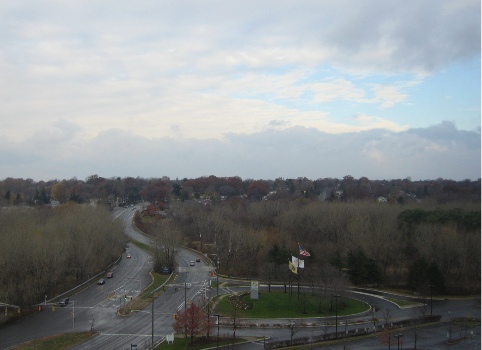
The New York/New Jersey metro area where I grew up and lived most of my life is very different from Wickenburg, AZ, where I live now. So different that I decided to take some photos to try to document some of the differences. I could have done better, but this is what I’ve got to share. This is the view from our hotel room in Teaneck, NJ, on Thursday morning. It had snowed and rained during the night and it was bitter cold that day.

This looks out to the southwest. As you can see, there are lots of tall trees, but they’re pretty much bare in late November. The overall effect is gray. A gray day with gray skies, gray trees, and gray pavement. I hated the gray of the New York metro area in the winter months. But it was the cold that finally chased me out of the area.

Photo

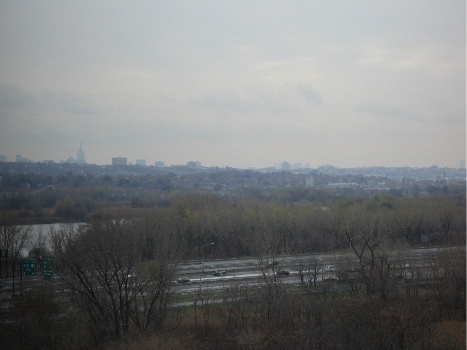
Here’s another look from our hotel room window. This view looks toward the southeast. The highway in the foreground is I-95, which stretches from Maine to Florida. The body of water is some marshland that might just be close enough to the Meadowlands to be considered part of it. The gray buildings poking into the gray sky are the skyscrapers of New York City off in the distance. The pointy one on the left is the Empire State Building, which is now the tallest building in New York again. It formerly held that title from 1934 to 1977, when the World Trade Center was completed. With the WTC gone, this depression-era building is once again the tallest in the city.

Photo

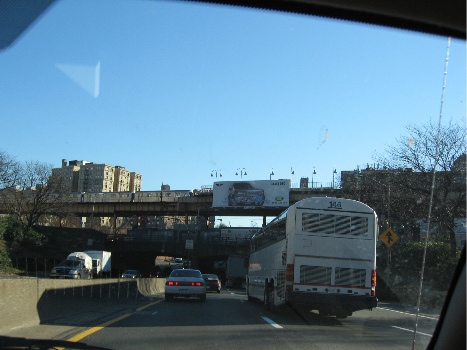
On Friday, we drove to Queens. Here’s a snapshot taken on the Cross Bronx Expressway, which goes from the George Washington Bridge (on the Hudson River), across the top of Manhattan and the middle of the Bronx, to two of the bridges to Long Island: the Whitestone and the Throgs Neck. When I was growing up, this area of the Bronx was filled with burned-out building shells, and we’d often see broken-down or abandoned cars being stripped on the side of the road as we drove through. But the buildings have they’ve since been renovated and people live there once again. Don’t get the idea that this is an up-and-coming area of New York, though. It’s still a poor, crime-ridden area. Ever read Bright Lights, Big City?

Photo

I forgot to take photos the day before, on the way to my brother’s house. We took the New Jersey Turnpike (I-95 down) and there are lots of weird scenic things along that, like the big gas tanks that appeared in a scene of Stephen King’s The Stand and Newark Liberty International Airport. Next time.

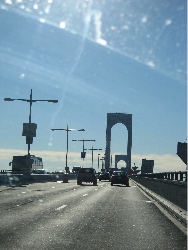
Here’s a pretty poor photo of the roadway on the Whitestone Bridge.

Photo

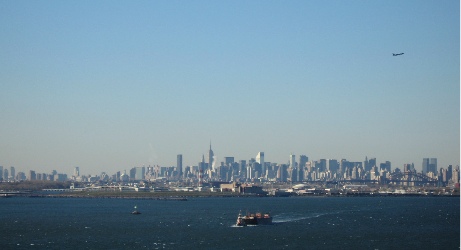
There are three bridges that’ll get you from the Bronx to Queens and Long Island and they’re all pretty similar in appearance: single-span suspension bridges. The Triboro Bridge has some nice art deco touches that make it my favorite of the three bridges, but that one’s much closer to Manhattan, which was out of our way. The Throgs Neck bridge has great views of the Long Island Sound which, in the summer, is full of sailboats and very picturesque. Of course, the Whitestone Bridge does offer the best long-distance views of Manhattan. I took a bunch of photos and this one was the best. It really gives you the flavor of new York from a distance. The tugboat with barge in the foreground, the plane departing La Guardia Airport (out of this shot on the left), and the huge cluster of buildings in midtown Manhattan. You can clearly see the Empire State Building almost dead center and CitiCorp Center (look for the slanted roof to the right). Astoria, Queens is in the foreground, on the other side of the water. And you can just about see the heavy black bridge of the train trestle that parallels the Triboro Bridge. If the World Trade Center were still standing, its towers would appear to the far left in this photo.

Photo

If you’ve never been to New York and you have the opportunity to visit, don’t pass it up. New York is like no other place on earth. As I was telling a Phoenix cab driver just the other day, it’s one of the few U.S. cities that blend old and new in a way that leaves you breathless. Go downtown, to the Wall Street area, and see exactly what they mean by the “Canyons of Wall Street.” The streets are so narrow and the buildings are so tall that light rarely gets down to the street. Although midtown has more tall buildings, the streets are a bit wider. You won’t believe the crowds walking the streets during a weekday lunch hour, the sea of yellow cabs, the bicycle messengers, the street vendors. This time of year, they’re roasting chestnuts near Rockefeller Center and steam is rising from manhole covers and vents on the street.

I do love New York, but I don’t have enough money to live there the way I want to. And New York is one of the grayest places I know.

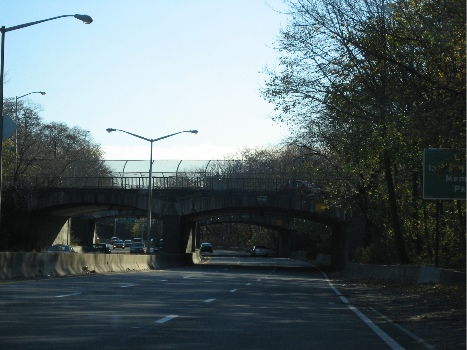
We didn’t get into the city during this trip. Next time I go back, I’ll take some photos. But you might have to wait a few years. Once in Queens, we hopped on the Cross Island Parkway to go to Mike’s Mom’s apartment. I took this shot out the front window of the car. It’s an interesting example of one of Robert Moses’s parkways. He built them all over Long Island — Queens is on the eastern end of Long Island — and this was probably one of his first. One of the trademarks of his roadways was his stone overpasses. They all look pretty much the same, but they’re really nicely executed. When you look at this photo, it’s hard to imagine that tens of thousands of people live within a mile of where it was taken.

Photo

This stretch of roadway is sunken in and surrounded by trees. Mike and I had our first apartment together about 5 miles further down this road, in Bayside. We had a wonderful view of Littleneck Bay (you’ve heard, perhaps, of Littleneck clams?), but had to listen to a never-ending stream of cars going by far beneath our terrace.

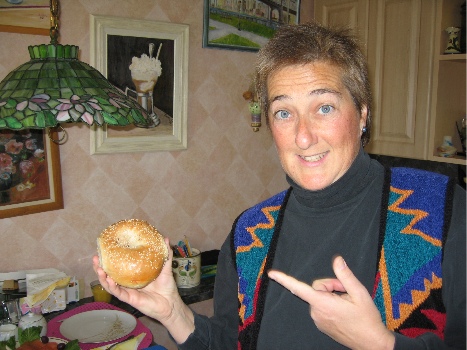
At Mike’s mom’s place, we had bagels for breakfast. This is a photo of me holding a real New York bagel. Notice that it is large and plump. The outside is crusty and the inside is moist and almost doughy. It doesn’t have blueberries or cranberries or any other type of berry in it. This one has sesame seeds (my personal favorite), but they also come plain, egg, poppy seed, salt, pumpernickel, onion, cinnamon raisin, or everything. Everything means seeds, onion, and salt and is a real assault to the taste buds. A common way for a New Yorker to eat a bagel is to slice it open and toast it, then cover each half with cream cheese and slices of lox (smoked salmon). Some people add red onions, capers, and/or tomatoes. (I don’t like tomatoes on my bagels.) A quick spread of cream cheese is referred to as a “schmear” in New York; I prefer a more generous helping. You can’t get a good bagel anywhere outside of the New York metro area, although you can get decent ones here and there. Einstein Brothers makes a decent bagel. Bagels do not come in the grocery freezer section; anything you find there that is labeled a bagel is a mere imitation.

Photo

The next time you go to New York, have a bagel as described above. It’s part of the New York experience and should be required for all serious visitors. And, while you’re at it, take a ride down to the Lower East Side and have a corned beef, pastrami, and tongue on rye sandwich at Katz’s Deli. Get that with mustard. Do not ask for it with mayonnaise; you will be forcibly removed from the premises and publicly laughed at out on the street. A Dr. Brown’s Creme soda is a nice accompaniment — and don’t forget the kosher pickle. Leave the Carnegie Deli for the tourists. What you’ll learn — among other things — is how to properly make a sandwich. There should be more meat than bread. That’s something they just don’t get outside the New York metro area.

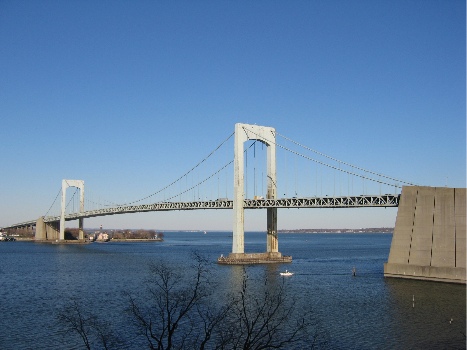
But I digress, again. This is a photo of the Throgs Neck Bridge, taken from Mike’s mom’s patio. She’s on the 7th floor and has a nice view out this way. Beyond the bridge is the Long Island Sound. Imagine it with lots of sailboats and you’re imagining the view on a summer Sunday afternoon. Put some green leaves in the tree in the foreground to complete the picture.

Photo

As you can see, it isn’t always grey in New York in the winter. Friday was a very nice day, although it was still bitter cold, with temperatures in the 30s and enough wind to make it feel a lot colder. Of course, it did get gray again on the next day.

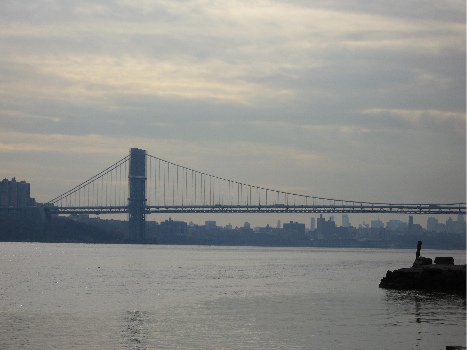
Here’s a look at the George Washington Bridge from the foot of the Palisades. The Palisades, in case you’re wondering, are a line of cliffs along the Hudson River in New Jersey. This photo was taken from a boat basin/park area almost directly across the river from the northernmost end of Manhattan. The view is to the southeast.

Photo

The GW Bridge has two decks — upper and lower — and is a major route between New Jersey and eastern New York. It’s actually the first bridge you get to if you sail up the river from New York Harbor. The next bridge is the Tappan Zee, which is at least 20 miles further upriver. To cross the river closer to downtown Manhattan, you can use one of two tunnels: the Lincoln (midtown at around 30th Street) and the Holland (downtown at around Houston).

When I was growing up in New Jersey, my family had a small boat that we used to take out in the river. I’ve been around Manhattan by boat more times than I can count. It’s a neat trip that you can do on the Circle Line tour boats. We also took a few perilous trips into New York Harbor and around the Statue of Liberty. I say perilous because our boat was really small and the water can get rough out in the harbor. I also remember going past Ellis Island long before it was fixed up and opened to the public. I’ve never been on the island, though.

Anyway, all those boat trips started at the base of the George Washington Bridge, on the New Jersey side. I can still remember the smell of the water at low tide, and the look of all those exposed barnacles. And the way the boat floated up and down as it was loosely tied at the boarding area. We didn’t swim in the river back in those days — it was too polluted south of the Tappan Zee — but we did fish in it, although we never ate any of the fish we caught.

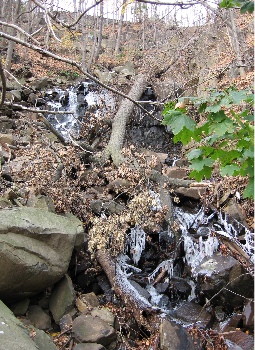
Here’s a shot of one of the “waterfalls” coming down the Palisades to the Hudson River. It’s really probably just runoff from a storm drain, but when we were kids, it was a waterfall and it was one of the most beautiful things we’d ever seen. My family often drove along the river’s shore road on Sunday outings. That’s back in the days when taking a drive in the family car was a cheap and fun day out. There were no malls, no computer games, no cell phones. We’d get in the car and go for a drive and drink up everything we saw out the window. If it was autumn, we’d go to a place called Tices Farms, which had apples and doughnuts (note the spelling) and cider and pumpkins for sale. When I got out of the car to take this photo, the smell of wet leaves brought me back to a time when we would rake them into huge piles and take turns jumping in them. Leave stems would stick in our sweaters and hair and we’d be breathless in the cool autumn sun. I don’t know if you can see it clearly, but there’s ice in the water in this photo. We’re talking cold enough to make a waterfall freeze. Cold.

Photo

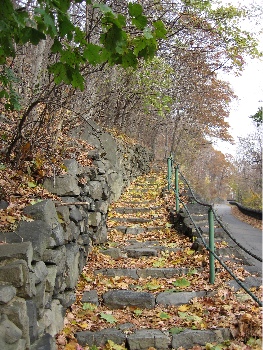
The Palisades area of Bergen County in New Jersey is one of its more historic areas. Originally settled by the Dutch in the 1600s, it was a hotbed of activity during the Revolutionary War. Posted alongside roads all over the area are “Washington’s Retreat Route” signs. Yes. This is the area George Washington retreated from when we weren’t doing very well in the first war with the Brits. Why we need that on signs is beyond me. But the area is also full of walking trails that were probably built during the depression. In more than a few places, you can find stairways and paths that climb the Palisades. This is one example, that follows the road for a short distance before cutting right up the cliff. We did a lot of hiking in the area when we lived there. The views from the top of the Palisades are magnificent.

Photo

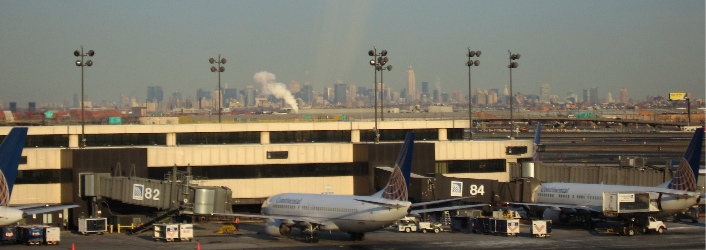
I took the shot that appears below from the AirTrain that travels around Newark Airport. That’s New York in the background.
Photo

This photo reminds me of a visit by one of my editors when we still lived in New Jersey. I picked him up at the airport and was driving north along the New Jersey turnpike toward our house. He looked off to the right as we climbed a bit of highway that passed over the marshes at the Meadowlands and said, “What city is that?” He was looking at New York. That’s when I realized that the skyline I’d grown up with wasn’t nearly as familiar to everyone else.

Am I homesick? Maybe a bit. Would I go back to live there again? Nope.

Been there, done that.

Giving Thanks…

…and asking questions.

This Thanksgiving season, as I prepare to fly back east to spend the holiday with family members in their comfortable homes, I can’t help but think about the thousands of people left homeless by Hurricanes Katrina and Rita.

I can’t imagine what it must be like to have my home and virtually all my possessions taken away by a natural disaster. I can’t imagine what it must be like to wonder where I’ll be living next week, month, or year. What I’ll be doing for a living. How my kids will go to school. Whether I’ll ever have the same level of comfort — even if that comfort level was low by many standards — as I used to.

We drop canned goods into collection boxes and write checks to aid organizations. Some of us even participate in holiday meals at homeless shelters. But do any of us really think about the people we believe we’re helping? How far do you think a few cans of tomatoes and a couple of pairs of jeans that no longer fit you will go to help the people who lost everything?

Thinking about the Katrina victims, formerly of New Orleans, is hardest for me. The levees broke and the pumps failed partially because they were in serious need of maintenance. Maintenance they couldn’t get because of budget cuts and confusion over who would pay. But where did that money go? What government-funded project got the cash that should have gone to the levees and pumps? A new war monument? A parking lot? Mardi Gras clean-up?

And what of the money that should be funding FEMA in this terrible time of need? Oh yes, I know where that’s going. It costs a lot of money to fund a war. I guess our government believes it’s more important to shove democracy down the throats of the Iraqis than to ensure the safety, welfare, and well-being of our own citizens at home.

So as you’re eating your Thanksgiving turkey this year, stuffing yourself with stuffing and gorging yourself with gravy, take a moment to think about the thousands in need in this country.

And give thanks that you’re not one of them.

A Trip to Sedona

I spend the day in Sedona, waiting for some passengers.

Yesterday, I had the pleasure of flying two very nice people from Canada from Wickenburg to Sedona for the day. We arrived at Sedona Airport, after a scenic flight around Wickenburg, Prescott, and Sedona’s red rocks, around 11:30 AM — just in time for the Pink Jeep Tour shuttle to pick us up and bring us down to the town. My passengers were taking a Jeep Tour; I planned on just hanging around downtown until they were ready to return at 3 or 4 PM. I escorted them to the Jeep Tour desk, reminded them that they could change their reservation, and watched them reserve a Jeep and driver all to themselves for departure at 1 PM. Then I left them to walk around town on my own.

The Pink Jeep Tour company’s offices are in “uptown” Sedona. That’s the heart of the tourist district in the northwest corner of town at the mouth of Oak Creek Canyon. The tourist shops that line both sides of the street there are dwarfed by the massive red rock formations behind them. But all attention in uptown Sedona is concentrated on those shops. I admit that mine was, too.

I hadn’t been to the town of Sedona for years. I’ve been flying in quite regularly with passengers, but I seldom come down off the mesa where the airport is located. There’s a restaurant up there and I usually have breakfast or lunch or whatever while my passengers explore the town on their own. They’re usually gone about 2 hours at the most, so I busy myself with a book while I’m waiting. It’s a nice, relaxing place.

But yesterday, my passengers wanted a longer stay in town. And since the Pink Jeep people offered me a lift in the shuttle, too, I went down the hill with them.

I walked the few blocks of uptown Sedona at a leisurely pace. I saw lots of T-shirt shops and lots of souvenir shops. The usual collection of real and fake Indian crafts and jewelry. Imported Mexican rugs. Jeep tour companies. Reservation centers. The wonderful map and bookstore that had been in one of the shopping areas was gone and I was sorely disappointed. I’d depended on that shop for reading material while I waited and it didn’t appear, at first, as if there were another bookstore in town. I finally found one across the street from the Pink Jeep storefront, the last shop on my walking tour.

My Sedona passengers from last week’s flight had spent only 90 minutes in town before returning to the airport. They called Sedona a “tourist trap.” And frankly, as I walked the streets, I couldn’t argue with them. But I hadn’t really expected it to be any different. I don’t know what they expected. After all, take a beautiful place, make its beauty well-known, and people will flock there. When enough people flock there, the tourist shops will start springing up like mold on old bread. After a while, those shops (like mold) completely cover the area, masking what people found so beautiful in the first place.

Now I don’t want to give you the idea that Sedona is “ruined.” It isn’t. There are still plenty of beautiful sights around town. Sadly, there are so many people there to view those sites, you’re always part of a crowd. You need to come to Sedona with your own Jeep and a trail map to get away from the herd. Bring a picnic lunch and your camera. And, for heaven’s sake, don’t come on a weekend!

I ran into my passengers on the street just before they went to lunch. They invited me to join them, but I felt as if I would be intruding, so I declined. I had lunch at a tea shop across from the Pink Jeep place and sat outside on a narrow balcony to eat and read the book I’d bought in the bookstore down below. It was windy and rather cold up there, so I didn’t last long.

Afterwards, I went for a walk back the way I’d come. That’s when I saw the Hummer tour sign. They had a 1-hour tour leaving immediately. It was the “Jeep Eater” Tour. Supposedly, this tour took passengers places were Jeeps couldn’t go. I pulled out my credit card and, minutes later, was seated in the front passenger seat of a Hummer, about 6 feet away from its driver. (Okay, so maybe it wasn’t that wide, but it sure seemed like it.) There were two passengers, a couple from Baton Rouge, in the open-air seating behind us. That was it.

The road that Jeeps can’t drive on isn’t in Sedona. It’s halfway back to Cottonwood, off of 89A. It’s a power line road — that’s a road built to maintain a power line — and frankly, there were only about 4 places on the whole ride that I would have been uncomfortable about taking my Jeep. That’s not to say that my Jeep couldn’t have done it. But I’m not sure that it could have done it with me at the wheel. During the whole ride, the driver kept pointing out other roads that the couple from Baton Rouge could explore on their own with the ATV’s they’d trailered up from home. The driver was obviously working hard to add value to the ride and maximize his tip potential. Whatever. It managed to stretch the tour out to 90 minutes, bringing us back to Sedona just when my passengers were due back. In case couldn’t read between the lines in this paragraph, I don’t recommend this tour. It wasn’t worth the $100 I spent on the tour plus tip. But at least I know what it’s like to ride in a real Hummer.

I hurried back toward the Pink Jeep place and found one of my passengers outside a gift shop. His wife was inside, shopping. They’d had a great time and had looked for me to join them before they left. I didn’t tell them about the Hummer.

I left them for a short while to pick up a gift for a friend of mine and a piece of apple pie that was really good. Then we got back on the shuttle, rode up to the airport, and flew home.

I’m glad I got to go to Sedona for the day. I feel all caught up with things down there. And I’m sure I’ll be back soon — not only by helicopter, but perhaps by Jeep to see just what my Jeep can do.