Wickenburg to Las Vegas by Helicopter

Again.

I couldn’t have asked for better weather. That’s what I was thinking as I preflighted my helicopter early on Wednesday morning.

I’d been hired to take three people from Wickenburg to the Las Vegas area with the primary objective of viewing the new bridge near the Hoover Dam from the air. My client, who had flown with me several times before, was willing to make the four-hour round-trip flight by helicopter — and pay for it — just for a look. To make the trip more worth his while, we’d also land at Boulder City Municipal Airport, where they’d rent a car and drive over to the dam for a tour. After lunch, they’d come back to the airport, climb back on board, and I’d take them for a Vegas Strip tour before returning to Wickenburg.

I’d mounted my GoPro Hero camera on the helicopter’s nose and set it up to shoot 720p video of the flight. I expected the flight up there to yield some good images and, if the camera was mounted properly, some smooth video footage. The camera seems to work best with the light behind the helicopter. On the way back, we’d by flying with the sun in front of us, so I didn’t have high expectations. Still, I brought along a pair of 16GB SD cards and the camera’s charger so I could capture it all. The images throughout this narrative are stills taken from that video.

The Flight Up

A thin, almost lacy layer of high clouds veiled the sky as we headed northwest from Wickenburg just after 8:30 AM. There wasn’t a breath of wind. The helicopter glided over the desert, 500 feet off the ground passing over cacti and other desert vegetation, open range cattle, and the occasional manmade water “tanks,” half of which were dry. Our departure from “civilization” to empty desert was almost immediate. As I often tell people, Wickenburg is on the edge of nowhere; I could just as easily say it’s a five minute flight from nowhere. We passed over a lonely ranch alongside the railroad tracks leading to Parker and beyond, then Route 71, which runs between Aguila and Congress, AZ. Then not a single building for thirty miles, when we reached the Wayside Inn and Alamo Lake.

Alamo Lake
Alamo Lake, at the confluence of the Big Sandy River, Santa Maria River, and Date Creek. The trickle of water released from the dam is the Bill Williams River, which eventually joins the Colorado River north of Parker, AZ.

I climbed not only to cross the lake within gliding distance of shore but to clear the mountains on the far side. As we crossed the lake, I was surprised by the number of campers parked alongside its shore and the boats tied up nearby. I suspected that a fishing tournament might be either starting or finishing up. The lake is popular with fisherman, which is probably a good thing. It’s so remote — heck, it’s a 90-minute drive from Wickenburg — that it simply doesn’t appeal to the typical powerboat/jetski crowd. They usually prefer Lake Pleasant, only 30 minutes from Phoenix (or Wickenburg), which is larger and far more interesting for boating.

Beyond the lake and the rugged mountains on its opposite shore was yet another stretch of empty desert. But rather than being just a flat expanse, this one was peppered with rock formations left behind by ancient volcanos. There were areas of broken basalt, including flat-topped mesas. In the distance, to our left, we could catch glimpses of the Colorado River. If we’d been in a plane, flying 3,000 feet higher, we’d have a better view of the river and mountains in the distance; at our cruise altitude of 500 to 1000 feet above the desert floor, we could clearly see the details of the rock formations, dry stream beds, and scant vegetation as we flew.
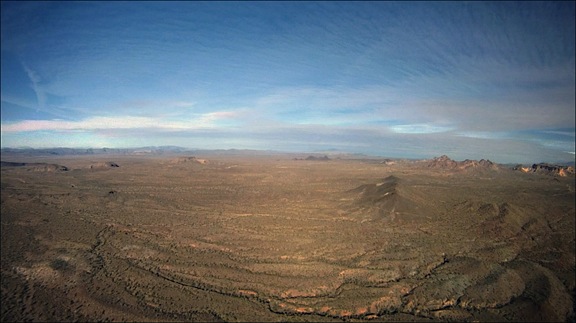
Beyond Alamo
The desert northwest of Alamo Lake is vast and empty.

Forty-five miles from Alamo Lake, we reached Lake Havasu, one of the Colorado River’s many lakes. Formed by Parker Dam far to the south, the lake widens in a broad valley. The founders of Lake Havasu City bought the London Bridge — the real London Bridge from England — and had it installed across a manmade canal as a tourist draw. The town formed nearby. It’s popular for water sports and has a huge influx of visitors during boat races and Spring Break. A friend of mine who lives there complains that the temperatures top 100°F six months out of the year.
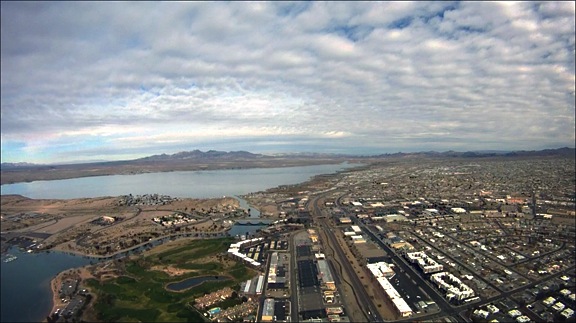
Lake Havasu
Lake Havasu’s surface was mirror calm as we flew over, reflecting not only the graceful arches of London Bridge, but the clouds high above.

I’d chosen our route carefully. Two hours is a long time to spend in a helicopter, especially out over the desert where the terrain can be — and, up to that point had been — very monotonous. I planned the trip to follow the Colorado River, which was quite scenic. From that point on, we’d be over one shore or another or at least nearby. It would give my passengers something interesting to see for the second hour of the flight.

Indeed, the scenery along the river can be breathtaking — especially where the river narrows and passes through mountainous terrain. Topock Gorge is one of those places. Although it’s a short stretch of river and takes only five minutes or so to overfly, it’s dramatic and rugged. During the summer season, when the lake busy, speedboats roar through this area all day long. But that day, the lake was calm and quiet and we were treated to beautiful reflections of the sky and canyon walls.
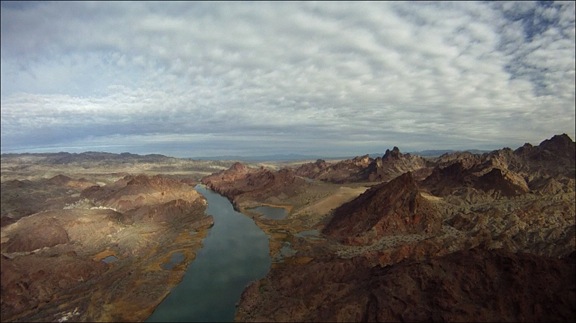
Topock Gorge
Topock Gorge is one of the more scenic areas along the Colorado River between Lake Havasu City and Bullhead City.

Past the gorge, the river twists and turns in big arcs to the east and west. Rather than follow its course exactly, we headed almost due north. We passed over I-40 where it crosses the Colorado and the farms and communities built up in the Mohave Valley. This was also desert, but desert made habitable by the river that passed through it. Make no mistake: we were still miles from anything remotely resembling a real city — but at least there were people living here.
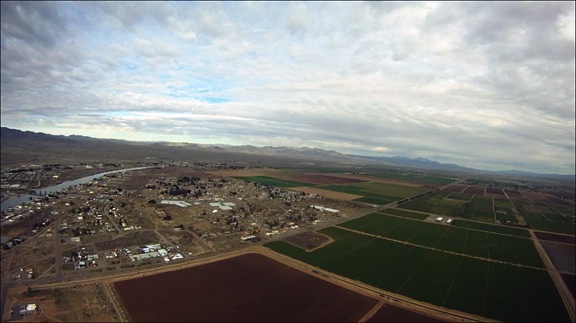
Mohave Valley
The Mohave Valley, near Needles, CA, is full of farms and small communities clustered up near the Colorado River.

A while later, we were within range of Bullhead City Airport and I called the controller for permission to transition the area along the river. Bullhead City Airport is a real oddity. It was built on the Arizona side of the river to support the casinos in Laughlin, NV. Although it’s well over 100 miles from any international border, it’s an International airport, meaning that you can fly into it from other countries and pass through customs and immigration. It even gets airline traffic; as we flew through the area, a Sun Country 737 was coming in to land. But the airport itself gets very little traffic. This might be because of the natural “wind tunnel” that funnels air up or down the river, resulting in winds that often top 20 knots. But that day, the wind was calm — the first time ever that I’d been there — and other than the jet, we were the only other traffic in the area.
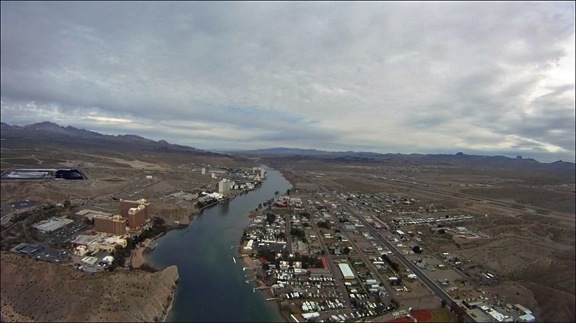
Laughlin, NV
The tall casinos of Laughlin, NV across the river from Bullhead City, AZ. You can see the Bullhead City airport on the far right.

Beyond Laughlin and Bullhead City was the Davis Dam, which forms Lake Mohave. Lake Mohave is another one of the oddities of the desert. Although there are a few marinas and campgrounds along its southern shores, most of the lake is deserted and I seldom see any boat traffic on it. Again, this is likely because of its remote location — although access is easy from the Laughlin area. It seems to me that Lake Mohave would be a great place to become a houseboat hermit.
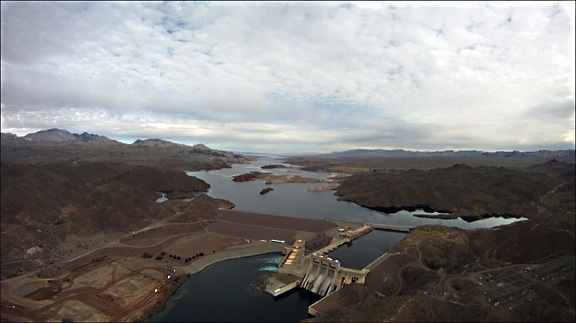
Davis Dam
The Davis Dam is just upriver from Laughlin and Bullhead City.
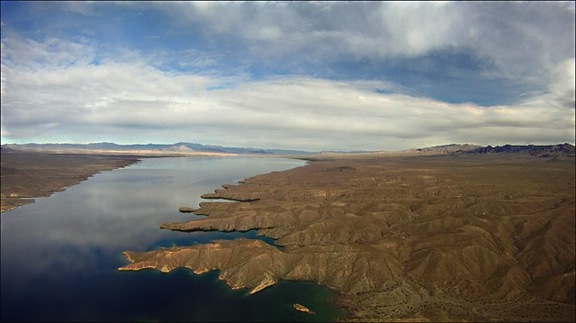
Lake Mohave
Lake Mohave seems like the perfect place to get away from it all on a clear, blue lake.

We flew up the eastern shore of the lake and I kept a sharp eye out for wild burros (donkeys). I’d seen them there before. While their trails were easily visible from the air, I didn’t see any animals — or people — at all.

The north end of the lake narrows considerably where the Colorado River winds through a gorge. The rock formations are rugged and starkly beautiful. This isn’t the place you’d want an engine failure — there aren’t many places for an emergency landing. But the landscape draws me to this area each time I fly up the river.
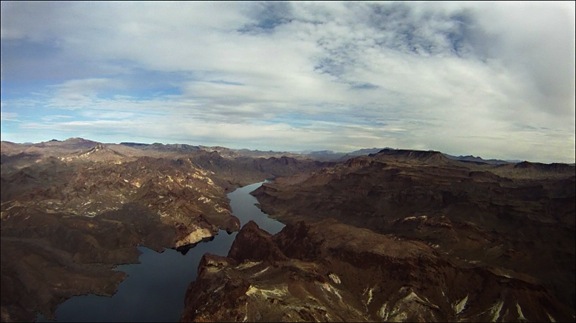
Colorado River
The Colorado River on the north end of Lake Mohave passes through a rugged gorge.

I tuned into the Lake Mead/Hoover Dam tour helicopter frequency and began monitoring communications. I knew that the area around the dam would be full of traffic and wasn’t sure what altitude pilots would be flying at. Routes and procedures are not published; my attempt to get this information from a tour operator failed miserably. (These operators apparently think they own the places they fly over and do what they can to keep everyone else out.)

I reached Willow Beach and made my first call. “Helicopter Six-Three-Zero-Mike-Lima at Willow Beach, heading for the bridge at 2500 feet.”

Some wise-ass tour pilot came on the radio and said “Which bridge? Hoover?”

What an idiotic question. There was only one bridge within 60 air miles. Which bridge did he think? What kind of morons are those tour companies hiring?

“Hoover,” I replied.

“Be advised that there will be four Maverick helicopters over the dam in about two minutes,” he replied. No indication of altitude or any other useful information.

Other pilots were more generous. Although the Papillon Pilots seemed to be crossing the river farther south at 3500 feet, the Maverick pilots were operating near the dam at 3000 feet. I planned to say at 2500 feet, which would keep me out of their way.

The bridge came into view around the same time the Maverick helicopters started appearing overhead. They were flying an odd S-shaped pattern that was obviously designed to give all their passengers a view. I did a three-quarter circle from the right to the left as my passengers leaned forward and then left to see. They got a good look — I was not prepared to loiter and they didn’t seem as if they needed me to. Then I was exiting the area along the road to Boulder City.

Hoover Dam and Bridge
The Hoover Dam and its new bridge are a popular tourist attraction for Las Vegas visitors. They’re amazing from the air.

I wasn’t finished yet, though. Another tour operator does very short tours of the dam and bridge from the Hacienda Hotel just up the road. He was preparing to launch as I flew over. He kindly said he’d wait until I’d passed by, then thanked me for talking on the radio. (Apparently, some pilots don’t — that’s a scary thought.) I thanked him for listening.

Not knowing the approach procedures for Boulder City Airport and anxious to stay out of the way of any other tour traffic, I stayed low as I crossed over the city and headed for the airport. (I was later told I’d likely get in trouble for that, but no one ever called. I guess I lucked out.) There were skydivers falling from the sky near the airport so, to stay clear, I circled around to the east and landed along one of the runways. I was still on edge from mixing with so much other traffic when I set down on one of the helicopter parking spots for the FBO.

Boulder City
Boulder City was built 90 years ago to provide a home for dam construction crews. It’s since grown to a vibrant community — the only one in Nevada that does not allow gambling.

We’d been in the air for 2.2 hours and I was ready for a break.

More about this trip in another post…

Today’s Snowy Adventure

A comedy of errors in four acts.

I’m at Bryce Canyon this morning. I flew up here with a client to do an aerial photo shoot. We knew the weather was going to get bad today and made sure we arrived yesterday, before we couldn’t get in at all. Based on the forecast, we figured we’d get the shoot done on Sunday afternoon and Monday morning before heading down to the Grand Canyon to do a shoot there.

The weather was surprisingly good and, if it hadn’t been so windy, we probably would have attempted the shoot on arrival. Instead, we parked the helicopter and I slipped on its blade hail covers, which I’d brought along. We’re not expecting hail, but I figured (correctly, according to two cold-climate pilots I spoke to) that the covers would also keep snow and ice off the blade surfaces. Unfortunately, there was no way to guarantee that snow wouldn’t accumulate on top of the covers. Heavy snow or ice sitting on the covers on the blades could cause them to droop excessively; if that happened, the blade droop stops could be damaged. So I’d have to keep an eye on the situation, possibly by making multiple trips to the airport during the weekend. The airport is 3 or 4 miles from the hotel we’re staying in, Ruby’s Inn. My client rented a car.

After checking in at Ruby’s the weather got better and better. My client went into the park to photograph the hoodoos and stayed there to watch the moon rise. He told me later that he took 20-minute exposures of the hoodoos lighted by just the moon and they look like they were shot in daylight. (I’m looking forward to seeing them.) I elected to stay in my room. I’m recovering from a nasty cold that just about ruined my vacation. It was cold out — probably around 35°F before sunset — and the heater works very well in my room. When I finally turned in for the night around 9 PM, the moon was shining brightly in what looked like a perfectly clear sky.

Hard to believe the weather forecast said 80% chance of snow in less than 2 hours.

Act I: The Snow Begins

Things were different when I woke up at about 3:40 AM. There was probably about 2 inches of snow on the ground and more coming down. Two hours later, when it started to get light, there was at least another 2 inches. Not much wind, either. I started wondering how much 4 inches of snow on 14-foot long helicopter rotor blades weighed.

At about 7 AM, my client showed up outside my door. I saw him through the window; he didn’t want to knock. I opened it. By then, the snow was quite impressive, piled up on everyone’s car. The wind had begun to blow a bit, too.

“Look at all this snow,” he said. “We can’t go to the airport to check the helicopter. The car is just a sedan. No four wheel drive.”

In all honesty, it didn’t look that bad yet. I recall driving 40 miles in snow twice as deep — in a 1987 Toyota MR2. Not exactly an all-terrain vehicle.

I told him I’d call the airport. I did. No one answered. I left a message asking them to peek out the window and report back to me about the rotor blades. But at the rate the snow was falling, I wasn’t willing to wait long for a report. I told my client I’d try again in a half hour. Otherwise, I needed to go.

The snow kept falling. The wind was blowing but didn’t seem to be making a dent in the accumulations on the tops of cars and trucks parked silently in the lot below my window.

Act II: Our Drive to the Airport — and Confrontation with a Jerk

Dressed for WinterAt 7:30, after getting no answer at the airport again, I got dressed in my best effort at winter gear. That meant a cotton turtleneck shirt with a cotton long sleeved shirt over that, a pair of nylon/spandex leggings with a pair of denim jeans over that, cotton socks, sneakers (I left from Phoenix where I don’t keep a pair of boots), my wool scarf, my leather jacket (with lamb fleece collar removed so as not to gather snow), ear warmer head band, baseball cap, and wooly gloves. The only pieces of clothing from my suitcase that I wasn’t wearing were my pajamas, the shirt I’d worn the day before, and one extra shirt I’d brought along. I looked ridiculous (see photo; I don’t think putting this photo on Craig’s List would get me in as much trouble as this guy’s photo did) but figured I’d be warm enough.

I went to my client’s door. He was wearing sweatpants, having a cup of coffee. He didn’t look ready to go out. I told him I’d start scraping the snow off the car. He protested quite loudly, but I just went.

Partially Cleared SnowI had a plastic shopping bag with me and I used it to cover one arm. (The goal was to keep as dry as possible.) I then used sweeping motions to get the snow off the car. It didn’t take long. The snow was a bit wet but moved easily. Not very heavy. But there was at least 8 inches of it accumulated. What would that weigh on my blades? I was starting to get very nervous about it.

A plow came through the parking lot leaving the inevitable snow bank behind the car.

My client appeared. He told me he was going to buy an ice scraper. I pointed out that there wasn’t any ice. I asked him to start the engine and use the wiper blades to finish off the front window. I recleared the side and back window; another 1/4 inch of snow had already blanketed them.

While he backed up, I stood at the hood, pushing. He didn’t seem to have much trouble moving it, but made the fatal error of turning the wheel before he’d cleared the snowbank. The back end of the car plowed into it and the car was stuck fast.

I started work on the snowbank. By this time, two other cars had successfully extracted themselves. Two guys hurried over to help us. When the car wouldn’t budge, one asked if he could sit at the wheel. My client stepped out and the other guy got in. With three of us pushing at the hood and the driver’s good “rocking” skills, the car was soon extracted. I asked if we could help them with their car and they assured us that wasn’t necessary. They had four-wheel drive.

My client wound his way through the plowed area of the parking lot and into the main road. He was not a happy camper. But the road didn’t seem slippery, and at our slow speed, we weren’t sliding around at all. The main trouble was seeing the road. Everything was white and the road surface perfectly matched the white snowbanks on either side. Visibility was probably about 1/4 mile. The airport’s weather system was reporting freezing fog and now I knew what that looked like.

When we reached the junction of Highway 12, we stopped. There was no one around us in any direction. From inside the car, it was impossible to see if the road had been plowed at all. So I got out to take a look. It had been plowed, but not recently. It had tire tracks on it. It looked doable.

But before I could begin convincing my client/driver to continue on, a beat up old pickup truck made the turn onto our road. Because we were stopped in the middle of the road, he pulled in on our right side, facing into incoming traffic (if there had been any). He got out and told us we needed to be off the road. The conversation went something like this:

Him: You need to get off the road.

Me: We’re just checking road conditions. We’re going to the airport.

Him: Do you know where that is?

Me: About a mile or two that way. (I pointed into the whiteness of Route 12.)

Him: You need to turn around and go back.

Me: We can’t turn around here.

Him: Then I’ll call a tow truck.

Me: We don’t need a tow truck. We’re not stuck.

Him: Then I’ll call the sheriff.

Me: Why?

Him: You need to get out of the road.

Me: We will. We’re just looking at the road conditions before deciding what to do.

Him: I’ll call the sheriff.

Me: [exasperated and tired of maintaining a pointless conversation with a self-important moron] Go ahead.

Meanwhile, my client was beginning to freak out. He’s not American born and although his English is good, I don’t think he was able to keep up with our rapid-fire exchange. He did, however, hear the word sheriff twice, and he assumed we’d done something serious enough to possibly get arrested.

Him being freaked out wasn’t helping matters. He already was worried about continuing on the road. Now we had this jerk partially blocking our car, talking to someone on his cell phone. I needed to get to the airport. I knew it was possible. I had to convince my client. Finally, all I managed to do was convince him to let me drive. But the jerk was still blocking us. Tooting the horn had no affect.

That’s when I got pissed off.

I got out of the car and walked around to his window. I could tell by his uniform shirt that he worked for a gas station or something. I asked him where he worked and he said he worked for the tow truck operator across from our hotel. (Figures.) I told him I didn’t like his attitude and would be talking to his boss. He held the phone out so whoever was on it could hear me and I repeated loudly at the phone, “Your attitude sucks and I’ll talk to your boss about it.” I started to walk away, but then turned back and said, “Now get the fuck out of our way.” (Once a New Yorker, always a New Yorker.)

As I walked away, he got back out of the truck and started shouting at my back. “Well, I’m also the fire chief in [redacted] and on the EMT team and — ” I didn’t hear the rest. I was already in the car with my door closed. He, of course, didn’t move. Instead, he made a big show of walking behind the car, apparently to get our license plate number, further freaking out my client. I had to carefully make my way around his piece-of-crap truck, avoiding the deep snow bank on my left as well as I could. Then I made the left turn onto Route 12 and headed toward the airport.

The going was easy. But what really surprised me is that the airport road was plowed. The only problem was the snow bank from our road to that one. So we got out, leaving the car in the middle of the deserted road, and worked on it. I discovered that a floor mat, when wielded by two people, works very well as a scraping shovel. I turned the corner and saw a big front-end loader coming toward us. The airport guy was using it to plow the road. We stopped and talked to him. He said there wasn’t much snow at all on the helicopter. Then he told us where we could turn around safely past his house down the road.

We continued to the airport and were very surprised to see that there was hardly any snow on the helicopter at all. The wind was doing all the work for me. All those worries for nothing. We stopped and talked to the airport guy again. He volunteered to keep an eye on the helicopter and clear snow off it needed. He was a good, reliable, friendly guy. I felt all my worries fade away as we said goodbye and headed back to the hotel.

Act III: Black Ice

If you’ve ever driven in fresh snow, you might know that some snow is actually quite easy to drive in. It’s the stuff that’s not too wet and not too dry. It packs under your tires as you drive but doesn’t turn to ice in the process. That’s what we’d been driving on until we got to the airport road.

The airport road, however, was freshly plowed. Maybe it was the sight of that clean black pavement on the road in front of me that gave me the confidence I needed to drive at 20 miles per hour rather than a more conservative 10 or 15. Unfortunately, what I didn’t realize is that I wasn’t looking at pavement. I was looking at the half-inch layer of solid, smooth ice that sat on top of it.

Black ice.

There’s a tiny bend in the airport road before you reach Route 12. It’s so slight, it doesn’t even show up on a map. As I turned the wheel to the left to make this bend, the tires started to skid. My client reacted by saying the appropriate frightened passenger words. I pumped the brakes gently and, for a second, had it under control. Then more skidding and more right seat panic. My brain shut off and my foot pressed the brake down hard. Then it was all over.

Snow BankIn slow motion, the car skidded nose first into the snow bank on the right side of the road.

Shit.

It was stuck good. I couldn’t even get it to move an inch in either direction. The front wheel drive tires were sitting right on some of that black ice and all they could do was spin. We worked on it for a good ten to fifteen minutes, even putting the floor mats behind each tire in case it moved. No joy. And I do mean that literally.

We retreated into the car where I tried to get the airport guy on the phone. He didn’t pick up his cell. I called another number on the airport’s voice mail message system and reached a guy in Las Vegas. He was the airport guy’s boss. He said that he was out on the plow (which I knew) and probably couldn’t hear the phone ring. I told him our predicament. He told me to call 911. I said, “No, this isn’t an emergency. We’re in a warm car with plenty of gas within sight of Route 12. One way or another, we’ll get out without emergency assistance. Let them take care of heart attacks and accidents.” I think he was surprised by my take on 911. I asked him to mention us to the airport guy if he happened to call back.

I thought about calling AAA and realized that they’d likely call the jerk I’d cussed at and he’d likely not come. (Yeah, yeah, save the lectures.)

I started walking back toward the airport while my client yelled at me to stay in the car. I had to slip and fall twice on that damn black ice before heeding his words.

I tried the airport guy a few more times. On the third time, he answered. I told him our predicament. He told me he’d be right out. I told him to take his time. Warm up, have some coffee. We could wait. My client agreed. “Bring a shovel, though,” I added.

He showed up about 15 minutes later with his big front-end loader and turned it around so its back end faced the back end of our car. Then we hunted around for a place to tie onto the car. In the old days, imports — this was a Mazda — had these loops on the front and back of the car to tie them down during the boat ride from Japan. This one didn’t have those. But he found a loop on the frame. Trouble was, his chain wasn’t long enough to reach it.

He climbed back into his rig. By that time it was snowing very hard and the wind was blowing it almost horizontally. When he came back, he told me he’d made some calls and couldn’t get chain long enough to do the job.

“What do you think our options are?” I asked him.

“Well, I called the rental company for you and they said they could send a tow truck for $45.”

I’d already told him about our confrontation with the jerk. “The same tow company that guy I had a fight with works for?”

“I can ask them not to send [redacted jerk’s name],” he promised, grinning at me.

“Then do it,” I said. “I’ll pay $45. Cash if they want it.”

He made the call. I overheard him say, “You have to send [redacted jerk’s name]?” and I said, “I’ll pay $75 if they don’t.” He laughed and said, they’re just pulling your leg.

Call done, he told us to wait in the car. My client had been shoveling snow the whole time. I told the airport guy to go back and we’d be okay. He said he’d stick around just in case [redacted jerk’s name] showed up. I offered to let him wait with us in the car, but he preferred the backhoe.

We got back in the car. My client was really freaked out by the snow accumulation and the prospect of driving back to the hotel. That surprised me because he lived in Chicago and was no stranger to snow. But he told me that at home he had a truck with some sort of special snow driving gear. I didn’t get the details, but it seemed that he was convinced such special equipment was required for driving in the snow.

Whatever.

I just felt like an idiot for skidding into the snow bank and getting stuck. I know nothing had been damaged other than my pride, but I resolved to rent my own car on any future trips to shield my clients from the consequences of my stupidity.

Act IV: The Happy Ending

The tow guys showed up a while later and [redacted jerk’s name] was not among them. One of them asked me if I was the one [redacted jerk’s name] had a fight with. I admitted I was and we all had a good laugh. It took some work to get the car out and all three of the guys helping us nearly fell on their butts because of the damn black ice. Every single time one of them slipped, they’d comment on it. It was really nasty stuff. When the car was out, they said they’d be just as happy if we paid via AAA — in other words, making it a free tow — and urged us to do so. That worked for me.

I told the airport guy that I owed him big time but he insisted we were even. Even? How? I hadn’t done him any favors. At least not yet. I’ll think of something and if I don’t come up with a good one, I’ll leave my friend Ben Franklin on his desk before I fly out on Monday.

My client drove back with me pointing out the road. He was still having trouble seeing it. The tow guys followed us. We went into the gas station where my client took care of paperwork. He told me he would put it on his AAA, but he wound up paying instead, worried that he’d need the tow again later in the day and knowing that AAA doesn’t respond twice in one day. (I’ll put a $45 credit on his bill for this job.) I slipped each of the tow guys $10 in plain sight of [redacted jerk’s name] who appeared outside as we arrived, apparently looking for sunglasses left in their truck. We all ignored him. (In real life, as in online forums, the best policy is usually to ignore the assholes.)

Meanwhile, my jeans were completely soaked and I was starving. My client and I went into Ruby’s for breakfast. While we waited for coffee, he urged me to check out the boots they had available in the adjacent store. I went into the store, but instead of looking at the boots, I found a pair of sweatpants. I used the fitting room to peel off my jeans, surprised that the leggings beneath them were dry. I put on the sweats and went right to the cash register, picking out a pair of socks on the way and carrying my wet pants and newly washed sneakers. “I’m buying these now,” I told the cashier, reaching into the back and pulling the price tag off. We had a good laugh as she rung me up. It was the first time I’d ever spent $16 on a pair of socks, but desperate times require desperate measures. I was back at the table before my coffee was cold and received the scolding delivered by my client because I’d come back without new shoes.

I changed my socks while my client was outside having a smoke and I was at the table waiting for our meals.

Breakfast was typical Ruby’s. I’d like just once to get a good meal with good service there.

My client dropped me off at my room before venturing into the park. Visibility is so low that I think it’ll take quite some time for conditions to improve enough for photography. But that’s what he’s here for.

Me, I’m just along for the ride until it’s time to fly.

And yes, I’ll keep my hands off his rental car.

February Needs More Days

We are experiencing scheduling difficulties. Please stand by.

Ever have one of those months where there just aren’t enough days? We all say that about February — mostly because it usually only has 28 of them — but even if it had its full share, it wouldn’t be enough. Mine is booked solid.

Want a glimpse of what my work/personal life is like right about now? Here’s the bullet point edition:

  • I have two chapters left to write on a book I’ve been struggling to finish since November. Part of the problem was that my editor didn’t seem to take much interest in the project, which led me to feel much the same way. Now, of course, they want it done already (as they should) and I also feel the same way.
  • One of my other publishers suggested a topic for a brand new book for them. I need to come up with an outline and make contact with the public relations person for the software company to see what kind of support I might be able to get from them.
  • That same publisher is gearing me up for a revision of my Mac OS X book for Lion. That book, which I also do layout for, has a brand new look, requiring a new template and mindset.
  • Another publisher is making noises about another revision for another project. I’m think it might be pretty far out on the horizon, but I need to chat with them about needs and scheduling.
  • AircraftOwner Online has announced that my monthly article deadline is now the 12th of the month rather than month-end.
  • I’m under contract to write two more articles (that I keep putting aside) for a Web publication. I won’t get paid for the first one I wrote (last year) until I hand in these two.
  • One of my aerial survey clients wants a 1-2 day wildlife survey flight in northern Arizona next week. (This just popped up today.)
  • One of my aerial photo clients has booked a 4-day photo flight in Arizona and Utah for mid-month. The flight requires me to obtain permits for flying low level in three different national parks. (And yes, one of them is the Grand Canyon. Wish me luck.)
  • I have to drop off my helicopter for its 100-hour inspection in Mesa, AZ; a few days later, I have to pick it back up. I also have to hope there’s nothing wrong with it that would prevent me from picking it up on time.
  • I have an FAA Part 135 check flight scheduled near month-end.
  • I have a day trip to Sedona scheduled near month-end.
  • I have a week-long vacation in the Bahamas with my husband. (A business trip for him; a chance to breathe for me.)
  • I have to drop off and then pick up Alex the Bird from his boarding facility before and after the vacation.

Get the idea?

You might have noticed that blogging does not appear anywhere on this list. That’s not a mistake. Blogging falls very low on the priority list. So low, it doesn’t even appear on lists. So this might be the only original blog post you see for quite a while.

Just thought it fair to warn you. This is going to be a very long short month.

And who says freelancers don’t work hard for a living?

So You Want to Be a Helicopter Pilot, Part 4: Choose a Reputable Flight School

Get what you pay for.

The quality of your training will be determined by your flight school. And believe me, you want the best training you can get.

Some Basic Tips

Here’s a bunch of tips for choosing a flight school; sadly, most of them are “don’ts” because of the kinds of marketing tactics some schools use:

  • Don’t be lured by ads for cheap training with promises of jobs at 300 hours of flight time. These schools are not interested in turning out quality pilots. They’re interested in attracting as many wannabes as possible to fill out their bottom line.
  • Don’t get fooled by schools that make verbal promises about hiring all graduates as flight instructors. A verbal promise isn’t worth more than the paper it’s written on. Many flight schools will tell you anything you want to hear to get you to sign up. Besides, wouldn’t you rather get trained at a school that chooses the best CFIs as instructors than the one who takes any CFI as an instructor? And do you really think they can hire all of their graduates? What happens when graduates hired as CFIs outnumber students? How many hours of flying will you get then?
  • Don’t look at the biggest or smallest schools. Look at schools somewhere in the middle. These are the ones where you’ll have the benefit of several CFIs on staff while still getting some level of personal attention.
  • Check into the experience of the training staff. Find out how many hours of flight time the chief flight instructor and some of the other flight instructors have. Find out whether any of them have real-life flying experience. Flight schools that offer tour and charter services also offer opportunities for their CFIs to get the kind of experience they’ll use in future jobs.
  • Once you’ve got the flight schools narrowed down to one or two, talk to some of the students and flight instructors there. See what they think. Try to get the contact information for one or two graduates who have moved on to see whether they thought their training at the school helped them succeed.

Don’t be lazy and take shortcuts here. Your future starts with your training. Do your homework. You’ll be amazed by what you learn.

Equipment

Learn to Fly Here SignThere are a lot of people who make a big deal over the kind of equipment used for flying. There are three basic helicopters used for training: Robinson R22, Schweitzer Schweizer 269/300 (which has a bunch of other names), and Enstrom F28F and 280FX. News flash: They’re all good.

The R22 is an extremely “squirrelly” helicopter. It really takes all of your attention to fly. Its two-bladed system makes it unsafe for aggressive or low-G maneuvers, but ground resonance is not an issue. Robinsons are widely respected and widely used in flight schools.

I can’t speak firsthand about the Schweitzer Schweizer since I’ve never flown one. I know that as a helicopter with a fully articulated rotor system, it’s capable of performing far more aggressive maneuvers than a Robinson. I’m not sure if that’s a good thing. It is susceptible to ground resonance. I have heard that its glide slope in autorotation is steeper than an R22 but can’t back that up with facts and figures.

I have flown an Enstrom and, in all honesty, I wasn’t impressed. The excessive vibrations really turned me off, but that could have been caused by the blades being out of balance or some other maintenance issue on that particular aircraft. It also has a fully articulated rotor system, but I can’t recall hearing anything about one getting into ground resonance. I don’t know enough about its flight characteristics to pass judgement on it.

Most pilots favor the helicopter they trained on. That’s true with me. Not only did I learn in an R22, but I owned an R22 Beta II for four years and put at least 1,000 hours on it. But who knows? If I’d trained in a 300, I might have all kinds of love for it instead.

I’m hoping that folks reading this who have more knowledge about the other two aircraft will comment on their experiences. (Warning: I will not allow an equipment-bashing comment thread to form for this post. Present facts about what you know; not hearsay about what you don’t.)

I certainly don’t think you should pass up a flight school because of the brand of its equipment. The age, maintenance quality, and condition is far more important. You want a flight school with its own hangar and maintenance facility. You might even want to take a look at it to make sure it’s relatively neat and clean and the mechanics look like they know what they’re doing. A place with friendly mechanics who are willing to talk to you when you have a mechanical problem or question will certainly help you get more out of your flight training.

There’s one other thing to keep in mind. Some flight schools have one or two turbine helicopters on hand that they use for charter work or even training. When trying to get you to sign with them, they might hint or even promise that they’ll give you a certain number of hours of turbine flight time. Get any promises in writing. It is not uncommon for flight schools to give students the impression they’d get turbine transition training in a package deal and then, for some reason, not provide it. Either the aircraft was down for maintenance or there were too many other pilots queued up for time in it or there was an additional fee that was never discussed. If a turbine aircraft is dangled like a carrot in front of you, get all the facts about flying it before signing up.

Beware of Package Deals

And that brings up the topic of package deals. My advice is this: Do not sign with a school that forces you to enter into a contract for all training and pay them a bunch of money up front. (This was also pointed out by Damien in comments for Part 2 of this series, which discussed funding your flight training.) You do not want to be contractually tied to any flight school (at least not without a contractual way out that won’t cost you anything) and you certainly don’t want them getting money upfront (beyond reasonable prepayments) for services yet to be rendered.

If there’s anything the Silver State debacle taught us, it’s that flight schools aren’t always around forever. If they fold with your money, you’re out of luck.

Equally important is that if you decide after a few weeks or months of training that you don’t like the flight school and want to continue training elsewhere, you have the freedom to do so. And believe me; this happens more often than you think.

Networking Potential

Keith, who has far more experience flying far more equipment in far more places than me, pointed out in comments to my earlier post about age:

I know several aspiring pilots who I have counseled about the helicopter business but I hesitate to recommend a school to them. My usual advice on schools has been pick the best ranked school that provides the greatest possible chance to get that first job.

It is a little discouraging to me to have to tell an aspiring career pilot that all the good grades, excellent flight reviews and mind numbing study may come to not if they don’t make that first job happen for themselves. Perseverance helps but choosing the right place to train and the connections and recommendations that come from certain schools and/or instructors might make all the difference. It is still a small industry where more positions are gained through personal recommendations and associations than any quantity of paper credentials. Your reputation in this industry begins at day one and for good or bad will follow you your entire career.

This is excellent advice for career pilots. I know of at least once school — now defunct — that had a terrible reputation for training. It got so bad that many employers would simply not consider any pilot that had that flight school listed on a resume. That’s a difficult hurdle to jump when you’re just starting out.

But I think what Keith’s saying goes beyond just choosing a flight school. I think it also has to do with how you represent yourself throughout training and your first few jobs. That’s attitude and I’ll cover that next.