Tips for Aerial Photographers

The pilot really does know best.

The other day, I had a very unusual aerial photography job. I was hired to take two videographers on an air-to-air photo shoot of the world’s largest paper airplane.

There were a few things about this gig that bugged me and, frankly, it all had to do with the primary videographer on the shoot. He did things that severely limited our ability to get the shots he needed and rendered some of my equipment non-functional after the flight.

I’d like to discuss this in a bit of detail in an effort to help other videographers understand how to make the most of an aerial video shoot.

Bad Seating Position

This was an air-to-air photo shoot requiring me to fly in formation with another helicopter that was towing an 800-pound, 45-foot “paper” airplane. (I put paper in quotes because there was some cardboard and tape and metal spars for stabilization, but it was mostly paper.) When the other helicopter dropped the airplane, I’d have to chase the airplane down to the ground. We had no idea how fast the airplane would fly or whether it would fly smoothly or erratically. And, of course, the other helicopter would be dangling a 150-foot long line, so it was vital that I didn’t fly right beneath it after the drop.

The other pilot and I agreed that I’d form up on him. What that means is that he basically ignores me and I have sole responsibility for maintaining a safe distance from him. He’s the “lead,” I’m the “wing.”

In order to maintain a safe distance, I have to be able to see the other aircraft at all times. Seems pretty simple, huh? Can’t maintain a safe distance from something you can’t see.

And this is where the problem arose. In order for me to see the other aircraft, I need a direct line of sight to it. I can’t see through a videographer’s body.

I asked the videographer to sit in the back, behind me. This would give both of us the same view. This is how I prefer to work. It enables me to keep the helicopter in position for the shot. I’ve done this on numerous photo shoots with fast-moving targets. It works.
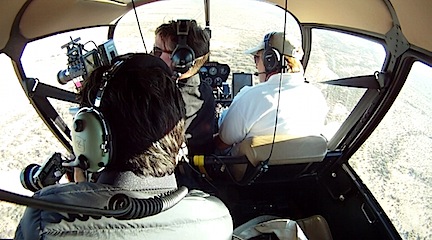
Aerial Video Shoot
This is a frame-grab from one of my GoPros. Ideally, I should have had only one videographer on board and he should have been sitting behind me.

But the videographer refused to even consider sitting in the back seat. He had to sit in the front. This forced me, in the right seat, to fly with the other aircraft on my left. The videographer’s body obstructed my view to the left toward the other aircraft.

Although I was able to see the other aircraft most of the time, there were two or three instances when I could not see it. To stay safe until I could regain a visual on it, I banked away from where I thought it might be.

The videographer was not happy about this. “Get closer,” he’d say. And I’d reply, “I can’t get closer to something I can’t see.”

On a go-forward basis, I will not allow a photographer or videographer to block my view on any air-to-air photo shoot. If he can’t sit behind me so we can both see the other aircraft, I won’t do the flight. Period.

Poor Choice of Equipment

Two years ago, I spent over $10,000 on a Moitek gyro-stabilized video camera mount. This system uses three Kenyon KS-8 gyros to remove virtually all vibration from a camera while bearing all the weight of the camera equipment and giving the videographer a wide range of motion left, right, up, and down. No, it’s not as flexible as a hand-held camera, but as long as the videographer can keep the subject in the frame, he’ll get smooth video of it.

In an effort to recoup the cost of this system — and compensate me for the 30 minutes of setup and 30 minutes of tear-down time required for use — I charge $500 per day.

I offered this to the client though the booking company they were working with. They declined. I assumed they preferred to hand-hold the camera.
Red and Redder
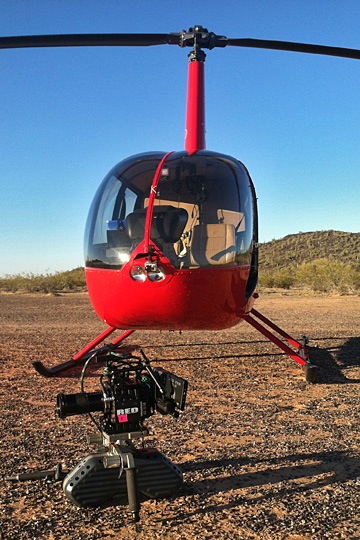
RED and redder.

When I arrived for the shoot, I discovered that the video guy had rented a Tyler Mini Gyro. This device has three smaller gyros mounted on a short monopod. The camera is mounted on top. The videographer usually places the monopod between his legs on the seat or on his lap while shooting. This stabilizes the video but limits motion in that the monopod base needs to be repositioned to make a significant vertical change of view. Without moving the base, the videographer would need to lean out into the slipstream to look down or lean back into the cockpit to look up. This isn’t always possible.

Apparently, the videographer was relying on me to keep in perfect formation with the other aircraft to prevent his need to move the camera. This was not possible, as discussed above. So when the paper airplane was released and it began its steep descent, he was unable to stay locked onto it with his camera.

I think using my mount or hand-holding the camera — possibly with a simpler gyro mount such a Micro-Gyro Mount offered by Blue Sky Aerials would have really benefited him. And I find it odd that although his equipment included a very costly RED camera, he had to rely on a rented gyro stabilizer.

Tampering with My Equipment

As discussed in numerous places throughout this blog, I’m a big fan of GoPro cameras and have three of my own that I sometimes use in flight. The folks from GoPro were at this event and they rigged up a bunch of their cameras all over the paper airplane and lift helicopter. They were thrilled that I already had good mounting solutions and loaned me a Hero 2 for one of my mount positions. So my helicopter had three GoPros, one of which was not mine, each of which had one of my 16GB cards in it. My arrangement with the GoPro guys was that after the flight, they’d pull video off each card and give the card back to me for my own personal (but limited) use.

Note that I mounted all the cameras with the GoPro guys. The video guy did not participate in this at all.

We did the flight and landed out in the desert near where the paper airplane had crashed. They did some video of the recovery on the ground. When we got back to my helicopter, I noticed that one of the GoPro mounts was missing its camera. I assumed it had fallen off and was very surprised because I know from experience how solid that mount is. That’s when the videographer told me he’d already removed them. Sure enough, all three mounts had been tampered with and all three cameras were gone.

Back at base, I went to the GoPro guys to find my cameras and the missing pieces of my mounts. They stuck to their word and I got everything back — except a piece from each of two mounts: a vibration isolator and a thumbscrew. Without these two pieces, two of the mounts are non-functional.

I don’t know who has them: the videographer or the GoPro guys. I suspect it’s the videographer. He likely put them in his pocket when he disassembled the mounts and forgot to give them back. (He also forgot to return a harness I provided for the shoot. That’s being shipped back to me this week.)

It is a Federal offense to tamper with equipment on an aircraft. Obviously, I’m not going to call the FAA to give this guy grief. But I will make sure it doesn’t happen again.

The Pilot Really Does Know Best

When you hire an experienced pilot for an aerial photo or video shoot, you need to fully communicate the needs of the mission before the flight and listen to the pilot’s advice. You need to work with your pilot to make a team to get the job done.

I know for a fact that I could have flown in perfect formation with the other aircraft if I could have seen it out my own window. I have done this before — not only with aircraft but with cars and trucks on the ground on tracks and on desert race courses, and with boats on lakes and rivers. A pilot cannot be expected to fly in formation with something he can’t see.

I know this videographer was unhappy with the results he got. But who is really to blame? I don’t think it’s me.
A Desert Flying Gig: Day Two

Cut short by a tragic disaster.

The second day of my job got off to a weird start. Although I was supposed to be at the client site at 8 AM, a family emergency had me driving toward Phoenix at 7:10 AM — the same time I should have been driving to the airport to get the helicopter. I wasn’t happy about this; it meant I’d be at least 3 hours late for work. Although my client was understanding, I wasn’t. The mission I was sent to accomplish — get two stranded people to Sky Harbor Airport in time for a 9 AM flight — was impossible to achieve in the time allotted. So not only was I going to let down a good client, but I was doing it for no good reason.

Fortunately, the two stranded people were able to make other arrangements. I was only 5 miles south of Wickenburg’s town limits when I got the call and was able to turn around. I arrived at the airport at 7:30. Even after removing the tie-downs, preflighting, hooking up the helicopter’s nosecam, starting up, warming up, and making the flight, I’d still be there within 15 minutes of my originally scheduled arrival time.

Nothing much was going on at Wickenburg Airport that morning — although there was a twin and a small jet parked in the jet parking area. I took care of business, made my radio calls, and took off to the west.

Along the way, I tried to notice things that I hadn’t noticed before — things I hadn’t included in yesterday’s blog post about Day 1. I realized that there weren’t nearly as many areas of carved water channels as I remembered. And I noticed cow paths. Other than that, there was nothing different, nothing to add to yesterday’s report.

I did a much better job bleeding off airspeed before coming into landing. The day before, I’d spotted an alternative landing zone that was must closer to the “town.” There were only two drawbacks that I could foresee: they were closer to the horse corrals, so I’d be more likely to frighten the horses, and it was much closer to the road, so I’d be more likely to stir up dust. I decided to give it a try.

Arrival at Robson's
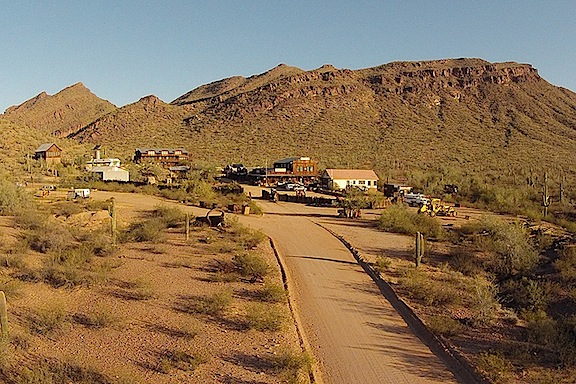
This “nose cam” shot from my final approach shows my landing zone (on right, beyond cactus) and the whole town, including the hotel.

As I approached, I began having doubts about the clearance between my main rotor blades and a palo verde tree at the edge of the landing zone. It had certainly seemed like enough space when I walked past the day before. I knew that judging distances could be tricky when airborne and decided to trust my initial thoughts about the spot. I kept coming.

The dust started kicking up when I was still 50 feet up. Not exactly brownout conditions, but a lot more dust than I like to see. Out of the corner of my eye, I noticed two of the horses prancing around a bit as the dust cloud approached them. Not exactly panicking, but far from calm. I wondered if the dust would make it all the way into town.

Knowing that the best way to make the dust stop blowing was to get on the ground and throttle down to idle power, I expedited my landing. The spot I picked was level and firm. I cut the throttle and, as predicted, the dust stopped churning. By the time I was tightening up the control frictions, the horses had already calmed down.

I had plenty of clearance from all obstacles.

Parking, Day 2
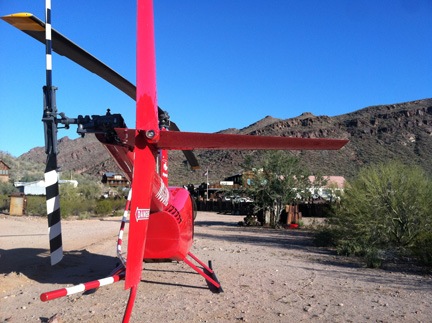
My parking spot on the second day was much closer to town.

I shut down and let the blades spin to a stop while I removed the two back doors. My clients used the back seat area of the helicopter for their equipment and we worked with the doors off. I figured I’d make up for being 10 minutes late by having the helicopter all ready for them when they came out with the equipment.

Not that anyone came running out to meet me. They usually don’t.

I grabbed my gear and headed to the cafe. Along the way, I saw some familiar faces and was greeted with a few waves and hellos. Inside, I met with my main contact and explained the family emergency that had prompted my phone call an hour before. Then I grabbed a glass of orange juice and went out to track down the folks who would be installing equipment in the helicopter.

The Equipment Installation

The tech folks were based in another part of the long building that had been set up like an old fashioned soda fountain. Most of the people reading this probably never even saw the real thing — they just don’t exist in many places anymore. This was made with components taken from real soda fountains — countertop, simple round bar stools, ice cream bins, syrup pumps, blenders, malt dispensers. Most stuff dated from the 1940s through the 1960s. None of it was set up for use anymore; every cabinet and bin was used to store paper and brochures and gift shop items. There were a handful of booths, each of which were being used to stage equipment. The walls were lined with gift shop items, all of which had likely been there at least five years. Some of the items were older than me.

I found the first tech almost immediately. He had a remote controlled camera head that he needed installed. It was part of a kit that included a 50-pound customized Pelican case containing a battery and some electronics. He configured and tested it while I waited, then showed me how he could control the camera head with his iPhone. Cool. We carried it out to the helicopter and found a good place for it on the front passenger seat. I got a few instructions about how to turn it on at flight time and we headed back to the soda fountain.

The antenna/radio guys were next. I watched them assemble and mount their equipment, tested occasionally to make sure it was mounted firmly, and picked up snipped wire ties as they dropped them in an effort to keep my landing zone FOD-free.

By 9:30 AM, the equipment was all set up in the helicopter to everyone’s satisfaction. For purposes of client confidentiality, I don’t share photos of their equipment or setup.

The Wait

Then the waiting began. The helicopter was just part of the testing process; there were vehicles and personnel vests to be configured, too. I knew from experience that this could take hours, but I hoped it wouldn’t be that long.

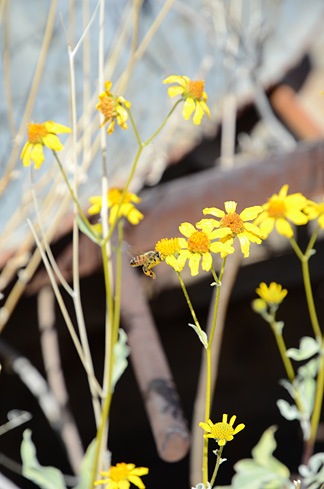
I took my camera out and began wandering around in the immediate area, shooting images of the few wildflowers that grew beside some of the old iron mining and farming equipment. It was a disappointing spring; wildflowers were limited to desert marigold, some brittlebush, and another yellow flower that might have been desert senna. There were also a few small pale purple flowers. The globe mallow were just starting to bloom. Hedgehog cactus should have been in full bloom, but I didn’t see any anywhere. Ditto for poppies.

Brittlebush
Heavy Metal

I spent about 45 minutes wandering around, trying to get good images. I’d run out of the house that morning without my tripod or monopod, so I set the camera for shutter speed priority and set the shutter speed to 1/1000 second. With full sun on yet another cloudless Arizona morning, there was certainly enough light. But I also got the narrow depth of field that I like when shooting flowers close up. The only disappointment was the lack of flowers to shoot. After a while, I began concentrating on all that old metal equipment.

I had a chat with the cowboy, who was messing with the hardware on the flagpole. I mentioned how I’d scared the horses a bit but they seemed okay. He told me to fly right over them. He and I both knew that the best way to get a horse used to some unusual noise or activity was to subject them to it until they began ignoring it. I had no real desire to overfly the horses, but was glad he’d offered it as an option. That direction was one of two possible “escape routes” if my landing started going south and I needed to do a go-around.

Not wanting to wander too far away from the techs, I returned to the soda fountain, found a table on the far side of the room, took out my laptop, and began reviewing photos and writing this blog post. I’d come prepared for a long wait.

I should mention here that although the place is off the grid, when this client comes, they set up a multi-node network that includes broadband Internet access. So not only could I compose a blog post, but I could check Twitter and Facebook and email. This was a good thing because my cell phone signal was very weak and 3G wasn’t really an option.

The Flight

At 11:30, it looked as if we might actually have a flight before lunch. I headed out to the helicopter and was surprised when two men I’d never seen before approached and announced they’d be flying with me. The reason I was surprised was because I knew one of the techs was planning to fly with me so he could monitor the equipment during the flight on his laptop — that was the usual procedure. But with the camera up front, I only had two passenger seats open in back.

What followed was some minor confusion. The tech told me we’d run the first flight as a sort of dry run for the actual tests, which would be done after lunch. He told me to take the other two men. So I briefed them, loaded them on board, and strapped them in. Then I started up and, during my warm-up processed, pushed the appropriate buttons on the camera equipment sitting beside me. A while later, I lifted off in a cloud of dust, made a 180° turn, and departed down the road, pushing the cyclic forward to accelerate as quickly as possible to clear the dust.

My job was to keep maintain a line of sight with the SUV on the road below me and the main building back in town. My passengers would monitor internet connectivity in the helicopter — yes, we were set up as a WiFi hotspot.

The flight lasted about 15 minutes. The biggest challenge was flying slow enough that I didn’t blow past the SUV and need to keep circling. There was just enough wind coming into the back seat headset mics to force me to turn off the voice activated intercom.

I watched the SUV pull off the road and make a U-Turn. I circled slowly, 500 feet above them. Then my phone rang. It was the tech back at the base, calling me back. They were done with this first test.

I headed back, leaving the SUV behind and landed in my spot. The dust cloud really was outrageous. The wind was blowing at about five mph from behind me — yes, I made a tailwind landing — and the dust kept getting blown into the town area. It didn’t go as far as the cafe, but it did seem to go as far as the soda fountain. No one had complained, though. I think they liked having the helicopter closer, where it was quicker and easier to get to than my old landing zone.

I let my passengers get out while I was still shutting down. Then, since it was already after noon, I headed back to the cafe, where I knew Rosa would have one of her excellent lunches. I found a seat among the techs and one of the long table and soon had a barbecue beef sandwich, cole slaw, and chili in front of me. During lunch, we talked about helicopter and the cherry drying work I do in Washington in the summer. That led to other conversations about weird helicopter work and weird helicopter flights.

I was just finishing desert when my contact stepped into the cafe. She had her phone against her ear, but she was addressing everyone in the room when she said calmly, “You guys might want to move your cars. The hotel is on fire.”

The Fire

We all cleared out of the building and into the street out front. I was expecting to see a thin trail of smoke coming from the building. Instead, the top right of the three-story building was engulfed in flames at least 10 feet high. Guys started running toward it while I ran back into the cafe, not willing to see what was happening. Rosa was there, looking at me, and I told her what was happening. She ran out to look and I followed her.

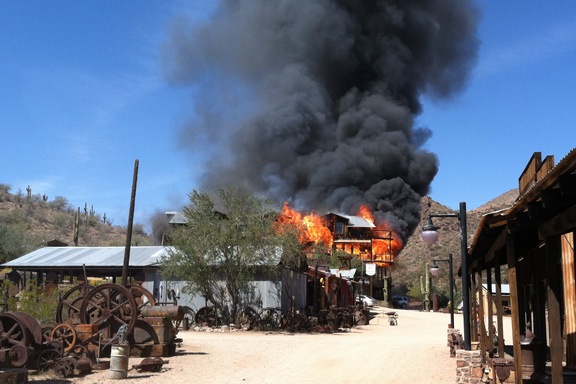
It was the most amazing thing. The fire spread at the rate of about one room per minute, moving right to left across the top floor of the hotel and then down. The rental cars parked at the base of the building were smoldering; as I watched, the hood of one burst into flames. I could feel the heat of the fire from the end of the main building. Guys who had tried too late to retrieve belongings from their hotel rooms were turned back while a handful of other guys ran back toward us holding scattered possessions in their hands. Thick black smoke climbed into the sky. Huge sheets of the hotel’s metal roof lifted into the sky like aluminum foil.

The Fire
The hotel at Robson’s just minutes after the fire started.

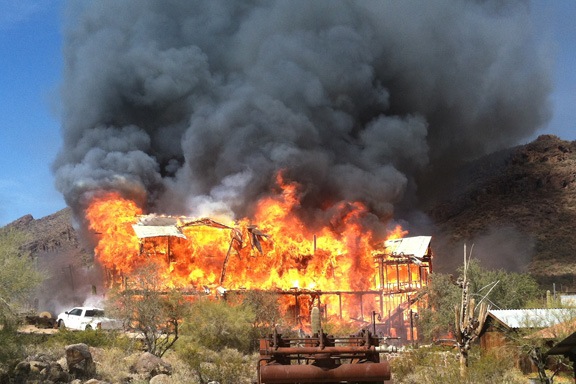
And there was nothing we could do. There were no hoses, no water spigots. It was clear from the start that the hotel was a goner, but the intense heat began to spread the fire closer to us, into the wind. The dry wood frame of a nearby building caught fire. Then another on the other side of the hotel, right beside one of the caretaker homes.

Hotel Fire
In less than 15 minutes the whole building was on fire and the fire was spreading. The truck in this shot was lost; no one could get near it.

The local fire department showed up just as another row of buildings caught fire. They’d brought two tanker trucks filled with water. They drove up the street as far as they could and got to work. One firefighter came toward us and told us to clear out of town.

In the background, we could clearly hear the sound of the rental car fuel tanks exploding.

The firefighters concentrated their efforts on the buildings that could still be saved, mostly to prevent the spread of the fire. I think that if they’d arrived ten minutes later, the whole town would have been lost.

We gathered in a group near the entrance to the town while additional firefighting equipment rolled in. My client had already gone through their list of participants. No one was missing. One guy had been burned running from the fire after retrieving some of his belongings. He’d used his arm to shield his head from the heat and his arm had gotten what were probably second degree burns. No one else was injured.

We all realized that if the fire had broken out at night, people would have been killed. It just spread so quickly.

It was obvious that the event was over. They began making arrangements to leave. At least six cars had been lost; they’d need to carpool back to Wickenburg and Phoenix. They came out to the helicopter and pulled their equipment off. I put the doors back on and prepared to leave.

Back in town, the hotel had been reduced to a single floor of burning rubble. One of the tanker trucks rolled out of town, empty, while another one rolled in.

The Flight Home

I took off in one final cloud of dust. But rather than head right back to Wickenburg, I circled around the back of the townsite to see if the fire had spread into the desert. After all, the wind was blowing that way. I was very surprised to see several other wooden buildings quite a distance away from the hotel completely burned to the ground and still in flames, obviously ignited by sparks. I paused just long enough for the helicopter’s “nosecam” to get a shot, then banked away to the east and headed back to Wickenburg Airport.

Aerial Shot of Fire

The flight back was uneventful. I didn’t pay much attention to my surroundings. I was feeling stunned and saddened by the loss of the old hotel. I knew the original owner would be heartbroken when she found out.

I also knew that it was the end of an era out in Aguila. The hotel would not be rebuilt; without it there wasn’t much to attract the groups that the owners needed to make it financially feasible. My client would not likely return; it was too far away from the closest overnight accommodations in Wickenburg to be convenient. I might not ever work for them again.

It was a hell of a way to end a job.

A Desert Flying Gig: Day One

The first day of a gig for a regular client doesn’t go exactly as planned.

The initial request for nearly a week’s worth of work for a regular client came about two weeks ago. I checked my calendar; it was wide open. I penciled them in. Then I reminded my contact that I’d spent far more time waiting than flying during the last two jobs I’d done for them. I couldn’t keep the helicopter offline from other work for them unless I flew at least as many hours as I waited — or charged a waiting fee.

She got back to me the same day. It would be two days: just Tuesday and Thursday. And she’d get back to me with the exact times I would be needed so I could plan my days accordingly.

I felt good about that. I’d been flying for the client pretty steadily for about four years — perhaps four jobs a year. The work was unusual and rather challenging at times. A friend who filled in for me once when I wasn’t available said he’d never do it again. That may have been partly because it’s in a remote place out in the desert about 20 flying miles from my home in Wickenburg. My friend lives in Phoenix.

Of course, my helicopter doesn’t live in Wickenburg anymore either. It spends part of its life in the Phoenix area, 30 minutes away by air or an hour away by car. There isn’t enough business in Wickenburg to keep it there.

But this client doesn’t mind paying me to bring it up to them and I’m usually glad to get the work.

I got an update via email the next day. It outlined a schedule that would have me there from 8 AM to at least 3 PM on Monday through Thursday. I felt doubtful as I entered the times for each day on my calendar.

I brought the helicopter up to Wickenburg on Sunday. I’d topped off the tanks in Phoenix and they were still full enough that I wouldn’t need more fuel.

I parked it on one of the two west end helispots that had been painted at one end of the jet parking area at my request nearly ten years before. Back then, there were five helicopters operating regularly out of Wickenburg: a LifeNet medevac helicopter based at the airport, my little R22, and three Hughes 500 models owned by three guys who lived in town and had more money to burn than I did. Since then, LifeNet moved out of town, I’d graduated to an R44 and then moved the helicopter out of town, a Hughes 500C moved out of town, and a Hughes 500D was sold. With the addition of a little Schweitzer 300, there are only two helicopters left in town. I could tell you more about the slow death spiral of life in Wickenburg, but it really isn’t worth wasting words on.

Day 1

I was at the airport first thing Monday morning, untying the helicopter’s blades, doing a preflight, and getting ready to go. It had dropped into the high thirties overnight and was in the 40s at 7:15 AM. The sun had just come up about a half hour before. I could feel its warmth through the cockpit bubble as I settled into my seat and got ready to start the engine.

Six seconds of priming after a night out in the cold — that was my estimate. I gave it just that, then pushed the starter button, holding the mixture knob ready to push in. Seven would have been better, I realized as I coaxed it to life. The engine caught; I pushed the mixture to full rich; I turned on the switches for the clutch, strobe, and alternator; and I modulated the throttle to keep the engine RPM as close to 55% as I could while the tightening belts tried to drag the engine down. The blades started to spin. The belt squealing sound I’d grown accustomed to on every startup for the past seven years faded and ceased. I brought the throttle down a bit and the RPMs settled to just under 60%.

I turned on the radio and GPS. A twin had come in while I walked out to the helicopter; it was parked in front of the terminal building, effectively blocking any other aircraft that might want to come into the jet parking area. Probably just a drop off or pick up. I punched my destination waypoint into the GPS. The clutch light went out and I brought the RPMs up to 68% for warmup.

Warming up an R44 means waiting for all engine gauges to be in the green. Oil temperature can be a bit slow on a very cold day — the kind of day when the oil drips off the dipstick life taffy when you check it. It wasn’t that cold and the oil temperature was in the green quickly. That left the slow gauge: cylinder head temperature (CHT). The gauge was new; I’d replaced the old one after one too many flights with it sticking in the cold position longer than just a minute or so. As a Part 135 operator, everything on the helicopter has to be in full working order, so having a finicky gauge was not an option. It cost $466 for the gauge and labor to replace it. The new gauge indicated warmup a lot quicker than the old one ever did — even when new. On a cold day, it cuts 2 to 3 minutes off my warmup time.

Another twin — a sky something? — called turning downwind as I throttled up to 75% RPM, did a mag check and a needle split. All good. I checked the doors to make sure they were closed and loosened the friction on the controls while scanning the sky for the arrival. Then I got on the radio and made my call:

“Wickenburg traffic, helicopter Six-Three-Zero-Mike-Lima on the west end helipads departing to the west. Looking for the downwind traffic.”

I caught sight of him rather low as he spoke: “We’re abeam the approach end of runway Two-Three. There’s a Columbia about ten minutes behind us.”

“Zero-Mike-Lima has you in sight. Departing to the west.” I’d picked it up into a hover as I spoke and turned 90 degrees to scan for other traffic. Then I just pushed the cyclic forward and took off.

The twin called final a minute or so later. Then the Columbia came on the radio, 15 miles west. I reported just leaving the airport, westbound, and that I’d stay at or below 3,000 feet, which would put me no higher than 600 feet above the ground. If the Columbia was that low, I was probably the least of his problems.

The sun at my back, I aimed for a tilted mountain range I could see off in the distance. The flight was over very familiar ground. A few hills, a few cattle tanks, some cattle. A ranch outpost with a small dirt strip. No homes, no paved roads. The kind of land that shocks city dwellers the first time they see it. Especially when they realize how vast and empty it is.

The desert was flat for most of the way, reminiscent of the sea floor that it had once been. The ground was a light sand color, studded with creosote and mesquite bushes. In some places, thin winding channels had been cut into the desert floor by the movement of water after heavy rains; they looked like so many varicose veins scarring the landscape. I’d once overflown this area after the remnants of a hurricane had dumped eight inches of rain in a day; several inches of standing water had reflected sunlight back into the sky, mile after mile.

I kept about 400 feet above the ground for the first ten miles or so. There were power lines up ahead — tall towers with multiple strands of thick wires that were remarkably difficult to see sometimes. I didn’t like to fly low until I passed them. Once they were behind me, I dropped 200 feet, skirting over the desert at 110 knots. Here and there, a rock outcropping rose 50 feet or so off the sandy desert floor. Tall saguaro cacti threw long shadows in the early morning light.

Desert

Ahead, I saw my destination — a rag-tag group of weather-worn wooden buildings at the base of the tilted mountain. Completely off the grid, it had been built years ago on the site of an old mine as a mining museum.

Number 7The original owner was apparently obsessed with collecting old mining and farming equipment — I can’t imagine a larger collection anywhere else in the world. It’s mostly heavy metal stuff made of iron so thick that even the rust can’t hurt it. White numbered boards precariously attached to some of the more interesting items serve as reminders of the walking tour visitors were encouraged to take.

But there’s more than just old mining and farming equipment. There’s a row of buildings set up as an old western town with a wooden boardwalk. A cafe, “opera house,” print shop display, blacksmith display, and firehouse complete with circa 1950s firetruck makes up the downtown. There’s a chapel overlooking the desert and a huge, three-story hotel at the far end of town. The whole place is powered by solar cells and a diesel generator.

The place changed hands and is now leased to an outfit trying to run it as a western destination. Trouble is, no one wants to come there. Even with horses and a real cowboy, there’s not enough to attract even the most hardcore western enthusiast. They’d rather see the Grand Canyon or Sedona or stay in a Phoenix resort. The place mostly plays host to marriage encounters run by church groups in small cities throughout central Arizona.

And my client.

My client has connections to the owner and has been using the place as a headquarters for corporate retreats and product testing. They invite clients, they show off their products. And they ask me to come on out to help them test their products.

I won’t go into detail here. Let’s just say that they produce high-tech wireless networking equipment with a specific non-consumer application. They mount stuff in my helicopter and I take their techs flying while they study computer screens and read off packet information. Sometimes we do photo flights. Sometimes I give people rides.

I crossed the only paved road along the way and started slowing down when I was still a mile out. I didn’t bother checking the wind; I knew it was dead calm. I’d land in a dirt spot beside the mile and half dirt road that came in almost a straight line from the paved road to the “town.” It was about a quarter mile from the town’s gate and I knew I’d walk the distance several times over the next few days. I’d purposely worn comfortable walking shoes.

I still had too much speed as I came in for my final approach so I overshot it, dumping the collective and pulling back the cyclic to bleed off all that extra energy without dropping out of the sky. When I felt comfortable with my speed and angle of approach, I turned toward my spot. I knew dust would fly when I got close to the ground, but I also knew it wouldn’t be bad — yet. Only after several hours of ATVs and Tahoes driving on the dirt around the helicopter would the dust be loose enough to really start flying. Then the whirling dust on each takeoff and landing would take just a little bit more paint off my rotor blades. Before the end of the year, my main rotor blades would likely have to be repainted for the third time at a cost of roughly $1,500. It was something I wasn’t happy about; a cost of doing business off-airport, out in the desert.

I landed on the far north end of the landing zone, which I knew from experience was level. A small dust cloud rose and then descended as I touched down and reduced the throttle back to 68%. The nose of the helicopter pointed toward town; the tail pointed away, where it was less likely for people to be walking.

As the engine began cooling down, I made a note on my duty log sheet with the Hobbs meter time. It had taken 3/10 of an hour to get there — a mere 18 minutes. By car, it would have taken nearly 45 minutes.

A truck headed toward me from town. It was the cowboy who managed the place. He waved and kept going.

After two minutes, I cut the throttle to idle and flicked the clutch switch to disengage the belts. The blades started to slow. Thirty seconds later, I pulled the mixture and the engine died. I pulled off my headset and waited for the blades to stop on their own. No sense in using the rotor brake if I wasn’t in a hurry.

It was 7:40. I was 20 minutes early.

At Robson's

I grabbed my bag with my iPad and a few other things in it and made the first walk into town. By then, the temperature was already in the 60s and it felt good to be walking outdoors on such a fine morning.

I realized something was not quite right when I walked into the cafe, the usual base of operations. Normally, the place would be buzzing with my clients staff members and guests finishing up a buffet breakfast. But there were just two people seated at a table and I didn’t recognize either one. The woman who runs the place greeted me and told me “they” were making themselves breakfast because Rosa, the cook, wasn’t there until noon. I peeked into the kitchen and saw four people from my client’s company gathered around the big commercial stove. I smelled bacon.

I made myself some instant oatmeal and grabbed a glass of orange juice. After a while, the four men came out of the kitchen with hearty breakfasts in hand. They settled down at the table beside mine and started to talk.

I waited for a break in the conversation. “Is it just you four?” I asked.

“Yeah,” one of them said. “I’m surprised to see you here. Did you fly out?”

“Yes. They told me you’d need me at eight o’clock.”

The four men exchanged glances. “We’re not flying today,” the guy who’d originally spoke said. “We’re just here for setup. They know the routine. We fly out on Sunday night and set up the network on Monday morning. Everyone else arrives later today. We’ll fly tomorrow.”

Somehow, I wasn’t surprised that someone had screwed up.

“I’m sorry you came out here for nothing,” he said.

I shrugged. “I just did what I was told,” I said. “It’ll be on my bill.”

We all had a good laugh over that.

I finished my breakfast, bussed my plate, and said goodbye. Then I made the long walk back to the helicopter.

Flying back into the sun, I had to put on my baseball cap to keep the sun flickering through the main rotor blades from being a serious annoyance. This time, after crossing the power lines, I dropped down and joined up with the railroad track that runs between Wickenburg and Aguila. I followed it, low-level, reminding myself again and again that at 110 knots, I didn’t need to worry about a train coming up behind me. Two miles short of the airport, I pulled up away from the tracks, made my radio call, and crossed the hills separating the railroad from the airport. I crossed the runway low level and landed at the fuel pumps to top off my tanks before putting it away for the day.

At least I hadn’t spent the day waiting.

more to come….

Feeling Overwhelmed?

Join the club.

Lately, I’ve been feeling a bit overwhelmed. It isn’t the first time and it won’t be the last. But it is bothersome — an uncomfortable feeling that makes me question everything about my life.

I’ve made some serious personal decisions recently that are likely to rock my world over the coming months. This is a stressful situation that’s not made any easier by the lack of support by friends and family members. I’m going it alone — as I so often do — and it’s weighing heavily on my mind.

But the feeling of being overwhelmed is primarily due to my workload. As a freelancer, I work when there’s work to do. When there isn’t work to do, I’m usually waiting for or looking for more work. Sometimes I need to make work. Other times, work appears unexpectedly — even when I don’t want it or have time for it. But I have to do it all — to turn down work is to possibly miss out on future work.

Such is the life of a freelancer.

Right now, I’m working on four content creation (writing, video, etc.) projects:

  • Book CoverFinishing up a special iBooks 2 interactive edition of my iBooks Author book. This requires me to record and edit dozens of screencast videos and completely re-layout the book in iBooks Author. The good news: I might be able to finish up today. That is, if Alex the Bird can keep quiet and the landscapers don’t spend much time blowing leaves outside my window. And the neighbor’s dog doesn’t bark nonstop for an hour. Again.
  • Lynda LogoPrepare scripts for a revision of my Twitter Essential Training course on Lynda.com. We’ll be recording this course soon and I want to be fully prepared before I fly out to Lynda to record. And my new producer, wants to see the scripts, too.
  • An aerial photography book. I began writing this last year and have put it aside repeatedly because I need artwork and photos that I can’t produce on my own. I suspect it’ll have to wait until this summer to finish up.
  • A book of helicopter pilot stories. I’m collecting these stories from other pilots and plan to compile them in a book for release later this spring. As I get more and more bogged down with other things, however, the self-imposed deadline keeps slipping. I suspect this will be finished up when I get to Washington, too.

Of course, with Mac OS X Mountain Lion announced, I know what I’ll be doing first when I get to Washington: Revising my Mac OS X Lion book for the new version of the OS. Oh, yeah — and then there’s the videos and Websites I’ve been asked to create for a handful of winemakers up there.

It’s not just writing work and the occasional helicopter flight that’s stacked up before me. It’s all the paperwork that goes with it.

I have two separate businesses, each with their own bank accounts and accounting records. I don’t have an accountant — hell, I am an accountant; my BBA is in accounting. To hire an accountant would be silly, since I could do that work myself and save a bunch of money. So I do. Or I try to. Often, it just stacks up, waiting for me to get to. I haven’t balanced a bank account in several months. And I’m only partially switched from Quicken (since it no longer works in the current version of Mac OS) to iBank (which I really don’t like). It’ll take days to sort out the accounting mess I face when I get around to it.

And then comes tax time. What a freaking nightmare that is.

And then my annual migration back to Washington. That’s a logistics issue. Find someone to fly up to Washington with me to help cover the flight costs. Do the flight. Catch a commercial flight back to Arizona. Pack the RV, get the truck ready. (Did I mention that I might have to buy a new truck this year, too? And take delivery before the end of April?) Make the 1200-mile drive to the Wenatchee area. Retrieve the helicopter from wherever I left it in Washington. Get my contracts set up for summer work.

Of course, that’s if there is summer work. My clients never want to sign up until after the last frost. There’s a chance I might get to Washington with the helicopter and a frost will wipe out the cherry crop. No need for my services then. Ready to fly but no clients. How do you think this possibility affects my stress levels?

On the flip side, there might be too much work for me to take on by myself. Then I have to scramble and find people who are willing to put their life on hold for 3-6 weeks and wait around for the rain in Washington. I’ve already started collecting possible candidate phone numbers. None of them are happy that they’ll have to wait until May to know whether there might be work for them.

Before I leave Arizona, however, I do have to pack up everything I own that’s in our Phoenix condo in case it’s rented or sold while I’m gone. That’s a whole office full of stuff, as well as clothes and other personal effects. Hell, I haven’t had enough time to unpack the boxes that brought some of this stuff here.

And I did mention that I have to travel to Lynda.com for a week to record a course, right?

And there is the possibility of a very big client needing to fly with me in late March or early April, before I go to Washington. Unfortunately, they can’t pin down a date. Once they do, if I’m not available, I’ll lose that job — and it’s not the kind of job I want to lose.

Along the way, I need to start seriously considering where I’m going to live and what I’m going to do when my work in Washington is done this year. I’ve been wanting to relocate for years. I’m sick of Wickenburg’s small-mindedness and the bullshit politics and greed that have ruined the town. Phoenix is no gem, either — except on February days like yesterday when the temperature hovers in the high 70s and there’s not a cloud in the sky. The personal decisions I’ve made recently give me a good opportunity to make the change. Unfortunately, I don’t know where I want to live. I’m leaning toward Oregon — perhaps in the Portland area — but who knows?

So with all this on my plate and on my mind is it any wonder that I’m feeling a bit overwhelmed?

But this is typical in my life — and in the life of most hardworking freelancers and business owners. Things don’t get done by themselves. And if things aren’t done, I start feeling it in the bank account. I don’t know about you, but I like to pay my bills on time and eat.

Guess I’d better get back to work.

The 2012 Buckeye Air Fair

Some small towns really know how to put on an airport event.

Yesterday, for the fourth (or possibly fifth) time, I participated in one of the nicest airport events in Arizona: The Buckeye Air Fair. The event was held annually for several years until 2009. It moved to Gila Bend for at least one year and I turned down an offer to participate because of the distance. I was thrilled to ask to participate again in the 2012 event when it returned to Buckeye.

I flew almost nonstop yesterday from 9 AM to 5 PM, with only short breaks for an airport closure (for an RC aircraft demonstration) and refuelings. There was a constant stream of people coming on board, aged 3 through 73. Although I missed the rest of the event — being stuck in the cockpit all day — I had a great time and met lots of really great people. I don’t think I’m exaggerating when I estimate that I took at least 50 people for their first-ever helicopter ride. For some of them, our flight was their first ever time airborne.

Interested in what you missed? Check out this video by Arizona Public on YouTube. You’ll see a couple of shots of me and my bright red helicopter.

Thanks again to Margaret and Steve and the rest of the folks at Buckeye for making this such a great event for everyone.