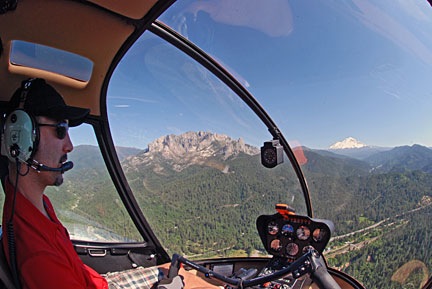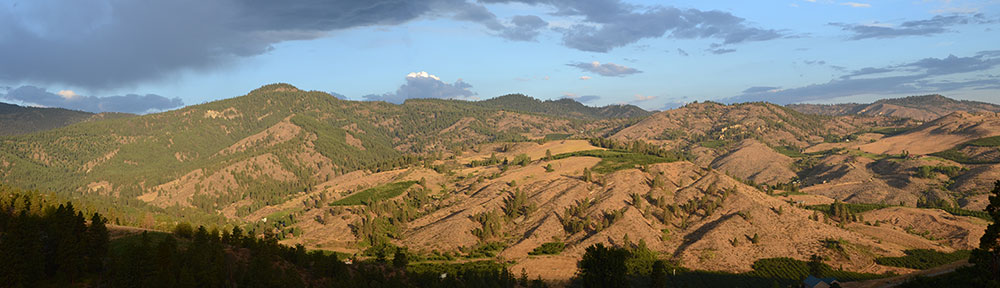
Helicopter Videos (and other Content) by Subscription

Making it easier to get the content you want.

One of the problems with this blog — at least as far as blogging experts are concerned — is that it covers too many topics. Blogging “experts” agree that to have a “successful” blog, it should concentrate on just one topic. That will attract people interested in that topic and keep them coming back for more, since it’s just what they want. A while back, I tried this by spinning off all the book support blog posts to a separate blog — Maria’s Guides — and leaving the rest behind here. I changed the name of this blog to An Eclectic Mind to help communicate the fact that there’s a lot of topics covered here. I refuse to spin off each major topic to its own blog — at least right now — because there’s so much overlap in the topics and because I simply can’t be bothered managing more than the 5 or so blogs I’m already dealing with. So this blog covers all kinds of things, from flying to photography to life in a tiny desert town to travel to politics to…well, you get the idea.

Finding Content with Categories and Tags

I’ve made content easier to find by embracing WordPress’s category and tag features. Categories are broad topics, tags are narrower ones. For example, you’ll find Flying as a category, but you’ll find helicopters, airplanes, airports, aviation, helicopter video, etc. as tags. The idea is that if you’re interested in flying but don’t give a hoot about helicopters, you can click the airplanes tag and zip right in to content that discusses airplanes. (Don’t expect much; I’m a helicopter pilot.) You can find all categories listed in the sidebar’s category list and all categories assigned to a post in the post’s footer. You can find the most popular 75 tags in the sidebar’s tag cloud and all tags assigned to a post in the post’s footer. All posts have at least one category; all recent posts have at least one tag.

(You can also use the Search box in the header to find content on the site, but even I don’t have very good luck with that. Too many results. This blog has nearly 2,000 posts and unless you’re looking for a topic with a very unusual word — for example, “cauliflower” — you’ll likely come up with more results than you’ll want to wade through.)

Which brings me to the real topic of this post — getting the content you want delivered right to you.

Using RSS to Subscribe to Categories or Tags

A friend of mine who is always sharing aviation photos and videos by e-mail recently discovered my “nosecam” helicopter videos. I create these by fixing a POV.1 video camera to the nose of my helicopter when I go flying. The resulting video can be tediously boring or extremely interesting or somewhere in between. I take the best videos, process them a bit, and put them on Viddler, a video sharing site. (And no, I really can’t explain why I don’t use YouTube. I should probably rethink this a bit if I want the videos to be seen by more people.) Once online, I usually create a blog post with the video embedded. Those are categorized Flying and tagged helicopter video.

Now WordPress has the incredible ability to generate an RSS feed based on any category or tag. The formula for creating the feed URL is very simple:

  • For a category on this site, https://aneclecticmind.com/category/category-name/feed/rss where category-name is the abbreviated name of the category. You can get the exact category name by looking in the address bar after clicking the category’s link in the sidebar. So the RSS feed for the Flying category would be: https://aneclecticmind.com/category/flying/feed/rss
  • For a tag on this site, https://aneclecticmind.com/tag/tag-name/feed/rss where tag-name is the abbreviated name of the tag. You can get the exact tag name by looking in the address bar after clicking the tag’s link in the sidebar. So the RSS feed for the helicopter video category would be: https://aneclecticmind.com/tag/helicopter-video/feed/rss

Of course, knowing in RSS feed URL is one thing, but using it is another. You’ll want to put this URL in your feed reader. If you don’t have one — or don’t even have a clue what I’m talking about — check out Google Reader. It’s a pretty popular feed reader that starts you off with a complete explanation, with video, about RSS feeds and how it works. Perhaps some of the more knowledgeable folks reading this post will share their favorite readers; I’m not big on feed readers and do all my feed reading from within Apple Mail.

Getting Helicopter Videos by E-Mail

Now back to my aviation video friend.

After looking at a bunch of my videos on Viddler, he e-mailed me and asked me to include him on my mailing list to be notified when new helicopter videos come out. Well, I don’t have a mailing list. I’m not one of those people who sees something cool on the Internet and e-mails it to half the people in my address book. In general, I don’t like to receive e-mails like that, so I certainly don’t like to send them.

But I realized that there were probably a few people who were interested in the videos, had no patience for RSS, and couldn’t be bothered manually checking this site periodically. So I whipped up a Feedburner subscription feed specifically for the helicopter video tag. Folks who want notification of the latest helicopter videos published on this site delivered directly to their e-mail in boxes can subscribe using one of the following methods:

Either way, you’ll be sending your e-mail address to Feedburner. Feedburner will send you a confirmation e-mail to assure that you really want to subscribe and this isn’t an attempt by someone else to add you to the list. You will get that e-mail message almost immediately. You MUST follow the instructions in the confirmation e-mail message to complete the subscription process. If you don’t, the subscription will not start. If you can’t find that e-mail message in your in-box, check your spam filter.

Once the subscription is activated, you’ll get an e-mail message only when there’s a new helicopter video on the site. That could be once a month or it could be three times in a week. I tend to release them in batches.

I use the Feedburner service because it’s good. It does not generate any spam. Your e-mail address is not shared with others. I know this because I also subscribe to several of my own feeds, just to make sure spam isn’t going out with the feed content. It’s also really easy to unsubscribe from; just click the link in the bottom of the e-mail message you get.

Getting All Content by E-Mail

You may have noticed an E-Mail Feed link at the top of the sidebar on this site. That’s for all site content. If you subscribe to site content using that link, you’ll get everything, including the helicopter videos. If you’re only interested in the helicopter videos, unsubscribe from that feed and subscribe to this one instead.

I hope this long story (as usual) gives you the information you need to subscribe to the content that interests you most here.

Cross-Country by Helicopter: E25 to BFI

14.4 Hours over four states.

Cross-Country, Defined
For those of you who are not pilots, allow me to explain the term cross-country as used by a pilot. A cross-country flight is basically any long flight with a landing a certain minimum distance from your starting point. For airplane pilots, it’s at least 50 miles. For helicopter pilots, it’s at least 25 miles. So while this blog entry discusses a very long cross-country flight, we did not fly all the way across the country.

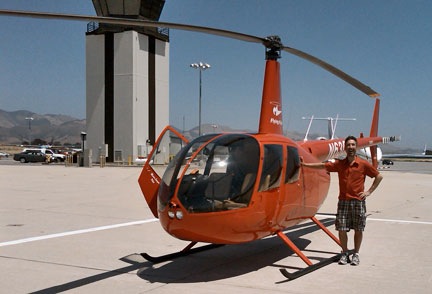
This past Thursday and Friday, I flew by helicopter with two other helicopter pilots, Ryan and Bryan, from Wickenburg, AZ to Boeing Field in Seattle. Bryan and Ryan did just about all of the flying. I sat up front being a nervous passenger when we were near the ground and playing with the radio and GPS. Brian let me make most of his radio calls on the first day, but I didn’t get to do much of that the second day.

It was a mutually beneficial journey. I needed to get the helicopter from Arizona to Washington State. Ryan and Bryan were both CFIs who wanted to build time in an R44 helicopter. It was way cheaper for them to fly with me on this trip than to rent an R44 from a flight school. There was also the added experience of planning and executing a flight through unknown terrain, with fuel stops and an overnight stop along the way. And the money they paid to fly my aircraft helped me cover the cost of this very long and very expensive helicopter flight. Win-win.

Corona Fuel

A very cool but very helicopter-unfriendly fuel island at Corona Airport in California.

Our flight path took us west, with Bryan at the controls, along state route 60 to I-10, across the Colorado River, and then along I-10 through Bythe, Chiriaco Summit, Palm Springs, and Banning; then back on 60 past March to Riverside on the 91. We stopped at Corona for fuel at what’s likely the coolest but most helicopter-unfriendly fuel island in the world. (We didn’t notice the separate fuel island more suitable for helicopters until we’d stopped and shut down.)

Here’s a video of our transition along the California coast through the LAX airspace on the Shoreline transition route. You might want to turn down the sound while playing it; lots of helicopter noise.

Then Ryan took us west on 91 through the airspace for Fullerton and Long Beach, with a Torrance low pass. (Robinson has entirely too many helicopters waiting for owners on its ramp and in its delivery room.) He then got clearance for the Shoreline helicopter transition of LAX space, which requires the pilot to drop to 150 feet 1/4 mile offshore to pass under LAX departing traffic. We continued following the coast up past Santa Monica, Pacific Palisades, Malibu, Oxnard, Ventura, and Santa Barbara. By then, the marine layer was moving in, so we went inland for a bit. Eventually, we reached San Luis Obispo (and the chatty controller) and stopped for fuel and lunch.

Ryan at San Luis Obispo

Here’s Ryan on the ramp at San Luis Obispo before departure northbound. I shot this one with my Blackberry’s camera, so pardon the quality.

Bryan was back at the controls for our departure northbound. After a very close call with a large bird, we followed the path of Route 101 northbound. Most of the route was up a riverbed in a very pleasant valley. We got to Salinas and realized that any coastal route would be out of the question — the marine layer was creeping in even there. So we headed over the mountains, eventually ending up in the western part of California’s Central Valley. We stopped for fuel at Byron.

Ryan took over and we continued north over Rio Vista and Yolo, finally hooking up with I-5. We followed that through endless farmland — much of it flooded for a crop that apparently needs lots of water — over Willows Glen and Red Bluff, with more than a few crop-dusters flying nearby at altitudes far below ours. We stopped for the night at Redding, tied down the helicopter, and got a hotel shuttle into town.

We’d flown 8.8 hours.

Ryan Flying Near Mt. Shasta

Ryan at the controls as we near Mt. Shasta in northern California.

The next morning, we were back at the airport at 9 AM, preflighting and getting ready to go. Ryan would start the flight. We headed north along I-5, over Lake Shasta and past Mount Shasta, which was snow-covered and beautiful. We were now past Central Valley’s vast farmland and up in the mountains. We flew past Weed, Siskiyou Co., Rogue Valley/Medford, and Grant’s Pass. Much of this flying was in canyons, along the same route as I-5 and a train line.

Things turned a bit iffy as I-5 swung to the east. We were hoping to go north and catch it on the other side of some mountains, shortening our route a bit, but clouds sitting on the tops of those mountains made that a bit uncertain. So we dropped altitude, slowed down, and followed I-5. Ryan flew while Bryan and I kept a sharp lookout for the power lines we knew — from both chart and GPS — were ahead. We weren’t that low and there wasn’t any real danger, but we were certainly not coming out of that canyon anywhere except the I-5 corridor. We passed the powerlines with plenty of room. The road descended into a valley and we stayed up beneath the cloud bottoms. Eventually, the sky cleared. We continued along I-5 past Myrtle Creek and Roseburg and stopped at Cottage Grove State for fuel and lunch.

Then it was Bryan’s turn again. We continued up I-5 past Hobby, Albany Municipal, and McNary. Then we headed northwest over Sportsman’s, Hillsboro, and Scappoose. We crossed the Columbia River and headed north on I-5 again over Kelso Longview and Olympia, with nice views of Mount St. Helens and Mount Rainier in the distance. Then on to Bremmerton, where we stopped for fuel. We probably had enough to make the last 20 minutes, but why take chances?

At BFI

Zero-Mike-Lima on the ramp at BFI. Another Blackberry photo. And yes, that’s Mt. Rainier in the background.

I flew the last leg with Bryan up front to handle the radio and give me directions. It was only a 15-minute flight, but the airspace was complicated, so I was grateful for the help. I set the helicopter down sloppily in the parking area. We’d flown a total of 14.4 hours.

It was a great flight. We saw so much that most of it is just a blur in my mind. With luck, these photos and videos will help me remember the trip for a long time to come.

Many thanks to Ryan and Bryan for accompanying me on this trip. I hope they learned a lot about cross-country flying.

Escalante Run (by Helicopter)

Another high-speed run up a canyon.

I don’t want anyone to think I do this regularly. I don’t. It’s dangerous. An engine failure at this altitude/speed/terrain combination would be very, very ugly. I won’t do this with paying passengers aboard — unless we’re on a video mission that requires it. I do wear a life jacket any time I’m flying over a body of water beyond glide distance to land. Yes, I do take risks when I need to. But I also try to minimize them any way I can.

I needed this footage for one of my video projects. I figured that it might make an interesting video, if set to music, on my blog. So here it is.

Hoodoo Run (by Helicopter)

Low-level, high speed run down a Utah canyon lined with hoodoos.

Hoodoos — in case you’re not familiar with the term — are pillars of stone shaped by wind and rain over long periods of time. The most famous hoodoos in the U.S. are the ones at Bryce Canyon. They’re red rock columns on the edge of a crescent-shaped cliff. (Bryce Canyon isn’t technically a canyon at all.)

But there are other hoodoos in other places out west — including up the Wahweap Creek near Lake Powell.

While doing this weekend’s video work, we paid the Wahweap Hoodoos a visit. They were a lot lower and closer to the ground than I thought and will probably not make it into our final video production. The rocks in this video are just a few hoodoo-like structures in the area. I flew past them with my POV.1 camera fastened to the helicopter’s nose. Although the footage appears to be in slow motion, it’s not. I was moving at roughly 90 knots for most of the run.

Enjoy.