We watch the Mets wipe the floor with the Diamondbacks.
Mike bought the tickets months ago. I didn’t expect to be around when it was time for the game. But when a book project dragged out and cherry drying fell through, I found myself still in Wickenburg when game day rolled along.
We went down to Chase Field — formerly the Bank One Ballpark or “BOB” — for the game. This was my second visit to the stadium and it still awed me. It is as unlike any New York baseball stadium as possible.
First of all, the ballpark is in downtown Phoenix. That means you can walk to it from just about any location down there. Not that anyone walks. The city streets, which are wide open on a Sunday afternoon because no one has any reason to be there, become the main thoroughfare for traffic to and from the game. In New York, this would cause gridlock. But in Phoenix, it just means a little longer wait at the various traffic lights, depending on which direction you come from.
We came from the north on Route 51. As we approached I-10, one of those programmable signs — you know, with lights that spell out messages — told us to take I-10 west. We could see the stadium to the east, so we went east on I-10. The next sign told us to take 7th Avenue. We knew the stadium was just west of 7th Street, so we took that instead. There was a slight detour due to construction around the Convention Center, but within minutes of leaving the highway, we were pulling into a 5-story parking structure on the northwest corner of the ballpark.
The ballpark is pretty new — completed within the past 10 years. It’s surrounded by restaurants and parking structures and is a short distance from the Convention Center, which is being expanded. It’s a covered structure, rectangular in shape, with a roof that slides back in the evenings to let in the cool air.
Not that there wasn’t any cool air in the ballpark. On the short walk from the car to the ballpark doors — after passing through required contingent of scalpers — we were walking through some of that June 100+° dry heat that Phoenix is so famous for. We crossed a plaza that surrounded the building where various vendors were playing loud music and selling beer and showing off products. (That’s the closest you can get to a tailgate party at a Diamondbacks home game.) Then we stepped through the doors of the ballpark and into air conditioned comfort. Yes, the entire ballpark is air conditioned.
Shade and air conditioning. I don’t think the folks back in New York realize the significance of watching baseball without having to suffer through sweltering heat. (Or the sound of jets flying to and from La Guardia or the screeching of subway cars.)
Chase Field is kept clean. I mean really clean. Unlike Yankee Stadium, where you feel as if you need to go to the game wearing clothes that you can throw away afterwards.
Our seats were in section 207, on the second level, right near first base. We came in through the wrong door, so we had to climb up one flight. Upstairs, the hallway that ran behind the seating was nearly empty. No crowds, no noise. Kind of eerie. There were concession stands selling the usual baseball fare, but few people on line. Some guys tried to get us to guess how many baseballs were in a glass container — I still don’t know what they were trying to sell.
 Mike had paid $52 apiece for the seats. I thought that was a little high. But it appeared that it was some kind of special concierge seating that included waitress service. (Huh?) It also included admission to the Acura Club, on our level in the outfield. Since we got there before the game started, we decided to check it out.
The Acura Club is a restaurant set up just inside the foul pole outside of right field. It has several levels of tables on the wall of the stadium, with each seat having an excellent view of the game. It appeared that we could have had lunch there, while we watched the game. We’d already eaten, so we settled on dessert. Since the place was half empty, they didn’t seem to have a problem seating us for just a few innings.
 The game started and we watched it while sipping iced tea and waiting for dessert. The Met started the inning and they promptly scored 3 runs. The Diamondbacks stepped up to the plate and stepped away scoreless.
Our desserts were delivered. Mine, a slice of banana cream pie, was completely covered in a non-dairy whipped topping that needed to be scraped aside. The pie was okay. Mike’s, a “giant chocolate cream puff” was definitely giant and chocolate, served with fresh strawberries. It looked very rich.
As we ate, the second inning came and went, scoreless. I’m not sure, but that may have been the inning when the Diamondbacks loaded the plates and then had their runner tagged out as he tried to run home. The throw from the outfield was amazing. A good play that had the Diamondbacks fans groaning.
The Mets stepped up to the plate at the top of the third and proceeded to score three runs. The Diamondbacks took their turn and went scoreless. I was staring to feel sorry for them.
 We left the Acura Club and went to our seats. The sound was much louder there, but the view was better, being so much closer to the action. There was a surprising number of Met fans in the audience, some of them even wearing Mets jerseys and hats. So when the Mets scored 6 more runs a bit later in the game, there was quite a bit of cheering. I really felt sorry for the D’backs at that point. They were losing 10 to 0.
There was a faint glimmer of hope a bit later in the game when one of the Diamondbacks hit a home run. It went over the right field wall into the swimming pool area. Yes, I did say swimming pool. One of the oddities of Chase Field is the swimming pool just outside of right field. It appears that you can rent it for parties and the like during the game. I took this photo from the Acura Club; you get the idea.
The Diamondbacks pitcher was pulled from the game a while later. He was booed off the field.
In between innings and while the Diamondbacks were changing pitchers, there was entertainment on the big Sony screen. One guy proposed to his girlfriend, live for all of us to see. Then the Kiss Cam focused on couples to kiss for us. Then the Muscle Cam for kids and adults to show off their muscles. There was a dance contest on top of the Diamondbacks dugout and some kind of video race between Ketchup, Mustard, and Relish to see which was the best topping for hot dogs. A kid got to play announcer for two innings, announcing the Diamondbacks players as they came to bat. And, of course, there was the constantly roving camera, picking out people in the crowd to focus on. The Sony screen had better entertainment than the game.
The fans beside me were Diamondbacks fans and I don’t think they were too happy when Mike cheered every time the Mets scored. At the top of one inning, when Petro Martinez (a Met) came to bat, a Diamondbacks fan nearby yelled out, “Pedro, you suck.” Pedro then proceeded to make a base hit. A Mets fan in front of us stood up, turned to the Diamondbacks fan, and yelled back, “Diamondbacks suck.” There was no fistfight. After all, the way the Diamondbacks were playing, even a die-hard Diamondbacks fan couldn’t argue.
We left right after the seventh inning stretch, just before the Diamondbacks came back to the plate. The final score of the game was 15-2.
baseball, Chase Field, Diamondbacks, Mets
 I’m sitting on a plastic chair on the front patio of a ground-floor apartment in Vancouver, British Columbia, Canada, watching four men wash the apartment building across the street. It looks to be a 24-story building and, like most of the buildings in this area, it’s got a steel and glass facade. The four men are sitting on separate wooden seats — kind of like the seats you’d find on a swing set — hanging from ropes on top of the building, about four stories down. Two of them have long hoses and the other two have brushes on long poles and plastic pails. They’re all wearing shorts and sneakers and are doing a lot of bouncing off the walls as they move back and forth and down.
 In the meantime, I’m enjoying my non-working hours in a clean, safe, and rather beautiful Canadian city. The weather is beautiful, in the mid 70s and mostly sunny, although a marine layer of clouds seems to be drifting in as I type this. My hotel and the office/apartment I’m working at are right on the water near Stanley Park. The view from my hotel room at the Westin is full of boats and seaplanes and healthy people strolling the waterfront.
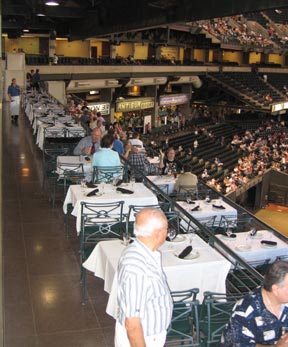 Mike had paid $52 apiece for the seats. I thought that was a little high. But it appeared that it was some kind of special concierge seating that included waitress service. (Huh?) It also included admission to the Acura Club, on our level in the outfield. Since we got there before the game started, we decided to check it out.
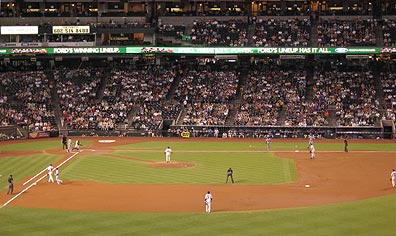 The game started and we watched it while sipping iced tea and waiting for dessert. The Met started the inning and they promptly scored 3 runs. The Diamondbacks stepped up to the plate and stepped away scoreless.
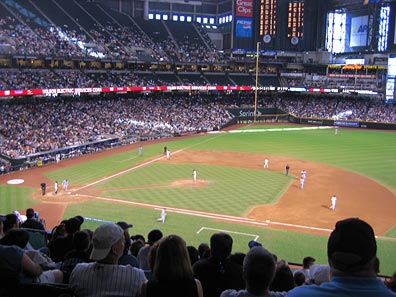 We left the Acura Club and went to our seats. The sound was much louder there, but the view was better, being so much closer to the action. There was a surprising number of Met fans in the audience, some of them even wearing Mets jerseys and hats. So when the Mets scored 6 more runs a bit later in the game, there was quite a bit of cheering. I really felt sorry for the D’backs at that point. They were losing 10 to 0.
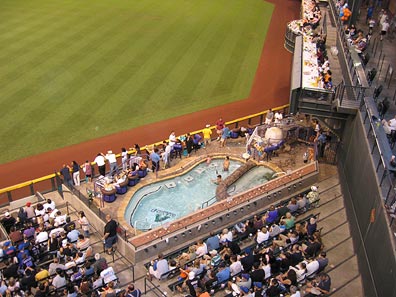 There was a faint glimmer of hope a bit later in the game when one of the Diamondbacks hit a home run. It went over the right field wall into the swimming pool area. Yes, I did say swimming pool. One of the oddities of Chase Field is the swimming pool just outside of right field. It appears that you can rent it for parties and the like during the game. I took this photo from the Acura Club; you get the idea.
 I couldn’t remember where this photo was taken, either. I knew it was in Maine and I knew I’d taken it on one of our outings with John and Lorna. So I e-mailed Lorna a copy of the image and asked her. The response came back almost immediately: Samoset Resort in Rockland, ME.
 You also can’t see the building at the end of breakwater about a mile from where this photo was taken. Here it is. It was a lighthouse and apparently still functions as one. But it’s closed to the public, so you can just walk around it or onto its stone steps. We spent some time sitting out in the sun, watching the boats go by. It was a peaceful, relaxing place. There was some fog in the trees on the other side of the channel — the same fog we’d walked through earlier in the day when visiting the Owl’s Head Lighthouse. (Did I get that one right, Lorna?)
 I took this photo of John and Lorna on the way back to the car. John’s not an easy guy to get a picture of. It seem like every time you tell him to stand still and pose for a picture, he acts like he doesn’t believe someone’s really going to take his picture. So you have to take a few of them in a row for one of them to come out natural enough to use. This one gets them both.