Flying M Air keeps me busy.
As anyone who runs a service business can tell you, work comes in spurts. You can go days or weeks without any customers, then wham! You’re busy with paying work several days or weeks in a row.
That’s how it is with Flying M Air. The months of January and February were a bit disappointing after a very busy December. But suddenly the phone started ringing again. And in less than 10 days, I had four good charter flights.
Sedona
The first, last week, was to Sedona. I like my Sedona flights. The scenery on the way up there and back (I take two different routes to keep it interesting for myself and my passengers) is beautiful and interesting. My passengers always enjoy the flight, especially if they’re not from Arizona and they’ve never seen its varied terrain. I cruise past the red rocks just enough to satisfy their needs to see them but without straying into the flight path of the helicopter tour company based up there.
At the airport, there’s a restaurant (or at least there is now; it’ll be closing soon) where I can grab a bite to eat while waiting for my passengers to do their thing down in the town. Then I hang out in thec terminal and read or write or chat with the FBO guys or helicopter tour guys or airplane charter guys.
My passengers, in the meantime, go down into the town of Sedona for a Jeep tour or shopping or lunch or any combination of those. They’re usually down there for about 3 hours and I include that waiting time in my price. When they return, I’m ready to go and we head back to our starting point. That’s usually Wickenburg, like it was last week, but I can do the tour from any airport in the Phoenix area. The great thing for the passengers is that they get a wonderful scenic flight lasting 90 to 120 minutes total (depending on where they started from) and they get to “do” Sedona in less than a day. When you’re on vacation based in Phoenix or Scottsdale or Wickenburg, that’s a big deal. My flight saves them the 2-3 hours each way it would take to drive and they still get back to their hotels in time for dinner.
My passengers last week were from Maryland, on vacation in Wickenburg. I set them up with a Jeep tour with the Pink Jeep Tour Company, the big outfit based in Sedona. They had lunch at the airport restaurant before returning to the helicopter for the flight back. They were a nice couple — heck, all my passengers are nice people — and they really enjoyed their day. That’s a bonus for me. And when we landed, they even gave me a tip. Woo-hoo!
Photo Shoot at the Proving Grounds
I’d just left the airport on Wednesday morning, ready to dig into a full day of work at my office, when my cell phone rang. A local contractor was looking for a helicopter to fly a photographer over a job he’d just finished at a local car manufacturer’s proving grounds. Was I available?
I wanted the work, but I wanted to get something done on the WordPress book I’m writing with Miraz. So I told him I was busy until 2 PM and could go then. He said he’d call me back. He did, a while later, and we scheduled the flight for 2.
Keep in mind here that I don’t keep my helicopter out on the ramp, all pre-flighted and ready to go. I keep it in the hangar and normally do most of my preflight work in the hangar (out of the wind or sun) before I drag it out, fuel it up, and park it on the ramp for departure. If everything goes well, I can do all this in about 30 minutes. But I like to allow 45-60 minutes, just in case something doesn’t go smoothly. That meant I needed to be at the airport at 1 PM.
I finished up early and waited for my passengers. They were two men, neither of which had been in a helicopter before. I gave the one with the camera the big option: door on or door off?
“What do most photographers do?” he asked.
“If they’re serious about the photos coming out good, they take the door off. Otherwise, they leave the door on and there’s some reflective glare in some of the photos.”
Door off.
I gave them their preflight briefing and loaded them onboard. Even though they were both pretty good sized men, I put them on the same side of the helicopter. This way, they’d have the same view, which I’d put on their side. It’s nearly impossible to load an R44 out of CG (center of gravity), so I wasn’t worried about that.
One of the passengers had drawn a map of where the proving grounds were. Trouble is, he drew it upside-down, so south was up, and I had to hold it upside down to make sense of it. I thought they wanted the proving grounds just south of Vulture Peak, but it turns out the place they wanted was farther east, near Grand Avenue. We found the place pretty quickly and I settled in for some slow circles around the area at about 500 feet.
There were three objects of the photography shoot. One was a huge skid pad — a big rectangular area, paved smoothly with asphalt. The pad would be filled with water and the cars would skid around on it. Another was a water line that ran from the skid pad to a well. The line was underground, so we expected to just see the disturbed earth over it. We had some trouble finding it because we were told it rand east-west when in fact it ran northeast-southwest right alongside an existing drag strip-like road. The final target was a dirt “hauling road” that ran alongside the edge of the property.
The photographer had a digital camera with 200 shots available and he took dozens of photos. It’s amazing what digital cameras can do. You can take anyone capable of pressing a shutter button, bring him to a place where he needs to take pictures, and let him take 200 shots. Some of them have to be good and a few have to be perfect. It’s just a matter of playing the percentages.
While we flew around and around, the cars below us were taking interest. A lot of the proving grounds in the area have cars that aren’t in production yet. Car magazines use helicopters to get spy photos. (Hey, Motor Trend, I’m available!) So when there are new cars out there, they tend to get under cover when a helicopter flies over. This is taken to a science at some proving grounds.
I pretty much ignored what was going on below me, being more interested in the F-16s that occasionally flew by. I was at the edge of the Luke Air Force Base jet training area and glad those guys had me on radar. But we were the only things flying that day — winds were gusting to 25 knots and all the other pilots were staying on the ground.
When we finished up at the proving grounds, we headed back to Wickenburg to take some photos of various houses and other things in town. We landed and I shut down. The whole job had taken less than an hour.
Grand Canyon
I also do Grand Canyon flights out of Wickenburg and the Phoenix area and I did one on Thursday. Like the Sedona flights, they save the passengers lots of driving time — at least 3 hours each way. But unlike the Sedona flights, the terrain we fly over each way is pretty boring, consisting mostly of high desert, open range with dry grass, stubby trees, and the occaisional group of cows.
I’d flown these passengers before. They were a couple from the Toronto, Canada area and they were very pleasant and well-traveled. The husband was in love with helicopter flight and used helicopters for all kinds of things. The wife was a bit nervous about flying, although not too nervous to let it spoil her trip. I’d taken them to Sedona a few months before and I’m already booked to fly them from Wickenburg to Sky Harbor Airport in Phoenix on Tuesday.
When we got up to the Grand Canyon Airport, the wind was howling and there was snow on the ground. It was cold. I called Papillon, who I’d booked a flight with for my passengers, to get a shuttle to take us from the main terminal to their terminal. It was walking distance, but not exactly close. It turned out that they’d lost my reservation and the long flight I’d booked them for wasn’t being done anymore because of weather on east side of the canyon. The only thing left was the short flight.
I looked across the street at Grand Canyon Helicopters, which is owned by Papillon but flies newer, nicer equipment, and asked the guy to book them on a flight over there. Then we walked over and I waited around until they got on board. I was happy to see them both get front seats next to Ron, a pilot I knew from my Papillon days.
Then, while they took their tour, I went back to Zero-Mike-Lima to retrieve my purse and place a fuel order. I called for a shuttle into the park when I got back to Grand Canyon Helicopters’ terminal. I chatted with the folks there — it’s true, I’ll talk to anyone — and was waiting when their flight returned. They’d enjoyed it and only wished it was longer. I wish it was, too — I know they would have enjoyed the other flight more. But what could we do?
In case you’re wondering why I didn’t take them over the canyon, it’s easy: I can’t. The Grand Canyon airspace is heavily controlled and I’d have to fly over at 10,500 and 11,500 feet (depending on direction). Although my helicopter can fly at 12,000 feet, anything over 9,000 sets up nasty vibrations that I just don’t like. The helicopter tour operators there — Papillon, Grand Canyon Helicopters, and Maverick — have special permits for conducting flights at 7,500 feet. That’s the altitude to fly the canyon. (And if you’re ever at the canyon, take a helicopter tour. It’s costly, but it’s an experience you’re not likely to ever forget.)
The shuttle arrived not long after they returned and it took us into the park. I had him drop us off at El Tovar Hotel, right on the rim. I told my passengers what they could do and see in a few hours. They invited me to join them for lunch and I agreed. We had a nice lunch at El Tovar, then split up. They walked down the rim path toward Bright Angel Lodge. I hung around El Tovar’s lobby for a while, then went out for a short walk. I was back in the lobby when they returned.

The Grand Canyon right after a snowfall.
They’d had a nice walk and had stopped into a few shops, including Hopi House, and the Fred Harvey museum in Bright Angel Lodge. We took the shuttle back to the airport. It took a long time to warm up the helicopter in the wind, which was now gusting to 22 knots, but we finally had the engine warmed up enough to depart. I was the only pilot on the radio. We took off to the south. I showed them our Howard Mesa property on the way, skirted around a controlled burn in Williams, and flew directly back to Wickenburg. It wasn’t an exciting flight but we were lucky that the wind was mostly out of the west, so it didn’t slow us down too much. We were back at the airport by 4:30 PM.
Golf Course Photo Shoot
The call came as Mike and I were preparing to go out to dinner on Thursday night. The woman was uncertain, as if she thought she was on a mission she’d never accomplish. Did I have a helicopter available to take a photographer around a golf course in Peoria the next day?
I saw another day of WordPress book work slipping away. “What time?” I asked.
“About ten?”
I told her I could do it and she gave me her contact information. She said the photographer might call to finalize the pick up location. She wanted me to land on the golf course, but didn’t have GPS coordinates for the landing zone and I’d never seen the golf course from the air — I usually don’t fly over there.
The photographer called a while later. She asked if we could do it earlier, like around 9:30. I told her we could. We talked some more. She said she wanted to get an early start, like maybe around 9 AM. I told her that was fine. We talked some more. She said she liked working early in the morning. Could I come earlier?
“What time do you want me?” I asked. I had already crossed out the time twice on the calendar and it was beginning to look pretty messy.
“Well how about around 8 AM? Or maybe a quarter to eight?”
“Seven forty-five?” I asked.
“Well, yes,” she said almost uncertainly. “Around a quarter to eight.” She made it sound as if that was a different time than seven forty-five.
We agreed to meet at Turf Soaring School, a small private airport that caters to gliders and ultralights. It should be easy for her to find and it should be near the golf course.
I got to the airport at 6:30 AM the next morning and pulled my helicopter out just as it was getting light. There was a big cloud on the horizon and the sun poked through it long enough to turn its edges golden. I wondered if the cloud would ruin her photos.
I fueled up, started up, warmed up, and took off. It was a quick flight, less than 20 minutes. I flew under that cloud I’d seen — evidently, it was a lot lower and smaller than it looked — and there was nothing but clear skies ahead. I landed at Turf, shut down, listened to a voicemail message on my cell phone from the photographer, and got out. I was just removing the front passenger door when the photographer drove up on the cross runway. I don’t think she realized it was a runway. It was dirt and not very well maintained.
We introduced ourselves and I told her where to park. Then I walked over and waited while she reformatted some cards for her digital camera. She had a huge bag of photographic equipment, almost all Nikon stuff. She told me how she’d gotten it cheap (or maybe for free) and dropped a few names of celebrities. Name dropping normally turns me off, but I wasn’t bothered too much. It was probably standard procedure in the circles she moved in. Not having other names to drop back, I kept quiet. (Really.)
We took off. The golf course was literally 5 minutes away. What followed was about a half hour of out of ground effect (OGE) hovering all over the golf course. Fortunately, houses hadn’t been built there yet, so I wasn’t endangering anyone on the ground. At one point, however, we moved close to the neighboring development of Trilogy and I saw people coming out of their homes to watch. I wondered whether the FAA would be calling later with complaints. I had nothing to worry about — I wasn’t hovering over anyone’s house — but people tend to exaggerate things to make their cases stronger when complaining.
It was a challenging flight for me. Lots of OGE hovering with a tail wind. But Zero-Mike-Lima and I were up to the challenge. That helicopter has all the power in the world with just two people on board. A few times, right after getting into a hover in the right spot, the wind would kick us from behind. I’d kick back with the pedals and get us stablized quickly.
The photograher, at one point, said, “You’re a great pilot.” At first, I thought she was just saying that to make me feel good. After all, who was I? Some Wickenburg-based pilot who didn’t even have any names to drop in a name-dropping conversation. But when she said it again and again, I started to think she might mean it. She did this kind of work with helicopter pilots all over the world. Although I don’t think I was the best, it was good to know I wasn’t the worst. In other words, I didn’t stink.
The golf course, by the way, was beautiful. Although I hate the idea of tearing up the natural desert to plant grass that soaks up our most precious resource here — water — I do admit that these desert golf course designers make glorious landscapes. This was one of the nicest I’d ever seen.
We finished up and flew back to Turf. The photographer told me that from now on, when she did aerial photography in Arizona, she’d use me. Of course, she lives in Monterey, CA, so I don’t know how often that would be. Better not quit my day job.
The Feast
That was the recent feast in my feast or famine cycle. With another two flights already scheduled for Tuesday, it has the potential to continue for a while. I hope so. Summer is dead time here and I’m not sure if that cherry drying gig will work out.
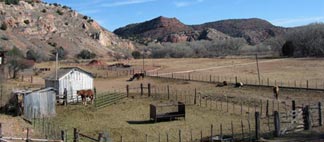 The ride ends at Perkinsville, where the canyon opens up to a broader valley. There’s a ranch there and the train stops literally in front of the ranch house. The place appeared occupied — there were horses and cattle there — but there wasn’t a person in sight. The conductor guy told us the story. Years and years ago, when the railroad was built, the land at the ranch was needed as a station to take on water and fuel for the steam engines. The railroad had offered the land owners a lump sum or a royalty for the use of the land. The Perkins family had taken the lump sum, giving up their control of the right of way. Today, under new ownership, the tour train had control of the land. The people who live in the house make themselves scarce when the train stops there on every run.
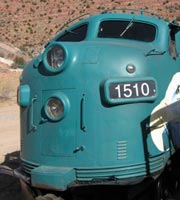 Why does the train stop at all? Well, this is the place the engines are moved from the front of the train to the back for the return ride. There’s a siding there and while we’re waiting, enjoying the scenery and feeling kind of bad for the people who have to deal with 130 tourists a day looking into their windows, the engineer takes the two engines and moves them. The task takes about 20 minutes and they sell ice cream sandwiches to us while we wait. Then we’re on our way back to Clarkdale at a slightly faster speed, leaving Perkinsville behind.