Computer Wait Speed

Maria Speaks Episode 34: Computer Wait Speed

My current computer woes remind me of something I heard long ago.

A long time ago — ten or more years, which is the middle ages in terms of the computing industry — computers were being marketed primarily on the basis of processor speed. Every time Intel or Motorola would come out with a new processor chip, members of the geeky set hurried to the stories to buy a new computer or upgrade that would bring their machines up to speed. It was then that I heard this rather curious statement:

All computers wait at the same speed.

The statement, of course, was meant to poke fun at computer users. At least that’s how I read it. Your computer could be the fastest in the world, but if you weren’t up to speed, all that extra fast processing power would be wasted. After all, each time a computer completes an instruction — whether it’s opening a dialog box, applying a font style change to some text, or matching e-mail addresses in your address book when you type into a field in a new e-mail message form — the computer faithfully waits…for you. As long as it has to. And while computer processors are getting ever faster, computer users are simply not keeping up.

Let Me Tell You About My Mom

All this reminds me of a sort of funny story. My mother, who has been using computers for nearly as long as I have, is not what you’d call a “power user.” She pretty much knows what her computer can do for her and she can usually make it do it. But she’s not the kind of person who pushes against the boundaries of what she knows very often. And when she’s working with her computer, she spends a lot of time making the computer wait while she thinks about what’s onscreen and how she needs to proceed. That isn’t a big deal — I’d say that 95% of computer users are like her. People react to what the computer does rather than anticipate what’ll come up next and have the next task prepared in their minds when the computer is ready to accept it. And all these computers are waiting at the same speed.

Anyway, for years, my Mom used dial-up Internet services. Most of us did. But as better alternatives came around and Web sites got ever more graphic-intensive, most of us updated our Internet connection technology to take advantage of cable or DSL or some other higher bandwidth connection. (I was literally the first (and only) kid on the block to get ISDN at my home. This was back in the days before cable and DSL Internet service. It cost me a fortune — heck, they had to dig a trench to lay new telephone lines to my house — but I simply could not tolerate busy signals, dropped carriers, and slow download speeds for my work. It operated at a whopping 128 Kbps and cost me $150/month. Ouchie!) My Mom, on the other hand, didn’t upgrade. She continued to surf the Internet through AOL on a dial-up connection, right into late 2006. Worse yet, she refused to get a second phone line, so she limited her Internet access or was impossible to get on the phone.

Let me take a little side trip here to discuss why her attitude wasn’t a bad thing at all. Personally, I believe we have too much dependence on the Internet. I recently read “I Survived My Internet Vacation” by Lore Sjöberg on wired.com, which takes a comic but all-too-real look at Internet withdrawal. If you’re the kind of person who uses the Internet to check the weather, look up vocabulary words, and find obscure information throughout each day without really needing that information, you owe it to yourself to read the piece. It really hit home for me. So in the case of my Mom, the fact that her Internet use was minimal wasn’t such a bad thing. Not at least as far as I was concerned.

But it had gotten to the point with my Mom that she was spending more time waiting for her computer than her computer was waiting for her. And it had nothing to do with processor speed. It was her dial-up Internet connection that made it slow.

At first, I don’t think she understood this. I think that when she replaced her aging Macintosh with a PC about 2 years ago, she really expected everything to get faster. But the Internet got slower and slower for her, primarily because Web designers don’t design sites for dial-up connections. (Shame on them!) The Internet had become a tedious, frustrating place for her and she couldn’t understand why so many people were spending so much time using it.

In November 2006, I came for a visit. I had to look up something on the Internet and within 15 minutes, I was about to go mad. I asked her why she didn’t upgrade to a different service. Then she showed me a flyer that had come with her cable bill. We sat down with her phone bill and AOL bill and realized that she could upgrade to cable Internet service and actually save money. A little more research with her local phone company saved even more money.

So she was paying a premium to connect at 56Kbps or less.

I made a few phone calls and talked to people in the United States and India for her. I’ll be honest with you — the price difference between cable Internet and her local phone company’s Internet was minimal, but we went with the phone company because the person who answered the phone spoke English as her first language. (Subsequently, my Mom needed some tech support after I was gone and that person was in India. Sheesh.) The installation would happen the day after I left to go back to Arizona, but I was pretty confident that they would make everything work. And although it didn’t go as smoothly as we’d hoped, my Mom was soon cruising the ‘Net at normal DSL speeds.

In other words, wicked fast.

My Mom was floored by the difference. I’d told her it was much faster, but I didn’t tell her it was 100 times faster. And it’s always on — all she has to do is turn on the computer and she’s online! And she can even get phone calls while she’s on the Internet! Imagine all that!

The happy ending of this story is that my mother now spends a lot more time on the Internet. (I’m not sure how happy that is.) And of course, she’s now back to the situation where the computer is waiting for her.

Who’s Waiting for What in My Office

I reported a hard disk crash here about 9 days ago. I know it was 9 days because that’s how long I’ve been waiting for the data recovery software to churn through whatever is left of my hard disk. And although it’s still progressing, it’s slowed to a crawl. I think it’s teasing me. But I’ll get the last laugh — I’m pulling the plug today.

There comes a time when you simply can’t wait anymore. I think 9 days shows a great deal of patience on my part. I know I couldn’t have waited so long if I didn’t have other computers to work with. I did get some work done this past week. I wrote up the outline for my Mac OS X book revision for Leopard. I did a lot of e-mail, fixed up a bunch of Web sites, wrote and submitted a bid for Flying M Air to dry cherries this summer in Washington State.

But what I did not do outweighed what I did do. I didn’t work on my Excel 2007 Visual QuickStart Guide. (I need the big monitor to do layout.) I did not pay my bills. (The latest version of my Quicken data files are on the sick drive.) I didn’t update Flying M AIr’s brochure. (Original files on the sick disk, need big monitor for layout.) The list does go on and on.

Now it’s time to get back to work. So I’ll pull the plug on the current data recovery attempt, put the hard disk in the freezer for a few hours, then reinstall it and try again by accessing the sick disk via Firewire from another computer. I can try multiple software solutions to fix the problem. And if that doesn’t work, I take the long drive down to the nearest Genius and let them give the computer a check up to make sure there’s no motherboard damage (again). If the mother board is still fine, I’ll leave them the disk to play with, get a new disk to replace it, and get the hell back to work.

That’s the plan, anyway.
A Helicopter Repair Story

Including a happy ending.

On Tuesday, I flew out to Robson’s Mining World in Aguila, AZ. I was scheduled to appear there on Saturday for their anniversary celebration and I wanted to make sure my usual landing zone was in good shape.

It was a windy day and I was tossed around a bit on the 8-minute flight from Wickenburg (vs. a 30-minute drive). But the winds were calmer closer to the ground. I circled Robson’s once, then set down on what I thought was a spot closer to the road. Turned out, it was the same spot I’d occupied the year before. It just looked closer to the road from the air. The quartz rocks Mike and John had laid out in a line for me were still there. The idea was to land with the helicopter’s cockpit over the line. That would keep my tail rotor away from the bushes behind us. But since the bushes looked bigger than they had the year before, I positioned the helicopter a little bit closer to the road.

I cooled down the helicopter and shut down the engine. Then I went out to assess the landing zone on foot. I discovered that the quartz line was still quite workable for me. The bushes were farther back than I’d thought on landing. (I always estimate the helicopter’s tail longer than it really is.) So the landing zone was fine. No trimming would be required. That’s good because I don’t like the idea of cutting any desert vegetation unless absolutely necessary.

I put on my jacket — it was still quite cool at 9 AM — and walked through Robson’s front gates. The place looked deserted. I headed toward the restaurant, planning on having a piece of pie for breakfast. The door was locked but as I was starting to turn away, Rosa, who works in the restaurant, hurried out from the kitchen and opened the door. I settled down at a table and she talked me into having a real breakfast of bacon and eggs. She set me up with a small pot of hot tea and went back into the kitchen to prepare my food.

I had a few awkward moments when the teapot’s lid fell into my cup and became stuck there. If I’d been with someone, we would have been laughing hard. But I was alone and laughed at myself more quietly. I had to pour all the tea back into the pot and wait for the lid in the cup to cool and contract a tiny bit before I could get it out.

Rosa brought me a plate of fresh fruit — grapefruit, pineapple, grapes, and oranges — then disappeared back into the kitchen. I busied myself by reading the history of Robson’s and some information about the equipment and vehicles on display. When she brought out my breakfast a while later, I gobbled down the two eggs over medium, three slices of bacon, and two slices of wheat toast with real butter. (Don’t you hate when restaurants use mystery spread on toast?)

The person I was hoping to see there, Rebecca, wasn’t in yet. She lives in Wickenburg and drives out five days a week to manage the place. I saw her drive in just as I was starting the engine for the helicopter at about 9:45. Since the engine was already running and the blades were already turning, I didn’t shut down. I had another stop to make.
Continue reading

Cows in the Landing Zone

Yes, cows.

One of Flying M Air’s clients is a local business that has a remote ranch along the Hassayampa River. I occasionally take their VIPs out to the ranch, turning a 45-minute (each way) car ride on washboarded dirt roads into a 6-minute scenic helicopter flight.

The landing zone is near a few of the ranch buildings, on a patch of sparse grass near a road. My approach route takes me along the road past large pens holding horses, cows, and calves.

On all of my previous flights, the cows were in the pens. But today, they were out and about. As I approached my landing zone, I was rather surprised to see a 2-month-old calf standing on the road, obviously mooing its little brains out. The recipient of this mooing was on the other side of the landing zone: a cow that might have been its mother.

Of course, I noted all this as I was coming in for a landing with three passengers on board. I’ve landed there so many times that I don’t normally do any kind of reconnoissance anymore. I know the landing zone very well and, if things aren’t as expected, I know the quick escape route I can use if I need to abort.

I didn’t need to abort. I set down where I usually do while my passengers debated whether they could walk past the cow about 100 feet away. The cow had horns — as all the cows at that ranch do — and they thought it might be a bull. Many people who don’t check an animal’s privates think horns are the indication of animal gender. I saw udders and I knew it was a cow.

While I descended to the ground, my rotor wash blew up a bunch of dried cow patties and dust. It all flew into the air and I wondered about the possibility of one of those smaller cow patties flying up into the tail rotor when it was time to take off.

I throttled down to cool-down RPM (68% on an R44) and let my passengers disembark, reminding them again of the tail rotor. I always park facing where my passengers need to go, so there’s no reason for them to walk behind the helicopter. As I cooled the helicopter down, I watched a cowboy greet them. They walked away to take a tour of the ranch. Routine stuff.

What wasn’t routine was the cows. They were all over the place. Cows and calves in every direction. There had to be at least twenty of them.

I shut down, watching the cows and wondering whether they were tall enough to interfere with the tail rotor. Those horns were pretty high up. They were watching me. All of them. Just standing around, with their cow faces looking my way. It was very weird.

I stopped the blades with the rotor brake and got out to survey my position on the landing zone. There was certainly a lot more cow patties than the last time I’d landed there. I’d landed in a patch of short, dry grass, surrounded by dirt. There was a shallow ditch off the front end of the right skid. No big rocks near the skids. Just a bunch of dried cow patties in all sizes. So dry that I could kick them away from the tail rotor area without getting cow poop on my shoes. But not dry enough that I to touch them with my hands.

I looked at the cows and their calves. They were still watching me. The closest one was about 100 feet away. One of them was mooing insistently.

I took out my Hobbs book and caught up with some paperwork. I knew my passengers would be at least 30 minutes. I’d forgotten my iPod at home and figured I’d use the time to catch up with some of the log stuff the FAA required for my Part 135 certificate.

When I looked up, a few of the cows were closer.

This was not good. I put away the book and got out. I made a big show of cleaning the cockpit bubble. The cows watched.

I finished and decided it was time to chase the cows away. I’d told my passengers that I’d start the engine when I saw them coming, but I wasn’t prepared to start the engine when a cow might walk into the tail rotor. I had to get them away.

Unfortunately, persistent “shooing” sounds with waving hands didn’t do the job.

I started walking toward the closest cow. Other cows and calves nearby immediately moved away. One of them stopped periodically to moo at me. But soon most of them were a bit farther off.

Except one. She was an older cow with horns that had the tips sawn off. I got the idea that she was a troublemaker who used her horns one too many times to bully another cow or maybe a horse or cowboy. She seemed fascinated with either me or (more likely) the red helicopter I’d arrived in. When I walked toward her, she walked away. When I stopped, she stopped and looked at me.

It was getting chilly; the wind was picking up. I climbed back into the helicopter and closed the doors on my side.

That’s when the ranch guy showed up. He was driving a blue New Holland tractor with a front-end loader on it. The tractor was pulling a matching blue water tank. He drove noisily down the road and carefully backed the tank into a spot near a horse corral. Two dogs were walking alongside his rig; I realized that two more were riding on the tank trailer. He stopped and a guy rode up on an ATV. I turned my attention to the cows. I think they were getting closer again. The guy with the ATV rode off. The ranch guy disconnected the water trailer and pulled the tractor away. He parked a short distance from me and called to the dogs.

There were four dogs and they all looked to be mutts. Three of them had some border collie or Australian shepherd or heeler in them. The other one looked like it might have some hound in it. But when the ranch guy hollered whatever it is he hollered, the dogs took off toward the closest group of cows.

The next ten minutes was an incredible show. The dogs, listening to a few simple commands from the ranch guy, proceeded to round up groups of 3 to 6 cows and move them toward the horse corrals 50 yards away from my helicopter. The cows didn’t want to be moved. The older ones turned their horns toward the dogs and even kicked at them, but the dogs were always faster and managed to stay safe. They barked and the cows mooed and the calves ran around in a panic. But eventually the pack was moved to the fence near the horse corral. Then the dogs got a short rest before the ranch guy would set them on another group of cows. I watched in amazement until all the cows except one had been moved to the side of the horse corral.

The whole time, the ranch guy just sat in the blue tractor, watching the dogs. Every once in a while, he’d yell out a command that I couldn’t quite hear. When the dogs were finished, they came back to the tractor and just lay down in the dirt. They stayed there for about five minutes. Then the ranch guy issued another command I couldn’t quite catch and motioned to the one cow that was still nearby. The dogs took off after it.

The cow ran into the bushes. The dogs ran after it. “Bring ’em back!” the ranch guy yelled. I saw the cow run back and forth through the bushes. The dogs split up and worked it as a team. Soon, the cow was running back across the clearing. It ran past the front of the helicopter toward the other cows. Finally it was among them. The dogs relaxed.

The ranch guy started the tractor and headed off back up the road. The dogs followed him. He rounded a bend in the road and moved out of sight.

The cows stood in a group near the horse corral. A few of them mooed angrily. One or two scratched their front hooves in the dirt like a bull at a bullfight in the movies.

A few minutes later, three of the dogs returned. They stared at the cows for a few minutes, then lay down in the dirt 50 feet away, watching them.

The cows didn’t move, although the mooing ones never really shut up.

My passengers returned a while later. I didn’t have to worry much about the cows and the tail rotor. The dogs had them under control.

This is one of the few times I didn’t have a camera with me. If I did, I’d have used the movie feature to get video of the dogs in action.

My total flight time was 0.3 hours, but I’ll get paid for 0.5 because of my half-hour minimum. I was on the ground waiting for nearly 50 minutes.

But that’s okay. I had a really good show.

Flying to Sedona (again)

A helicopter flight that has become routine.

As I write this, 36% of the site visitors who have taken the time to vote in my Most Interesting Topics Poll (that’s 11 people so far; I’m hoping for continued growth in that vote count) have said that Flying is the most interesting topic on this site. So I decided to devote this morning’s blog session to a flying article.

(For those of you just tuning in for the first time, among the hats I wear is a commercial helicopter pilot hat. I operate a Single Pilot Part 135 helicopter tour and charter company out of Wickenburg, AZ — Flying M Air.)

I flew yesterday. I flew three passengers from Wickenburg to Sedona and back. The passengers were originally from Russia and now live in the U.K. They’re staying at the Flying E Ranch, one of Wickenburg’s remaining three guest ranches.

I can’t get excited about this flight. It was so routine. After all, by now I must have flown from Wickenburg to Sedona and back at least 50 times.

The only thing unusual about the flight yesterday was visibility. In Arizona, it’s clear and sunny almost every day. Not only can I usually see the Weaver Mountains about 15 miles to the north, but I can usually see them clearly — that means I can distinguish rocks and canyons and other features from 15 miles away. But yesterday was different. It was hazy, as if a thin gauze had been stretched across my eyes. As I drove to the airport at about 10:00, it was apparent why: there was moisture in the air. There was condensation on my Jeep and even a little frost down where the horses were munching their morning meal. Imagine that. Moisture.

My passengers arrived early, all bundled up for the 50°F temperatures we expected in Sedona. After giving them their preflight briefing and loading them on board, I started the helicopter and waited for it to warm up. A few minutes later, we were on our way, climbing to the northeast into hazy skies.

The air was smooth, the sights were the same as usual (except for the haze) and I pointed them out faithfully to my passengers. They didn’t talk much, which is always a danger with me. I wind up talking to fill the silence, telling them more about the area than I usually do. I had three passengers on board, so I had to make sure I pointed out things on both sides of the helicopter — normally, with just two on board, I put them on the same side of the helicopter so I only have to point out things on one side.

We crossed the Weaver Mountains not far from the hidden cabins I’d discovered years before. Then we followed the Hassayampa River up toward Prescott, crossing the Bradshaws. My passengers were thrilled by the sight of snow on the north side of the moutains. I was thrilled by the fact that the haze had cleared out and it was a nice, clear day up there.

As we got close to town, I reported in to the tower at Prescott Airport. I planned to follow Route 69 a bit and then head toward the pass atop Mingus Mountain. This would have me cutting as much as one mile into Prescott’s airspace. (I normally go around it so I don’t have to talk to the tower, but our heavy weight had our airspeed a bit slower than usual and I wanted to save a few minutes of time.) We were over Prescott Valley when the tower pointed out a Baron about 400 feet above us, crossing in front of us. I descended about 500 feet — I was high because of all the mountains I’d have to cross — to stay out of his way. Then the tower cut me loose and I climbed up and over Mingus Mountain, reaching my highest elevation of the flight: about 8,000 feet.

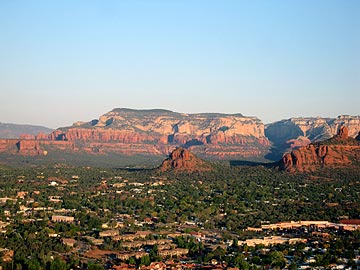
West SedonaFrom there, I started a 1,000 fpm descent to the northwest, descending past the former ghost town of Jerome. I told my passengers about the first time I’d been there nearly 20 years ago when only a handful of people lived there. Now it was a booming tourist town, with art galleries and restaurants in the old buildings perched along its hillside. I showed them the open pit mine, then continued northwest to the red rocks. We did a red rocks tour on the way into Sedona, avoiding the flight path of the helicopter tour operators there, and landed at the airport.

Uneventful.

Of course, I’d been so concerned with getting my credit card terminal to work at the airport that I’d forgotten to bring a book or my laptop so I’d have something to do while my passengers went on their Jeep tour. Duh. After the Jeep picked them up, I walked over to Sedona’s restaurant for lunch. (I don’t think I can recommend the Chicken Alfredo with Broccoli; too thick and starchy, although the chicken was cooked nicely.) Then back to the terminal to wait.

I wound up renting a car from the car rental guy there. $20 for up to 3 hours (I think). I didn’t even have it two hours. I drove down off Airport Mesa and hit the New Frontiers grocery store at the bottom of the hill. It has a magnificent selection of cheese and a very knowledgeable cheese guy behind the counter. I tasted some cheeses and wound up buying them all. I also bough brussels sprouts on the stalk — something that’s simply not available in Wickenburg.Then into “uptown” Sedona to visit a bookstore (the Worm) which seemed to have fewer books than I remember. And coffee at the coffee shop across the street. Then back to the airport so I’d be there when my passengers returned.

I talked to everyone who worked at the airport. The car rental guy, the AZ Adventures helicopter tour guys, the FBO guys, and the Maverick helicopter tour guy. That kept me busy even after my passengers returned from the Jeep tour and went to have lunch at the airport restaurant. By 3:30 PM, they were back and it was time to go.

The return trip was almost as routine. The haze had moved in a bit and we were flying right into the sun. My hat was under my seat, so I had to shade my eyes with my hand once in a while. Instead of heading straight for the southern end of Mingus Mountain, we headed southeast to Oak Creek Village. My front seat passenger had his camera out and the red rocks were being illuminated by that gently filtered afternoon sun. The views out that side of the helicopter were great. I flew just past Oak Creek VIllage before turning to the southwest, back into the sun. The mountains rose as dark shapes silhouetted against the hazy light.

I didn’t have as much to say on the way back. Part of that was my intercom system, which was creating static again. (I have to fix that! It’s driving me nuts!) So I had the squelch set so it was less likely to make noise. My passengers weren’t talking anyway. They were just looking; the daughter, who was probably close to 18 years old, had her iPod on under her headset and probably wouldn’t have heard what we were saying anyway.

The farther south we flew, the worse the haze got. It was definitely brownish in color toward the Phoenix area — smog trapped in an inversion. At one point, we could clearly see a dark line in the sky that marked the inversion layer. Very unusual.

I flew them over Crown King, a tiny town in the Bradshaw Mountains. The main reason I go that way on the way back is that you can normally see Wickenburg Airport from the Crown King area — a distance of about 23 nautical miles. But not yesterday. The haze was so complete that if I didn’t have my GPS set to Wickenburg (or at least a heading in mind) I would have strayed off course. I simply couldn’t see that far away. Even Lake Pleasant was difficult to see from the air, although I did point it out for my passengers as we flew about 10 miles north of its northern edge.

We were over the Monte Cristo mine on Constellation Road when I was still trying to figure out exactly where we were. When I saw the mine shaft and buildings, I thought I’d stumbled upon a mine I’d never seen before. Then I recognized it and was surprised that we were so close to town. Less than 10 miles to the airport, according to my GPS. I could just about make out reflections downtown and the scars of the earth around the airport.

I flew over town and then headed out to Flying E to show them the ranch where they were staying from the air. (That’s something I do for people staying in our local hotels and guest ranches.) Then we landed by the fuel pumps at the airport. I cooled down and shut down.

Routine.

After a while, flying the same route over and over does become routine or — dare I say it? — boring. Sedona is a place of incredible beauty and the best way to appreciate its beauty is to see it from the air. Yet when you’ve seen it as many times as I have, the impact of all that beauty fades. That’s one of the things I talked to the FBO guys in Sedona about. They both agreed that when they’d first come to Sedona, they were amazed at its beauty. Now, living with it all around them every day, it simply isn’t a big deal.

I felt like that when I flew at the Grand Canyon, too. Don’t get me wrong — it never got so boring that I’d prefer to fly elsewhere. I just wished I had the freedom to alter my flight path for a slightly different view or a new way of seeing things.

And here in Wickenburg. The upstairs front windows of my home look out over the Weaver Mountains in the distance. When I first moved into the house, I thought it was a view I’d never grow tired of. But I did. Kind of. I’m not sure why.

I’d be interested in hearing from other pilots who fly in beautiful places and have somehow lost sight of that beauty because of routine. Use the Comments link.

Amazon.com Wish Lists

A great way to let people know what you want.

I’ve maintained an Amazon.com wish list for at least a year now. I do it for two reasons:

  • To keep track of the books, DVDs, CDs, and other items I want. When I place an order with Amazon.com for something I need and I either need another item to get free shipping or want to piggyback a little gift to myself on that order, I pick something off the list and buy it in the same order.
  • To let other people know about the books, DVDs, CDs, and other items I want. This is especially useful for family members around the holidays, when they don’t know what to get me. But it’s also nice for site visitors. After all, I’ve bought Amazon.com wish list items for other bloggers and software developers. I thought maybe someone might want to surprise me.

My list grows. I add more things to it than I actually get. In fact, I added about 10 books today (after going through a back issue of Bookmarks).

My Amazon.com wish list didn’t help my mother buy me a Christmas gift this year. I sent her the link to my list and she e-mailed me back saying, “Is that all you have on the list? Books and movies?”

When I told her that was it, she didn’t reply. But the Friday before Christmas, she e-mailed me to let me know she’d sent my Christmas gift late. I still haven’t gotten it, but I know she didn’t buy anything on my Amazon.com wish list. I’m imagining a sweater (I live in Arizona) from Belk, a Florida-based department store. I distinctly remember the fruit trees she bought me for my birthday a few years ago. Yes. Live fruit trees. Apple and pear, I believe. (Remember, I live in the Sonoran desert of Arizona.) I sent them back to her in Florida. They probably died en route — she never mentioned them. The trees are one of the reasons I created the wish list.

I don’t get it. The wish list includes items ranging in price from about $10 to $75. A person can choose any number of things to buy a perfect gift for his/her budget. Shipping is usually free for orders over $25. And ordering is as simple as clicking a few onscreen buttons. (She even has DSL now!) I know my brother and sister would have used the wish list if they hadn’t bought us a wonderful set of Calphalon cookware for a combo Christmas/Wedding present. (Something else on a wish list.)

So apparently it’s up to me to eat away at the wish list by piggybacking items with other things I need to buy. That’s okay. The wish list is there when I need it, so I won’t forget what items I want.

Anyway, I recommend creating an Amazon.com wish list if you don’t already have one. Then keep the link handy for the next time someone asks what you want for Christmas or your birthday. But if your mom is like mine, add a few things other than just books and CDs. Otherwise, you might wind up with a sweater, too.