Digging Deep: Using Old Stones

My stone collecting obsession and how I’m trying to move forward.

Let’s get one thing straight from the get-go: I like rocks and always have. I’ve collected interesting rocks since I was a kid. You know — like when you’re out on a walk and you see one on the ground that catches your eye and it winds up in your pocket and later on your dresser.

Or when you’re on the beach with your family and you wind up picking up more rocks than shells and you keep them in a jar of water at home so they stay wet and shiny but become an algae-filled science experiment that disappears one day while you’re at school.

Or even in the school playground one afternoon in the 1970s when Steven Gaydos claims to have a moon rock and sells it to you for $2. (Yes, I was one of his suckers.)

Buy my jewelry!
After being encouraged (or nagged?) by too many other artist friends, I finally opened an Etsy shop to make it easy for folks to buy and for me to sell my finished pendants. It’s called MLGemstones. What I like about selling on Etsy is that it’s relatively easy to keep up-to-date — I can add pendants as I make them and remove them as I sell them — and Etsy does all the work to create for receipts and postage labels and calculate and pay sales tax.

Even when I got older and into a relationship, I collected pretty rocks. My future wasband did, too, which I always thought was natural. We’d go out in the desert and come back with a bunch of rocks. One day, while Jeeping out near Congress, AZ, we came upon a really nice, almost perfectly cubed piece of white quartz. It took three of us to get it in the back of the Jeep and it wound up in the front yard of our home. (It later disappeared; I don’t know if my wasband took it or someone looking at the house during the years it was for sale took it. I certainly had no use for it.)

Quartzsite Makes it Serious

Every year, when I lived in Arizona, I’d take at least one trip out to Quartzsite during the January rock shows. I exercised a lot of self-control in those days, but I did come home with rocks now and then. I had, by that time, seen the pattern of my rock acquisitions: find, bring home, set aside, lose, repeat. It made no sense to pay money for something I’d too quickly lose interest in.

After I moved to Washington state, I’d still go down to Quartzsite as part of my winter migration. And one year, I caught the rock bug bad.

Bacon Agate Pendant
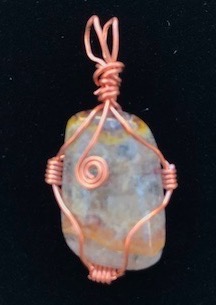
It’s almost embarrassing to share this photo of my second pendant, but sometimes you need to look behind you to see how far you’ve come. I recently found this pendant (after misplacing it for a year) and plan to reframe it and wear it as a reminder of the rock that started it all.

It started with a rock seller giving me a nice, polished bacon agate cabochon. I had to do something with it. That’s when I started playing around with jewelry making. I was awful back then and never realized that I would get better. All I thought about then was that now that I had something useful to do with the rocks, it made sense to buy a few.

A few hundred, is more like it.

The Growing Collection

Kingman Turquoise
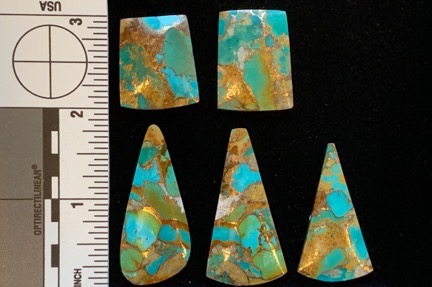
Kingman Turquoise with bronze is one of my best selling stones these days. I get these from a lapidary in Pennsylvania.

Since then — which was only two years ago this coming January — I’ve not only added to my collection, but I’ve begun displaying the stones in Riker boxes with felt inserts. Each box has a type of stone: jasper, agate, moss agate, jade/opal, turquoise/chrysocolla/azurite, etc. Each stone is meticulously inventoried with a tiny sticker on the back with its name, inventory number, and selling price. Yes, I now sell cabochons, too. I have become a rock dealer.

I get about half my stones in Quartzsite or Tucson every year. Honestly, I get better deals in Quartzsite so that’s where I mostly shop, starting as early as December.

I get another 45% of my stones from lapidaries — people who polish stones into the cabochons I use for my jewelry.

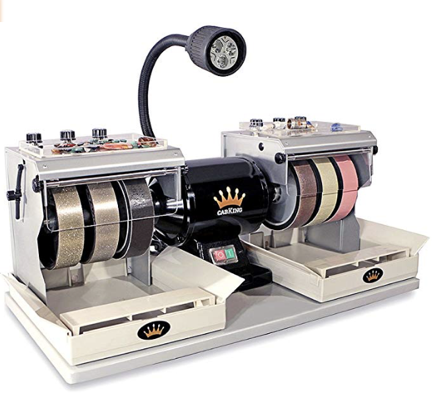
CabKing6
I bought one of these so I could polish local stones.

The final 5% are made in my shop. When I got rock fever bad enough, I bought a CabKing 6 cab making machine. I have a very large supply of local petrified wood and obsidian that I got in trade from a client. They both make very nice cabochons — when I have the time to polish them. Of course, once I got the machine, I started acquiring slabs of rock from all over the world so I could make my own cabochons. Unfortunately, I’ve been having trouble finding time to do that.

Selling Stones

My cabochons range in acquisition price from $1 to $20. I obviously sell them for more than that. I have them on display at venues where I sell my jewelry. I get a lot of rock lovers stopping by to look — some of them can spend 15 minutes or more at my booth looking and chatting with me. I enjoy sharing my knowledge and learning from some of them. And I love hearing their stories! I don’t even mind when they take up a bunch of my time and don’t buy anything. (The only thing I do mind is kids with dirty hands touching the tops of the display boxes. 🤯)

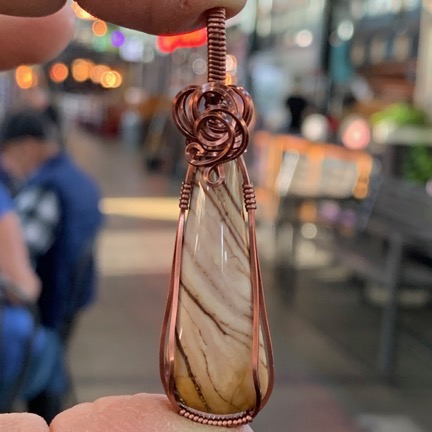
Fallon NV Wonderstone
This Fallon Nevada Wonderstone was one of the first “expensive” rocks I bought. I think I paid $15 for it. The pendant sold for $79 the other day.

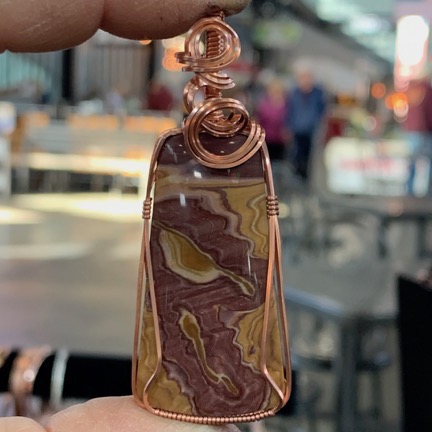
Picasso Stone
This was the first Picasso stone cabochon I bought and I think it was the nicest. It sold last weekend.

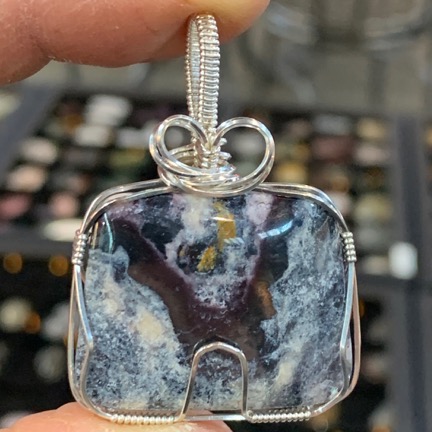
Indian Blanket Jasper
This was one of the first 100 stones in my collection. I’ve since learned that square stones are a tough sell, but I suspect this one will eventually find a home.

Petrified Wood
I obtained this petrified wood cabochon long before I got about 100 pounds of local petrified wood in trade with one of my clients.

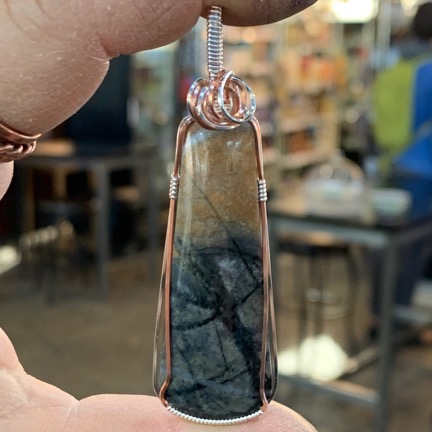
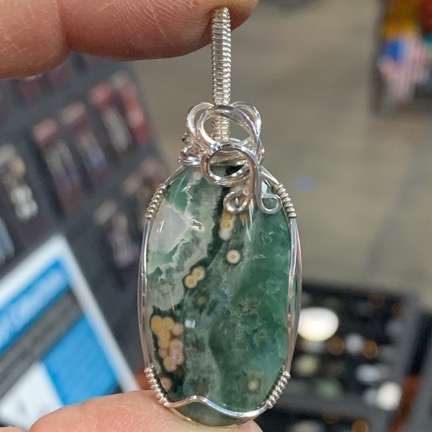
Ocean Jasper
I remember the day I bought this Ocean jasper cabochon and another very much like it in a Sacramento, CA bead shop. I paid too much (as I now know) but got my investment back (and more) when it sold last weekend.

Although the main reason I have the stones on display is to entice shoppers to have a custom pendant made from one of them — I can do it while they shop or have lunch — I also wind up selling a lot of stones. Just last February, I sold 20 stones over two days to a woman in Wickenburg, AZ — she came to my booth twice — and one day this past summer I sold 18 stones to a woman in Leavenworth, WA. These sales are good and bad. They’re good because I’m making money on inventory that requires no work other than cataloging and transporting. They’re bad because these folks often pick my best stones, leaving me with ones that aren’t quite as interesting or impressive. (Of course, that gives me an excuse to buy more.)

And then there are the folks who buy out my entire stock of one particular stone. I’ll see these folks at rock shows, like the one I do in Mesa, AZ every January. I discount all my cabochons by 20% to stay competitive with other rock sellers at the event. One day, a guy bought all of my K2 granite stones and the next day another guy bought all my bumblebee jasper stones. Fortunately, I went right back to Quartzsite the day after the show and was able to replenish my supplies.

Digging Deep

My stone inventory is listed by date and I still have a bunch of stones from my early days of collecting them. I’ve begun making a conscious effort to get these stones out of my inventory by making them into jewelry. And that’s what I’m showing off here: photos of stones I’ve had in my collection for over a year that I’ve finally made into jewelry.

It’s interesting to note that I started writing this blog post earlier this month when I began making these pendants. Since then, three of the five have sold. That tells me that even back when I first started collecting I had pretty good taste in stones.

Over time, I’ve learned what sells quickly and, when I get to Arizona, I’ll be stocking up on those stones. But I’ll also be on the lookout for some other beauties that I won’t be able to resist. When I find a stone I really like, I price it so high that no one wants to buy it so I can keep it as long as possible. But everyone seems to have their own idea of how much is too much and I often sell them to collectors anyway. That’s okay; it funds my future collections.

As for my current status, after buying and selling stones and pendants made from stones for nearly two years, I have 370 cabochons in my collection. Is it any wonder that rock lovers stop and stare when I have them laid out in my booth for everyone to see?

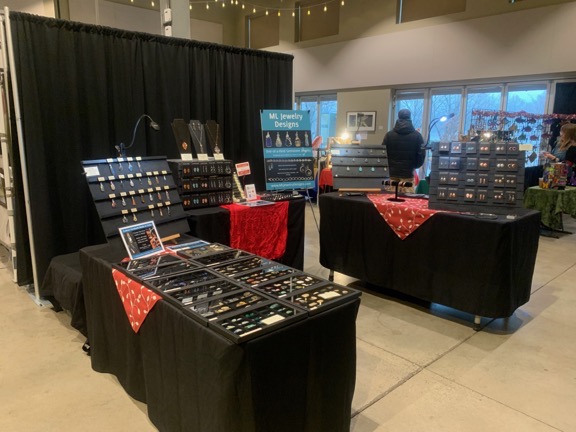
Booth Shot
My stones get their own table when I set up my jewelry booth at shows, like this Holiday Artisan Fair in Wenatchee last weekend.

Gyroplane Flight: Pattern Work at Watts-Woodland

A video from the Flying M Air YouTube channel.

SIT ON THE MAST OF AN OPEN COCKPIT GYROPLANE as I take it around the traffic pattern three times in Woodland, CA.

I dug deep into my archives for this video from April 2014, which first appeared, in part, on my personal YouTube channel. In it, I’m flying a Magni M-16 gyroplane with a GoPro camera mounted on the mast. There is a bunch of vibration in this video; removing it with stabilization software reduced the video resolution without significantly improving the video quality, so I let it stay as is.

I learned to fly a gyro back in 2014 and got as far as my first solo before calling it quits. (No reason to go on since there’s no gyro in my future and it would be nearly impossible to keep current.) My flight instructor was an anesthesiologist friend who has three planes, including this one, and flies on his days off. He said I was the most difficult pilot to teach and we realized it was because was a helicopter pilot and not an airplane pilot — the idea of touching down when you’re still speeding along at 60 knots or more scared the heck out of me so I kept trying to slow down on final. You can learn more about my lessons here: https://aneclecticmind.com/2014/04/24/learning-to-fly-gyros/

About Me, the Flight Instructor, and the Gyroplane

  • I have been flying since 1998. My nearly 4,000 hours of flight time (as of 2019) is in Robinson R44, Robinson R22, and Bell 206L (Long Ranger) helicopters.
  • My flight instructor, who sat behind me in this video, is George, who makes his living as an anesthesiologist. He also owns and flies two other planes and is rated to fly helicopters. The last time I saw him was the day we flew together from Malaga to Woodland in 2016. (Long story there.)
  • The gyroplane is a Magni M-16 that belonged to George. I don’t know anything about it other than it has a flashy Angry Birds theme paint job that seemed a lot more relevant in 2014 than it does now. It was in perfect condition and well maintained by George, who was its second owner. You can see a photo of the gyroplane in the title screen of this video; that’s me after my first (and only, I think) solo flight.

About the Video

  • The video and sound was recorded with a GoPro Hero 3 camera mounted with an adhesive mount to the gyroplane’s mast. This is obviously not the best setup given the vibrations you see in the video.
  • The video was edited on a Macintosh using Screenflow software. Learn more about it here: https://www.telestream.net/screenflow/overview.htm
  • The intro music is by Bob Levitus, famed “Dr. Mac.” You can find him here: http://www.boblevitus.com/

I try to drop cockpit POV videos every Sunday morning and “extras” with more info about owning and operating a helicopter midweek. (Some channel members and patrons get early access to some of these videos.) I also host occasional livestreams with Q&A chats. Subscribe so you don’t miss anything new! And tell your friends. The more subscribers I have, the more motivated I am to keep producing videos like this one.

Any Amazon links on my channel are affiliate links (https://amzn.to/32PLHTD). If you click one of them and buy something, Amazon sends me a few pennies. Enough pennies make a dollar. Enough dollars buy new equipment. It doesn’t cost you anything so I hope you’ll shop with one of those links. Thanks.

Want to support the FlyingMAir channel? Here are four suggestions:

Helicopter Commute: Airport to Home

Another video from the FlyingMAir YouTube channel.

SIT ON THE NOSE OF MY OLD HELICOPTER as I from the airport in Wenatchee across the Columbia River to my home under construction in Malaga.

This “Throwback Thursday” video is the whole flight from June 2014. I’ve just refueled after cherry drying and have gone home to wait for the next call out. It’s a beautiful day with great reflections in the river. I tell you a little about the area and my home in a narration added in editing.

About Me and the Helicopter

  • I have been flying since 1998. My nearly 4,000 hours of flight time (as of 2019) is in Robinson R44, Robinson R22, and Bell 206L (Long Ranger) helicopters.
  • The helicopter is a 2005 Robinson R44 Raven II — the same one that appears in the photo at the beginning of the video. This was my first R44, which was lost in a crash back in 2018. You can learn more about R44s here: https://robinsonheli.com/r44-specifications/ I owned this helicopter and now own another one very much like it, but blue. I’ve owned a helicopter since 2000.

About the Video

  • This video was recorded in 2014 with a GoPro Hero 3 camera mounted on the nose of the helicopter. Audio comes from the camera’s built-in speaker and has been incorporated into this video at 25% normal volume.
  • Narration was added using a Røde Podcaster microphone (https://amzn.to/2IFnbNr) connected to a Macintosh. I recorded the narration while I was watching the video in the editing software.
  • The video was edited on a Macintosh using Screenflow software. Learn more about it here: https://www.telestream.net/screenflow/overview.htm
  • The intro music is by Bob Levitus, famed “Dr. Mac.” You can find him here: http://www.boblevitus.com/

I try to drop cockpit POV videos every Sunday morning and “extras” with more info about owning and operating a helicopter midweek. (Some channel members and patrons get early access to some of these videos.) I also host occasional livestreams with Q&A chats. Subscribe so you don’t miss anything new! And tell your friends. The more subscribers I have, the more motivated I am to keep producing videos like this one.

Any Amazon links on my channel are affiliate links (https://amzn.to/32PLHTD). If you click one of them and buy something, Amazon sends me a few pennies. Enough pennies make a dollar. Enough dollars buy new equipment. It doesn’t cost you anything so I hope you’ll shop with one of those links. Thanks.

Want to support the FlyingMAir channel? Here are four suggestions:

Helicopter Flight: Nick Over the Rocks, Part 3

Another video from the FlyingMAir YouTube channel.

COME FLY WITH ME as I take Central Washington University geology professor and star of “Nick on the Rocks” Nick Zentner on a helicopter tour of the eastern Malaga, Rock Island, and Lower Moses Coulee with a focus on geology. It was a beautiful day for this second flight together and we start off by laughing about the camera problems I had on our first flight. The Nosecam footage is amazing and Nick points out many geological features along the way. This is part 3 of a multi-part series and the longest so far; I’m trying to keep them short and sweet.

Places mentioned in this video:

About Me and the Helicopter

  • I have been flying since 1998. My nearly 4,000 hours of flight time (as of 2019) is in Robinson R44, Robinson R22, and Bell 206L (Long Ranger) helicopters.
  • My helicopter is a 2005 Robinson R44 Raven II — the same one that appears in the photo at the beginning of the video. You can learn more about them here: https://robinsonheli.com/r44-specifications/ I own this helicopter. It is the third helicopter I’ve owned since 2000.
  • My helicopter has ADS-B Out and is picked up by radar facilities. You can see my track for recent flights on Flightradar24: https://www.flightradar24.com/data/aircraft/n7534D This is a great site for tracking any almost any flight, including the airlines.

About Nick Zentner

About the Video

I try to drop cockpit POV videos every Sunday morning and “extras” with more info about owning and operating a helicopter midweek. (Some channel members and patrons get early access to some of these videos.) I also host occasional livestreams with Q&A chats. Subscribe so you don’t miss anything new! And tell your friends. The more subscribers I have, the more motivated I am to keep producing videos like this one.

Any Amazon links on my channel are affiliate links (https://amzn.to/32PLHTD). If you click one of them and buy something, Amazon sends me a few pennies. Enough pennies make a dollar. Enough dollars buy new equipment. It doesn’t cost you anything so I hope you’ll shop with one of those links. Thanks.

Want to support the FlyingMAir channel? Here are four suggestions:

How YouTube Ad Revenue Works for Monetized Channels

A behind-the scenes look at how YouTube creators can make money on advertising.

A while back, I blogged about an unexpected windfall from my YouTube videos and how that had motivated me to create new content and keep my channel growing as a real source of income. Since then, I’ve learned a few things.

The most important thing I learned was how YouTube advertising revenue works, and I thought I’d share it with the folks who think that they can become rich quick as YouTube content creators. As you’ll see, it isn’t that easy.

Yes, once your channel is monetized — a step that requires the channel to have at least 10,000 subscribers, which is a challenge in itself — you can get a small part of the revenue that YouTube collects on the ads that appear before, on, after, and sometimes during your video.

As a creator, you get some control over what kind of ads appear and when they appear. You can do this on a video-by-video basis or set default options that apply to all new videos you publish. Here’s what the Video Monetization screen looks like for one of my longer videos:

Video Monetization Options
Here’s the Video Monetization settings for one of my upcoming videos.

Of course, all this is moot for a video if you turn monetization off. That doesn’t turn ads off — it just turns off your ability to collect ad revenue on the video. Why would you do that? Well, perhaps the video has a paid promotion in it; if so, YouTube requires you to turn off monetization. Failure to do so is a violation of the terms of service which is a serious no-no in YouTubeland.

If Monetization is turned on, you can select what kind of ads you’ll allow on the video and when they will appear. YouTube recommends that you turn all of them on and it’s pretty obvious that a lot of creators do. But because I hate seeing ads in the middle of a video, I keep the During Video option (at the bottom) turned off. (I wish everyone did.) Other than that, I keep them set as you see here, with most turned on. Skippable ads run for about 5 seconds before you can click to skip them and I think that’s a small price to pay for free content. (To my knowledge, skipping an ad does not reduce my revenue.) Non-skippable ads are a little more frustrating but they’re always short. Overlay ads and sponsored cards both appear over content and I have one turned on and the other turned off; I think my logic was that one is more obtrusive than the other.

Now you might think that turning these on results in ads appearing on every single view. That’s simply not the case. Surely you’ve seen YouTube videos without ads?

There’s actually a sitewide estimate of how often ads appear on YouTube content: 40% of the time. So if one of my videos is viewed 10,000 times, only 4,000 of those views were likely to include ads. This becomes an important number, as we’ll see in a moment.

I should mention here that you can actually calculate your current ad percentage manually by consulting two different analytics screens. The Channel Analytics Overview screen tells you the number of views for a specific period — 28 days by default. The Channel Analytics Revenue screen tells you the number of monetized playbacks. Divide monetized playbacks by total views to get the percentage:

For example, as of today, for the past 28 days my numbers are as follows:
Monetized Playbacks: 62.7 ÷ Total Views: 124.3K = Percent of Videos Monetized: 50.4%

So right now I’m having a higher percentage of monetized playbacks than average. That could be because one of my recent videos has become very popular and may be more attractive for advertisers so I’m getting more ad buys.

Ad Types
Here are the kinds of ads sold on my channel in the past 28 days.

Of course, I don’t see all the details of every single ad sale. All I see is a breakdown of the kinds of ads sold for videos on my channel and the all-important CPM. The breakdown is on the Channel Analytics Revenue screen and clicking a SEE MORE link brings up a full screen of detail.

The CPM, which also appears on that Revenue screen, is an average of what I’ll be paid per 1,000 monetized views. This number changes regularly — it’s $6.79 this morning, but was down to $4+ the other day. (Again, I suspect a popular video has made space on my channel more valuable.) I’ve seen it as high as $11+. I would not be surprised if I checked in this evening and it was different. (In a way, it’s kind of like a stock market per share valuation for my channel or a specific video. It rises and falls depending on the market for ads on my channel or specific video.) They say that $4 is an average CPM for YouTube creators, so I’ll stick to that for illustrative purposes.

But no, this doesn’t mean you get $4 per view or even $4 per monetized view. It means you get $4 per 1,000 monetized views.

So going back to my previous example, if a video got 10,000 views and 40% of them were monetized and you were getting $4 per monetized view, that’s

10,000 x 40% /1000 X 4 = $16.00

My channel is doing pretty well this month, mostly because of my 737 MAX video‘s popularity. I published it 8 days ago and it has almost 50,000 views as I type this. I can get analytics for just this video and the numbers are very nice: almost 50% monetized playbacks and an $8.38 CPM. That video has earned me $104.54 in ad revenue in just 8 days. Sounds great, right?

Well, let’s look at the video that came out right before it, the Autumn Cockpit POV flight. Although it has a higher percentage of monetized playbacks, it’s only been viewed 2,800 times in two weeks. Its CPM is just $5.91. In two weeks, it’s earned me a whopping $11.99. (That’s not per day, by the way. It’s for the entire two weeks. That’s less than $1 per day.)

And please do remember that a video will not earn the same amount per day/week/month/etc. throughout its whole life. Sometimes they start like duds and pick up steam, like the 737 MAX video — it wasn’t doing well at all for the first two days. And then sometimes they’re going like gangbusters and interest suddenly disappears. You never know what to expect and can only hope for a pleasant surprise.

Views
Here are the view analytics for my most popular video ever. It had hardly any views for the first year it was published and then took off like a rocket, with periodic surges. The current live analytic for the past 48 hours shows 4,466 views — three years after it was released! This is a YouTube content creator’s dream; I wish I had a dozen like this.

When I started writing this, I didn’t mean to get into the complex details of revenue calculations for specific videos. I just wanted to explain how ad revenue works for monetized channels on YouTube. To take some of the mystery out of it.

The takeaway on all this is that in order to make YouTube a full-time business — as some creators have — you need a strategy that combines ad revenue from wildly popular videos and other sources. This is why so many content creators on YouTube also sell merchandise and offer memberships or Patreon patron benefits.

I’ll be frank here: creating content for my YouTube channel is crazy expensive. Not only do I have to fly an aircraft that costs hundreds of dollars an hour to fly, but I have to have the cameras, camera mounts, and video editing equipment to record and edit the resulting footage. And the time I spend doing all this is time I’m not spending doing something that could earn money elsewhere so there’s a definite value to my time. I could easily drop $300 to $600 to make a video that will never earn more than what it cost to make.

I’m not complaining here — I’m just telling it like it is. I love flying and having an excuse to fly. I enjoy making the videos. I like most of the very positive feedback I get. But a girl has to make a living so I hope folks don’t mind me pushing Flying M Air hats and T-shirts or asking for Patreon patrons. If my video creation efforts wind up costing me more than I take in over the long term, I simply won’t be able to continue making them.

And every once in a while, I publish one that actually makes the ad revenue work for me. My Home to Airport by Helicopter video, which has over 9.5 million views, is one of them.

Now if only I could come up with about a dozen more like that.