On Being a Professional Writer

Some thoughts on writing for a living.

I make my living as a writer. And I make a very good living.

When people ask me what I do, I tell them I’m a writer. The next question is usually, “Oh, have you had anything published?”

Hello? How can you make a living as a writer if you haven’t had anything published? After all, the money comes from the publishers. It doesn’t come out of thin air just because you spent time putting words on paper or in a word processor. Or in a blog, for that matter.

I’ve written 58 books since 1990. True, most of those books were revisions. Like my Mac OS books, which have been bestsellers since the very first edition. That was about Mac OS 8 back in 1998. I revised it for 8.5, 8.6, 9.0, 9.1, X, 10.1, 10.2, and 10.3. I’m going to start work on the 10.4 edition soon.

I learned very early on in this field that if I wanted to make a living as a writer, I had to write a lot and get it all published. So I learned to write my computer books extremely quickly, giving my publishers just what they wanted pretty darn close to the day they wanted it by. Publishers like that. They don’t want to work with prima donas who won’t do things their way. They don’t want to work with writers who can’t deliver on time. Because I met the needs of my publishers, they gave me a lot of assignments. I always had work to do. And since these books only last 12 to 18 months (on average), I needed to keep working. Even a bestseller doesn’t pay a dime when it’s out of date.

I had two bestsellers: the aforementioned Mac OS books and my Quicken books. The Mac OS books continue to do well. I’m extremely proud of the latest edition, which is over 600 pages long and full of great information. The next edition will be even better. The Quicken books aren’t doing as well these days. I think the market is saturated. I have other thoughts on this, but I’ve been advised to keep them to myself and I agree it’s probably a good idea.

Bestsellers are nice. They generate big checks. I wish I could have 10 bestsellers, all at the same time. Then maybe I’d have a little house on top of Howard Mesa instead of a camper with a pair of bad batteries.

If you’ve been reading these blogs, you know that I have a summer job as a pilot. It isn’t quite over yet, but it will be soon enough. Some people think I got the job because I needed the extra money. In all honesty, the job is a money sucker. The pay is terrible and I probably spend as much money commuting to work by helicopter as I earn each day. (But heck, it sure beats the 40-minute drive in the Jeep.) And every day I’m away from my office is a day I can’t work on a book. So I’m losing money when I’m flying. Good thing I enjoy doing it.

This summer, I worked a 7 days on/7 days off schedule. But I fiddled with that a bit and got it set up as 5 days on/9 days off for much of the summer. As a result, I was able to go home and work on books. I revised my Quicken book in June. I worked on my new Word Visual QuickProject Guide in July and August. And this month, I started my new Excel Visual QuickProject Guide. I have another Word book (a revision) and my Mac OS X book (a revision) lined up after these. So there’s plenty of work to do.

I also got some work writing articles for a Web site. I can write those when I’m away at my summer job. I use my laptop. They don’t pay as well as a book, but I can knock one off in a few hours. And it’s kind of nice to write about a bunch of different things rather than just one main thing.

There are lots of people out there who want to be writers. I’ve met many of them. I was even pretty good friends with one or two. But they just didn’t get it. They didn’t understand that if you want to write for a living, you must write what the publishers want so they’ll buy it. If the publishers don’t buy it, you won’t make any money on it.

And don’t talk to me about self publishing. I have a friend who went that route and still has a garage full of books. Five different titles! Self publishing is risky. There’s a huge cash outlay involved and if you don’t know how to market (or sell) your book, you’ll never make any of that money back.

Yes, the key word here is sell. Sell your writing, sell yourself.

If you do it well enough, you can have a very nice lifestyle. After all, it’s nice to be able to make your own hours, work in your pajamas, take vacation anytime you want. Those are the perks of being self-employed. But you have to work to earn those perks. Pay dues, so to speak.

What a disjointed blog entry this is! But sometimes it’s nice to write something that you don’t have to sell. I guess that’s what these blogs are all about.
Who Needs Electricity? I Do!

How I cope with a sudden electricity problem at Howard Mesa.

About a month ago, Mike and I took care of a water problem at Howard Mesa (detailed in another blog entry). In doing that, we used the water pump hooked up to the camper to flush a bunch of water down the septic system. I think that overuse of the water pump may have been what triggered a new problem.

The problem is this: In the morning, after turning on the light and the stereo in the camper and running the water a bit, I would get a “Low DC” message on the refrigerator’s control panel. The refrigerator does not run off the battery. It uses gas. But it evidently needs some amount of electricity to operate. When the battery’s power level falls below 10 volts, the refrigerator tells me it’s time to start turning things off.

This doesn’t make any sense to me. I’ve been living in the camper every other week, while working at the Grand Canyon, since April. The solar panel on the roof has done an excellent job of keeping the two batteries charged. I never had any indication of a low battery.

Until the day after we used the water pump for so long.

Mike thinks the extra electricity use discharged the batteries and the solar cell has not been able to bring them back up to full charge. But the solar panels have full sunshine almost every day when I’m not around running the stereo or turning on the lights. Actually, they get a whole week of charging time without me around to discharge anything. I even shut off the fridge and turned off the power one week. I think the batteries have gone bad and they’re simply not holding a charge. Of course, since I can’t prove that and the batteries are less than two years old, I must be wrong.

The solution, according to Mike, was to buy a generator and hook that up to the camper. So we went to Lowes and bought a 1,000-watt “portable” generator. We loaded it into the helicopter’s passenger seat (if Frank Robinson saw that, he’d probably have a canary) and strapped it in with the seat belt (like a 50-lb squat box is going to shift in flight). I flew it to Howard Mesa, lugged it into position behind the camper, and fired it up.

It was easy to start. It reminded me of the old days when I used to mow the lawn. You know, that pull cord thing. There’s a trick to starting it, but I learned that trick when I got my GoPed, so I was all set.

Although it was advertised as quiet, I’m not sure what they’re comparing it to. Yes, it’s quieter than a Bell 206L helicopter. But it’s considerably louder than the sound of the wind through the trees, which is the only other sound I have to deal with here at Howard Mesa.

It vibrates. It vibrates so much that the power cord that connected it to the camper kept falling out. I had to use bungee cords to hold it in.

But when it’s running and plugged in, I can use all the electricity I want and I don’t get any flashing warnings from the Fridge.

It won’t run the microwave. Whatever rocket scientist thought a camper needed a 1450-watt microwave was gravely mistaken. A 700-watt microwave would have done the job nicely. And the generator would have run it (if I turned everything else off and cooked in the dark).

This morning, I really put it to the test. When I woke up, it was 38° F outside and 45° F inside. Not the kind of indoor climate conducive to showering. And when I turned on the light and the stereo, the refrigerator started flashing. So I put my sweatpants on over my long johns (which I wear to bed here) and threw a sweatshirt over my nightshirt. I went outside, fired up the new generator, plugged it in, and fastened the bungee cords. Then I went inside and turned on the heat. The heat isn’t electric either — it’s gas. But its fan is electric and I knew it would suck the batteries dry within minutes.

The place warmed up nicely. And I couldn’t even hear the generator because the heater made so much noise it drowned out the sound. I had my coffee and took a nice, hot shower. It was pleasant. Until the carbon monoxide detector went off. I guess I shouldn’t have placed the generator with it’s tiny exhaust pipe facing the camper. I had to leave the camper door open when I left for the day because I was worried that the constant beep-beep of the carbon monoxide detector would drain the batteries as quickly as the solar cells filled them.

I finished work at sunset today and raced to Three-Niner-Lima. I was airborne within 10 minutes. I had a great 20-knot tailwind. I made record time getting back to Howard Mesa, but it was still pretty dark when I arrived. (I couldn’t check the windsock from the air because I couldn’t find it. Another 15 minutes and I wouldn’t have found the trailer.) I moved the generator to the front of the camper, so I wouldn’t have to walk so far in 30+° weather in the morning. And, hopefully, I wouldn’t have to listen to the carbon monoxide detector.

As I type this, I’m sitting on my sofa, listening to the stereo. The light is on. The heater has just gone off automatically — it reached its 65° setting. The generator is outside, about 10 feet away. I can hear it humming away. I think I’ll raise the heat so I can listen to that instead.

But at least the refrigerator is happy.

Arizona Strip Trip – Intro

About the trip I planned on the Arizona Strip.

I’d been planning the trip for weeks. I had a week off from work in the middle of September. The same week that the aspen trees on the north rim should be turning color. And that Rod Carr would be at Bar 10 Ranch on the west side of the North Rim. I’d finally make a trip up there to see the roads I flew over every day from the ground. And take Mike to see Bar 10, which is one of my favorite get-away-from-it-all places.

The plan was loosely set up as follows:
Day 1: Tusayan to Page, with stops in the Navajo Reservation and Antelope Canyon.
Day 2: Page to North Rim or Jacob Lake, with unpaved road excursions into the forest and stops at Point Imperial and the North Rim.
Day 3: North Rim or Jacob Lake to Bar 10, with stops at Point Sublime and Toroweap.
Day 4: Bar 10, with short trips to the rim and other points of interest.
Day 5: Bar 10 to someplace on Lake Mead.
Day 6: Lake Mead to Wickenburg (for a day of rest before back to work) or Tusayan (to pick up Mike’s truck).

But things don’t always come off the way you plan them and this trip was like that.

Remembering Harry Combs

My thoughts on a great man in aviation who I was privileged to know.
I first met Harry Combs in November 2002, not long after I’d taken over operation of the airport. I’d been subletting his hangar every summer for my helicopter for three years, but had never met him in person up to that point.

Mr. C, as many folks called him, had a home at Rancho de los Caballeros in Wickenburg. He’d arrive in Wickenburg each November as a passenger on a Lear 35 jet — the same jet he’d owned and flown years before. At the Pima Air Museum, there’s a Wright Brothers display that includes a photograph of Mr. C standing beside his Lear with the distinctive Kitty Hawk monument in the distance. Mr. C had sold the jet to a fractional jet company with the stipulation that any time he wanted to fly, that same jet would take him.

Last year, Mr. C would occasionally stop in at the airport terminal to chat. He had many nice things to say about the work I’d done at the airport and it was an honor to receive complements from such an aviation legend.

I recall a conversation I had with Mr. C at the terminal one spring, when he told me about the Wright Flyer reproduction he had commissioned for display at Kitty Hawk. He’d been almost outraged that there was no full-scale reproduction of the plane at the park and had done something about it. “It’s going to cost a lot,” he told me more than once during the conversation. I never asked how much.

Every year, someone would ferry Mr. C’s Bonanza down to Wickenburg, not long after his arrival. At that point, the subletter would be kicked out of his hangar — sometimes with as little as two days’ notice — and his plane would be moved in.

I recall seeing him arrive at the airport with Joyce, his secretary, for a flight in the spring. Mr. C had turned 90 in January and he was a bit unsteady. Joyce looked nervous. We all tried to talk Mr. C out of flying — without insulting him, of course. But Mr. C was stubborn and it appears he knew what he was doing. His takeoff on runway 23 looked smooth as silk, despite the crosswind. After flying around the desert northwest of the airport for a while, I heard Joyce’s voice on the radio, announcing their return. (Mr. C left all radio communications to Joyce.) Mr. C landed smoothly and taxied back to the hangar. Ed and Rob put his plane away. That’s the last time I saw them fly.

Mr. C was 90 when he made that flight. He’d been flying for 75 years, since he was 15 years old. He had witnessed aviation grow from the days when flying was left to daredevils to a time when getting on a plane to go from one point to another is commonplace for anyone. He was a great supporter of aviation and aviation history, the author of a book about the Wright Brothers (Kill Devil Hills), and a contributor to aviation museums.

Mr. C died just after his trip to the 100th anniversary celebration of the Wright Brother’s first flight. He was two months shy of his 91st birthday.

I’ll miss Mr. C, but I’m glad I had a chance to know him.

Another Trip to Howard Mesa

I arrive at Howard Mesa and take care of a few unusual chores.

Last week, when I left Howard Mesa, I decided to check the water level in the big water tank. I tapped on it but couldn’t find the place where the water level was. So I opened the top and looked in. And saw a dead animal floating in the water.

There was a dead animal in my water supply. The water I bathed in. The water I washed my dishes in. Thank heaven it wasn’t the water I drank.

In my mind, the water was contaminated and had to be replaced. That meant it had to be drained out and someone had to scoop out that dead thing and any other dead things that might have been floating with it. And the water truck would have to come up to the mesa to bring fresh water.

Obviously, this was a job for Mike.

He arranged to meet the water truck at the bottom of the mesa this morning at 11 AM. We woke up at 5:30 to a cloudy day. The original plan had me flying my helicopter to Grand Canyon Airport (GCN), picking up my Jeep, and meeting him and his plane at Williams Airport. This way, he could avoid the 2-1/2 hour drive each way. The flight would take him less than an hour. But with low clouds, and t-storms in the forecast, I knew he wouldn’t fly. So I took off in Three-Niner-Lima while he took off in the Chevy.

I had an incredible 25-knot tailwind most of the way. At one point, my GPS showed a ground speed of 118 knots. Egads! And although it was cloudy, the air was smooth and there was no rain. A very pleasant flight. But with rain in the forecast, I decided to pick up the Jeep at GCN anyway, so I flew straight there. 1.2 hours on the Hobbs meter — a new record from Wickenburg. I’d left at 7 AM and had arrived at 8:15 AM. Wow.

I tied down the helicopter, placed a fuel order, and hopped in the Jeep. I bought $20 worth of regular gasoline at a whopping $2.39/gallon. I used my Papillon discount at McDonalds to buy a bacon egg cheese biscuit breakfast with orange juice (I’m very picky about my coffee). Then I hit the road for the 40-minute drive to Howard Mesa.

Did you know that when an antelope is running straight toward you, it looks just like a kangaroo? When I got to the mesa, I thought I was seeing a kangaroo until it turned and I saw what it really was. A kangaroo would have been too weird.

When I unlocked the camper door, I was greeted with an all-too-familiar beep-beep noise. It was the refrigerator, telling me that it was out of propane. Of course, it didn’t run out just before I got there. It ran out some other time, perhaps days ago, so all the food inside it had plenty of time to not only go bad, but get really stinky. Well, that’s not true. Only the freezer was really stinky. It had been full of frozen uncooked shrimp and frozen chicken potstickers. And ice. The shrimp and potstickers stunk to high heaven and the humidity caused by the melted and warmed ice had gotten a good mold crop growing. Are you grossed out yet? Well, you didn’t smell it. I did.

I cleaned out the freezer and fridge while I waited for Mike. His timing was perfect. I was just finishing when he pulled up. He went right to work on the water tank. He didn’t see the critter right away, but eventually did. He fished it out with a pool skimmer we use at home for our hot tub. (Like leaves fall in it.) He said it was very small. He offered to show it to me three times. He didn’t seem to think it required a water drain. But it was a dead animal. I didn’t care if it was the size of my thumb. It was dead. It was in my water. The water was tainted. I wanted it out.

We had to dump 800 gallons of water. We dumped a bunch of it into the trailer’s holding tank to rinse it out. Right now the trailer is connected to our septic system so nothing is actually “held” in the holding tank. But since the toilet uses so little water, I thought there was a chance that stuff wasn’t getting flushed down the pipe. So why not use some of that water to flush out the tank?Mike used the rest to make mud. He did this while I was waiting for the water truck man. I left at 10:45 and arrived at the bottom of the mesa at 10:58. I then proceeded to wait until 11:50, when the truck finally rolled into view. Good thing I’d brought a book with me. Mike called twice during that time; the first time to report that he’d spoken to the water man’s wife and the second time to tell me that she’d spoken to him and that he’d be there “any minute.” The truck followed me toward the mesa. I noticed that anytime we went up a hill — even a little hill — he fell way back. I decided to give him a choice on which road to take to the top. I stopped right before the turnoff to the state road and walked back to his truck. “You have a choice,” I said. “The steep road or the bumpy road.””We took the bumpy road last time,” he told me, remembering his trip to us on Easter Sunday (what a guy!). “How steep is the steep road? What’s the grade?””I don’t know,” I admitted. “But when I take the Jeep up, I have to shift into 4 wheel drive. Of course, I don’t usually carry 2,000 gallons of water over my drive wheels.””Let’s take the bumpy road,” he said.

I led him up the state road. He did very well. We arrived at the camper and I parked. He pulled into position in front of the big tank, driving through some of that nice fresh mud Mike had made just for him. The tank was almost empty. Mike needed the water guy to help him tip it to pour the rest out. They did that, then the water guy helped us rinse it out with a jet of water from the truck. Satisfied that it was as clean as it would get, Mike put the fittings back on and the water guy started pumping.

While he pumped, we talked about his truck. It had a white plastic tank on back. You could see all 2,000 gallons of water on board, right through the plastic, and you could watch it drain from the tank as he pumped. The truck had a Chevy Duramax engine, like Mike’s truck, and weighed 17,000 pounds when it was full of water. Wow.

He told us that in Flagstaff, it was cheaper to have water delivered than to buy it from the city. It was only $80 per load. (That works out to only 4¢/gallon.) Of course, it was $150 per load (7.5¢/gallon) to us on top of Howard Mesa. But it sure beats fetching it yourself. And if there hadn’t been a mouse in the water, the 800 gallons we had left would have easily lasted me the rest of the season. That’s $150/year for water.

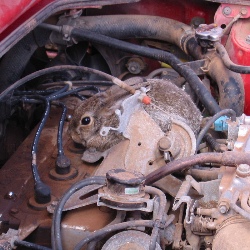
Rabbit in the Engine CompartmentWhile we were doing odd jobs around the place, I decided to peek into the engine compartment for my Toyota. The Toyota lives at Howard Mesa these days and every time it’s parked for more than a week, mice take up residence in its engine compartment. I was supposed to put moth balls in there last time I was up, but I forgot. So when I opened the lid, I fully expected to find at least one mouse nest to clean out. Instead, I found a rabbit crouched on top of the engine. He was alive and very cute, with big brown eyes. He didn’t move when I saw him and asked what he was doing in there. He didn’t even move when Mike came over to look at him. Or when I took a picture. We were just starting to think that it was a mommy bunny sitting on some babies when it took off through the engine. It hit the ground running and gave Jack the Dog something to chase for a minute or so. I left the lid up to discourage other squatters from taking up residence.

When the water guy was done, we led him and his truck down the steep road. We had the camper’s gas tanks and a cooler with us. We made the trip into Williams where we had an extremely mediocre lunch, filled the gas tanks, and spent $100 on groceries — some of which replaced the items that had turned into the stinky mess in the freezer and fridge. We finished up our trip to Williams with Dairy Queen. Back at the camper, I put away the groceries while Mike took care of the gas tanks. A while later, the fridge was running again, with some dry ice to help it along.

Mike and Jack left at 4:00 PM. Since then, I’ve been doing odds and ends to set up housekeeping for the week, writing blog entries, and having dinner of potstickers. I wish the iced tea I made this afternoon would get cold already.

Autumn is coming. It’s 7:22 PM and already 66 degrees inside and out. Time to close up the place for the night.