
A little bit about the birds in my life.
This morning, my rooster started crowing at 4:03 AM. I know this because I heard him. We’re getting on to the time of year when you can leave windows open all night. I think one of the bedroom windows must be open a crack because I heard him quite clearly this morning. I was already awake, of course, so it didn’t really bother me. It just reminded me that I have a rooster. And it made me wonder whether my new neighbors — the folks that moved into the pink house on 328th Avenue — could hear him. And whether he bothered them.
My closest neighbors must hear him pretty good. I asked them once if he bothered them and they assured me that he didn’t. They like the sound. That’s good to know. But when you consider that he does most of his crowing before sunrise, it makes you wonder how early they get up.
One of my other neighbors had a rooster for a while. I could tell because I’d hear crowing far off sometimes, when it wasn’t my rooster. Then the crowing stopped and I knew the coyotes had paid Mr. Rooster a visit.
The coyotes have paid my chickens numerous visits. The first time was way back with my first batch of 8 chickens, all hens, which I used to let out during the day. They’d come down the driveway to where the horses live and spend the morning scratching around in the sand for bugs and other chicken delicacies. One afternoon, when they all came back to roost, there were only five of them. Three had disappeared without a trace. You’d think the horses would protect them, but no. Horses have no interest in chickens.
A funny story here. Every night during the summer’s monsoon season, we have to move our horses out of their lower corral, because it’s in a flood zone, to spend the night in their much smaller upper corral. The upper corral has fence-hung feeders. I’d go to the upper corral in the evening and prepare it by adding hay and a grain mixture we call “bucket” to each feeder before bringing up the horses. The chickens were usually out and about and even though they don’t have enough brains to fill a shot glass, they figured out that there was grain in the feeders. So once in a while, they’d hop up there and scratch around a bit. One day, when I brought the horses up, Jake, our unflappable Quarter Horse, stuck his head in his feeder to get at the grain and immediately pulled it out. A chicken popped out, onto the ground, and ran away. Jake seemed to let out a deep sigh before he stuck his head back in for dinner.
I currently have three hens and a rooster. Over the years, I’ve lost lots of chickens to coyotes, which is why a coyote tail hangs from my Honda’s rearview mirror. More recently, however, the problem has been my neighbor’s dogs. I like my neighbors and I like their dogs. We live outside the town limits, at the end of a dead-end road. There are only three houses out here and we all have dogs. Although leashes are technically required — this is Maricopa County — none of us pay much attention to that. Instead, we’ve trained our dogs to stay nearby. Dogs don’t necessarily understand property lines, so our dogs occasionally stray onto each others’ property. No big deal there. My neighbor’s dogs, Bo and Trixie, often come up to my house to visit my dog, Jack. Sometimes they go down to the wash and play together. They play rough — too rough for my brother’s dog, who came to visit for Thanksgiving. But they have fun and they don’t really bother anyone.
That is, until Bo and Trixie discovered that if they dug under the fence, they could get at the chickens. The fence was my effort to contain the chickens so the coyotes would stop getting them. Coyotes are evidently lazy and are not interested in the hard labor of digging under a fence. Bo and Trixie, on the other hand, like to dig. The chickens gave them a reward for good digging. So one day, they dug under the fence, got in, and had a good chicken dinner, leaving only two live chickens behind as mute witnesses.
At first, I thought the coyotes had done the dirty deed. But then I realized that whoever had done it had left parts. Coyotes don’t leave parts. They take the whole chicken in their mouth and trot off with it. I’ve seen them do this. But I wasn’t putting two and two together yet so I figured it was the coyotes. So we reinforced the bottom of the fence with stakes and filled in the holes and got some more chickens, including the current rooster.
One day around Thanksgiving, I’m lounging around the house with my house guests and there’s a knock on the door. That in itself is amazing; no one ever knocks on our door. No one can ever find our house. If you know where our house is, it’s likely that you know us well enough to just open the door and holler “Hello?” I opened the door and found my neighbor’s three little kids standing there. They’re aged 4 to 8 or something like that. Two boys and their older sister. “Our dogs are eating your chickens,” they reported.
I threw on my shoes and ran down the driveway, followed closely by my brother and whoever else was around. Sure enough, the dogs were in the chicken yard. But these chickens had some survival skills — quite impressive for chickens — and had retreated into the upper part of the coop. The dogs were unable to catch them.
We got the dogs out and secured the chickens in the upper coop, where I knew they’d be safe. We patched up the hole Bo and Trixie had made. And a few weeks later, we installed an electric fence around the outside bottom edge of the fenced-in yard. I was there one day when Bo touched it. He went yelping back home and didn’t return for over a week. Needless to say, they don’t try getting into the chicken coop anymore.
The chickens, however, must be traumatized by all these close calls. Only one of the three hens lays eggs. I get about 5 eggs a week from her. The other two are freeloaders. They don’t know how lucky they are. My chicken-raising book advises you to eat the chickens that stop laying.
 I also have a bird in the house. Alex the Bird is an African Grey parrot. As I type this at my kitchen table, Alex is practicing his vocabulary. “Jack, no! You’re bad! Are you cranky? Hello Mikey. Are you a duck? Gimme that thing. Jack, no! Alex! Hey goober. Fatso. Come on Jack. Wanna go upside down? Are you a chicken? Are you a cow? Are you a cranky bird? Ricky bird. Alex, are you cranky? Alex is a maniac. Okay, Alex the Bird. Hello. Hey, you goober. See you later alligator.” You get the idea. He’s 2-1/2 years old and he says a ton of stuff. In fact, he’s forgotten half of what he used to know. It’s pretty amazing considering that he’ll live to be about 50. By the time I’m dead and gone, he’ll be talking better than most people I know.
Alex also does sound effects, like the dog whining, my cell phone, and the squeal of the back screen door (which no longer squeals, but Alex squeals anyway every time we open it). He whistles pretty darn good, too. Right now, I’m teaching him the theme for the “Andy Griffith Show,” which I downloaded from the Internet. Every once in a while, I play it a few times for him. He practices in the morning — like right now — and I repeat back the part he’s trying to do to reinforce the correct stuff.
African Grey parrots are incredible companion pets. They thrive on attention and will learn to say whatever you take the time to teach them. Like all other birds, they’re messy, but if you have a dog that likes bird food, a lot of the mess is cleaned up as it happens. Every morning, in fact, when Alex has his breakfast (scrambled eggs), he drops half of it on the floor where Jack is waiting to gobble it up. Sometimes I think he drops the food on purpose just to watch Jack.
Unlike the typical African Grey (at least according to most books and articles I’ve read), Alex is extremely affectionate and likes to be cuddled. I hug him every morning before I put him back in his cage for the day and every night before I put him back in his cage for bed. He also likes to play rough. I hold him upside down by his feet and tickle his belly. Although he makes some fussy noises sometimes — his way of saying, “Cut that out!” — I know he likes it. It’s the attention, I think. He trusts me and knows I won’t hurt him. So although our rough play should be scary to him, it isn’t.
There are a lot of wild birds around Wickenburg, too. Hummingbirds abound. I used to keep feeders filled for them, but I’ve been slacking off. I don’t spend enough time at home to watch them. There are also quail, doves, Gila woodpeckers, thrushes, orioles, and more others than I know. When I had my office in the house, I recall looking up out the window one morning to see a Gambels quail dad leading his six or seven baby chicks to a shady spot in my flower garden. I watched them lounge for quite a while, transfixed. The babies were so cute! Then dad decided to move the troop on and they hopped out of sight.
We also have roadrunners here, although I don’t see them very often. Roadrunners are most often found in sandy washes and places where they can find lizards and snakes, which they eat. I was in Lake Havasu City the other day, chatting with some folks at the Nautical Inn when we spotted a roadrunner standing on the deck of a building less than 50 feet away. One of the men told us a story about an exchange between a roadrunner and a coyote that he had witnessed. The two animals faced off with a long chain-link fence between them. The roadrunner made cackling noises, and walked back and forth on his side of the fence, teasing the coyote. The coyote walked back and forth. Little by little, the roadrunner and coyote got closer and closer to the end of the fence. Finally, the coyote seized his chance. He took off, darting around the edge of the fence. But the roadrunner was quicker. He took off (they do know how to fly) and sailed over the fence, landing on the other side. Then they faced off again, on opposite sides of the fence, and the roadrunner started cackling all over again. It was quite clear who was smarter (in case those cartoons didn’t convince you) and the roadrunner was definitely having some fun at the coyote’s expense.
We don’t get many birds in the yard anymore, probably because of Jack the Dog. He chases all animals out of the yard. That’s okay, though. There are plenty of other places for them to go. I’m sure I could get some back if I put out seed for them, but Jack is actually quite good at catching doves and I really don’t want to see any more dead doves on my doorstep. (And they say cats are bad.)There are three red tailed hawks in the area. They live near the golf course on Steinway Road. I often see them together on the power lines there. The are also turkey vultures in town. They just got back from wherever it is that they go for the winter. They look wonderful in flight and many observers mistake them for hawks. But there’s no mistaking them when they’re on the ground around a dead cow. They’re downright ugly!We have owls, too. There was one that lived in the state land out behind my house. Every evening, just after sunset, he’d fly out for his nighttime hunt. He’d land on a tree behind our house and hoot for a bit, then soar past our house and land on the top of a power pole on 328th Avenue. We saw him nearly every day for weeks. And we often saw or heard him coming in early in the morning. But one day, he misjudged his landing on the power pole. His wings evidently touched the power lines in just the wrong way. Fried. We found him on the ground near the power pole. The next day, his body was gone.
That’s the way things are here in the desert. Every animal — dead or alive — is a meal for another animal. Nature keeps a delicate balance here that really isn’t a balance at all. For example, because of all the rain we’re having, there’s a lot of grass. That means there’s plenty of food for the rabbits. That means there will be plenty of rabbits this spring and summer. Rabbits are good food for coyotes. So next year, there will be lots of coyotes. It happened the last time we had an El Niño year, so I know what to expect.
That’s all for now; I need my second cup of coffee. And my rooster is crowing again.
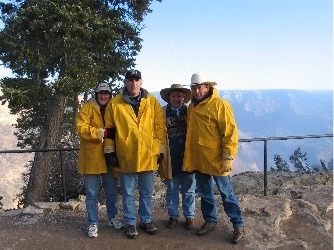 We’d done it before, perhaps ten years ago. It had been a Christmas present for Mike. A two-night mule trip to Phantom Ranch at the bottom of the Grand Canyon. This time, we did it with John and Lorna, two friends of ours from Maine. The Grand Canyon’s mule operators have, during the high season, 160 mules on hand to take riders or supplies into and out of the canyon. In late February, there are several dozen. We turned up at the “round corral” at 8 AM as instructed, wearing our outfitter-supplied yellow rain slickers. The temperature was in the 20s (F, of course) and we were shivering as we waited. There were about 12 of us going down that day, but eight were doing the day trip to Plateau Point, which looks out over the Inner Gorge not far from Indian Gardens. That’s about a 3-hour ride (each way). Our ride would be 4-1/2 hours, taking the Bright Angel Trail all the way down to the river.
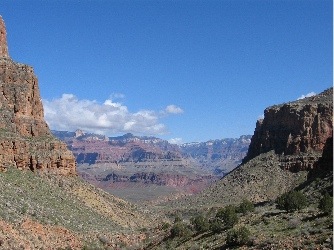 All the time, we were heading down into the canyon, on a trail that was about six feet wide in most places. Near the top — perhaps the first 30 minutes of the ride — there was ice on the trail and you had to just hope your mule was surefooted enough to cross it safely. It turns out that the mules wear special winter shoes that help grip that ice. Further down into the canyon, the ice was melting and running off from the top, making tiny streams and waterfalls. Everything was wet and alive. And the view was great. Mules are not afraid of heights and they seem to like to prove this. They often walk on the outside edge of the trail, sometimes only inches from a sheer cliff. This did not bother me much on the way down, but, for some reason, freaked me out a bit on the way back up. (Go figure.) My mule’s name was Bumpy because he was. But his name could also have been Muddy, Dirty, or Filthy. He obviously liked rolling in the mud of the mule enclosure and the wranglers didn’t think it was worth brushing all that mud off his neck, legs, and lower body. His saddle was quite uncomfortable and seemed to have seams running right under my butt. Of course, those could have been the seams of my underwear against a rock-hard seat as I bumped down the trail.
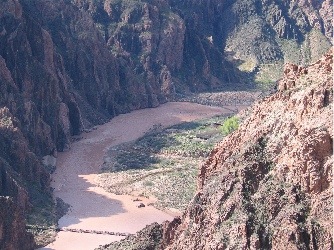 We rode for another hour or so after that, finally reaching the pair of bridges that cross the Colorado to Bright Angel Canyon. The first bridge, a silver-colored suspension bridge, was for foot traffic only, so we added an extra 20 minutes to our ride getting to the black bridge of the Kaibab Trail, about a half-mile upriver. We had to ride through a low tunnel in the rock wall to get to the bridge. From there, it was only 20 minutes more to Phantom Ranch. By the time we reached the ranch, I was in serious pain. My stirrups were too short and my knees were aching. It felt good to get out of the saddle. Although I didn’t think I’d ever recover, I was feeling much better just a half hour later.
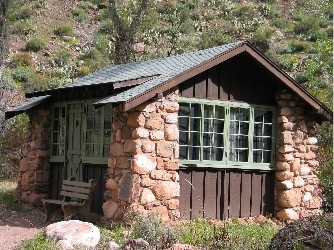 Dave, the ranch manager, met us at the corral and took us to our cabins. There were only two cabins with queen sized beds at Phantom Ranch and we’d reserved them both — eight months ago. The cabins, which were designed by Mary Colter and built in the 1920s, were one-room buildings built primarily of stone. Very quaint. Each one had a closet with a toilet in it and a sink that ran cold water. Hot water and showers were available in a building a few hundred yards away. The main lodge building was where you could buy supplies and have your meals. We stopped in for a lemonade not long after we arrived.
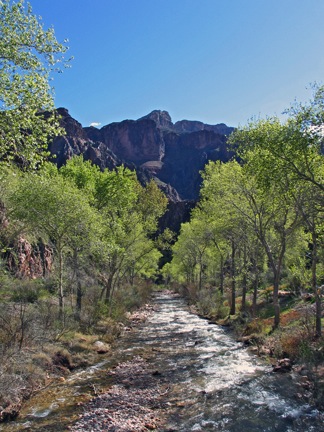 We went for a short hike back down to the river before dinner, checking out the confluence of the river with the clear waters of Bright Angel Creek. Then a good, hot shower. Then back to the lodge. Dinner was served family style with two seatings. We were in the first seating, at 5 PM, the first night. The meal featured steak, which was surprisingly tender (although not cooked quite enough for my taste), baked potatoes, corn, peas, salad, and cornbread. It was all you could eat and I ate a ton. I think I expected all the exercise I’d get during our stay to burn off calories. Sadly, it didn’t.
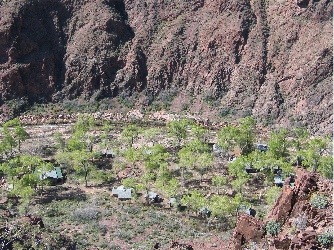 After a hearty (too hearty!) breakfast in the lodge, we headed out for a hike on the Clear Creek Trail. This trail climbs about 1,000 feet in its first mile, passes a lookout point where you can see all of Phantom Ranch below you, then offers stunning views of the Colorado River, Inner Gorge, and canyon walls. The first mile was a killer for me — I don’t do up very well. But it was worth it. The views were great and the trail leveled out for a pleasant walk.
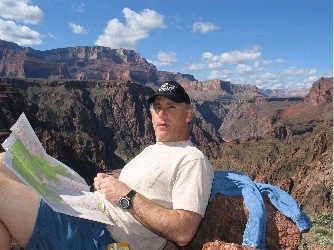 We did about two miles, stopping for lunch on a point that looked down the river. The trail kept going, lined with yellow flowers as it climbed a bit more to the top of the inner gorge. But we’d had enough. We turned around and went back. Mike and John headed up Bright Angel Creek while Lorna and I went back to the ranch to relax. We got there just before 3 PM.
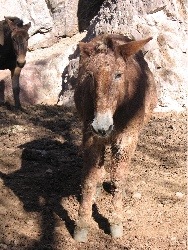 The next day, after yet another hearty breakfast, we headed over to the mule corral where Bumpy, Charlie, BB, and Darth Vader were waiting. Frank, a different wrangler, had come down the day before to take us out. There was a female wrangler there, too. She was in charge of the eight or so riders that had come down the previous day for a one-night trip. They left before us and we mounted up and followed Frank out. Fortunately, I’d had the foresight to have my stirrups lengthened, so I wasn’t in as much pain on the way out as I’d been in on the way down. Now if only I’d brought a cushion for the seat!The ride out of the canyon was considerably longer, primarily because we had to stop often to rest the mules. I figure it took about five hours. We stopped at Indian Gardens for a snack and a bathroom break on the way out. We saw some more bighorn sheep and a condor. And lots of photo opportunities along the way. Finally, we were back on the rim and the trip was over.