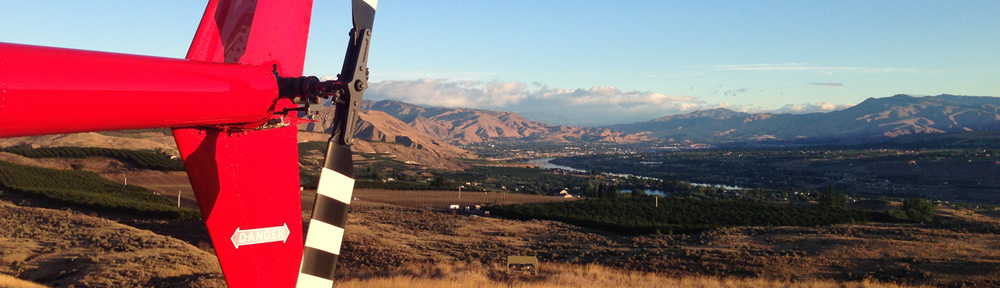
And it ain’t over yet.
Flying M Air’s second big weekend of the season started on Friday morning, with a call from a man who wanted to charter the helicopter. The weather was cloudy and it had rained earlier in the morning. Although he wanted to go to Sedona with his daughter, he’d settle for Tucson. He decided to wait and see what the weather was like closer to noon.
When I hung up, I started doing some research on the weather. There’s no weather forecast specifically for Sedona, but I checked Flagstaff and Prescott, which are on either side of Sedona. (Sedona is closer to Flag.) Things in Flag didn’t look good. Clouds, thunderstorms, wind with gust up to 27. It looked like there might be a window of opportunity (so to speak) between 11 AM and about 3 PM. But even that was suspect — a forecast like the one I was reading usually doesn’t hold out. It seemed to me that multiple weather systems were going through the area, west to east, and that anything could happen.
But ceilings were forecast high enough for me to fly. I only need 500 feet AGL to get from point A to Point B — “clear of clouds” is what the weather minimums say for helicopters — and the forecast told of clouds at 2,000 feet AGL. That’s certainly enough room for me to move around beneath them.
Things looked better at Prescott. Higher clouds, earlier clearing, less talk of T-storms and wind gusts. But of course, Sedona is closer to Flag.
I worked for a while on my QuickBooks book, did some e-mail, goofed off on eBay. Then I got a call from Stan, who was back from a trip to Portugal. Stan’s Latte Cafe — my nickname for his hangar and its professional espresso machine — was opening for business in a while. Did I feel like a Latte? I certainly didn’t feel like working. So I hopped in the Honda (which I’d just picked up from a nice detailing that morning) and sped on over to the airport.
I wasted a good hour there, then headed over to my hangar to do some paperwork and collect the camera mount I’d bought for the helicopter. I wasn’t happy with the way the mount attached and had thoughts of going to Benner-Nauman (the local fabrication place) and having a custom piece built. I also had to drive out to Congress to put up some posters for the $25 helicopter rides I planned the next day.
I was just heading out toward Congress when my potential customer called again. I told him what I’d learned about the weather, but added that I’d checked more than two hours ago and the forecast could have changed. He was very interested in Sedona and I was very interested in taking him. He and his daughter, who were from out of town, had driven up I-17 as far as Carefree Highway and he wanted to know whether there was somewhere around there that I could pick them up. I told him about Turf Soaring School, near Carefree Highway, and he said they’d head over there. I told him I’d check the weather again and get ready. If he didn’t hear from me, I’d meet him at 2 PM or sooner.
That began a flurry of activity. Checking weather (which did indeed look better), creating my Part 135 flight plan, filing two flight plans with the FAA (one for each leg of the trip), picking up Alex at work, bringing him home, dressing in something more appropriate for flying customers around, pulling the helicopter out of the hangar, fueling up, preflighting, starting up, warming up, and flying down to Turf.
Turf is about 30 miles from Wickenburg and I made it there in .3 hours. I got there 1:45 PM, set down, cooled down, and shut down. My customer, Tony, and his daughter, Angela, were pleasant people who had already flown many times in R44s. Tony, in fact, was a part owner of one and, with his partner and a flight instructor, operated a small flight school in the Detroit area where he lived. After a quick safety briefing, we climbed aboard. Tony volunteered to sit in back. I didn’t think he’d have enough room back there — he was a pretty big guy — but he later told me that the back seat was very comfortable and had good visibility. (It was his first time in the back; I’ve still never sat in the back of an R44.)
We flew to Sedona via Lake Pleasant and I-17. My passengers found the flight interesting — the terrain was so different from their home. The further north we got, the cloudier it got. We could see rain showers off to our right or left and flew through some rain once right before reaching Sedona. The ceilings were high enough and the air was pretty smooth, considering the look of those low, puffy clouds. Things at Sedona were pretty quiet — it was, after all, a Friday, and clouds tend to scare off most Arizona pleasure pilots. I called the FBO for a taxi as I set down on the helipad and the FBO guy came out in a pickup truck to get my passengers. I walked to the terminal in the light drizzle that was falling. My passengers were already gone when I got there.
I ordered fuel, said hello to the few folks I remembered from my back-to-back Sedona flights in late July, and headed over to the restaurant. It was the first time I ever sat inside there. Usually, I sit out on the patio in the shade. But the rain had closed down the patio. I settled down with my book (I’m currently reading The Name of the Rose) and had lunch. Tony would call when they were ready to come back, sometime around 4 PM.
They didn’t last that long. I’d just finished lunch when he called. He said the taxi would take them right to the helicopter, so I hustled up to pay for lunch, pay for fuel (which was actually cheaper than in Wickenburg), and head out to the helicopter.
I had just finished stowing my stuff and checking the oil when my cell phone rang. It was my contact at one of the local guest ranches. She had five people who wanted desperately to go to the Grand Canyon. Could I help? I made a phone call to try to get a second helicopter to take the extra two guests. Then we climbed on board and, after a quick tour of Sedona’s red rocks — looking dramatic but not terribly red in the cloudy weather — headed back to Turf.
After dropping off my passengers (and collecting payment), I flew right back to Wickenburg. It was after 5 PM when I set down on one of the helipads. I was driving home when I started checking messages on my cell phone. My contact at the ranch had called again. So had the guy I’d called to try to get another helicopter. I waited until I got home, then called the guy to get the helicopter story first. Because they’d have to ferry the helicopter from their base of operations (30 minutes from Wickenburg), it would cost my passengers $2,700 for the round trip flight from Wickenburg to the Grand Canyon. Ouch!!! Their hourly rate was $550 (for comparison, I get $395 from Wickenburg and $495 from the Valley but don’t charge for ferry time) and they expected it to take 2.5 hours each way. I charge a flat rate of $995 from Wickenburg to the Grand Canyon and back. So the total, including tax, for both helicopters would be nearly $4,000. For five people. And neither of us were allowed to fly over the canyon (at reasonable altitudes), so the passengers would still have to shell out $75 per person for their tours. Egads.
I called my contact at the ranch and gave her the bad news. She was appalled. I think she realized what a good deal Flying M Air offers passengers. She said she didn’t think the passengers would go for it, but she also said that they were willing to have just 3 passengers go to the canyon. I told her I’d plan on it then and that I’d call her in the morning for the weights and names I needed for my Part 135 manifest.
I called and told the helicopter guy that it was a no-go for him. I also told him that they might want to consider coming up with some kind of industry rate so I could use them in the future. $550 per hour with $550 going right to ferry time is insane.
Then I had to juggle my schedule. The first thing that had to go was the $25 helicopter rides in Congress. It wasn’t a real planned event and no one was really expecting me there. I just thought I’d spend a few hours on the side of the road at the intersection of 71 and 89 with signs up to see how I could do. If I didn’t fly, fine. I had a book to read. And fortunately, I never had an opportunity to put out the posters. But I couldn’t reach my contact by phone because I couldn’t find his phone number in the book. He’s probably still wondering what the hell happened to me.
In the afternoon, I’d been scheduled to help out BC Jeep Tours, the local Jeep tour operator, with a big party they had from the same ranch. I called and asked if Mike could drive instead of me. He’s a better Jeep driver anyway, I told them (and it’s probably true). Cathy said it would be fine and wished me luck on my big charter. Poor Mike was leading a horseback ride in the morning for the Wickenburg Horsemen’s Association. After the ride, he’d have to hurry home with the horses, skipping the lunch they’d planned, so he could be cleaned up, dressed, and in the Jeep at the ranch by 1:30 at the latest.
The next morning, I called my contact at the ranch and got the information I needed about the passengers. If the weights were right (and they weren’t), I’d have a light load. But I never believe weights and assumed they’d weigh more. (Of course, they wound up weighing even more than that, but Zero-Mike-Lima could handle it.) I did all my flight planning and FAA-required stuff, then headed out to the airport.
Stan’s Latte Cafe was open and I joined the crowd there for a latte. Then I preflighted the helicopter, started it up, and flew it over to the fuel island for fuel. Normally, I wouldn’t fly it, but I figured that would be a good way to shorten up the startup time by having the engine pre-warmed before the passengers arrived. The ranch van pulled up to the airport as the fueler was finishing up. I greeted them in the terminal and showed them, on the big chart, where we were going. That’s also when I realized that they were a bit heavier than I’d been told. I was glad I’d taken on less fuel than the flight planning said I could.
My passengers were three German men. One man spoke English very well and was accompanied by his grown son. The other man didn’t speak English very well at all. But all were friendly and in good spirits. I gave them the safety briefing, speaking slowly and using lots of hand motions to make sure they’d all understand. Then we climbed on board. I started up and took off.
I planned to follow a direct route to the Grand Canyon from Wickenburg. The only way I can make money on this fixed-price flight is to keep the flight time as short as possible. Duats calculated flight time as 1 hour and 16 minutes, but that was based on 110 knots. With my heavy load and the climbs necessary to clear the Weaver Mountains and Mogollon Rim near Williams, I was lucky to get 100 knots. The route took us over Yarnell, between Kirkland Junction and Kirkland, east of Skull Valley, West of Granite Mountain and Prescott, west of Chino Valley and Williams, and west of Valle. In fact, much of the ride was over open high desert — mostly deserted ranchland. I pointed out points of interest as I saw them. The men were generally quiet, but occasionally spoke to each other in German. The man who spoke good English usually told me what they were saying or asked me a question related to what they were saying.
It took about 90 minutes to get to the canyon. It was a beautiful day and the air was smooth — until we got to the airport. Then the wind was variable with some small gusts. The tower cleared me to land along the taxiway — with a quartering tailwind — but I didn’t have any trouble with the landing. I set down on the helipad I used to land at when I flew to work at Papillon two summers ago. I cooled down, shut down, and escorted my passengers to the terminal, where they’d board their 12 PM flight on Grand Canyon Airlines.
They weighed in at the counter and that’s when I learned that the “200-lb man” was really a 240-lb man. So I figured that the total weight I was carrying was about 80 pounds more than the ranch folks had told me. I calculated for 40 pounds more. When I ordered fuel, I had only 15 gallons put on. With the airport at nearly 7,000 feet, I wanted to be as light as possible for departure. It least it wasn’t hot — the ATIS claimed 12¬?F.
While waiting for the flight, my passengers broke out their box lunches and I shared it with them. Sandwiches, cheese, fruit, chips, cookies, and lots of bottled water. One of the photographers I knew from Papillon showed up to take pictures. He remembered me and we spent about 20 minutes chatting about things at Papillon and the pilots I’d known there. Then they started boarding. My passengers got on line for their flight and my photographer friend went to work. I settled back in the sun with my book and a bag of chips.
The flight lasted nearly an hour and when my passengers emerged, they flashed thumbs up. We went back into the terminal so they could look at their picture (which they bought) and use the rest rooms. Then we all climbed back into the helicopter. I fired it up, waited a long time while it warmed up, then called the tower and took off. I had a quick beep from the low rotor RPM horn as we started our takeoff run (rusty pilot technique), but we had plenty of power and were soon climbing over the taxiway and then away from the airport.
The helicopter felt heavy at that altitude and vibrated like the R22 used to when I left Grand Canyon Airport with full fuel on board. I could barely get 90 knots at the allowed power setting of 21 inches of manifold pressure. But we had a tailwind and were making well over 100 knots ground speed. I decided to take my passengers back a different way, over Prescott and down the Hassayampa River. I fully admit this was more for me than for them. Flying in a straight line was downright boring.
We descended over the Mogollon Rim west of Williams and the helicopter immediately felt better. More normal, if you know what I mean. Understand that the vibration at higher altitudes when you’re heavy is perfectly normal. Or at least it was to me. I remember my trip in the R22 when I flew around the Grand Canyon Airspace. I had to cross the Kaibab Plateau, where it was necessary to climb to 9600 feet. Even though it was just me and my gear on board and I only had 3/4 tanks of fuel, that poor helicopter vibrated as if it were going to come apart at the seams. (Okay, so I’m exaggerating.) I felt a lot better when I could descend to a more reasonable altitude and the vibrations went back to their normal levels. The R44, on the other hand, has very few vibrations (compared to the R22) so they’re a lot more noticeable when they occur.
Along the way, my passengers showed a keen interest in every rock quarry we passed over or near. I learned that that was their business: making patio blocks out of concrete and rocks. They saw a few antelope just outside of Prescott. We flew around the west side of the airspace because the airport was so busy the controller told us to stay five miles out. Then we passed over the town of Prescott and headed down the Hassayampa River. When we got to the canyon, the man next to me said they were getting their own private tour of a little Grand Canyon.
As we neared Wickenburg, one of the passengers asked if we could fly over the ranch. So I did a fly-by for them. We landed at the airport and the van I’d called for when we were still 8 miles out was waiting to take them back to the ranch. They gathered their belongings, thanked me and paid me, and shook my hand. Nice guys. It was a pleasure to take them.
It’s Sunday morning now and I’m “on call” for the ranch this afternoon. So there might be more flying fun later today. In the meantime, I’ll clean up the helicopter after its two big charters and stay near my cell phone.