I begin a short stay at our vacation place.
If you’ve been following these blogs at all, you might know that Mike and I bought 40 acres of “ranch land” north of Williams, AZ (south of the Grand Canyon) about six years ago. The “subdivision” — for lack of a better name — is called Howard Mesa Ranch. We’re on the east side of route 64, at the very top of the mesa. Our land is five miles from pavement, up a maze of partially maintained dirt roads, and is “off the grid,” meaning it has no utilities.
The idea, when we bought the place, was to build a small summer home up there, somewhere we could escape the heat of central Arizona, where daytime temperatures typically exceed 110° F in July and August. The reality was that it was extremely difficult — if not downright impossible — to get contractors to do work at our place. Heck, it took over a year for a contractor to put in our septic system. So although we might be able to get a mobile home hauled up to our lot and installed on jacks (like our next door neighbor did), it would be extremely tough to get a real builder to build us the tiny custom home we designed and had drawn up. To make matters worse, Mike’s work kept him tied to the office throughout the summer and we didn’t spend nearly as much time at Howard Mesa as we’d hoped to. So the building plans are on hold, at least for now.
In the meantime, we used the land to “camp” during the summer months. We have a horse trailer with living quarters (which is for sale, if anyone’s interested) and I lived in that two summers ago when I flew for Papillon at the Grand Canyon. Last summer, we brought the trailer back to Howard Mesa and I stayed there with Alex the Bird, Jack the Dog, and our two horses for over a month. We’d had a pre-constructed, portable shed brought up to the property to hold our camping gear so we wouldn’t have to tow a trailer back and forth. I spent the month making that usable, blogging, and getting little else done.
Now I’m back, at least for a few days, using the shed as my base camp.
I drove up yesterday with Alex, Jack, and the horses. It was a long drive made tolerable — if not interesting — by podcasts from NPR and Slate. I accumulate podcasts on my computer at the office and keep my iPod updated with them. Then, when I’m stuck in the car for a long period of time — like for a drive down to Phoenix — or sometimes when I’m flying alone, I listen to them. It’s a great way to catch up on what I’ve been missing and feed my brain.
The horses were happy to get out of the trailer after the 3-hour drive and immediately began grazing — there’s enough grass right now to sustain them. The first thing we did to the land after buying it was to fence it in so the horses could roam around. Oddly enough, although they have 40 acres to roam, they spend 95% of their time within sight of our camp. In fact, one of their favorite poop spots is about 50 feet from the shed. Never thought I’d have to fence them out.
(A little side note here. Our friends Matt and Elizabeth live full-time on the mesa, on the northwest side. The mesa is open range, meaning that cattle can — and apparently do — roam around, grazing. Recently, a herd of cattle invaded Matt and Elizabeth’s property, destroying their garden, drinking all the water out of their fish pond, and breaking their patio blocks. Unfortunately, the law in Arizona says that if you live on open range land and want the cows off your property, you have to fence them out. Last week, Matt and Elizabeth put in a fence to protect their home from the cows. Now I’m thinking about putting in a little fence to protect our camp from our own horses.)
It took me about an hour to settle in. Then I spent much of the day assembling some storage shelves and cabinets I’d brought up in the back of the truck. I had my iPod settled in the i-Fusion speaker do-dad I bought (and wrote about in this blog) a few months ago so I could listen to music while I worked. Outside was cooler than inside by about 10 degrees — not much air circulation in a shed, even if it does have six windows — so I’d step out periodically to feel the breeze.
The weather was constantly changing. Mostly overcast, I could see thunderstorms moving off in the distance.
One of the things I love about our place at Howard Mesa is the views. We’re on top of the mesa and can see the horizon in almost every direction. (From the second floor of the house we designed, we’ll be able to see the horizon in every direction.) It’s monsoon season now in Arizona and isolated thunderstorms roll through every afternoon. From our camp, I can see them moving through, sweeping across the flat, barren desert to the northwest or west or the mountainous terrain to the south and southeast. I can see storms when they approach and prepare for them before the sudden downpour. But sometimes those storms I see coming pass just to the north or south of me with just a drizzle for all my trouble.
Yesterday was like that: more action elsewhere and very little rain on our camp. Only one storm was fierce enough for me to close the door and lower the windows on the shed. And even then, it was just for ten or fifteen minutes. When the rain let up, I opened everything back up to let in the cool, moist air, heavy with the smell of the rain.
The other thing I love about our place up here is the solitude. Sure, there’s a house across the road, about 1/4 mile away. But that’s the only one I can see. And there’s hardly ever anyone there. It’s a big event when someone drives by. And the fence and gate — with its No Trespassing sign — keep out the occasional real estate investor who wanders up here, sent by a Realtor too lazy to show him the lot in person.
Sunset was a glorious thing, with the sun peeking out from behind thick clouds on the horizon, illuminating in silhouette the mesa I can see miles and miles away to the northwest. The rain was falling hard there and the sheets of rain glowed orange. To the east, the tops of the thunderheads shined puffy white. Then the sun dipped below the horizon, turning the cloud bottoms to the west gold, salmon, and violet.
I called it quits for the day, made my bed, and took a short shower. Water is precious here. We don’t have a well; hardly anyone does. The water table is far below the surface — much farther than most people can afford to drill. So we have water tanks — two of them — and normally pay someone to fill them up. I figure I have about 700 gallons of the 2,100 gallons total capacity. The horses drink 30-50 gallons (total) a day, depending on how hot it is. So we use water like the precious resource it is. That means a three-part shower — wet down, soap up, rinse off — with the water turned off for the middle part.
I made a cup of coffee and sat outside on the picnic table in my pajamas, watching the light show to the west. To the east, another thunderstorm was on the move, flashing white lightning to announce its arrival. Some coyotes howled. I heard an elk call. The horses were milling around in the corral, nibbling on some alfalfa I’d left out for them. I went in for the night.
Believe it or not, I watched an episode of Monk on my iPod. On a whim, I’d downloaded the two-part series pilot a few weeks ago. I set the iPod in the i-Fusion and settled down to watch it. The iPod’s battery made it through the 47-minute first part. And the tiny screen isn’t so bad when it’s just you watching it and it’s twelve inches from your face.
I slept terribly. Part of it must have been the coffee. I used to drink coffee all the time and it never kept me up. But now I usually have just one cup a day and rarely drink coffee before bed. And I’m getting old. I guess I’m going to have to buy some decaf.
The other part of it was the mice. The shed has a mouse problem. Every time we arrive after being away for a while, there are mouse droppings all over the place — that means I spend the first hour or so of every visit vacuuming and washing everything in sight. At night, when it’s really quiet, we could hear them inside the walls. One morning, one ran right past where we were sleeping. We’ve caught four of them in the past and I regularly leave rat poison around when we leave at the end of a weekend.
Last time we came, Mike brought an inverter and three mouse repellant noise makers. (The shed has a pair of solar panels and can generate DC power.) He set them up right before we left. When I got here yesterday, it was pretty much clean. Those silly things really do work. The one in our garage has kept it mouse-free for over two years. But I can’t stand the sound of them so I can’t keep them turned on when I’m around.
Anyway, I was worried that they were still in the walls and would walk over me while I was sleeping. So that kept me up.
And my neighbor’s light woke me up, too. Imagine a dark, moonless night in the middle of the desert, high on a mesa. The only lights are miles away in the distance. Then, suddenly, a bright light flicks on, piercing the night. It shines right into the window where you’re sleeping, right into your face. Of course you’re going to wake up. Especially if you weren’t fully asleep in the first place. I’m not sure why it went on, but it probably has a motion detector. An elk or coyote must have triggered it. It was on for about three minutes, then went off. The darkness closed in around me again.
I was sleeping quite soundly this morning when a noise outside woke me. I knew what it was without even looking. My horse, Cherokee, was trying to get at the bird food in Alex’s lucite travel box, which I’d left outside. I yelled out, “Cherokee!” and heard him walking away. But the damage was done. I was fully awake.
I made some coffee and came outside. It was still overcast, but obviously raining to the west. The sun was just below the horizon and, for the first time ever, I saw a red rainbow — the whole arc, stretching from northwest to southwest. As I watched, she sun rose and the rest of the colors filled in, crowding the red to the outside where it belonged.
Today I’ll finish my shelf assembly project. Then I’ll drive down to Williams for a visit to Java Cycle (my favorite coffee shop), where I’ll have a green tea smoothie (or whatever they call it), send this blog entry, and check my e-mail. I’ll hit the True Value hardware store and Safeway to pick up a few things on a list I’ve been keeping. Then I’ll drive back up to the mesa and spend the rest of the afternoon relaxing.
Hopefully, it’ll be raining by then and I’ll be able to listen to the sound of the falling rain while I read.
[posted with ecto]

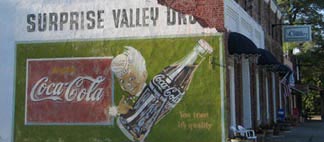 Yes, it’s the side of a building. But it’s also an old billboard for a drugstore that probably doesn’t even exist anymore. And there’s something about it that I really like.
