A pleasant challenge.
Yesterday, on Thanksgiving Day, Mike, Jack the Dog, Alex the Bird, and I took the truck up to our getaway place north of Williams, AZ. It’s an off-the-grid camping cabin on top of a mesa, 5 miles from pavement. If you’re not familiar with the term off-the-grid, it means that it’s not connected to any public utilities. We have solar panels with related equipment for electricity, a propane gas tank, and hauled water.
We left Wickenburg at about 9 AM for the 2-1/2 hour, 154-mile drive. We made one stop on our way out of town — to buy milk and an onion — another stop at the Chino Valley Safeway gas station (where we got a 70¢/gallon discount on diesel), and a final stop at the Jack in the Box restaurant in Williams.
More about Jack in the Box
I do need to digress a tiny bit here. This was the first time since my college days 20+ years ago that I’d been in a Jack in the Box. The last one I’d been in was in Hempstead, NY. I’d been standing at the counter, waiting to place my order, when someone robbed the place by reaching over the counter and grabbing money out of the cash register drawer when it opened. The robber fled quickly — the whole thing happened in about 5 seconds. I clearly remember the manager of the place vaulting over the counter with a sawed-off shotgun. When I say it was a rough neighborhood, I’m not kidding.
The robbery isn’t why I’ve avoided Jack in the Box restaurants all these years. Back in those days, the menu at those places seemed to center around tacos that weren’t very good. I’m not a big fast-food person — I haven’t had a McDonald’s hamburger in at least 10 years — so it wasn’t easy to avoid Jack in the Box. But yesterday surprised me. Mike and I both had hamburgers (since we planned to have turkey for dinner) and agreed that they were probably the best fast food burgers we’d ever had.
Muddy Roads…Again
Anyway, we ate the burgers on the road. There was snow on the ground — maybe about 3 inches of the stuff. It was wet and didn’t completely cover the ground. The clouds were low and thick and slow-moving. Every once in a while, we’d get a clear view of some upper level clouds or some blue sky. Everything was wet and clean looking. It was so un-Arizona. It was magnificent.
 We made the turn off pavement and started the five mile trek up to our mesa-top retreat. We’d gotten about 2 miles in when the road’s surface started getting snotty. That’s really the only way to describe the reddish brown dust when it gets wet enough to make mud. Soon, it had coated the truck’s tires and we were starting to fishtail. Mike put the truck in 4WD. We continued up a gentle grade. The truck would not stay pointed in the right direction. This was not a good thing since (1) the road was only a tiny bit wider than a single lane and (2) there was a deep ditch on one side with water flowing in a shallower ditch on the other side. The photo here shows what it looked like the next day, after at least two other vehicles had passed through. By this time, the snot had solidified a bit and the road was passable again.
Back in May 2005, as I summarized in my blog post, “The Roads of Howard Mesa,” Mike’s truck had slid off the road into a deep ditch about 2-1/2 miles short of our place. The conditions had been similar. We’d been fortunate in that a neighbor had seen us go off the road and had “rescued” us with a Jeep. But it had cost $250 to get a tow truck over to pull the truck out. Neither of us wanted a replay on Thanksgiving Day. So when it seemed clear that we weren’t going to make it up the hill, we decided to back down, turn around, and try another route. We wound up sliding into the shallower of the two ditches. Mike put the truck in 4WD Low and powered us down. It was a tense 5 minutes or so, but then we were making a tricky 3-point turn in a bend in the road and going back the way we’d come.
There are 3 roads to access the lots at the top of the mesa. The access road for two of them was the snot-covered road we knew we couldn’t pass. The other road went up to the west side of the mesa. Our friends live up there year-round and the road up is kept in good condition. Between their lot and our side of the mesa is a 2-track “road” carved in by ranchers and hunters years ago. It’s not maintained at all and seldom used. In fact, I’d venture to guess that I use it more than anyone else, since it’s a “shortcut” to our friends’ place from ours. But the good thing about the road is that it’s relatively level and free of the snot-like mud on all the mesa’s other roads.
So we went that way. It was a 2-mile stretch of snow-covered ruts. Mike took it in 4WD at a pretty steady pace. We were both very glad to see the big metal water tank at the other end of the road. We got back onto the gravel surface and drove the final 3/4 mile without any problems.
“Off the Grid” Doesn’t Mean without Conveniences
At our camping shed were more challenges. We had to get the systems up and running. That meant turning on AC power (flicking a switch), turning on the gas (a lever), getting the gas refrigerator started (sometimes tricky), getting the hot water heater turned on (also tricky at times), and firing up the furnace. It’s this last thing that caused the most grief yesterday. As usual, a mouse had build a home in the furnace’s burner area and it had to be cleaned out before we started it up. Our miserable ShopVac stopped sucking, making Mike’s job more difficult. He worked on it most of the afternoon while I cooked dinner.
Cooking wasn’t tough at all. After all, we had an oven big enough for our 7-lb turkey breast (and nothing else), a 4-burner stove, and the decent quality cookware I’d had at home until we replaced it last year. There’s enough counter space, a cutting board, two good quality, sharp knives, and all the bowls and other cooking implements I needed. If you didn’t know we were off the grid, you’d never guess it. The only thing I didn’t use was our 600-watt microwave — and that was mostly because I didn’t want to waste what battery power we had left on what had become a nasty, rainy day.
I made an abbreviated version of a traditional Thanksgiving dinner: turkey breast, stuffing. gravy, and rice pilaf. Although I’d fully intended to make a fresh batch of mango chutney to go with it (instead of cranberries), I’d forgotten to bring along the mango. Going to the store definitely wasn’t an option. So I made the mango chutney recipe with apples. It didn’t come out bad at all. I was going to make some brussels sprouts, but after cooking for about 3 hours, I was too tired.
By 5:30 PM, Mike had the heat going. It wasn’t cold in the shed — the oven and stove had taken care of the chill — but it was nice to get the heat up to a more normal temperature, especially while we ate. We got Jack the Dog back in — he’d spent all afternoon trying in vain to catch one of the fat pack rats living under the shed — and wrapped his wet muddy body in a towel. Then we settled down for a good Thanksgiving dinner, complete with wine.
Reward After a Long Day
After dinner, we did the dishes and spent some time relaxing. I really love it up here — it seems that the troubles of everyday life just don’t exist. We played some “Chicken Foot” dominoes, then loaded a DVD — “Flawless” with Michael Caine and Demi Moor — in my laptop, turned out the lights, and watched the movie. Later, we climbed up into the sleeping loft, where it was nice and toasty — remember, heat rises — and went to bed.
I spent a lot of time looking out the window into the almost perfect blackness. A cloud had descended onto the mesa and there wasn’t anything to see. I’m pretty sure we were the only people around for miles. Some brief flashes of light in the clouds to the north indicated a thunderstorm over the Grand Canyon.
 In the morning, when it got light, we were in a fog bank. We could see the clouds move in, then clear. It was all quiet except the sound of coyotes off in the distance.
I took this photo, mostly to remember the fog — and the moment. It’s the view from the shed, looking northwest.
In Arizona, fog is a special treat to be savored. There’s no better place to savor it than at our getaway place in the middle of nowhere.

 Here’s almost the same view today. This is normal weather here — blue skies and almost unlimited visibility. Although this photo is a bit too small to see it, Mount Trumbull, which is about 80 miles away, is visible just left of center on the horizon. We can also see the North Rim of the Grand Canyon (which is higher than the South Rim) about 40 miles away.
 Mike shot this photo of Mount Kendricks (left) and the San Francisco Peaks (right) a little while ago. Both mountains got snow yesterday, although kendricks only got a dusting of it. If you’re not familiar with the San Francisco Peaks, Mount Humphreys, which is the tallest of the peaks, is the tallest mountain in Arizona. Don’t quote me, but I believe it’s somewhere around 12,000 feet. (No access to the ‘Net right now, so I can’t look it up).
 And because I can’t resist, here’s a sunset photo taken on Friday evening. Clouds (or particulates in the air) are what makes for nice sunset photos. I rarely get an opportunity to take a decent sunset photo because there are rarely any clouds in the sky in Arizona. But there were clouds Friday and I snapped a few shots from right outside the camping shed. The mountains silhouetted on the horizon are about 50 miles away, near Seligman, AZ.

 And here’s a shot from last January’s visit to San Francisco. That’s the dome of City Hall with Sutro Tower in the background. I took the photo from my hotel room at the Nikko. I think it comes across pretty well as a fake miniature.
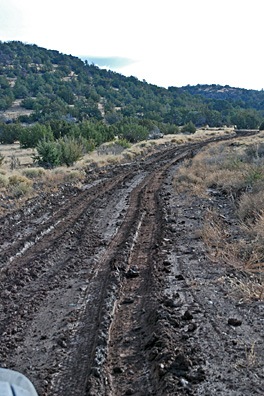 We made the turn off pavement and started the five mile trek up to our mesa-top retreat. We’d gotten about 2 miles in when the road’s surface started getting snotty. That’s really the only way to describe the reddish brown dust when it gets wet enough to make mud. Soon, it had coated the truck’s tires and we were starting to fishtail. Mike put the truck in 4WD. We continued up a gentle grade. The truck would not stay pointed in the right direction. This was not a good thing since (1) the road was only a tiny bit wider than a single lane and (2) there was a deep ditch on one side with water flowing in a shallower ditch on the other side. The photo here shows what it looked like the next day, after at least two other vehicles had passed through. By this time, the snot had solidified a bit and the road was passable again.
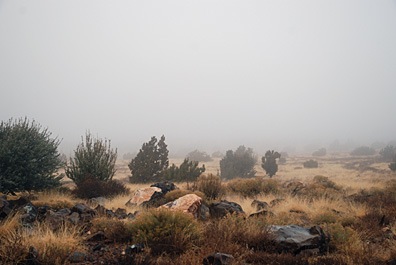 In the morning, when it got light, we were in a fog bank. We could see the clouds move in, then clear. It was all quiet except the sound of coyotes off in the distance.