On Illiteracy and the CelebCult

Thoughts about the demise of intelligence and critical thinking.

Today, two thought-provoking articles that I read online came together in my brain. Here’s the meat of the matter.

Can You Read Me Now?

About three weeks ago, one of my Twitter friends, @BlankBaby, tweeted a link to an article on truthdig by Chris Hedges titled “America the Illiterate.” The article begins with a few statements I can’t help but agree with:

We live in two Americas. One America, now the minority, functions in a print-based, literate world. It can cope with complexity and has the intellectual tools to separate illusion from truth. The other America, which constitutes the majority, exists in a non-reality-based belief system. This America, dependent on skillfully manipulated images for information, has severed itself from the literate, print-based culture. It cannot differentiate between lies and truth. It is informed by simplistic, childish narratives and clichés. It is thrown into confusion by ambiguity, nuance and self-reflection. This divide, more than race, class or gender, more than rural or urban, believer or nonbeliever, red state or blue state, has split the country into radically distinct, unbridgeable and antagonistic entities.

At no time did this become more evident than during our recent presidential campaign. Consider these points:

Existing in a non-reality-based belief system? Unable to distinguish between lies and truth? Informed by simplistic, childish narratives and clichés? Yeah. I think so.

Mr. Hedges’ article goes into some detail about the problem of illiteracy in America. He has statistics — although I’m not sure where they’re from — that claim 42 million American adults, including 20% with high school diplomas, cannot read and 50 million read at an elementary school level. He claims — and, as a writer, I find this hard to believe — that “…42 percent of college graduates never read a book after they finish school. Eighty percent of the families in the United States last year did not buy a book.”

There’s a lot more and it makes for fascinating reading. I agree with much of the opinion content, which is unfortunate because it paints such a bleak picture of Americans. But the following quote stuck with me when I read the piece and I actually clipped it out to write about it later:

In an age of images and entertainment, in an age of instant emotional gratification, we do not seek or want honesty. We ask to be indulged and entertained by clichés, stereotypes and mythic narratives that tell us we can be whomever we want to be, that we live in the greatest country on Earth, that we are endowed with superior moral and physical qualities and that our glorious future is preordained, either because of our attributes as Americans or because we are blessed by God or both.

I’m reminded of thought-free flag-wavers who cry treason whenever someone uses their Constitutional right of free speech to question American policies at home and overseas. I’m reminded of Sarah Palin, claiming that these flag-wavers are the “real Americans” while the rest of us, in that other America — the people who know how to think critically — are unpatriotic.

A Canary Speaks Out

This morning, I followed up on another link sent out into the ether by a Twitter friend that turned out to be related — at least in my mind. @BWJones linked to an article by noted film critic Roger Ebert in the Chicago Sun-Times blog called “Death to Film Critics! Hail to the CelebCult!” In it, Mr. Ebert claims that “a newspaper film critic is like a canary in a coal mine.” His piece was prompted by a 500-word limit imposed by the Associated Press (AP) for all articles by entertainment writers.

Worse, the AP wants its writers on the entertainment beat to focus more on the kind of brief celebrity items its clients apparently hunger for. The AP, long considered obligatory to the task of running a North American newspaper, has been hit with some cancellations lately, and no doubt has been informed what its customers want: Affairs, divorces, addiction, disease, success, failure, death watches, tirades, arrests, hissy fits, scandals, who has been “seen with” somebody, who has been “spotted with” somebody, and “top ten” lists of the above. (Celebs “seen with” desire to be seen, celebs “spotted with” do not desire to be seen.)

He goes on to say:

The CelebCult virus is eating our culture alive, and newspapers voluntarily expose themselves to it. It teaches shabby values to young people, festers unwholesome curiosity, violates privacy, and is indifferent to meaningful achievement.

That’s the root of the matter right there. People are more interested in celebrity lives than just about anything else. They’d rather read about what a “hot” celebrity ate for lunch yesterday than the failing economy, war in Iraq or Afghanistan, energy problems and solutions, or the struggles of third-world nations against poverty, disease, and genocide.

Of course, they’d rather see video or pictures of what the celebrity ate for lunch. No reading required.

It’s a failure of critical thinking. Too many people living in a non-reality-based world. And the media is feeding it. Newspapers and television channels are selling out, providing this low-level content just to survive.

Mr. Ebert points out, “As the CelebCult triumphs, major newspapers have been firing experienced film critics. They want to devote less of their space to considered prose, and more to ignorant gawking.” He goes on to say:

Why do we need critics? A good friend of mine in a very big city was once told by his editor that the critic should “reflect the taste of the readers.” My friend said, “Does that mean the food critic should love McDonald’s?” The editor: “Absolutely.” I don’t believe readers buy a newspaper to read variations on the Ed McMahon line, “You are correct, sir!” A newspaper film critic should encourage critical thinking, introduce new developments, consider the local scene, look beyond the weekend fanboy specials, be a weatherman on social trends, bring in a larger context, teach, inform, amuse, inspire, be heartened, be outraged.

But his conclusion is what ties his piece in with the truthdig article I started this post with — at least for me:

The celebrity culture is infantilizing us. We are being trained not to think. It is not about the disappearance of film critics. We are the canaries. It is about the death of an intelligent and curious, readership, interested in significant things and able to think critically. It is about the failure of our educational system. It is not about dumbing-down. It is about snuffing out.

Think about it…if you can.
Photos from Our Flight to San Diego

The view from above.

In November, Mike and I took my helicopter to the San Diego area for business. The flights to and from San Diego were over some of the most interesting — and boring — desert terrain out there.

Our route to San Diego from Wickenburg (E25) took us southwest, skirting around the restricted area north of Yuma, where we landed for fuel. (Fuel there was $1.20/gallon cheaper than at my home base.) Then almost due west along I-8, over the Glamis Dunes and Imperial Valley, which lies below sea level. Finally, a climb over some mountains and a descent down to Gillespie Field (SEE).

On the return flight, we took a different route. We flew east along I-8, then northeast to the northern tip of the Salton Sea to Chiriaco Summit and then along I-10 to Blythe, where we refueled. (The fat guy is gone.) From there, we overflew Quartzsite before making a bee-line for Wickenburg.

You can see the approximate routes below; click the map for a larger view with readable labels.

Route of Flights

Mike’s got his private pilot certificate and 100 hours of flight time in helicopters, so he’s legal (per my insurance company) to fly passengers. So he did most of the flying. I had my door off for the Yuma to El Cajon part of the flight and took photos — mostly over the Glamis dunes. It was nice to be a passenger for a change — to be able to use my camera without left-handed contortions. I also had the POV.1 video going for part of the flight, although the sound crapped out part of the way.

Anyway, here are a few of the photos I took on the flight. You can find more of my aerial photos — as well as larger versions of these — in my photo gallery.

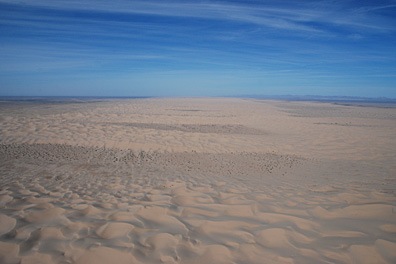
Glamis Sand DunesGlamis Sand Dunes

Formally known as the Algodones Dunes or the Imperial Sand Dunes Recreation Area, the Glamis Dunes is a huge series of sand dunes west of the Colorado River, northwest of Yuma, AZ in California. The dune field stretches 45 miles north to south and 6 miles east to West. This photo shows only a portion of the dunes, looking north from the I-8 area. The dunes are extremely popular for off-road vehicles; this photo was taken on a relatively quiet Friday morning.

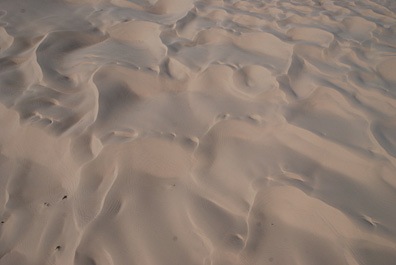
Sand DunesSand Dunes

Here’s a closeup shot of the Algodones Dunes from the air. This shot was taken from about 500 feet above the ground, over I-8, just west of the Arizona-California border.

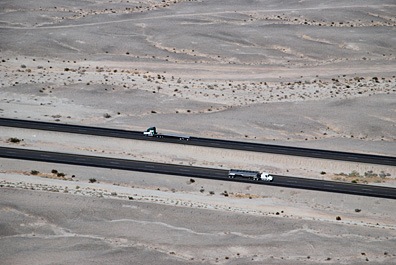
Desert FreewayDesert Freeway

The folks back east probably have no concept of the long distances of nothingness on a freeway that cuts through the desert. This shot of two tractor trailer trucks passing each other in the barren wasteland of the Imperial valley’s southern extremities might give them an idea.

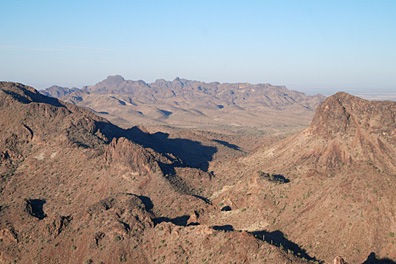
Desert MountainsDesert Mountains

The mountains just seem to go on forever in this aerial shot of mountains in southwest Arizona, not far from Quartzsite. Lake afternoon light casts long shadows.

CAP CanalCAP Canal

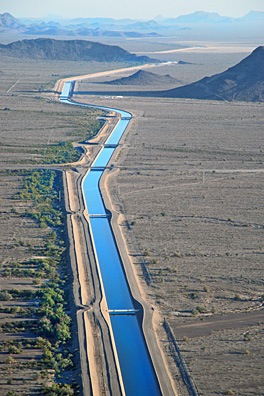
The Central Arizona Project (CAP) snakes its way through the Arizona desert, bringing water from the Colorado River and its lakes to Phoenix and its suburbs. This shot was taken just north of Hope, AZ on our return flight to Wickenburg.

Forepaugh RanchForepaugh Ranch

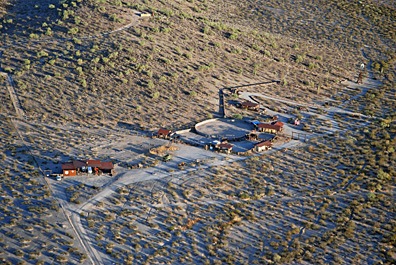
This ranch is nestled at the base of two hills in Forepaugh, AZ, out of sight from the main road (Route 60) only a mile or so away. It reminds me of an earlier day of ranching, when remote ranches were self-sufficient homes on the range.

Another View, No Fog

A quick shot or two…or three.

The other day, I blogged about Thanksgiving and the fog we experienced the following morning. I even included a photo of the foggy morning.

Howard Mesa ViewHere’s almost the same view today. This is normal weather here — blue skies and almost unlimited visibility. Although this photo is a bit too small to see it, Mount Trumbull, which is about 80 miles away, is visible just left of center on the horizon. We can also see the North Rim of the Grand Canyon (which is higher than the South Rim) about 40 miles away.

San Francisco PeaksMike shot this photo of Mount Kendricks (left) and the San Francisco Peaks (right) a little while ago. Both mountains got snow yesterday, although kendricks only got a dusting of it. If you’re not familiar with the San Francisco Peaks, Mount Humphreys, which is the tallest of the peaks, is the tallest mountain in Arizona. Don’t quote me, but I believe it’s somewhere around 12,000 feet. (No access to the ‘Net right now, so I can’t look it up).

SunsetAnd because I can’t resist, here’s a sunset photo taken on Friday evening. Clouds (or particulates in the air) are what makes for nice sunset photos. I rarely get an opportunity to take a decent sunset photo because there are rarely any clouds in the sky in Arizona. But there were clouds Friday and I snapped a few shots from right outside the camping shed. The mountains silhouetted on the horizon are about 50 miles away, near Seligman, AZ.

Faking Tilt-Shift Photography

It works!

The other day, I got my first exposure (pun intended) to the world of tilt-shift photography. It was a link tweeted by one of my Twitter friends, @jebro, to a series of videos by Keith Loutit on Vimeo. These videos used time-lapse tilt-shift photography. The result were videos that looked as if they were created painstakingly with miniature models.

Take a minute right now and check out Keith’s video, “The North Wind Blew South.”

I’ve heard of time-lapse photography, of course. In fact, I used to play around with it using my Webcam software. You can see some examples here, here, and here.

But I’d never heard of tilt-shift photography. I did some research and found an excellent article on Wikipedia (of course) that included photos of camera equipment used to make the images. Per Wikipedia, the basic explanation is as follows:

Tilt-shift photography refers to the use of camera movements on small- and medium format cameras. In many cases, it refers to tilting the lens relative to the image plane and using a large aperture to achieve a very shallow depth of field.

The end result is that only a small portion of the image is in focus. This became popular in portrait photography. But it also has become popular as a technique to make fake miniatures — in other words, photos of full-size, real-life objects or people made to look as if they are miniature models. Wikipedia has a separate page about tilt-shift miniature faking that includes sample images.

You can also find plenty of sample images and videos on Smashing Magazine’s article, “50 Beautiful Examples Of Tilt-Shift Photography.”

Photography is one of my hobbies and I was extremely interested in this technique. I think the photos look kind of silly and cool. But I wasn’t interested in buying special lenses just to give it a try. Fortunately, I didn’t have to. The Smashing Magazine article included a link to a tutorial on the Tilt-Shift Photography Web site titled “Tilt-Shift Photography Photoshop Tutorial.” It explains how you can use Photoshop to create a fake tilt-shift photograph.

I tried it today with a number of photos that happen to be with me on my laptop. The one shown below is my fifth try. It’s a photo of Juneau, AK (I think; forgive me if I got the wrong port city), taken from an upper deck on a cruise ship. In the original photo, the entire image is in focus; for this fake miniature, I focused on a boat and two buildings in the foreground. The color is saturated and the contrast is increased as recommended to give it that painted model feel. I think this photo is a pretty good example of the tilt-shift photography effect. What do you think?

Tilt-Shift Example

My first four tries simply didn’t look right. I think it was a combination of the image I chose and the lens blur mask I used. The photo here uses a radial gradient mask rather than the reflected gradient recommended by the tutorial. That makes it possible to pinpoint the in-focus area, which worked for this image. The example image in the tutorial had a horizontal strip of the photo in focus; that simply doesn’t work for all photos.

But I apparently did get the hang of it. Here’s my next try, with another Alaska port city:

Fake Tilt-Shift Example

San Francisco in MiniatureAnd here’s a shot from last January’s visit to San Francisco. That’s the dome of City Hall with Sutro Tower in the background. I took the photo from my hotel room at the Nikko. I think it comes across pretty well as a fake miniature.

And here’s a shot my husband Mike took on a helicopter trip up the Colorado River last year. It’s the Hoover Dam with the new bridge under construction:

Hover Dam Miniature

And one more…this is the power house downstream from Lake Chelan in Washington State. It’s another aerial photo — they certainly do make good subjects for this kind of exercise. The heavy equipment looks like Tonka trucks!

Lake Chelan Pumphouse Miniature

Anyway, now that I’ve tried this with a certain amount of success, I think I can get it out of my system. If anyone out there has experimented with this kind of photography — especially using a camera and lens rather than cheating with Photoshop — please use the Comments link or form for this post to link to examples of your work. And feel free to share any tips you might have for folks who are interested in giving this a try.

An Off-the-Grid Thanksgiving

A pleasant challenge.

Yesterday, on Thanksgiving Day, Mike, Jack the Dog, Alex the Bird, and I took the truck up to our getaway place north of Williams, AZ. It’s an off-the-grid camping cabin on top of a mesa, 5 miles from pavement. If you’re not familiar with the term off-the-grid, it means that it’s not connected to any public utilities. We have solar panels with related equipment for electricity, a propane gas tank, and hauled water.

We left Wickenburg at about 9 AM for the 2-1/2 hour, 154-mile drive. We made one stop on our way out of town — to buy milk and an onion — another stop at the Chino Valley Safeway gas station (where we got a 70¢/gallon discount on diesel), and a final stop at the Jack in the Box restaurant in Williams.

More about Jack in the Box

I do need to digress a tiny bit here. This was the first time since my college days 20+ years ago that I’d been in a Jack in the Box. The last one I’d been in was in Hempstead, NY. I’d been standing at the counter, waiting to place my order, when someone robbed the place by reaching over the counter and grabbing money out of the cash register drawer when it opened. The robber fled quickly — the whole thing happened in about 5 seconds. I clearly remember the manager of the place vaulting over the counter with a sawed-off shotgun. When I say it was a rough neighborhood, I’m not kidding.

The robbery isn’t why I’ve avoided Jack in the Box restaurants all these years. Back in those days, the menu at those places seemed to center around tacos that weren’t very good. I’m not a big fast-food person — I haven’t had a McDonald’s hamburger in at least 10 years — so it wasn’t easy to avoid Jack in the Box. But yesterday surprised me. Mike and I both had hamburgers (since we planned to have turkey for dinner) and agreed that they were probably the best fast food burgers we’d ever had.

Muddy Roads…Again

Anyway, we ate the burgers on the road. There was snow on the ground — maybe about 3 inches of the stuff. It was wet and didn’t completely cover the ground. The clouds were low and thick and slow-moving. Every once in a while, we’d get a clear view of some upper level clouds or some blue sky. Everything was wet and clean looking. It was so un-Arizona. It was magnificent.

Howard Mesa RoadsWe made the turn off pavement and started the five mile trek up to our mesa-top retreat. We’d gotten about 2 miles in when the road’s surface started getting snotty. That’s really the only way to describe the reddish brown dust when it gets wet enough to make mud. Soon, it had coated the truck’s tires and we were starting to fishtail. Mike put the truck in 4WD. We continued up a gentle grade. The truck would not stay pointed in the right direction. This was not a good thing since (1) the road was only a tiny bit wider than a single lane and (2) there was a deep ditch on one side with water flowing in a shallower ditch on the other side. The photo here shows what it looked like the next day, after at least two other vehicles had passed through. By this time, the snot had solidified a bit and the road was passable again.

Back in May 2005, as I summarized in my blog post, “The Roads of Howard Mesa,” Mike’s truck had slid off the road into a deep ditch about 2-1/2 miles short of our place. The conditions had been similar. We’d been fortunate in that a neighbor had seen us go off the road and had “rescued” us with a Jeep. But it had cost $250 to get a tow truck over to pull the truck out. Neither of us wanted a replay on Thanksgiving Day. So when it seemed clear that we weren’t going to make it up the hill, we decided to back down, turn around, and try another route. We wound up sliding into the shallower of the two ditches. Mike put the truck in 4WD Low and powered us down. It was a tense 5 minutes or so, but then we were making a tricky 3-point turn in a bend in the road and going back the way we’d come.

There are 3 roads to access the lots at the top of the mesa. The access road for two of them was the snot-covered road we knew we couldn’t pass. The other road went up to the west side of the mesa. Our friends live up there year-round and the road up is kept in good condition. Between their lot and our side of the mesa is a 2-track “road” carved in by ranchers and hunters years ago. It’s not maintained at all and seldom used. In fact, I’d venture to guess that I use it more than anyone else, since it’s a “shortcut” to our friends’ place from ours. But the good thing about the road is that it’s relatively level and free of the snot-like mud on all the mesa’s other roads.

So we went that way. It was a 2-mile stretch of snow-covered ruts. Mike took it in 4WD at a pretty steady pace. We were both very glad to see the big metal water tank at the other end of the road. We got back onto the gravel surface and drove the final 3/4 mile without any problems.

“Off the Grid” Doesn’t Mean without Conveniences

At our camping shed were more challenges. We had to get the systems up and running. That meant turning on AC power (flicking a switch), turning on the gas (a lever), getting the gas refrigerator started (sometimes tricky), getting the hot water heater turned on (also tricky at times), and firing up the furnace. It’s this last thing that caused the most grief yesterday. As usual, a mouse had build a home in the furnace’s burner area and it had to be cleaned out before we started it up. Our miserable ShopVac stopped sucking, making Mike’s job more difficult. He worked on it most of the afternoon while I cooked dinner.

Cooking wasn’t tough at all. After all, we had an oven big enough for our 7-lb turkey breast (and nothing else), a 4-burner stove, and the decent quality cookware I’d had at home until we replaced it last year. There’s enough counter space, a cutting board, two good quality, sharp knives, and all the bowls and other cooking implements I needed. If you didn’t know we were off the grid, you’d never guess it. The only thing I didn’t use was our 600-watt microwave — and that was mostly because I didn’t want to waste what battery power we had left on what had become a nasty, rainy day.

I made an abbreviated version of a traditional Thanksgiving dinner: turkey breast, stuffing. gravy, and rice pilaf. Although I’d fully intended to make a fresh batch of mango chutney to go with it (instead of cranberries), I’d forgotten to bring along the mango. Going to the store definitely wasn’t an option. So I made the mango chutney recipe with apples. It didn’t come out bad at all. I was going to make some brussels sprouts, but after cooking for about 3 hours, I was too tired.

By 5:30 PM, Mike had the heat going. It wasn’t cold in the shed — the oven and stove had taken care of the chill — but it was nice to get the heat up to a more normal temperature, especially while we ate. We got Jack the Dog back in — he’d spent all afternoon trying in vain to catch one of the fat pack rats living under the shed — and wrapped his wet muddy body in a towel. Then we settled down for a good Thanksgiving dinner, complete with wine.

Reward After a Long Day

After dinner, we did the dishes and spent some time relaxing. I really love it up here — it seems that the troubles of everyday life just don’t exist. We played some “Chicken Foot” dominoes, then loaded a DVD — “Flawless” with Michael Caine and Demi Moor — in my laptop, turned out the lights, and watched the movie. Later, we climbed up into the sleeping loft, where it was nice and toasty — remember, heat rises — and went to bed.

I spent a lot of time looking out the window into the almost perfect blackness. A cloud had descended onto the mesa and there wasn’t anything to see. I’m pretty sure we were the only people around for miles. Some brief flashes of light in the clouds to the north indicated a thunderstorm over the Grand Canyon.

View with FogIn the morning, when it got light, we were in a fog bank. We could see the clouds move in, then clear. It was all quiet except the sound of coyotes off in the distance.

I took this photo, mostly to remember the fog — and the moment. It’s the view from the shed, looking northwest.

In Arizona, fog is a special treat to be savored. There’s no better place to savor it than at our getaway place in the middle of nowhere.