Great Loop 2021: My (First) Great Loop Adventure

How I found a chance to cruise the Hudson River, Erie Canal, and Great Lakes from New York City to Chicago — without my own boat.

A while back, I blogged about The Great Loop, a boat trip I wanted to take before I turned 65 — which is still a way off. With thousands of miles of river, canal, and even ocean to navigate over the course of about a year, it isn’t a trip to be taken lightly. Not only would I need a boat capable of making the trip — and yes, I’ve been shopping for one — but I’d also need to build a knowledge base and skills to be able to do the trip safely. Although my self-imposed deadline was still years away, I’ve learned that the older I get, the faster the years go. I can’t waste time dreaming about it. I need to get my rear in gear and get to work.

It Started with a Crew Wanted Ad

I started building my knowledge base by joining an organization that provides support for “Loopers,” as Great Loop cruisers are known: America’s Great Loop Cruisers’ Association. (I blogged more about that organization here.) The AGLCA’s website has a number of features, many of which require membership to fully access. While browsing through it, I saw that they had a classified ads section. And while browsing through that, I saw that there were listings for Crew Wanted.

I’d never really thought about doing any of the trip as a member of someone else’s crew. I’m a hands-on person and I guess I kind of like being in control of things I get involved with. But I definitely lacked many of the skills and much of the knowledge I’d need to take command of a boat on a cruise like this. Perhaps being part of someone else’s crew could give me the hands-on experience I’d need to learn a lot of what I’d need to know a lot more quickly than I would without access to a boat.

The Nano
Capt Paul’s boat, the Nano.

There were two ads and I answered one of them. It was posted by Capt Paul, an experienced boat captain who had a 27 foot Ranger Tug — coincidentally the same boat I was interested in buying (although he has the older inboard engine model). He set up a FaceTime call, which I soon realized was one of many interviews he’d be doing to find crew members.

The Interview

The interview lasted about an hour. We discussed what he was looking for and my qualifications for the position.

He was looking for two crew members to accompany him from his home in the Portland area of Maine to the Stuart area of Florida. I originally thought he just planned to go down the coast, moving into the Intracoastal Waterway around Chesapeake Bay. But no! He wanted to enter the Hudson River at New York City, take that to the current incarnation of the Erie Canal, and cruise various Great Lakes to Chicago before heading south of the Illinois, Mississippi, and other rivers to get to the Gulf of Mexico and then cross central Florida in the canal system there. In other words, he wanted to do about 2/3 (or more?) of the Great Loop.

Wow. That was a bit more than my mind could take in. It would be a long trip — maybe longer than I was willing to commit to? I wasn’t sure.

The arrangement would be cost sharing. I think he wanted two crew members not only to deal with the locks on the canals — which are notoriously difficult for solo boaters — but to keep the cost of the trip down. I thought immediately of my friend Bill as another crew member, but family obligations currently have him tied up.

We spent a lot of time talking about my boating experience. I didn’t realize I had so much until I had to brag about it:

  • I grew up in northern New Jersey where my family had a series of small — think around 20 feet? — boats. We’d put in at the boat ramp under the George Washington Bridge and cruise on the Hudson. A common trip would go around Manhattan, but we also went as far north as just past West Point.
  • I’ve been houseboating on Lake Powell twice: a 7-day trip and a 4-day trip. I did a lot of the driving.
  • I’ve rented powerboats on Lake Powell, Lake Mead, and various other lakes and rivers throughout my adult life.
  • I’ve owned a pair of Waverunners, which I used on various Arizona lakes and in the Colorado River on an epic overnight trip from Lake Havasu to Laughlin, NV.
  • I’ve owned a small jet boat for the past 10 years, which I’ve taken on various rivers and lakes in Washington state and Arizona.
  • I took a 12-day “Learn to Navigate the Inside Passage” cruise a few years go where I was one of just four passengers learning about cruising.
  • I’ve been an active passenger numerous times on other people’s boats in various waterways, from inland lakes and rivers to the San Juan Islands.

I also have a huge interest and tons of experience in navigation, on land, on sea, and in the air. Maps have always interested me and I have good map skills, even in this age of Googled driving directions. Hell, I’m nutty enough to put nautical charts on my iPad while on big ship cruises so I can track where we’re going.

Anyway, we hit it off well enough. Capt Paul seemed like a no-nonsense guy and I’m all for that. I apparently didn’t come off as (too) flaky and my experience seemed to score some points. I probably scored more on enthusiasm and apparent financial stability. He mentioned other interviews and we said our goodbyes.

The Plan

A few days went by. I had a chance to wrap my head around the trip. Capt Paul sent a planned itinerary with dates. I had some time constraints — I couldn’t leave Washington until after cherry drying season ended, which was at least two weeks into Capt Paul’s trip.

In the meantime, he found another crew member willing to do the whole trip with him and another willing to join him in Chicago. I had to hustle or I’d miss out.

We started emailing back and forth about me going from New York City to Chicago with them. I really wanted to do the Hudson River — the cruising grounds from my childhood — and the Erie Canal. In fact, I pretty much decided that if I couldn’t do those parts of the trip, I’d skip it. After all, I was facing a big expense just getting out there and back and a lot of work finding someone to take care of my pups while I was away. I may as well do the trip I wanted to do.

We played with dates a little. I found a pilot willing to take over for me in my helicopter if cherry season went long. Capt Paul agreed to wait until August 10 to depart New York City. I could arrive the night before and meet up with him and the other crew member (Dianne) at Liberty Landing Marina. I bought plane tickets to get out there.

And then, when he sent out an email to all the folks who had applied for the crew positions to tell them he’d made his selections, I double-checked to make sure that I was one of them.

I was.

The trip is a go.

Some Closing Thoughts

I have a lot more to share about this adventure now and will have a ton more to share in the future. But I do want to share a few thoughts as I finish up this blog post.

I guess the main point I want to make is this: if you want something badly enough, you need to make it happen. This is something my wasband used to say to me when I was a twenty-something on a career path I hated in corporate America. I took his advice to heart and have been doing so ever since. If you know me and my history, you know that I’ve been making things happen for myself for the past 35+ years.

I was in a Zoom meeting with other Loopers recently — blog post to come about the AGLCA Rendezvous — and mentioned my upcoming crew duties. One of the attendees who was also shopping (with his wife) for a boat wanted to know how I’d managed to get the chance to do it. He sounded — dare I say it? — jealous.

I answered a classified ad, I told him.

You can’t just wait around for opportunities to present themselves. You have to look for them. And then you have to take action to make it happen.

If I hadn’t needed time to think about the possibility — and difficulties — of doing the whole trip, I could have had Diane’s slot — or maybe we could have both been crew members for the whole thing. That’s okay because I’ve bit off exactly what I wanted to chew this time around, but it also brings home the point that if I’d delayed at all, someone else would have had my slot.

If you want something badly enough, you have to make it happen. I’m making this trip happen and I can’t wait for it to start.
Helicopter Flight Over Wenatchee

Another video from the Flying M Air YouTube channel.

Join me for a 20-minute flight from the maintenance hangar at Wenatchee Pangborn Memorial Airport to the Columbia River, up to the Rocky Reach Dam, and back down to Malaga. Along the way, I’ll tell you about what you’re seeing and tell you about my helicopter maintenance and ground handling wheels.

Note: This is the 1080 HD version of this video. A 4K UHD version without the animated subscribe button and Member Wall that also includes landing at my summer base is available to members at the Sponsor level or higher.

First Art Show of the Season

Surprisingly successful.

This past weekend was my first art show of the season. It’s at a venue which is usually good for me, but this time, it was surprisingly good. I thought I’d blog a bit about it.

But before I go into a report of this past weekend’s art show, let me begin by explaining how I sell my work. (You know me; there’s always a back story.)

My sales channels

I sell most of the jewelry I make in three different channels:

  • My Art Show Booth
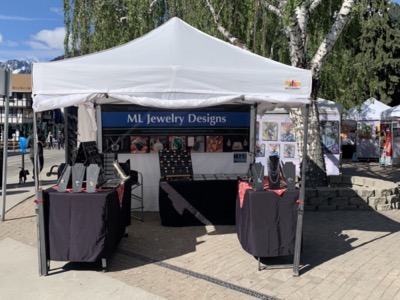
    My art show booth as it appeared this past weekend in Leavenworth. I was fortunate to have an end spot and be open on three sides.

    Art Shows. This accounts for far more than half of my sales, but it’s the hardest work I do. I (normally) pay a free up front for booth space and then, on the day of the show, arrive early with a 10×10 foot tent, tables, table covers, signage, and merchandise displays. I set everything up — it takes roughly 90 minutes — placing my work as artistically and practically as I can. Then I sit in the booth all day — sometimes for as many as five days in a row — to sell what I’ve brought, make more inventory (when possible), and take/make orders for custom items. Then, at the end of the show, I pack everything back up. The benefit: I (normally) get to keep 100% of the selling price for each item.

  • Wholesale and Consignment Sales. This accounts for maybe 15% of my sales and involves a lot less work — but at a cost. My wholesale price is 50% off the retail price; consignment fees are typically 35% to 40%. Even though it costs more, I prefer wholesale sales — once an item is sold, I can pretty much cross it off my inventory and forget about it. (The exception is the trade-in policy I offer for my wholesale clients; if something doesn’t sell in their shop in 6 to 18 months, I allow them to trade it in for another item.) Consignment is a royal pain in the ass. Not only am I letting a consignment shop hold onto my inventory (so I can’t sell it myself), but I need to keep track of all that stuff. And if an item is lost through theft at their shop, I’m pretty much screwed. Or if they go out of business while they have my stock, I have to worry about getting it back. Needless to say, I really don’t do much on consignment. What’s nice about these channels, however, is that they do often lead to a regular stream of sales with monthly income. So there’s that.
  • My Online Store. This accounts for another 10% of my sales. Right now, I’m using Etsy, but I hope to switch to a more professional solution soon. Etsy takes a small cut of each sale — it’s less than 10% (unless the sale is related to a special ad they’ve placed) — so it isn’t the cost that bothers me. It’s being in an online retail space with people selling cheap, imported junk that they’re trying to pass off as their own work. The only thing that keeps me with Etsy is their integrated shipping feature, which not only makes it easy to ship to addresses all over the world, but gives me a discount on USPS postage costs.

The rest of my sales are face-to-face to friends and acquaintances. That’s a tiny percentage of the total.

This Weekend’s Show

This past weekend I was at Leavenworth Art in the Park. This is a weekly art show in the center of town that has been fine-tuned over the past year for COVID. Right now, it’s operating with only 15 artist vendors in widely spaced outdoor booths; when restrictions ease a bit more, I suspect it’ll go back to its previous capacity which was about 20.

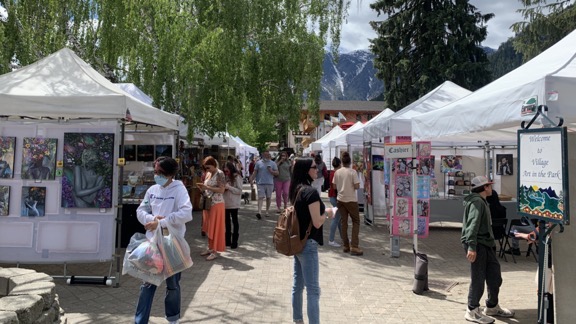
Art in the Park
With spacing for COVID, booths are able to be open on all sides.

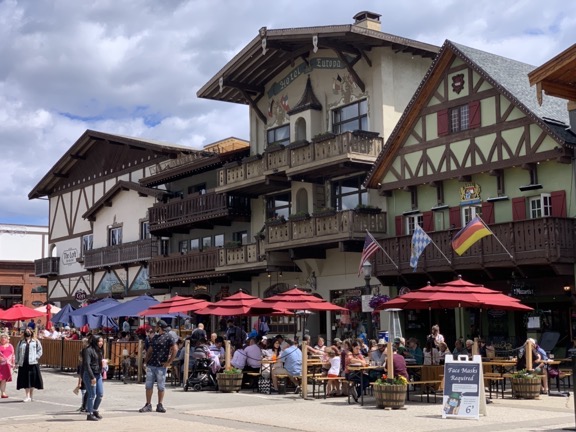
Leavenworth, Washington, is a small town in the foothills to the Cascade Mountains. It’s a gorgeous location, nestled near mountains that remain snow-capped for much of the year. Its Bavarian Theme is what brings tourists in all summer long. The town also has (or had before COVID) lots of festivals, including a three week long Oktoberfest and big Christmas celebrations. The area has tons of hiking, white water rafting, camping, and other outdoor activities. It’s a nice place to visit, although admittedly a bit too touristy in town for my taste.

Leavenworth, WA
Downtown Leavenworth, WA was completely redone years ago to require Bavarian style architecture. One of the nice things about COVID — there are silver linings if you look for them — is that it got the town to close down the main street to vehicle traffic to make room for outdoor dining.

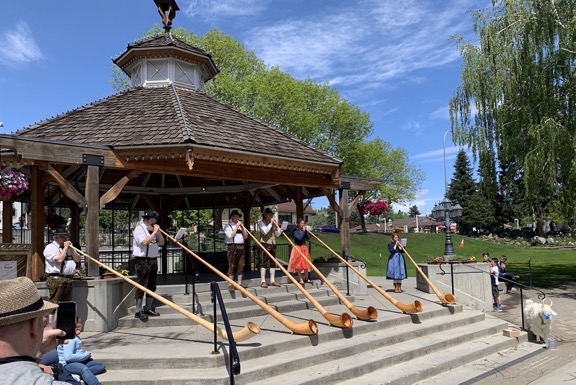
Elk horns
One of the draws to Leavenworth is entertainment, like this elk horn group. I shot this photo from my booth; it was very close to where the entertainment was.

I started showing/selling my work at Art in the Park in 2019. I attend on a limited basis because my primary work, which is cherry drying with my helicopter, requires me to be close to the helicopter in the Wenatchee area from roughly June 1 to August 15 every summer.

In a way, my limited time there is a good thing. Leavenworth is 50 miles from my home and the days there are long: 9 AM to 6 PM. Add that to my one hour (each way) commute and I’m looking at 11 hours. Spring and early autumn can be cold, summer can be hot. Parking is a pain in the ass. There are long lines at restaurants and, often, for the restrooms.

The reward of being there, however, is great sales. Folks who come to Leavenworth come to be entertained and to spend money. They shop in town and at the Art Show. They eat and drink in countless restaurants and bars. They stay in local hotels. They are in money-spending mode. And because most of them come from the Seattle side of the mountains, they have a bit more disposable income than the local folks I used to sell to at smaller venues in downtown Wenatchee. A pendant priced $59 isn’t a big expenditure for these folks, so I can actually sell and make money on my work.

This weekend was a great example. Although it was the second weekend of the show, it was my first weekend attending. I set up on Friday morning and began selling almost immediately. By 6 PM, I’d sold more than I had in an entire weekend on my last show. I did even better on Saturday and almost as well on Sunday.

Overall, it was the best weekend I’d ever had at any show anywhere.

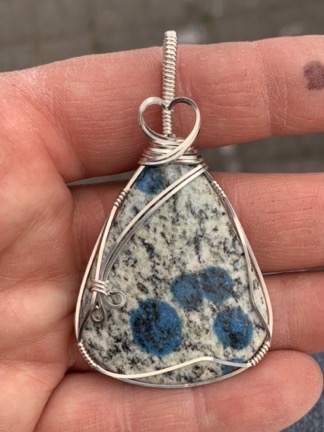
Pendant
Here’s one of the pendants I made while I was sitting in my booth on Sunday morning. I made a total of six pendants that day.

It was so good that I spent most of Saturday and Sunday making more inventory. My wire work pendants continue to sell well in Leavenworth and I made five custom pendants for customers while I was there. I also made a bracelet and three beaded necklaces. This week I’ll be making a lot of earrings in my shop.

Now although the booth fee at Art at the Park is remarkably low, the non-profit organization that runs it does take a cut of sales: 21%. So I don’t get all of the money I brought in. But 21% is a lot less than the 35% or 40% I’m paying two galleries to show and sell my work. And I sold a lot more this past weekend than I’ve sold in my three year relationship with both galleries combined. So I’m definitely not complaining.

I’m doing two more weekends at Leavenworth this month. Then I’m stuck in Wenatchee for most of the summer. I applied to a show in Wenatchee in June and another show in Chelan in July. (I had to find a booth sitter for the July show in case rain is possible and I need to stay home.) I’m scheduled to go back to Leavenworth in August and September, but I may need to cancel that because of a conflict with another opportunity that I’m not quite ready to discuss here yet.

And if you’re a Leavenworth tourist reading this, I sure hope you’ll stop by Art in the Park while you’re in town. It’s open on Fridays, Saturdays, and Sundays from about 9 AM to 6 PM (or 5 PM on Sundays). I believe it’s also open on Thursdays between Memorial Day and Labor Day. Support local artists and makers!

On Ghostwriting

There are only two reasons to do it.

Yes, I’m a helicopter pilot and jewelry artist now. But my second career, which has pretty much wound down at this point, was as a freelance writer. That career, which was in full swing when I started this blog in 2003 (not a typo) was successful enough for me to buy multiple investment properties, completely fund my retirement, take flying lessons, and buy a helicopter.

So yes, I think it’s fair to say that I know a bit about the business of writing.

The Crazy Ghostwriting Offer

So imagine my surprise when I see a tweet from a wannabe writer offering to “ghostwrite your sci fi, fantasy story, ebook, novel” for $5.

My first thought was what kind of desperate idiot would write someone else’s book for $5?

Let’s be clear here: writing may not be terribly difficult — it wasn’t for me — but it is time consuming. The fastest I ever churned out a book was a 280-pager in 10 days. It was my third or fourth book. Would I have taken $5 for 10 days of work? Hell no.

Would I have taken $5 for any piece of writing that had someone else’s name on it? Fuck no.

Ghostwriting Explained

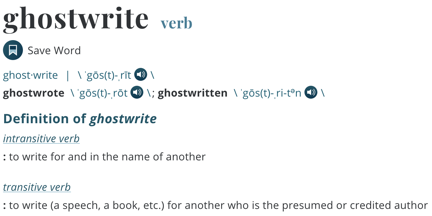
Ghostwrite definition
Definition from Merriam-Webster: ghostwrite.

That’s what ghostwriting is all about: writing something for someone else and having that person’s (or another person’s) name on on it as the author. In most (or probably all) cases, copyright goes to the person or organization who hired the ghostwriter. This is a work for hire, which is relatively common in the publishing world.

Ghostwriters are commonly used by famous people with a story to tell — often biographical in nature — who lack the skill, time, and/or desire to sit down and write it. Remember, writing isn’t easy for everyone, there are lots of really crappy writers out there, and writing takes time, no matter how good or bad a writer is. Ghostwriter names don’t usually appear as author, although sometimes they’ll appear in smaller print after “as told to” or something like that.

There’s no glory in being a ghostwriter.

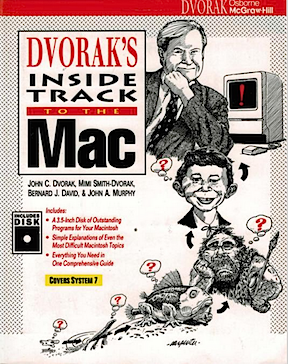
Dvorak's Inside Track
This is the first book I was involved in; I was a ghostwriter on 4 chapters and am mentioned in the acknowledgements.

I know this firsthand. My first book project was as a ghostwriter for John C Dvorak and Bernard J David on Dvorak’s Inside Track to the Mac back in 1991. Bernard hired me, after his agent suggested me, to write one chapter of the book. They liked what I turned in so much that they hired me for another three chapters. (You can read about this in a post titled “Freebies” on this site. I highly recommend reading this if you’re starting out as a writer and hope to make a living at it.)

Much later in my career, I ghostwrote a chapter or two for someone else’s book — was it the Macintosh Bible? I can’t even remember. In that case, I had expertise that the author lacked and the writing experience to get the job done right and on time.

Why Be a Ghostwriter?

Would I ghostwrite something today? Well, that depends. In my mind, there are only two reasons to ghostwrite a book:

  • Money. Plain and simple. That’s the only reason I did that second ghostwriting job. They paid me. And it wasn’t $5. (I honestly can’t remember what it was, but at that point in my career, it must have been at least $2,000.) Even that first ghostwriting gig, when I was a complete unproven unknown writer, paid me $500 per chapter — that’s $2,000 total.
  • Relationship building. This one is a little grayer. Suppose a publisher/editor contacted me about ghostwriting a book for a famous pilot. Suppose they were willing to pay (more than $5) but it wasn’t quite enough to get me to drop what I was doing and get to work. But suppose that this publisher/editor was building a book series by a bunch of pilots and the series was already popular. There was the definite possibility that ghostwriting this book could lead to more offers. And, if they liked my work enough, I’d be able to negotiate higher fees or other benefits — like an “as told to” byline on the cover — or even royalties on future work. If I thought this offer was a relationship builder that could lead to more or better opportunities in the future, I might go for it. It’s relationship building that I really got from those first four book chapters for Bernard. I co-authored my first book with him and that launched a solo writing career that spanned 85 books and hundreds of articles in just over 20 years.

At every writing opportunity, every writer should be asking one big question: what’s in it for me?

(Haven’t read my “Freebies” post yet? This is a perfect time to go do that.)

Why is this guy offering to write someone else’s book for $5? I can’t imagine — unless he just doesn’t have any ideas and wants someone to feed them to him?

Otherwise, why wouldn’t he just write his own damn book and self-publish it? Then at least his name would be on the cover and he’d own the copyright. He might even make more than $5.

Writers Write

I’ve been a writer since I was 13 years old and wrote stories and book chapters in spiral ring binders. Back then, I tried entering short story contests and failed miserably, not really knowing how to get started, and honestly, not being a very good writer. (I have those old notebooks to prove it; they make me cringe!) But I wrote anyway because I was a writer and the more I wrote — and read, don’t forget that! — the better I got.

(By the way, I write in this blog because I’m a writer. Real writers write. We can’t help it. I just don’t need to make a living as a writer anymore.)

Meanwhile, my family pounded the idea of having a stable career into my head. Writing was not a stable career — at least not in their minds. Being young and foolishly believing that they knew best, I made a wrong turn into a career in auditing and finance, losing 8 years that I could have spent building a writing career. By the time I became a freelance writer back in 1990, I had a home and financial responsibilities. I had to make a living as a writer. There was no going back.

Could I have made a living as a writer if I didn’t analyze every opportunity I found? Of course not. Instead, I’d be banging away at an office job, writing stories, likely never to be published, on evenings and weekends — as I did during my 8 year wrong turn.

The Take-Away

The takeaway is this: if you want to write, write. If you want to make a living as a writer, make sure you don’t sell yourself short. Take only the jobs that will move your career forward — or at least help pay the bills.

Winter Helicopter Flight to McMinnville Pt 1

Another video from the FlyingMAir YouTube channel.

Guess who flew back down to McMinnville in March?

Join me for the first part of this flight, where I leave Wenatchee Pangborn Memorial Airport (KEAT) and head south over winter terrain. This flight has both nosecam and instrument cam views, as well as cockpit narration and radio chatter. I’ll release additional parts of this flight throughout the summer.

Note: This is the 1080 HD version of this video. A 4K UHD version without the animated subscribe button and Member Wall is available to members at the Sponsor level or higher.