Great Loop 2021: Doing My Homework

I research my part of the route.

The Girl Scout motto is “be prepared,” and it’s something I’ve taken to heart ever since I was a scout. The best way to ensure a smooth endeavor is to be prepared for what may come up along the way. While I wanted my two-month boat trip to be smooth, I also wanted to make sure I didn’t miss anything.

Of course, I am limited in what I can see and do on the trip. After all, I am not the captain of the boat and the captain — like an aircraft pilot in command — makes all the decisions. I assumed I’d have some kind of input, but I couldn’t be sure. Still, I wanted to know all of the options — or as many as I could discover through research — so I could share an educated opinion when one was requested.

That meant hitting the books.

What I’d Already Done

If you haven’t read the previous posts in this series, let me recap my early research.

AGLCA
I had discovered and explored the American Great Loop Cruisers’ Association (AGLCA) website where there is lots of basic information for non-members. I wound up joining the association and ponying up even more money to attend a web-based Rendezvous which was very informative. (I blogged my thoughts about the AGLCA and Rendezvous here.) I’ve been back to the website, which has since been revised, to see if I could learn more, but stopped short at paying to watch narrated slide shows, wading through forum questions and answers, and participating in the new social networking features. I have a budget and limited time; I need to spend both time and money wisely. While I believe that the forums can be a valuable resource to get specific questions answered, I don’t see them being very helpful until I have a specific question. As for social networking — well, until I actually start my cruise, I really don’t have anything to network about.
Crossing The Wake
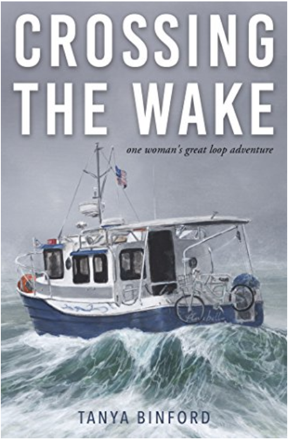
Here’s the book I read first about motoring the Great Loop. I keep looking at that photo and imagining all the salt water corrosion on that poor bicycle.

Crossing the Wake
I read Crossing the Wake: One Woman’s Great Loop Adventure by Tanya Binford, which I reviewed briefly in the first blog post of this series. The only thing I learned from the book was that a barely prepared middle-aged woman could do the trip “solo” in a 25-foot boat. (I put “solo” in quotes because apparently there are so many people doing this trip that it’s common to join up with one or more boats and do lengths of it together.) The book was more of a personal memoir than a useful travelogue because it lacked most of the details a cruiser would need to plan and execute this trip.

Needing — or maybe just wanting? — more detailed information about the trip from Jersey City, where Captain Paul, first mate Dianne, and the Motor Vessel Nano would pick me up, to Chicago, where I’d leave them, I started digging deeper

Waterway Guide

I learned about Waterway Guide at one of the “Lunch and Learn” sessions at AGLCA’s Rendezvous. Lunch and Learn sessions basically give an AGLCA sponsor time in front of members to sell their product. They are informative and can be helpful, especially if they’re selling something you’re interested in. Waterway Guide was definitely something that interested me. It’s an online service that provides a wealth of navigation, marina, anchorage, service center, and points of interest information for east coast waterways, including the entire length of the Great Loop. (They do have a database of west coast marinas and some other services, but it is not maintained anywhere to the level of the east coast information; they apparently focus on the east coast, leaving me to wonder if another organization fills the void out west.) Of course, membership is required to get access to all of the information they have online and, of course, I joined to get that information. (My AGLCA membership got me a discount, which was nice.)
Waterway Guide Online
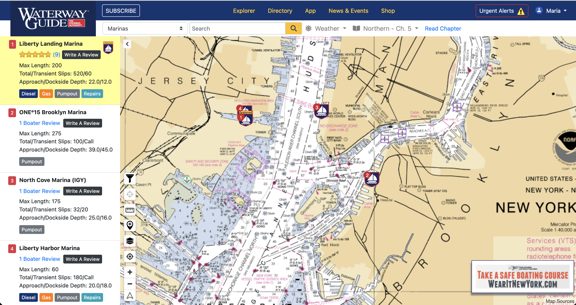
Waterway Guide’s website showing New York Harbor. I love the fact that it displays charts and plots various features on it. Zooming in provides more detail. If I turned on location tracking in my browser, it would put an icon near my position.
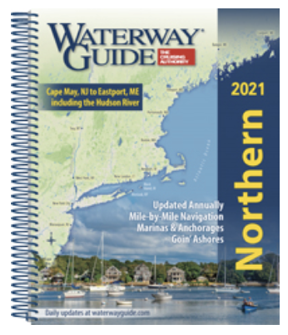
Waterway Guide Cover
The printed Waterway Guides offer detailed information about various east coast waterways.

The membership level I chose also came with two of their printed guides. I chose Northern, which would take me up the Hudson River, and Great Lakes Volume 1, which would take me through the Erie Canal and into Lake Erie. These books, which are revised annually, include all of the information that’s on the website in a handy spiral bound format that’s easy to leave open and consult while traveling. (Sadly, they are not small so I won’t be bringing them with me on the trip; there’s limited space on the Nano. I hope Captain Paul will have his copies with him.)

I have a love-hate relationship with these books. First, I love the amount of detail that’s included. Reading through them makes me want to go ashore and explore every place they talk about. But what drives me nuts is the way the book is organized. Each section is broken down into segments that can be 5 to 25 miles in length. Within each segment are subsections:

  • An overview or notes section discusses the segment of waterway in terms of geography, geology, and points of interest.
  • Navigation tells you more about navigating each part of the segment, including which chart(s) to use. This has some more points of interest information.
  • Dockage/Moorings tells you where you can find marinas or other places to tie up. This information is repeated in chart format for the section.
  • Anchorage suggests places to drop anchor and provides useful information about each place such as how it is protected and whether there is noise.

Sounds great, right? Well, it is and isn’t. The information is great but the presentation isn’t presented logically. For example, in the “Tappan Zee Bridge to Bear Mountain — Mile 27 to Mile 46.7” segment of the Northern guide, the overview takes you through that roughly 20 miles of Hudson River with a separate heading at the end for the Bear Mountain Bridge. Then Dockage/Moorings takes you back from the beginning of that stretch to the end. Then Anchorage takes you back again from the beginning to the end. So there’s a lot of back and forth in a 20-mile stretch of river. What I found, especially in the segments covering the Erie Canal, is that I couldn’t keep track of where a marina or anchorage was without trying to follow along on the online guide, which included charts and icons for many of the things they were talking about.

I think the guide would be a lot easier to follow if the Dockage/Moorings and Anchorage sections were combined and that information was presented together. Or, better yet, combine all information with a much shorter overview. Just take me up the river and tell me what I’ll find along the way without forcing me to go back and forth on a map to see where points of interest, navigation details, marinas/moorings, and anchorages are when moving forward.

I guess what I’m trying to say is that the books could probably use a deep edit to remove repetition and better organize the data. Having more charts/maps and possibly fewer photos would be helpful. As for the photos, I can’t tell you how frustrating it is to see a photo of an interesting or beautiful place that has neither caption nor label to identify where it is.

(Please keep in mind that I spent 20+ years in publishing where I wrote and laid out dozens of books. One of the series I wrote for — Peachpit Press’s Visual QuickStart Guide series — made extensive use of “spreads” where everything you needed to see for a task was either on one page or two facing pages (a spread). I laid out these books, so I know it’s possible to present information in a format that doesn’t require a lot of paging back and forth. It drives me nuts when information could be presented more logically for the reader and isn’t.)

But overall, the books are worth the money — about $50 each — if you need printed detailed information for a trip.

But wait! There’s more! Waterway Guide also has an app, which I downloaded for my iPad.
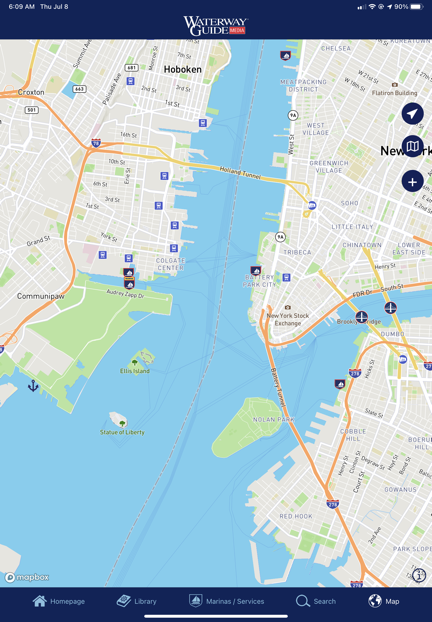
Waterway Guide App
The Waterway Guide app doesn’t even use nautical charts as the base map layer.

So far, I’m not impressed. In order to get the kind of detailed information the printed guide has, you have to subscribe to each chapter — even if you’re a member, logged in, and have already obtained the printed version of the book containing that chapter. I subscribed to the New York Harbor & the East River chapter for $2.99/year to give it a try. The content is the same as what you’d find in the book, including the organizational shortcomings I mentioned above. It’s basically an ebook that you pay for each chapter you want to read using a subscription format that hits you up for another fee every year. (I can only assume the old information becomes inaccessible if you cancel the subscription.) And yes, it does include ads — although I admit I didn’t see many (yet). I’m bummed out because I was hoping it would be an offline version of the website and it falls far short of that. It doesn’t even have real charts. I’d much rather use the web browser in my iPad to access the website, where I have all the information without having to pay more subscription fees.

Skipper Bob’s Guide
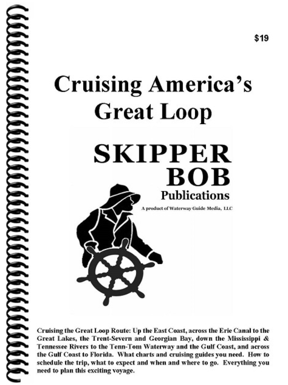
Skipper Bob's Guide
Skipper Bob’s guide, Cruising America’s Great Loop, is an excellent overview of the entire trip.

If you want the “Cliff’s Notes” version of Waterway Guide specifically for the Great Loop, try Cruising America’s Great Loop, a Skipper Bob publication. This $19 book provides 108 pages of information about cruising the Great Loop. It’s a good overview that tells you which charts to use, what you’ll see along the way, and things to watch out for.

My opinion: If you’re considering the Great Loop and want to learn more, start with this book. It really is a good overview to help you decide whether cruising the Great Loop is something you really want to do. It’s also a great visual aide when you’re trying to explain to friends and family members what the Great Loop is all about.

New York State Canal System Cruising Guide
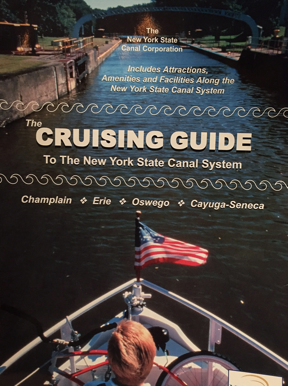
Cruising Guide
I got my copy of the Cruising Guide for free from the New York State Canal Corporation, but I’m not sure how.

I think it was the Skipper Bob book that recommended getting a copy of The Cruising Guide to The New York State Canal System from the New York State Canal Corporation. I tracked it down online where I found a printable (!) order form. I filled it in, sent a check for $29.95, and waited. About two weeks later, I got a thick envelope with a spiral bound book, a bunch of other informative pamphlets and maps, a letter, and my check. The letter informed me that they were no longer accepting payment for the guide; it was free. For the life of me, now I can’t find a link on their website to order the book, but there’s some good navigation info here. I did find the same book on a website that is charging $29.95 for it.

The book breaks down the canal from west to east — the opposite direction I’ll be traveling in August — with charts, photos, and descriptions on full-page sections along the way. (This is the format I wished Waterway Guides would use.) It’s got a LOT of information specific to the canal, inlcuding the amount of time between points and the expected time to lock through each specific lock. It’s easy to see why the book is now free: there are ads throughout. But the ads don’t distract from the content and are strategically placed near where they apply. For example, an ad for a marina will be on the same or facing page as the map where it can be found.

This is a great book that I would definitely bring with me if Captain Paul hadn’t already assured me that he also had a copy and it would be on board.

Quimby’s Guides

The one book I bought that I really regret buying is Quimby’s Cruising Guide. This well-known resource for eastern U.S. boaters is nothing more than a listing of commercial establishments and locks on various inland waterways. While it might have a lot of value for folks doing the entire Great Loop, it didn’t provide any coverage for the area I’d be cruising: the Hudson River, the Erie Canal, and three of the five Great Lakes. I don’t know what made me think it would provide coverage; it’s my own damn fault that I didn’t read the description thoroughly. At $42, it was a costly lesson.

I should mention here that although the information it provides is extremely limited and the book has quite a few ads, I do like the way the information is presented: in order of river mile. There’s no bouncing back and forth in the text to get the big picture. Instead, it’s just a list, by river mile, of the facilities and related contact information.

Summing Up

I think one of the things that has me so excited about my trip is that there’s so much that I can learn along the way. I’m familiar with just a tiny stretch of this trip — from Jersey City to just beyond West Point, where my family took our small motorboat on outings when I was a kid. The rest is new and full of challenges and history. How can that not be exciting?

Preparing for the trip by researching it as much as possible can help me make the most of the journey. I’ll keep reading right up to the day I head east.

A Message for Anti-Vaxxers

It’s simple: vaccines save lives.

While I’ve been blogging about my summer cold, I’ve also been innundated by ads on YouTube, news stories on the web and radio, and Twitter posts practically begging people to get their COVID-19 vaccinations. The fact that people are not doing this blows my mind. Why wouldn’t you get a vaccine that could prevent you from getting a potentially fatal illness?

Apparently there are a lot of folks out there who believe conspiracy theories about the vaccine putting a chip in them, magnetizing their skin, or being “experimental” and, thus, dangerous. (I guess these are the same people dumb enough to believe the earth is flat, we never landed on the moon, and jet contrails are full of mind control chemicals. Does the stupid ever end?)

I’ve got one thing to say to these gullable morons: wake the fuck up.

Vaccines save lives. We no longer have to fear polio, smallpox, measles, and other serious, life-threatening illnesses because of vaccines. This has been proven again and again all over the world.

And to everyone out there who says they’re not getting vaccinated because “COVID is 99% survivable,” understand that there’s a huge difference between having an illness — whether it’s the common cold (which I appear to have), the flu, or COVID-19 — and dying from it.

Sure, there are folks who have gotten COVID and have survived. Lots of them. Maybe even 99% of them.

But are you considering the percentage who have been bedridden for weeks or months due to symptoms? The ones who have lost their jobs because they simply can’t do them anymore? The ones who have been hospitalized and separated from their friends and families? The ones with ventilator tubes painfully inserted into their airways, making it impossible to breathe on their own or even talk or eat? Do you think those folks are glad they weren’t vaccinated even though they survived (or have survived so far)?

Long COVID symptoms
Do you really want these symptoms for months or years? This scares me more than dying. At least when you’re dead you’re not suffering every damn day of your life.

And what about the ones who survived but are still dealing with post-COVID symptoms, including “long COVID” sufferers who still feel weak or achey, suffer from headaches, or can’t taste their food? And those with permanent brain or organ damage?

And what about the ones who survived but infected friends or family members who weren’t so lucky? The ones who have to carry the weight of someone else’s death on their shoulders because they so stupidly believed in conspiracy theories or disregarded science?

Don’t be a statistic like the folks in this Washington Post article:

A coronavirus outbreak at a Florida government building killed two people and hospitalized several others who were unvaccinated against the virus, a county official said.

The Manatee County Administration Building reopened Monday after the virus that causes covid-19 spread throughout the county’s IT department and forced the building to shut down on Friday. Manatee County Administrator Scott Hopes, who is also an epidemiologist, said six unvaccinated employees, including five in the IT department, tested positive for the virus within a two-week period.

The two IT employees who died last week were identified in local media and obituaries as Mary Knight, 58, and Alphonso Cox, 53.

Hopes said that the one IT employee, 23, exposed to the virus who was vaccinated did not get infected.

Do you see a pattern here? I’m sure we’ll be seeing a lot more pieces like this one. Don’t let yourself or a loved one be featured as one of those killed or permanently disabled by their own stupidity — or yours.

Wake up and get vaccinated now.

Flying in a Heat Wave: Safe? Legal?

I explore the logic behind performance charts and what the FAA told me about flying in hot weather.

Upcoming Weather
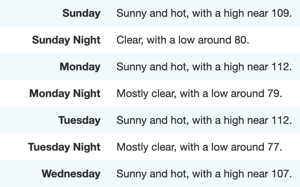
Next week’s weather. It’s going to be hot.

I have a Part 135 check ride coming up on Tuesday. Per the National Weather Service — my primary source of weather information — the forecast high in Wenatchee for that day is 112°F.

If you live in any country other than the metric-unfriendly US, that’s 44.4°C.

IGE Hover Chart
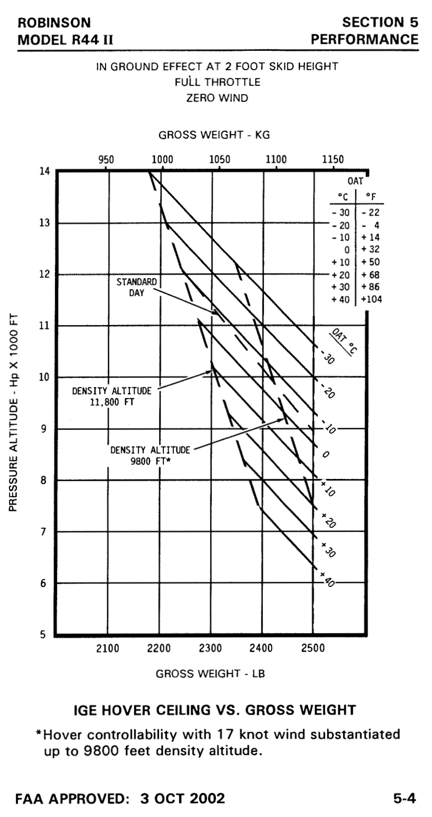
The IGE Hover Chart for an R44 Raven II does not chart any performance data for temperatures above 40°C.

The In Ground Effect (IGE) Hover charts for a Robinson R44 Raven II, which is what I fly, end at 40°C. That is, they do not provide any performance data for 44.4°C.

Now I learned to fly in Arizona and on a typical summer afternoon, 112°F was not uncommon. We flew in all kinds of heat. Hell, I remember landing at Bullhead City one day and reading 123°F on my outside air temperature (OAT) gauge. (And that was in a helicopter without air conditioning.) If the flight school I attended — which is still in business — didn’t fly when it was above 104°F (40°C), they wouldn’t be able to fly half the day about a third of the year. No one questioned whether it was safe or legal. We just did it.

Time went by. Someone suggested to me that flying when the temperature was above 40°C was not only unsafe but illegal. “You’re a test pilot when you do that,” more than a few people have told me. “Your insurance wouldn’t cover you in a crash,” another said, “because you’re operating outside of published data.”

Curious to see what other pilots thought about this, I put a poll on Twitter and gave the Pilots of Twitter 24 hours to respond. I also asked for comments. A lively discussion got going in the comments. It was also pointed out that I could have added “Unsafe but legal” as one of the options with the shared opinion that “the FAA gives you enough rope to hang yourself with.”

I do recall airplanes being grounded at Phoenix Sky Harbor airport one day when temperatures were “too hot” for some of the airliners, although it wasn’t clear from articles I read about how the limit was established.

Well, in an effort to head off a “gotcha” by my FAA examiner, I emailed him this morning to warn him of the heat:

A quick heads up.

We’re expecting high temperatures of 112°F on Tuesday. If you are of the school of thought that says we can’t fly when temperatures exceed 104°F because that’s the highest temperature on performance charts, we should probably plan to fly very early, before the temperature tops out. …

If you’re not of that school of thought — I learned to fly in Arizona so I’m not — we should be fine. The helicopter does have air conditioning, although I’ve never tested it in 112°F weather.

Please let me know what time you plan to arrive.

He replied, in part:

I am unaware of a temperature limitation that restricts operations of the R-44. We can complete the ground during the afternoon of the 28th so we can fly on the morning of the 29th to minimize the effects of the heat. …

So that’s telling me that it’s legal. (But he’s not taking any chances or doesn’t want to test my air conditioning.)

Never Exceed Speed
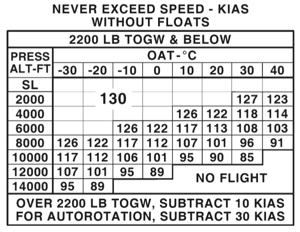
Here’s a limitations chart: Never Exceed Speed. If I extrapolated, I think operations at lower elevations would be fine, but I certainly wouldn’t exceed about 85 knots 44°C at 8000 feet. (Heck, the helicopter would be vibrating like crazy at that speed and elevation anyway.)

Is it safe? Well, as this “test pilot” could tell you, if you extrapolate the data in the charts, keeping in mind the aircraft’s gross weight and the altitude you would be operating at, it can be. Keep the aircraft light, don’t plan any high altitude landings, and keep your speed down.

Chances are, the helicopter will continue to operate in heat that you won’t want to be flying in anyway.

A Footnote about My Cold on Day 5

A theory on how I got it.

I blogged about the cold I’ve been dealing with since Friday afternoon here. It’s now Wednesday morning and I’ve still got symptoms.

Yesterday, I got a call from one of the pilots who’s been working with me on cherry drying for the past bunch of years, Gary. Gary had arrived on Tuesday with his RV and, on Wednesday, after two of his pilots arrived with the helicopter, we all went out to lunch at a local restaurant called McGlinn’s Public House. McGlinn’s has indoor and outdoor seating, but since the outdoor seating was all taken and we were all vaccinated, we settled on indoor seating in the sparsely furnished bar area.

Temperature
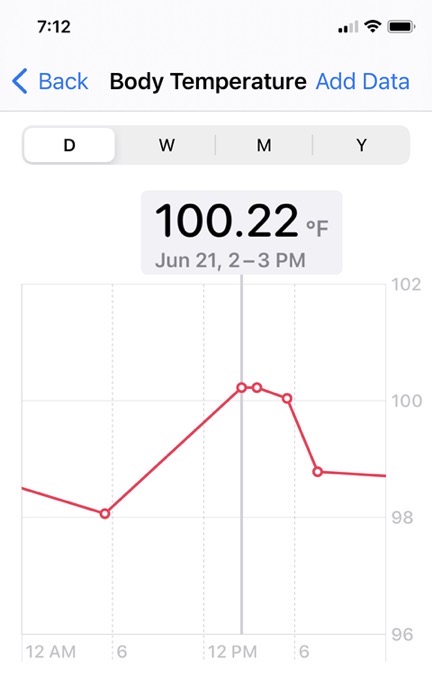
Who knew? Each time I took my temperature with my Kinsa thermometer, it was sending the reading to my iPhone where it synced with Apple’s Health app. Since my “normal” temperature is in the 97s, you may be able to imagine how I felt at 100.2° on Monday. I’m in the low 98s today.

Mask use has always been a little iffy on this red side of a blue state and I can’t say I saw any masks in the restaurant. Of course, it is a restaurant where people eat and it’s impossible to eat with a mask on so I wasn’t really surprised.

Gary, his crew, and I were together briefly again on Thursday when I showed them a parking spot for Gary’s RV. And I was with Gary again briefly on Friday when we ran into town in his truck to pick up a few things at the store. I didn’t wear a mask at all during this time.

Fast forward to the call from Gary yesterday (Tuesday). He began by apologizing for “disappearing.” “I’ve been sick as a dog all weekend,” he told me.

“Me, too!” I exclaimed. We then went on to compare symptoms. He seemed to have more pain than I did and I seemed to have more coughing than he did but otherwise we had pretty much the same thing. Together, we stepped backward to the places we’d been and the timing was just right for mutual exposure at McGlinn’s.

Later, he spoke to the two pilots who had been with us. Both of them were at least 20 years younger than us — hearty young guys who might be able to fight a bug better than we could. Neither were sick. But still. It was too much to be a coincidence.

I then began wondering how I could be hit so hard by something that wasn’t COVID when I really didn’t get sick that often at all. And then I realized that it might have something to do with my isolation over the past year or so. I live a pretty solitary existence, but I would normally go out and about, maskless, at least a few times a week. Over the past year, however, I’d been out a lot less frequently and had been wearing a mask among strangers almost all the time. Could that have weakened my immune system? Could not exposing myself to miscellaneous germs in the natural course of my day have put my immune system on vacation?

Sure seems that way. Numerous news stories, including this one on PBS Newshour, report exactly that:

A curious thing happened during the COVID-19 pandemic: With masks, social distancing, and Purell galore, we kept most other germs at bay.

Flu vanished. Cases of respiratory syncytial virus, or RSV, which in a normal winter puts nearly 60,000 children under age 5 in the hospital, were nonexistent. Most of us appeared to sidestep the soup of bugs that cause colds.

But as masks come off, schools reopen, and some travel resumes, we should expect a resurgence of these viruses — perhaps a big one. Some experts fear we’re in for a nasty cold-and-flu season or two, pointing to a combination of factors that could make for a rough re-entry to the mixed microbes world.

There’s more, of course. I encourage you to read the whole piece.

I seem to be living proof of this. After more than a year of protecting myself, I dropped my guard and, less than a week later, I’m sick with a bad cold I can’t seem to shake.

Would I have gotten this sick if I hadn’t been wearing a mask the whole time? I don’t know. I do know that I could have been sicker — possibly with COVID — so don’t for a minute regret my caution.

What I do regret, however, is dropping my guard as if the health risk is over. Clearly, it’s not.

Getting Past a Cold

Is it my age or a weakened immune system?

I’m just starting to recover from a cold that pretty much knocked me completely out of commission for the past three full days. Even today, I’m feeling it, but at least I’m starting to feel somewhat better — or at least good enough to take a shower, do some light household chores, and take care of sending orders out to Etsy customers.

I started feeling it on Friday afternoon, after yet another full day doing things around the house and yard and helping one of my contract pilots settle in for his five week stay nearby. Really feeling tired and run down. I was supposed to visit with a friend at the local winery but cancelled. I needed to rest.

The Lead Up

Let me take a few steps back. The previous weekend had been super stressful for me. I’d signed up to sell my jewelry at a festival in Wenatchee that was originally supposed to be held in early May, long before cherry season. It had been postponed to June. There was rain in the forecast and two of my clients had pushed their start dates up a week earlier. I was short a pilot because a guy had cancelled two weeks before his start date and I hadn’t been able to find someone to replace him. One of my pilots was brand new and had never dried before.

I flew on Saturday morning at 4:30 AM, then spent the day sitting in my jewelry booth, trying not to worry about the weather. The weather for Sunday looked so bad that I packed up my booth a day early, risking the ire of festival management for the sake of my sanity. Another night with four hours of sleep led to a beautiful day — until around 7 PM when the thunderstorms rolled in and frantic clients started calling. I still can’t believe we tried to dry cherry trees in that wind with t-storms in the area. We wound up landing to wait it out — one of us in an orchard and two of us on a building site adjacent to one of the orchards. When the storms passed, we each dried an orchard block before landing. It was nearly dark.

Up at 3 AM the next morning. Rain and sun on and off all day. The drying conditions were much better, but we flew a lot. One of the pilots and I even launched at 8:40 PM to cover an orchard in Quincy. Although we didn’t finish, we gave it our best effort. It was dark when we got back.

The LZ
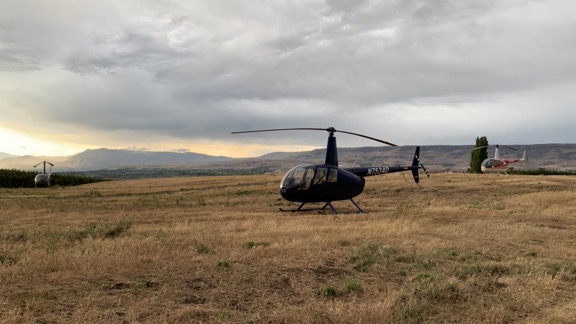
Here are our helicopters in the LZ on Monday evening. We were waiting for more rain and actually did get called out one more time after this.

Up at 3 AM again the next morning. Called out to dry that Quincy orchard again. Then a meeting with the FAA to inspect my helicopter. (Don’t ask; even I don’t understand why they sent two guys in two separate cars all the way from Spokane.) Then helping settle a pilot in and trying to catch up with the work I’d been neglecting all weekend.

I tried to sleep in every morning for the rest of the week. I really did. But my body clock wanted me out of bed before 4 AM. And I had things to do, so I didn’t argue. Occasionally, I found time for a nap in the afternoon.

And that brings me to the end of the week, when I was physically exhausted and starting to feel a cold coming on.

The Symptoms Multiply

The next morning, Saturday, I was a mess. Sore throat, dry cough. Aches all over. Flu-like symptoms.

I immediately thought the worst: COVID. Sure, I’m vaccinated, but the Johnson & Johnson vaccine isn’t at the top of anyone’s list of vaccine choices. I got it because that’s what was available. None of the vaccines are 100% effective, after all, and I’d spent way too much time in public, eating in restaurants with my pilots and shopping without a mask in a mostly maskless environment. There are just enough wackos out here who think the virus is a hoax — did I mention that I live on the red side of this blue state? — or don’t believe in vaccines. Or — heaven help us — that Bill Gates is putting microchips in the vaccine to track us. Do you think those people will be wearing masks when no one is checking to see if they’ve been vaccinated?

I tried to get sign up info for COVID testing at the local health care place, Confluence Health. Although their drive-up facility was still set up, you needed a doctor’s order to get the test. And it looked as if they might be charging a fee for it — $200+? — which doesn’t surprise me, given that they recently charged me $240 to talk to a doctor for 7 minutes about my arthritis, which she couldn’t do anything to help.

Walgreens had free drive up testing. I’d used one of their locations in Arizona with a friend back on Super Bowl Sunday so I was familiar with how it worked. Of course, the test wasn’t available that day. I’d have to come back on Sunday. I made my appointment.

I spent the day eating and sleeping and reading. Eating because warm or cold food going down my throat really felt good. Sleeping because I had no energy. Reading because I had to do something while I was awake.

My dogs were surprisingly understanding about all this. They slept near me on my bed or the sofa or the reading chair in my living room. They didn’t seem to need to go out very much, which was fine with me.

Sleeping Pups
My pups slept even more than I did, which is difficult to believe, considering how much I slept.

On Guard
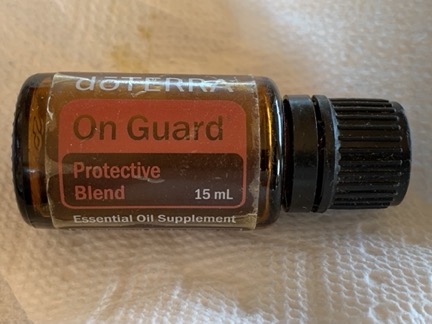
I’m not a believer in “essential oils” as remedy, although I do have other versions of dōTERRA products because I like the way they smell. I don’t ingest any of them, though.

My neighbor brought me chicken soup, zinc tablets, and some sort of “essential oil supplement” that she used when she had a cold. “Put a drop on your tongue.” She demonstrated by putting a drop on her finger and then putting it on her tongue. “It doesn’t even taste that bad,” she told me. It reeked of cloves, which isn’t a horrible smell, but not something I wanted in my mouth. I read the label. “For aromatic or topical use,” it says. Needless to say, I did not put any on my tongue.

I did have a few zinc tablets, though. Why not? And the soup was good.

I took my temperature and was shocked to see it at 99.1°F. “Normal” for me is in the 97s, so this was a legitimate fever for me. I never get fevers. I was already taking ibuprofen for the pain; I added aspirin for the fever.

Before bed, I took a nighttime cold remedy, hoping it would knock me out. I slept restlessly most of the night, prompting one of my dogs to sleep on the sofa.

Sunday was more of the same, although my nose was starting to get into the act.

I went to Walgreens at the pre-determined time and got the kit at the drive up. But I made the mistake of giving my nose a good blow before using the swab. As a result, there was a drop of blood on the swap and the girl on the other side of the plexiglass said she couldn’t use it. Same result on the second swab. “You get one more try,” she told me, sending over a third swab. I swabbed gingerly in one nostril, as instructed, and got a blood-free result. But did it have enough snot on it to conduct the test?

I got the result by email 30 minutes later. Negative.

But did the swab have enough snot on it to conduct the test?

I may never know.

I went home and slept the afternoon away. I took my temperature a few times. I reached a high of 101°F. I felt like total crap. Even ice cream didn’t help. I had to sleep sitting up to prevent the drip at the back of my nose from aggravating my throat.

By Monday (yesterday) morning, my nose was all in. I’ve had worse runny noses — usually allergy related — but this was bad enough to keep a tissue box close at hand. At the same time, my cough had gotten worse and was now producing a thick, yellow mucus. Every time I coughed some up, I figured I was done — there couldn’t possibly be any more in there. But there was.

I napped in the morning and spent the afternoon watching a variety of weird content on YouTube. I learned how women in 18th century Europe dressed. I learned how a volcanic eruption in Indonesia in 1815 killed likely over a million people worldwide by changing global weather for a year. I watched the entire final season of The Clone Wars animated TV show on Disney+.

Hydration Multiplier
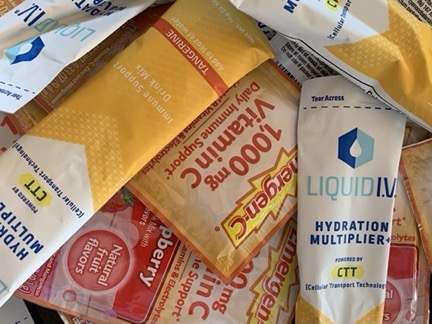
Here’s what my neighbor brought over. I actually have used EmergenC in the past and had a dose of it this morning, too.

Another neighbor came by with “hydration multiplier” packets. This is apparently a substance you can use to turn water into something like Gatorade. I had been drinking a ton of water, tea, and orange juice. I didn’t really see the need to put chemicals — including salt — into what I was drinking. But I really do have to thank my neighbors for being so caring and trying to help.

The End is Near

I slept sitting up again last night with a nighttime cold remedy to help me sleep better. It seemed to work. I slept well — right until Rosie decided I needed to wake up and came over to stand on me. It was after 5 AM — the latest I’d slept in over two weeks.

I felt a little better, too. I had my coffee in bed, then made some cream of wheat with honey and applesauce for breakfast. It sure did feel good going down my (still) sore throat. I coughed up some more yellow mucus. I took a shower and put on clean clothes. I started this blog post.

I have a few non-strenuous things to do today in my jewelry shop before making a trip to the post office and a neighbor’s house to drop off eggs. Then I’ll keep resting up. I’ve learned (the hard way) that you can’t rush a cold’s recovery.

At this point, I just hope I’m back to at least 90% by Friday. And, for once, I’m glad there’s no rain in the forecast.