
Perfect conditions, except for the cold.
It was a photo flight that brought me to Page and Lake Powell on my annual trip from Wickenburg, AZ to Seattle, WA for cherry drying season. Although I usually depart Arizona mid-May, when this flight came up, I figured I’d use it as a springboard to start my trip. Rather than return to Arizona, I’d use the ferry fees to take me two hours closer to Seattle. Not exactly a direct trip — it would likely add at least an hour to my total flight time — but it was something.
I flew to Lake Powell on Thursday afternoon so I could be ready for the photo flight at 6 AM on Friday. I planned to spend Friday night in Page as well, since our second flight of the day was scheduled for 6 PM.
So at 5:30 AM, I was at the airport, preflighting the helicopter. It was already light; the sun rose while I was working. There was a thin layer of clouds to the east and it filtered the sun, softening the light. Exactly the kind of light my best Lake Powell photo client likes.
Fifteen minutes later, I was waiting in my rented car in front of the terminal. I own a hangar at Page — it’s for sale if anyone’s interested — so I have a key card to get onto the ramp. I figured I’d pick up my passengers in front and drive them out to the helicopter. I’d then leave the car out there until we got back.
My passengers were on time. The photographer was a big guy, weighing in at 240 pounds. His wife was much smaller and thinner; only 130 pounds. We said our introductions and I drove them out to the helicopter. I pulled the front passenger door off and put it in the trunk of the car. Then I gave them a safety briefing and handed out the life jackets. (I always make my passengers wear life jackets over the lake.) They were Russian — it seems that most of my Lake Powell photo clients are — but they spoke English well. I don’t speak any Russian.
It took a while to warm up. The temperature had dropped down near freezing overnight. But by 6 AM sharp, I was pulling pitch and taking off. We climbed out and I turned uplake.
That’s when I realized that my photographer client had no idea where he wanted to go. He told me to take him to places that I knew were good. Places I’d taken other photographers. And Rainbow Bridge.
 So we did a quick circuit around Gunsite Butte and Alstrom Point, then hustled up the lake toward Rainbow Bridge. Although the forecast had called for 50% overcast and morning winds up to 10 MPH, the sun was bright but filtered and the wind was not an issue at all. Flying toward the sun, the views weren’t very good, but glances to the left or right as I turned showed stunning morning views of the lake and red rock cliffs. My client didn’t provide much instruction, so I didn’t waste his time by being a tour guide. (Note that this photo and all the others that appear in this post were taken at other times; I can’t take pictures while I’m flying with clients aboard.)
I should mention here that it was bitter cold. With my heat not functioning — it had triggered a carbon monoxide warning the day before — and a door off, the cold morning air rushed in. I had a hat, scarf, and three layers of long sleeves on, but no gloves. My client was out in it. His wife sat behind me and didn’t say much, so I don’t know how she was taking the cold. But I figured that Russians were probably a lot more accustomed to cold weather than thin-blooded Arizonans.
 We had a bit of a tense time when my client asked me to fly lower near Rainbow Bridge. The problem is, Rainbow Bridge is at the bottom of a narrow canyon. I know that I can get down to 5,000 feet MSL safely, so that’s what I always shoot for. He wanted me lower. That would bring me very close to a canyon wall. When I pointed that out, he backed down. I think he may have been spooked. But I gave him a good look at the bridge and was satisfied to hear his camera clicking right through his microphone.
Afterwards, he told me he wanted to go into a canyon he’d seen on the way up. But we were so close to Reflection Canyon, which everyone loves, that I asked if I could take him there. It added about 10 minutes total to the flight. He seemed happy with what we saw. The light was breaking through the clouds by then and although it was still soft, it was brining out the colors of the lake and the rocks.
We headed downlake and I reminded him several times that all he had to do was direct me and I’d fly wherever he wanted me to. We went into Wetherall Canyon on the south side of the lake, but he turned me around after only a few minutes. Then back to the main channel. Another side trip up Rock Creek’s main branch and back. Then another trip up Last Chance Bay and back. And some time over Padre Bay. There was a lot to see and the light was good, but he didn’t direct me to do much. I just flew, trying to enjoy myself, trying not to worry about my client not getting his money’s worth because he didn’t tell me where to fly.
 He asked me to take him to Horseshoe Bend and I headed out that way. I purposely swung past the Glen Canyon Dam, putting it on his side of the aircraft so he could take photos. I heard his camera snap. Then I climbed — Horseshoe Bend is best seen from at least 6,000 feet — and headed downriver. A few minutes later, I pointed out Horseshoe Bend and began making a climbing circle to the left around it. I was about 270° into it when he told me we were done.
I dumped the collective and started a steep descent, banking east toward the airport. I landed on the taxiway as a National Park Service patrol plane took off.
Here’s a look at our route on the official Park Service map:

My client jumped out while I was cooling down the engine. He snapped a few pictures of the aircraft as his wife got out and joined him. Then I shut down, got the blades stopped, and climbed out. We’d flown 1.3 hours.
I brought them back to the front of the terminal. My client told me that he was going to cancel the evening flight — it was just too cold. I was shocked. He’d paid me for 5.3 hours of flight time but had only been airborne for 1.3 of those hours. A second flight would cost more, but it would also help spread the cost of the ferry time and help him get his money’s worth.
But who was I to argue? The wind was supposed to kick up later in the day and I wasn’t eager to be out over the lake with the wind howling around the canyons.
So at 8 AM, I was done for the day.
Two hours later, I was heading toward Bryce Canyon. But that’s another story.
 I climbed steadily at about 200-300 feet per minute, gaining altitude slowly to clear the 5,000 foot Weaver Mountains ahead of me. Below me, I could see the scars the near-bankrupt developers had left on the desert where Routes 93 and 89 split off. Greed had scraped the desert clean, built a golf course, and then let the grass wither and die. Where there was once pristine rolling hills studded with cacti and small desert trees, there was now flattened dirt, void of vegetation, shaped by bulldozers and men. A dust bowl on windy days covering hundreds of acres of Sonoran desert.
 The weather up ahead gave me a good idea of what I’d be facing for much of the trip: a never-ending series of isolated rain and snow showers. They appeared as low clouds with hanging tendrils of wispy precipitation. But unlike the gray rains hanging below summer rainclouds, these were white, making me wonder whether I was looking at rain or snow. With outside air temperature around 4°C (40°F), it could have been either. Or something worse; damaging hail or icy sleet.
 Near the Drake VOR, I detoured more to the east to avoid a rapidly approaching shower. Raindrops fell on my cockpit bubble and the 110 wind of my airspeed whisked them away. The sky was clearer ahead of me, although the tops of Bill Williams Mountain was still shrouded in clouds. The Prescott (KPRC) ATIS reported mountain obscuration and snow showers to the north, east, and west. I couldn’t see the San Francisco Peaks, which were likely getting more snow to extend the skiing season at the Snow Bowl.
 Then I was back out in the sun — a good thing, since the outside temperature had dropped to just over freezing and my cabin heat wasn’t able to keep up with the cold. I climbed up the Mongollon Rim just west of Bill Williams Mountain, trading high desert scrub for ponderosa pines. The mountain had recently been dusted with fresh snow. That didn’t surprise me; only three hours before, the airport at Williams (KCMR) had been reporting 1/4 mile visibility.
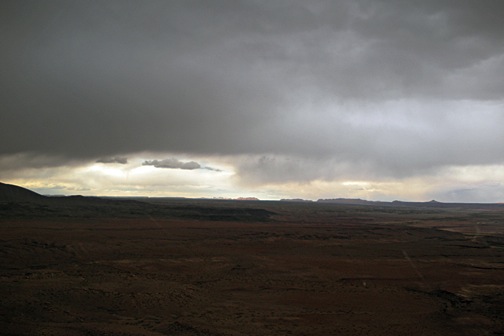 I passed through the rain and emerged on the other side with a clean cockpit bubble and likely very clean rotor blades. Ahead of me, now due north again, the sky was brighter and I could clearly see the Echo Cliffs. Before entering the storm, I’d punched Tuba City (T03) into my GPS to keep my bearings; now I punched in Page (KPGA) and was pleased to see that I was already right on course. I aimed for The Gap, a small town at the gap in the cliffs, right on Route 89, adjusted power to maximize speed, and sped forward, 500 feet off the high desert floor.
 I crossed Highway 89 at The Gap and flew through the gap in the Echo Cliffs. I was now about 45 miles from Page, flying among three sets of high tension power lines that stretched from the Navajo Generating Station on Lake Powell to points south. There was a dirt road here that made a short cut to page — if you didn’t mind driving more than 40 miles on a dirt road. Navajo homesteads were scattered about. The sky was a mixture of clouds and patches of deep blue. I warmed in the sunny spots and cooled in the shadows.


