So You Want to be a Helicopter Pilot, Part 1: Read This First

Read up; this will tell you everything you need to know.

I’ve been blogging since 2003 and have been writing about my experiences as a helicopter pilot since the very start. A lot of what I’ve written covers the commercial side of flying helicopters — flying for hire. I’ve also written about the helicopter job market; that post, now about three years old, remains one of the most-read posts on this blog, with dozens of comments that help make it even more valuable for blog readers.

Along the way, I’ve been accused of “shooting people down,” “destroying people’s dreams,” etc., ad nauseam. That is not my purpose. I like to see people achieve their dreams, but I am a realist. I believe that people can achieve their dreams if they work hard and smart and do the right things to make it happen.

Captain MariaAfter all, I did it. I’m a woman (which, sadly, does matter in this particular field) from a middle-class family with absolutely no aviation background. I waited until I was in my late 30s to start flight training, doing it more as a hobby than a career change. I covered the cost of training to get my private and then commercial ratings. When I realized I was hooked, I set a goal of flying helicopters at the Grand Canyon. I achieved that goal in 2004, working as a seasonal pilot for one of the tour operators there. Now my goal is to get a job as an ENG or movie pilot. I’m working on that and believe I can achieve it.

But what are the right things to do if you want to build a career as a helicopter pilot? That’s what this multi-part post will attempt to address.

Who Needs to Read This

If you are a man or woman at least 16 years old with a serious desire to become a helicopter pilot, this post might be for you. Answer these questions honestly:

I want to become a helicopter pilot because:
(A) I love to fly and want to do it as much as I can.
(B) I think helicopters are cool and being a helicopter pilot would really impress my friends.
(C) I want a job earning $80K or more a year.

I’m sure I can fly a helicopter because:
(A) Well, I’m not really sure, but I think a good instructor can teach me.
(B) I can fly helicopters on my flight simulator.
(C) It looks pretty easy.

The most important thing to learn about flying helicopters is:
(A) It’s all important, from basic maneuvers to FAA regulations.
(B) Being able to do autorotations.
(C) Knowing how to fly like the pilots in the movies.

Helicopters are:
(A) Utility aircraft designed to perform missions that airplanes can’t.
(B) Like airplanes but without wings.
(C) Built for fun.

If you knew that the “right” answer to each of these question was A, there’s definitely hope for you. You might have the right attitude to be a helicopter pilot. And that’s important because, as I’ll discuss, attitude is vital to success.

If you honestly picked B or C for any of the answers, you need to think a bit harder about a career as a helicopter pilot. You likely have some misconceptions about what flying helicopters is all about. Why not stop by your local medevac base or helicopter charter company office and chat with some of the professional pilots there? Don’t chat with folks at a flight school — they’ll simply tell you anything you want to hear. Talk to the folks who are actually flying helicopters for a living. They’ll give you the facts and set you straight.

Who Doesn’t Need to Read This

This post is for people who want to build a career as a helicopter pilot. In other words, they want to fly helicopters for a living.

If you just want to learn to fly helicopters — as a hobby or just another skill — you don’t need this advice. Just go find a flight school and sign up. That’s what I did. I never intended to fly professionally. I just got hooked and then needed to be paid to fly in order to keep flying.

If you’re thinking about flying helicopters for a hobby, be aware that it is a very expensive hobby. It’ll cost about $10K to get your private helicopter pilot certificate. Flight time in the cheapest helicopter you can find will cost at least $180/hour and likely much more. Ownership is even more expensive — especially if you don’t fly more than 100 or so hours a year. Even home-built helicopters are costly to acquire and operate.

I’m not trying to talk you out of it — I’m just pointing out the facts. I know quite a few private helicopter pilots, most of whom own their own helicopters. They’re all rich guys. All of them. I am the poor kid on the block; I need paying passengers to fly.

And if you’re interested in helicopter ownership, be sure to read this.

The Advice

In the next part of this series, I’ll start providing my advice. While you might be tempted to skip one or more of the parts, don’t. Every single one will provide vital information you’ll need to succeed. Read them all; post your questions as comments on the appropriate post. I’d love to see a good discussion start — something that’ll really help you and others achieve your goals.

Oh, and by the way. I think the information you’ll find here applies to getting started in a career as any kind of pilot — even fixed wing.

Strangers Know My Name

And that’s kind of spooky.

The other day, on my flight from Page, AZ (PGA) to Phoenix Deer Valley Airport (DVT), an odd thing happened. I was about 12 miles out, coming down through the mountains near New River on the east side of I-17 when I caught sight of a low-flying aircraft ahead of me. The tiny dot in the distance moved left to right in front of my flight path at about my altitude. When it made a sharp turn, I knew it was a helicopter.

I was tuned into the helicopter air-to-air frequency, 123.025, and keyed my mic. “Helicopter over New River, are you on frequency?”

Nothing. Repeating this call twice also brought no response. In the meantime, it appeared that the helicopter was circling in that area. It couldn’t be a media helicopter; they monitor the helicopter frequency. Who was it, what were they doing, and — most important — did they see me?

I started to climb. That in itself was odd. Normally, when I see traffic in my vicinity, I descend to avoid it. But this guy seemed as if he were looking at something on the ground. As he moved from right to left, I veered off a bit to the right, planning to either pass behind him or into his view if he turned again.

I had the helicopter’s nosecam running and just inspected the video. It reminds me that I was flying into the low-lying winter sun for most of the flight; this clip was from about 11:30 AM. The other helicopter is almost impossible to see because of the wide angle lens exaggerating distances, but as the video progresses, I can clearly the the flash its blades as the sunlight reflects off them at certain bank angles. Here’s a capture from the movie with an inset blowup of one of those flashes; he was 2-3 miles away at this point:

Traffic

He didn’t turn. He continued to the left, eastbound, out of my path of flight. I resumed normal navigation, keeping an eye on him to make sure he didn’t come back. He didn’t. Instead, he began heading south about a mile east of me, slightly higher. I could see from the shape of his helicopter that he wasn’t flying a Robinson or a Hughes. It could have been a JetRanger.

Meanwhile, I was nearing Deer Valley and had listened to the ATIS on my second radio. I was about 7 miles out and ready to call in when another helicopter called in, using the same position report I’d use: “7 miles north.” Unless there was another helicopter right behind me, it had to be the guy I’d been watching. He was going to the north hangars, which is a huge group of hangars on the northeast side of the runways. The tower responded, telling him to report a mile out.

I called in immediately with basically the same call but to the Atlantic ramp, which is on the south side of the runways. I added: “I have the other helicopter in sight.” I was told to report a mile north and expect a midfield crossing at 2,000 feet. The usual.

The tower frequency was unusually quiet, but the controller did talk to one or two other pilots. Then the other helicopter came on. “Helicopter 1-2-3 (I can’t remember its real tail number and wouldn’t use it anyway) is just crossing Carefree Highway.” There was a pause and then he added, “Maria.”

He was talking to me. On the tower frequency. Creepy.

A little surprised, I spoke up, “Helicopter Zero-Mike-Lima has you in sight.” What I later realized is that he still didn’t see me and was trying to get me to tell him where I was in relation to him. I should have added, “I’m at your two o’clock low,” which is where I was, still at least a half mile away. But I was a bit frazzled by a stranger speaking to me directly, by name, on the tower frequency.

Hell, wouldn’t you be?

But was he a stranger? Maybe I did know him. But I couldn’t think of anyone I knew who owned a helicopter like that. If he’d been landing on the south side, it could have been a media or medevac helicopter and then I might know the pilot, but he wasn’t. He was landing at the rental hangars on the north. That meant his helicopter was likely privately owned or he was visiting someone up there. Who was it? Beats me.

A minute or two later, he called again, “Deer Valley Tower, Helicopter 1-2-3 has the red Robbie in sight.”

(Why does it bug me just a tiny bit when other helicopter pilots refer to Robinsons as Robbies?)

Then I was making my call a mile out and getting instructions to cross midfield at 2,000 feet. I was making my spiraling descent on the other side of the runway when the other helicopter reported a mile out and got his instructions to land.

And that was the last I heard from him.

Of course, all this reminds me that the helicopter community is a small world where most folks know most other folks. Of all the helicopter pilots out there, how many are women? Likely 5% or less. Of all the female helicopter pilots, how many are flying red Robinson R44 helicopters in the Phoenix area? Probably just one: me.

And it’s a lot easier to remember the name of the one oddball in the pack than every other pilot out there.

I just wish I knew who was flying the other helicopter.

On “Aspiring” Helicopter Pilots

Get a clue.

Earlier this week, I pulled together clips from a two-hour flight between Phoenix and Page, AZ and made it into an eight-minute video set to some solo piano music. It’s not a masterpiece of video editing — hell, that isn’t what I do. It was just a way to create some fresh marketing material for Flying M Air using what I thought was some pretty awesome video footage from my flight.

I blogged about the trip and embedded the video here.

A Tiny Bit More about the Video

I need to make a few points about this video before I start my rant:

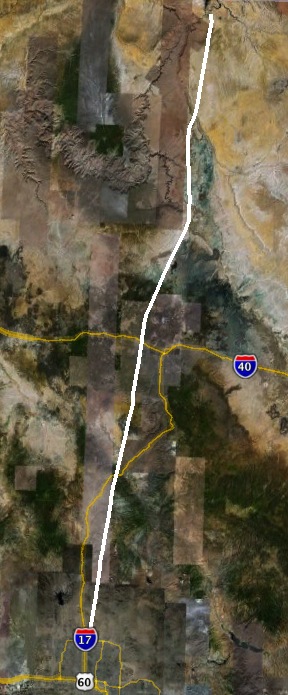
  • Route to PageThe purpose of the flight was not to make the video. The purpose of the flight was to get from Phoenix to Page as quickly as possible. My clients paid for two hours of flight time; every minute past that was being paid for out of my pocket. I flew nearly a straight line, as shown in this Google Earth plot created from actual GPS points. (I sometimes run a geologger while I fly; I happened to have it running that day.)
  • The primary purpose of the video was as a marketing tool. I had good, smooth footage of places I often fly. The lighting for some of the flight was excellent. The footage was representative of what a client might see while flying with me. Why not turn it into a marketing video?
  • The only footage in the entire video that I considered not including were the low flight clips over the Navajo reservation, including the clip where I fly between two buttes. The reason: it is not representative of what a client might experience when flying with me. Why? Because my Part 135 certificate requires me to maintain minimum altitudes of 300 feet AGL with passengers on board during a Part 135 flight. Coincidentally, this footage also documented some of the more exciting portions of the flight — 110 knots at low level isn’t exactly dull when you’re experiencing it.
  • The overall tone of the video is peaceful and serene. I was showing off beautiful scenery that floated by beneath us. The music seemed to work with it.

I shared the video on this blog (as mentioned earlier) and linked to it in a few places, including a social networking site for helicopter pilots. I got a lot of positive feedback that made me feel good.

Enter, the “Aspiring Pilot”

On the helicopter site, a lot of pilots complemented me. A few asked questions, which I answered. And then Dan (not his real name) commented:

I’ll still look like a little jerk, but god that that flight is boring. I dare not imagine the other 112 minutes. A helicopter is made for fun, caution kills the fun !!

I was immediately taken aback. I never intended the video to be exciting. Hell, if I made it too exciting, it would have raised all kinds of red flags with my contacts at the FAA. It was just a marketing video.

And then I started thinking about what the little jerk — hey, it was his self-applied label — had just said: “caution kills the fun!!” What kind of pilot would say such a thing?

I checked out his profile and it became clear. He was an “aspiring pilot.” In other words, he wasn’t a pilot at all.

Instead, he was an immature, idiotic wannabe.

I knew the type. They think flying helicopters is cool, mostly because of what they’ve seen in the movies. (I assume not the scenes where the helicopter explodes.) They’ve never been at the controls of a helicopter, they’ve never read anything about helicopter aerodynamics or maneuvers. They don’t know the first thing about flying helicopters. Maybe they’ve never even been close enough to a helicopter to touch it — let alone sit in one.

But they’re experts!

A helicopter is made for fun, caution kills the fun!!

They hang around helicopter forums, trying to fit in, trying to make cool comments that’ll score points with people they see as their peers. Instead, they just spout inane bullshit:

A helicopter is made for fun, caution kills the fun!!

The helicopter forums are full of little jerks like this — which is why you won’t find me on the helicopter forums. I have no patience for the kind of crap put out by wannabe helicopter pilots who haven’t got a clue about flying helicopters.

A helicopter is made for fun, caution kills the fun!!

Attention “aspiring pilots”: a helicopter is not “made for fun.” It’s a utility aircraft that can perform maneuvers and operate in situations impossible for an airplane. It is a complex piece of machinery. It takes real skill and knowledge to fly.

A lot more skill and knowledge than you’ll get playing with your Flight Simulator.

And caution? Well, that’s what keeps you alive so you can fly again tomorrow. It’s also what keeps your passengers alive so they can tell their friends about how great it was. It keeps your helicopter in one piece so its owner doesn’t take a huge financial hit. It keeps the FAA off your back so you keep your license. That’s what caution does.

Flying helicopters is serious business. It isn’t a game. Any pilot who doesn’t take flying seriously is a pilot I don’t want to see at the controls of an aircraft.

Wanna Be a Pilot?

Stop pretending and start studying.

And shut the hell up until you know what you’re talking about.

Phoenix to Lake Powell by Helicopter

Again, but this time with video.

The initial call about the January photo gig at Lake Powell came in December through one of my Russian connections. Apparently, two Russian businessmen who were attending the Consumer Electronics Show (CES) in Las Vegas wanted to photograph the Lake Powell area from the air. They were willing to pay me to fly up to Lake Powell from Phoenix and make at least two flights totaling 3 to 5 hours.

Trips like this are extremely costly — after all, the client has to pay for 4 hours of flight time just to get me up there and back — and I honestly didn’t expect it to happen. But a week before the chosen dates — January 12-13 — I got the green light and the all-important credit card number I needed to get paid for that 4 hour repositioning flight plus a standard overnight fee to cover my expenses and compensate me for my time away from home.

The Gig

Weight and BalanceI admit I wasn’t looking forward to the gig. The two photographers claimed to weigh 242 pounds (converted from kilos) and I knew they likely weighed more fully dressed and carrying camera equipment. I calculated the weight and balance as soon as I had this information and discovered that I’d have to strip all non-essential equipment out of the helicopter to lighten it up so we could take enough fuel for 2 hour flight segments (plus FAA-required reserves). Anything that was left on board would have to be shifted from under my seat to under the seat behind me, just to shift weight backwards. Having two fatties — yes, including me — up front would make us front-heavy. Having two fatties on the left side would make us heavy on that side. But even after adding 15 pounds of weight for each of them, I confirmed that’d be in balance with 2/3 fuel or less on board.

The other thing that bothered me was weather. Page, AZ was having unseasonably cold weather with daytime highs barely getting above freezing. Flying a helicopter with two doors off guarantees plenty of outside air inside the cabin and no amount of heat is going to win against 30°F outside air. So not only did I have a bit of a challenge ahead of me with a listing (but still within acceptable CG) aircraft to fly, I’d likely be freezing my ass off.

As far as the helicopter goes, I wasn’t worried about the cold weather affecting operations. My R44 Raven II is fuel injected, so carburetor ice is not an issue. I’d flown it in cold weather before and it was always peppy — once I got it started. In fact, that was my only real concern: Lake Powell photographers usually want to get off the ground at dawn for morning flights and with overnight temperatures under 20°F, I worried a bit about getting the helicopter started for its morning flight.

But the gig did have one big thing going for it: at least 4 hours of revenue time. And if there’s one thing I’m interested in, it’s getting paid to fly.

The Flight Up

Lake Powell is about 200 nautical miles north of the Phoenix area. Since my clients were paying for a 2-hour flight, my goal was to make it there in two hours. That meant flying as close to a straight line as I could.

CourseUsing Sky Vector, I plotted a course from Phoenix Deer Valley Airport (KDVT) to Page Municipal Airport (KPGA) with only one waypoint in between: the Little Colorado River Gorge (LCRG) on the east side of Grand Canyon’s Special Use Airspace. I wrote down the coordinates for the LCRG to punch them into my GPS — a recent GPS battery change had wiped my user waypoint list clean. The flight path would take me north along the east side of I-17, crossing it just before it dips down to Camp Verde. I’d cut across the Verde Valley between Sedona and Cottonwood, then climb the Mogollon Rim west of Sedona, pass east of the restricted area for the Navajo Army Depot, west of Flagstaff, and west of the San Francisco Peaks, the tallest mountain in Arizona. From there, I’d drop back down into the Navajo Reservation, flying over its western edge, hop the Echo Cliffs, and drop back down to Page, AZ.

And that’s mostly how it all came off.

I departed Deer Valley at about 8:45 AM under partly cloudy skies with little or no wind. It was a cool morning, with temperatures just climbing through the 50s. I crossed Deer Valley’s runways at 2000 feet MSL as required by the Tower there and got right on course, aiming for the LCRG waypoint I’d added to my GPS.

It was interesting and different to fly a straight line route through an area I knew so well. After all, I’ve been flying from the Phoenix area to Sedona, the Grand Canyon, Flagstaff, and Lake Powell for years, so it’s not as if the area I’d be flying over was new to me. But I usually fly with passengers on board and, to make the flight more interesting, I fly over or past various points of interest, such as towns, highways, mine sites, and canyons. On this flight, speed was the goal — I wasn’t interested in scenery. But I got scenery anyway — how can you fly a helicopter through Arizona without seeing something spectacular every mile?

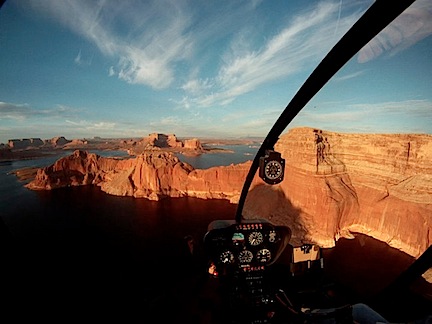
As I flew, my GoPro Hero camera recorded a 720p widescreen video of the flight. Mounted up front, it offered an unobstructed view of everything ahead of me. The wide angle lens brought in details of what was close while pushing back distant points. Later that night, I’d watch much of the 2 hours of video and remember the various points of the flight.

Mountains north of PhoenixWhat fascinated me was the way the light changed throughout the flight. At first, it was partly cloudy. Then the sun slipped behind the clouds and it was cloudy. Then the sun began to break through, speckling the mountainsides with light. This still image, captured from the video, gives you an idea of what I mean. The light changed numerous times over the two-hour period of the flight — at one point, clouding over completely only 1,000 feet above me — giving the illusion that the flight was conducted over multiple days.

It wasn’t just the light that changed, of course. It was also the terrain. Flat desert in the Phoenix area, soft mountains studded with saguaro cacti as I headed north, flat mesas with steep basalt sides, deeply carved canyons, wide valleys, red rock cliffs and hoodoos, alpine forests blanketed with snow, tall mountains, ancient cinder cones, flat “painted” desert, deep gorges, buttes, uplifted cliff faces, slot canyons. I saw it all over the course of my two hour flight — all without trying to see it. My nearly straight line course simply put me over the top of all these things. I sat comfortable and warm in my seat, admiring the view as I glided over it.

Glided is definitely a good word. There was hardly a breath of wind during the entire flight so it was amazingly smooth. A pilot’s dream. And although outside temperatures dipped as low as -5°C, I was cosy and warm with the heat up only about halfway.

SedonaOne of the highlights of the flight was crossing the red rock cliffs west of Sedona and climbing up over the Mogollon Rim. The light was absolutely perfect, breaking through light scattered clouds to illuminate the rocks with a soft golden light. Absolutely breathtaking and the GoPro camera captured the whole thing.

Beyond that was a surprising amount of snow and a light overcast layer that shrouded the top of the San Francisco Peaks. The temperature there was around 0°C, but the Flagstaff ATIS reported -5°C — a real thermal inversion only 10 miles east. The low cloud layer and dimly lighted snowfields made me feel claustrophobic. Ahead of me, it looked as if some precipitation could be falling from the clouds. That got me a bit worried about icing, but I continued on. By the time I got to the point I thought I’d seen rain or snow falling, it had stopped — and so did my worries.

The only surprise on my flight was upon reaching the GPS coordinates for the LCRG. Simply said: it wasn’t there. It was about 10 miles northwest of where I’d plotted it to be. I can only assume that I’d punched in a wrong digit when I entered the waypoint into my helicopter’s GPS. So rather than fly over its most dramatic point, I crossed a bit to the east and kept going. I deleted that waypoint so I wouldn’t depend on it again. Oddly if I’d made a serious mistake in the entry, I would have noticed it a lot sooner. But because it was only off by a little bit, it wasn’t until I passed the waypoint that I realized the error. I’ll definitely be more careful in the future.

Over the RezWhen I got to the empty expanse of the Navajo Reservation, I dropped down and flew low over the ground. There were few homes in the hundreds of square miles and only a handful showed signs of life. In the video, my helicopter’s shadow is clearly visible: small when I’m flying higher and larger when I’m flying lower. The video makes it seem as if I’m going much faster during this portion of the flight, but I’m not. I managed to keep a steady 100-110 ground speed for most of the flight. It’s just an illusion: the closer the camera is to the ground, the faster I seem to be flying.

I crossed over the Echo Cliffs at Cedar Ridge — at least I think that’s where I was — and sped across more of the Navajo Reservation north. In all, I think about 45 minutes of the flight was spent over the Rez. It’s an amazing land of stark beauty, sprinkled with traditional homesteads, more modern yet simple homes, and, on its far western reaches, the ruins of abandoned homesites clearly visible as rock rings and corrals. The traditional Navajo home is a round or octagonal building called a hogan and they are clearly visible from the air. Also visible on most days are livestock such as cattle and sheep and wild horses.

I descended down toward the lake, flying at a low enough level that I didn’t actually see its clear blue water until I was about 15 miles out. Of course, I could see other landmarks — notably the bulk of Navajo Mountain about 50 miles to the east of Page and the Navajo Power Plant, with tall stacks belching ugly smoke into the air just outside of town. The radio frequency was silent as I descended toward the airport. I lined up with the taxiway and set down on one of the helipads.

The Video

Later, after doing 3.4 hours of photo flying around the lake and points east, I watched the video shot by my GoPro Hero. It was probably some of the best footage I’d ever captured with the camera. My only regret was that I hadn’t shot in in 1080p.

Over the course of two days, I assembled a movie from seven-second clips shot during that two hour flight. Last night I added titles and music. I exported it for my iPad and uploaded it to YouTube. Here it is. Enjoy.

2010: My Year in Flights

I was all over the place.

I thought I’d take a moment to blog about some of the flying I did this past year. LogTen Pro, the software I blogged about yesterday, makes keeping track of my flying activities a lot easier to summarize.

The Big Picture

I flew a total of 207.3 hours in 2010 with exactly 300 takeoffs and landings. Nine takeoffs were at night while 13 landings were at night — this inequality occurs, in part, because of long flights that begin just before dawn or just before dusk. But I only flew 5.1 hours at night.

Flights by MonthMy flights are spread out over the entire year, with February, March, September, and October my busiest months. LogTen Pro created this graph for me so I could visualize it.
Some Details

I broke my flight time down into different types that I want to track:

  • 71.5 hours Solo. Solo flight time is the time I was on board all alone. Much of this time was spent repositioning the aircraft for a flight. I often offer this time at low rates on Flying M Air’s Web site, but seldom have people take advantage of it. Their loss. I don’t mind flying alone. I suspect I have an unusually high percentage of solo flight time for a helicopter pilot.
  • 89.4 hours Cross Country. For helicopters, cross-country flight time is considered anything over 25 miles. This number includes only flights that landed at least 25 miles from the starting point. It does not include flights where I flew at least 25 miles away and then came back to the same airport or another one nearby. I did make several very long cross-country flights last year, including flights between Phoenix and Seattle and flights from the Phoenix area to Lake Powell, Monument Valley, Las Vegas, and Blythe, CA.
  • 30.2 hours High DA/Mountain. I track high density altitude/mountain flying because it’s important to some employers. The definition I use is flights that begin or end at an airport at 5000 feet density altitude or higher and the part of that flight spent over that DA. So if I flew from Wickenburg (2400 feet elevation) to Prescott (5000 feet elevation) and was over 5,000 feet for about half of that 30-minute flight, I’d log .2 or .3 for High DA/Mountain flying. All of the flights I did when I flew at the Grand Canyon were High DA/Mountain flights because I started and ended at 6300 feet and never got any lower. If I started at a low elevation and landed at a low elevation, however, I probably wouldn’t log any high flying in between unless it was either very high flying or involved crossing mountains, etc. I know this is subjective and not perfect, but I’m really not required to log this at all, so I do it my own way just to get a ballpark idea.

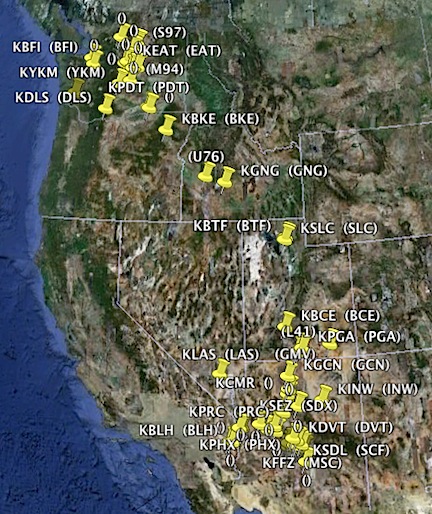
Landing ZonesI landed at 52 different places in Arizona, California, Nevada, Utah, Idaho, Oregon, and Washington. 16 of these landing zones were off-airport, although two of them were official helipads registered with the FAA. These numbers do not include about a dozen off-airport landing zones I used during one mine survey job in March; it just wasn’t worth logging them all. This Google Earth map shows where they were, using data from LogTen Pro. (Seriously: isn’t this cool?)
I only flew one aircraft: my R44 Raven II.

The Flights

A look at my logbook reveals a wide variety of flight types:

  • Day Trips to Grand Canyon, Sedona, and Meteor Crater/La Posada. This is something Flying M Air offers and I’m pretty sure we’re the only operator in the Phoenix area that does so at a reasonable price. Truth is, I’ll take you anywhere I’m allowed to — which is almost anywhere in the 48 contiguous states — for the day if you pay me to. These are the trips I offers, so these are the trips I sell. Sure do wish someone would ask for something different once in a while. If I spent any more time at the Grand Canyon, I could probably get a part time job as a tour guide there.
  • Phoenix Tours. This is Flying M Air’s “cheap flight.” Frankly, it isn’t worth going to the airport for less than an hour of flight time, so this is the lowest price tour I sell. It’s a great flight around the city and I customize it for clients, partially to make them happy and partially to make it more interesting for me. One of these custom flights required me to visit several specific GPS locations, four of which were inside class Bravo (PHX) or class delta (CHD) airspace. That was a challenging flight.
  • Moonlight Dinner Tours. I only did one of these last year, but it was a biggie: the guy popped the question and the gal said yes. What’s especially memorable about this flight is that I picked them up and dropped them off at the Sky Harbor helipad, which is between the runways and always a fun challenge.
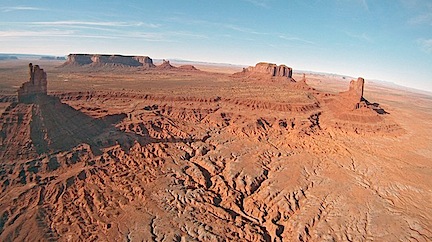
  • Monument ValleySouthwest Circle Helicopter Adventure. I only did one of these last year, with a nice couple from Tucson. (In 2009, I did four of them and I have one scheduled (so far) for 2011.) This is a six-day excursion with overnight stops at Sedona, Grand Canyon, Lake Powell (at Page), Monument Valley, and, on this particular trip, Winslow (which I actually prefer over Flagstaff, the usual stop). This was the first trip where I actually had to alter my course and change tour reservations due to weather — the second day had low clouds and rain that cleared out later in the day. You can find photos from this trip here.
  • Las Vegas Weekend. I took two women up to Las Vegas for the weekend. It was a nice flight and a relatively nice weekend away, despite some mechanical problems.
  • Video flights at the Best in the Desert (BITD) Parker 425 race. Last year was my third year at the race. It’s my favorite annual gig and I’m only sorry that it’s just one day a year. I flew three videographers last year, chasing race trucks through the desert. (The aerial shots in the video here were made from my helicopter.) Of course, the last videographer let his seatbelt hang out the door, causing damage that cost $2K to repair. I won’t let that happen again.

  • Wine Shopping. I took some regular clients on a wine shopping trip from Wickenburg to Scottsdale. They bought four cases of wine and we managed to fit them all in back under and on the third passenger seat. We named our “passenger” Bacchus.
  • Mine Survey. I took five different people (on multiple flights) to test soil samples on various mine sites not far from Blythe, CA. Although the logged time didn’t add up very much — each flight segment was less than 10 minutes — the waiting time sure did. I was satisfactorily compensated, so that’s not an issue. Now I bring my iPad on all flights so I have something to keep me occupied while clients are out doing their thing.
  • Equipment Testing. I actually did two of these gigs, each over multiple days, out in the desert west of Wickenburg. It required the client to hook up some communications equipment on the helicopter and me to fly as specified so they could test range, etc. There was a lot of flying, a lot of landing, and a lot of waiting. On the first gig, we brought our truck and new fifth wheel trailer out into the desert and camped. The truck had my fuel transfer system on board, which made it unnecessary to go back to Wickenburg for fuel. It gave us a good opportunity to test out the trailer before I used it that summer.
  • Over Lake PowellPhoto and video flights. I did a bunch of photo flights in the Phoenix area, north of Phoenix, south of Phoenix, and all the way up at Lake Powell. In fact, I spent a total of 45.4 hours (according to LogTen Pro’s summary of my remarks field) doing photo and video flights last year. I even got to do one flight with my new Moitek Gyro-stabilized Video Camera Mount.
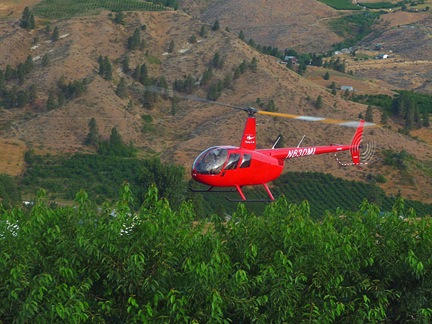
  • Cherry DryingCherry Drying. I spent more time drying cherries this year than I did in the previous two years combined — but it still only added up to 20 hours over 11 weeks. Anyone who thinks drying cherries is a good way to build time is very wrong. (If you’re a pilot interested in cherry drying, read this.)
  • Rides. I did rides at one public event and one private one last year. I also did a few odd rides here and there, mostly for folks I owed favors to. I figure I took about 40 helicopter “virgins” up for their first ride, along with at least 30 others who had already been in a helicopter.
  • Golf Ball Drops. I did two drops in 2010 and I’m starting to get good at it. On the last drop, I got one ball in the cup and another right on the cup rim.
  • Ash Scattering. I did only one of these in 2010, but that’s okay. Although I don’t mind doing them, I don’t particularly like them. Good part: family happy to have complied with wishes of deceased. Bad part: Climbing to altitude and worrying about packet of ashes breaking open and getting into my air intake (again). This flight went well and the folks were happy. For two of them, it was their first ever helicopter flight.
  • Fun. I did some flights just for fun, mostly in Washington state. I sure do love flying up and down the Columbia River. I also enjoy low-level flight over the empty desert.

Not a Bad Year

I’ve been averaging 200 hours a year — except for the year I flew at the Grand Canyon, which was considerably higher — since I began flying. I have the huge chore ahead of me of entering all that flight time into LogTen Pro. I figure I’ll do a few months a week. I’ll likely finish up over the summer when I’m back in Washington waiting for it to rain.

When I’m done, I’m sure I’ll show off my stats here.