Minimizing Trash

How I do my part — and how you can do yours.

Earlier this week, NPR did a story about the food waste ban in Massachusetts. It led with the following fact:

Americans alone, on average, throw out about 20 pounds of food a month, most of it hauled away with the trash.

They’re talking primarily about excess food thrown away by institutional organizations (think hospitals, schools) as well as buffet restaurants. But there’s also the food waste that we consumers create, often through spoilage or simply preparing more food than we eat and throwing away the leftovers. The end result of all this is ever more added to our landfills, which are already overflowing with detritus of our wasteful lifestyles.

The article appealed to me because it confirmed that my own personal efforts to reduce what I put in landfills can make a difference if others did the same. I thought I’d share what I do with readers, possibly to give them ideas of what they can do make a difference. And hopefully, they might share a few new ideas with me.

Recycle

First and foremost — and actually required in many places — is recycling. I’m fortunate to have “single-stream” recycling available to me. That means I get a big garbage pail and put all recyclable items into it together. No need to sort or have multiple bins.

I keep a small blue recycling garbage pail in my kitchen, right beside my garbage pail. They’re the same size, but I wind up emptying the blue pail at least twice as often — sometimes every day. I put anything other than styrofoam that has a recycling logo on it into that pail. (My local waste company does not take styrofoam.) This includes the plastic “cans” that Penny’s dog food come in, junk mail, paper waste from bills and receipts, paper and cardboard packaging, cans, newspaper, and plastic bottles. (I save glass bottles, such as wine and cider bottles for art projects; more on that in another post.) You can imagine how quickly this might get filled up at a home that consumes a lot of packaged foods. (I don’t.)

I also get a lot of mail order items for my various hobbies — beekeeping, warm glass work, etc. — mostly because they’re simply not available locally. These items come in cardboard boxes. I cut down the boxes and use them to fill any empty space in my big recycling bin before I bring it out for collection.
Garbage Pails
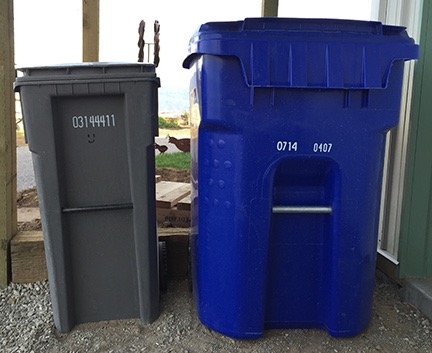
Yes, my recycle bin is about twice the size as my garbage bin. And yes, I did draw a smiley face on my garbage pail so I could distinguish mine from my neighbors’.

It does cost me an extra $8/month to have my big recycling bin, but I think it’s worth it. The waste management company collects it every 2 weeks, which is about the same frequency I take out my much smaller garbage bin. The big drawback for me is that I have to take both bins 2 miles out to the end of our private road for collection. But I think the cost and inconvenience are worth it so I can do my part.

Upcycle and Reuse

I mentioned above that I save glass bottles for art projects. I will eventually do a blog post about that. But it’s just part of my “upcycling” efforts.

Upcycling is where you take something that could be discard it and turn it into something else that might even be more useful. I’ve done quite a bit of this with pallets, scrap wood, and glass bottles.

I also reuse a lot of things — plastic containers that food comes in and large plastic paint buckets are two pretty good examples.

The trick is to look at an item before tossing it out and think about how it might be reused. Large yogurt containers make excellent scoops for chicken feed and potting soil. The single-serving yogurt containers make great seed starters — I started my avocado plant in one before transplanting it to a nicer pot. They’re also good as open storage containers for small items I need while working on projects around my home. If these things are damaged during their second (or third or fourth) use, so what? They go from that use into the recycle bin.

I also collect packing peanuts, other packing foam, bubble wrap, and air bags used as padding for items shipped to me. I stow them in large bags that I drop off at a local shipping place for them to reuse. I recycle most paper padding, but do save some of it as starter for my beekeeping smoker or fire pit.

Upcycling and reusing make sense not only because they help minimize waste, but they save you money. A search for “chicken feed scoop” on Google, for example, results in a list of plastic and metal scoops ranging in price from $2.69 to $15.93. Mine were free and when they break, I’ll be able to replace them for free.

Compost

If you have a garden, you should be composting. Period.

Seriously, why wouldn’t you?

According to the EPA‘s “Composting at Home” web page,

Compost is organic material that can be added to soil to help plants grow. Food scraps and yard waste currently make up 20 to 30 percent of what we throw away, and should be composted instead. Making compost keeps these materials out of landfills where they take up space and release methane, a potent greenhouse gas.

Although I don’t think this page is the best source of detailed information about composting, it does have this two-page, illustrated composting guide that explains the whys and hows of composting, including the all important difference between greens and browns and lists of what should and shouldn’t be composted.

Spinning Composter
This composter can hold quite a bit. With stirring rods inside, spinning it on its horizontal axis aerates the contents.

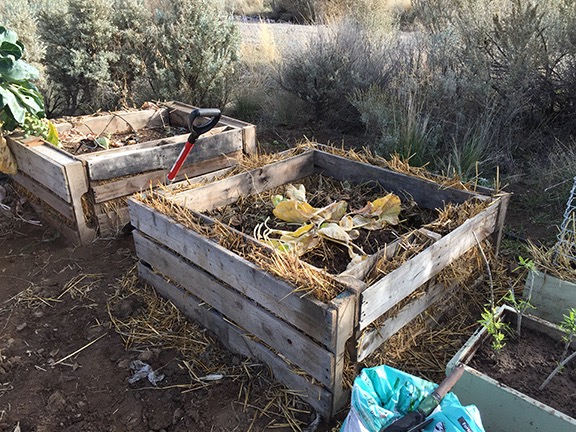
I’ve been composting rather haphazardly for years. Back in Arizona, we had a compost bin that we’d occasionally throw items into. It wasn’t properly maintained, especially after I started going away for the summer each year for work and my wasband began living at home only on weekends. I don’t consider it a success. But here in Washington, I’ve embraced composting as a source of soil for my garden. I bought a rotating composter and, when that filled up last week, built a new pallet planter to hold additional end-of-season garden waste to compost over the winter months.
Pallet Planters
With two spare pallets from my bee yard, I simply built a fourth pallet planter and filled it with excess yard waste. With luck, it’ll be full of something resembling soil next spring and I can use it as another planter.

What do I compost? Mostly filled coffee filters and vegetable scraps that I don’t feed my chickens, such as onion skins and potato peels. I keep a small plastic container — a used yogurt container, of course — on the countertop and fill it throughout the day. I usually empty and rinse it in the afternoon. And, of course, all that garden waste, including vines, stalks, and leaves.

Of course, when I clean out my chicken coop, all of their droppings go into my compost bin, too. If I had horses, some of their manure would also go in. (Might fetch some manure from a friend’s horses this week.)

The rotating bin makes it easy to mix up the compost — five half-spins seems to do the job. There’s already a lot of rich, dark soil in there.

I’ll likely stop adding to my compost bin in late winter to assure that the entire contents can be used in my garden in spring. Then I’ll start over and build up a supply for the following spring.

Feed Your Critters

Because I have chickens, I also have a place to get rid of most of my salad and vegetable trimmings. Chickens will eat nearly anything — they’ve been cleaning my brussels sprouts stalks and carved pumpkins lately — and turn them into the most delicious eggs you could imagine. They get most of what comes from my kitchen in the evening, after I’ve made dinner. When they see me coming, they all run to the gate to their pen to see what goodies I have: salad trimmings, carrot or apple peels, broccoli stems, tomato cores — you name it.

(And if you don’t have chickens but live in an area that allows them, think about it. They’re extremely easy to take care of and lots of fun to have and watch. And there’s nothing like a fresh egg still warm from the chicken’s butt. And no, you don’t need a noisy rooster to get eggs. Four hens should provide enough eggs for a couple or family of three. I have six hens and get about 3 dozen eggs a week.)

Penny the Tiny Dog gets any fat or skin I’ve trimmed off meat or chicken. I don’t like meat fat or chicken skin — I never have. All this stuff gets trimmed off either before or after cooking. If there’s a lot of it — for example, suppose I’ve roasted a whole chicken or made chicken soup from scratch — I put it in a plastic container in my freezer. Every day, I hack off a bunch of it, chop it up, and heat it in the microwave. I then pour it over her kibbles for her evening meal. If there’s fat trimmed off a cooked steak I have for dinner, I throw it in the fridge and use it the same way for her meals until it’s gone — then go back to the freezer source. She absolutely loves this. And because there’s so little of it — perhaps 1-2 ounces per meal — I don’t think it really counts as giving her “people food.” Most of her nutrition comes from the canned and dry food she eats. (And no, I’m not at all interested in cooking for my dog, taking her off store-bought dog food, or eliminating gluten from her diet.)

Shop Wisely

Of course, what really helps minimize food waste is to simply shop wisely. When I linked to the NPR article on Facebook, one of my friends responded:

I hate wasting food. Drives me absolutely crazy to throw it away. I never stock up on anything perishable and hit the market daily for whatever I’m making for dinner.

I’m with him. This is actually a habit I picked up years ago when I lived in New Jersey. The local market — which also had a real German butcher shop in it — was walking distance from my home. We’d walk over nearly every day after work and buy whatever we planned to eat for dinner. Later, in Arizona, I’d stop at the supermarket — it was on the way home — to pick up whatever I needed for the next day or two. I very seldom fill a shopping cart with groceries weekly (or even less frequently) as so many people do. The result: everything is recently purchased so little of it goes bad before it’s eaten.

But I take this a step farther with how I shop for produce items. I skip those plastic bags as much as possible. Unless I’m buying a bunch of small loose items — for example, brussels sprouts or new potatoes — I just throw them loose into my cart. Do you really need a plastic bag around those two apples? Or that head of broccoli or lettuce? You’re just going to take the food out of the little plastic bag when you get home, so why bother taking it?

Of course, you can also apply that to your grocery bags. Why use the plastic or paper sacks the supermarket provides when you can bring your own reusable canvas or nylon bags? My problem is my memory — I can’t seem to remember to bring them with me. But I’m working on it.

Minimize Waste

That’s just a few of the things I do to minimize waste. Of course, being a party of one with a tiny dog means I don’t generate as much waste as most households anyway. But can you imagine how much less waste we’d all send to landfills if we just made an effort to reduce it through recycling, upcycling, reusing, composting, and shopping wisely?

What can you add to my list? Use the comments form or link to share your experience.
Stop Whining and Just Do Your F*cking Job

A Google search phrase touches a nerve.

Every once in a while, when I check the stats for my blog, I also take a look at the search engine terms and phrases that visitors used to find posts on my blog. This list is never complete — Google has begun hiding search words/phrases for privacy reasons — but it certainly is enlightening. It gives me a good idea of what people come to my blog to learn. That, in turn, gives me ideas for future topics.

During the first six hours of today, the following search phrase stands out:

i m a girl and i want become a pilot so what can i do

This is a seriously sore subject with me. You see, I don’t believe a woman should do anything different from a man when pursuing any career. The career path to becoming a pilot is the same no matter what your gender is: get the required education and training, get job experience, and move forward.

How could this possibly be any different for women than it is for men?

Women need to stop thinking of themselves as women when out in the job market. They need to stop thinking about men vs. women and simply think of job candidates vs. job candidates.

The way this search phrase was written, I get the distinct impression that the searcher was a young person — perhaps even a teen or younger. After all, she referred to herself as a “girl” instead of as a “woman” or simply “female.” That means that for some reason, she’s been taught to think of herself first as female and second as a professional. Why are parents and teachers doing this to our young people?

These days, there have been far too many whining complaints from women who are complaining about different treatment because they’re women. I’m calling bullshit on all of this. The reason you’re being treated differently is because you’re acting differently. Maybe you’re making different demands from your employer — excessive time off to deal with your children. Maybe you’re dressing differently in the workplace — short skirts, tight pants, and low-cut blouses. Maybe you’re acting differently at the office — spending too much time on the phone or gossiping about coworkers.

If you want to be treated the same as your male counterparts in the workplace, you need to stop acting like a woman and start acting like a worker.

And before you share your sob stories with me or put me on your hate list, take a lead from me. I’ve been in and achieved success in three male dominated careers — by choice — in the past 32 years:

  • Corporate auditing/finance. Straight out of college at the age of 20, I got a job as an auditor for the New York City Comptroller’s Office. I’d estimate that only about 20% of the people holding the same job were women. By the age of 22, I was a supervisor with 12 people below me, most of whom were men. Three years later, I moved into an Internal Audit position at a Fortune 100 corporation. I’d say 30% of our small audit staff were female. From there, I moved into a financial analyst position at the same company; 25% were women. I got good pay raises every year and with every promotion. (And yes, I was promoted.)
  • Technical computing/computer book authoring. In 1990, I left my full-time job to pursue a freelance career as a computer trainer and book author. This is clearly a male-dominated industry with roughly 10-20% of the people doing what I did being women. Yet I was able to get and hold a number of computer training positions, land over 80 book contracts, and write hundreds of articles about computing. I’m still doing this work.
  • Aviation/piloting. In 2000, I learned to fly and began building a career as a pilot and charter operator. How many female pilots do you see around? And helicopter pilots? I can’t imagine more than 5% of all helicopter pilots being women. It’s a seriously male-dominated field. Yet I built my company over time to the point where it generates a good amount of business, especially through summer contract work. For the past two seasons, I have been the only female helicopter pilot doing cherry drying work in Washington state.

How did I achieve such success when surrounded by men doing the same job? By simply doing my job without whining.

Ladies, take note! You want the same opportunities as men in the workplace? Stop whining and crying about how different you are. Stop being different. Focus on the work and get the job done. Do it to the best of your abilities. Be a team player.

Nobody likes a whiner. I’m sick of being lumped into a group — women — who incessantly whine about how different they’re treated when all they can do is show how different they are.

And if you think you’re a woman first and an employee second, you have absolutely no place in the workplace. Employers and clients don’t want men or women. They want people who get the job done.

November 6, 2014 PM Postscript: Here’s another blog post from 2013 that also discusses this issue, but with quotes from female pilots.

Planting Trees

I make plans to add some serious foliage to my property.

I bought 10 acres of view property in Malaga, WA at the end of July, 2013 — the day after my divorce decree was issued. Although financial uncertainty delayed the start of construction of my new home, I finally got the builders out here in May, 2014, and building commenced. Although the shell of the building is done and all of my possessions are tucked safely indoors, the living space still has a way to go. While I wait for that to be done, I’ve gotten back to work on developing the land around my new home: cleaning up my vegetable garden, planting bulbs, sewing wildflower seeds, etc.

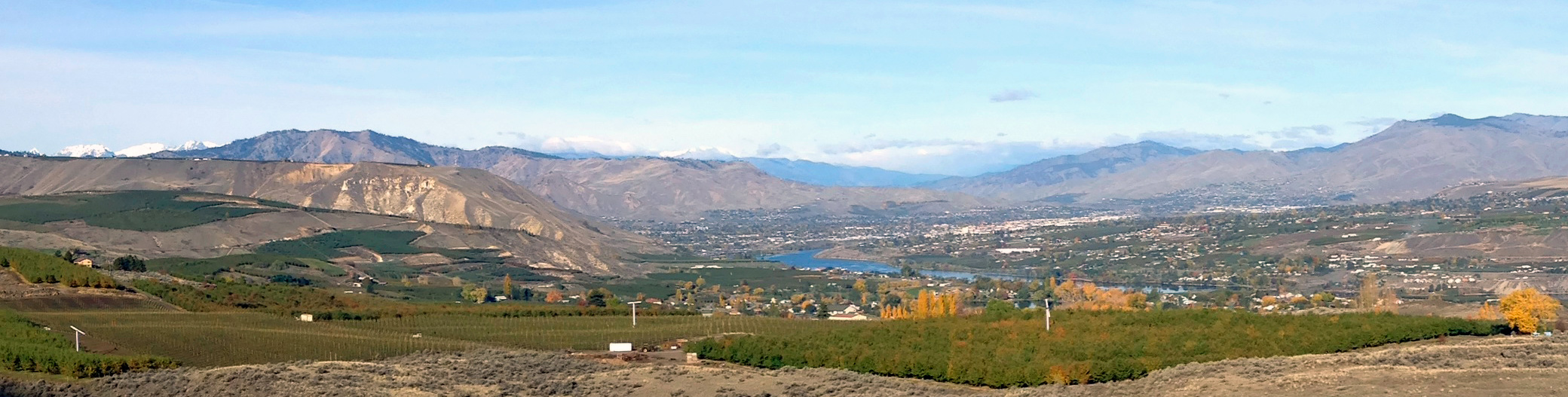
My lot is beautiful. It sits on the north side of the road — the side facing the Wenatchee Valley. On clear days — which is most of the time here on the dry side of Washington — the view goes on forever and ever. I see the Columbia River, countless orchards, the cities of Wenatchee and East Wenatchee, the valley walls, and snow-covered mountains nearly year-round. This time of year, the fall color is amazing as individual trees and full orchards change into reds, yellows, and oranges. I built my home to take advantage of these views, with a total of 21 windows, most of which look out to the north, northwest, and northeast where the best views are.

Autumn View
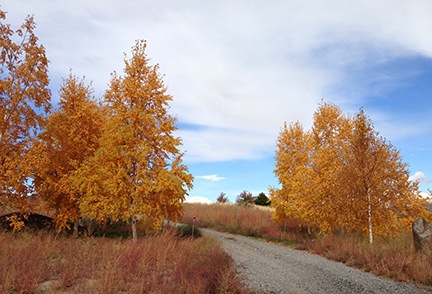
I shot this photo on Monday morning from my Lookout Point bench, after the sunlight had filled the valley. The snow is back on the mountains I can see to the west. Click this image to see a larger version where more detail is visible.

The best thing about this view: it’ll never be blocked. The land drops down sharply near my property line into a deep ravine owned by the county as a wildlife corridor. Beyond it, where the land climbs a bit again, is a very large orchard owned by a local fruit grower. I picked this lot because of this situation — one thing I learned in the past (the hard way) was that if land in front of your view can be bought/changed by someone else, it will be. Even if the PUD did sell that low-lying land to a developer (or something worse), whatever’s down there will never obstruct my view.

The view on the other side of the road isn’t too shabby, either. Basalt cliffs, hundreds of feet tall, filled with bighorn sheep that sometimes wander down to graze on the bunchgrass that dominates the hills below them. The cliffs illuminate with a golden light at sunrise or sunset, especially during the summer months. Really breathtaking sometimes.

Cliff View
This shot gives you a good idea what’s behind my home, on the other side of the road. (Before I completed the RV garage space and driveway apron, my helicopter was parked outside.)

But although there are trees up in the cliffs and trees down in the valley, there aren’t many trees on the properties on my side of the road. My 10 acres doesn’t have a single tree over 10 feet tall. Instead, it’s mostly gently rolling hills with bunch grass and sage brush.

That’s good, to a certain extent. The views wouldn’t be perfect if there were trees in the way. But I would like some trees for shade, privacy from the road, and autumn color. Trees that are drought tolerant once established, trees that grow naturally in the area and will do well here without a lot of watering or maintenance.

Enter the annual Cascadia Conservation District Native Plant Sale. This program makes native plants available at affordable prices to homeowners in the area. It includes tall trees such as ponderosa pines, quaking aspen, rocky mountain Maple, and blue elderberry, as well as shorter shrubs such as red osier dogwood, serviceberry, mock orange, and woods rose. The brochure clearly indicates how large each plant will get, when it flowers, and whether it has edible fruit and/or attracts wildlife. This makes it easy to decide which plants to buy.

Actually, it doesn’t. I want to buy some of everything.

I plan on planting in a few areas. First, alongside the road behind my building. My building is set down in a sort of bowl below the road with no trees or bushes to block it from the road. It’s sort of a fishbowl effect with minimum privacy. Fortunately, my building faces away from the road so I don’t have to worry at all about privacy when I’m inside. But I’d like to get some when I’m outdoors, working in the garden, etc. And a row of bushy trees will not only give me that privacy, but cut down on the dust kicked up by the occasional passing car. (I should mention that there are only three driveways past mine on the road, so it isn’t as if there’s any real “traffic” up here.)

Quaking Aspen
Some of my neighbor’s aspen trees.

What to put up there? I was thinking of a mix of willow (which I’ve already got rooting from a friend in the area), quaking aspen, and red osier dogwood. (A neighbor already offered me some of their aspens — I need to go over and dig them up; after all the rain we’ve been having lately, it shouldn’t be too difficult.) This will give me the privacy/dust screen I want while providing early forage for my bees and vibrant fall colors later in the year. Although all of these do best with some irrigation, I’ve already got irrigation lines on that side of the driveway so it won’t be much of a chore to run another line up to the roadside. All of these varieties grow quickly and self-propagate.

I wasn’t going to plant anything beyond my driveway, but recent events have convinced me to extend that row of trees past the driveway, possibly all the way to the fence line that marks the end of my property. Unlike my neighbors on the other side of the road, my property stretches east along the road. Their lots stretch south up into the cliffs — in fact, they each own not only the cliff face behind their homes, but a bit of land near the top, which is impossible to reach by car or truck. (Not sure the value of that — unless you have a helicopter, of course.) My 10-acre lot actually stretches in front of three of their 20-acre lots.

Rather than have to see my neighbor’s rather unattractive roofline and bright, reflective chimney, I thought I’d plant some trees along the road to block my view. Some tall trees like ponderosa pines would fit in with the vegetation on the cliff side of the road and give me the screen I want. Maybe some blue elderberry and serviceberry so I can harvest some edible fruit at season’s end. I have irrigation set up on that side of my driveway, too, and can run the line quite far — I have excellent water pressure here — so getting all of these plants started and thriving should be pretty easy to do.

Since I plan to move my bee yard out toward the east end of my property next spring, trees out there will give the bees a nice screen from the wind and possibly a bit of shade. I’ll plant all kinds of flowering bushes around the bee yard so there’s foraging opportunities for them nearby. Maybe some snowberry, woods rose, and mock orange?

Not sure what I’ll plant on the view side of my home yet. I think I might wait until spring 2016, when I’m really settled in, to develop in that direction. Next year, I’ll be expanding my garden beyond the small area near my shed to include various locations in the immediate vicinity of my building. After all, if I’m going to plant around the building, why not plant things I can eat?

Beyond that, I suspect I’ll keep things close to the ground — that’s one direction that I don’t want a screen of tall trees. A wildflower field, kept vibrant through irrigation if necessary, might be just what I need. I’ve already got the seeds started.

50,000 Tweets

A milestone.

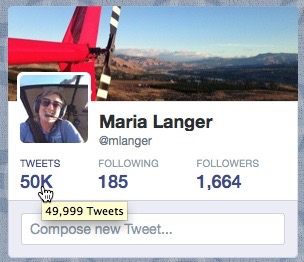
Today, at 4:24 PM, I posted my 50,000th Twitter tweet.

Before After
Tweet count, before and after.

I had been watching the tweet count as I closed in on this milestone. I manage to capture screenshots of the count before and after I sent the tweet.

I spent a lot too much time thinking about what I would say to mark the occasion. It came to me the day before. I’d mention @andypiper, the very first person I followed on Twitter.

Back in 2007, Twitter was just a year old and have such a small user base that it was still possible to see the full Twitter timeline — in other words, every single tweet posted as it was posted. As I watched the tweets go by, I seemed to zero in on Andy’s tweets and I followed him.

Years have gone by. There are now millions of Twitter users and no way (that I know of) to follow the full stream of all tweets in one place. I’ve authored four courses for Lynda.com about Twitter, including the most recent, Up and Running with Twitter . Andy, who lives in the U.K., now works for Twitter. This past spring, when I was in California for business, we met in person in San Francisco where we shared an excellent Dim Sum meal, coffee, and a lot of conversation.

A lot of people just “don’t get” Twitter. That’s okay. For the people who do, it’s a great social networking service to bring people together.

Using a Daily Routine to Maximize Productivity

Some things that work for me might work for you, too.

BooksI’ve been a freelance writer since I left my last full-time job in 1990. While freelancing might sound great to the folks who punch a clock or work some version of the typical 9 to 5 grind, it’s not all about working in your pajamas and goofing off in coffee shops. It more about finding work that pays and getting the work done on time. If you’re a good freelancer, you’re doing those two things every working day. If you’re not, you’re probably not earning a living as a freelancer.

My Background as a Writer

Peachpit Logo
Lynda.com

My career has followed what might look like a bell curve. A slow start in 1990 with a steep rise in the late 1990s that peaked in the mid 2000s and began a decline in 2006 or so. This is mostly because the market for what I wrote — computer how-to books for beginning to intermediate users — has gone into decline, pushed into obsolescence by the rise of Google, Internet based software support, and video how-to. I was fortunate enough to hop on the video train in 2006 and have authored a number of videos for a great organization, Lynda.com. I still do this and I really enjoy it. But the heydays of writing about computers is definitely over.

Fortunately, I still have enough of a reputation as a writer that I can get opportunities to write short how-to articles and blog posts for paying markets. I did quite a few of these over the years, but lost interest in 2011 and hit a mental road block in 2012 that made it very difficult to write much of anything. I’ve worked my way though that now, mostly out of necessity. My recovery is due, in part, to two new editorial contacts that have offered me money for fresh content. Because my other work as a helicopter pilot is seasonal and very slow in the winter months, I’m embracing these new opportunities. My book and video course royalties only go so far.

Unfortunately, I’m also still “flaking out” once in a while — basically dropping the ball on opportunities I should consider myself lucky to get. As I told one of my editors the other day, I’m my own worst enemy. When I’m focused, I can write good content very quickly — my editors are always happy with what I send. The trick is getting and staying focused long enough to get the job done.

And that brings me to today’s topic: setting up and sticking to a routine.

My Current Routine

I am a morning person. I have been for longer than I can remember. I wake up early and work best before noon. This becomes extremely important as I try to maximize productivity and still have time to take care of the other important things in my life — like the construction of my new home, socializing with friends, and exploring new hobbies like beekeeping and warm glass work.

That said, I generally wake between 4 and 6 AM. (Yes, I know that’s pretty freaking early, but that’s the way things are these days. I haven’t set an alarm clock in years.) I usually stay in bed until at least 5; if I wake before that, I check in on Twitter and Facebook on my iPad before getting out of bed. I’ll also check the weather and my calendar for the day. (More on the calendar in a moment.)

After taking care of bathroom stuff, I head into the kitchen to make coffee, wash the few dishes that might be in the sink, and feed Penny the Tiny Dog. Sometimes I’ll make breakfast, too.

I take my coffee and breakfast to the kitchen table where I spend some quiet time writing in my journal about the previous day’s activities and thoughts. (If you think I share a lot here and on social networks, you should read my journal. This blog is the tip of a very deep iceberg. I’ve already made arrangements to have it published when I die.)

By 7 AM, I’m at my desk working. I try to spend a solid 4-6 hours writing. I’ll try to write work I can sell first, but if nothing comes to mind, I’ll write in my blog about something that’s been on my mind. Sometimes that stimulates my mind enough to trigger ideas for a piece I can sell.

Yesterday was an extremely productive day. By 8 AM, I’d already written a 450-word illustrated how-to article for an editor, a short illustrated blog post for this blog, and a brief proposal for a new video course. I’d gotten an early start — I was at my desk by 5 — but I was still pleasantly surprised.

Distraction is my enemy and it takes many forms. Social media is the worst. Using the Internet to research and shop for things that interest me comes next. Reading old blog posts comes after that. If I’m not careful, these activities can blow hours of my day.

Oops! I’m back. Just lost 30 minutes doing all of the above. Seriously. I wish I were kidding.

The key is to not allow distractions to take you away from your work. Face it: if a task takes 4 hours to complete and you blow away 2 hours on distractions, you now have a 6-hour work day. Wouldn’t you rather finish your work and have the rest of the day off to deal with other things, including those distractions? I know I would. But sometimes it’s difficult to avoid them.

(This is something that’s been on my mind for a while. In 2007, I blogged “5 Tips for Staying Focused.” And in 2009, I blogged “Writing Tips: Avoiding Distractions.”)

When I’m done with the task at hand and have nothing on my calendar to take me away from my desk, if I’m on a roll I try hard to keep working. Yesterday, after a lengthy midday distraction, I made several false starts on a blog post for an aviation blog, started to write a different flying-related blog post for my own blog, and realized what I was writing for my blog might work for the other blog. I pasted the text from my blog composition software — yes, I still use ecto — to Microsoft Word and finished it up. I sent it in and crossed my fingers that it’s accepted. If it isn’t, no sweat; I’ll publish it here on this blog and write something else.

I should mention my calendar and its importance in all this. Because I do my best work in the morning, I try to schedule all my non-work activities for the afternoon. This reserves the morning time for work. I also put everything on my calendar, mostly because I forget scheduled responsibilities if I don’t. And I use to do list software that automatically syncs between my Mac, iPhone, and iPad to keep track of tasks that need to be done and maintain a shopping list. (I should probably blog about that one day, too.)

Yesterday I had to run errands down in the valley (on my to do list), buy a few items (on my to do list), and join some friends for dinner and pumpkin carving (on my calendar). Because I was determined to finish that blog post before I joined my friends and because I allowed midday distractions to eat into my work time, I arrived late for the social activities and only ran two of three errands.

That’s my basic routine: Wake early, coffee, journaling, and writing work in the morning; personal and social activities in the afternoon and evening.

I should mention here that I’ve tried working in the afternoon after something takes up my morning and I simply can’t do it. There’s something about the morning that makes me more productive and enables me to stay more focused. When I sit at my desk in the afternoon, I can’t even get started. The distracting influences are simply calling too loudly.

I should also mention that the short days I experience here in Central Washington State make it very easy to occupy myself at my desk in the early morning. The sun rose this morning at 7:43. (Of course, next week, when we change the clocks, that’ll drop back to 6:43.) But, on average, I’m awake for two or more hours before the sun rises here in the late autumn, winter, and early spring. If I’m not working at my desk, what else could I be doing when it’s still dark out? To me, I’m spending the least useful part of the day doing something that helps me earn a living, leaving the most useful part of the day available to do other things. In the summer, of course, things are very different — and so is my routine.

Setting Up Your Routine

That’s my routine. Now think of yours.

First of all, consider when your best work period is. I’m certainly not suggesting that you wake before 6 and hit the keyboard. (Hell, I wish I didn’t do it.) That works for me but it won’t work for everyone.

Once you know when that golden productivity time is, schedule your day around it. Make that period of time sacred, a time when the only thing you’ll do is work-related. Follow the suggestions in the two posts I linked to above to minimize distractions. Know that distractions will only lengthen your time at your desk. Don’t allow yourself to leave a task unfinished if it only needs another hour or two of your undivided attention to get done. Finishing tasks is extremely rewarding.

If you finish early and have other tasks to complete, do them! Do enough of them and you might get a whole day off.

Ddo your best to make each day’s work schedule pretty much the same, creating a routine. This adds a rhythm to your life that should make it easier to get work done.

What do you think? Use the comments link or form to share your thoughts and tips.