Flying Under Bridges

What were we thinking?

Back in the spring of 2004, when I interviewed at Papillon Grand Canyon Helicopters for a tour pilot job, one of the interviewers — there were three of them — asked me what the craziest thing I’d ever done in a helicopter was. I said, “Well, I was sitting in the PIC seat but not manipulating the controls when we flew under a bridge.”

There was a brief moment of silence and then all three men laughed long and hard. I’m not sure if they laughed because they thought what we’d done was funny or if they thought it was funny that I’d actually answered truthfully instead replying with something I thought they’d want to hear, like “I never do crazy things in a helicopter.” (I don’t lie, even when it’s in my best interest to do so.) But it must have been a good enough answer because I got a job offer and I took the job. That summer gave me some of the best flying experience I could get to hone skills, build confidence, and move forward in my career as a helicopter pilot.

In this blog post, I want to talk a little about the events leading up to us flying under the bridge and what happened to the pilot manipulating the controls that day.

The Backstory

It was July 19, 2003. I’d spent the previous day ferrying a brand spanking new R44 Raven II from Torrance, CA to St. George, UT. The helicopter had been purchased by a student pilot we’ll call John who had a heck of a lot more money to burn than I ever will. Not only had he bought the Raven II for cash, but he’d paid the person who’d ordered it for his own operation an extra $40K so he wouldn’t have to wait for his own to be built.

He’d asked his flight instructor — we’ll call him Roy — to pick it up, but Roy didn’t meet Robinson’s very strict ferry pilot requirements. Although he had 2,000 hours in Robinson helicopters, he’d never taken the factory safety course. I’d met Roy the month before when he was rounding up burros out at Alamo Lake in Arizona. He remembered me and the fact that I had R44 experience and guessed (correctly) that I’d taken the safety course. John and Roy arranged for me to fly the helicopter with Roy from Torrance to St. George. Due to Robinson’s rules about ferry passengers, John would stay behind.

It was a mostly uneventful trip. The helicopter was ugly: white with a bright orange stripe and chocolate brown leather interior. But it flew fine and we cruised through the desert, mostly following I-15. We stopped for fuel at Boulder City, NV and then landed again at Mesquite, NV to wait out a thunderstorm in our path. John met us when we landed at St. George. They took me out for dinner, put me in a motel room up at the airport, and made plans to get me home to Wickenburg (near Phoenix) the next day.

The Flight

That brings us to July 19 again. John was eager to go flying in his new helicopter, so they decided to fly me down to Wickenburg. It would be about a 2-1/2 hour flight. Roy put me in the right (PIC) seat while he sat in the left, just like the day before. The duals were still in. John sat in the back. He’d get his chance to fly on the way home. (To this day, I think it was very kind of them to allow me a few more hours of stick time in the R44. I only had about 40 hours in one at that point.)

We headed south over the east end of Lake Mead near Pearce Ferry, past the Grand Wash Cliffs, and down through Lapai Alley to Kingman. That’s where we stopped for fuel. The rest of the flight was very familiar to me — I’d likely flown the route along State Route 93 dozens of times in the R22 I owned back then.
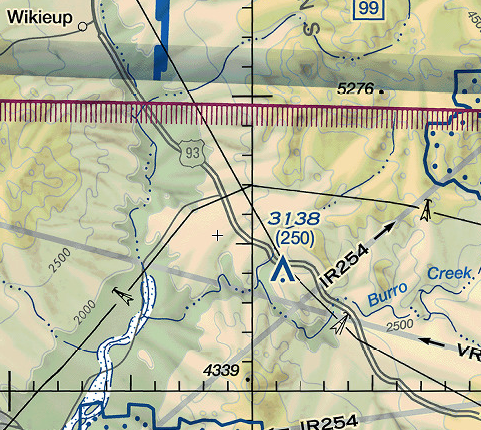
Near Wikieup
Here’s a piece of the Phoenix Sectional Chart that covers the area of Route 93 south of Wickieup. Note the wires.

Sometime just after passing over Wikieup, John asked Roy how he found burros from the air. (Remember, he’d done burro roundup only a month before.) Roy asked for the controls and I let him have them. He dropped down low and explained how he looked for bare patches in the desert where the burros would rub themselves. We looked but although we saw patches like he described, we didn’t see burros.

By that time, we’d reached Kaiser Canyon. Roy dropped down very low and followed it to where it joined up with Burro Creek. That’s when he turned to me and asked, “Have you ever flown under a bridge?”

I admitted that I hadn’t.

“Want to?” he asked.
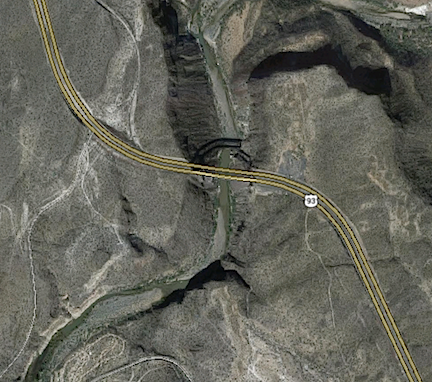
Burro Creek Satellite
A recent satellite image of Burro Creek Canyon. If you look closely, you can actually see the shadow of the two bridge spans upstream from the bridge. We came from the south, following the creek.

I knew the bridge he was thinking of: the Burro Creek Bridge on Route 93, which spanned the canyon not far ahead. I’m not sure if I answered. Or if John answered. The canyon opened up enough for Roy to drop us into it. We rounded a bend and the bridge came into view.

That’s when John started getting cold feet. “I don’t think we should do this,” he said nervously.

But he was really too late. We were moving at at least 80 knots and the bridge was coming up quickly.
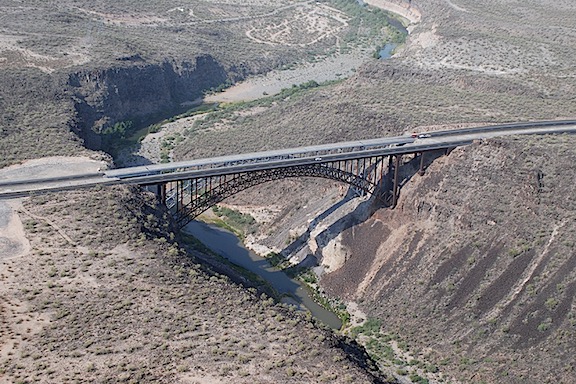
Burro Creek Bridge
The Burro Creek Bridge not long after the second span was completed. Back when we flew under it, there was only one span. Please don’t fly under this or any other bridge. It’s dangerous.

It wasn’t the bridge up ahead that had me worried. It was the two sets of big power lines — we call them “Bonnevilles” here in Washington state — that spanned the canyon on our side of the bridge. They wires actually drooped lower than the bottom of the bridge, which is something I’d never noticed before. But I only felt real fear for a moment. That’s how long it took to pass under them and the bridge beyond.

I can’t remember what happened next. Probably some euphoric whooping by all three of us. And laughter. Roy gave back the controls and I got us back on course. They dropped me off at Wickenburg, fueled up, and headed home.

I lived in that area for another 10 years and owned a helicopter the entire time. Although I passed by the bridge dozens of times — I even did a photo flight while the second span was under construction — I never flew under it again. What the hell were we thinking, anyway?

Afterwards

Time passed. I helped John and Roy out again in August, doing helicopter rides at a country fair in the same R44. (According to my log book, I logged a total of about 20 hours in that helicopter.) I think I visited Roy in St. George once again after that. Then we lost touch.

I don’t know what happened to John and his helicopter.

But I do know what happened to Roy. On April 6, 2014, the helicopter Roy was flying collided with terrain in a canyon near Green River, UT. He and his passenger both died.

I read about it in the news and my heart sank a little — the way it does when someone we know dies in a crash. (If you’re a pilot and it hasn’t happened to you yet, it will.) The investigation is still going on, but the NTSB preliminary report states that there is no evidence of engine failure.

That got me thinking, there are old pilots and bold pilots…
Dead People on Facebook

Why do we remain friends?

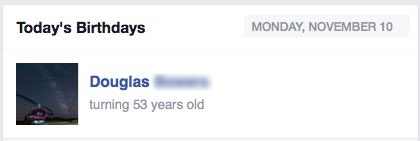
Today is Doug’s birthday. He would have been 53. My age.

But he’s not, because he’s dead. He died last year, in the spring. His last post on Facebook is dated April 13, 2013. Three days later, he was dead.

Birthday
Happy birthday, Doug.

I know all this because Doug’s Facebook account is still online. I can see his last post and the things he posted before that. He was a helicopter pilot with a job and a family and a sense of humor. Like so many people I know on Facebook, I never actually met him in person. He was a friend of a friend of a friend. I still felt sad when I heard that he’d died. And I feel sad when Facebook reminds me about his birthday. And I feel sad when I visit his Facebook page and see the wall posts his friends and family continue to share there.

Doug isn’t my first dead Facebook friend. Ralph is. He was a huge baseball fan. One of his last Facebook updates, dated July 2010, was about being in Boston for one of his daughters’ BU orientation. A month later, he was dead.

And there’s also Michael and Ron and Jim.

Of my 406 Facebook “friends,” at least five of them are dead. I say “at least” because I don’t know how many others who aren’t close friends or simply aren’t active on Facebook have passed away.

For these people, Facebook has become a sort of virtual gravesite, a place where visitors can come and leave comments and photos. A place where they can tell the deceased how much they miss him or just that they were thinking about them.

Or wish them a happy birthday.

Maybe that’s why we stay friends with these dead people? So we feel welcome at their virtual gravesites? So we have a place to pay our respects when we want to?

Or simply so we don’t forget them?

Happy birthday, Doug.

Out My Window

How do I get anything done?

Today was probably the last nice day of autumn. After an early morning drizzle, the sky cleared and the sun came out. I came out, too — I had a bunch of work to do in the yard and inside my big garage in preparation for moving my RV.

But time and again I found myself stopping just to look out at the view from my shelf in what I’ve taken to calling “Malaga Heights.” The fall colors are peaking right about now with yellow aspens and willows and red and orange orchard trees. The sky was blue with white clouds, the Columbia River was that incredible blue it so often reflects from the sky.

Small View
Here’s the cropped view of what I saw today. Click it to see the full panorama. It’s big.

I remembered what a friend said to me the other day. She’d come to keep me company while I worked on my wiring and wound up helping me run wires from the circuit panel to the second floor. We worked until around 2 PM that day, then stopped for the day. We both wanted lunch and I needed to vote and visit Home Depot. While I took care of a few things inside to prep for my trip into town, my friend wandered down to the bench at Lookout Point. I met her there a while later. She was sitting on the bench, looking out over the view.

“I don’t know how you get anything done,” she said. “If I lived here, I’d be looking out at this view all day long.”

I get things done because I have to get things done. My home won’t be finished by itself.

But I can’t tell you how much I look forward to sitting up on my deck with a cup of coffee in the morning or a glass of wine in the afternoon — or maybe both — just taking in the view in front of me.

In the meantime, I’m enjoying these final days of autumn. The weather will turn cold on Tuesday and there’s a chance of snow on Thursday. At this point, I’m planning to spend the winter here, working on my home, spending time with my friends, and maybe even getting in a little skiing. It’s nice living in a place with four seasons and such beautiful scenery.

I’m so glad I’ve made this my home.

Link Bait: Gun Control Edition

Why are you sharing this poorly written crap?

Link bait is defined by Wiktionary as

Articles, infographics, videos, and other content on websites created as part of a strategy to attract links and go viral.

Linkbait TitleWe’ve all seen it. It usually has a title or headline written with a hook to reel you in. (In researching this piece, I even found a Linkbait Generator and a Link Bait Title Generator.) Link bait is commonly shared on social media, often by people who link to it specifically because the title leads them to believe it’s something their friends and followers might be interested in.

One of my Twitter and Facebook friends posted a perfect example today: “Father Open Carries Into School; The School Board’s Reaction Was Perfect.” The title formula leaves you curious to know exactly what the school board did. You want to click it. I know you do. Go ahead. It won’t hurt you.

But what it will do is display a really poorly written, misleading piece of drivel — which, after all, is what most link bait does.

The article is about a father who was carrying a pistol in a hip holster picking up his kid in school. The school board adopted a lock down policy that included dialing 911 for any future episodes. There. I just told you everything of interest in the article.

The rest is a mishmash of conflicting information which can’t all possibly be facts. Let me deconstruct some examples.

A Michigan man, picking his child up at school, carried his pistol into the building in his hip holster. The staff was not amused. Since open carry is legal in Michigan, the parent was within his rights.

Let’s accept for a moment that the holster and gun were visible. That qualifies the possession as “open carry,” which simply means that the gun can be seen by anyone. Many states allow open carry of firearms. The Wikipedia link lists them.

But later, the article says

Open carry is perfectly legal in Michigan but only if you have a Concealed Pistol License (CPL). The parent — who remains anonymous — did have a CPL.

Huh? Why would a CPL be required to open carry? “Concealed carry” means that the gun is hidden from view. Concealed. Duh.

Of course, the author got that wrong. About five minutes of research uncovered this on the Michigan Open Carry, Inc. website:

A person without a CPL can legally open carry a pistol as long as the pistol they are carrying has been lawfully purchased in accordance with MCL 28.422 and is registered in their name and they are at least 18 years of age. Without a CPL you may NOT carry a firearm that belongs to and is registered to someone other than yourself.

We’ll assume the dad was at least 18 years old and was carrying his own gun. So that’s the first piece of conflicting info. The article incorrectly states that open carry requires a CPL. It would have taken the author less than five minutes to find the correct info online. Hey, but why get the facts? That’s not the purpose of link bait content.

The article then says:

But both state and federal law prohibits guns on school property except for a legal parent or guardian who must leave the weapon in the car and this only applies to CPL holders, who must pass a comprehensive background check and carry the gun visibly.

WTF? She’s mixing up so much information here that it’s clear she’s clueless about this issue. Dump everything after the word car and you have all the information you need to get to the heart of the matter.

If Federal and State Law prohibit guns on school property, allowing parents or guardians to bring them only if they leave them in the car, then how was the parent “within his rights” when he brought it into the school? Clearly bringing the gun into the school — whether he had a CPL or not — is in violation of federal and state law.

So this is how I see it. A man comes into the school illegally carrying a gun. What the hell should the school do? Obviously, what they determined their new “plan” should be:

School Board President Rebecca Walsh has set out the following plan:
“If this occurs during school hours, the building will immediately go into lockdown status, and 9-1-1 will be called so law enforcement agencies can make a determination on the status of the person with the weapon.”

And we needed an article about this?

Of course we did! We needed link bait. We needed people to come to “Addicting Info” and get all fired up by something so poorly written that the facts don’t matter. It’s the emotions that count. Let’s fire them up with some misleading drivel!

I don’t know about you, but I’m sick of link bait content. Come on, people. Read what you share before you share it. Stop linking to poorly written crap. Stop linking to sites with hidden agendas. Stop trying to drag controversy into places it doesn’t deserve to be.

At least I got something to blog about this morning.

Get What You Pay For

Why bargain hunting isn’t such a bad thing.

There’s an old saying everyone seems to know: “You get what you pay for.” It’s normally applied to situations where you buy something at a low cost and it breaks. “You get what you pay for” is supposed to explain why it broke — you apparently didn’t pay enough money for it.

Lots of people use this logic when they shop. If something is cheap, it must be crap because “you get what you pay for.” If someone else is selling the same thing or something similar for more money, it must be better, right?

Not always.

My Hair

Yes, I’m going to use my hair as an example.

I dye my hair. It’s no secret. I’ve been doing it since I was in my 20s when those first few grays started making their appearance. I did it myself for at least 20 years, using a reddish shade of brown that got even redder when exposed to Arizona sunlight. The color looked at least somewhat natural — at least no one ever commented on it looking fake. I’ve since switched to a browner color that’s more in line with what I remember my hair looking like. It’s been so long, I’m not sure. And those few strands of gray now account for about 75% of my hair.

Last year, I began living in an RV full time after leaving my Arizona home and waiting for my new home in Washington to be built. If you know anything about hair dye, you know that good water pressure is a must-have for rinsing that crap off your hair. So is a good supply of hot water. My RV is weak on both counts, so I began getting my hair dyed “professionally.”

I put “professionally” in quotes, because I started going to the local Beauty Academy. These are highly supervised girls (mostly) who are training to become beauticians. They do everything, from hair trims to dye jobs to perms. They don’t mix a color without consulting with a supervisor. The “classic color” service I needed cost $28.

I went every 6 weeks for quite a while. There was a different girl doing my hair each time. Based on observations, conversations, and chatter among the dozen or so girls working there, most of them were under 25 and apparently had at least one kid but no husband. Young women learning a good trade to support themselves and their families. We had nothing in common so conversation was minimal. Each girl took a long time to get the color in — a typical dye job would take over 3 hours. But it came out good each time and the color lasted. I was satisfied.

Then I succumbed to peer pressure. (Can you believe it?) When I complained to one of my girlfriends that it took so long to get my hair dyed, she ridiculed me for getting my hair done there. She recommended her woman at JC Penney’s salon. So I figured, why not?

I went to Sally (not her real name) and she did my hair. Although she was closer to my age than the Beauty Academy kids, she didn’t seem interested in striking up a conversation with me. While the dye “processed” in my hair, she disappeared into a back room. I learned to read a book or play a game on my phone.

The first time I went, she insisted on cutting my hair and waxing my eyebrows. I was trying to grow my hair long, but when I came every six weeks, she’d cut off 5 weeks of growth. And I don’t usually mess with my eyebrows. I let them do their own thing. But after waxing, they needed maintenance, so I had to have them waxed every time. The bill? $90. When I cut out the hair cuts and waxing, it went down to $70.

And I didn’t feel as if I were getting any better service than those young girls practicing on my hair.

So yesterday I went back to the Beauty Academy. The girl who did my hair was young but she had a professional attitude and would be graduating in just two weeks. She already had a job lined up. She did a great job on my hair, matching my existing color so she only had to do the roots. Because it was Customer Appreciation Day, the dye job only cost $18.

That’s more than $50 saved. And I got a pumpkin muffin to snack on.

I don’t think Sally will be seeing me again.

As for my peer pressure friend — well, I don’t talk to her these days anyway.

Harbor Freight

I was out with some friends last night, all sitting around a big table in a restaurant. I got into a conversation with a friend who was telling me about a crane he’d bought at Harbor Freight and had attached to his cargo trailer. He’s been collecting and selling scrap metal lately and needed something to lift engine blocks.

Harbor Freight, if you aren’t familiar with it, is a company that sells “quality tools at ridiculously low prices.” That’s what it says on their website. I can confirm the low prices, but I can’t agree about the quality. Most of what they sell is pretty crappy stuff.

But not all of it. My friend and I chatted about this. The “you get what you pay for” phrase was thrown around a bit. We both agreed that you had to think about how you planned to use what you were buying when making that purchase decision. If it was something you’d use occasionally and rather lightly, Harbor Freight was probably a good source. But if it was something that you needed to use hard and frequently — something you wanted to last a good, long time — Harbor Freight probably wasn’t the place to go.

Walmart

Most of my friends hate Walmart. It’s a policy thing — low pay and questionable promotional practices for employees, an abundance of cheap, low quality merchandise, and an atmosphere that appeals to the kind of shopper that most of us simply don’t want to get too close to.

I hate Walmart, too. But I have to admit here that I do occasionally shop there. Why? Because it sells two things I use every day at a price too low to pass up:

  • Eight O'ClockThe first is coffee. I like Eight O’Clock coffee. It’s a medium or perhaps light roast Arabica bean. I grind it myself and brew it strong, by the cup. I’ve been doing this for at least 15 years, if not longer. I’ve tried other coffees over the years but always come back to this one. And if there’s one thing that’s important for me to get right, it’s that first cup of coffee in the morning. Trouble is, Eight O’Clock coffee isn’t easy to find. And when I do find it, it’s expensive. Walmart has it for $4.99/package. That’s $2/package less than I can buy it directly from Eight O’Clock’s website.
  • Penny eats Cesar dog food. Yes, it’s the foo-foo dog food that comes in tiny plastic containers. She eats one every morning. They come in many flavors and are easy to store and serve. And travel with. It just makes sense. Unfortunately, Safeway and Fred Meyer sell it for $1.29/container. Cesar Dog FoodSometimes, if it’s on sale, I can get it for 10 for $10 ($1/container). But Walmart sells it for 70¢/container. So let’s do the math here. Suppose I’d always buy it on sale at Fred Meyer for $1/container. Walmart saves me 30¢/container. 365 days in a year is $109 saved. And since I’m going to Walmart for my coffee anyway…

Yes, there is a point here. By buying these two things in Walmart, I’m getting exactly what I want for less money than it would cost elsewhere. Quality isn’t an issue — it’s the same exact thing I could get somewhere else. In this case, I’m getting what I pay for but I’m paying a lot less.

Is my monthly shopping expeditions to Walmart to buy two things is supporting Walmart policies? Maybe. But hell, I need my coffee!

More Examples?

I can probably spend weeks blogging about other examples, but I think you get the idea. You can probably even come up with a few of your own examples.

I think the point I’m trying to make is this: when shopping for what’s best for you, it’s important to not only consider price, but to also consider the quality of what you’re getting. Don’t assume that low price means low quality — often, it doesn’t. Often, you can get the same quality for a lower price.

But not always. A smart shopper — especially someone who wants (or needs) to save money — has to look at the big picture with every purchase decision.