Another eBook.
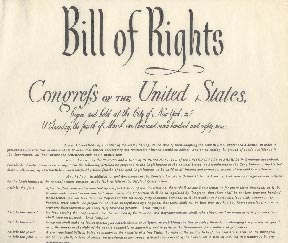 Recently, I’ve wanted a copy of the Bill of Rights to carry around with me. (Really!) So today I put together an eBook file with that content. I loaded it onto my Treo so I can consult it at any time.

Another eBook.
Recently, I’ve wanted a copy of the Bill of Rights to carry around with me. (Really!) So today I put together an eBook file with that content. I loaded it onto my Treo so I can consult it at any time.
Can following a person’s tweets make him a real friend?
Sometime last night or this morning — I can’t keep track with the time zone thing — Andy Piper posted a Twitter tweet with a link to an article by Clive Thompson about Twitter. Because the article reinforces something I’d mentioned in my most recent post here about Twitter, I thought I’d share it.
The key paragraph (as far as I’m concerned) from “Clive Thompson on How Twitter Creates a Social Sixth Sense” on Wired.com is this:
When I see that my friend Misha is “waiting at Genius Bar to send my MacBook to the shop,” that’s not much information. But when I get such granular updates every day for a month, I know a lot more about her. And when my four closest friends and worldmates send me dozens of updates a week for five months, I begin to develop an almost telepathic awareness of the people most important to me.
This is pretty much I was trying to say in the introduction of my post. But I can go on to say that even though many of these people started out as strangers, reading their tweets day after day have given me a certain awareness about them that a real friend — but perhaps not a good friend — would have.
I see Twitter as a way to make friends across the world. Although, I don’t ever expect to ever meet most of these people in person, there is a chance that I might actually make real friends with one or two.
For example, I’m actively seeking out interesting Twitter members who live in Arizona to follow. By following their tweets, I can get a sense of what these people are all about. If we have a lot in common, it’s easy enough to take the next step to start a real friendship. And it’s easy enough for them to respond or ignore me.
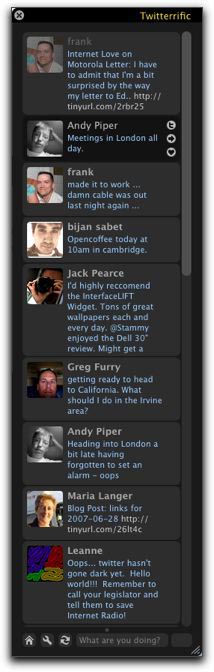 I’m not talking instant friendships here. I’m talking about possibly months of watching tweets as part of my day. In my case, that means having Twitterific open on my Mac’s desktop and peeking at the tweets of a handful of people as they come in. I delete “friends” who really don’t seem to be on the same wavelength with me and add “friends” who might. Over time, the ones who remain on my desktop are the ones that could become real friends. If they’re in the area, why not get together for coffee or a hike or a museum trip?
It all comes down to using Twitter seriously, which I’ve discussed in at least one other blog post about Twitter. Use a Twitter tool (like Twitterific or some other program that selectively tracks tweets) to track only the tweets of people who interest you. Obviously, real friends should be included — if you can get them to use Twitter.
To find new people to follow, I’ll occasionally watch Twittervision and read the tweets posted in the US, especially in my area. I’ll add one or two “friends” to track for a while. I also use the Public Timeline to find interesting tweets and add corresponding Twitter members. In both cases, I limit my time to about 5 minutes — without setting a limit, either of these monitoring tools could suck hours away from your life.
My biggest problem: Most Twitter users are between 18 and 27 years old. That really shows in their posts. (Take that any way you like.) My goal is to find mature, interesting people to follow.
And, little by little, I think I’m building up a good group of Twitter “friends.”
But the question remains: will any of these people become real friends? We’ll see.
Yes, it’s cool, but there are other options. And is coolness really a reason to wait on line?
 I’ve been reading, with great interest, the articles about iPhone hype and reviews of the iPhone by people who have actually used one for a few weeks. The interest is twofold:
Before I go any further, let me make two things clear: I’m a loyal Apple computer user and have been so since 1989. I’d like very much to have an iPhone because everything I’ve seen so far indicates that it will be a great product. I’m also an Apple stockholder.
That said, what is the big deal? The iPhone is just another smartphone. Yes, it’s got a great design and yes, it’s hot. But there are several smartphones already on the market that do just about everything that the iPhone will do.
My Treo 700p comes to mind. It’s got a touch screen. It does e-mail and Web browsing and lets me send and receive text messages. It syncs with my Mac so I can take my entire address book and calendar with me wherever I go. It takes still photos and video and saves them on the phone or e-mails them to someone else. It plays MP3s (although I still prefer using my iPod for that). GoogleMaps for Palm OS gives the Treo the same Map feature the iPhone offers at no extra cost. With the addition of relatively inexpensive software, the Treo can also do handwriting recognition and voice dialing. And software — did I mention that there are hundreds of third-party software products that can extend the functionality of my Treo?
Now don’t get me wrong. I’m not suggesting that you buy a Treo instead of an iPhone.
I’m just pointing out that there are other products out there that do what the iPhone does. And I’m pretty sure that all of them are cheaper and available with calling plans that are cheaper. So you can do the same thing for less money.
The main difference I see, however, is design. The iPhone looks cool and I know the interface is going to be a heck of a lot more intuitive than the relatively confusing interface of the Treo. (I can do standard tasks with the Treo, but have a hell of a time setting configuration options, which don’t seem to be centralized in a logical place.) If there’s one thing that Apple excels at, it’s design — from its product packaging to its advertisements to its stores to its hardware and software products.
But since when does good design warrant the kind of attention and consumer demand the iPhone is getting?
People have been using and raving about poorly designed products for years. (I won’t get specific here because I don’t want to set set myself up for the fanboys to bash.) Why, all of a sudden, has a potentially well-designed product become the center of attention?
Could it simply be the “cool factor”?
I remember when the Motorola Razr came out. My husband just had to get one the day they became available. He came home to show it off. Sure, it was sleek and small. But compared to my 3-year-old Motorola flip phone, it wasn’t very comfortable to hold and the buttons were difficult to push. I wasn’t terribly impressed. But I saw the reaction of others when he whipped out his phone to answer a call in front of friends and work associates. They were really impressed.
Could that be why people want the iPhone badly enough to wait in line for four days? Or to pay someone else to wait in line for them?
Is anyone out there saying “duh-uh”? Or is this a revelation to some of you?
Is the iPhone craze just another example of our skewed sense of values? Looks that way to me.
Meanwhile, the poll on this site indicates that of the 352 people who have voted, 28% of them claim they want an iPhone badly enough to wait on line to get one. Another 34% say they expect to get one within the next 6 months. Only 13% say they don’t want one at all. I realize that this isn’t the most scientific poll — after all, the people who found it online are the ones obviously interested in the iPhone. Here’s a more objective poll.
As for me, I don’t do lines. (Take that any way you like.) I won’t even wait 20 minutes for a table at a restaurant. (And I like to eat.)
So I continue to watch the excitement with great interest from a safe position on the sidelines. Would love to get comments from other spectators.
Apathy and death among Hofstra University’s Class of 1982.
Yesterday’s mail brought a big white envelope from Hofstra University, my alma mater. May 20 was the 25th anniversary of my graduating class, the Class of 1982. Although I was tempted to make the cross-country trek to Long Island, NY from my home in Arizona, I’d scheduled a helicopter rides gig for May 19 in Yarnell and preferred to do that. I’m glad I did.
A few months before the event, Hofstra’s Alumni Association sent out a survey form requesting bios from class members. Proud of what I’ve done since my college years, I promptly filled mine out and returned it to the school. They wanted a digital photo to go with it, but I forgot to go online (as they requested) and upload a suitable image.
Understand this: my college years were among the most difficult yet enjoyable years of my life. Difficult primarily because of the expense. Hofstra, a private school, was getting about $120 per credit in those days. While I know that’s nothing compared to today’s tuitions, that $1800 to $2200 per semester tuition bill (plus books plus room and board) was killing me. The deal I cut with my parents was that each of them (they were divorced) would cough up 1/3 and I’d put in the final third. I consider myself lucky for being able to get that much from them. I also consider myself lucky for getting two scholarships that knocked more than $1000 off the annual tuition fee. So yes — I only had to come up with about $1200 a year. But I had to work two part-time minimum wage jobs (at less than $3/hour, if I recall) to make that and the money I needed to keep my car running and food in my mouth. I was 20 when I graduated and, by that point, I’d already worked harder than anyone else I knew.
(I was also incredibly thin at one point, weighing in at only 105 pounds. I ate little and worked hard and simply couldn’t keep the weight on. At 5’8″ tall, I looked terrible — absolutely skeletal. It took the school’s meal plan and those delicious hot rolls at dinner to fatten me back up.)
I’m not complaining about the hard work or financial situation. I believe in working hard to get ahead. And 25 years later, I still believe it. Too many people are looking for a free ride. Too many people spend more effort trying to get away with as little real work as possible than actually doing the work they’re being paid to do. And then they wonder why they’re not getting anywhere in life, why the promotions are always going to someone else, or why they’re first in line for layoff when their company starts sending jobs to India and Pakistan.
I also think that everyone should be a little needy at least once in their life. Back in those days, having $20 in my pocket made me rich. The money I made went to my tuition bill, to feed myself (until I got on that meal plan and my parents picked up 2/3 the cost), and to put gas in my car. (I drove a 1970 VW bug and gas cost 70¢ per gallon.) Most of my friends were in a similar situation, although I think I was the only one footing part of the bill for my education. We learned how far you could stretch a dollar and how important it was not to waste money on things we didn’t really need. I think that’s a lesson many of today’s kids could learn from. When you have to earn every dollar you spend, that dollar becomes a lot more valuable.
As for my college years being the most enjoyable of my life — well, that might be a bit of an exaggeration, but it’s mostly true. It gave me my first taste of real freedom — and real responsibility. I learned how to have fun and take care of the things I had to do to stay in school, get decent grades, and earn enough money to get by. I had a lot of friends — mostly people like me. I never joined a sorority, but I did become part of the yearbook staff as a photographer. I spent my off-hours during the day in the school’s game room, shooting pool with some friends and becoming a reasonably good pinball player. In the evening, we’d head over to a local bar, which had excellent french onion soup for just a buck and cheap beer on Thursday nights. We also hit the Ambassador Diner in Hempstead periodically for greasy but excellent batter dipped onion rings. Almost all of my friends were guys, but there was no sex between us. (I’ve always been “one of the guys” and I still am.) I dated two different guys while in college and, unlike so many of the girls at Hofstra for their “MRS” degree, wound up single when I graduated at the age of 20 with a BBA in accounting. That was fine with me.
I never really felt any affection for Hofstra. It seemed like every time I turned around, they had their hands out for money. I nearly got kicked out for late payment of tuition twice, yet they never failed to send requests for donations to my family. I get those requests now. They come to my house with full-color booklets about the newest on campus building and latest event, along with a summary of what the entire alumni student body has been up to — well, at least those members who bothered to provide updates. I used to provide updates once in a while, announcing a new book or providing information about my latest endeavor. They even featured my helicopter charter business in one issue. But the way I saw it, I struggled enough to pay them when I was a student and they never cut me any slack when I had trouble coming up with the dough. I didn’t owe them a thing.
But when the reunion material arrived, I decided to fill it out and return it. I was curious about my classmates, curious about what they’d been up to all these years. I even toyed with the idea of blowing off my helicopter gig and going out for the reunion.
But when the reunion materials arrived today, I was glad I’d made the decision I’d made. Accompanying the “sorry we missed you” letter and donation request form was a thin booklet titled, Congratulations to the Class of 1982 on your 25th Anniversary. In it were photos as “bios” from 59 students (including me). I’d known two of them well — one of them is my step cousin. The photos were right out of the yearbook, with current photos added for the folks who had bothered to send them. Few had. Most bios lacked any amount of imagination, simply stating what degree the person had earned during his stay at Hofstra and whether he had gone on to earn additional degrees. Marriages to college sweethearts were mentioned more than a few times. Women were sure to mention how many kids they had. It was pretty boring stuff; only about 5 people wrote bios that actually brought readers up to date. (I was one of them, as you probably guessed.)
What was more tragic was the “In Memoriam” page after the bios. It listed 54 classmates that are no longer walking on this earth. 54! Sheesh! Almost as many dead ones as ones who bothered to respond to the reunion notice. And remember, this is a 25-year anniversary — not a 50-year. Most of my classmates are under 50. That means that at 54 of them died before their 50th birthday.
Now I don’t know how many people were in the class of 1982. I know that the School of Business, which was my slot at the graduation ceremonies, had hundreds of students in it. There had to be at least 2,000 students in the entire class. And the alumni association got reunion responses for just 113 of them — 54 of which were dead. Can you say apathy? And I thought I was alone in my feelings — or lack thereof — for the school.
And how many people actually showed up for the May 20 party? I hope they didn’t rent a big hall.
It never ceases to amaze me how rude some people can be online.
Although I don’t closely follow any one blog closely, I do tend to read posts I stumble upon — including the comments left by other readers. And it never ceases to amaze me how incredibly rude some blog commenters can be.
What is it with people? Can’t they read a blog entry for what it is — a personal view of a particular topic?
Yes, I said personal view. That means a view formed, in part, by opinion.
Today, I read a post on a blog where someone commented in brief about the new features of Mac OS X Leopard. His comments were generally positive, but certainly not the comments of a “fan boy.” The first commenter attacked by saying that Leopard was a Vista rip-off and had absolutely nothing in it that couldn’t be found in Vista, which was a far superior OS. But rather than say this in the spirit of friendly debate, he went on the attack, rudely contradicting and belittling everything the blogger had to say.
Later today, I read a post by a blogger who made some negative comments about George Bush and the Iraq War. These were comments I’ve read in many other places, opinions that are shared by millions of people worldwide. Yet the first commenter went on the attack, presenting a laundry list of fallacies that he intended to prove that the blogger was wrong. Again, his comments were rudely presented, meant to belittle the blogger on his own blog.
Earlier today, I wrote a blog post about why I won’t be buying an iPhone. That post immediately attracted comments suggesting that I was stupid to be a Verizon customer, that AT&T was a far superior company than Verizon, and that no one cared about whether I bought an iPhone. Some of these comments were obviously written to make me look like a fool.
On my own blog.
What I can’t figure out is why. Why would someone take the time to bash a stranger for voicing an opinion?
I’ve said it before and I’ll say it again: When you visit a person’s blog, it’s like stepping into their living room. Use some manners when you have something to say.
The blogosphere is filled with hate — people going out of their way to be nasty and spiteful to other people. Why? It’s so completely unproductive and, frankly, it makes these nasty people look like a bunch of stupid, rude SOBs.
I’m not saying that commenters shouldn’t voice opposing opinions. I’m just saying that they should do so with a certain amount of restraint. Kindness gets you a lot farther in this world than a bad attitude ever will.
And for heaven’s sake, if you have a constant need to post nasty comments on other people’s blogs, take a few days off to cool down. You need a break. You need to mellow out. You need to find your life and get back to it. And you need to grow up and stop acting like a spoiled child.