A Trip to Phantom Ranch

We take a mule ride to the bottom of the Grand Canyon, spend two nights, and return to civilization.

There are two ways to get to the bottom of the Grand Canyon: hike or ride a mule. Although I’m quite sure I could hike down into the Grand Canyon, I am equally sure that I could not hike up. So that left the mule ride.
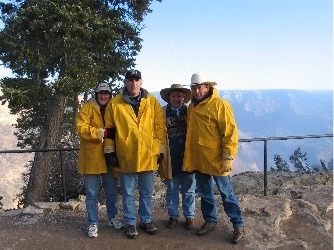
Ready to Ride!We’d done it before, perhaps ten years ago. It had been a Christmas present for Mike. A two-night mule trip to Phantom Ranch at the bottom of the Grand Canyon. This time, we did it with John and Lorna, two friends of ours from Maine. The Grand Canyon’s mule operators have, during the high season, 160 mules on hand to take riders or supplies into and out of the canyon. In late February, there are several dozen. We turned up at the “round corral” at 8 AM as instructed, wearing our outfitter-supplied yellow rain slickers. The temperature was in the 20s (F, of course) and we were shivering as we waited. There were about 12 of us going down that day, but eight were doing the day trip to Plateau Point, which looks out over the Inner Gorge not far from Indian Gardens. That’s about a 3-hour ride (each way). Our ride would be 4-1/2 hours, taking the Bright Angel Trail all the way down to the river.

We mounted up right after the first group left. Our wrangler’s name was Jeff and he didn’t seem to be too happy to be making the trip to Phantom Ranch with us. Maybe he’d woken up on the wrong side of the bed that morning. But when we headed out, I started working on him and I softened him up a bit. We told him what we all did and he told us about some of the places he’d worked. I think he soon realized that we were among the most experienced riders he’d have on a mule ride and I think that helped him to relax.
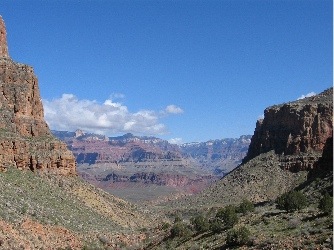
Grand Canyon from Bright Angel TrailAll the time, we were heading down into the canyon, on a trail that was about six feet wide in most places. Near the top — perhaps the first 30 minutes of the ride — there was ice on the trail and you had to just hope your mule was surefooted enough to cross it safely. It turns out that the mules wear special winter shoes that help grip that ice. Further down into the canyon, the ice was melting and running off from the top, making tiny streams and waterfalls. Everything was wet and alive. And the view was great. Mules are not afraid of heights and they seem to like to prove this. They often walk on the outside edge of the trail, sometimes only inches from a sheer cliff. This did not bother me much on the way down, but, for some reason, freaked me out a bit on the way back up. (Go figure.) My mule’s name was Bumpy because he was. But his name could also have been Muddy, Dirty, or Filthy. He obviously liked rolling in the mud of the mule enclosure and the wranglers didn’t think it was worth brushing all that mud off his neck, legs, and lower body. His saddle was quite uncomfortable and seemed to have seams running right under my butt. Of course, those could have been the seams of my underwear against a rock-hard seat as I bumped down the trail.

We were in the shadows for most of the first two hours of the ride and it was quite cool. But at least we were sheltered from the wind that had been blowing up top. We saw three big horn sheep and a small herd of mule deer along the way. By the time we got to Indian Gardens, I was ready to shed the yellow slicker. We dismounted and I took a few moments to stretch the kinks out of my legs before sitting down to the box lunch Jeff had brought us. The other riders were already there, finishing up their lunches. While we ate, they mounted up again and headed down the trail to Plateau Point. We spent about 30 minutes out of the saddle, made an all-important visit to the pit toilets — among the nicest I’ve ever seen — then mounted back up and continued down our trail.

The ride slipped into a narrow canyon that rode alongside Pipe Creek for a while. The creek was rushing with water from the runoff up above and we had to cross it several times. There were a few places where the trail seemed to narrow as it wound along the edge of various cliffs. Every time we passed hikers, Jeff would instruct them to stand on the inside of the trail, leaving us to go around them on the outside. We got to a point in the trail where a small creek far below came into view and Jeff told us the stupidest question a rider had ever asked: “If the dam wasn’t built, would there be more water there?” The rider was obviously mistaking a tiny runoff creek for the Colorado. Jeff had merely replied, “Yes.” He figured that she probably felt pretty stupid when she saw the Colorado a while later.

We came out of the bottom of Pipe Creek Canyon — so named because the trans-canyon pipeline runs up it to Indian Gardens — and the Colorado was suddenly before us: rushing wildly with silty runoff. Colorado means reddish in Spanish (or so I’ve read) and what we were seeing was the natural color of the river. Nowadays, the river’s normal color is a deep blue-green. (I know because I flew over it multiple times over the past summer.) The Glen Canyon Dam 80 miles or so upstream doesn’t just hold back the water. It holds back the silt. So the water coming out of the dam is always clear and cold. But with all the rain we’d been having in Arizona, there was lots of water draining into river tributaries, including the Little Colorado River to the east and multiple side canyons. So the canyon was getting its share of silt and the water color was a bright, muddy brown.
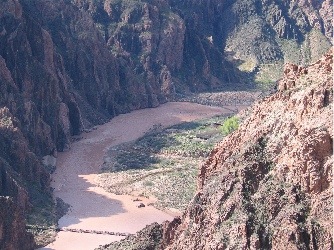
Bridges over the ColoradoWe rode for another hour or so after that, finally reaching the pair of bridges that cross the Colorado to Bright Angel Canyon. The first bridge, a silver-colored suspension bridge, was for foot traffic only, so we added an extra 20 minutes to our ride getting to the black bridge of the Kaibab Trail, about a half-mile upriver. We had to ride through a low tunnel in the rock wall to get to the bridge. From there, it was only 20 minutes more to Phantom Ranch. By the time we reached the ranch, I was in serious pain. My stirrups were too short and my knees were aching. It felt good to get out of the saddle. Although I didn’t think I’d ever recover, I was feeling much better just a half hour later.
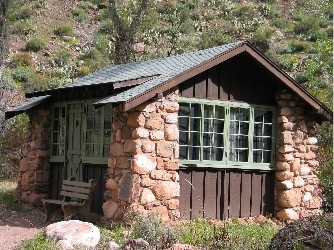
Phantom RanchDave, the ranch manager, met us at the corral and took us to our cabins. There were only two cabins with queen sized beds at Phantom Ranch and we’d reserved them both — eight months ago. The cabins, which were designed by Mary Colter and built in the 1920s, were one-room buildings built primarily of stone. Very quaint. Each one had a closet with a toilet in it and a sink that ran cold water. Hot water and showers were available in a building a few hundred yards away. The main lodge building was where you could buy supplies and have your meals. We stopped in for a lemonade not long after we arrived.
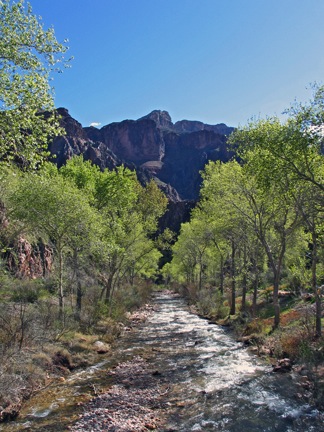
Bright Angel CreekWe went for a short hike back down to the river before dinner, checking out the confluence of the river with the clear waters of Bright Angel Creek. Then a good, hot shower. Then back to the lodge. Dinner was served family style with two seatings. We were in the first seating, at 5 PM, the first night. The meal featured steak, which was surprisingly tender (although not cooked quite enough for my taste), baked potatoes, corn, peas, salad, and cornbread. It was all you could eat and I ate a ton. I think I expected all the exercise I’d get during our stay to burn off calories. Sadly, it didn’t.

After the second seating, the lodge opened back up for drinks (beer, terrible wine, and soft drinks), talking, and game playing. We hung around for a short while, then headed back to our cabins. I slept great that night — much better than I had in our cabin on the rim — and woke the next morning feeling really refreshed.
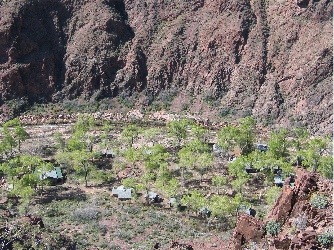
Phantom RanchAfter a hearty (too hearty!) breakfast in the lodge, we headed out for a hike on the Clear Creek Trail. This trail climbs about 1,000 feet in its first mile, passes a lookout point where you can see all of Phantom Ranch below you, then offers stunning views of the Colorado River, Inner Gorge, and canyon walls. The first mile was a killer for me — I don’t do up very well. But it was worth it. The views were great and the trail leveled out for a pleasant walk.

Oddly enough, while we were hiking, we came out to a viewpoint that looked down at the mouth of the Bright Angel Creek. A helicopter was spinning on a helipad far below us. We hadn’t even heard him come in. It was the park helicopter and, as we watched, it took off with a long line below it and headed up Bright Angel Canyon. A few moments later, it returned, dangling a generator or welder beneath it as it headed to the South Rim. (There had been a water line break in the canyon and this was probably some of the equipment needed to fix it. He returned for another load a short while later, then returned once again to have the long line removed. It amazed me how little noise the helicopter made. I’d begun to believe what I heard from the tree-huggers: that helicopters were a noisy intrusion on the grandeur of the canyon. In reality, the sound of the river and the bends in the canyon walls swallowed the sound of the helicopter.
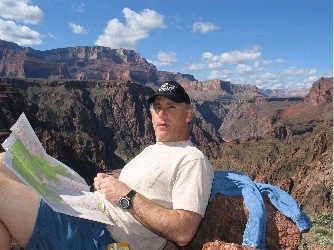
Mike in the Grand CanyonWe did about two miles, stopping for lunch on a point that looked down the river. The trail kept going, lined with yellow flowers as it climbed a bit more to the top of the inner gorge. But we’d had enough. We turned around and went back. Mike and John headed up Bright Angel Creek while Lorna and I went back to the ranch to relax. We got there just before 3 PM.

Dinner that second night was beef stew and it was good. I ate a ton of food and fully regretted it the next day, when I had to cram my body into a clean pair of jeans. We spent some time playing dominoes after dinner, then hit the sack.
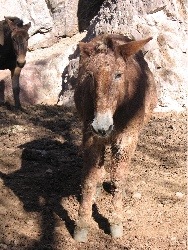
Mule at Phantom RanchThe next day, after yet another hearty breakfast, we headed over to the mule corral where Bumpy, Charlie, BB, and Darth Vader were waiting. Frank, a different wrangler, had come down the day before to take us out. There was a female wrangler there, too. She was in charge of the eight or so riders that had come down the previous day for a one-night trip. They left before us and we mounted up and followed Frank out. Fortunately, I’d had the foresight to have my stirrups lengthened, so I wasn’t in as much pain on the way out as I’d been in on the way down. Now if only I’d brought a cushion for the seat!The ride out of the canyon was considerably longer, primarily because we had to stop often to rest the mules. I figure it took about five hours. We stopped at Indian Gardens for a snack and a bathroom break on the way out. We saw some more bighorn sheep and a condor. And lots of photo opportunities along the way. Finally, we were back on the rim and the trip was over.

Did I have a great time? You bet! Would I recommend this trip to others? Of course! A mule ride to the bottom of the canyon is an experience that I’ll remember forever. I’m just fortunate enough to have done it twice.

Exploring the Desert by Helicopter

We wander through a mill site, fly over an open pit mine, get a hamburger in the middle of nowhere, and see the “land now” light four miles short of home.

It all started over a year ago. I discovered the beauty of the Santa Maria River from the air.

The canyon east of route 93 is unbelievably beautiful, with dramatic rock formations, cacti, and a river with real water in it. Part of the canyon is in the Arrastra Wilderness and I generally avoid it. But most of it is open to the flying public (so to speak) and I occasionally fly through it, following the winding canyon from Alamo Lake to 93.

On my flights, I’ve always noticed the remains of some kind of mining site at the end of a road not far from 93. There was some kind of shack there, what appeared to be a metal tank, and some tailings piles. Among all that was what appeared, from the air, to be a good landing zone. I thought about what a neat place it might be to take passengers or even to set up a base camp for hiking the area over a period of several days. But the road that wound through the desert from 93 to the site made it less than perfect. After all, why take a helicopter to a camp when you can hop in a Jeep and do it for a lot less money?

Time passed. Then, on Thursday, I got a call from a man named Bobby who wanted me to take him and his wife to see some ranch land he owned on the Santa Maria River from the air.

You can probably guess where this is going. The “ranch land” was the mill site I’d seen from the air.

According to Bobby, the site is named Waters Sunset Mine. I spent a good part of this morning — my usual blogging time, in fact — trying to research the site. What I came up with was the Waters/Sunset Mill and Mine, which was purchased by Orex Corporation back in 1999. This kind of jived with what Bobby had told me: that he’d sold the land to a mining company and they’d gone bust so he’d gotten the land back. There was 46 acres of this land, right on the Santa Maria River, and he owned both the land and the corresponding water rights, which he said were now worth more than the land.

It turns out, the road to the mine is not passable, partly because the Santa Maria River, which is running pretty good right now, runs right through it. There’s only one road in. So it’s impossible to get there by wheeled vehicle (unless it’s amphibious). Bobby didn’t want to land there — which is a good thing, since I’m still not legal to land with paying passengers. He just wanted to photograph it from the air. So the job was an aerial photography/survey job rather than a sightseeing tour.

After he shot his pictures and we moved on to another site to photography, we talked about the site. I told him my ideas about using the land. I told him that I’d rather use private land than public land because it’s easier to get permission. He said that he’d give me permission to use the land. I told him that if I used the land for paying customers, I’d pay him a fee per customer I brought there. He liked that idea. I think he saw it as a way to make a few bucks off some otherwise useless land.

That was Friday. This morning — Saturday — Mike and I decided to go check it out from the ground. We called John and Lorna and they were interested in coming along. So at 10:00 AM, I lifted off from Wickenburg in Zero-Mike-Lima with all four seats full for the 41-mile flight to the mill site. We followed 93 most of the way, drifting to the west when we saw the rock formation known as Shiprock. (No, this isn’t the big Shiprock near the Four Corners area. It’s a much smaller, differently-shaped version.)

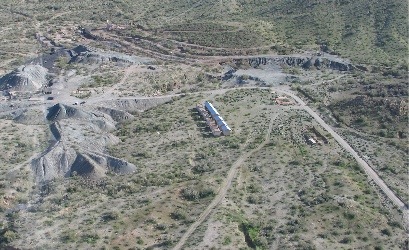
Landing ZoneWe overflew the site and I set up to land, coming up the canyon from downstream. There were two big, apparently flat areas to choose from. The first choice was not a good one; the landing zone wasn’t flat enough and the helicopter rocked a bit on its skids when I set down. I don’t like that, so I tried another spot. It wasn’t until I set down the fifth time, in another big, clear area that I was satisfied. I shut it down and we got out to explore.

Core SamplesThere isn’t much at the site in the way of ruins. There are some nicely preserved rock foundations and a weird metal shed. There are also hundreds — if not thousands — of core samples that were once neatly piled in wooden boxes alongside a big rock formation. The wood has rotted considerably and the boxes, in some places, have fallen over.

We spent nearly two hours there, walking among the ruins and trying to identify what the things we saw were for. We also spent quite a bit of time along the river. I’d been worried, at first, that we’d be able to hear the traffic on 93. After all, it was only a mile or two upstream. But the sound of the water drowned out any other sounds. Even when we hiked up the road to the top of a hill where the sound of the water was much fainter, there was no car sound. That made me happy. It’s hard to sell a place as “wilderness” when you can hear cars on a highway nearby.

The Santa Maria RiverThe river was beautiful, flowing swiftly over rocks and sand. There were a number of very nice beaches (if that’s the right word) that would have been wonderful for sunning yourself or even swimming. And the sand just below the water’s surface absolutely sparkled with mica — or was that gold? I think I’ll have to bring a gold pan the next time I fly out.

I asked John, Lorna, and Mike if they thought the site would make an interesting day trip for passengers. They all agreed that it would. Then I asked if they thought it would work for overnight camping trips. They said it would be great for camping. Lots of level places to pitch tents, plenty of water nearby, and wonderful, peaceful scenery.

Heck, I’m sold.

We climbed back into the helicopter at about 12:30, now hungry for lunch. I didn’t expect us to be there so long, so we didn’t bring any food. We decided to hit the Wayside Inn near Alamo Lake for some of their excellent hamburgers. But first, we’d swing past Bagdad so I could show John and Lorna the mine there.

Bagdad is a mining town about 60 miles northwest of Wickenburg, about 15 miles off route 93. Its main feature is an open pit copper mine and that’s what pretty much supports the whole town. Unfortunately, I didn’t have my camera out when we flew over the mine — it’s quite a site to behold from the air! John and Lorna were suitably impressed. I think they’d been expecting the usual mine shaft that we can often see from the air. But this was a big pit with huge dump trucks hauling ore out, even on a Saturday afternoon. I flew past the leeching ponds and descended down into the canyon. We followed that to Kaiser Canyon, where I pointed out the hot spring far below us, then followed Burro Creek to the Big Sandy Wash and followed that to Alamo Lake.

The lake is high because of all the rain we’d been having. So high, in fact, that the road that runs across its eastern end is under 16 feet of water. (I know that because our waitress told us. She also said she caught a huge bass there the other day.) I headed out toward the Wayside Inn, which is southeast of the lake and, because we had a tailwind, flew past and circled around to land into the wind. I set down on a triangle of land at the crossroads there, right across the road from the campground. I kicked up a bunch of dust, but no one complained. I shut down and we went in for lunch.

(I’m sure I’ve covered the Wayside Inn in another blog post. Let me look it up so you can read about it….ah, here it is.)

At the Wayside InnThe waitress remembered me from the last time I’d been in. “That’s a different helicopter from last time,” she said.

“Yeah, I added water and it grew,” I told her. That had become the joke that all my helicopter friends were using. “I wish it was that easy,” I added.

We ordered lunch, admiring the photos of the fish caught in the nearby lake. Some of the fish were quite large. There were dated Polaroids of dozens of them, held up by the people who’d caught them, on the wall near our table. Each photo included the date and the weight of the fish. The newest photos were only two days old. When the burgers were history, I helped myself to desert: a Schwans ice cream sundae cup. It was exactly the right kind of desert for a meal in the middle of nowhere.

It was about 2:00 PM when we headed home. When I started up, I realized that we were a bit lower on fuel than I thought we were. But as we gained speed, heading straight back to Wickenburg, the GPS told us we’d be there in less than 15 minutes. Surely I had enough fuel to make it back. Although my smaller, aux tank was on E, the main tank showed about 7 or 8 gallons. I remembered how I’d occasionally get both of Three-Niner-Lima’s gauges down to E without the Low Fuel (AKA Land Now) light going on. It certainly looked as if I’d have enough fuel to make it back.

I almost did.

Another Landing ZoneWe were about four miles out of Wickenburg when the Low Fuel light started to flicker. It went on, then off, then on, then off. Then on. According to my gauges, I still had about 1/8 left in the main. But I remembered what they’d taught us in the Robinson Factory Safety Course: trust the light, not your gauges. To me, the light meant “Land Now.” So I landed. On a dirt road. In the desert. At least a mile from pavement.
You have to understand that if I did run out of fuel, there was only one way down and it was the fast way. I much preferred taking my time about the landing, picking a spot when I still had enough fuel to get me there with the engine running. So I landed even when I may have had enough fuel to make it back to Wickenburg. After all, I might not have had enough fuel to make it back and then things could have gotten ugly.

Mike volunteered to walk to 60 and hitch a ride back to the airport. He started walking and I started making phone calls. I got Gus on the phone and told him where the fuel cans were. He wanted to know how far out we were. I didn’t really know how far out we were on 60. I gave him Mike’s cell phone number.

Then I saw a helicopter off in the distance. Could it be? I got in, flicked the master switch, turned on the radio, and put on my headset. I keyed my mike. “Ray? Is that you?”

“Yeah, what’s up, Maria? Where are you?”

“We ran out of gas about four miles short of the airport.”

“Got a fuel light?” he wanted to know.

“Yeah. I’m not taking chances.”

He flew by a few minutes later. Then I asked him to fetch us some fuel from the airport to save Gus a ride. Gus heard me on the radio and he and Ray made arrangements. I turned off the radio and called Mike. It was a good thing I did. True to form, he’d decided to bushwhack through the desert, thinking he’d take a shorter route back to pavement. But rather than bushwhack on a route that went more southbound (correct) he was going more westbound (incorrect). As we later pointed out to him, if he’d stayed on his track, he’d have walked an extra mile or so before reaching the road. Next time, I’m going to give him a compass. I had one under the back seat.

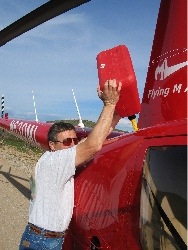
Just add fuelRay landed in a nice grassy area not long after Mike returned. We got the two fuel cans out of the back of his helicopter — he still doesn’t have seats back there — and he took off. Then Mike and John poured the 10.7 gallons of fuel into the helicopter. When I started up and looked at my gauges, I saw that we now had more fuel than when we’d left the Wayside Inn.

We flew back to Wickenburg and I landed at the pumps. Earl, who was on duty there, topped both of them off. We parked outside — I’m flying again tomorrow. Gus came by and made some jokes about me running out of fuel. I realized that I’d be getting ribbed about it for a long time to come.

We all had a great time, though, and I don’t mind the ribbing.

Quartzsite 2005

I spend a day in Quartzsite, AZ with friends.

I know I’ve mentioned Quartzsite more than a few times on these pages. I can’t remember if I explained what Quartzsite is. So I’ll explain here.

Quartzsite, you see, is more of a what than a where. Where is easy: it’s on I-10 about 20 miles east of the Colorado River/California Border. What is more difficult. It’s a town with a population that swells from a summertime low of about 1,000 people to a wintertime high of over 100,000 people. Most of those people show up in January. They show up in RVs and motor homes, they fill the campgrounds and the overflow vehicles park on the BLM land out in the desert.

Why do they come? For the swap meets, rock and art shows, and RV show. The whole town fills with vendors selling everything from dental picks to RV toilet systems. There are tools, clothes, RV equipment, blankets, custom license plate frames, hand trucks, scooters, dried fruit — you name it. All spread out in “shows” throughout the town on what are normally dirt lots. By mid-February much of this is gone. By March, most of it is gone. Any by April, Quartzsite has a ghost town appearance. Things don’t start picking up again until November or December. Talk about seasonal economies!

I’d wanted to spend a week out at Quartzsite, giving helicopter rides. But I was too late to arrange for a landing zone. Besides, when I was out there last week, flying over with Nancy and Bill, I wasn’t very impressed by the size of the crowd. It didn’t seem worth the bother.

But yesterday, when I rode into town in the back seat of John and Lorna’s pickup, I got a different picture. What a difference a week makes! Last year I’d guessed that the biggest week in Quartzsite was the week of the RV show. Yesterday confirmed it. There were at least three times as many RVs parked out in the desert as there had been the week before. I have no idea of where all these people came from, but there’s no denying they were there. In numbers.

After inching our way through traffic in town, we found a good parking space on Kuehn Street, which runs parallel to I-10 on the south side of the highway. That became our base for exploring two of the shows: The RV show, which John and Lorna were anxious to explore, and Tyson Wells, a rock and art show across the street.

Before we hit the shows, however, I scoped out a piece of land I was interested in leasing for the following year. I’d seen it from the air and it seemed like a perfect location for basing helicopter rides. It was 20 acres, but I’d only need an acre or two. There was a For Sale or Lease sign on it with a phone number. I called the number and spoke to what I assume must have been a Realtor. He promised to e-mail me information about the property.

The RV show was packed. Walking inside the huge tent, in fact, often reminded me of the old days, when I shuffled with thousands of other commuters through the Port Authority Bus Terminal to the subway escalator in New York. (Days I don’t miss one bit.) Everyone had something to sell, some line to try on you. I especially admired the cookware sales people, with their tiny stages and ten or so audience seats, repeating, over and over, the well-rehearsed lines that expounded the benefits of their products. Imagine doing that hour after hour, day after day, for ten days? I couldn’t.

It soon became apparent that, at 43 years old, I was the youngest person in the crowd. RVers in January in Quartzsite tend to be retired folks who are escaping from some cold climate. Some of these people will show up in Wickenburg for Gold Rush Days, the town’s annual attempt to capture revenue from seasonal tourists. Later, when we went to Tyson Wells and the Main Event, the average age dropped a bit and I didn’t feel like a young whippersnapper anymore.

One thing John, Lorna, and I agreed on: the prices of some of the RV equipment seemed very high. We talked about the average cost of the rigs people were towing or driving. A fifth wheel rig averaged about $75K while a Class A motor home (the kind you drive) probably averaged around $150K. These people obviously had no qualms about spending money to make themselves more comfortable. That’s probably why there were at least eight satellite television receiver booths, ten generator booths, and countless booths for electric massage devices and drug-free pain relief products.

We picked up a smoked turkey leg to bring home for Mike, then went back to the truck to drop off our purchases. I’d bought a five-pack of micro-fiber towels ($20 inside the tent; $5 outside the tent — I bought outside). John and Lorna had bags of product literature that Lorna said they’d probably never look at. Near the truck, John bought a battery-operated, bug-zapping fly swatter and threw that in the truck, too. Then it was on to Tyson Wells for lunch.

There were a bunch of food vendors at Tyson Wells. We looked around and found Smokin’ Willie’s BBQ. The Smokin’ Willies people had spent about a week at Wickenburg Airport, at my invitation, the year before. It was my lame attempt to find some kind of “restaurant” at the airport. They did well while they were there, but they had other gigs (like Quartzsite) where they could do better, so they left. They remembered me well. John, Lorna, and I ate at their booth.

We walked around Tyson Wells for a while. I bought two 16′ telescoping poles that I could use to hang flags at helicopter ride events. (I still had four red, white, and blue flags I’d bought for the airport but had not included in my asset sale.) John and Lorna bought some ocarinas to give as gifts. I inquired at a booth about an engraved key tag. I’d bought one at Quartzsite years ago for Three-Niner-Lima: a classy leather tag with an engraved metal insert. I wanted the same thing for Zero-Mike-Lima. We were directed to the Main Event, which is where I’d gotten the other one made. So we walked back to the truck, pulled out, and got back into the inching traffic to cross the highway and hit the Main Event.

The Main Event is probably the longest-running show in Quartzsite. By that, I mean it seems to be the first to start and the last to end. We got a good parking space on the east end (the parking gods must have been watching over us that day) and got out to walk. We found the engraving booth right away. The guy remembered me. He no longer made the leather/metal key tags, but he had some other designs. I picked one and requested that he engrave N630ML on it. Then I designed a license plate frame for my Honda that said “My Helicopter is Red, Too!” and paid for my purchases. While I was there, the booth guy and his wife told me that the Main Event was now owned by two different people. The show was Main Event East and Main Event West. Interesting.

We walked around the show and it soon became apparent that the split was quite serious. A big piece of land between the east and west sides had been fenced off and was vacant. This is the same land that had been crammed with vendors the year before. A fence with a gate let people into the west side. There were fewer vendors than I remember and the overall quality of what was offered was a bit lower than the usual low I’d come to expect. Many of the vendors were what I call “garage sale” booths — booths that seem to be selling junk from someone’s garage. But the cactus people were there, along with a few better quality vendors. Among these was the pelt and feather guy (as I call him) from Sedona. I took a moment to call Janet in Colorado and see if she needed any feathers. (Janet is an artist who paints on feathers.) I wound up buying two different kinds of pheasant skins for her. So I got to carry around two dead birds with me for the rest of the day.

We crossed back to the east side and walked around those vendors for a while. We bought some dried fruit and some other odds and ends. Then we went back to the engraving guy and picked up my key tag and license plate frame. Both were perfectly done. I told the engraver that he was an artist and I think that pleased him quite a bit.

We met with John and Lorna’s friends, Steve and Sandy, soon after that. They were camping in BLM land off Dome Rock Road. We chatted at the McDonald’s, eating $1 ice cream sundaes. By the time we went our separate ways, it was about 3:30 PM.

I was beat. I spend too much time sitting on my butt, so when I do a lot of walking, it really wipes me out. But we had one more thing to try to find. Ruben, at Screamers, had asked me to pick up a machete for him. He said you could find them “everywhere” in Quartzsite. I’d been looking all day and hadn’t seen a single one. So on our way out of town, we went to the show he said he’d seen them. I don’t know the name of the show, but it’s on the north side of the highway, at the east intersection with SR 95. The machete was in the first booth we walked into. $4. I bought it. Mission accomplished.

The ride home was long — Quartzsite is about 100 miles west of Wickenburg — but pleasant. For much of the ride, there was a rainbow off to our left, where heavy rain was falling over the Harcuvar Mountains. Centennial Wash would be flowing later in the day. We got back to West Park, where John and Lorna are staying, just after sunset.

It had been a good day and I’d gotten plenty of exercise. I’d need some Ibuprofen to help work out the aches and pains today.

A Trip to Quartzsite

I have a nice flight to Quartzsite and back with some pilot friends.

Now that I’ve got my new helicopter, lining up paying gigs to fly it is my top priority. I need to take in about $4K a month to cover its fixed costs, like the monthly loan payment, insurance, and the cost of that annual inspection. Owning a helicopter ain’t cheap, which is why I started Flying M Air in the first place. There has to be some revenue coming in. The R22’s costs were about half of this helicopter’s, so I need to earn twice as much money with this helicopter to keep it.

That said, I’m always on the prowl for possible flying gigs. This month is the “big month” in Quartzsite, AZ. A friend of mine, Ivan, said he and his wife did some barnstorming out there one season with a Hiller and did very well. That was years ago, but he seems to think that it can be done again.

For those of you who have never heard of Quartzsite, let me explain. This little desert town is on I-10 about 20 miles east of the Colorado River and Arizona border. It has a year-round population of about 1,000. But when winter comes, the snowbirds begin arriving in their RVs. They descend upon the town, taking up all the campground parking spaces and overflowing into the BLM land around the town. At its peak — the time of the big RV show in January — there are about 100,000 people within a five-mile radius of the center of town, with more on the outskirts.

What brings all these people to an otherwise boring piece of desert on the highway? Swap meets, mostly. The place turns into a giant flea market, with hundreds of vendors selling everything from small tools to RV solar solutions. There are also a few specific shows, like the RV show, the Main Event, and Tyson Wells Extravaganza (or whatever it calls itself). People are shopping all day, looking for great deals and things to buy and do. And a helicopter ride over the area is a real eye-opener to how the town spreads out.

The trouble is the landing zone. Although the town doesn’t seem opposed to landing a helicopter on an empty lot and doing rides — as long as I have a business permit — the owner of that empty lot might not be so accommodating. So I have to locate an appropriate landing zone, track down the owner, and get his permission. If he says no, I have to start the whole process all over again.

Of course, Quartzsite is completely surrounded by BLM land and it is possible to get a permit from BLM. But it takes 6 months — really! — for them to decide whether they’ll let you. And I don’t have six months.

I called Dick Cloud of Cloud’s Jamboree. Mr. Cloud owned a ton of land on the east side of town, on either side of I-10. His Jamboree was held annually for years and years. Then the State decided that Quartzsite needed another exit. They wanted to put it on Mr. Cloud’s land. So they condemned most of it, paid him off (I hope), and built the new exit. He’s left with only 6 acres on the north side and a trailer park on the south side. He moved the Jamboree to the Avi hotel on the Colorado River in the southernmost reaches of Nevada. He said he’d give me the permission I want, but he doesn’t have room for me. There are RV dealers on the six acres and not enough room for me. But he’s trying to buy some of the land back from the state. In the meantime, I asked him about helicopter rides on weekends at the Avi. He’s going to talk to the General Manager there and let me know. I wouldn’t mind spending every weekend on the Colorado River, especially if they set me up with a room and let me bring Alex the Bird.

Mr. Cloud got some wheels turning in my head, though. The land that had once belonged to him now belonged to the state. If I could get a permit from the state — much easier, I’m told, than BLM — I can set up on some land adjacent to his property. He’d mentioned a lot behind his trailer park, but I wanted more ideas before I made a trip down to the State offices in Phoenix. So that meant a flight out to Quartzsite.

After taking care of some odd jobs around my apartments this morning — including scrubbing a kitchen floor on my hands and knees (but let’s not go there, okay?) — I headed out to the airport. Mike was busy and had other plans, so I figured I’d track down Ivan and his wife and ask them to come along with me. Ivan was there, but he was busy with his Yak. Ivan, who used to fly helicopters, now flies antique airplanes at airshows, etc. The Yak is his plane, but he also flies L-39 jets for an outfit out of Deer Valley. He’d taken his Yak apart about 6 months ago to restore it and was working on it faithfully, every Sunday. This Sunday, his wife wasn’t with him and he was busy cleaning some parts. He said he wanted to come, but had to work on the plane. Besides, his wife’s sister was coming and he had to be home by 4 PM.

Next, I walked around the corner of Ivan’s hangar in search of Ray and Robbie. Their car was there, but only Ray was in the hangar. He was changing the oil on his often-flown and well-pampered Mooney. Robbie was doing things at home. They couldn’t come because he had to finish the oil change and Robbie had some big but unspecified plans for the afternoon.

I was beginning to think it was me, that no one wanted to spend 90 minutes in a helicopter with me.

I called my friend Keri and left a message on her answering machine. Then I drove to Screamers and bought a milk shake. Then I drove back to the airport. Chris, who has the hangar across from me, was just leaving. I went into the hangar, vacuumed Zero-Mike-Lima’s interior, and got the mysterious blood stain off the rear seat. (I’d been pretty upset when I’d seen it, but it came right off the leather with water and a paper towel. Phew!) Keri called back. She had a bad cold and although she wanted to come, she didn’t want to get me sick. I didn’t want to get sick either. Lance, her husband, had just returned from a hunting trip. He’d been up since 2 AM and wouldn’t be good company.

By this time, it was 12:30 and if I wanted to walk around a bit in Quartzsite while I was there, I had better leave soon. So I started hooking up Zero-Mike-Lima to its tow equipment.

I heard a sound behind me and looked up. It was Bill, a former helicopter pilot, whose wife, Nancy, flies an aerobatic Decathalon. He’d come to look at the helicopter. I asked him what he was doing at the airport and he told me that he and Nancy were planning to take a flight out over the desert to see which rivers were flowing and look at some biking trails.”How would you like to come with me to Quartzsite instead?” I asked. “I want to fly out there to look at some landing zones and could use a little company.”It didn’t take a behavioral specialist to realize that he was thrilled at the idea. “When are you going to go?” he asked.”As soon as I get this outside,” I replied.”Nancy’s putting fuel in the plane,” he told me. “I’ll tell her to put it away.” And then he was gone.

Zero Mike Lima at WickenburgI pulled Zero-Mike-Lima out of the hangar, grabbed a water bottle and the emergency kit, closed up the hangar, and towed Zero-Mike-Lima to one of the jet parking spots on the ramp. I had it all disconnected and was taking photos of it when Nancy and Bill showed up, all ready to go.

Ray showed up, too. His Hughes 500D is being painted in Nevada and should be back any day now. He wanted to look at my ship. He peeked into the cockpit and made a comment that told me he was impressed by the interior. (I don’t think people expect to see leather in a helicopter.) Then, obviously realizing that we were on our way out, he wandered back to the terminal.

Bill sat up front and Nancy sat behind him. I started up, giving Bill a narrative of what I was doing. Bill had owned one of the first Rotorways years ago, when he and Nancy lived in Scottsdale and only one airplane was based at the then tiny Scottsdale Airport. He used to fly his helicopter all over the place — even drop Nancy off at work. They’d bought the land that my house currently sits on and built what is now my neighbor’s house. There was (and still is) a landing area there and he routinely landed there with his helicopter. So he seemed pretty interested in what I was telling him.

We flew off to the west. The day was absolutely perfect for flying. Light winds, warm but not hot, clear blue skies. We zipped along at 500 feet above the surface, doing about 110 knots. I didn’t have GPS coordinates for Quartzsite, so I couldn’t punch it into my GPS and get the ETA info. I figured it would take about 45 minutes, though. We had full fuel and none of us were in a hurry. We had some nice conversation, talking about flying and swapping stories about flights. We talked about the things we passed over or near. It was nice having passengers who knew how to position the mike on their headsets so the voice activation feature of the intercom worked flawlessly.

I crossed over Eagle Roost Airpark and the two dirt strips nearby in Aguila. Oddly enough, a plane was just taking off from Eagle Roost — I didn’t think any of those people actually flew. Then Indian Hills in Salome, which was dead as usual. I adjusted course to follow SR-60 and descended after the ridge west of Salome. We flew over the Kofa Cafe, which has gone steadily downhill since it changed ownership two years ago but still seems popular with truckers. Then we passed over one trailer park after another through the valley. We hooked up with I-10, came through a pass, and saw Quartzsite spread out before us.

At QuartzsiteWe circled the town a few times. Nancy took photos with my Canon digital, which I’d left in the back. Remember, I was looking for landing zones. She took a perfect shot of Mr. Cloud’s property on the east side of town on the north side of the property. The RV sellers hadn’t filled it (yet) and there was a nice gate on the far east side that would offer easy yet restricted access to passenger. I could call Mr. Cloud back and offer to e-mail the photo with my proposed LZ drawn in on it. I also saw some land adjacent to Mr. Cloud’s property on the north side of the highway. I’d try getting a permit for that with the state later in the week.
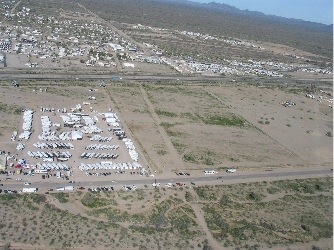
Quartzsite Landing ZoneI also saw a perfect LZ with a “No Camping” sign in it (yes, I was low enough to read it from the air) and wondered how I could find out who owned it. (It’s not as if lot numbers were printed on the land like on a map.) I liked it because there was some grass on it to keep down the dust and no power lines in sight. it was also on a heavily-trafficked road with plenty of parking on the roadside.
We spotted all three landing strips in town, including the one on the Sectional Charts (now marked with a big X in the middle), the one everyone lands at (which has a slight dogleg in it), and the one the ultralights used which I landed at a few times (which now has palm trees planted near the edge). Bill kept telling us about a rock crushing facility he knew of beside the highway, but none of us could see it. I think it may have closed down since he’d seen it or, perhaps it was further west on the highway.

Since neither Bill nor Nancy were interested in getting out to stretch their legs, we departed the area, heading northeast. Rather than going straight back to Wickenburg the way we’d come, I decided to take them for a trip past Swansea, up the Bill Williams River, and back to Wickenburg via the Wayside Inn and Robson’s. A scenic flight. Let’s face it, the flight path along SR-60 from Wickenburg to I-10 isn’t exactly scenic.

Swansea from the AirI made several course adjustments before I thought I was following the right road to Swansea. I wasn’t. We ended up on the Bill Williams River, west of Swansea. We followed the river east. The river was flowing hard and had done some damage to farmland in the valley. Lots of silt. We came upon Swansea a few minutes later. There were a few Jeeps and ATVs on the roads there. I was very surprised to see that half the old worker’s houses had brand new metal roofs on them. It appeared that BLM was not only taking care of the place but it was restoring it. Swansea is one of my intended destinations from Wickenburg when I get my Part 135 certificate. Of course, I’m only two weeks into the six month application process, so I don’t even know whether they’ll let me land there with paying passengers.

We followed the Bill Williams River to the Alamo Dam and Alamo Lake. The lake was the fullest I’d ever seen it, with plenty of brown water coming in from Burro Creek and the Santa Maria River. We flew over the Wayside Inn, which had an airplane parked nearby, and up the Date Creek wash, which was wet in places but not flowing. Spotting some ATVs on the road, I “buzzed” them from a safe altitude, just to give them something to talk about. Then we headed toward Robson’s, where I repeated part of the tour I’d been doing the day before, crossed north of Forepaugh, where the RC airplane pilots were playing, circled Vulture Peak, and landed at Wickenburg.

I’d put 2.1 hours on the Hobbs meter and had two very satisfied passengers. Bill insisted on paying for the fuel to top off the tanks, but knowing what that would cost, I told him I only needed one tank topped off. He wound up paying for 18.3 gallons, which, at $2.89 per gallon, is more than generous.

As I put Zero-Mike-Lima away, I reflected on how successful the flight had been. I’d found three possible landing zones and had already established the means to get permission for two of them. There was a good chance I’d be in Quartzsite next weekend and I was looking forward to it.

New Year’s Weekend

How We Celebrated the New Year.

After several painfully boring New Year’s Eves spent in Wickenburg and one relatively interesting one spent in Prescott, we decided we wanted a more memorable New Year’s Eve.

So we left town.

We stuffed the trunk of my Honda S2000 with overnight bags, dress clothes, and two bottles of champagne, wedged ourselves into the passenger seats, buckled up, put the top down, and sped off to the west on Friday morning.

We went to La Jolla, CA, which is just north of San Diego. We booked a room at the Sea Lodge at La Jolla Shores. Our room featured a huge sliding glass door and private balcony that faced the ocean. All day long, we could watch the waves and the people and birds on the beach. We could listen to the rhythm of the ocean waves. We could watch the weather move in and the kayakers move out and the surfers just float around, waiting for the perfect wave.

On New Year’s Eve, we had reservations for the early seating at Nine Ten, the restaurant in La Jolla’s Grand Colonial Hotel. We chose dinner with a wine pairing. (For those of you who don’t know what that means, each course is served with a different wine that has been selected by someone knowledgeable about wines and foods.) Four courses, four wines. The food was exquisite. I had chestnut soup, sea bass, venison, and a chocolate desert. Everything was both beautifully prepared and delicious. It was the kind of meal you’d couldn’t get within 40 miles of Wickenburg. And I enjoyed every bite of it.

After dinner, we changed into regular clothes and went for a walk on the beach. It was a nice night and there were very few people out and about. Then we had some champagne on our balcony and listened to the waves to welcome in the new year.

On Saturday, New Year’s Day, we drove into San Diego. We spent some time walking around the popular Gaslight Quarter, which reeked of beer from the previous night’s celebrations. Most shops and restaurants were closed; we got there too early. We walked a total of about 20 blocks and saw three Starbucks coffee shops. In all three instances, the Starbucks had been placed near an existing coffee shop. I realized that Starbucks is trying to put all the other coffee shops out of business. This was a revelation to me. We went into one of those little coffee shops for some latte. It was quaint and had lots of character — much nicer than the cookie-cutter design of a Starbucks. And the person who took my order actually made my coffee — imagine that! I wondered how long the place would survive with Starbucks right across the street. So I decided then and there that I would no longer buy coffee (or anything else) in a Starbucks. I’d like to see some little coffee shop put a Starbucks shop out of business and I’ll do my part to help make it happen.

We drove over the big bridge to Coronado Island. We walked around the east side of the island for a while, admiring the view of San Diego, then headed west to the Coronado Hotel. I got an excellent parking spot on the street near the hotel entrance, saving the $5 per hour parking fee I’d have to pay to park on the hotel’s parking lot. We walked around the hotel for a while and I bought a gift for Lorna who, with John, was housesitting for us. The Coronado Hotel is a wonderful historic landmark that is magnificently maintained. We had lunch outdoors in the sunshine: sea bass prepared two different ways. Then a long walk around the town in search of just the right desert. We found a coffee/pastry shop (with a Starbucks right next door — the nerve!) but didn’t find just the right bit of chocolate to satisfy my after-lunch craving. We left town heading south on the long causeway that ends just three miles north of the Mexican border, then headed back north.

Our last stop for the day was Cabrillo National Monument, where the original Point Loma lighthouse stands on a hill overlooking the San Diego Bay. Magnificent views all around. I took lots of pictures and used the movie feature of my camera to create a panoramic movie of the bay and city beyond.

By this time, it was late afternoon and the warm sunshine we’d been enjoying all day was fading behind thin clouds on the horizon. We headed back to La Jolla Shores for a rest before dinner. We had dinner in La Jolla, at a place called Roppongi. The restaurant featured “Asian fusion” food. We ordered five different tapas dishes, all excellent, and a sake sampler. More food you can’t get at home.

On Sunday, we checked out early and headed back down to San Diego’s Balboa Park. Many people know the park as the home of the San Diego Zoo, but the park also features many museums. We visited the Air and Space Museum there, which was surprisingly good. There were many airplanes and spacecraft on display, including the Apollo 9 Space Capsule and an actual GPS satellite. Exhibits were arranged historically, with early aviation exhibits near the entrance of the building and space exhibits near the exit. The building is round, so you walk in a circle to see all of the exhibits. A courtyard in the middle of the building has a glass ceiling and, since the building is in the flight path for San Diego Airport, jets fly right over the roof just a few thousand feet up. It reminded Mike of growing up in Flushing, NY, in the flight path for La Guardia.

Lunch was at Ole Madrid, a restaurant in the Gaslight Quarter that was supposed to offer Sunday Brunch. They called it brunch, but it wasn’t the buffet style meal we expected. Instead, we ordered tapas from a menu. Everything was good.

We left the city soon after that and headed east on I-8. We made one stop: in the town of Alpine where there’s an Indian Casino and large outlet mall. The mall was beautifully designed and landscaped with lots of statues, fountains, and vegetation. It was a pleasure to walk through it. After picking up a few things we can’t get in Wickenburg, we hit the road again. The day was cloudy and we drove with the top up to keep warm. (We’d had the top down all weekend long.) After coming through the mountains on I-8, we turned off, following the road toward Mexicali. The drive along the border was mildly interesting — certainly more interesting than the drive along I-8. We joined up with I-8 just west of the sand dunes and followed that to Yuma. Then 95 to Quartzsite, I-10 to SR 60, and SR 60 to Wickenburg. We got in just after 8 PM.

It had been a nice trip away, made possible, in part, by our friends John and Lorna, who stayed at our house and watched the menagerie (Alex the Bird, Jack the Dog, Jake and Cherokee (horses), and the chickens).

Now it’s back to reality in Wickenburg.