Making Documents Portable with a Scanner and iPad

For those documents you really want to have with you all the time.

From the very beginning, I embraced my iPad as an ebook reader. I have books stored in all three ebook reader apps: iBooks, Kindle for iPad, and Nook for iPad. But it didn’t take long for me to realize that the iPad could also be used to reference books and other documents I already had or could create in PDF format.

I use GoodReader for this. I’m not saying its the best PDF reader for iPad, but I like it. One of its best features is the ability to synchronize with DropBox. I can create folders in DropBox, fill them with PDFs or other compatible document formats, and see them on my iPad. And, of course, I can also see them on any computer I use to access my DropBox account.

What I’ve found is that many software manuals and other user guides are available online as PDF format files. So now, on my iPad, I have a copy of the 300+ page user guide for my new Nikon D7000. And Dragon Dictation. And Final Cut Pro. And dozens of other software programs and devices I use regularly but don’t know as well as I could.

Yesterday, I took this a step further: I scanned all 191 pages of the Robinson R44 Raven II Pilot’s Operating Handbook. Yes, the manual for my helicopter.

No, I don’t plan on reading it while I’m flying. I’m required to have an up-to-date copy on board and I do. This is for consulting when I’m on the road. For example, suppose I’m doing a photo flight with a client and need to consult the performance information for a certain combination of load, altitude, and temperature. The charts are in the book. Rather than get my butt out to the helicopter, I can consult the book on my iPad, in the comfort of my office, hotel room, or client meeting.

ScanSnap S1100191 pages is a lot to scan and I admit I never would have attempted it with my old flatbed scanner. But last week I bought a ScanSnap S1100 portable scanner. Although it only takes a page at a time, its feeder considerably speeds up the scanning process. I was able to get the whole book scanned in about 20 minutes. (Yes, it would have gone quicker with a duplex model, but that’s not what I bought.) I saved the resulting PDF to Evernote, which performed optical character recognition (OCR) on the document to make it searchable on Evernote. And I copied the PDF file created during the process to my DropBox so it would sync to my iPad.

I’m hoping that more and more organizations see the benefit of distributing documentation in PDF or ebook format. Although Robinson currently distributes Safety Notices and the like as PDFs on its Web site, manuals are conspicuously missing. I’m not sure if it’s because they want to sell these things or because they’re worried about people consulting older copies that might be floating around on the Internet. (I plan on updating my copy when new pages become available; I think I can modify a PDF’s pages with Preview. It’s in my best interest to keep the book up to date.)

Until then, I’ll create my own PDFs of the documents I need to consult when I’m on the go.

So You Want to Be a Helicopter Pilot, Part 5: Check Your Attitude at the Door

Attitude is everything.

You think you’re a hot shot because you’re learning to fly helicopters? Check that attitude at the door. It won’t do you any good if you plan to make flying a career.

Attitude is everything when it comes to any career. A cocky, overconfident attitude will not help you in training and it certainly won’t help you get your entry level job — likely as a flight instructor — when your training is done.

Be open to what your instructor and other knowledgeable pilots have to say. If you don’t understand something, admit it and work with your instructor to learn. Don’t be afraid to ask questions. Show respect for your CFI, chief flight instructor, flight school employees, other students, and FAA examiners. Act mature. (This isn’t high school, grow up.) Be helpful and cooperative. Don’t be a whiner.

Beyond the Flight School Environment

Attitude also extends beyond training and into your jobs.

Just the other day, while flying in the high-traffic area around the Hoover Dam, I had the displeasure of conducting a useless radio exchange with a tour pilot. This little twerp probably had half the flight experience that I have, yet he talked down to me in a sarcastic manner that was obviously his [failed] attempt to prove how much smarter he was. The radio exchange wasted bandwidth and provided little useful information about what could have been a traffic conflict. It was clearly more important for him to try to intimidate me than to provide me with the information I needed to avoid his aircraft, such as position, altitude, and flight path.

Yet only moments later, another pilot operating nearby communicated exactly what he was planning to do and even offered to wait a minute or two until I was clear of the area.

Which one had the better attitude? Which one do you think other pilots would want to fly with? Or employers would want to hire?

Attitude Extends to Safety, Too

And it’s not just a positive attitude that will help you achieve your goals. It’s a safe attitude. If you don’t conduct yourself as a safe pilot, you will simply not move forward in your career.

Back in 2009, I had a run-in with a tour pilot in Sedona. He was upset that I’d parked my helicopter in the spot across from his at the airport. Apparently, he liked that spot kept free so he could fly through it on departure. To “show me a lesson” he departed nearly right over my passenger’s heads as we waited for him to leave the area. His action was foolish and dangerous. I reported him to the airport manager and the FAA. I later learned that this same pilot had demonstrated his bad attitude at the local FSDO within earshot of one of the inspectors. It was the pilot that was taught a lesson that day.

Accidents like the one at Grand Canyon West in 2001 are teaching employers the importance of their pilots flying safely. The accident pilot had a history, backed up with videotape, of performing aggressive maneuvers during tour flights.

One of the [past] passengers stated that there were particularly exciting episodes during the tour that were frightening to some of the others. As part of the tour, they flew over a site that was used in the commercial motion picture film Thelma and Louise, and the pilot pointed out the cliff. … During the return to LAS, the pilot asked if they wanted to know what it was like to drive a car off of a cliff. She stated that they all said “no” to this question; however, he proceeded to fly very fast toward the edge of the cliff and then dove the helicopter as it passed the edge. The passenger reported that it was “frightening and thrilling at the same time but it scared the others to death.”

On August 10, the pilot and six passengers were killed; the other passenger received serious burns on most of her body that have likely destroyed her life. The NTSB report’s probable cause was:

the pilot’s in-flight decision to maneuver the helicopter in a flight regime, and in a high density altitude environment, in which the aircraft’s performance capability was marginal, resulting in a high rate of descent from which recovery was not possible. Factors contributing to the accident were high density altitude and the pilot’s decision to maneuver the helicopter in proximity to precipitous terrain, which effectively limited any remedial options available.

Evidence shows that the pilot may have been attempting to perform the “Thelma and Louise” maneuver when the aircraft crashed. (You can read the details of this accident to learn more by downloading the full NTSB report as a PDF.)

You can bet that if there are any questions about your attitude regarding safety, you simply will not get hired as a pilot.

Start Now

Getting into the habit of having a good attitude should stick with you throughout your career — and your life. Start now, before you even begin your search for a flight school.

Next up, I’ll remind you why flight training is like any other school.

Wickenburg to Las Vegas by Helicopter

Again.

I couldn’t have asked for better weather. That’s what I was thinking as I preflighted my helicopter early on Wednesday morning.

I’d been hired to take three people from Wickenburg to the Las Vegas area with the primary objective of viewing the new bridge near the Hoover Dam from the air. My client, who had flown with me several times before, was willing to make the four-hour round-trip flight by helicopter — and pay for it — just for a look. To make the trip more worth his while, we’d also land at Boulder City Municipal Airport, where they’d rent a car and drive over to the dam for a tour. After lunch, they’d come back to the airport, climb back on board, and I’d take them for a Vegas Strip tour before returning to Wickenburg.

I’d mounted my GoPro Hero camera on the helicopter’s nose and set it up to shoot 720p video of the flight. I expected the flight up there to yield some good images and, if the camera was mounted properly, some smooth video footage. The camera seems to work best with the light behind the helicopter. On the way back, we’d by flying with the sun in front of us, so I didn’t have high expectations. Still, I brought along a pair of 16GB SD cards and the camera’s charger so I could capture it all. The images throughout this narrative are stills taken from that video.

The Flight Up

A thin, almost lacy layer of high clouds veiled the sky as we headed northwest from Wickenburg just after 8:30 AM. There wasn’t a breath of wind. The helicopter glided over the desert, 500 feet off the ground passing over cacti and other desert vegetation, open range cattle, and the occasional manmade water “tanks,” half of which were dry. Our departure from “civilization” to empty desert was almost immediate. As I often tell people, Wickenburg is on the edge of nowhere; I could just as easily say it’s a five minute flight from nowhere. We passed over a lonely ranch alongside the railroad tracks leading to Parker and beyond, then Route 71, which runs between Aguila and Congress, AZ. Then not a single building for thirty miles, when we reached the Wayside Inn and Alamo Lake.

Alamo Lake
Alamo Lake, at the confluence of the Big Sandy River, Santa Maria River, and Date Creek. The trickle of water released from the dam is the Bill Williams River, which eventually joins the Colorado River north of Parker, AZ.

I climbed not only to cross the lake within gliding distance of shore but to clear the mountains on the far side. As we crossed the lake, I was surprised by the number of campers parked alongside its shore and the boats tied up nearby. I suspected that a fishing tournament might be either starting or finishing up. The lake is popular with fisherman, which is probably a good thing. It’s so remote — heck, it’s a 90-minute drive from Wickenburg — that it simply doesn’t appeal to the typical powerboat/jetski crowd. They usually prefer Lake Pleasant, only 30 minutes from Phoenix (or Wickenburg), which is larger and far more interesting for boating.

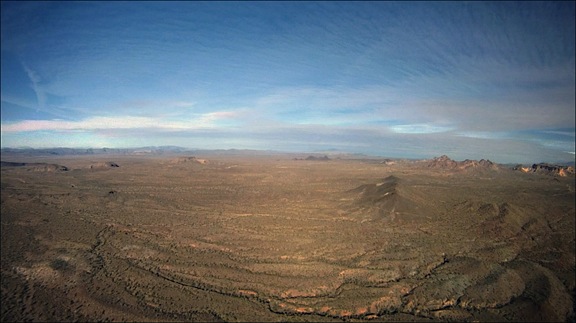
Beyond the lake and the rugged mountains on its opposite shore was yet another stretch of empty desert. But rather than being just a flat expanse, this one was peppered with rock formations left behind by ancient volcanos. There were areas of broken basalt, including flat-topped mesas. In the distance, to our left, we could catch glimpses of the Colorado River. If we’d been in a plane, flying 3,000 feet higher, we’d have a better view of the river and mountains in the distance; at our cruise altitude of 500 to 1000 feet above the desert floor, we could clearly see the details of the rock formations, dry stream beds, and scant vegetation as we flew.

Beyond Alamo
The desert northwest of Alamo Lake is vast and empty.

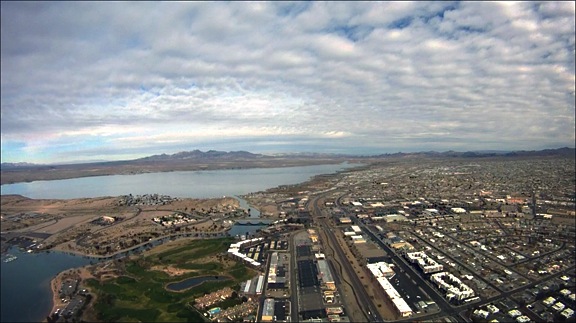
Forty-five miles from Alamo Lake, we reached Lake Havasu, one of the Colorado River’s many lakes. Formed by Parker Dam far to the south, the lake widens in a broad valley. The founders of Lake Havasu City bought the London Bridge — the real London Bridge from England — and had it installed across a manmade canal as a tourist draw. The town formed nearby. It’s popular for water sports and has a huge influx of visitors during boat races and Spring Break. A friend of mine who lives there complains that the temperatures top 100°F six months out of the year.

Lake Havasu
Lake Havasu’s surface was mirror calm as we flew over, reflecting not only the graceful arches of London Bridge, but the clouds high above.

I’d chosen our route carefully. Two hours is a long time to spend in a helicopter, especially out over the desert where the terrain can be — and, up to that point had been — very monotonous. I planned the trip to follow the Colorado River, which was quite scenic. From that point on, we’d be over one shore or another or at least nearby. It would give my passengers something interesting to see for the second hour of the flight.

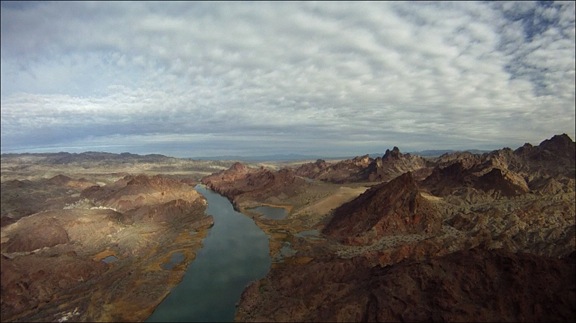
Indeed, the scenery along the river can be breathtaking — especially where the river narrows and passes through mountainous terrain. Topock Gorge is one of those places. Although it’s a short stretch of river and takes only five minutes or so to overfly, it’s dramatic and rugged. During the summer season, when the lake busy, speedboats roar through this area all day long. But that day, the lake was calm and quiet and we were treated to beautiful reflections of the sky and canyon walls.

Topock Gorge
Topock Gorge is one of the more scenic areas along the Colorado River between Lake Havasu City and Bullhead City.

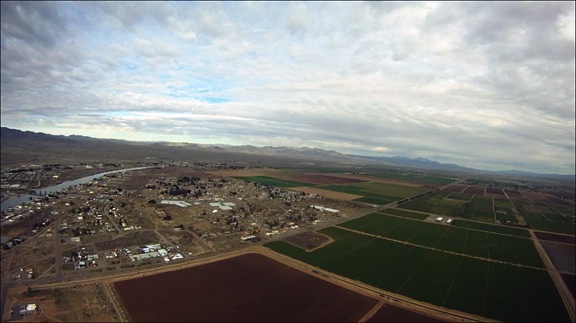
Past the gorge, the river twists and turns in big arcs to the east and west. Rather than follow its course exactly, we headed almost due north. We passed over I-40 where it crosses the Colorado and the farms and communities built up in the Mohave Valley. This was also desert, but desert made habitable by the river that passed through it. Make no mistake: we were still miles from anything remotely resembling a real city — but at least there were people living here.

Mohave Valley
The Mohave Valley, near Needles, CA, is full of farms and small communities clustered up near the Colorado River.

A while later, we were within range of Bullhead City Airport and I called the controller for permission to transition the area along the river. Bullhead City Airport is a real oddity. It was built on the Arizona side of the river to support the casinos in Laughlin, NV. Although it’s well over 100 miles from any international border, it’s an International airport, meaning that you can fly into it from other countries and pass through customs and immigration. It even gets airline traffic; as we flew through the area, a Sun Country 737 was coming in to land. But the airport itself gets very little traffic. This might be because of the natural “wind tunnel” that funnels air up or down the river, resulting in winds that often top 20 knots. But that day, the wind was calm — the first time ever that I’d been there — and other than the jet, we were the only other traffic in the area.

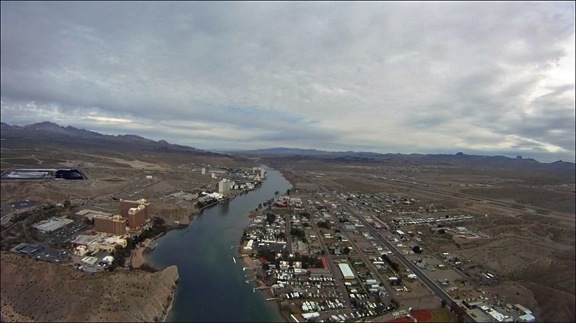
Laughlin, NV
The tall casinos of Laughlin, NV across the river from Bullhead City, AZ. You can see the Bullhead City airport on the far right.

Beyond Laughlin and Bullhead City was the Davis Dam, which forms Lake Mohave. Lake Mohave is another one of the oddities of the desert. Although there are a few marinas and campgrounds along its southern shores, most of the lake is deserted and I seldom see any boat traffic on it. Again, this is likely because of its remote location — although access is easy from the Laughlin area. It seems to me that Lake Mohave would be a great place to become a houseboat hermit.

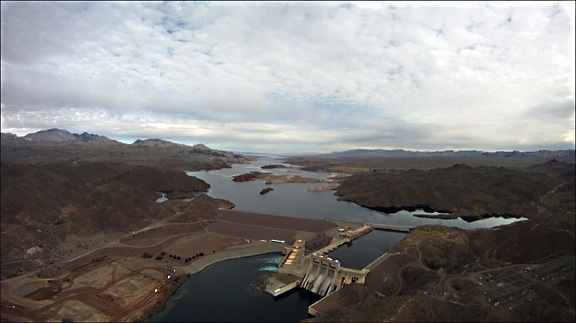
Davis Dam
The Davis Dam is just upriver from Laughlin and Bullhead City.

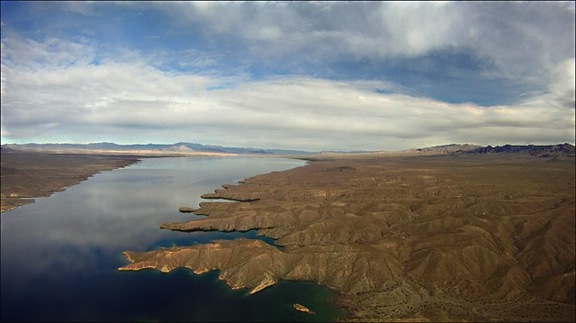
Lake Mohave
Lake Mohave seems like the perfect place to get away from it all on a clear, blue lake.

We flew up the eastern shore of the lake and I kept a sharp eye out for wild burros (donkeys). I’d seen them there before. While their trails were easily visible from the air, I didn’t see any animals — or people — at all.

The north end of the lake narrows considerably where the Colorado River winds through a gorge. The rock formations are rugged and starkly beautiful. This isn’t the place you’d want an engine failure — there aren’t many places for an emergency landing. But the landscape draws me to this area each time I fly up the river.

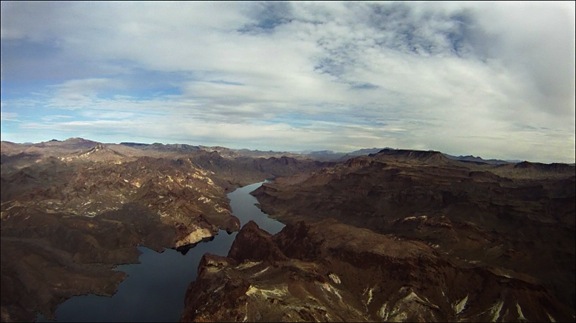
Colorado River
The Colorado River on the north end of Lake Mohave passes through a rugged gorge.

I tuned into the Lake Mead/Hoover Dam tour helicopter frequency and began monitoring communications. I knew that the area around the dam would be full of traffic and wasn’t sure what altitude pilots would be flying at. Routes and procedures are not published; my attempt to get this information from a tour operator failed miserably. (These operators apparently think they own the places they fly over and do what they can to keep everyone else out.)

I reached Willow Beach and made my first call. “Helicopter Six-Three-Zero-Mike-Lima at Willow Beach, heading for the bridge at 2500 feet.”

Some wise-ass tour pilot came on the radio and said “Which bridge? Hoover?”

What an idiotic question. There was only one bridge within 60 air miles. Which bridge did he think? What kind of morons are those tour companies hiring?

“Hoover,” I replied.

“Be advised that there will be four Maverick helicopters over the dam in about two minutes,” he replied. No indication of altitude or any other useful information.

Other pilots were more generous. Although the Papillon Pilots seemed to be crossing the river farther south at 3500 feet, the Maverick pilots were operating near the dam at 3000 feet. I planned to say at 2500 feet, which would keep me out of their way.

The bridge came into view around the same time the Maverick helicopters started appearing overhead. They were flying an odd S-shaped pattern that was obviously designed to give all their passengers a view. I did a three-quarter circle from the right to the left as my passengers leaned forward and then left to see. They got a good look — I was not prepared to loiter and they didn’t seem as if they needed me to. Then I was exiting the area along the road to Boulder City.

Hoover Dam and Bridge
The Hoover Dam and its new bridge are a popular tourist attraction for Las Vegas visitors. They’re amazing from the air.

I wasn’t finished yet, though. Another tour operator does very short tours of the dam and bridge from the Hacienda Hotel just up the road. He was preparing to launch as I flew over. He kindly said he’d wait until I’d passed by, then thanked me for talking on the radio. (Apparently, some pilots don’t — that’s a scary thought.) I thanked him for listening.

Not knowing the approach procedures for Boulder City Airport and anxious to stay out of the way of any other tour traffic, I stayed low as I crossed over the city and headed for the airport. (I was later told I’d likely get in trouble for that, but no one ever called. I guess I lucked out.) There were skydivers falling from the sky near the airport so, to stay clear, I circled around to the east and landed along one of the runways. I was still on edge from mixing with so much other traffic when I set down on one of the helicopter parking spots for the FBO.

Boulder City
Boulder City was built 90 years ago to provide a home for dam construction crews. It’s since grown to a vibrant community — the only one in Nevada that does not allow gambling.

We’d been in the air for 2.2 hours and I was ready for a break.

More about this trip in another post…

So You Want to Be a Helicopter Pilot, Part 4: Choose a Reputable Flight School

Get what you pay for.

The quality of your training will be determined by your flight school. And believe me, you want the best training you can get.

Some Basic Tips

Here’s a bunch of tips for choosing a flight school; sadly, most of them are “don’ts” because of the kinds of marketing tactics some schools use:

  • Don’t be lured by ads for cheap training with promises of jobs at 300 hours of flight time. These schools are not interested in turning out quality pilots. They’re interested in attracting as many wannabes as possible to fill out their bottom line.
  • Don’t get fooled by schools that make verbal promises about hiring all graduates as flight instructors. A verbal promise isn’t worth more than the paper it’s written on. Many flight schools will tell you anything you want to hear to get you to sign up. Besides, wouldn’t you rather get trained at a school that chooses the best CFIs as instructors than the one who takes any CFI as an instructor? And do you really think they can hire all of their graduates? What happens when graduates hired as CFIs outnumber students? How many hours of flying will you get then?
  • Don’t look at the biggest or smallest schools. Look at schools somewhere in the middle. These are the ones where you’ll have the benefit of several CFIs on staff while still getting some level of personal attention.
  • Check into the experience of the training staff. Find out how many hours of flight time the chief flight instructor and some of the other flight instructors have. Find out whether any of them have real-life flying experience. Flight schools that offer tour and charter services also offer opportunities for their CFIs to get the kind of experience they’ll use in future jobs.
  • Once you’ve got the flight schools narrowed down to one or two, talk to some of the students and flight instructors there. See what they think. Try to get the contact information for one or two graduates who have moved on to see whether they thought their training at the school helped them succeed.

Don’t be lazy and take shortcuts here. Your future starts with your training. Do your homework. You’ll be amazed by what you learn.

Equipment

Learn to Fly Here SignThere are a lot of people who make a big deal over the kind of equipment used for flying. There are three basic helicopters used for training: Robinson R22, Schweitzer Schweizer 269/300 (which has a bunch of other names), and Enstrom F28F and 280FX. News flash: They’re all good.

The R22 is an extremely “squirrelly” helicopter. It really takes all of your attention to fly. Its two-bladed system makes it unsafe for aggressive or low-G maneuvers, but ground resonance is not an issue. Robinsons are widely respected and widely used in flight schools.

I can’t speak firsthand about the Schweitzer Schweizer since I’ve never flown one. I know that as a helicopter with a fully articulated rotor system, it’s capable of performing far more aggressive maneuvers than a Robinson. I’m not sure if that’s a good thing. It is susceptible to ground resonance. I have heard that its glide slope in autorotation is steeper than an R22 but can’t back that up with facts and figures.

I have flown an Enstrom and, in all honesty, I wasn’t impressed. The excessive vibrations really turned me off, but that could have been caused by the blades being out of balance or some other maintenance issue on that particular aircraft. It also has a fully articulated rotor system, but I can’t recall hearing anything about one getting into ground resonance. I don’t know enough about its flight characteristics to pass judgement on it.

Most pilots favor the helicopter they trained on. That’s true with me. Not only did I learn in an R22, but I owned an R22 Beta II for four years and put at least 1,000 hours on it. But who knows? If I’d trained in a 300, I might have all kinds of love for it instead.

I’m hoping that folks reading this who have more knowledge about the other two aircraft will comment on their experiences. (Warning: I will not allow an equipment-bashing comment thread to form for this post. Present facts about what you know; not hearsay about what you don’t.)

I certainly don’t think you should pass up a flight school because of the brand of its equipment. The age, maintenance quality, and condition is far more important. You want a flight school with its own hangar and maintenance facility. You might even want to take a look at it to make sure it’s relatively neat and clean and the mechanics look like they know what they’re doing. A place with friendly mechanics who are willing to talk to you when you have a mechanical problem or question will certainly help you get more out of your flight training.

There’s one other thing to keep in mind. Some flight schools have one or two turbine helicopters on hand that they use for charter work or even training. When trying to get you to sign with them, they might hint or even promise that they’ll give you a certain number of hours of turbine flight time. Get any promises in writing. It is not uncommon for flight schools to give students the impression they’d get turbine transition training in a package deal and then, for some reason, not provide it. Either the aircraft was down for maintenance or there were too many other pilots queued up for time in it or there was an additional fee that was never discussed. If a turbine aircraft is dangled like a carrot in front of you, get all the facts about flying it before signing up.

Beware of Package Deals

And that brings up the topic of package deals. My advice is this: Do not sign with a school that forces you to enter into a contract for all training and pay them a bunch of money up front. (This was also pointed out by Damien in comments for Part 2 of this series, which discussed funding your flight training.) You do not want to be contractually tied to any flight school (at least not without a contractual way out that won’t cost you anything) and you certainly don’t want them getting money upfront (beyond reasonable prepayments) for services yet to be rendered.

If there’s anything the Silver State debacle taught us, it’s that flight schools aren’t always around forever. If they fold with your money, you’re out of luck.

Equally important is that if you decide after a few weeks or months of training that you don’t like the flight school and want to continue training elsewhere, you have the freedom to do so. And believe me; this happens more often than you think.

Networking Potential

Keith, who has far more experience flying far more equipment in far more places than me, pointed out in comments to my earlier post about age:

I know several aspiring pilots who I have counseled about the helicopter business but I hesitate to recommend a school to them. My usual advice on schools has been pick the best ranked school that provides the greatest possible chance to get that first job.

It is a little discouraging to me to have to tell an aspiring career pilot that all the good grades, excellent flight reviews and mind numbing study may come to not if they don’t make that first job happen for themselves. Perseverance helps but choosing the right place to train and the connections and recommendations that come from certain schools and/or instructors might make all the difference. It is still a small industry where more positions are gained through personal recommendations and associations than any quantity of paper credentials. Your reputation in this industry begins at day one and for good or bad will follow you your entire career.

This is excellent advice for career pilots. I know of at least once school — now defunct — that had a terrible reputation for training. It got so bad that many employers would simply not consider any pilot that had that flight school listed on a resume. That’s a difficult hurdle to jump when you’re just starting out.

But I think what Keith’s saying goes beyond just choosing a flight school. I think it also has to do with how you represent yourself throughout training and your first few jobs. That’s attitude and I’ll cover that next.